---
category: general
scraped_at: '2025-11-12T14:10:04.197251'
title: Agent-to-Agent Tests Reference
url: /docs/agent-to-agent-tests
---
# Agent-to-Agent Tests Reference
## Overview
Agent-to-Agent testing is a revolutionary approach to conversation testing that uses AI-powered agents to simulate realistic user interactions with your Voiceflow agent. Instead of predefined scripts, these tests use artificial intelligence to conduct natural, goal-oriented conversations.
There are two types of agent-to-agent testing available:
1. **OpenAI-Powered Testing**: Uses OpenAI models (GPT-4, GPT-3.5, etc.) to simulate user behavior
2. **Voiceflow Agent Testing**: Uses another Voiceflow agent as the tester to interact with your target agent
## How It Works
### OpenAI-Powered Testing Flow
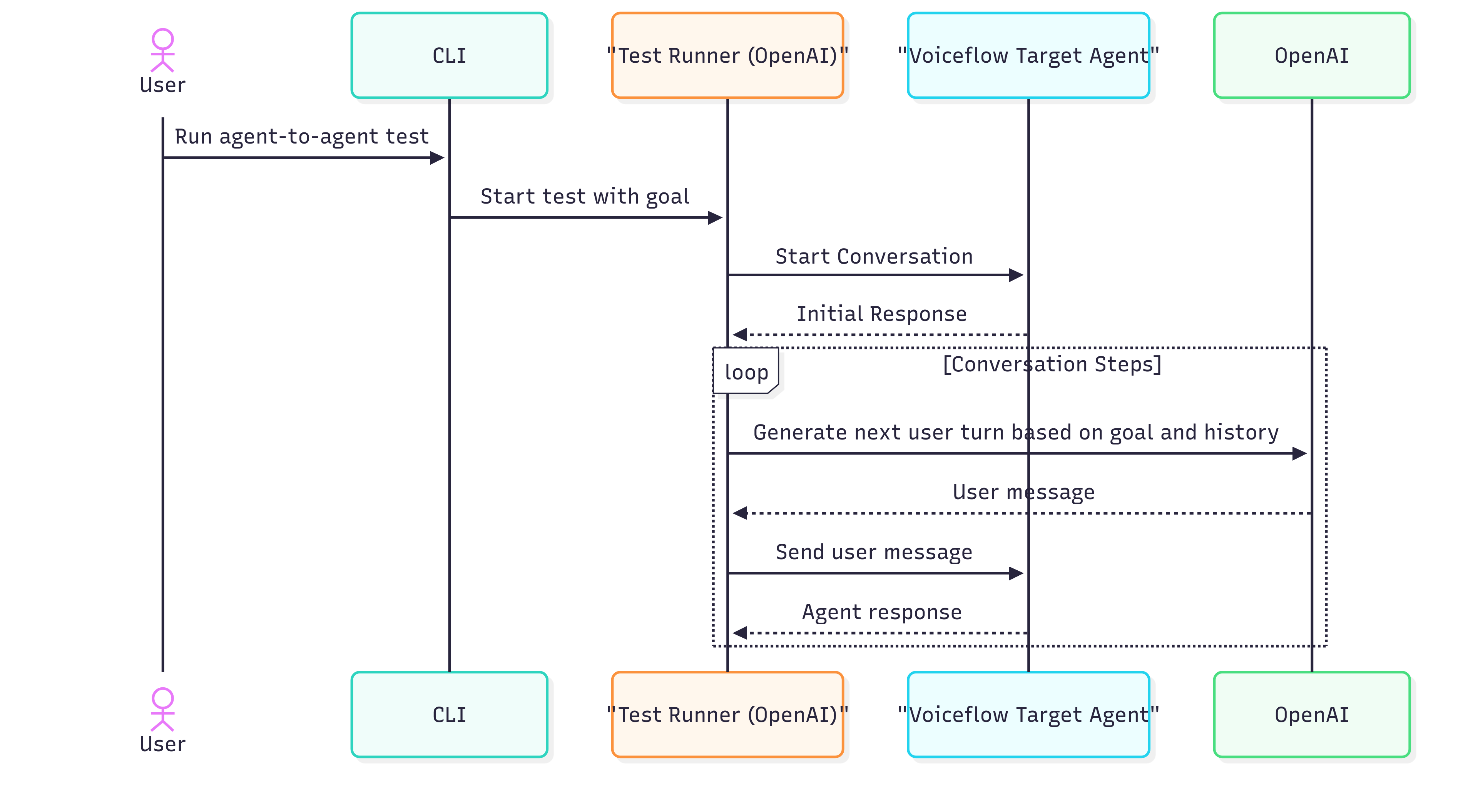
1. **🚀 Initialization**: An AI agent is configured with a specific goal, persona, and user information
2. **💬 Conversation Start**: The AI agent launches a conversation with your Voiceflow agent
3. **🤖 Dynamic Interaction**: The AI agent responds naturally to your agent's messages, adapting to different conversation paths
4. **📋 Information Requests**: When your agent requests user information, the AI agent provides predefined data or generates realistic responses
5. **🎯 Goal Tracking**: The system continuously evaluates progress toward the specified goal
6. **✅ Completion**: The test succeeds when the goal is achieved or times out after maximum steps
### Voiceflow Agent-to-Agent Testing Flow
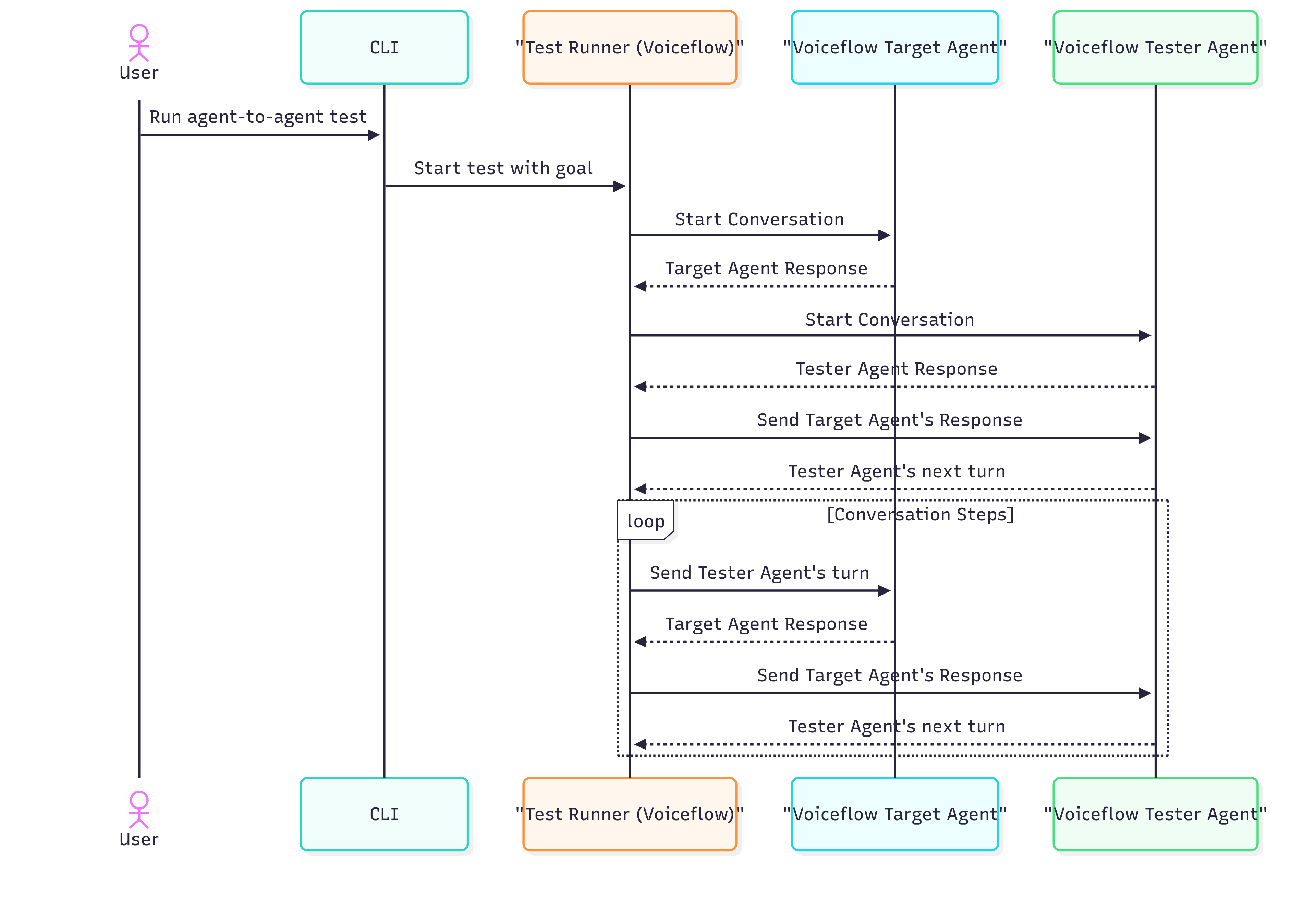
1. **🚀 Initialization**: Two Voiceflow agents are configured - one as the tester and one as the target
2. **💬 Conversation Start**: Both agents are launched simultaneously
3. **🤖 Agent Interaction**: The tester agent conducts a conversation with your target agent
4. **🎯 Goal Tracking**: OpenAI evaluates whether the specified goal is achieved based on the conversation
5. **✅ Completion**: The test succeeds when the goal is achieved or times out after maximum steps
### Key Advantages
* **🎭 Natural Conversations**: AI agents respond like real users, not scripted robots
* **🔄 Multiple Paths**: One test can explore various conversation flows automatically
* **📊 Comprehensive Coverage**: Tests edge cases and unexpected user behaviors
* **⚡ Efficient**: Replaces dozens of traditional tests with one adaptive test
* **🎯 Goal-Focused**: Measures success based on outcomes, not exact responses
* **🤖 Dual Testing Modes**: Choose between OpenAI-powered testing or Voiceflow agent testing based on your needs
## Test Configuration
### OpenAI-Powered Testing Structure
YAML
```
name: Customer Support Agent Test
description: Test agent's ability to resolve customer issues
agent:
goal: "Get help with a billing issue and update my account information"
persona: "A confused customer who received an unexpected charge on their account"
maxSteps: 20
userInformation:
- name: 'email'
value: '[email protected]'
- name: 'account_number'
value: 'ACC-123456'
- name: 'phone'
value: '555-0123'
openAIConfig:
model: gpt-4o
temperature: 0.7
```
### Voiceflow Agent-to-Agent Testing Structure
YAML
```
name: Customer Support Agent Test
description: Test using a Voiceflow agent as the tester
agent:
goal: "Get help with a billing issue and update account information"
maxSteps: 15
# OpenAI config is still used for goal evaluation
openAIConfig:
model: gpt-4o
temperature: 0.3
voiceflowAgentTesterConfig:
environmentName: "production" # Environment of the tester agent
apiKey: "VF.DM.your-tester-agent-api-key"
# Note: userInformation is not used with Voiceflow agent testing
# The tester agent should be pre-configured with any needed information
```
### Configuration Properties
#### `goal` (Required)
Defines what the AI agent is trying to accomplish. Be specific and measurable.
**Examples:**
* `"Complete a hotel booking for 2 guests for next weekend"`
* `"Report a lost credit card and request a replacement"`
* `"Get technical support for a software installation problem"`
* `"Schedule a doctor's appointment for next month"`
#### `persona` (OpenAI-Powered Testing Only)
Describes the character and context the AI agent should adopt during the conversation. **This property is only used with OpenAI-powered testing and is ignored when using Voiceflow agent testing.**
**Examples:**
* `"An elderly customer who is not tech-savvy and needs extra help"`
* `"A busy professional who wants quick, efficient service"`
* `"A frustrated customer whose previous issue wasn't resolved"`
* `"A new user who doesn't understand the product yet"`
#### `maxSteps` (Required)
Maximum number of conversation turns before the test is considered failed. Consider your conversation complexity when setting this value.
**Recommendations:**
* Simple tasks: 5-10 steps
* Medium complexity: 10-20 steps
* Complex scenarios: 20-30 steps
#### `userInformation` (OpenAI-Powered Testing Testing Only)
Predefined user data that the AI agent can provide when your Voiceflow agent requests personal information. **This property is only used with OpenAI-powered testing.**
For Voiceflow agent testing, any required user information should be pre-configured within the tester agent itself.
**Common Information Types:**
* Contact details: `email`, `phone`, `address`
* Account information: `account_number`, `customer_id`, `membership_id`
* Personal details: `name`, `first_name`, `last_name`, `date_of_birth`
* Transaction data: `order_number`, `transaction_id`, `amount`
#### `openAIConfig` (Optional)
Configures the OpenAI model and parameters used for the AI agent in this specific test. This configuration overrides any suite-level OpenAI settings.
**For OpenAI Testing**: Used to power the AI agent that conducts the conversation.
**For Voiceflow Agent Testing**: Used only for goal evaluation to determine if the test objective has been achieved.
**Properties:**
* `model`: The OpenAI model to use (default: `gpt-4o`)
* `temperature`: Controls response randomness from 0.0 (deterministic) to 1.0 (creative) (default: `0.7`)
#### `voiceflowAgentTesterConfig` (Voiceflow Agent-to-Agent Testing Only)
Configures a Voiceflow agent to act as the tester instead of using OpenAI. When this configuration is present, the system will use agent-to-agent testing with two Voiceflow agents.
**Properties:**
* `environmentName`: The environment name of the tester Voiceflow agent (e.g., "production", "development")
* `apiKey`: The API key for the tester Voiceflow agent (format: `VF.DM.xxxxx.xxxxx`)
**Important Notes:**
* When using Voiceflow agent testing, the `persona` and `userInformation` properties are ignored
* The tester agent should be pre-configured with appropriate conversation logic and any required user data
* OpenAI is still used for goal evaluation even when using Voiceflow agent testing
**Example:**
YAML
```
# OpenAI-powered testing configuration
agent:
goal: "Get technical support for a complex software issue"
persona: "A software developer who needs detailed technical assistance"
maxSteps: 15
openAIConfig:
model: gpt-4o
temperature: 0.3 # Lower temperature for more focused technical responses
```
YAML
```
# Voiceflow agent-to-agent testing configuration
agent:
goal: "Complete a hotel booking for this weekend"
maxSteps: 12
openAIConfig:
model: gpt-4o
temperature: 0.3 # Used only for goal evaluation
voiceflowAgentTesterConfig:
environmentName: "production"
apiKey: "VF.DM.your-tester-agent-key"
```
## Choosing Between Testing Methods
### OpenAI-Powered Testing
**Best for:**
* ✅ Flexible persona and behavior simulation
* ✅ Dynamic user information generation
* ✅ Complex reasoning and decision-making scenarios
* ✅ Testing edge cases and unexpected user behaviors
* ✅ Rapid prototyping and testing different user types
**Requirements:**
* OpenAI API key and sufficient quota
* Persona and user information configuration
### Voiceflow Agent Testing
**Best for:**
* ✅ Consistent, reproducible test behavior
* ✅ Testing specific conversation flows designed in Voiceflow
* ✅ Using existing Voiceflow agents as test users
* ✅ Avoiding OpenAI API costs for conversation simulation
* ✅ Pre-configured user personas built in Voiceflow
**Requirements:**
* A separate Voiceflow agent configured as the tester
* API key for the tester agent
* OpenAI API key still needed for goal evaluation
## OpenAI Model Configuration
### Model Recommendations
* `gpt-4o`: Best for complex reasoning and nuanced conversations
* `gpt-4o-mini`: Good balance of performance and cost for most use cases
* `gpt-3.5-turbo`: Budget-friendly option for simpler interactions
### Temperature Guidelines
* `0.0-0.3`: Highly focused, deterministic responses (ideal for technical support)
* `0.4-0.7`: Balanced responses with some creativity (good for general conversations)
* `0.8-1.0`: More creative and varied responses (useful for casual interactions)
## Suite-Level OpenAI Configuration
You can also configure OpenAI settings at the suite level, which applies to all agent tests unless overridden at the test level:
YAML
```
name: Customer Service Test Suite
description: Comprehensive customer service scenarios
environmentName: production
# Suite-level OpenAI configuration
openAIConfig:
model: gpt-4o-mini
temperature: 0.5
tests:
- id: billing_support
file: ./tests/billing_test.yaml
- id: technical_support
file: ./tests/technical_test.yaml # Can override with test-level config
- id: voiceflow_agent_test
file: ./tests/voiceflow_agent_test.yaml # Uses suite config for goal evaluation
```
## Best Practices
### Writing Effective Goals
✅ **Good Goals:**
* Specific and measurable
* Achievable within the conversation scope
* Focused on user outcomes
❌ **Avoid:**
* Vague objectives
* Impossible tasks
* Testing internal system functions
### Creating Realistic Personas (OpenAI Testing)
✅ **Good Personas:**
* Include emotional context
* Specify technical skill level
* Mention relevant background
❌ **Avoid:**
* Generic descriptions
* Inconsistent characteristics
* Unrealistic behaviors
### Configuring Voiceflow Tester Agents
✅ **Best Practices:**
* Design the tester agent with clear conversation flows
* Include appropriate user information within the agent
* Test the tester agent independently before using in tests
* Use meaningful environment names and secure API keys
❌ **Avoid:**
* Using production agents directly as testers
* Hardcoding sensitive information in tester agents
* Creating overly complex tester agent flows
### Setting Appropriate Step Limits
* **Too Low**: May timeout before completion
* **Too High**: May hide conversation inefficiencies
* **Just Right**: Allows natural completion with buffer for edge cases
## Authentication Requirements
### OpenAI Testing Requirements
OpenAI-powered agent tests require OpenAI API access for the AI agent functionality. Make sure to:
1. Set up your OpenAI API key in your environment
2. Configure authentication as described in the [Authentication](/overview/authentication) page
3. Ensure sufficient API quota for test execution
### Voiceflow Agent Testing Requirements
Voiceflow agent-to-agent tests require:
1. **Target Agent**: API key for the agent being tested
2. **Tester Agent**: API key for the agent acting as the tester (specified in `voiceflowAgentTesterConfig`)
3. **OpenAI API**: Still required for goal evaluation functionality
4. **Environment Access**: Ensure both agents are accessible in their respective environments
## Monitoring and Debugging
### Test Logs
Both testing methods provide detailed logs including:
**OpenAI Testing Logs:**
* AI agent's thought process and responses
* Conversation flow and decision points
* Goal achievement evaluation
* User information requests and responses
**Voiceflow Agent Testing Logs:**
* Interaction between tester and target agents
* Message exchange flow
* Goal achievement evaluation
* Agent response details
### Common Issues
**General Issues:**
* **Goal not achieved**: Review if the goal is realistic and achievable
* **Timeout errors**: Consider increasing `maxSteps` or simplifying the goal
* **Authentication errors**: Verify API key configuration
**OpenAI Testing Specific:**
* **Inconsistent behavior**: AI responses may vary; focus on goal achievement rather than exact responses
* **OpenAI API errors**: Check API key and quota limits
**Voiceflow Agent Testing Specific:**
* **Tester agent errors**: Verify the tester agent is properly configured and accessible
* **API key issues**: Ensure both target and tester agent API keys are valid
* **Environment mismatches**: Verify environment names are correct for both agents
Updated 4 months ago
---
[Interaction-Based Examples](/docs/contains)[Agent-to-Agent Examples](/docs/agent-to-agent-examples)
Ask AI
* [Table of Contents](#)
* + [Overview](#overview)
+ [How It Works](#how-it-works)
+ - [OpenAI-Powered Testing Flow](#openai-powered-testing-flow)
- [Voiceflow Agent-to-Agent Testing Flow](#voiceflow-agent-to-agent-testing-flow)
- [Key Advantages](#key-advantages)
+ [Test Configuration](#test-configuration)
+ - [OpenAI-Powered Testing Structure](#openai-powered-testing-structure)
- [Voiceflow Agent-to-Agent Testing Structure](#voiceflow-agent-to-agent-testing-structure)
- [Configuration Properties](#configuration-properties)
+ [Choosing Between Testing Methods](#choosing-between-testing-methods)
+ - [OpenAI-Powered Testing](#openai-powered-testing)
- [Voiceflow Agent Testing](#voiceflow-agent-testing)
+ [OpenAI Model Configuration](#openai-model-configuration)
+ - [Model Recommendations](#model-recommendations)
- [Temperature Guidelines](#temperature-guidelines)
+ [Suite-Level OpenAI Configuration](#suite-level-openai-configuration)
+ [Best Practices](#best-practices)
+ - [Writing Effective Goals](#writing-effective-goals)
- [Creating Realistic Personas (OpenAI Testing)](#creating-realistic-personas-openai-testing)
- [Configuring Voiceflow Tester Agents](#configuring-voiceflow-tester-agents)
- [Setting Appropriate Step Limits](#setting-appropriate-step-limits)
+ [Authentication Requirements](#authentication-requirements)
+ - [OpenAI Testing Requirements](#openai-testing-requirements)
- [Voiceflow Agent Testing Requirements](#voiceflow-agent-testing-requirements)
+ [Monitoring and Debugging](#monitoring-and-debugging)
+ - [Test Logs](#test-logs)
- [Common Issues](#common-issues)
