Glama

blend-ai

The most intuitive and efficient MCP Server for Blender. Control Blender entirely through AI assistants like Claude — create 3D models, set up scenes, animate, render, and more, all through natural language.

blend-ai goes beyond tool exposure: it guides the LLM to produce professional 3D results through expert prompts, proven workflows, visual feedback, and mesh quality analysis.

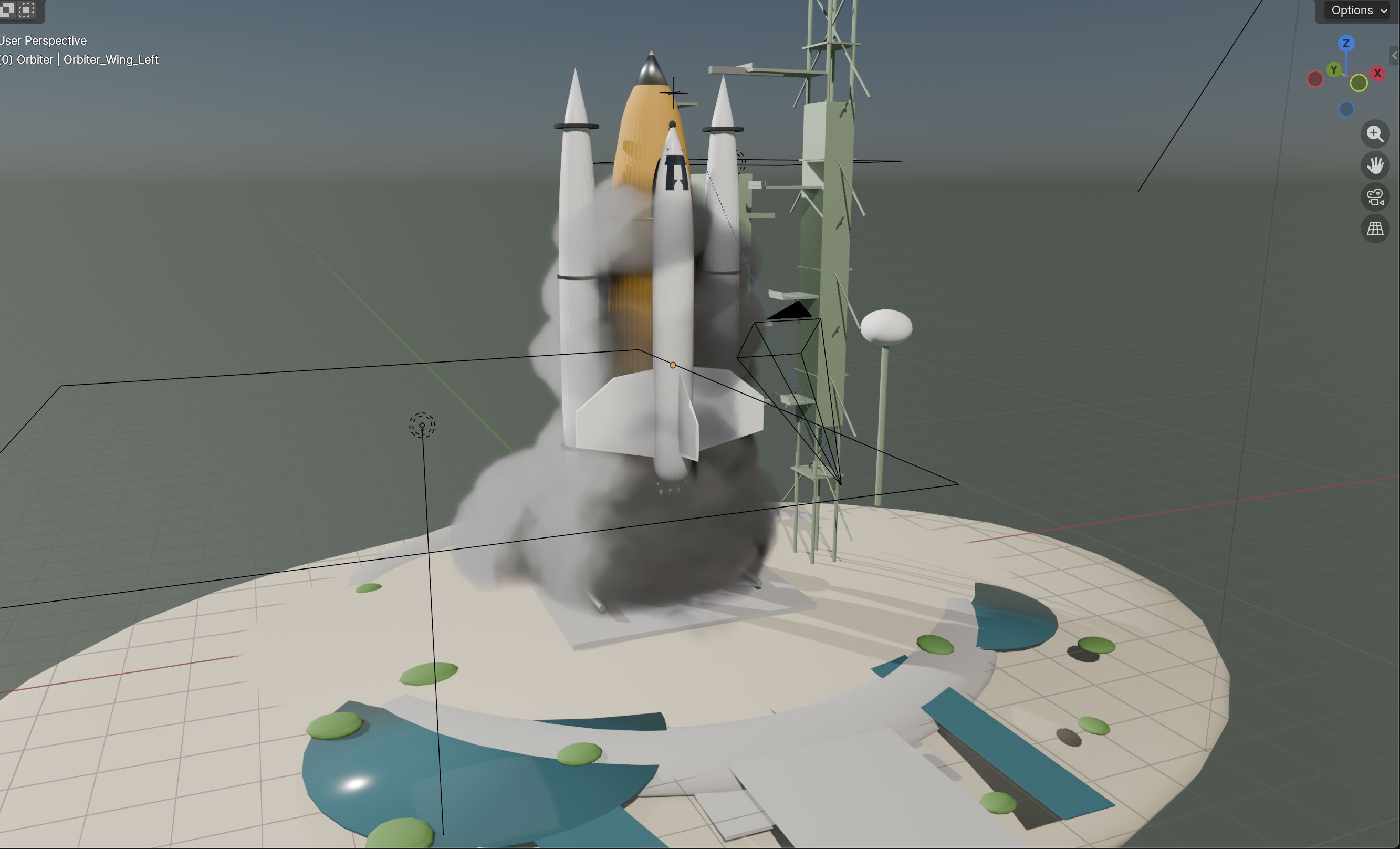
This was created via Claude Code using the Haiku model and 20 random reference images. It took 5 minutes:

blend-ai screenshot

Key Features

  • 164 tools across 24 modules covering every major Blender domain: modeling, mesh editing, materials, shader nodes, lighting, camera, animation, rendering, sculpting, UV mapping, physics, geometry nodes, rigging, curves, annotations, collections, file I/O, Bool Tool, viewport control, mesh quality analysis, and extension suggestions

  • 12 expert prompts — topology best practices, real-world scale references, lighting principles, studio setup, character basemesh workflow, PBR material guide, auto-critique feedback loop, and more

  • Visual feedback loop — fast viewport screenshots via OpenGL render (~ms, not seconds) with auto-critique prompts that guide the LLM to check its own work

  • Mesh quality analysis — structured reports covering non-manifold edges, loose vertices, zero-area faces, duplicate vertices, and wire edges

  • Extension suggestions — proactively recommends Bool Tool, LoopTools, and Node Wrangler when a task would benefit from them (skips already-installed extensions)

  • Sandboxed code executionexecute_blender_code blocks dangerous imports (os, subprocess, socket, etc.) and dangerous builtins (exec, eval, open) while allowing safe Blender operations

  • Render-aware — automatically detects when Blender is rendering and queues commands. Recovers from stuck render guards via load_post handler and reset command

  • Blender 4.2+ compatible — ships as a Blender Extension; tested against Blender 5.1 with EEVEE identifier, Annotation API, sculpt stroke_method, SLIM UV unwrap, Raycast shader node, and EEVEE light path intensity controls

  • Custom port — configure the server port from the N-panel UI (default: 9876, range: 1024–65535)

  • Zero telemetry — no usage tracking, no analytics, no data collection. Everything runs locally on 127.0.0.1

  • Zero-dependency addon — the Blender addon uses only Python stdlib + bpy. Nothing to pip install inside Blender

  • Thread-safe architecture — background TCP server with queue-based main-thread execution, TCP keepalive for stale connection detection

  • 1190 tests — comprehensive coverage across tools, handlers, validators, prompts, and the cross-platform installer (ubuntu/macos/windows × py3.11/3.13 in CI)

Quickstart

1. Install the MCP server

git clone https://github.com/HoldMyBeer-gg/blend-ai.git
cd blend-ai
uv pip install -e .

2. Install the Blender addon

  1. Download the latest addon zip from GitHub Releases

  2. Open Blender 4.2 or later

  3. Go to Edit > Preferences > Get Extensions, click the dropdown (▾) top-right, and choose Install from Disk...

  4. Select the downloaded .zip file

  5. Enable "blend-ai" in the extensions list

Blender 4.0 / 4.1 users: Not supported. blend-ai ships as a Blender Extension, which requires Blender 4.2 (LTS) or later. Please upgrade Blender from blender.org/download.

If you're developing on blend-ai, symlink the addon folder into Blender's user extensions directory instead. Replace <ver> with your Blender version (e.g. 4.2, 5.1).

# macOS
ln -s "$(pwd)/addon" ~/Library/Application\ Support/Blender/<ver>/extensions/user_default/blend_ai

# Linux
ln -s "$(pwd)/addon" ~/.config/blender/<ver>/extensions/user_default/blend_ai

# Windows (run as admin)
mklink /D "%APPDATA%\Blender Foundation\Blender\<ver>\extensions\user_default\blend_ai" "%cd%\addon"

Then enable the extension in Blender preferences under Get Extensions > User.

blend-ai ships as a Blender Extension (blender_manifest.toml), installed under Edit > Preferences > Get Extensions. Python caches imported modules, so replacing files in-place without a restart can leave stale handlers registered.

  1. If the server is running, open the N-panel blend-ai tab and click Stop Server.

  2. In Blender, open Edit > Preferences > Get Extensions, find blend-ai, and click Uninstall.

  3. Quit and restart Blender (this clears cached blend_ai modules).

  4. Install the new .zip via the ▾ > Install from Disk... menu and enable it.

For the developer symlink install, upgrading is just git pull followed by a full Blender restart — do not rely on reloading scripts, because the background TCP server thread survives reloads.

3. Start the server in Blender

In Blender's 3D Viewport, open the N-panel (press N), find the blend-ai tab. Set your preferred port (default: 9876), then click Start Server.

4. Connect your AI assistant

claude mcp add blend-ai -- uv run --directory /path/to/blend-ai blend-ai

Replace /path/to/blend-ai with the actual path to your clone. Make sure Blender is running with the addon server started before using the tools.

Usage:

$ claude

> Create a red metallic sphere on a white plane with three-point lighting

> Add a subdivision surface modifier to the sphere and set it to level 3

> Analyze the mesh quality of the sphere and fix any issues

> Set up a turntable animation and render it to /tmp/turntable/

Add blend-ai to your Claude Desktop config (~/Library/Application Support/Claude/claude_desktop_config.json on macOS):

{
  "mcpServers": {
    "blend-ai": {
      "command": "uv",
      "args": ["run", "--directory", "/path/to/blend-ai", "blend-ai"]
    }
  }
}

Replace /path/to/blend-ai with the actual path to your clone.

Restart Claude Desktop. The Blender tools will appear in the tool list.

blend-ai is a standard MCP server using stdio transport. Any MCP-compatible client can connect by running the server directly:

uv run --directory /path/to/blend-ai blend-ai
# or: python -m blend_ai.server

The exact config location and format vary by client (typically JSON or TOML under ~/.<client>/). The command is uv and the args are ["run", "--directory", "/path/to/blend-ai", "blend-ai"].

The server communicates over stdin/stdout using the MCP protocol. It connects to Blender's addon over TCP on 127.0.0.1:9876 (or your configured port).

Expert Guidance

blend-ai includes 12 MCP prompts that guide the LLM toward professional-quality results:

Prompt

What It Teaches

blender_best_practices

Bool Tool preference, mesh editing patterns, modifier workflow

topology_best_practices

Quad topology, edge flow, poles, n-gon cleanup, face density

scale_reference_guide

Real-world dimensions for 8 common objects, unit system setup

lighting_principles

Three-point lighting, HDRI, EEVEE vs Cycles, color temperature

studio_lighting_setup

6-step studio lighting workflow with specific energy values

character_basemesh_workflow

7-step character base mesh from cube with mirror + subdivision

material_workflow_guide

PBR materials, Principled BSDF recipes, texture color spaces

auto_critique_workflow

Visual feedback loop — when to screenshot, what to check, token budget

product_shot_setup

Professional product shot setup guide

character_base_mesh

Character modeling guide

scene_cleanup

Scene organization workflow

animation_turntable

Turntable animation setup

Tool Domains

Domain

Tools

Highlights

Scene

6

Get scene info, set frame range, manage scenes, suggest helpful extensions

Objects

14

Create primitives, duplicate, parent, join, visibility, origin, convert, auto-smooth

Transforms

6

Position, rotation (euler/quat), scale, apply, snap

Modeling

13

Modifiers, booleans, subdivide, extrude, bevel, loop cut, bridge edge loops

Mesh Editing

16

Inset, fill, grid fill, mark seam/sharp, normals, dissolve, knife project, spin, crease

Mesh Quality

1

Analyze mesh defects: non-manifold, loose verts, zero-area faces, duplicates

Bool Tool

4

Auto union, difference, intersect, slice (via Blender's Bool Tool addon)

Materials

15

Principled BSDF, textures, blend modes, shader node graph (add/connect/remove nodes, including 5.1 Raycast node)

Lighting

7

Point/sun/spot/area lights, HDRIs, light rigs, shadows

Camera

6

Create, aim, DOF, viewport capture, active camera

Animation

8

Keyframes, interpolation, frame range, follow path

Rendering

7

Engine, resolution, samples, output format, render, EEVEE light path intensity

Curves

10

Bezier/NURBS/path, 3D text, convert, reverse, handle types, cyclic, subdivide

Sculpting

8

Brushes, remesh, multires, symmetry, dynamic topology, stroke_method

UV Mapping

4

Smart project, unwrap (ANGLE_BASED, CONFORMAL, SLIM), projection, pack islands

Physics

9

Rigid body, cloth, fluid, particles (velocity, rendering, delete), bake

Geometry Nodes

5

Create node trees, add/connect nodes, set inputs

Armature

6

Bones, constraints, auto weights, pose

Annotations

5

Annotation layers and strokes (5.1 Annotation API)

Collections

4

Create, move objects, visibility, delete

File I/O

5

Import/export (FBX, OBJ, glTF, USD, STL...), save/open

Viewport

3

Shading mode, overlays, focus on object

Screenshot

1

Fast viewport capture (OpenGL) or full render, base64 output

Code Exec

1

Sandboxed Python execution in Blender (dangerous imports blocked)

Architecture

AI Assistant <--stdio/MCP--> blend-ai server <--TCP socket--> Blender addon <--bpy--> Blender
  • MCP Server (src/blend_ai/): Python process using the mcp SDK. Exposes tools, resources, and prompts over stdio. Validates all inputs before forwarding to Blender.

  • Blender Addon (addon/): Runs a TCP socket server inside Blender on a background thread. Commands are queued and executed on the main thread via bpy.app.timers to respect Blender's threading model.

  • Render Guard: Tracks render state via bpy.app.handlers. During renders, the server immediately returns a "busy" status. Automatically recovers from crashed renders via load_post handler. Can be force-reset via MCP command.

  • Protocol: Length-prefixed JSON messages over TCP with SO_KEEPALIVE for stale connection detection. Each message is a 4-byte big-endian length header followed by a UTF-8 JSON payload.

Privacy & Security

  • Zero telemetry — blend-ai collects no usage data, sends no analytics, and makes no network requests beyond the local TCP connection to Blender.

  • Fully local — all communication stays on your machine. No cloud services, no external APIs, no phone-home behavior.

  • Open source — the entire codebase is auditable. What you see is what runs.

  • Localhost only: The TCP socket binds to 127.0.0.1 — never exposed to the network.

  • Sandboxed code execution: execute_blender_code blocks 25 dangerous imports (os, subprocess, socket, shutil, sys, ctypes, importlib, pathlib, signal, multiprocessing, pickle, shelve, tempfile, http, urllib, ftplib, smtplib, xmlrpc, code, codeop, compileall, webbrowser, antigravity, turtle, tkinter) and removes dangerous builtins (__import__, exec, eval, compile, open, globals, locals, vars, input, breakpoint, exit, quit, help, memoryview). Safe Blender imports (bpy, bmesh, mathutils, math, json) are allowed.

  • Input validation: All inputs pass through validators before reaching Blender — name sanitization, path traversal prevention, numeric range checks, enum allowlists.

  • File safety: Import operations disable use_scripts_auto_execute to prevent script injection from imported files. File extensions are checked against allowlists.

  • Command allowlist: The addon dispatcher only processes explicitly registered commands. Unknown commands are rejected.

  • Shader node allowlist: Only 64 known shader node types can be created — prevents arbitrary type injection.

Limitations

  • Blender must be running: The MCP server communicates with Blender over TCP. Blender must be open with the addon enabled and server started.

  • Single connection: The addon accepts one client connection at a time. Multiple AI assistants cannot control the same Blender instance simultaneously.

  • Selection is all-or-nothing: Most mesh editing tools operate on all geometry. Fine-grained vertex/edge/face selection by index is not yet exposed, though select_linked is available.

  • Sculpt strokes cannot be simulated: You can configure brushes, symmetry, dyntopo, and remeshing, but actual brush strokes are not yet exposed.

  • Node graphs require sequential calls: Both shader node trees and geometry node trees must be built one node/connection at a time.

  • No undo integration: Operations appear in Blender's undo history individually but there's no MCP-level undo/redo or transaction grouping.

  • Viewport capture requires a visible 3D viewport: Headless Blender may not support viewport screenshots.

  • No real-time feedback: The MCP protocol is request/response. There's no streaming of viewport updates or render progress.

Development

# Install with dev dependencies
uv pip install -e ".[dev]"

# Run tests (1190 tests)
uv run --extra dev pytest

# Run tests with coverage
uv run --extra dev pytest --cov=blend_ai

# Lint
ruff check src/ tests/

# Format
ruff format src/ tests/
blend-ai/
├── src/blend_ai/          # MCP server
│   ├── server.py           # FastMCP entry point
│   ├── connection.py       # TCP client to Blender (with busy-retry)
│   ├── validators.py       # Input validation
│   ├── tools/              # 24 tool modules (164 tools)
│   ├── resources/          # MCP resources (scene, objects, materials)
│   └── prompts/            # 12 expert prompt templates
├── addon/                  # Blender addon (zero external deps)
│   ├── blender_manifest.toml  # Blender 4.2+ Extension manifest
│   ├── __init__.py         # bl_info (legacy fallback) + register/unregister
│   ├── server.py           # TCP socket server (SO_KEEPALIVE)
│   ├── dispatcher.py       # Command routing + allowlist
│   ├── thread_safety.py    # Main-thread execution queue
│   ├── render_guard.py     # Render state tracking + crash recovery
│   ├── ui_panel.py         # N-panel UI (start/stop + port config)
│   └── handlers/           # 23 handler modules
└── tests/                  # 1186 unit tests

License

AGPL-3.0-or-later. See LICENSE.

Copyright © 2026 jabberwock.

Install Server
A
security – no known vulnerabilities
A
license - permissive license
B
quality - B tier

Resources

Unclaimed servers have limited discoverability.

Looking for Admin?

If you are the server author, to access and configure the admin panel.

Latest Blog Posts

MCP directory API

We provide all the information about MCP servers via our MCP API.

curl -X GET 'https://glama.ai/api/mcp/v1/servers/HoldMyBeer-gg/blend-ai'

If you have feedback or need assistance with the MCP directory API, please join our Discord server