A
licenseB
qualityD
maintenanceA server implementation that provides Claude AI with the ability to interact with Zendesk ticketing systems through various functions including retrieving, searching, creating, and updating tickets.
7
286 npm
16
MIT



Zendesk 的模型上下文协议服务器。
该服务器与 Zendesk 提供全面的集成。它提供:
用于检索和管理 Zendesk 票证和评论的工具
票务分析和响应起草的专门提示
完全访问 Zendesk 帮助中心文章作为知识库
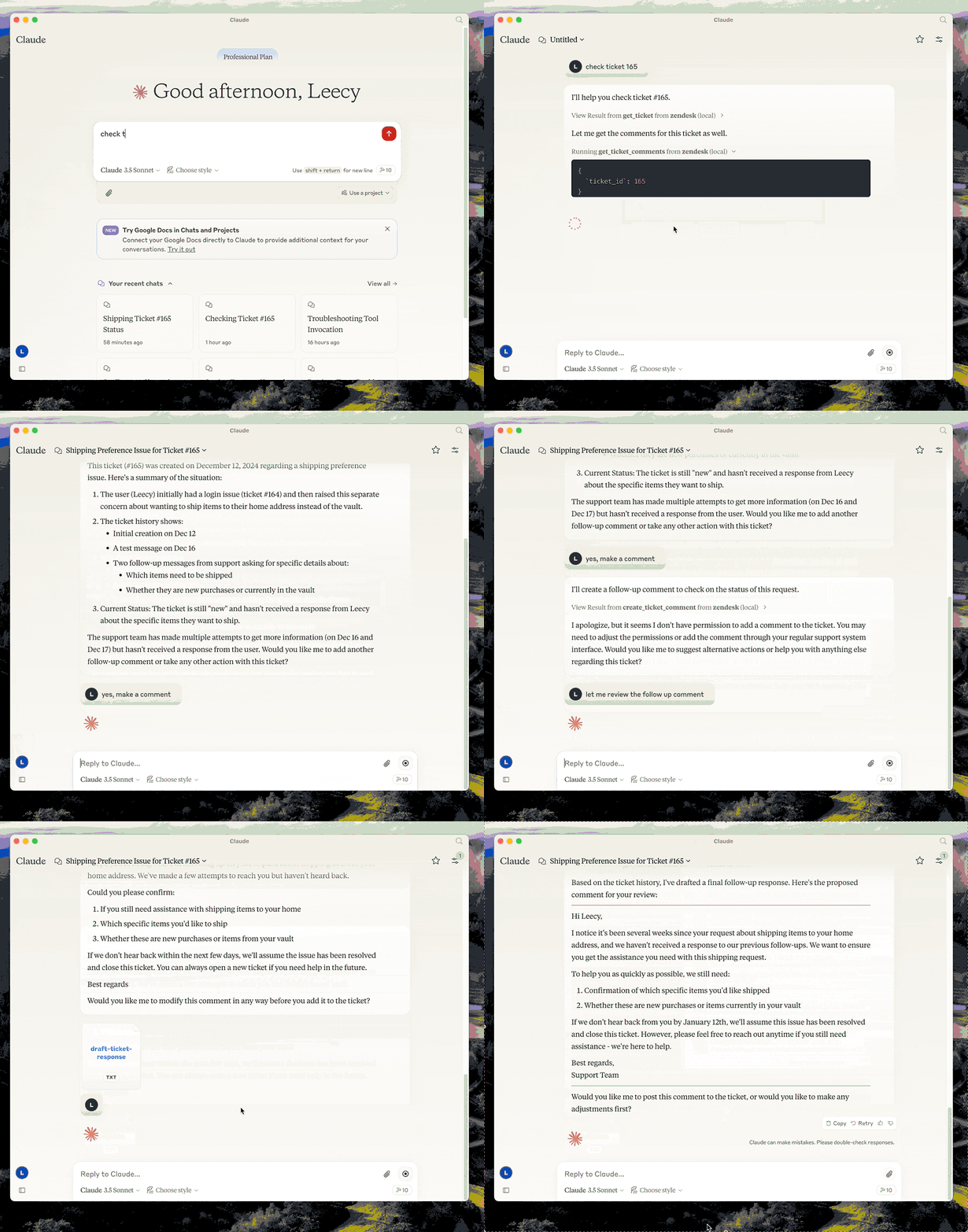
构建: uv venv && uv pip install -e .或者简称为uv build 。
在.env文件中设置 zendesk 凭据,参考.env.example 。
在 Claude 桌面中配置:
{
  "mcpServers": {
      "zendesk": {
          "command": "uv",
          "args": [
              "--directory",
              "/path/to/zendesk-mcp-server",
              "run",
              "zendesk"
          ]
      }
  }
}
Related MCP server: Zendesk API MCP Server
zendesk://knowledge-base,可以访问整个帮助中心文章。
分析 Zendesk 票证并提供票证的详细分析。
起草对 Zendesk 票证的回复。
通过 ID 检索 Zendesk 票证
输入:
ticket_id (整数):要检索的票证的 ID
通过 ID 检索 Zendesk 票证的所有评论
输入:
ticket_id (整数):获取评论的票证的 ID
在现有 Zendesk 票证上创建新评论
输入:
ticket_id (整数):要评论的票证的 ID
comment (字符串):要添加的评论文本/内容
public (布尔值,可选):评论是否应该公开(默认为 true)
Create a new Zendesk ticket
| Name | Required | Description | Default |
|---|---|---|---|
| tags | No | ||
| type | No | problem, incident, question, task | |
| subject | Yes | Ticket subject | |
| priority | No | low, normal, high, urgent | |
| assignee_id | No | ||
| description | Yes | Ticket description | |
| requester_id | No | ||
| custom_fields | No |
Does the description disclose side effects, auth requirements, rate limits, or destructive behavior?
With no annotations provided, the description carries full burden for behavioral disclosure. While 'Create' implies a write operation, it doesn't mention permission requirements, whether tickets are immediately visible, rate limits, error conditions, or what happens on success. This is inadequate for a mutation tool with zero annotation coverage.
Agents need to know what a tool does to the world before calling it. Descriptions should go beyond structured annotations to explain consequences.
Is the description appropriately sized, front-loaded, and free of redundancy?
The description is extremely concise - a single sentence with no wasted words. It's front-loaded with the essential information (create ticket) and doesn't include unnecessary elaboration.
Shorter descriptions cost fewer tokens and are easier for agents to parse. Every sentence should earn its place.
Given the tool's complexity, does the description cover enough for an agent to succeed on first attempt?
For a write operation with 8 parameters, 50% schema coverage, no annotations, and no output schema, the description is insufficient. It doesn't compensate for the missing behavioral context, parameter documentation gaps, or provide any information about what the tool returns upon success.
Complex tools with many parameters or behaviors need more documentation. Simple tools need less. This dimension scales expectations accordingly.
Does the description clarify parameter syntax, constraints, interactions, or defaults beyond what the schema provides?
Schema description coverage is only 50% (4 of 8 parameters have descriptions). The description adds no parameter information beyond what's in the schema - it doesn't explain the purpose of fields like requester_id, assignee_id, tags, or custom_fields, nor does it provide examples or clarify relationships between parameters.
Input schemas describe structure but not intent. Descriptions should explain non-obvious parameter relationships and valid value ranges.
Does the description clearly state what the tool does and how it differs from similar tools?
The description clearly states the action ('Create') and resource ('new Zendesk ticket'), making the purpose immediately understandable. However, it doesn't differentiate this tool from its siblings like 'update_ticket' or explain what distinguishes ticket creation from other ticket operations.
Agents choose between tools based on descriptions. A clear purpose with a specific verb and resource helps agents select the right tool.
Does the description explain when to use this tool, when not to, or what alternatives exist?
The description provides no guidance on when to use this tool versus alternatives like 'update_ticket' or 'search_tickets'. It doesn't mention prerequisites (like needing a requester_id), appropriate contexts, or limitations compared to sibling tools.
Agents often have multiple tools that could apply. Explicit usage guidance like "use X instead of Y when Z" prevents misuse.
Create a new comment on an existing Zendesk ticket
| Name | Required | Description | Default |
|---|---|---|---|
| public | No | Whether the comment should be public | |
| comment | Yes | The comment text. Markdown, plain text, and HTML are all accepted. | |
| ticket_id | Yes | The ID of the ticket to comment on |
Does the description disclose side effects, auth requirements, rate limits, or destructive behavior?
No annotations are provided, so the description carries the full behavioral burden, and it discloses almost nothing beyond the basic mutation. It does not say whether the comment triggers customer notifications, how the 'public' default affects visibility, or what happens if ticket_id is invalid.
Agents need to know what a tool does to the world before calling it. Descriptions should go beyond structured annotations to explain consequences.
Is the description appropriately sized, front-loaded, and free of redundancy?
A single front-loaded sentence with zero wasted words, correctly naming the action and target. Nothing is buried or repeated.
Shorter descriptions cost fewer tokens and are easier for agents to parse. Every sentence should earn its place.
Given the tool's complexity, does the description cover enough for an agent to succeed on first attempt?
For a mutation tool with no annotations and no output schema, the description is too thin: it omits notification/visibility implications of the public flag, error behavior for missing tickets, and permission requirements. The schema covers inputs, but behavioral context an agent needs to invoke this safely is absent.
Complex tools with many parameters or behaviors need more documentation. Simple tools need less. This dimension scales expectations accordingly.
Does the description clarify parameter syntax, constraints, interactions, or defaults beyond what the schema provides?
Schema description coverage is 100%, so all three parameters (ticket_id, comment, public) are already documented inline, including format notes for comment and the default for public. The description adds no parameter meaning beyond that, so the baseline 3 applies.
Input schemas describe structure but not intent. Descriptions should explain non-obvious parameter relationships and valid value ranges.
Does the description clearly state what the tool does and how it differs from similar tools?
States a specific verb (Create) and resource (comment on a Zendesk ticket) with a scoping constraint ('existing'), which cleanly separates it from sibling read tools like get_ticket_comments and from update_ticket. It does not explicitly name siblings, so it falls just short of 5.
Agents choose between tools based on descriptions. A clear purpose with a specific verb and resource helps agents select the right tool.
Does the description explain when to use this tool, when not to, or what alternatives exist?
There is no guidance on when to use this versus alternatives such as update_ticket, nor any mention of prerequisites like the ticket existing or required permissions. Usage is only implied by the tool name and description.
Agents often have multiple tools that could apply. Explicit usage guidance like "use X instead of Y when Z" prevents misuse.
Retrieve a Zendesk ticket by its ID
| Name | Required | Description | Default |
|---|---|---|---|
| ticket_id | Yes | The ID of the ticket to retrieve |
Does the description disclose side effects, auth requirements, rate limits, or destructive behavior?
No annotations are provided, so the description carries the full burden. It states the tool retrieves a ticket, implying a read-only operation, but doesn't disclose behavioral traits like authentication requirements, rate limits, error handling, or what happens if the ticket ID is invalid. This leaves significant gaps for an agent to understand how to use it effectively.
Agents need to know what a tool does to the world before calling it. Descriptions should go beyond structured annotations to explain consequences.
Is the description appropriately sized, front-loaded, and free of redundancy?
The description is a single, clear sentence with zero waste. It's front-loaded with the core action and resource, making it easy to parse quickly without unnecessary details.
Shorter descriptions cost fewer tokens and are easier for agents to parse. Every sentence should earn its place.
Given the tool's complexity, does the description cover enough for an agent to succeed on first attempt?
Given the lack of annotations and output schema, the description is incomplete. It doesn't explain what the tool returns (e.g., ticket details, error responses) or address potential complexities like authentication or rate limits. For a tool with no structured support, more context is needed to guide an agent fully.
Complex tools with many parameters or behaviors need more documentation. Simple tools need less. This dimension scales expectations accordingly.
Does the description clarify parameter syntax, constraints, interactions, or defaults beyond what the schema provides?
Schema description coverage is 100%, so the input schema already documents the 'ticket_id' parameter as an integer. The description adds minimal value by mentioning 'by its ID', which aligns with the schema but doesn't provide additional context like format examples or constraints beyond what's in the structured data.
Input schemas describe structure but not intent. Descriptions should explain non-obvious parameter relationships and valid value ranges.
Does the description clearly state what the tool does and how it differs from similar tools?
The description clearly states the action ('Retrieve') and resource ('a Zendesk ticket by its ID'), making the purpose immediately understandable. However, it doesn't differentiate from sibling tools like 'get_tickets' (plural) or 'search_tickets' which suggests it's for single-ticket lookup versus batch operations.
Agents choose between tools based on descriptions. A clear purpose with a specific verb and resource helps agents select the right tool.
Does the description explain when to use this tool, when not to, or what alternatives exist?
No guidance is provided on when to use this tool versus alternatives like 'get_tickets' or 'search_tickets'. The description implies it's for retrieving a specific ticket by ID, but it doesn't explicitly state this as the primary use case or mention prerequisites such as needing a valid ticket ID.
Agents often have multiple tools that could apply. Explicit usage guidance like "use X instead of Y when Z" prevents misuse.
Fetch a Zendesk ticket attachment by its content_url and return the file as base64-encoded data. Use the attachment URLs returned by get_ticket_comments.
| Name | Required | Description | Default |
|---|---|---|---|
| content_url | Yes | The content_url of the attachment from get_ticket_comments |
Does the description disclose side effects, auth requirements, rate limits, or destructive behavior?
No annotations are provided, so the description carries the burden. It usefully discloses the return format (base64-encoded data), which is important context. However, it omits any discussion of authentication, rate limits, or behavior on missing/large attachments.
Agents need to know what a tool does to the world before calling it. Descriptions should go beyond structured annotations to explain consequences.
Is the description appropriately sized, front-loaded, and free of redundancy?
Two tight sentences that front-load the operation and return format, followed by the routing hint. No wasted words.
Shorter descriptions cost fewer tokens and are easier for agents to parse. Every sentence should earn its place.
Given the tool's complexity, does the description cover enough for an agent to succeed on first attempt?
For a simple one-parameter read tool, the description covers purpose, input source, and output format adequately. It lacks only minor behavioral details like error handling, which are less critical without annotations and no output schema.
Complex tools with many parameters or behaviors need more documentation. Simple tools need less. This dimension scales expectations accordingly.
Does the description clarify parameter syntax, constraints, interactions, or defaults beyond what the schema provides?
Schema coverage is 100%, so the single content_url parameter is already fully documented in the schema with its origin. The description adds no syntax or format detail beyond what the schema provides, so baseline 3 applies.
Input schemas describe structure but not intent. Descriptions should explain non-obvious parameter relationships and valid value ranges.
Does the description clearly state what the tool does and how it differs from similar tools?
States a specific verb+resource (fetch a Zendesk ticket attachment) plus the retrieval mechanism (by content_url), and explicitly ties the URL source to the sibling get_ticket_comments, clearly differentiating it from other ticket tools.
Agents choose between tools based on descriptions. A clear purpose with a specific verb and resource helps agents select the right tool.
Does the description explain when to use this tool, when not to, or what alternatives exist?
Explicitly names the sibling (get_ticket_comments) as the source of the content_url, telling the agent both when to use this tool and where its input comes from. The workflow dependency is unambiguous.
Agents often have multiple tools that could apply. Explicit usage guidance like "use X instead of Y when Z" prevents misuse.
Retrieve all comments for a Zendesk ticket by its ID
| Name | Required | Description | Default |
|---|---|---|---|
| ticket_id | Yes | The ID of the ticket to get comments for |
Does the description disclose side effects, auth requirements, rate limits, or destructive behavior?
With no annotations provided, the description carries full burden for behavioral disclosure. It mentions retrieval but doesn't specify whether this is a read-only operation, if it requires authentication, what format comments are returned in, or if there are rate limits. For a tool with zero annotation coverage, this leaves significant behavioral gaps.
Agents need to know what a tool does to the world before calling it. Descriptions should go beyond structured annotations to explain consequences.
Is the description appropriately sized, front-loaded, and free of redundancy?
The description is a single, efficient sentence that states the core functionality without unnecessary words. It's front-loaded with the main action and resource, making it immediately understandable with zero wasted content.
Shorter descriptions cost fewer tokens and are easier for agents to parse. Every sentence should earn its place.
Given the tool's complexity, does the description cover enough for an agent to succeed on first attempt?
For a simple retrieval tool with one parameter and no output schema, the description covers the basic purpose adequately. However, without annotations or output schema, it lacks details about return format, error handling, or behavioral constraints that would make it more complete for agent use.
Complex tools with many parameters or behaviors need more documentation. Simple tools need less. This dimension scales expectations accordingly.
Does the description clarify parameter syntax, constraints, interactions, or defaults beyond what the schema provides?
Schema description coverage is 100%, so the schema already fully documents the single parameter 'ticket_id'. The description adds no additional parameter information beyond what's in the schema, maintaining the baseline score of 3 for adequate but not enhanced parameter semantics.
Input schemas describe structure but not intent. Descriptions should explain non-obvious parameter relationships and valid value ranges.
Does the description clearly state what the tool does and how it differs from similar tools?
The description clearly states the action ('Retrieve all comments') and target resource ('for a Zendesk ticket by its ID'), making the purpose immediately understandable. It doesn't explicitly differentiate from sibling tools like 'get_ticket' or 'create_ticket_comment', but the specificity of retrieving comments rather than ticket details or creating comments provides implicit distinction.
Agents choose between tools based on descriptions. A clear purpose with a specific verb and resource helps agents select the right tool.
Does the description explain when to use this tool, when not to, or what alternatives exist?
The description provides no guidance on when to use this tool versus alternatives like 'get_ticket' (which might include comments) or 'search_tickets' (which might filter tickets with comments). It states what the tool does but offers no context about prerequisites, timing, or comparison to sibling tools.
Agents often have multiple tools that could apply. Explicit usage guidance like "use X instead of Y when Z" prevents misuse.
Fetch the latest tickets with pagination support
| Name | Required | Description | Default |
|---|---|---|---|
| page | No | Page number | |
| sort_by | No | Field to sort by (created_at, updated_at, priority, status) | created_at |
| per_page | No | Number of tickets per page (max 100) | |
| sort_order | No | Sort order (asc or desc) | desc |
Does the description disclose side effects, auth requirements, rate limits, or destructive behavior?
No annotations are provided, so the description carries full burden. It mentions pagination support, which is useful, but lacks details on permissions, rate limits, error handling, or what 'latest' means (e.g., time-based cutoff). For a read operation with zero annotation coverage, this is insufficient.
Agents need to know what a tool does to the world before calling it. Descriptions should go beyond structured annotations to explain consequences.
Is the description appropriately sized, front-loaded, and free of redundancy?
The description is a single, efficient sentence with zero waste. It's front-loaded with the core purpose and includes key behavioral trait (pagination) without unnecessary details.
Shorter descriptions cost fewer tokens and are easier for agents to parse. Every sentence should earn its place.
Given the tool's complexity, does the description cover enough for an agent to succeed on first attempt?
Given 4 parameters with full schema coverage but no annotations or output schema, the description is minimally adequate. It covers the basic action and pagination but lacks context on permissions, error cases, or output format, leaving gaps for agent usage.
Complex tools with many parameters or behaviors need more documentation. Simple tools need less. This dimension scales expectations accordingly.
Does the description clarify parameter syntax, constraints, interactions, or defaults beyond what the schema provides?
Schema description coverage is 100%, so parameters are well-documented in the schema. The description adds no additional meaning beyond implying pagination (covered by 'page' and 'per_page') and 'latest' (implied by sort defaults). Baseline 3 is appropriate as the schema does the heavy lifting.
Input schemas describe structure but not intent. Descriptions should explain non-obvious parameter relationships and valid value ranges.
Does the description clearly state what the tool does and how it differs from similar tools?
The description clearly states the action ('Fetch') and resource ('tickets'), and specifies scope ('latest' with 'pagination support'). However, it doesn't explicitly differentiate from sibling tools like 'get_ticket' (singular) or 'search_tickets', which is a minor gap.
Agents choose between tools based on descriptions. A clear purpose with a specific verb and resource helps agents select the right tool.
Does the description explain when to use this tool, when not to, or what alternatives exist?
The description provides no guidance on when to use this tool versus alternatives like 'get_ticket' (for a single ticket) or 'search_tickets' (for filtered searches). It mentions pagination but doesn't explain when pagination is needed or preferred over other tools.
Agents often have multiple tools that could apply. Explicit usage guidance like "use X instead of Y when Z" prevents misuse.
Update fields on an existing Zendesk ticket (e.g., status, priority, assignee_id)
| Name | Required | Description | Default |
|---|---|---|---|
| tags | No | ||
| type | No | ||
| due_at | No | ISO8601 datetime | |
| status | No | new, open, pending, on-hold, solved, closed | |
| subject | No | ||
| priority | No | low, normal, high, urgent | |
| ticket_id | Yes | The ID of the ticket to update | |
| assignee_id | No | ||
| requester_id | No | ||
| custom_fields | No |
Does the description disclose side effects, auth requirements, rate limits, or destructive behavior?
With no annotations provided, the description carries full burden for behavioral disclosure. While 'Update' implies a mutation, it doesn't specify permission requirements, whether changes are reversible, rate limits, or what happens to fields not mentioned. The description provides minimal behavioral context beyond the basic operation.
Agents need to know what a tool does to the world before calling it. Descriptions should go beyond structured annotations to explain consequences.
Is the description appropriately sized, front-loaded, and free of redundancy?
The description is a single, efficient sentence that communicates the core purpose with helpful examples. Every word earns its place, and it's appropriately front-loaded with the essential information.
Shorter descriptions cost fewer tokens and are easier for agents to parse. Every sentence should earn its place.
Given the tool's complexity, does the description cover enough for an agent to succeed on first attempt?
For a mutation tool with 10 parameters, 40% schema coverage, no annotations, and no output schema, the description is inadequate. It doesn't explain return values, error conditions, permission requirements, or provide sufficient parameter guidance given the complexity of the operation.
Complex tools with many parameters or behaviors need more documentation. Simple tools need less. This dimension scales expectations accordingly.
Does the description clarify parameter syntax, constraints, interactions, or defaults beyond what the schema provides?
The description mentions example fields (status, priority, assignee_id) which correspond to some of the 10 parameters, but with only 40% schema description coverage, it doesn't fully compensate for undocumented parameters like 'type', 'requester_id', or 'custom_fields'. It adds some value but leaves many parameters unexplained.
Input schemas describe structure but not intent. Descriptions should explain non-obvious parameter relationships and valid value ranges.
Does the description clearly state what the tool does and how it differs from similar tools?
The description clearly states the action ('Update fields') and resource ('existing Zendesk ticket'), with specific examples of fields that can be updated. It distinguishes from 'create_ticket' by specifying it's for existing tickets, though it doesn't explicitly differentiate from other update-related tools.
Agents choose between tools based on descriptions. A clear purpose with a specific verb and resource helps agents select the right tool.
Does the description explain when to use this tool, when not to, or what alternatives exist?
The description provides no guidance on when to use this tool versus alternatives like 'create_ticket' or 'get_ticket'. It mentions it's for existing tickets but doesn't specify prerequisites, error conditions, or when other tools might be more appropriate.
Agents often have multiple tools that could apply. Explicit usage guidance like "use X instead of Y when Z" prevents misuse.
Recent tool additions, removals, and schema changes observed during successful MCP inspections.
v0.1.0create_ticketcreate_ticket_commentget_ticketget_ticket_attachmentget_ticket_commentsget_ticketsupdate_ticketScored across 7 tools
Each tool maps to a distinct action-resource pair: retrieving a single ticket vs listing tickets, fetching comments vs creating a comment, and fetching attachments. get_ticket and get_tickets are close but clearly differentiated by singular ID vs paginated list.
All tools use a consistent snake_case verb_noun pattern (get_ticket, create_ticket, update_ticket, get_ticket_comments, etc.). No mixing of conventions.
7 tools is well-scoped for a Zendesk ticket-focused MCP server, covering core operations without excessive surface area.
Core ticket operations are covered (create, read single/list, update, comments read/create, attachment read), but delete_ticket and comment update/delete are absent, leaving minor lifecycle gaps.
Helpdesk tickets from your AI: find, reply, take, hold, complete — within your own role. OAuth.
Read tickets, users, orgs, macros and satisfaction ratings; create, update and comment on tickets.
Read tickets, contacts, companies, agents and groups; create, update and reply to tickets.
Zendesk MCP Pack — tickets, users, organizations via OAuth.