


A
licenseD
qualityD
maintenanceA Model Context Protocol server that enables searching for similar images by text description, integrating Inspire's backend image search capabilities with LLM interfaces like Claude Desktop.
1
3
GPL 3.0


Сервер Model Context Protocol (MCP) для поиска изображений и информации на Pinterest.
Поиск изображений на Pinterest по ключевым словам
Получите подробную информацию об изображениях Pinterest
Полная интеграция с Cursor IDE через MCP
Поддержка режима headless-браузера
Ограничение контроля результатов поиска
Поиск и загрузка изображений из Pinterest
Related MCP server: FGCLIP-MCP
Node.js (v18 или выше)
Cursor IDE для интеграции MCP
Самый простой способ использовать Pinterest MCP Server — через npx:
npx pinterest-mcp-serverВы можете настроить сервер с помощью параметров командной строки:
# Specify download directory
npx pinterest-mcp-server --downloadDir /path/to/downloads

# Specify filename template
npx pinterest-mcp-server --filenameTemplate "pinterest_{id}"

# Specify both options
npx pinterest-mcp-server --downloadDir ./images --filenameTemplate "pinterest_{id}"Чтобы установить пакет глобально и использовать его непосредственно из командной строки:
npm install -g pinterest-mcp-serverПосле установки вы можете запустить сервер с помощью:
pinterest-mcp-serverС теми же параметрами командной строки, что и у версии NPX:
pinterest-mcp-server --downloadDir /path/to/downloads --filenameTemplate "pinterest_{id}"Чтобы автоматически установить mcp-pinterest для Claude Desktop через Smithery :
npx -y @smithery/cli install mcp-pinterest --client claudeКлонируйте этот репозиторий:
git clone https://github.com/terryso/mcp-pinterest.git pinterest-mcp-server
cd pinterest-mcp-server
Установите зависимости:
npm installСборка сервера:
npm run buildЗапускаем сервер:
npm startОткрыть курсор IDE
Перейдите в Настройки (⚙️) > Расширения > MCP.
Нажмите «Добавить сервер».
Введите следующие данные:
Имя: Pinterest MCP
Тип: Команда
Команда: node
Аргументы: ["/path/to/mcp-pinterest/dist/pinterest-mcp-server.js"]
或者直接编辑Cursor的MCP配置文件(通常位于~/.cursor/mcp.json ),添加以下内容:
"pinterest": {
  "command": "node",
  "args": ["/path/to/mcp-pinterest/dist/pinterest-mcp-server.js"]
}
Нажмите «Сохранить».
Вы также можете настроить Cursor на использование npx-версии сервера:
Открыть курсор IDE
Перейдите в Настройки (⚙️) > Расширения > MCP.
Нажмите «Добавить сервер».
Введите следующие данные:
Имя: Pinterest MCP
Тип: Команда
Команда: npx
Аргументы: ["pinterest-mcp-server"]
Нажмите «Сохранить».
Для большей гибкости вы можете настроить сервер с помощью переменных среды в конфигурации Cursor MCP:
"pinterest": {
  "command": "npx",
  "env": {
    "MCP_PINTEREST_DOWNLOAD_DIR": "/Users/xxx/Desktop/Images",
    "MCP_PINTEREST_FILENAME_TEMPLATE": "pin_{imageId}_{timestamp}.{fileExtension}",
    "MCP_PINTEREST_PROXY_SERVER": "http://127.0.0.1:7890"
  },
  "args": ["pinterest-mcp-server"]
}
Эта конфигурация:
Использует npx для запуска сервера
Устанавливает пользовательский каталог загрузки на рабочем столе.
Использует пользовательский шаблон имени файла с идентификатором изображения и временной меткой.
Настраивает прокси-сервер для пользователей в регионах, где Pinterest может быть заблокирован
Добавьте это в файл ~/.cursor/mcp.json или настройте через интерфейс Cursor IDE.
Сервер предоставляет следующие функции MCP:
pinterest_search : Поиск изображений на Pinterest по ключевому слову
Параметры:
keyword : Поисковый термин (обязательно)
limit : количество возвращаемых изображений (по умолчанию: 10)
headless : использовать ли режим headless браузера (по умолчанию: true)
pinterest_get_image_info : Получите подробную информацию об изображении Pinterest
Параметры:
image_url : URL-адрес изображения Pinterest (обязательно)
pinterest_search_and_download : Поиск и загрузка изображений с Pinterest
Параметры:
keyword : Поисковый термин (обязательно)
limit : количество возвращаемых изображений (по умолчанию: 10)
headless : использовать ли режим headless браузера (по умолчанию: true)
После настройки вы сможете использовать функции Pinterest MCP непосредственно в чате ИИ Cursor:
Search for robot images on PinterestИИ будет использовать сервер MCP для поиска в Pinterest и отображения результатов.
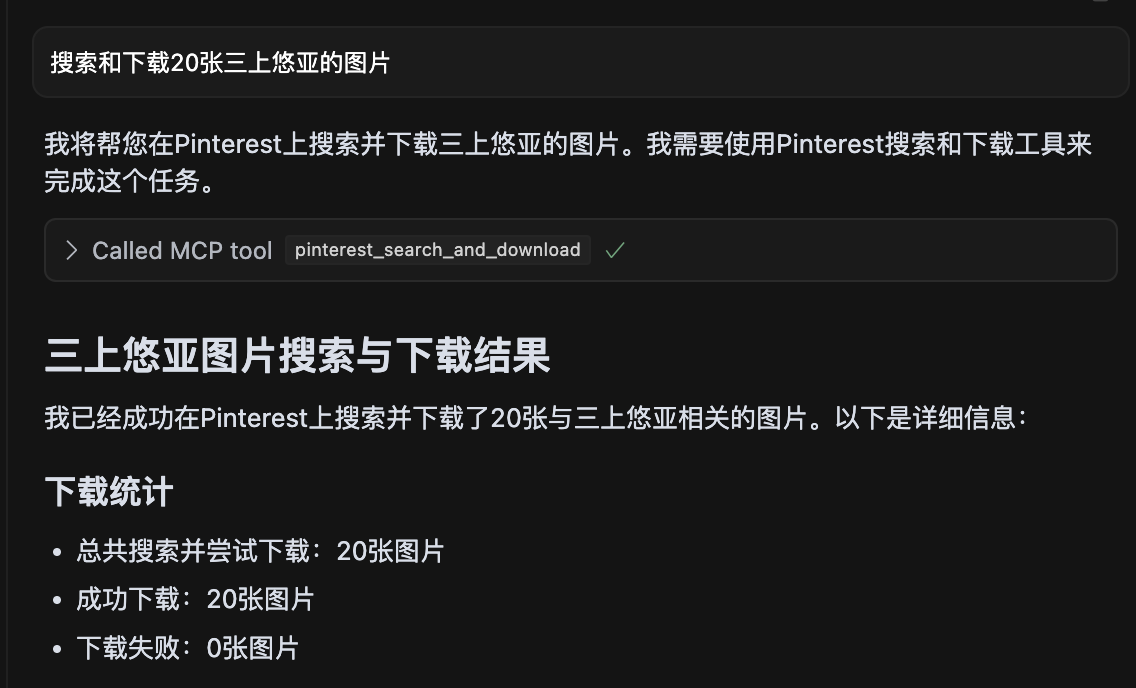
Снимок экрана, показывающий поиск 20 изображений 三上悠亚, все изображения успешно загружены.
pinterest-mcp-server.ts : Основной файл сервера
dist/pinterest-mcp-server.js : Созданный файл JavaScript для производства
package.json : Конфигурация проекта и зависимости
Чтобы добавить новые функции MCP:
Изменить pinterest-mcp-server.ts
Регистрация новых функций с использованием MCP SDK
Реализовать логику функции
Пересобрать с помощью npm run build
Если сервер не запускается, проверьте, не используется ли уже порт.
Убедитесь, что все зависимости установлены правильно с помощью npm install
Убедитесь, что TypeScript правильно настроен с помощью файла tsconfig.json
Если вы столкнулись с ошибками сборки, попробуйте запустить npm install -D typescript @types/node
Проверьте сетевое подключение для доступа к Pinterest
Данный проект лицензирован по лицензии MIT — подробности см. в файле LICENSE .
При использовании сервера через npx вы можете настроить его с помощью следующих параметров командной строки:
--downloadDir : Указывает корневой каталог для загрузки изображений.
npx pinterest-mcp-server --downloadDir /path/to/downloads--filenameTemplate : Указывает шаблон имени файла для загруженных изображений.
npx pinterest-mcp-server --filenameTemplate "pin_{imageId}_{timestamp}"--port : указывает порт, который будет прослушивать сервер (по умолчанию: 3000)
npx pinterest-mcp-server --port 8080--proxyServer : указывает прокси-сервер, используемый для подключения к Pinterest.
npx pinterest-mcp-server --proxyServer "http://127.0.0.1:7890"Вы можете комбинировать несколько вариантов:
npx pinterest-mcp-server --downloadDir ./images --filenameTemplate "pinterest_{id}" --port 8080 --proxyServer "http://127.0.0.1:7890"Сервер также поддерживает следующие переменные среды для конфигурации:
MCP_PINTEREST_DOWNLOAD_DIR : Указывает корневой каталог для загрузки изображений. Если не задано, по умолчанию используется каталог ../downloads относительно скрипта сервера.
MCP_PINTEREST_FILENAME_TEMPLATE : Указывает шаблон имени файла для загруженных изображений. Если не задано, по умолчанию используется pinterest_{imageId}.{fileExtension} .
MCP_PINTEREST_PROXY_SERVER : Указывает прокси-сервер, который будет использоваться для подключения к Pinterest. Формат должен быть protocol://host:port , например http://127.0.0.1:7890 или socks5://127.0.0.1:1080 .
Эти переменные среды можно задать несколькими способами:
Прямо в вашем терминале (как показано в примерах ниже)
В конфигурации Cursor MCP через поле env (см. Полный пример конфигурации )
В файле .env в корневом каталоге проекта
Через параметры командной строки с npx (как показано в разделе «Параметры командной строки »)
Использование npx с параметрами командной строки:
npx pinterest-mcp-server --downloadDir /path/to/your/download/directoryЗадайте каталог загрузки с помощью переменной среды:
# Linux/macOS
export MCP_PINTEREST_DOWNLOAD_DIR=/path/to/your/download/directory
npx pinterest-mcp-server

# Windows (CMD)
set MCP_PINTEREST_DOWNLOAD_DIR=C:\path\to\your\download\directory
npx pinterest-mcp-server

# Windows (PowerShell)
$env:MCP_PINTEREST_DOWNLOAD_DIR="C:\path\to\your\download\directory"
npx pinterest-mcp-server
Если переменная окружения не задана, сервер будет использовать каталог загрузки по умолчанию (относительно ../downloads серверного скрипта).
Использование npx с параметрами командной строки:
npx pinterest-mcp-server --filenameTemplate "pin_{imageId}_{timestamp}.{fileExtension}"Использование переменной среды:
# Linux/macOS
export MCP_PINTEREST_FILENAME_TEMPLATE="pin_{imageId}_{timestamp}.{fileExtension}"
npx pinterest-mcp-server

# Windows (CMD)
set MCP_PINTEREST_FILENAME_TEMPLATE="pin_{imageId}_{timestamp}.{fileExtension}"
npx pinterest-mcp-server

# Windows (PowerShell)
$env:MCP_PINTEREST_FILENAME_TEMPLATE="pin_{imageId}_{timestamp}.{fileExtension}"
npx pinterest-mcp-server
Шаблон поддерживает следующие переменные:
{imageId} : уникальный идентификатор изображения Pinterest.
{fileExtension} : расширение файла (например, jpg, png)
{timestamp} : Текущая временная метка UTC в формате ГГГГММДДЧЧММСС
{index} : номер индекса при загрузке нескольких изображений (начинается с 1)
Примеры шаблонов:
pinterest_{imageId}.{fileExtension} (по умолчанию)
pin_{timestamp}_{imageId}.{fileExtension}
pinterest_image_{index}_{imageId}.{fileExtension}
{timestamp}_pinterest.{fileExtension}
Если шаблон недействителен (например, содержит неподдерживаемые переменные или имеет несоответствующие скобки), сервер выведет предупреждение и будет использовать шаблон по умолчанию.
Если вам необходимо использовать прокси-сервер для доступа к Pinterest (особенно в регионах, где Pinterest может быть ограничен), вы можете настроить конфигурацию прокси-сервера:
Использование npx с параметрами командной строки:
npx pinterest-mcp-server --proxyServer "http://127.0.0.1:7890"Использование переменной среды:
# Linux/macOS
export MCP_PINTEREST_PROXY_SERVER="http://127.0.0.1:7890"
npx pinterest-mcp-server

# Windows (CMD)
set MCP_PINTEREST_PROXY_SERVER=http://127.0.0.1:7890
npx pinterest-mcp-server

# Windows (PowerShell)
$env:MCP_PINTEREST_PROXY_SERVER="http://127.0.0.1:7890"
npx pinterest-mcp-server
Поддерживаемые прокси-протоколы:
HTTP: http://host:port
HTTPS: https://host:port
SOCKS4: socks4://host:port
SOCKS5: socks5://host:port
Конфигурация прокси-сервера влияет как на браузер, используемый для поиска, так и на процесс загрузки изображений.
При запуске сервер проверит существование и возможность записи в каталог загрузки. Если каталог не существует, он попытается его создать; если его невозможно создать или записать в него, сервер завершит работу.
Клиентам не следует указывать пути загрузки или шаблоны имен файлов через параметры при вызове инструментов, связанных с загрузкой, поскольку все загрузки будут использовать конфигурацию переменных среды сервера или значения по умолчанию.
Сервер автоматически очищает имена файлов, заменяя недопустимые символы (такие как / , \ , : , * , ? , " , < , > , | ) на подчеркивания.
Сервер предоставляет следующие инструменты MCP:
pinterest_search : Поиск изображений Pinterest по ключевому слову
pinterest_get_image_info : Получите подробную информацию об изображении Pinterest
pinterest_search_and_download : Поиск и загрузка изображений Pinterest
Подробные справочные данные по параметрам интерфейса см. в определениях инструмента MCP.
Get Pinterest image information
| Name | Required | Description | Default |
|---|---|---|---|
| image_url | Yes | Image URL |
Does the description disclose side effects, auth requirements, rate limits, or destructive behavior?
No annotations are present, and the description does not disclose any behavioral traits such as read-only nature, authentication requirements, or rate limits. It merely restates the name.
Agents need to know what a tool does to the world before calling it. Descriptions should go beyond structured annotations to explain consequences.
Is the description appropriately sized, front-loaded, and free of redundancy?
The description is a single sentence with no unnecessary words. It is appropriately concise, though it could include more information without becoming verbose.
Shorter descriptions cost fewer tokens and are easier for agents to parse. Every sentence should earn its place.
Given the tool's complexity, does the description cover enough for an agent to succeed on first attempt?
The tool is simple with one parameter and no output schema, but the description does not mention what information is returned. Without output schema, the agent has no indication of the response format or content, making it incomplete.
Complex tools with many parameters or behaviors need more documentation. Simple tools need less. This dimension scales expectations accordingly.
Does the description clarify parameter syntax, constraints, interactions, or defaults beyond what the schema provides?
The input schema already provides a description for the single parameter 'image_url' as 'Image URL'. The tool description does not add any additional meaning or context beyond the schema. With 100% schema coverage, baseline 3 is appropriate.
Input schemas describe structure but not intent. Descriptions should explain non-obvious parameter relationships and valid value ranges.
Does the description clearly state what the tool does and how it differs from similar tools?
The description uses a specific verb 'Get' and resource 'Pinterest image information', distinguishing it from sibling tools like search and search_and_download. However, it does not specify what information is retrieved, which could be improved.
Agents choose between tools based on descriptions. A clear purpose with a specific verb and resource helps agents select the right tool.
Does the description explain when to use this tool, when not to, or what alternatives exist?
No guidance is provided on when to use this tool versus alternatives. For instance, it could mention that this is used after searching to fetch details for a specific image.
Agents often have multiple tools that could apply. Explicit usage guidance like "use X instead of Y when Z" prevents misuse.
Search for images on Pinterest by keyword
| Name | Required | Description | Default |
|---|---|---|---|
| keyword | Yes | Search keyword | |
| limit | No | Number of images to return (default: 10) | |
| headless | No | Whether to use headless browser mode (default: true) |
Does the description disclose side effects, auth requirements, rate limits, or destructive behavior?
No annotations are provided, so the description carries full responsibility for behavioral disclosure. However, it only states the basic action without revealing key traits such as browser automation (implied by the headless parameter), result format, pagination, or any potential side effects. This minimal transparency is insufficient for agents to understand the tool's operational behavior.
Agents need to know what a tool does to the world before calling it. Descriptions should go beyond structured annotations to explain consequences.
Is the description appropriately sized, front-loaded, and free of redundancy?
The description is a single, focused sentence that efficiently communicates the core purpose without any extraneous words. It is appropriately sized and front-loaded, making it quick for an agent to parse.
Shorter descriptions cost fewer tokens and are easier for agents to parse. Every sentence should earn its place.
Given the tool's complexity, does the description cover enough for an agent to succeed on first attempt?
Given the lack of output schema and annotations, the description is insufficiently complete for a search tool. It does not specify return values (e.g., image URLs, metadata), result sorting, error handling, or rate limits. The description omits critical operational context that an agent would need to use the tool correctly.
Complex tools with many parameters or behaviors need more documentation. Simple tools need less. This dimension scales expectations accordingly.
Does the description clarify parameter syntax, constraints, interactions, or defaults beyond what the schema provides?
All three parameters (keyword, limit, headless) are fully described in the input schema with 100% coverage. The description adds no additional meaning beyond the schema; for example, 'by keyword' merely repeats the required parameter. Per guidelines, with high schema coverage, baseline score is 3.
Input schemas describe structure but not intent. Descriptions should explain non-obvious parameter relationships and valid value ranges.
Does the description clearly state what the tool does and how it differs from similar tools?
The description 'Search for images on Pinterest by keyword' clearly states the action (search), resource (images on Pinterest), and method (by keyword). It effectively distinguishes this tool from its siblings: 'pinterest_get_image_info' retrieves details of specific images, while 'pinterest_search_and_download' implies additional download functionality, making this tool's purpose unique.
Agents choose between tools based on descriptions. A clear purpose with a specific verb and resource helps agents select the right tool.
Does the description explain when to use this tool, when not to, or what alternatives exist?
The description provides no guidance on when to use this tool versus its siblings or alternatives. It lacks information about prerequisites, limitations, or appropriate contexts, leaving the agent to infer usage from the tool name alone.
Agents often have multiple tools that could apply. Explicit usage guidance like "use X instead of Y when Z" prevents misuse.
Search for images on Pinterest by keyword and download them
| Name | Required | Description | Default |
|---|---|---|---|
| keyword | Yes | Search keyword | |
| limit | No | Number of images to return and download (default: 10) | |
| headless | No | Whether to use headless browser mode (default: true) |
Does the description disclose side effects, auth requirements, rate limits, or destructive behavior?
With no annotations, the description must disclose behavior. It only states the action, not side effects (e.g., file saving location, format, or any destructive operations). Minimal behavioral transparency.
Agents need to know what a tool does to the world before calling it. Descriptions should go beyond structured annotations to explain consequences.
Is the description appropriately sized, front-loaded, and free of redundancy?
A single, efficient sentence with no wasted words. Could be slightly more structured but overall well-sized.
Shorter descriptions cost fewer tokens and are easier for agents to parse. Every sentence should earn its place.
Given the tool's complexity, does the description cover enough for an agent to succeed on first attempt?
For a tool that downloads images, missing details on output format, file saving behavior, and how it differs from sibling tools. Incomplete for an agent to reliably invoke.
Complex tools with many parameters or behaviors need more documentation. Simple tools need less. This dimension scales expectations accordingly.
Does the description clarify parameter syntax, constraints, interactions, or defaults beyond what the schema provides?
Schema coverage is 100%, and the description adds no extra meaning beyond what the schema already provides. Baseline score of 3 is appropriate.
Input schemas describe structure but not intent. Descriptions should explain non-obvious parameter relationships and valid value ranges.
Does the description clearly state what the tool does and how it differs from similar tools?
The description clearly states the verb 'search and download' and resource 'images on Pinterest by keyword'. It distinguishes from siblings by combining both actions, though not explicitly differentiating from pinterest_search.
Agents choose between tools based on descriptions. A clear purpose with a specific verb and resource helps agents select the right tool.
Does the description explain when to use this tool, when not to, or what alternatives exist?
No explicit guidance on when to use this tool vs siblings. The context is implied by the name and description, but lacks when-not-to-use or alternative mentions.
Agents often have multiple tools that could apply. Explicit usage guidance like "use X instead of Y when Z" prevents misuse.
Each tool has a distinct purpose: retrieving metadata, searching, and searching with download. The names and descriptions make it easy to distinguish between them.
All tools use the 'pinterest_' prefix and snake_case, but 'pinterest_search_and_download' combines two verbs while the others use a single verb, introducing slight inconsistency.
Three tools is a minimal but reasonable set for an image search and download service. It covers core functionality without being too sparse or excessive.
The set covers basic search and metadata retrieval, but lacks common Pinterest operations like board management, pinning, or user actions, leaving notable gaps for broader use.
Unclaimed servers have limited discoverability.
If you are the server author, to access and configure the admin panel.
Personal knowledge base MCP server with semantic search, auto-categorization, metadata extraction
MCP Server for an Agent Task Marketplace
MCP server for Drosophila neuroscience data from VirtualFlyBrain
We provide all the information about MCP servers via our MCP API.
curl -X GET 'https://glama.ai/api/mcp/v1/servers/terryso/mcp-pinterest'
If you have feedback or need assistance with the MCP directory API, please join our Discord server