


A
licenseD
qualityD
maintenanceA Model Context Protocol server that enables searching for similar images by text description, integrating Inspire's backend image search capabilities with LLM interfaces like Claude Desktop.
1
3
GPL 3.0


Ein Model Context Protocol (MCP)-Server für die Bildersuche und Informationsbeschaffung auf Pinterest.
Suchen Sie auf Pinterest nach Bildern anhand von Schlüsselwörtern
Detaillierte Informationen zu Pinterest-Bildern abrufen
Nahtlose Integration mit Cursor IDE über MCP
Unterstützung für den Headless-Browsermodus
Limitkontrolle für Suchergebnisse
Suchen und laden Sie Bilder von Pinterest herunter
Related MCP server: FGCLIP-MCP
Node.js (v18 oder höher)
Cursor-IDE für MCP-Integration
Der einfachste Weg, den Pinterest MCP-Server zu verwenden, ist über npx:
npx pinterest-mcp-serverSie können den Server mit Befehlszeilenoptionen konfigurieren:
# Specify download directory
npx pinterest-mcp-server --downloadDir /path/to/downloads

# Specify filename template
npx pinterest-mcp-server --filenameTemplate "pinterest_{id}"

# Specify both options
npx pinterest-mcp-server --downloadDir ./images --filenameTemplate "pinterest_{id}"So installieren Sie das Paket global und verwenden es direkt über die Befehlszeile:
npm install -g pinterest-mcp-serverNach der Installation können Sie den Server mit Folgendem ausführen:
pinterest-mcp-serverMit den gleichen Befehlszeilenoptionen wie die NPX-Version:
pinterest-mcp-server --downloadDir /path/to/downloads --filenameTemplate "pinterest_{id}"So installieren Sie mcp-pinterest für Claude Desktop automatisch über Smithery :
npx -y @smithery/cli install mcp-pinterest --client claudeKlonen Sie dieses Repository:
git clone https://github.com/terryso/mcp-pinterest.git pinterest-mcp-server
cd pinterest-mcp-server
Installieren Sie Abhängigkeiten:
npm installErstellen Sie den Server:
npm run buildFühren Sie den Server aus:
npm startÖffnen Sie die Cursor-IDE
Gehen Sie zu Einstellungen (⚙️) > Erweiterungen > MCP
Klicken Sie auf „Server hinzufügen“
Geben Sie die folgenden Details ein:
Name: Pinterest MCP
Typ: Befehl
Befehl: node
Argumente: ["/path/to/mcp-pinterest/dist/pinterest-mcp-server.js"]
或者直接编辑Cursor的MCP配置文件(通常位于~/.cursor/mcp.json ),添加以下内容:
"pinterest": {
  "command": "node",
  "args": ["/path/to/mcp-pinterest/dist/pinterest-mcp-server.js"]
}
Klicken Sie auf „Speichern“
Sie können Cursor auch so konfigurieren, dass die NPX-Version des Servers verwendet wird:
Öffnen Sie die Cursor-IDE
Gehen Sie zu Einstellungen (⚙️) > Erweiterungen > MCP
Klicken Sie auf „Server hinzufügen“
Geben Sie die folgenden Details ein:
Name: Pinterest MCP
Typ: Befehl
Befehl: npx
Argumente: ["pinterest-mcp-server"]
Klicken Sie auf „Speichern“
Für maximale Flexibilität können Sie den Server mit Umgebungsvariablen in Ihrer Cursor-MCP-Konfiguration konfigurieren:
"pinterest": {
  "command": "npx",
  "env": {
    "MCP_PINTEREST_DOWNLOAD_DIR": "/Users/xxx/Desktop/Images",
    "MCP_PINTEREST_FILENAME_TEMPLATE": "pin_{imageId}_{timestamp}.{fileExtension}",
    "MCP_PINTEREST_PROXY_SERVER": "http://127.0.0.1:7890"
  },
  "args": ["pinterest-mcp-server"]
}
Diese Konfiguration:
Verwendet npx zum Ausführen des Servers
Legt ein benutzerdefiniertes Download-Verzeichnis auf Ihrem Desktop fest
Verwendet eine benutzerdefinierte Dateinamenvorlage mit Bild-ID und Zeitstempel
Konfiguriert einen Proxyserver für Benutzer in Regionen, in denen Pinterest möglicherweise blockiert ist
Fügen Sie dies Ihrer Datei ~/.cursor/mcp.json hinzu oder richten Sie es über die Cursor-IDE-Schnittstelle ein.
Der Server stellt die folgenden MCP-Funktionen bereit:
pinterest_search : Suche nach Bildern auf Pinterest nach Stichworten
Parameter:
keyword : Suchbegriff (erforderlich)
limit : Anzahl der zurückzugebenden Bilder (Standard: 10)
headless : Ob der Headless-Browsermodus verwendet werden soll (Standard: true)
pinterest_get_image_info : Erhalten Sie detaillierte Informationen zu einem Pinterest-Bild
Parameter:
image_url : URL des Pinterest-Bildes (erforderlich)
pinterest_search_and_download : Bilder von Pinterest suchen und herunterladen
Parameter:
keyword : Suchbegriff (erforderlich)
limit : Anzahl der zurückzugebenden Bilder (Standard: 10)
headless : Ob der Headless-Browsermodus verwendet werden soll (Standard: true)
Nach der Konfiguration können Sie die Pinterest MCP-Funktionen direkt im KI-Chat von Cursor verwenden:
Search for robot images on PinterestDie KI verwendet den MCP-Server, um Pinterest zu durchsuchen und die Ergebnisse anzuzeigen.
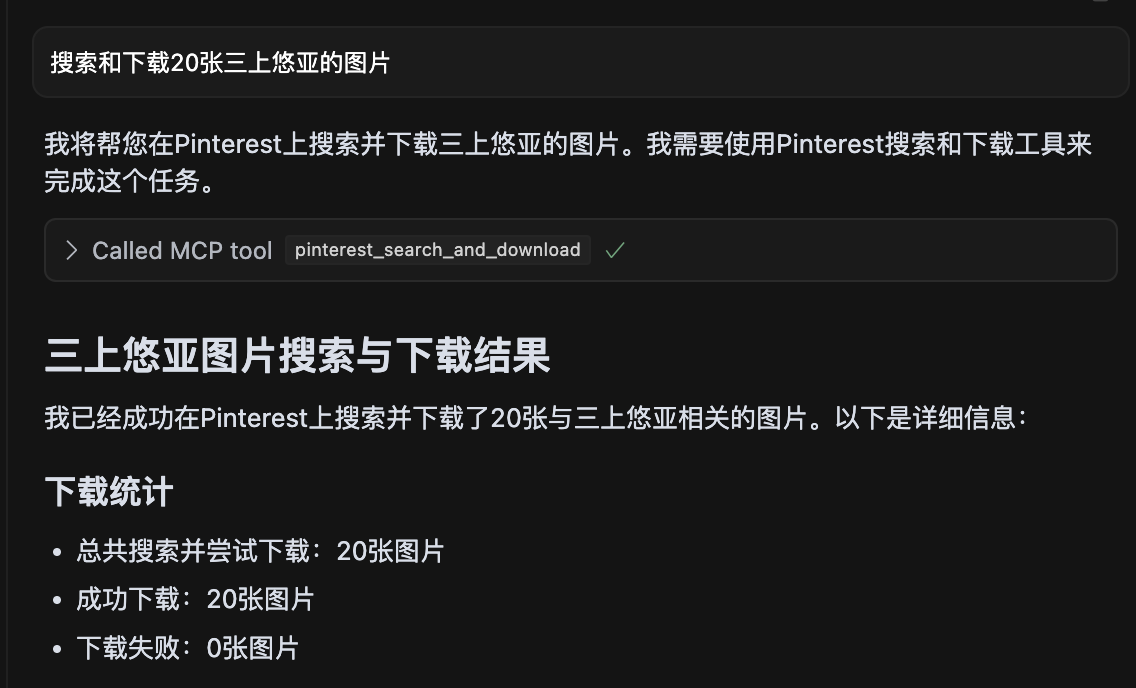
Screenshot, der eine Suche nach 20 Bildern von 三上悠亚 zeigt, wobei alle Bilder erfolgreich heruntergeladen wurden.
pinterest-mcp-server.ts : Hauptserverdatei
dist/pinterest-mcp-server.js : Erstellte JavaScript-Datei für die Produktion
package.json : Projektkonfiguration und Abhängigkeiten
So fügen Sie neue MCP-Funktionen hinzu:
Ändern Sie pinterest-mcp-server.ts
Registrieren neuer Funktionen mit dem MCP SDK
Implementieren der Funktionslogik
Neuaufbau mit npm run build
Wenn der Server nicht startet, prüfen Sie, ob der Port bereits verwendet wird
Stellen Sie sicher, dass alle Abhängigkeiten mit npm install korrekt installiert sind
Stellen Sie sicher, dass TypeScript mit einer tsconfig.json Datei richtig konfiguriert ist
Wenn beim Erstellen Fehler auftreten, versuchen Sie npm install -D typescript @types/node auszuführen.
Überprüfen Sie die Netzwerkkonnektivität für den Pinterest-Zugriff
Dieses Projekt ist unter der MIT-Lizenz lizenziert – Einzelheiten finden Sie in der Datei LICENSE .
Wenn Sie den Server über npx verwenden, können Sie ihn mit den folgenden Befehlszeilenoptionen konfigurieren:
--downloadDir : Gibt das Stammverzeichnis zum Herunterladen von Bildern an
npx pinterest-mcp-server --downloadDir /path/to/downloads--filenameTemplate : Gibt die Dateinamenvorlage für heruntergeladene Bilder an
npx pinterest-mcp-server --filenameTemplate "pin_{imageId}_{timestamp}"--port : Gibt den Port an, auf dem der Server lauschen soll (Standard: 3000)
npx pinterest-mcp-server --port 8080--proxyServer : Gibt den Proxyserver an, der für die Verbindung mit Pinterest verwendet werden soll
npx pinterest-mcp-server --proxyServer "http://127.0.0.1:7890"Sie können mehrere Optionen kombinieren:
npx pinterest-mcp-server --downloadDir ./images --filenameTemplate "pinterest_{id}" --port 8080 --proxyServer "http://127.0.0.1:7890"Der Server unterstützt außerdem die folgenden Umgebungsvariablen zur Konfiguration:
MCP_PINTEREST_DOWNLOAD_DIR : Gibt das Stammverzeichnis für den Download von Bildern an. Wenn nicht festgelegt, wird standardmäßig das Verzeichnis ../downloads relativ zum Serverskript verwendet.
MCP_PINTEREST_FILENAME_TEMPLATE : Gibt die Dateinamenvorlage für heruntergeladene Bilder an. Wenn nicht festgelegt, lautet der Standardwert pinterest_{imageId}.{fileExtension} .
MCP_PINTEREST_PROXY_SERVER : Gibt den Proxyserver an, der für die Verbindung mit Pinterest verwendet werden soll. Das Format sollte protocol://host:port sein, z. B. http://127.0.0.1:7890 oder socks5://127.0.0.1:1080 .
Diese Umgebungsvariablen können auf verschiedene Arten festgelegt werden:
Direkt in Ihrem Terminal (wie in den folgenden Beispielen gezeigt)
In Ihrer Cursor-MCP-Konfiguration über das Feld env (siehe Vollständiges Konfigurationsbeispiel )
In einer .env -Datei im Stammverzeichnis des Projekts
Über Befehlszeilenoptionen mit npx (wie im Abschnitt „Befehlszeilenoptionen “ gezeigt)
Verwenden von npx mit Befehlszeilenoptionen:
npx pinterest-mcp-server --downloadDir /path/to/your/download/directoryLegen Sie das Download-Verzeichnis mithilfe einer Umgebungsvariablen fest:
# Linux/macOS
export MCP_PINTEREST_DOWNLOAD_DIR=/path/to/your/download/directory
npx pinterest-mcp-server

# Windows (CMD)
set MCP_PINTEREST_DOWNLOAD_DIR=C:\path\to\your\download\directory
npx pinterest-mcp-server

# Windows (PowerShell)
$env:MCP_PINTEREST_DOWNLOAD_DIR="C:\path\to\your\download\directory"
npx pinterest-mcp-server
Wenn die Umgebungsvariable nicht festgelegt ist, verwendet der Server das Standard-Downloadverzeichnis (relativ zum Verzeichnis ../downloads des Serverskripts).
Verwenden von npx mit Befehlszeilenoptionen:
npx pinterest-mcp-server --filenameTemplate "pin_{imageId}_{timestamp}.{fileExtension}"Verwenden einer Umgebungsvariablen:
# Linux/macOS
export MCP_PINTEREST_FILENAME_TEMPLATE="pin_{imageId}_{timestamp}.{fileExtension}"
npx pinterest-mcp-server

# Windows (CMD)
set MCP_PINTEREST_FILENAME_TEMPLATE="pin_{imageId}_{timestamp}.{fileExtension}"
npx pinterest-mcp-server

# Windows (PowerShell)
$env:MCP_PINTEREST_FILENAME_TEMPLATE="pin_{imageId}_{timestamp}.{fileExtension}"
npx pinterest-mcp-server
Die Vorlage unterstützt die folgenden Variablen:
{imageId} : Die eindeutige ID des Pinterest-Bildes
{fileExtension} : Die Dateierweiterung (z. B. jpg, png)
{timestamp} : Aktueller UTC-Zeitstempel im Format JJJJMMTTHHMMSS
{index} : Die Indexnummer beim Herunterladen mehrerer Bilder (beginnt bei 1)
Beispielvorlagen:
pinterest_{imageId}.{fileExtension} (Standard)
pin_{timestamp}_{imageId}.{fileExtension}
pinterest_image_{index}_{imageId}.{fileExtension}
{timestamp}_pinterest.{fileExtension}
Wenn die Vorlage ungültig ist (z. B. nicht unterstützte Variablen enthält oder nicht übereinstimmende Klammern aufweist), protokolliert der Server eine Warnung und verwendet die Standardvorlage.
Wenn Sie für den Zugriff auf Pinterest einen Proxy verwenden müssen (insbesondere in Regionen, in denen Pinterest möglicherweise eingeschränkt ist), können Sie die Proxy-Konfiguration festlegen:
Verwenden von npx mit Befehlszeilenoptionen:
npx pinterest-mcp-server --proxyServer "http://127.0.0.1:7890"Verwenden einer Umgebungsvariablen:
# Linux/macOS
export MCP_PINTEREST_PROXY_SERVER="http://127.0.0.1:7890"
npx pinterest-mcp-server

# Windows (CMD)
set MCP_PINTEREST_PROXY_SERVER=http://127.0.0.1:7890
npx pinterest-mcp-server

# Windows (PowerShell)
$env:MCP_PINTEREST_PROXY_SERVER="http://127.0.0.1:7890"
npx pinterest-mcp-server
Unterstützte Proxy-Protokolle:
HTTP: http://host:port
HTTPS: https://host:port
SOCKS4: socks4://host:port
SOCKS5: socks5://host:port
Die Proxy-Konfiguration wirkt sich sowohl auf den für die Suche verwendeten Browser als auch auf den Bilddownloadvorgang aus.
Der Server prüft beim Start, ob das Download-Verzeichnis vorhanden und beschreibbar ist. Falls das Verzeichnis nicht vorhanden ist, wird versucht, es zu erstellen. Ist dies nicht möglich, wird der Server beendet.
Clients sollten beim Aufrufen von Download-bezogenen Tools keine Downloadpfade oder Dateinamenvorlagen über Parameter angeben, da alle Downloads die Umgebungsvariablenkonfiguration oder Standardeinstellungen des Servers verwenden.
Der Server bereinigt Dateinamen automatisch, indem er ungültige Zeichen (wie / , \ , : , * , ? , " , < , > , | ) durch Unterstriche ersetzt.
Der Server stellt die folgenden MCP-Tools bereit:
pinterest_search : Suche nach Pinterest-Bildern nach Stichwort
pinterest_get_image_info : Erhalten Sie detaillierte Informationen zu einem Pinterest-Bild
pinterest_search_and_download : Pinterest-Bilder suchen und herunterladen
Ausführliche Referenzen zu den Schnittstellenparametern finden Sie in den MCP-Tooldefinitionen.
Get Pinterest image information
| Name | Required | Description | Default |
|---|---|---|---|
| image_url | Yes | Image URL |
Does the description disclose side effects, auth requirements, rate limits, or destructive behavior?
No annotations are present, and the description does not disclose any behavioral traits such as read-only nature, authentication requirements, or rate limits. It merely restates the name.
Agents need to know what a tool does to the world before calling it. Descriptions should go beyond structured annotations to explain consequences.
Is the description appropriately sized, front-loaded, and free of redundancy?
The description is a single sentence with no unnecessary words. It is appropriately concise, though it could include more information without becoming verbose.
Shorter descriptions cost fewer tokens and are easier for agents to parse. Every sentence should earn its place.
Given the tool's complexity, does the description cover enough for an agent to succeed on first attempt?
The tool is simple with one parameter and no output schema, but the description does not mention what information is returned. Without output schema, the agent has no indication of the response format or content, making it incomplete.
Complex tools with many parameters or behaviors need more documentation. Simple tools need less. This dimension scales expectations accordingly.
Does the description clarify parameter syntax, constraints, interactions, or defaults beyond what the schema provides?
The input schema already provides a description for the single parameter 'image_url' as 'Image URL'. The tool description does not add any additional meaning or context beyond the schema. With 100% schema coverage, baseline 3 is appropriate.
Input schemas describe structure but not intent. Descriptions should explain non-obvious parameter relationships and valid value ranges.
Does the description clearly state what the tool does and how it differs from similar tools?
The description uses a specific verb 'Get' and resource 'Pinterest image information', distinguishing it from sibling tools like search and search_and_download. However, it does not specify what information is retrieved, which could be improved.
Agents choose between tools based on descriptions. A clear purpose with a specific verb and resource helps agents select the right tool.
Does the description explain when to use this tool, when not to, or what alternatives exist?
No guidance is provided on when to use this tool versus alternatives. For instance, it could mention that this is used after searching to fetch details for a specific image.
Agents often have multiple tools that could apply. Explicit usage guidance like "use X instead of Y when Z" prevents misuse.
Search for images on Pinterest by keyword
| Name | Required | Description | Default |
|---|---|---|---|
| keyword | Yes | Search keyword | |
| limit | No | Number of images to return (default: 10) | |
| headless | No | Whether to use headless browser mode (default: true) |
Does the description disclose side effects, auth requirements, rate limits, or destructive behavior?
No annotations are provided, so the description carries full responsibility for behavioral disclosure. However, it only states the basic action without revealing key traits such as browser automation (implied by the headless parameter), result format, pagination, or any potential side effects. This minimal transparency is insufficient for agents to understand the tool's operational behavior.
Agents need to know what a tool does to the world before calling it. Descriptions should go beyond structured annotations to explain consequences.
Is the description appropriately sized, front-loaded, and free of redundancy?
The description is a single, focused sentence that efficiently communicates the core purpose without any extraneous words. It is appropriately sized and front-loaded, making it quick for an agent to parse.
Shorter descriptions cost fewer tokens and are easier for agents to parse. Every sentence should earn its place.
Given the tool's complexity, does the description cover enough for an agent to succeed on first attempt?
Given the lack of output schema and annotations, the description is insufficiently complete for a search tool. It does not specify return values (e.g., image URLs, metadata), result sorting, error handling, or rate limits. The description omits critical operational context that an agent would need to use the tool correctly.
Complex tools with many parameters or behaviors need more documentation. Simple tools need less. This dimension scales expectations accordingly.
Does the description clarify parameter syntax, constraints, interactions, or defaults beyond what the schema provides?
All three parameters (keyword, limit, headless) are fully described in the input schema with 100% coverage. The description adds no additional meaning beyond the schema; for example, 'by keyword' merely repeats the required parameter. Per guidelines, with high schema coverage, baseline score is 3.
Input schemas describe structure but not intent. Descriptions should explain non-obvious parameter relationships and valid value ranges.
Does the description clearly state what the tool does and how it differs from similar tools?
The description 'Search for images on Pinterest by keyword' clearly states the action (search), resource (images on Pinterest), and method (by keyword). It effectively distinguishes this tool from its siblings: 'pinterest_get_image_info' retrieves details of specific images, while 'pinterest_search_and_download' implies additional download functionality, making this tool's purpose unique.
Agents choose between tools based on descriptions. A clear purpose with a specific verb and resource helps agents select the right tool.
Does the description explain when to use this tool, when not to, or what alternatives exist?
The description provides no guidance on when to use this tool versus its siblings or alternatives. It lacks information about prerequisites, limitations, or appropriate contexts, leaving the agent to infer usage from the tool name alone.
Agents often have multiple tools that could apply. Explicit usage guidance like "use X instead of Y when Z" prevents misuse.
Search for images on Pinterest by keyword and download them
| Name | Required | Description | Default |
|---|---|---|---|
| keyword | Yes | Search keyword | |
| limit | No | Number of images to return and download (default: 10) | |
| headless | No | Whether to use headless browser mode (default: true) |
Does the description disclose side effects, auth requirements, rate limits, or destructive behavior?
With no annotations, the description must disclose behavior. It only states the action, not side effects (e.g., file saving location, format, or any destructive operations). Minimal behavioral transparency.
Agents need to know what a tool does to the world before calling it. Descriptions should go beyond structured annotations to explain consequences.
Is the description appropriately sized, front-loaded, and free of redundancy?
A single, efficient sentence with no wasted words. Could be slightly more structured but overall well-sized.
Shorter descriptions cost fewer tokens and are easier for agents to parse. Every sentence should earn its place.
Given the tool's complexity, does the description cover enough for an agent to succeed on first attempt?
For a tool that downloads images, missing details on output format, file saving behavior, and how it differs from sibling tools. Incomplete for an agent to reliably invoke.
Complex tools with many parameters or behaviors need more documentation. Simple tools need less. This dimension scales expectations accordingly.
Does the description clarify parameter syntax, constraints, interactions, or defaults beyond what the schema provides?
Schema coverage is 100%, and the description adds no extra meaning beyond what the schema already provides. Baseline score of 3 is appropriate.
Input schemas describe structure but not intent. Descriptions should explain non-obvious parameter relationships and valid value ranges.
Does the description clearly state what the tool does and how it differs from similar tools?
The description clearly states the verb 'search and download' and resource 'images on Pinterest by keyword'. It distinguishes from siblings by combining both actions, though not explicitly differentiating from pinterest_search.
Agents choose between tools based on descriptions. A clear purpose with a specific verb and resource helps agents select the right tool.
Does the description explain when to use this tool, when not to, or what alternatives exist?
No explicit guidance on when to use this tool vs siblings. The context is implied by the name and description, but lacks when-not-to-use or alternative mentions.
Agents often have multiple tools that could apply. Explicit usage guidance like "use X instead of Y when Z" prevents misuse.
Each tool has a distinct purpose: retrieving metadata, searching, and searching with download. The names and descriptions make it easy to distinguish between them.
All tools use the 'pinterest_' prefix and snake_case, but 'pinterest_search_and_download' combines two verbs while the others use a single verb, introducing slight inconsistency.
Three tools is a minimal but reasonable set for an image search and download service. It covers core functionality without being too sparse or excessive.
The set covers basic search and metadata retrieval, but lacks common Pinterest operations like board management, pinning, or user actions, leaving notable gaps for broader use.
Unclaimed servers have limited discoverability.
If you are the server author, to access and configure the admin panel.
Personal knowledge base MCP server with semantic search, auto-categorization, metadata extraction
MCP Server for an Agent Task Marketplace
MCP server for Drosophila neuroscience data from VirtualFlyBrain
We provide all the information about MCP servers via our MCP API.
curl -X GET 'https://glama.ai/api/mcp/v1/servers/terryso/mcp-pinterest'
If you have feedback or need assistance with the MCP directory API, please join our Discord server