


A
licenseD
qualityD
maintenanceA Model Context Protocol server that enables searching for similar images by text description, integrating Inspire's backend image search capabilities with LLM interfaces like Claude Desktop.
1
3
GPL 3.0

Un servidor de Protocolo de Contexto Modelo (MCP) para la búsqueda de imágenes y la recuperación de información en Pinterest.
Buscar imágenes en Pinterest por palabras clave
Recuperar información detallada sobre las imágenes de Pinterest
Integración perfecta con Cursor IDE a través de MCP
Compatibilidad con el modo de navegador sin cabeza
Control de límites para los resultados de búsqueda
Busca y descarga imágenes de Pinterest
Related MCP server: FGCLIP-MCP
Node.js (v18 o superior)
IDE de Cursor para la integración de MCP
Para instalar mcp-pinterest para Claude Desktop automáticamente a través de Smithery :
npx -y @smithery/cli install mcp-pinterest --client claudeClonar este repositorio:
git clone https://github.com/terryso/mcp-pinterest.git pinterest-mcp-server
cd pinterest-mcp-server
Instalar dependencias:
npm installConstruir el servidor:
npm run buildAhora puedes usar este servidor como servidor MCP en Cursor.
Abrir cursor IDE
Vaya a Configuración (⚙️) > Extensiones > MCP
Haga clic en "Agregar servidor"
Introduzca los siguientes datos:
Nombre: Pinterest MCP
Tipo: Comando
Comando: node
Argumentos: ["/path/to/mcp-pinterest/dist/pinterest-mcp-server.js"]
或者直接编辑Cursor的MCP配置文件(通常位于~/.cursor/mcp.json ),添加以下内容:
"pinterest": {
  "command": "node",
  "args": ["/path/to/mcp-pinterest/dist/pinterest-mcp-server.js"]
}
Haga clic en "Guardar"
El servidor expone las siguientes funciones MCP:
pinterest_search : busca imágenes en Pinterest por palabra clave
Parámetros:
keyword : término de búsqueda (obligatorio)
limit : Número de imágenes a devolver (predeterminado: 10)
headless : si se debe utilizar el modo de navegador sin cabeza (valor predeterminado: verdadero)
pinterest_get_image_info : Obtenga información detallada sobre una imagen de Pinterest
Parámetros:
image_url : URL de la imagen de Pinterest (obligatorio)
pinterest_search_and_download : Busca y descarga imágenes de Pinterest
Parámetros:
keyword : término de búsqueda (obligatorio)
limit : Número de imágenes a devolver (predeterminado: 10)
headless : si se debe utilizar el modo de navegador sin cabeza (valor predeterminado: verdadero)
Una vez configurado, puedes usar las funciones de Pinterest MCP directamente en el chat de IA de Cursor:
Search for robot images on PinterestLa IA utilizará el servidor MCP para buscar en Pinterest y mostrar los resultados.
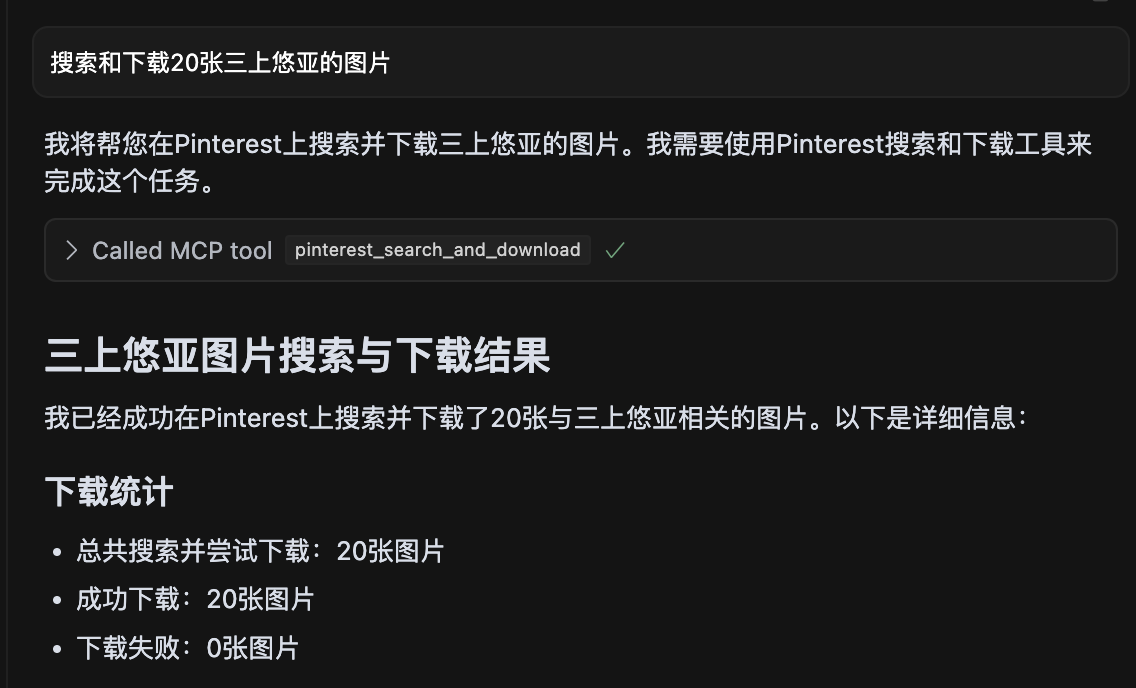
Captura de pantalla que muestra una búsqueda de 20 imágenes de 三上悠亚 con todas las imágenes descargadas correctamente.
pinterest-mcp-server.ts : Archivo del servidor principal
dist/pinterest-mcp-server.js : Archivo JavaScript creado para producción
package.json : Configuración del proyecto y dependencias
Para agregar nuevas funciones MCP:
Modificar pinterest-mcp-server.ts
Registrar nuevas funciones utilizando el SDK de MCP
Implementar la lógica de la función
Reconstruir con npm run build
Si el servidor no se inicia, verifique si el puerto ya está en uso
Asegúrese de que todas las dependencias estén instaladas correctamente con npm install
Asegúrese de que TypeScript esté configurado correctamente con un archivo tsconfig.json
Si encuentra errores de compilación, intente ejecutar npm install -D typescript @types/node
Verificar la conectividad de red para acceder a Pinterest
Este proyecto está licenciado bajo la licencia MIT: consulte el archivo de LICENCIA para obtener más detalles.
El servidor admite las siguientes variables de entorno para la configuración:
MCP_PINTEREST_DOWNLOAD_DIR : Especifica el directorio raíz para descargar imágenes. Si no se configura, el valor predeterminado es el directorio ../downloads correspondiente al script del servidor.
MCP_PINTEREST_FILENAME_TEMPLATE : Especifica la plantilla de nombre de archivo para las imágenes descargadas. Si no se configura, el valor predeterminado es pinterest_{imageId}.{fileExtension} .
MCP_PINTEREST_PROXY_SERVER : Especifica el servidor proxy que se usará para conectarse a Pinterest. El formato debe ser protocol://host:port , por ejemplo, http://127.0.0.1:7890 o socks5://127.0.0.1:1080 .
Establezca el directorio de descarga mediante una variable de entorno (método recomendado):
# Linux/macOS
export MCP_PINTEREST_DOWNLOAD_DIR=/path/to/your/download/directory
# Then start the server
node pinterest-mcp-server.js

# Windows (CMD)
set MCP_PINTEREST_DOWNLOAD_DIR=C:\path\to\your\download\directory
# Then start the server
node pinterest-mcp-server.js

# Windows (PowerShell)
$env:MCP_PINTEREST_DOWNLOAD_DIR="C:\path\to\your\download\directory"
# Then start the server
node pinterest-mcp-server.js
Si la variable de entorno no está configurada, el servidor utilizará el directorio de descarga predeterminado (relativo al ../downloads del script del servidor).
Puede personalizar el patrón del nombre de archivo para las imágenes descargadas utilizando la variable de entorno MCP_PINTEREST_FILENAME_TEMPLATE :
# Linux/macOS
export MCP_PINTEREST_FILENAME_TEMPLATE="pin_{imageId}_{timestamp}.{fileExtension}"
# Then start the server
node pinterest-mcp-server.js

# Windows (CMD)
set MCP_PINTEREST_FILENAME_TEMPLATE="pin_{imageId}_{timestamp}.{fileExtension}"
# Then start the server
node pinterest-mcp-server.js

# Windows (PowerShell)
$env:MCP_PINTEREST_FILENAME_TEMPLATE="pin_{imageId}_{timestamp}.{fileExtension}"
# Then start the server
node pinterest-mcp-server.js
La plantilla admite las siguientes variables:
{imageId} : El ID único de la imagen de Pinterest
{fileExtension} : La extensión del archivo (por ejemplo, jpg, png)
{timestamp} : Marca de tiempo UTC actual en formato AAAAMMDDHHMMSS
{index} : El número de índice al descargar varias imágenes (comienza desde 1)
Plantillas de ejemplo:
pinterest_{imageId}.{fileExtension} (predeterminado)
pin_{timestamp}_{imageId}.{fileExtension}
pinterest_image_{index}_{imageId}.{fileExtension}
{timestamp}_pinterest.{fileExtension}
Si la plantilla no es válida (por ejemplo, contiene variables no admitidas o tiene corchetes no coincidentes), el servidor registrará una advertencia y utilizará la plantilla predeterminada.
Si necesita utilizar un proxy para acceder a Pinterest (especialmente en regiones donde Pinterest podría estar restringido), puede establecer la configuración del proxy:
# Linux/macOS
export MCP_PINTEREST_PROXY_SERVER="http://127.0.0.1:7890"
# Then start the server
node pinterest-mcp-server.js

# Windows (CMD)
set MCP_PINTEREST_PROXY_SERVER=http://127.0.0.1:7890
# Then start the server
node pinterest-mcp-server.js

# Windows (PowerShell)
$env:MCP_PINTEREST_PROXY_SERVER="http://127.0.0.1:7890"
# Then start the server
node pinterest-mcp-server.js
Protocolos proxy compatibles:
HTTP: http://host:port
HTTPS: https://host:port
CALCETINES4: socks4://host:port
CALCETINES5: socks5://host:port
La configuración del proxy afecta tanto al navegador utilizado para la búsqueda como al proceso de descarga de imágenes.
El servidor verificará la existencia y la escritura en el directorio de descarga al iniciarse. Si el directorio no existe, intentará crearlo; si no se puede crear ni escribir en él, el servidor cerrará.
Los clientes no deben especificar rutas de descarga o plantillas de nombres de archivos a través de parámetros al llamar a herramientas relacionadas con la descarga, ya que todas las descargas utilizarán la configuración o los valores predeterminados de la variable de entorno del servidor.
El servidor desinfecta automáticamente los nombres de archivos reemplazando caracteres ilegales (como / , \ , : , * , ? , " , < , > , | ) con guiones bajos.
El servidor proporciona las siguientes herramientas MCP:
pinterest_search : busca imágenes de Pinterest por palabra clave
pinterest_get_image_info : Obtenga información detallada sobre una imagen de Pinterest
pinterest_search_and_download : Busca y descarga imágenes de Pinterest
Para obtener referencias detalladas de los parámetros de la interfaz, consulte las definiciones de la herramienta MCP.
Get Pinterest image information
| Name | Required | Description | Default |
|---|---|---|---|
| image_url | Yes | Image URL |
Does the description disclose side effects, auth requirements, rate limits, or destructive behavior?
No annotations are present, and the description does not disclose any behavioral traits such as read-only nature, authentication requirements, or rate limits. It merely restates the name.
Agents need to know what a tool does to the world before calling it. Descriptions should go beyond structured annotations to explain consequences.
Is the description appropriately sized, front-loaded, and free of redundancy?
The description is a single sentence with no unnecessary words. It is appropriately concise, though it could include more information without becoming verbose.
Shorter descriptions cost fewer tokens and are easier for agents to parse. Every sentence should earn its place.
Given the tool's complexity, does the description cover enough for an agent to succeed on first attempt?
The tool is simple with one parameter and no output schema, but the description does not mention what information is returned. Without output schema, the agent has no indication of the response format or content, making it incomplete.
Complex tools with many parameters or behaviors need more documentation. Simple tools need less. This dimension scales expectations accordingly.
Does the description clarify parameter syntax, constraints, interactions, or defaults beyond what the schema provides?
The input schema already provides a description for the single parameter 'image_url' as 'Image URL'. The tool description does not add any additional meaning or context beyond the schema. With 100% schema coverage, baseline 3 is appropriate.
Input schemas describe structure but not intent. Descriptions should explain non-obvious parameter relationships and valid value ranges.
Does the description clearly state what the tool does and how it differs from similar tools?
The description uses a specific verb 'Get' and resource 'Pinterest image information', distinguishing it from sibling tools like search and search_and_download. However, it does not specify what information is retrieved, which could be improved.
Agents choose between tools based on descriptions. A clear purpose with a specific verb and resource helps agents select the right tool.
Does the description explain when to use this tool, when not to, or what alternatives exist?
No guidance is provided on when to use this tool versus alternatives. For instance, it could mention that this is used after searching to fetch details for a specific image.
Agents often have multiple tools that could apply. Explicit usage guidance like "use X instead of Y when Z" prevents misuse.
Search for images on Pinterest by keyword
| Name | Required | Description | Default |
|---|---|---|---|
| keyword | Yes | Search keyword | |
| limit | No | Number of images to return (default: 10) | |
| headless | No | Whether to use headless browser mode (default: true) |
Does the description disclose side effects, auth requirements, rate limits, or destructive behavior?
No annotations are provided, so the description carries full responsibility for behavioral disclosure. However, it only states the basic action without revealing key traits such as browser automation (implied by the headless parameter), result format, pagination, or any potential side effects. This minimal transparency is insufficient for agents to understand the tool's operational behavior.
Agents need to know what a tool does to the world before calling it. Descriptions should go beyond structured annotations to explain consequences.
Is the description appropriately sized, front-loaded, and free of redundancy?
The description is a single, focused sentence that efficiently communicates the core purpose without any extraneous words. It is appropriately sized and front-loaded, making it quick for an agent to parse.
Shorter descriptions cost fewer tokens and are easier for agents to parse. Every sentence should earn its place.
Given the tool's complexity, does the description cover enough for an agent to succeed on first attempt?
Given the lack of output schema and annotations, the description is insufficiently complete for a search tool. It does not specify return values (e.g., image URLs, metadata), result sorting, error handling, or rate limits. The description omits critical operational context that an agent would need to use the tool correctly.
Complex tools with many parameters or behaviors need more documentation. Simple tools need less. This dimension scales expectations accordingly.
Does the description clarify parameter syntax, constraints, interactions, or defaults beyond what the schema provides?
All three parameters (keyword, limit, headless) are fully described in the input schema with 100% coverage. The description adds no additional meaning beyond the schema; for example, 'by keyword' merely repeats the required parameter. Per guidelines, with high schema coverage, baseline score is 3.
Input schemas describe structure but not intent. Descriptions should explain non-obvious parameter relationships and valid value ranges.
Does the description clearly state what the tool does and how it differs from similar tools?
The description 'Search for images on Pinterest by keyword' clearly states the action (search), resource (images on Pinterest), and method (by keyword). It effectively distinguishes this tool from its siblings: 'pinterest_get_image_info' retrieves details of specific images, while 'pinterest_search_and_download' implies additional download functionality, making this tool's purpose unique.
Agents choose between tools based on descriptions. A clear purpose with a specific verb and resource helps agents select the right tool.
Does the description explain when to use this tool, when not to, or what alternatives exist?
The description provides no guidance on when to use this tool versus its siblings or alternatives. It lacks information about prerequisites, limitations, or appropriate contexts, leaving the agent to infer usage from the tool name alone.
Agents often have multiple tools that could apply. Explicit usage guidance like "use X instead of Y when Z" prevents misuse.
Search for images on Pinterest by keyword and download them
| Name | Required | Description | Default |
|---|---|---|---|
| keyword | Yes | Search keyword | |
| limit | No | Number of images to return and download (default: 10) | |
| headless | No | Whether to use headless browser mode (default: true) |
Does the description disclose side effects, auth requirements, rate limits, or destructive behavior?
With no annotations, the description must disclose behavior. It only states the action, not side effects (e.g., file saving location, format, or any destructive operations). Minimal behavioral transparency.
Agents need to know what a tool does to the world before calling it. Descriptions should go beyond structured annotations to explain consequences.
Is the description appropriately sized, front-loaded, and free of redundancy?
A single, efficient sentence with no wasted words. Could be slightly more structured but overall well-sized.
Shorter descriptions cost fewer tokens and are easier for agents to parse. Every sentence should earn its place.
Given the tool's complexity, does the description cover enough for an agent to succeed on first attempt?
For a tool that downloads images, missing details on output format, file saving behavior, and how it differs from sibling tools. Incomplete for an agent to reliably invoke.
Complex tools with many parameters or behaviors need more documentation. Simple tools need less. This dimension scales expectations accordingly.
Does the description clarify parameter syntax, constraints, interactions, or defaults beyond what the schema provides?
Schema coverage is 100%, and the description adds no extra meaning beyond what the schema already provides. Baseline score of 3 is appropriate.
Input schemas describe structure but not intent. Descriptions should explain non-obvious parameter relationships and valid value ranges.
Does the description clearly state what the tool does and how it differs from similar tools?
The description clearly states the verb 'search and download' and resource 'images on Pinterest by keyword'. It distinguishes from siblings by combining both actions, though not explicitly differentiating from pinterest_search.
Agents choose between tools based on descriptions. A clear purpose with a specific verb and resource helps agents select the right tool.
Does the description explain when to use this tool, when not to, or what alternatives exist?
No explicit guidance on when to use this tool vs siblings. The context is implied by the name and description, but lacks when-not-to-use or alternative mentions.
Agents often have multiple tools that could apply. Explicit usage guidance like "use X instead of Y when Z" prevents misuse.
Each tool has a distinct purpose: retrieving metadata, searching, and searching with download. The names and descriptions make it easy to distinguish between them.
All tools use the 'pinterest_' prefix and snake_case, but 'pinterest_search_and_download' combines two verbs while the others use a single verb, introducing slight inconsistency.
Three tools is a minimal but reasonable set for an image search and download service. It covers core functionality without being too sparse or excessive.
The set covers basic search and metadata retrieval, but lacks common Pinterest operations like board management, pinning, or user actions, leaving notable gaps for broader use.
Unclaimed servers have limited discoverability.
If you are the server author, to access and configure the admin panel.
Personal knowledge base MCP server with semantic search, auto-categorization, metadata extraction
MCP Server for an Agent Task Marketplace
MCP server for Drosophila neuroscience data from VirtualFlyBrain
We provide all the information about MCP servers via our MCP API.
curl -X GET 'https://glama.ai/api/mcp/v1/servers/terryso/mcp-pinterest'
If you have feedback or need assistance with the MCP directory API, please join our Discord server