


A
licenseD
qualityD
maintenanceA Model Context Protocol server that enables searching for similar images by text description, integrating Inspire's backend image search capabilities with LLM interfaces like Claude Desktop.
1
3
GPL 3.0

Pinterest の画像検索と情報取得用の Model Context Protocol (MCP) サーバー。
Pinterestでキーワードで画像を検索する
Pinterestの画像に関する詳細情報を取得する
MCP による Cursor IDE とのシームレスな統合
ヘッドレスブラウザモードのサポート
検索結果の制限制御
Pinterestから画像を検索してダウンロードする
Related MCP server: FGCLIP-MCP
Smithery経由で Claude Desktop 用の mcp-pinterest を自動的にインストールするには:
npx -y @smithery/cli install mcp-pinterest --client claudeこのリポジトリをクローンします:
git clone https://github.com/terryso/mcp-pinterest.git pinterest-mcp-server
cd pinterest-mcp-server
依存関係をインストールします:
npm installサーバーを構築します。
npm run buildこれで、このサーバーを Cursor の MCP サーバーとして使用できるようになりました。
オープンカーソルIDE
設定(⚙️)>拡張機能>MCPに移動します
「サーバーを追加」をクリックします
次の詳細を入力してください。
名前: Pinterest MCP
タイプ: コマンド
コマンド: node
引数: ["/path/to/mcp-pinterest/dist/pinterest-mcp-server.js"]
または、Cursor を直接押す MCP 構成ファイル (通常は~/.cursor/mcp.jsonにあります)、以下の内容を追加します。
"pinterest": {
  "command": "node",
  "args": ["/path/to/mcp-pinterest/dist/pinterest-mcp-server.js"]
}
「保存」をクリック
サーバーは次の MCP 機能を公開します。
pinterest_search : Pinterestでキーワードで画像を検索
パラメータ:
keyword : 検索語(必須)
limit : 返される画像の数(デフォルト: 10)
headless : ヘッドレスブラウザモードを使用するかどうか(デフォルト: true)
pinterest_get_image_info : Pinterest 画像の詳細情報を取得します
パラメータ:
image_url : Pinterest画像のURL(必須)
pinterest_search_and_download : Pinterest から画像を検索してダウンロードします
パラメータ:
keyword : 検索語(必須)
limit : 返される画像の数(デフォルト: 10)
headless : ヘッドレスブラウザモードを使用するかどうか(デフォルト: true)
設定が完了すると、Cursor の AI チャットで Pinterest MCP 機能を直接使用できるようになります。
Search for robot images on PinterestAI は MCP サーバーを使用して Pinterest を検索し、結果を表示します。
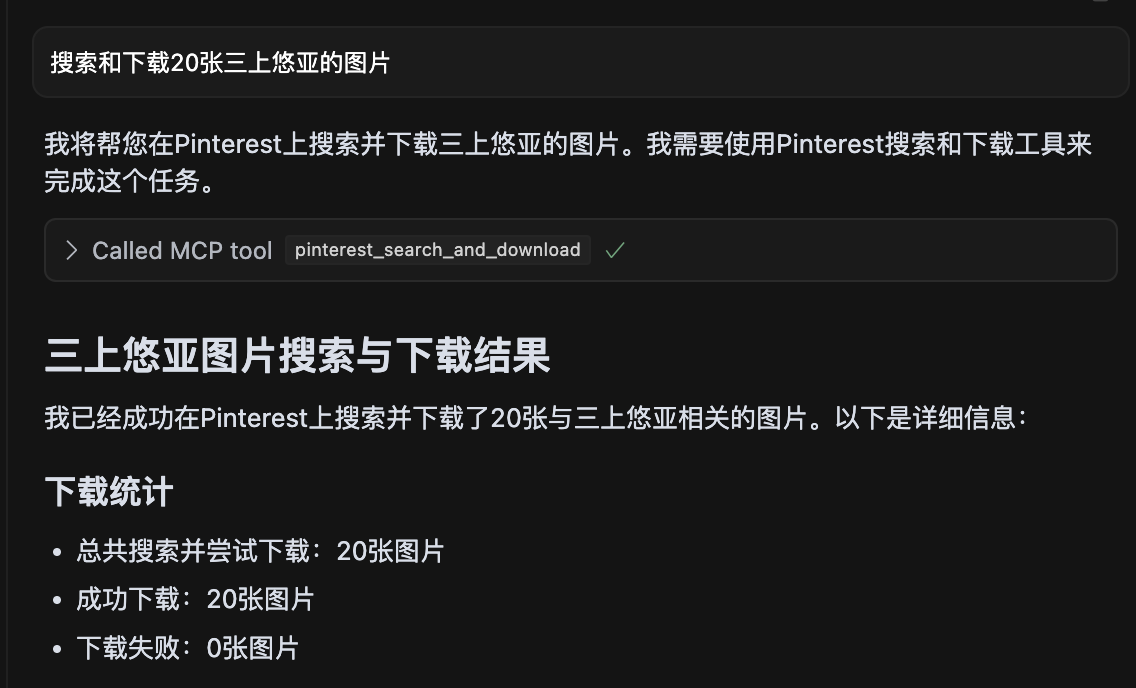
三上悠亚の画像20枚を検索し、すべての画像が正常にダウンロードされたことを示すスクリーンショット。
pinterest-mcp-server.ts : メインサーバーファイル
dist/pinterest-mcp-server.js : 本番環境用に構築された JavaScript ファイル
package.json : プロジェクトの構成と依存関係
新しい MCP 機能を追加するには:
pinterest-mcp-server.ts変更する
MCP SDKを使用して新しい関数を登録する
関数ロジックを実装する
npm run buildでリビルドする
サーバーの起動に失敗した場合は、ポートがすでに使用されていないか確認してください。
npm installですべての依存関係が正しくインストールされていることを確認します。
TypeScriptがtsconfig.jsonファイルで適切に設定されていることを確認してください
ビルドエラーが発生した場合は、 npm install -D typescript @types/nodeを実行してみてください。
Pinterest にアクセスするためのネットワーク接続を確認する
このプロジェクトは MIT ライセンスに基づいてライセンスされています - 詳細についてはLICENSEファイルを参照してください。
サーバーは、構成用に次の環境変数をサポートしています。
MCP_PINTEREST_DOWNLOAD_DIR : 画像をダウンロードするルートディレクトリを指定します。設定されていない場合は、サーバースクリプトを基準とした../downloadsディレクトリがデフォルトとなります。
MCP_PINTEREST_FILENAME_TEMPLATE : ダウンロードした画像のファイル名テンプレートを指定します。設定されていない場合、デフォルトはpinterest_{imageId}.{fileExtension}です。
MCP_PINTEREST_PROXY_SERVER : Pinterestへの接続に使用するプロキシサーバーを指定します。形式はprotocol://host:portです。例: http://127.0.0.1:7890またはsocks5://127.0.0.1:1080 。
環境変数を使用してダウンロード ディレクトリを設定します (推奨方法):
# Linux/macOS
export MCP_PINTEREST_DOWNLOAD_DIR=/path/to/your/download/directory
# Then start the server
node pinterest-mcp-server.js

# Windows (CMD)
set MCP_PINTEREST_DOWNLOAD_DIR=C:\path\to\your\download\directory
# Then start the server
node pinterest-mcp-server.js

# Windows (PowerShell)
$env:MCP_PINTEREST_DOWNLOAD_DIR="C:\path\to\your\download\directory"
# Then start the server
node pinterest-mcp-server.js
環境変数が設定されていない場合、サーバーはデフォルトのダウンロード ディレクトリ (サーバー スクリプトの../downloadsを基準としたディレクトリ) を使用します。
MCP_PINTEREST_FILENAME_TEMPLATE環境変数を使用して、ダウンロードした画像のファイル名パターンをカスタマイズできます。
# Linux/macOS
export MCP_PINTEREST_FILENAME_TEMPLATE="pin_{imageId}_{timestamp}.{fileExtension}"
# Then start the server
node pinterest-mcp-server.js

# Windows (CMD)
set MCP_PINTEREST_FILENAME_TEMPLATE="pin_{imageId}_{timestamp}.{fileExtension}"
# Then start the server
node pinterest-mcp-server.js

# Windows (PowerShell)
$env:MCP_PINTEREST_FILENAME_TEMPLATE="pin_{imageId}_{timestamp}.{fileExtension}"
# Then start the server
node pinterest-mcp-server.js
テンプレートは次の変数をサポートします。
{imageId} : Pinterest画像の一意のID
{fileExtension} : ファイル拡張子(例:jpg、png)
{timestamp} : 現在の UTC タイムスタンプ(YYYYMMDDHHMMSS 形式)
{index} : 複数の画像をダウンロードする場合のインデックス番号(1から始まる)
テンプレートの例:
pinterest_{imageId}.{fileExtension} (デフォルト)
pin_{timestamp}_{imageId}.{fileExtension}
pinterest_image_{index}_{imageId}.{fileExtension}
{timestamp}_pinterest.{fileExtension}
テンプレートが無効な場合 (サポートされていない変数が含まれている、括弧が一致していないなど)、サーバーは警告をログに記録し、デフォルトのテンプレートを使用します。
Pinterest にアクセスするためにプロキシを使用する必要がある場合 (特に Pinterest が制限されている可能性のある地域)、プロキシ構成を設定できます。
# Linux/macOS
export MCP_PINTEREST_PROXY_SERVER="http://127.0.0.1:7890"
# Then start the server
node pinterest-mcp-server.js

# Windows (CMD)
set MCP_PINTEREST_PROXY_SERVER=http://127.0.0.1:7890
# Then start the server
node pinterest-mcp-server.js

# Windows (PowerShell)
$env:MCP_PINTEREST_PROXY_SERVER="http://127.0.0.1:7890"
# Then start the server
node pinterest-mcp-server.js
サポートされているプロキシ プロトコル:
HTTP: http://host:port
HTTPS: https://host:port
SOCKS4: socks4://host:port
SOCKS5: socks5://host:port
プロキシ設定は、検索に使用されるブラウザと画像のダウンロードプロセスの両方に影響します。
サーバーは起動時にダウンロードディレクトリの存在と書き込み可能性を確認します。ディレクトリが存在しない場合は作成を試みます。ディレクトリを作成または書き込みできない場合は、サーバーは終了します。
すべてのダウンロードではサーバーの環境変数設定またはデフォルトが使用されるため、クライアントはダウンロード関連のツールを呼び出すときにパラメータを使用してダウンロード パスまたはファイル名テンプレートを指定しないでください。
サーバーは、不正な文字 ( / 、 \ 、 : 、 * 、 ? 、 " 、 < 、 > 、 |など) をアンダースコアに置き換えて、ファイル名を自動的にサニタイズします。
サーバーは次の MCP ツールを提供します。
pinterest_search : キーワードでPinterestの画像を検索
pinterest_get_image_info : Pinterest 画像の詳細情報を取得します
pinterest_search_and_download : Pinterest の画像を検索してダウンロードする
詳細なインターフェース パラメータのリファレンスについては、MCP ツール定義を参照してください。
Get Pinterest image information
| Name | Required | Description | Default |
|---|---|---|---|
| image_url | Yes | Image URL |
Does the description disclose side effects, auth requirements, rate limits, or destructive behavior?
No annotations are present, and the description does not disclose any behavioral traits such as read-only nature, authentication requirements, or rate limits. It merely restates the name.
Agents need to know what a tool does to the world before calling it. Descriptions should go beyond structured annotations to explain consequences.
Is the description appropriately sized, front-loaded, and free of redundancy?
The description is a single sentence with no unnecessary words. It is appropriately concise, though it could include more information without becoming verbose.
Shorter descriptions cost fewer tokens and are easier for agents to parse. Every sentence should earn its place.
Given the tool's complexity, does the description cover enough for an agent to succeed on first attempt?
The tool is simple with one parameter and no output schema, but the description does not mention what information is returned. Without output schema, the agent has no indication of the response format or content, making it incomplete.
Complex tools with many parameters or behaviors need more documentation. Simple tools need less. This dimension scales expectations accordingly.
Does the description clarify parameter syntax, constraints, interactions, or defaults beyond what the schema provides?
The input schema already provides a description for the single parameter 'image_url' as 'Image URL'. The tool description does not add any additional meaning or context beyond the schema. With 100% schema coverage, baseline 3 is appropriate.
Input schemas describe structure but not intent. Descriptions should explain non-obvious parameter relationships and valid value ranges.
Does the description clearly state what the tool does and how it differs from similar tools?
The description uses a specific verb 'Get' and resource 'Pinterest image information', distinguishing it from sibling tools like search and search_and_download. However, it does not specify what information is retrieved, which could be improved.
Agents choose between tools based on descriptions. A clear purpose with a specific verb and resource helps agents select the right tool.
Does the description explain when to use this tool, when not to, or what alternatives exist?
No guidance is provided on when to use this tool versus alternatives. For instance, it could mention that this is used after searching to fetch details for a specific image.
Agents often have multiple tools that could apply. Explicit usage guidance like "use X instead of Y when Z" prevents misuse.
Search for images on Pinterest by keyword
| Name | Required | Description | Default |
|---|---|---|---|
| keyword | Yes | Search keyword | |
| limit | No | Number of images to return (default: 10) | |
| headless | No | Whether to use headless browser mode (default: true) |
Does the description disclose side effects, auth requirements, rate limits, or destructive behavior?
No annotations are provided, so the description carries full responsibility for behavioral disclosure. However, it only states the basic action without revealing key traits such as browser automation (implied by the headless parameter), result format, pagination, or any potential side effects. This minimal transparency is insufficient for agents to understand the tool's operational behavior.
Agents need to know what a tool does to the world before calling it. Descriptions should go beyond structured annotations to explain consequences.
Is the description appropriately sized, front-loaded, and free of redundancy?
The description is a single, focused sentence that efficiently communicates the core purpose without any extraneous words. It is appropriately sized and front-loaded, making it quick for an agent to parse.
Shorter descriptions cost fewer tokens and are easier for agents to parse. Every sentence should earn its place.
Given the tool's complexity, does the description cover enough for an agent to succeed on first attempt?
Given the lack of output schema and annotations, the description is insufficiently complete for a search tool. It does not specify return values (e.g., image URLs, metadata), result sorting, error handling, or rate limits. The description omits critical operational context that an agent would need to use the tool correctly.
Complex tools with many parameters or behaviors need more documentation. Simple tools need less. This dimension scales expectations accordingly.
Does the description clarify parameter syntax, constraints, interactions, or defaults beyond what the schema provides?
All three parameters (keyword, limit, headless) are fully described in the input schema with 100% coverage. The description adds no additional meaning beyond the schema; for example, 'by keyword' merely repeats the required parameter. Per guidelines, with high schema coverage, baseline score is 3.
Input schemas describe structure but not intent. Descriptions should explain non-obvious parameter relationships and valid value ranges.
Does the description clearly state what the tool does and how it differs from similar tools?
The description 'Search for images on Pinterest by keyword' clearly states the action (search), resource (images on Pinterest), and method (by keyword). It effectively distinguishes this tool from its siblings: 'pinterest_get_image_info' retrieves details of specific images, while 'pinterest_search_and_download' implies additional download functionality, making this tool's purpose unique.
Agents choose between tools based on descriptions. A clear purpose with a specific verb and resource helps agents select the right tool.
Does the description explain when to use this tool, when not to, or what alternatives exist?
The description provides no guidance on when to use this tool versus its siblings or alternatives. It lacks information about prerequisites, limitations, or appropriate contexts, leaving the agent to infer usage from the tool name alone.
Agents often have multiple tools that could apply. Explicit usage guidance like "use X instead of Y when Z" prevents misuse.
Search for images on Pinterest by keyword and download them
| Name | Required | Description | Default |
|---|---|---|---|
| keyword | Yes | Search keyword | |
| limit | No | Number of images to return and download (default: 10) | |
| headless | No | Whether to use headless browser mode (default: true) |
Does the description disclose side effects, auth requirements, rate limits, or destructive behavior?
With no annotations, the description must disclose behavior. It only states the action, not side effects (e.g., file saving location, format, or any destructive operations). Minimal behavioral transparency.
Agents need to know what a tool does to the world before calling it. Descriptions should go beyond structured annotations to explain consequences.
Is the description appropriately sized, front-loaded, and free of redundancy?
A single, efficient sentence with no wasted words. Could be slightly more structured but overall well-sized.
Shorter descriptions cost fewer tokens and are easier for agents to parse. Every sentence should earn its place.
Given the tool's complexity, does the description cover enough for an agent to succeed on first attempt?
For a tool that downloads images, missing details on output format, file saving behavior, and how it differs from sibling tools. Incomplete for an agent to reliably invoke.
Complex tools with many parameters or behaviors need more documentation. Simple tools need less. This dimension scales expectations accordingly.
Does the description clarify parameter syntax, constraints, interactions, or defaults beyond what the schema provides?
Schema coverage is 100%, and the description adds no extra meaning beyond what the schema already provides. Baseline score of 3 is appropriate.
Input schemas describe structure but not intent. Descriptions should explain non-obvious parameter relationships and valid value ranges.
Does the description clearly state what the tool does and how it differs from similar tools?
The description clearly states the verb 'search and download' and resource 'images on Pinterest by keyword'. It distinguishes from siblings by combining both actions, though not explicitly differentiating from pinterest_search.
Agents choose between tools based on descriptions. A clear purpose with a specific verb and resource helps agents select the right tool.
Does the description explain when to use this tool, when not to, or what alternatives exist?
No explicit guidance on when to use this tool vs siblings. The context is implied by the name and description, but lacks when-not-to-use or alternative mentions.
Agents often have multiple tools that could apply. Explicit usage guidance like "use X instead of Y when Z" prevents misuse.
Each tool has a distinct purpose: retrieving metadata, searching, and searching with download. The names and descriptions make it easy to distinguish between them.
All tools use the 'pinterest_' prefix and snake_case, but 'pinterest_search_and_download' combines two verbs while the others use a single verb, introducing slight inconsistency.
Three tools is a minimal but reasonable set for an image search and download service. It covers core functionality without being too sparse or excessive.
The set covers basic search and metadata retrieval, but lacks common Pinterest operations like board management, pinning, or user actions, leaving notable gaps for broader use.
Unclaimed servers have limited discoverability.
If you are the server author, to access and configure the admin panel.
Personal knowledge base MCP server with semantic search, auto-categorization, metadata extraction
MCP Server for an Agent Task Marketplace
MCP server for Drosophila neuroscience data from VirtualFlyBrain
We provide all the information about MCP servers via our MCP API.
curl -X GET 'https://glama.ai/api/mcp/v1/servers/terryso/mcp-pinterest'
If you have feedback or need assistance with the MCP directory API, please join our Discord server