claude-skills-mcp
Claude Skills MCP 服务器
此 MCP 服务器已不再托管或维护。 Agent Skills 已被所有主流 AI 平台原生采用 —— Cursor、Windsurf、Claude Code、Copilot 等现在都已开箱即用地支持技能。不再需要 MCP 桥接器来为您的编码助手提供技能。感谢所有使用并为本项目做出贡献的人!

将 Claude 强大的新技能系统 与任何 AI 模型或编码助手一起使用 - 包括 Cursor、Codex、GPT-5、Gemini 等。此 MCP 服务器通过模型上下文协议将 Anthropic 的 Agent Skills 框架引入整个 AI 生态系统。
一个模型上下文协议 (MCP) 服务器,提供智能搜索功能,利用向量嵌入和语义相似度来发现相关的 Claude Agent Skills。该服务器实现了 Anthropic 在其 Agent Skills 工程博客 中描述的相同渐进式披露架构,使任何兼容 MCP 的 AI 应用程序都能使用专业技能。
由 K-Dense AI 开发的开源项目 - 科学研究自主 AI 科学家的创造者。
此 MCP 服务器使任何兼容 MCP 的 AI 助手能够智能地搜索并检索我们精选的 Claude 科学技能 存储库以及其他技能源(如 官方 Claude 技能)中的技能。
演示
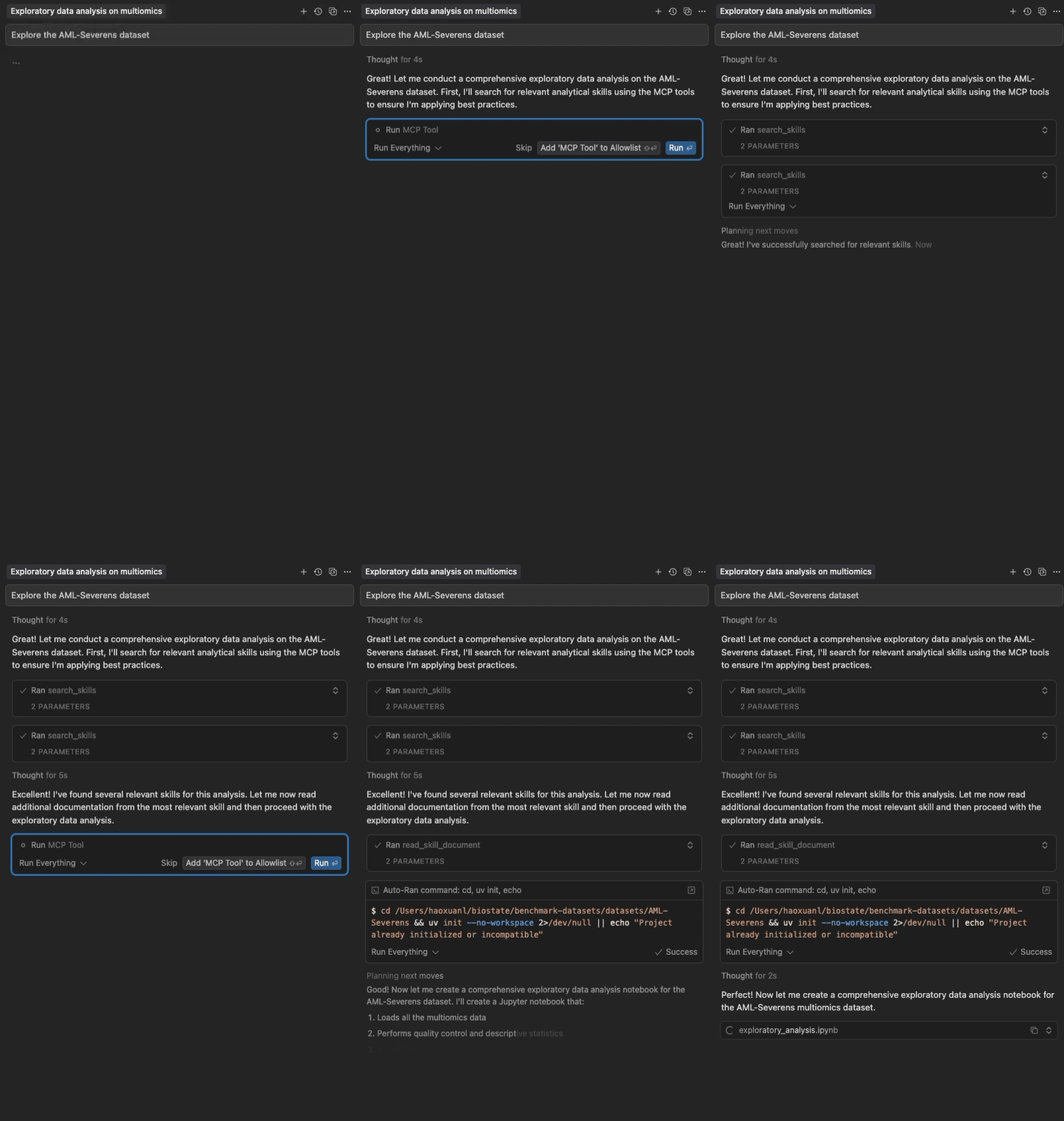
在 Cursor 中对 Claude Agent Skills 进行语义搜索和渐进式加载
Related MCP server: skill4agent MCP Server
亮点
双包架构:轻量级前端 (~15 MB) 立即启动;后端 (~250 MB) 在后台下载
无 Cursor 超时:前端响应时间 <5 秒,解决了超时问题
语义搜索:用于智能技能发现的向量嵌入
渐进式披露:多级技能加载(元数据 → 完整内容 → 文件)
零配置:通过精选技能开箱即用
多源支持:从 GitHub 存储库和本地目录加载
快速且本地:无需 API 密钥,具有自动 GitHub 缓存功能
可配置:自定义源、模型和内容限制
快速入门
针对 Cursor 用户
通过 Cursor 目录 添加,或添加到您的 Cursor 配置 (~/.cursor/mcp.json) 中:
{
"mcpServers": {
"claude-skills": {
"command": "uvx",
"args": ["claude-skills-mcp"]
}
}
}前端立即启动并显示工具,自动在后台下载并启动后端(由于 RAG 依赖项,首次运行需约 60-120 秒)。后续使用均为即时响应。
使用 uvx (独立运行)
使用默认配置运行服务器:
uvx claude-skills-mcp这将启动轻量级前端,它会自动下载后端并加载来自 Anthropic 官方技能库和 K-Dense AI 科学技能集合的约 90 个技能。
使用自定义配置
# 1. Print the default configuration
uvx claude-skills-mcp --example-config > config.json
# 2. Edit config.json to your needs
# 3. Run with your custom configuration
uvx claude-skills-mcp --config config.json文档
入门指南 - 安装、Cursor 设置、CLI 使用和故障排除
架构指南 - 双包设计、数据流和组件
API 文档 - 工具参数、示例和最佳实践
使用示例 - 高级配置、实际用例和自定义技能创建
测试指南 - 完整的测试说明、CI/CD 和覆盖率分析
MCP 工具
该服务器提供了三个用于处理 Claude Agent Skills 的工具:
find_helpful_skills- 根据任务描述对相关技能进行语义搜索read_skill_document- 从技能中检索特定文件(脚本、数据、参考资料)list_skills- 查看所有已加载技能的完整清单(用于探索/调试)
有关详细参数、示例和最佳实践,请参阅 API 文档。
架构 (v1.0.0)
该系统使用双包架构以实现最佳性能:
前端 (
claude-skills-mcp):轻量级代理 (~15 MB)立即启动 (<5 秒) ✅ 无 Cursor 超时!
首次使用时自动下载后端
用于 Cursor 的 MCP 服务器 (stdio)
后端 (
claude-skills-mcp-backend):重型服务器 (~250 MB)使用 PyTorch 和 sentence-transformers 进行向量搜索
MCP 服务器 (可流式传输 HTTP)
由前端自动安装或可独立部署
优势:
✅ 解决 Cursor 超时问题(前端立即启动)
✅ 相同的简单用户体验 (
uvx claude-skills-mcp)✅ 后端在后台下载(不会阻塞 Cursor)
✅ 可连接到远程托管的后端(无需本地安装)
有关详细设计和数据流,请参阅 架构指南。
技能源
从 GitHub 存储库(直接技能或 Claude Code 插件)或 本地目录 加载技能。
默认情况下,从以下位置加载:
Anthropic 官方技能 - 15 种用于文档、演示文稿、Web 工件等的多元化技能
K-Dense AI 科学技能 - 78+ 种用于生物信息学、化学信息学和科学分析的专业技能
本地目录
~/.claude/skills(如果存在)
贡献
欢迎贡献!贡献方式:
报告问题:针对错误或功能请求 提交 issue
提交 PR:Fork 项目,创建功能分支,确保测试通过 (
uv run pytest tests/),然后提交代码风格:提交前运行
uvx ruff check src/添加测试:新功能应包含测试
开发
版本管理:此 monorepo 使用集中式版本系统:
编辑仓库根目录下的
VERSION文件以提升版本号运行
python3 scripts/sync-version.py以同步所有引用(或使用--check进行验证)scripts/build-all.sh脚本会在构建前自动同步版本
如有疑问,请发送电子邮件至 orion.li@k-dense.ai
加入我们的社区!🚀
我们非常欢迎您加入我们的 Slack 社区! 与其他用户交流、分享技巧、获取技能帮助,并第一时间了解新功能和更新。
无论您是在构建自定义技能、集成不同的 AI 模型,还是仅仅在探索 Agent Skills 的可能性,我们的社区都会为您提供支持!
了解更多
Agent Skills 文档 - 关于 Skills 格式的 Anthropic 官方文档
Agent Skills 博客文章 - 公告和概述
模型上下文协议 - 使跨平台技能成为可能的协议
工程博客:为现实世界装备智能体 - 关于 Skills 架构的技术深度解析
许可证
本项目采用 Apache License 2.0 授权。
版权所有 2025 K-Dense AI (https://k-dense.ai)
星标历史
Available Tools
3 toolslist_skillsList All Loaded SkillsA
Returns a complete inventory of all loaded skills with their names, descriptions, sources, and document counts. Use this for exploration or debugging to see what skills are available. NOTE: For finding relevant skills for a specific task, use the 'search_skills' tool instead - it performs semantic search to find the most appropriate skills for your needs.
| Name | Required | Description | Default |
|---|---|---|---|
No parameters | |||
TDQS
Does the description disclose side effects, auth requirements, rate limits, or destructive behavior?
With no annotations provided, the description carries full burden of behavioral disclosure. It clearly indicates this is a read operation ('Returns') and specifies the scope ('complete inventory of all loaded skills'). However, it doesn't mention potential limitations like pagination, rate limits, or authentication requirements that might be relevant for a complete behavioral understanding.
Agents need to know what a tool does to the world before calling it. Descriptions should go beyond structured annotations to explain consequences.
Is the description appropriately sized, front-loaded, and free of redundancy?
The description is perfectly structured in two sentences: the first states the purpose and output format, the second provides usage guidance and sibling differentiation. Every sentence adds value with zero wasted words, making it easy to parse and understand quickly.
Shorter descriptions cost fewer tokens and are easier for agents to parse. Every sentence should earn its place.
Given the tool's complexity, does the description cover enough for an agent to succeed on first attempt?
For a simple read-only tool with no parameters and no output schema, the description provides excellent context about what the tool does and when to use it. The main gap is the lack of information about the return format structure, which would be helpful since there's no output schema. However, given the tool's simplicity, the description is largely complete.
Complex tools with many parameters or behaviors need more documentation. Simple tools need less. This dimension scales expectations accordingly.
Does the description clarify parameter syntax, constraints, interactions, or defaults beyond what the schema provides?
With 0 parameters and 100% schema coverage, the baseline would be 4. The description appropriately acknowledges this by not discussing parameters at all, focusing instead on the tool's purpose and usage guidelines. This is efficient and avoids redundancy.
Input schemas describe structure but not intent. Descriptions should explain non-obvious parameter relationships and valid value ranges.
Does the description clearly state what the tool does and how it differs from similar tools?
The description clearly states the specific verb ('Returns') and resource ('complete inventory of all loaded skills'), listing the exact data fields included (names, descriptions, sources, document counts). It explicitly distinguishes this from its sibling 'search_skills' by stating this is for exploration/debugging rather than task-specific relevance.
Agents choose between tools based on descriptions. A clear purpose with a specific verb and resource helps agents select the right tool.
Does the description explain when to use this tool, when not to, or what alternatives exist?
The description provides explicit guidance on when to use this tool ('for exploration or debugging to see what skills are available') and when not to use it, naming the alternative tool 'search_skills' for finding relevant skills for specific tasks. This gives clear context for tool selection.
Agents often have multiple tools that could apply. Explicit usage guidance like "use X instead of Y when Z" prevents misuse.
read_skill_documentRead Skill DocumentA
Retrieve specific documents (scripts, references, assets) from a skill. Use this after searching for skills to access additional resources like Python scripts, example data files, reference materials, or images. Supports pattern matching to retrieve multiple files at once (e.g., 'scripts/*.py' for all Python scripts).
| Name | Required | Description | Default |
|---|---|---|---|
| document_path | No | Path or pattern to match documents. Examples: 'scripts/example.py', 'scripts/*.py', 'references/*', 'assets/diagram.png'. If not provided, returns a list of all available documents. | |
| include_base64 | No | For images: if True, return base64-encoded content; if False, return only URL. Default: False (URL only for efficiency) | |
| skill_name | Yes | Name of the skill (as returned by search_skills) |
TDQS
Does the description disclose side effects, auth requirements, rate limits, or destructive behavior?
With no annotations provided, the description carries the full burden of behavioral disclosure. It describes pattern matching capabilities and the base64 encoding option for images, which are useful behavioral details. However, it doesn't mention error conditions, rate limits, authentication requirements, or what happens when no documents match the pattern.
Agents need to know what a tool does to the world before calling it. Descriptions should go beyond structured annotations to explain consequences.
Is the description appropriately sized, front-loaded, and free of redundancy?
The description is efficiently structured with two sentences that each serve clear purposes: the first states the core function, the second provides usage context and behavioral details. There's no wasted language, and important information is front-loaded.
Shorter descriptions cost fewer tokens and are easier for agents to parse. Every sentence should earn its place.
Given the tool's complexity, does the description cover enough for an agent to succeed on first attempt?
For a tool with 3 parameters, 100% schema coverage, and no output schema, the description provides adequate context about what the tool does and when to use it. However, without annotations or output schema, it could benefit from more information about return formats (beyond the base64 mention), error handling, or performance characteristics.
Complex tools with many parameters or behaviors need more documentation. Simple tools need less. This dimension scales expectations accordingly.
Does the description clarify parameter syntax, constraints, interactions, or defaults beyond what the schema provides?
The schema description coverage is 100%, so the schema already documents all three parameters thoroughly. The description adds some context about what types of documents can be retrieved (scripts, references, assets) and mentions pattern matching, but doesn't provide additional parameter semantics beyond what's in the schema descriptions.
Input schemas describe structure but not intent. Descriptions should explain non-obvious parameter relationships and valid value ranges.
Does the description clearly state what the tool does and how it differs from similar tools?
The description clearly states the specific action ('Retrieve specific documents') and resources ('scripts, references, assets') from a skill. It distinguishes from sibling tools like 'list_skills' and 'search_skills' by focusing on accessing document content rather than listing or searching skills themselves.
Agents choose between tools based on descriptions. A clear purpose with a specific verb and resource helps agents select the right tool.
Does the description explain when to use this tool, when not to, or what alternatives exist?
The description provides explicit guidance on when to use this tool ('Use this after searching for skills to access additional resources') and includes examples of what types of resources it handles (Python scripts, data files, reference materials, images). It clearly positions this as a follow-up to search operations.
Agents often have multiple tools that could apply. Explicit usage guidance like "use X instead of Y when Z" prevents misuse.
search_skillsClaude Agent Skills SearchA
Search and discover proven Claude Agent Skills that provide expert guidance for your tasks. Use this tool whenever you're starting a new task, facing a coding challenge, or need specialized techniques. Returns highly relevant skills with complete implementation guides, code examples, and best practices ranked by relevance. Each result includes detailed step-by-step instructions you can follow immediately. Essential for leveraging battle-tested patterns, avoiding common pitfalls, and accelerating development with proven solutions. Perfect for finding reusable workflows, debugging strategies, API integration patterns, data processing techniques, and domain-specific methodologies.
| Name | Required | Description | Default |
|---|---|---|---|
| list_documents | No | Include a list of available documents (scripts, references, assets) for each skill (default: True) | |
| task_description | Yes | Description of the task you want to accomplish. Be specific about your goal, context, or problem domain for better results (e.g., 'debug Python API errors', 'process genomic data', 'build React dashboard') | |
| top_k | No | Number of skills to return (default: 3). Higher values provide more options but may include less relevant results. |
TDQS
Does the description disclose side effects, auth requirements, rate limits, or destructive behavior?
With no annotations provided, the description carries full burden. It discloses that results are 'ranked by relevance' and include 'complete implementation guides, code examples, and best practices' which adds behavioral context beyond basic search. However, it doesn't mention rate limits, authentication requirements, error conditions, or pagination behavior that would be important for a search tool.
Agents need to know what a tool does to the world before calling it. Descriptions should go beyond structured annotations to explain consequences.
Is the description appropriately sized, front-loaded, and free of redundancy?
The description is appropriately front-loaded with core functionality but contains some redundant phrasing ('proven solutions' vs 'battle-tested patterns'). Sentences like 'Essential for leveraging battle-tested patterns...' and 'Perfect for finding reusable workflows...' could be more concise while maintaining value. The structure flows logically but could be tighter.
Shorter descriptions cost fewer tokens and are easier for agents to parse. Every sentence should earn its place.
Given the tool's complexity, does the description cover enough for an agent to succeed on first attempt?
For a search tool with 3 parameters, 100% schema coverage, but no annotations or output schema, the description provides adequate context about what the tool does and when to use it. However, it lacks details about the return format structure, error handling, or performance characteristics that would be helpful given the absence of an output schema.
Complex tools with many parameters or behaviors need more documentation. Simple tools need less. This dimension scales expectations accordingly.
Does the description clarify parameter syntax, constraints, interactions, or defaults beyond what the schema provides?
Schema description coverage is 100%, so the schema already fully documents all three parameters. The description doesn't add any additional parameter semantics beyond what's in the schema. It mentions 'returns highly relevant skills' which aligns with the task_description parameter but doesn't provide extra guidance on parameter usage or interactions.
Input schemas describe structure but not intent. Descriptions should explain non-obvious parameter relationships and valid value ranges.
Does the description clearly state what the tool does and how it differs from similar tools?
The description clearly states the tool's purpose as searching and discovering Claude Agent Skills with specific outputs (implementation guides, code examples, best practices). It distinguishes from 'list_skills' by emphasizing search functionality and from 'read_skill_document' by returning multiple ranked results rather than reading a single document. However, it doesn't explicitly name these siblings for full differentiation.
Agents choose between tools based on descriptions. A clear purpose with a specific verb and resource helps agents select the right tool.
Does the description explain when to use this tool, when not to, or what alternatives exist?
The description provides clear context for when to use the tool ('starting a new task, facing a coding challenge, or need specialized techniques') and includes examples of appropriate use cases. It doesn't explicitly state when NOT to use it or name alternative tools, but the context strongly implies this is for discovery/search rather than listing or reading specific documents.
Agents often have multiple tools that could apply. Explicit usage guidance like "use X instead of Y when Z" prevents misuse.
Tool Schema Changelog
Recent tool additions, removals, and schema changes observed during successful MCP inspections.
3 tool updates
- First observed
list_skills - First observed
read_skill_document - First observed
search_skills
TDQS
Scored across 3 tools
Each tool has a clearly distinct purpose: list_skills provides an inventory, search_skills performs semantic search for task relevance, and read_skill_document retrieves specific documents. The descriptions explicitly differentiate them, with list_skills even noting to use search_skills for task-specific needs, eliminating overlap.
All tools follow a consistent verb_noun pattern with snake_case: list_skills, search_skills, and read_skill_document. This uniformity makes the set predictable and easy to understand, enhancing usability for agents.
With 3 tools, the count is reasonable for a skills management server, covering exploration, search, and document retrieval. It feels slightly thin but well-scoped for its purpose, as each tool serves a distinct workflow without unnecessary bloat.
The tool surface covers core workflows: inventory listing, semantic search, and document access. Minor gaps exist, such as no direct skill execution or management tools (e.g., load/unload), but agents can work around this by using retrieved documents, making it nearly complete for the domain.
Maintenance
Related MCP Connectors
Capability registry for the agentic economy. Semantic search over verified MCP server listings.
Model Context Protocol server for the Apideck Unified API. Connect any MCP-compatible agent framework to 100+ accounting systems, HRIS platforms, file storage providers, and more through one integration. More information https://www.apideck.com/mcp-server
- UnifAPIOAuthcom.unifapi
Hosted MCP server for live public-data APIs and Skills for AI agents.
Related MCP Servers
- AlicenseNot gradedqualityNot gradedmaintenanceAn MCP server that transforms Claude-style skills and resources into callable tools for any MCP-compatible agent or client. It automatically discovers, exposes, and executes scripts from skills organized in local directories or packaged archives.MIT
- AlicenseBqualityCmaintenanceMCP (Model Context Protocol) Server for skill4agent - Search, view, and install AI skills in AI conversations.319 npm4MIT
- FlicenseNot gradedqualityDmaintenanceLocal MCP server that provides semantic search (RAG) over code repositories, enabling AI clients like Claude and Gemini to access project context without manual re-upload.-
- AlicenseNot gradedqualityDmaintenanceMCP Memory Server for Claude Code that provides persistent context across sessions using semantic search (RAG).Apache 2.0
