Glama
K-Dense-AI

claude-skills-mcp

by K-Dense-AI

Claude Skills MCP Server

This MCP server is no longer hosted or maintained. Agent Skills have been natively adopted by all major AI platforms — Cursor, Windsurf, Claude Code, Copilot, and others now support skills out of the box. There is no longer a need for an MCP bridge to deliver skills to your coding assistant. The final release (v1.1.0) remains installable from PyPI. Thank you to everyone who used and contributed to this project!



Tests Python 3.12 | 3.13 License Code style: ruff PyPI version

Use Claude's powerful Skills system with ANY AI model or coding assistant - including Cursor, Codex, GPT-5, Gemini, and more. This MCP server brings Anthropic's Agent Skills framework to the entire AI ecosystem through the Model Context Protocol.

A Model Context Protocol (MCP) server that provides intelligent search capabilities for discovering relevant Claude Agent Skills using vector embeddings and semantic similarity. This server implements the same progressive disclosure architecture that Anthropic describes in their Agent Skills engineering blog, making specialized skills available to any MCP-compatible AI application.

An open-source project by K-Dense - creators of autonomous AI scientists for scientific research.

This MCP server enables any MCP-compatible AI assistant to intelligently search and retrieve skills from our curated Scientific Agent Skills repository and other skill sources like the Official Claude Skills.

Demo
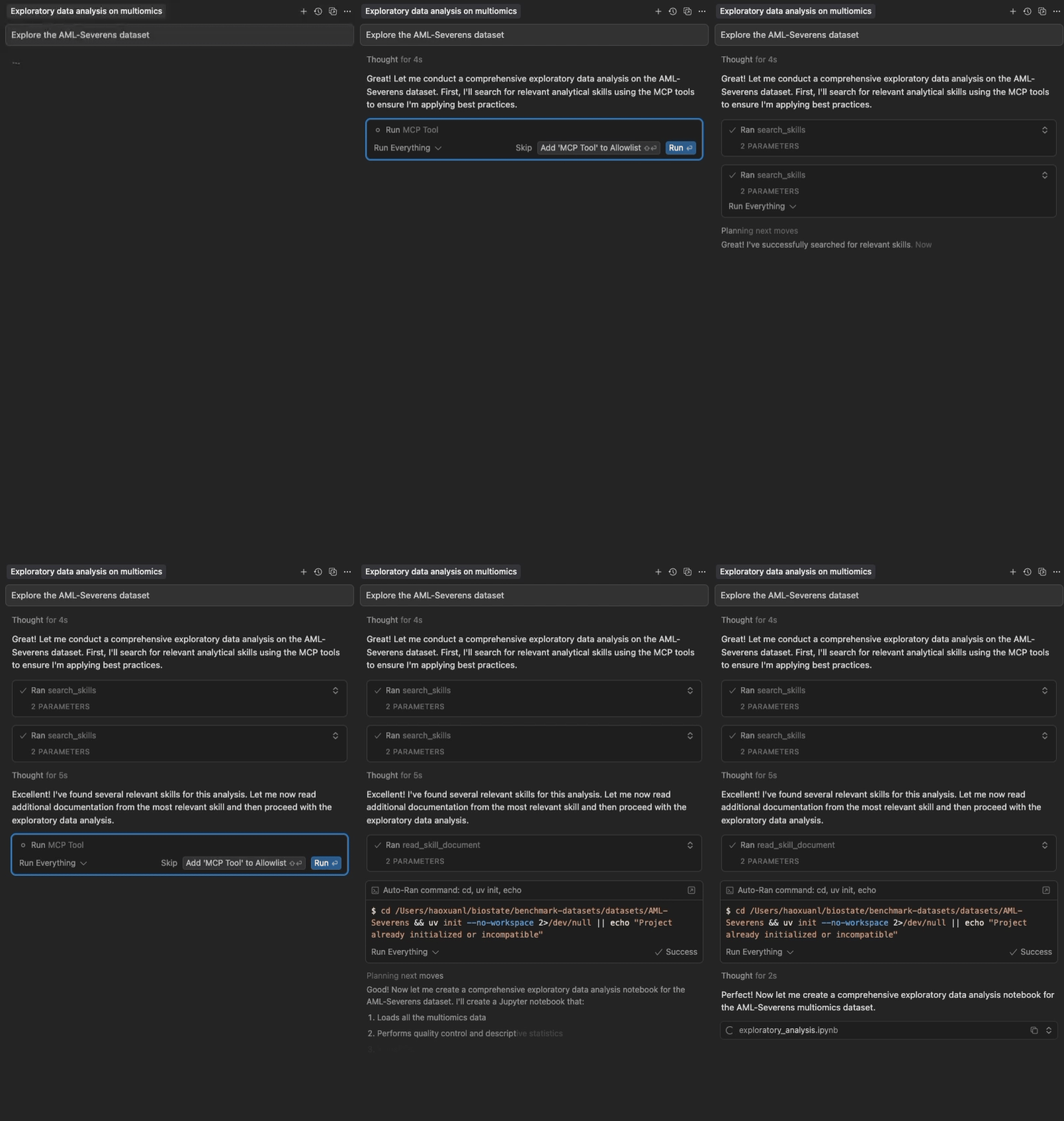
Claude Skills MCP in Action

Semantic search and progressive loading of Claude Agent Skills in Cursor

Related MCP server: skill4agent MCP Server

Highlights

  • Two-Package Architecture: Lightweight frontend (~15 MB) starts instantly; backend (~250 MB) downloads in background

  • No Cursor Timeout: Frontend responds in <5 seconds, solving the timeout issue

  • Semantic Search: Vector embeddings for intelligent skill discovery

  • Progressive Disclosure: Multi-level skill loading (metadata → full content → files)

  • Zero Configuration: Works out of the box with curated skills

  • Multi-Source: Load from GitHub repositories and local directories

  • Auto-Updating: Checks skill sources hourly and re-indexes when they change

  • Fast & Local: No API keys needed, with automatic GitHub caching

  • Configurable: Customize sources, models, and content limits

Quick Start

For Cursor Users

Add through the Cursor Directory, or add to your Cursor config (~/.cursor/mcp.json):

{
  "mcpServers": {
    "claude-skills": {
      "command": "uvx",
      "args": ["claude-skills-mcp"]
    }
  }
}

The frontend starts instantly and displays tools, automatically downloading and starting the backend in the background (~60-120s due to RAG dependencies, one-time). Subsequent uses are instant.

Using uvx (Standalone)

Run the server with default configuration:

uvx claude-skills-mcp

This starts the lightweight frontend which auto-downloads the backend and loads 160+ skills from Anthropic's official skills repository and K-Dense's Scientific Agent Skills collection.

With Custom Configuration

# 1. Print the default configuration
uvx claude-skills-mcp --example-config > config.json

# 2. Edit config.json to your needs

# 3. Run with your custom configuration
uvx claude-skills-mcp --config config.json

Documentation

MCP Tools

The server provides three tools for working with Claude Agent Skills:

  1. find_helpful_skills - Semantic search for relevant skills based on task description

  2. read_skill_document - Retrieve specific files (scripts, data, references) from skills

  3. list_skills - View complete inventory of all loaded skills (for exploration/debugging)

See API Documentation for detailed parameters, examples, and best practices.

Architecture

The system uses a two-package architecture for optimal performance:

  • Frontend (claude-skills-mcp): Lightweight proxy (~15 MB)

    • Starts instantly (<5 seconds) ✅ No Cursor timeout!

    • Auto-downloads backend on first use

    • MCP server (stdio) for Cursor

  • Backend (claude-skills-mcp-backend): Heavy server (~250 MB)

    • Vector search with PyTorch & sentence-transformers

    • MCP server (streamable HTTP)

    • Auto-installed by frontend OR deployable standalone

Benefits:

  • ✅ Solves Cursor timeout issue (frontend starts instantly)

  • ✅ Same simple user experience (uvx claude-skills-mcp)

  • ✅ Backend downloads in background (doesn't block Cursor)

  • ✅ Can connect to remote hosted backend (no local install needed)

See Architecture Guide for detailed design and data flow.

Skill Sources

Load skills from GitHub repositories (direct skills or Claude Code plugins) or local directories.

By default, loads from:

Contributing

As this project is no longer maintained, new issues and pull requests may not be reviewed. If you'd like to build on it, please fork the repository. For reference, the original workflow was:

  1. Report issues: Open an issue for bugs or feature requests

  2. Submit PRs: Fork, create a feature branch, ensure tests pass (uv run pytest tests/), then submit

  3. Code style: Run uvx ruff check src/ before committing

  4. Add tests: New features should include tests

Development

Version Management: This monorepo uses a centralized version system:

  • Edit the VERSION file at the repo root to bump the version

  • Run python3 scripts/sync-version.py to sync all references (or use --check to verify)

  • The scripts/build-all.sh script automatically syncs versions before building

For questions, email orion.li@k-dense.ai

Learn More

License

This project is licensed under the Apache License 2.0.

Copyright 2025-2026 K-Dense (https://www.k-dense.ai)

Available Tools

3 tools
list_skillsList All Loaded SkillsA

Returns a complete inventory of all loaded skills with their names, descriptions, sources, and document counts. Use this for exploration or debugging to see what skills are available. NOTE: For finding relevant skills for a specific task, use the 'search_skills' tool instead - it performs semantic search to find the most appropriate skills for your needs.

ParametersJSON Schema
NameRequiredDescriptionDefault

No parameters

TDQS

A4.6/5.0
Behavior4/5

Does the description disclose side effects, auth requirements, rate limits, or destructive behavior?

With no annotations provided, the description carries full burden of behavioral disclosure. It clearly indicates this is a read operation ('Returns') and specifies the scope ('complete inventory of all loaded skills'). However, it doesn't mention potential limitations like pagination, rate limits, or authentication requirements that might be relevant for a complete behavioral understanding.

Agents need to know what a tool does to the world before calling it. Descriptions should go beyond structured annotations to explain consequences.

Conciseness5/5

Is the description appropriately sized, front-loaded, and free of redundancy?

The description is perfectly structured in two sentences: the first states the purpose and output format, the second provides usage guidance and sibling differentiation. Every sentence adds value with zero wasted words, making it easy to parse and understand quickly.

Shorter descriptions cost fewer tokens and are easier for agents to parse. Every sentence should earn its place.

Completeness4/5

Given the tool's complexity, does the description cover enough for an agent to succeed on first attempt?

For a simple read-only tool with no parameters and no output schema, the description provides excellent context about what the tool does and when to use it. The main gap is the lack of information about the return format structure, which would be helpful since there's no output schema. However, given the tool's simplicity, the description is largely complete.

Complex tools with many parameters or behaviors need more documentation. Simple tools need less. This dimension scales expectations accordingly.

Parameters4/5

Does the description clarify parameter syntax, constraints, interactions, or defaults beyond what the schema provides?

With 0 parameters and 100% schema coverage, the baseline would be 4. The description appropriately acknowledges this by not discussing parameters at all, focusing instead on the tool's purpose and usage guidelines. This is efficient and avoids redundancy.

Input schemas describe structure but not intent. Descriptions should explain non-obvious parameter relationships and valid value ranges.

Purpose5/5

Does the description clearly state what the tool does and how it differs from similar tools?

The description clearly states the specific verb ('Returns') and resource ('complete inventory of all loaded skills'), listing the exact data fields included (names, descriptions, sources, document counts). It explicitly distinguishes this from its sibling 'search_skills' by stating this is for exploration/debugging rather than task-specific relevance.

Agents choose between tools based on descriptions. A clear purpose with a specific verb and resource helps agents select the right tool.

Usage Guidelines5/5

Does the description explain when to use this tool, when not to, or what alternatives exist?

The description provides explicit guidance on when to use this tool ('for exploration or debugging to see what skills are available') and when not to use it, naming the alternative tool 'search_skills' for finding relevant skills for specific tasks. This gives clear context for tool selection.

Agents often have multiple tools that could apply. Explicit usage guidance like "use X instead of Y when Z" prevents misuse.

read_skill_documentRead Skill DocumentA

Retrieve specific documents (scripts, references, assets) from a skill. Use this after searching for skills to access additional resources like Python scripts, example data files, reference materials, or images. Supports pattern matching to retrieve multiple files at once (e.g., 'scripts/*.py' for all Python scripts).

ParametersJSON Schema
NameRequiredDescriptionDefault
document_pathNoPath or pattern to match documents. Examples: 'scripts/example.py', 'scripts/*.py', 'references/*', 'assets/diagram.png'. If not provided, returns a list of all available documents.
include_base64NoFor images: if True, return base64-encoded content; if False, return only URL. Default: False (URL only for efficiency)
skill_nameYesName of the skill (as returned by search_skills)

TDQS

A4.1/5.0
Behavior3/5

Does the description disclose side effects, auth requirements, rate limits, or destructive behavior?

With no annotations provided, the description carries the full burden of behavioral disclosure. It describes pattern matching capabilities and the base64 encoding option for images, which are useful behavioral details. However, it doesn't mention error conditions, rate limits, authentication requirements, or what happens when no documents match the pattern.

Agents need to know what a tool does to the world before calling it. Descriptions should go beyond structured annotations to explain consequences.

Conciseness5/5

Is the description appropriately sized, front-loaded, and free of redundancy?

The description is efficiently structured with two sentences that each serve clear purposes: the first states the core function, the second provides usage context and behavioral details. There's no wasted language, and important information is front-loaded.

Shorter descriptions cost fewer tokens and are easier for agents to parse. Every sentence should earn its place.

Completeness3/5

Given the tool's complexity, does the description cover enough for an agent to succeed on first attempt?

For a tool with 3 parameters, 100% schema coverage, and no output schema, the description provides adequate context about what the tool does and when to use it. However, without annotations or output schema, it could benefit from more information about return formats (beyond the base64 mention), error handling, or performance characteristics.

Complex tools with many parameters or behaviors need more documentation. Simple tools need less. This dimension scales expectations accordingly.

Parameters3/5

Does the description clarify parameter syntax, constraints, interactions, or defaults beyond what the schema provides?

The schema description coverage is 100%, so the schema already documents all three parameters thoroughly. The description adds some context about what types of documents can be retrieved (scripts, references, assets) and mentions pattern matching, but doesn't provide additional parameter semantics beyond what's in the schema descriptions.

Input schemas describe structure but not intent. Descriptions should explain non-obvious parameter relationships and valid value ranges.

Purpose5/5

Does the description clearly state what the tool does and how it differs from similar tools?

The description clearly states the specific action ('Retrieve specific documents') and resources ('scripts, references, assets') from a skill. It distinguishes from sibling tools like 'list_skills' and 'search_skills' by focusing on accessing document content rather than listing or searching skills themselves.

Agents choose between tools based on descriptions. A clear purpose with a specific verb and resource helps agents select the right tool.

Usage Guidelines5/5

Does the description explain when to use this tool, when not to, or what alternatives exist?

The description provides explicit guidance on when to use this tool ('Use this after searching for skills to access additional resources') and includes examples of what types of resources it handles (Python scripts, data files, reference materials, images). It clearly positions this as a follow-up to search operations.

Agents often have multiple tools that could apply. Explicit usage guidance like "use X instead of Y when Z" prevents misuse.

search_skillsClaude Agent Skills SearchA

Search and discover proven Claude Agent Skills that provide expert guidance for your tasks. Use this tool whenever you're starting a new task, facing a coding challenge, or need specialized techniques. Returns highly relevant skills with complete implementation guides, code examples, and best practices ranked by relevance. Each result includes detailed step-by-step instructions you can follow immediately. Essential for leveraging battle-tested patterns, avoiding common pitfalls, and accelerating development with proven solutions. Perfect for finding reusable workflows, debugging strategies, API integration patterns, data processing techniques, and domain-specific methodologies.

ParametersJSON Schema
NameRequiredDescriptionDefault
list_documentsNoInclude a list of available documents (scripts, references, assets) for each skill (default: True)
task_descriptionYesDescription of the task you want to accomplish. Be specific about your goal, context, or problem domain for better results (e.g., 'debug Python API errors', 'process genomic data', 'build React dashboard')
top_kNoNumber of skills to return (default: 3). Higher values provide more options but may include less relevant results.

TDQS

A3.5/5.0
Behavior3/5

Does the description disclose side effects, auth requirements, rate limits, or destructive behavior?

With no annotations provided, the description carries full burden. It discloses that results are 'ranked by relevance' and include 'complete implementation guides, code examples, and best practices' which adds behavioral context beyond basic search. However, it doesn't mention rate limits, authentication requirements, error conditions, or pagination behavior that would be important for a search tool.

Agents need to know what a tool does to the world before calling it. Descriptions should go beyond structured annotations to explain consequences.

Conciseness3/5

Is the description appropriately sized, front-loaded, and free of redundancy?

The description is appropriately front-loaded with core functionality but contains some redundant phrasing ('proven solutions' vs 'battle-tested patterns'). Sentences like 'Essential for leveraging battle-tested patterns...' and 'Perfect for finding reusable workflows...' could be more concise while maintaining value. The structure flows logically but could be tighter.

Shorter descriptions cost fewer tokens and are easier for agents to parse. Every sentence should earn its place.

Completeness3/5

Given the tool's complexity, does the description cover enough for an agent to succeed on first attempt?

For a search tool with 3 parameters, 100% schema coverage, but no annotations or output schema, the description provides adequate context about what the tool does and when to use it. However, it lacks details about the return format structure, error handling, or performance characteristics that would be helpful given the absence of an output schema.

Complex tools with many parameters or behaviors need more documentation. Simple tools need less. This dimension scales expectations accordingly.

Parameters3/5

Does the description clarify parameter syntax, constraints, interactions, or defaults beyond what the schema provides?

Schema description coverage is 100%, so the schema already fully documents all three parameters. The description doesn't add any additional parameter semantics beyond what's in the schema. It mentions 'returns highly relevant skills' which aligns with the task_description parameter but doesn't provide extra guidance on parameter usage or interactions.

Input schemas describe structure but not intent. Descriptions should explain non-obvious parameter relationships and valid value ranges.

Purpose4/5

Does the description clearly state what the tool does and how it differs from similar tools?

The description clearly states the tool's purpose as searching and discovering Claude Agent Skills with specific outputs (implementation guides, code examples, best practices). It distinguishes from 'list_skills' by emphasizing search functionality and from 'read_skill_document' by returning multiple ranked results rather than reading a single document. However, it doesn't explicitly name these siblings for full differentiation.

Agents choose between tools based on descriptions. A clear purpose with a specific verb and resource helps agents select the right tool.

Usage Guidelines4/5

Does the description explain when to use this tool, when not to, or what alternatives exist?

The description provides clear context for when to use the tool ('starting a new task, facing a coding challenge, or need specialized techniques') and includes examples of appropriate use cases. It doesn't explicitly state when NOT to use it or name alternative tools, but the context strongly implies this is for discovery/search rather than listing or reading specific documents.

Agents often have multiple tools that could apply. Explicit usage guidance like "use X instead of Y when Z" prevents misuse.

TDQS

A4.1/5.0
Disambiguation5/5

Each tool has a clearly distinct purpose: list_skills provides an inventory, search_skills performs semantic search for task relevance, and read_skill_document retrieves specific documents. The descriptions explicitly differentiate them, with list_skills even noting to use search_skills for task-specific needs, eliminating overlap.

Naming Consistency5/5

All tools follow a consistent verb_noun pattern with snake_case: list_skills, search_skills, and read_skill_document. This uniformity makes the set predictable and easy to understand, enhancing usability for agents.

Tool Count4/5

With 3 tools, the count is reasonable for a skills management server, covering exploration, search, and document retrieval. It feels slightly thin but well-scoped for its purpose, as each tool serves a distinct workflow without unnecessary bloat.

Completeness4/5

The tool surface covers core workflows: inventory listing, semantic search, and document access. Minor gaps exist, such as no direct skill execution or management tools (e.g., load/unload), but agents can work around this by using retrieved documents, making it nearly complete for the domain.

Maintenance

ActivitySlowing
ResponsivenessSyncing

Resources

Unclaimed servers have limited discoverability.

Looking for Admin?

If you are the server author, to access and configure the admin panel.

Related MCP Connectors

Related MCP Servers

  • A
    license
    Not graded
    quality
    Not graded
    maintenance
    An MCP server that transforms Claude-style skills and resources into callable tools for any MCP-compatible agent or client. It automatically discovers, exposes, and executes scripts from skills organized in local directories or packaged archives.
  • F
    license
    Not graded
    quality
    D
    maintenance
    Local MCP server that provides semantic search (RAG) over code repositories, enabling AI clients like Claude and Gemini to access project context without manual re-upload.

Latest Blog Posts

MCP directory API

We provide all the information about MCP servers via our MCP API.

curl -X GET 'https://glama.ai/api/mcp/v1/servers/K-Dense-AI/claude-skills-mcp'

If you have feedback or need assistance with the MCP directory API, please join our Discord server