Glama
K-Dense-AI

claude-skills-mcp

by K-Dense-AI

Servidor MCP de Claude Skills

Este servidor MCP ya no está alojado ni mantenido. Las Agent Skills han sido adoptadas de forma nativa por todas las principales plataformas de IA: Cursor, Windsurf, Claude Code, Copilot y otras ahora admiten habilidades de forma nativa. Ya no es necesario un puente MCP para entregar habilidades a su asistente de codificación. ¡Gracias a todos los que usaron y contribuyeron a este proyecto!



Tests Python 3.12 License Code style: ruff PyPI version

Utilice el nuevo y potente sistema de Skills de Claude Claude's powerful new Skills system con CUALQUIER modelo de IA o asistente de codificación, incluidos Cursor, Codex, GPT-5, Gemini y más. Este servidor MCP lleva el marco de Agent Skills de Anthropic a todo el ecosistema de IA a través del Protocolo de Contexto de Modelo.

Un servidor del Protocolo de Contexto de Modelo (MCP) que proporciona capacidades de búsqueda inteligente para descubrir habilidades relevantes de Claude Agent utilizando incrustaciones vectoriales y similitud semántica. Este servidor implementa la misma arquitectura de divulgación progresiva que Anthropic describe en su blog de ingeniería de Agent Skills, haciendo que las habilidades especializadas estén disponibles para cualquier aplicación de IA compatible con MCP.

Un proyecto de código abierto de K-Dense AI: creadores de científicos de IA autónomos para la investigación científica.

Este servidor MCP permite que cualquier asistente de IA compatible con MCP busque y recupere de forma inteligente habilidades de nuestro repositorio curado de Claude Scientific Skills y otras fuentes de habilidades como las Habilidades Oficiales de Claude.

Demo
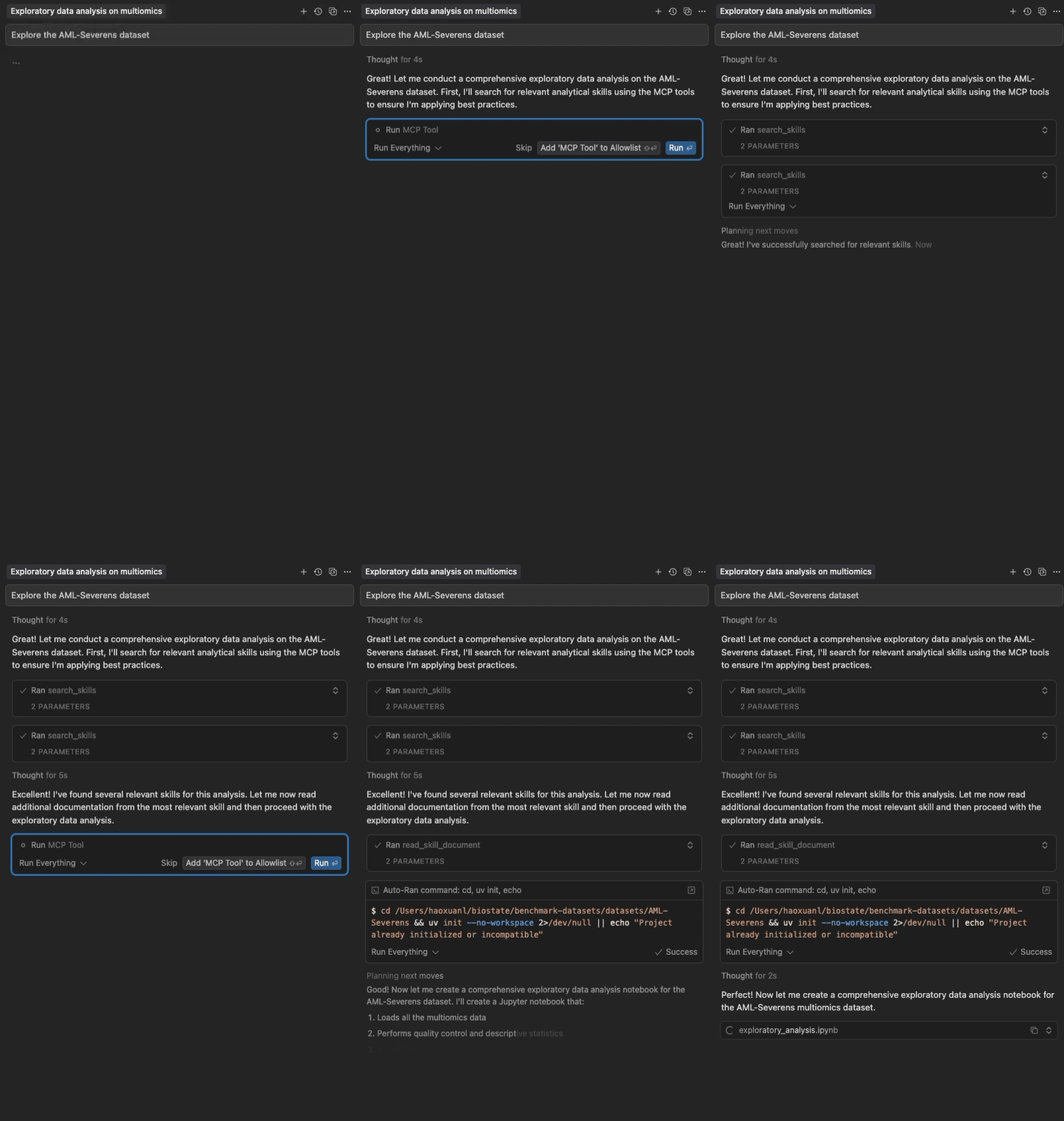
Claude Skills MCP en acción

Búsqueda semántica y carga progresiva de Claude Agent Skills en Cursor

Related MCP server: skill4agent MCP Server

Aspectos destacados

  • Arquitectura de dos paquetes: El frontend ligero (~15 MB) se inicia al instante; el backend (~250 MB) se descarga en segundo plano

  • Sin tiempo de espera en Cursor: El frontend responde en <5 segundos, resolviendo el problema de tiempo de espera

  • Búsqueda semántica: Incrustaciones vectoriales para el descubrimiento inteligente de habilidades

  • Divulgación progresiva: Carga de habilidades multinivel (metadatos → contenido completo → archivos)

  • Configuración cero: Funciona de inmediato con habilidades curadas

  • Fuentes múltiples: Carga desde repositorios de GitHub y directorios locales

  • Rápido y local: No se necesitan claves API, con almacenamiento en caché automático de GitHub

  • Configurable: Personalice fuentes, modelos y límites de contenido

Inicio rápido

Para usuarios de Cursor

Agréguelo a través del Directorio de Cursor, o agréguelo a su configuración de Cursor (~/.cursor/mcp.json):

{
  "mcpServers": {
    "claude-skills": {
      "command": "uvx",
      "args": ["claude-skills-mcp"]
    }
  }
}

El frontend se inicia al instante y muestra las herramientas, descargando e iniciando automáticamente el backend en segundo plano (~60-120 segundos debido a las dependencias de RAG, una sola vez). Los usos posteriores son instantáneos.

Usando uvx (Independiente)

Ejecute el servidor con la configuración predeterminada:

uvx claude-skills-mcp

Esto inicia el frontend ligero que descarga automáticamente el backend y carga ~90 habilidades del repositorio oficial de habilidades de Anthropic y la colección de habilidades científicas de K-Dense AI.

Con configuración personalizada

# 1. Print the default configuration
uvx claude-skills-mcp --example-config > config.json

# 2. Edit config.json to your needs

# 3. Run with your custom configuration
uvx claude-skills-mcp --config config.json

Documentación

  • Primeros pasos - Instalación, configuración de Cursor, uso de CLI y solución de problemas

  • Guía de arquitectura - Diseño de dos paquetes, flujo de datos y componentes

  • Documentación de la API - Parámetros de herramientas, ejemplos y mejores prácticas

  • Ejemplos de uso - Configuración avanzada, casos de uso del mundo real y creación de habilidades personalizadas

  • Guía de pruebas - Instrucciones completas de prueba, CI/CD y análisis de cobertura

Herramientas MCP

El servidor proporciona tres herramientas para trabajar con Claude Agent Skills:

  1. find_helpful_skills - Búsqueda semántica de habilidades relevantes basadas en la descripción de la tarea

  2. read_skill_document - Recuperar archivos específicos (scripts, datos, referencias) de las habilidades

  3. list_skills - Ver el inventario completo de todas las habilidades cargadas (para exploración/depuración)

Consulte la Documentación de la API para obtener parámetros detallados, ejemplos y mejores prácticas.

Arquitectura (v1.0.0)

El sistema utiliza una arquitectura de dos paquetes para un rendimiento óptimo:

  • Frontend (claude-skills-mcp): Proxy ligero (~15 MB)

    • Se inicia al instante (<5 segundos) ✅ ¡Sin tiempo de espera en Cursor!

    • Descarga automática del backend en el primer uso

    • Servidor MCP (stdio) para Cursor

  • Backend (claude-skills-mcp-backend): Servidor pesado (~250 MB)

    • Búsqueda vectorial con PyTorch y sentence-transformers

    • Servidor MCP (HTTP transmitible)

    • Instalado automáticamente por el frontend O desplegable de forma independiente

Beneficios:

  • ✅ Resuelve el problema de tiempo de espera de Cursor (el frontend se inicia al instante)

  • ✅ Misma experiencia de usuario sencilla (uvx claude-skills-mcp)

  • ✅ El backend se descarga en segundo plano (no bloquea Cursor)

  • ✅ Puede conectarse a un backend alojado de forma remota (no se necesita instalación local)

Consulte la Guía de arquitectura para obtener un diseño detallado y el flujo de datos.

Fuentes de habilidades

Cargue habilidades desde repositorios de GitHub (habilidades directas o complementos de Claude Code) o directorios locales.

De forma predeterminada, carga desde:

Contribución

¡Las contribuciones son bienvenidas! Para contribuir:

  1. Informar problemas: Abra un problema para errores o solicitudes de funciones

  2. Enviar PRs: Bifurque, cree una rama de funciones, asegúrese de que las pruebas pasen (uv run pytest tests/), luego envíe

  3. Estilo de código: Ejecute uvx ruff check src/ antes de confirmar

  4. Agregar pruebas: Las nuevas funciones deben incluir pruebas

Desarrollo

Gestión de versiones: Este monorepo utiliza un sistema de versiones centralizado:

  • Edite el archivo VERSION en la raíz del repositorio para aumentar la versión

  • Ejecute python3 scripts/sync-version.py para sincronizar todas las referencias (o use --check para verificar)

  • El script scripts/build-all.sh sincroniza automáticamente las versiones antes de compilar

Para preguntas, envíe un correo electrónico a orion.li@k-dense.ai

¡Únase a nuestra comunidad! 🚀

¡Nos encantaría tenerte en nuestra comunidad de Slack! Conéctate con otros usuarios, comparte consejos y trucos, obtén ayuda con tus habilidades y sé el primero en conocer las nuevas funciones y actualizaciones.

👉 Únete a la comunidad de K-Dense en Slack 👈

Ya sea que estés creando habilidades personalizadas, integrándote con diferentes modelos de IA o simplemente explorando las posibilidades de las Agent Skills, ¡nuestra comunidad está aquí para apoyarte!

Aprende más

Licencia

Este proyecto está bajo la Licencia Apache 2.0.

Copyright 2025 K-Dense AI (https://k-dense.ai)

Historial de estrellas

Gráfico del historial de estrellas

Available Tools

3 tools
list_skillsList All Loaded SkillsA

Returns a complete inventory of all loaded skills with their names, descriptions, sources, and document counts. Use this for exploration or debugging to see what skills are available. NOTE: For finding relevant skills for a specific task, use the 'search_skills' tool instead - it performs semantic search to find the most appropriate skills for your needs.

ParametersJSON Schema
NameRequiredDescriptionDefault

No parameters

TDQS

A4.6/5.0
Behavior4/5

Does the description disclose side effects, auth requirements, rate limits, or destructive behavior?

With no annotations provided, the description carries full burden of behavioral disclosure. It clearly indicates this is a read operation ('Returns') and specifies the scope ('complete inventory of all loaded skills'). However, it doesn't mention potential limitations like pagination, rate limits, or authentication requirements that might be relevant for a complete behavioral understanding.

Agents need to know what a tool does to the world before calling it. Descriptions should go beyond structured annotations to explain consequences.

Conciseness5/5

Is the description appropriately sized, front-loaded, and free of redundancy?

The description is perfectly structured in two sentences: the first states the purpose and output format, the second provides usage guidance and sibling differentiation. Every sentence adds value with zero wasted words, making it easy to parse and understand quickly.

Shorter descriptions cost fewer tokens and are easier for agents to parse. Every sentence should earn its place.

Completeness4/5

Given the tool's complexity, does the description cover enough for an agent to succeed on first attempt?

For a simple read-only tool with no parameters and no output schema, the description provides excellent context about what the tool does and when to use it. The main gap is the lack of information about the return format structure, which would be helpful since there's no output schema. However, given the tool's simplicity, the description is largely complete.

Complex tools with many parameters or behaviors need more documentation. Simple tools need less. This dimension scales expectations accordingly.

Parameters4/5

Does the description clarify parameter syntax, constraints, interactions, or defaults beyond what the schema provides?

With 0 parameters and 100% schema coverage, the baseline would be 4. The description appropriately acknowledges this by not discussing parameters at all, focusing instead on the tool's purpose and usage guidelines. This is efficient and avoids redundancy.

Input schemas describe structure but not intent. Descriptions should explain non-obvious parameter relationships and valid value ranges.

Purpose5/5

Does the description clearly state what the tool does and how it differs from similar tools?

The description clearly states the specific verb ('Returns') and resource ('complete inventory of all loaded skills'), listing the exact data fields included (names, descriptions, sources, document counts). It explicitly distinguishes this from its sibling 'search_skills' by stating this is for exploration/debugging rather than task-specific relevance.

Agents choose between tools based on descriptions. A clear purpose with a specific verb and resource helps agents select the right tool.

Usage Guidelines5/5

Does the description explain when to use this tool, when not to, or what alternatives exist?

The description provides explicit guidance on when to use this tool ('for exploration or debugging to see what skills are available') and when not to use it, naming the alternative tool 'search_skills' for finding relevant skills for specific tasks. This gives clear context for tool selection.

Agents often have multiple tools that could apply. Explicit usage guidance like "use X instead of Y when Z" prevents misuse.

read_skill_documentRead Skill DocumentA

Retrieve specific documents (scripts, references, assets) from a skill. Use this after searching for skills to access additional resources like Python scripts, example data files, reference materials, or images. Supports pattern matching to retrieve multiple files at once (e.g., 'scripts/*.py' for all Python scripts).

ParametersJSON Schema
NameRequiredDescriptionDefault
document_pathNoPath or pattern to match documents. Examples: 'scripts/example.py', 'scripts/*.py', 'references/*', 'assets/diagram.png'. If not provided, returns a list of all available documents.
include_base64NoFor images: if True, return base64-encoded content; if False, return only URL. Default: False (URL only for efficiency)
skill_nameYesName of the skill (as returned by search_skills)

TDQS

A4.1/5.0
Behavior3/5

Does the description disclose side effects, auth requirements, rate limits, or destructive behavior?

With no annotations provided, the description carries the full burden of behavioral disclosure. It describes pattern matching capabilities and the base64 encoding option for images, which are useful behavioral details. However, it doesn't mention error conditions, rate limits, authentication requirements, or what happens when no documents match the pattern.

Agents need to know what a tool does to the world before calling it. Descriptions should go beyond structured annotations to explain consequences.

Conciseness5/5

Is the description appropriately sized, front-loaded, and free of redundancy?

The description is efficiently structured with two sentences that each serve clear purposes: the first states the core function, the second provides usage context and behavioral details. There's no wasted language, and important information is front-loaded.

Shorter descriptions cost fewer tokens and are easier for agents to parse. Every sentence should earn its place.

Completeness3/5

Given the tool's complexity, does the description cover enough for an agent to succeed on first attempt?

For a tool with 3 parameters, 100% schema coverage, and no output schema, the description provides adequate context about what the tool does and when to use it. However, without annotations or output schema, it could benefit from more information about return formats (beyond the base64 mention), error handling, or performance characteristics.

Complex tools with many parameters or behaviors need more documentation. Simple tools need less. This dimension scales expectations accordingly.

Parameters3/5

Does the description clarify parameter syntax, constraints, interactions, or defaults beyond what the schema provides?

The schema description coverage is 100%, so the schema already documents all three parameters thoroughly. The description adds some context about what types of documents can be retrieved (scripts, references, assets) and mentions pattern matching, but doesn't provide additional parameter semantics beyond what's in the schema descriptions.

Input schemas describe structure but not intent. Descriptions should explain non-obvious parameter relationships and valid value ranges.

Purpose5/5

Does the description clearly state what the tool does and how it differs from similar tools?

The description clearly states the specific action ('Retrieve specific documents') and resources ('scripts, references, assets') from a skill. It distinguishes from sibling tools like 'list_skills' and 'search_skills' by focusing on accessing document content rather than listing or searching skills themselves.

Agents choose between tools based on descriptions. A clear purpose with a specific verb and resource helps agents select the right tool.

Usage Guidelines5/5

Does the description explain when to use this tool, when not to, or what alternatives exist?

The description provides explicit guidance on when to use this tool ('Use this after searching for skills to access additional resources') and includes examples of what types of resources it handles (Python scripts, data files, reference materials, images). It clearly positions this as a follow-up to search operations.

Agents often have multiple tools that could apply. Explicit usage guidance like "use X instead of Y when Z" prevents misuse.

search_skillsClaude Agent Skills SearchA

Search and discover proven Claude Agent Skills that provide expert guidance for your tasks. Use this tool whenever you're starting a new task, facing a coding challenge, or need specialized techniques. Returns highly relevant skills with complete implementation guides, code examples, and best practices ranked by relevance. Each result includes detailed step-by-step instructions you can follow immediately. Essential for leveraging battle-tested patterns, avoiding common pitfalls, and accelerating development with proven solutions. Perfect for finding reusable workflows, debugging strategies, API integration patterns, data processing techniques, and domain-specific methodologies.

ParametersJSON Schema
NameRequiredDescriptionDefault
list_documentsNoInclude a list of available documents (scripts, references, assets) for each skill (default: True)
task_descriptionYesDescription of the task you want to accomplish. Be specific about your goal, context, or problem domain for better results (e.g., 'debug Python API errors', 'process genomic data', 'build React dashboard')
top_kNoNumber of skills to return (default: 3). Higher values provide more options but may include less relevant results.

TDQS

A3.5/5.0
Behavior3/5

Does the description disclose side effects, auth requirements, rate limits, or destructive behavior?

With no annotations provided, the description carries full burden. It discloses that results are 'ranked by relevance' and include 'complete implementation guides, code examples, and best practices' which adds behavioral context beyond basic search. However, it doesn't mention rate limits, authentication requirements, error conditions, or pagination behavior that would be important for a search tool.

Agents need to know what a tool does to the world before calling it. Descriptions should go beyond structured annotations to explain consequences.

Conciseness3/5

Is the description appropriately sized, front-loaded, and free of redundancy?

The description is appropriately front-loaded with core functionality but contains some redundant phrasing ('proven solutions' vs 'battle-tested patterns'). Sentences like 'Essential for leveraging battle-tested patterns...' and 'Perfect for finding reusable workflows...' could be more concise while maintaining value. The structure flows logically but could be tighter.

Shorter descriptions cost fewer tokens and are easier for agents to parse. Every sentence should earn its place.

Completeness3/5

Given the tool's complexity, does the description cover enough for an agent to succeed on first attempt?

For a search tool with 3 parameters, 100% schema coverage, but no annotations or output schema, the description provides adequate context about what the tool does and when to use it. However, it lacks details about the return format structure, error handling, or performance characteristics that would be helpful given the absence of an output schema.

Complex tools with many parameters or behaviors need more documentation. Simple tools need less. This dimension scales expectations accordingly.

Parameters3/5

Does the description clarify parameter syntax, constraints, interactions, or defaults beyond what the schema provides?

Schema description coverage is 100%, so the schema already fully documents all three parameters. The description doesn't add any additional parameter semantics beyond what's in the schema. It mentions 'returns highly relevant skills' which aligns with the task_description parameter but doesn't provide extra guidance on parameter usage or interactions.

Input schemas describe structure but not intent. Descriptions should explain non-obvious parameter relationships and valid value ranges.

Purpose4/5

Does the description clearly state what the tool does and how it differs from similar tools?

The description clearly states the tool's purpose as searching and discovering Claude Agent Skills with specific outputs (implementation guides, code examples, best practices). It distinguishes from 'list_skills' by emphasizing search functionality and from 'read_skill_document' by returning multiple ranked results rather than reading a single document. However, it doesn't explicitly name these siblings for full differentiation.

Agents choose between tools based on descriptions. A clear purpose with a specific verb and resource helps agents select the right tool.

Usage Guidelines4/5

Does the description explain when to use this tool, when not to, or what alternatives exist?

The description provides clear context for when to use the tool ('starting a new task, facing a coding challenge, or need specialized techniques') and includes examples of appropriate use cases. It doesn't explicitly state when NOT to use it or name alternative tools, but the context strongly implies this is for discovery/search rather than listing or reading specific documents.

Agents often have multiple tools that could apply. Explicit usage guidance like "use X instead of Y when Z" prevents misuse.

Tool Schema Changelog

Recent tool additions, removals, and schema changes observed during successful MCP inspections.

  1. 3 tool updates
    • First observedlist_skills
    • First observedread_skill_document
    • First observedsearch_skills

TDQS

A4.1/5.0

Scored across 3 tools

Disambiguation5/5

Each tool has a clearly distinct purpose: list_skills provides an inventory, search_skills performs semantic search for task relevance, and read_skill_document retrieves specific documents. The descriptions explicitly differentiate them, with list_skills even noting to use search_skills for task-specific needs, eliminating overlap.

Naming Consistency5/5

All tools follow a consistent verb_noun pattern with snake_case: list_skills, search_skills, and read_skill_document. This uniformity makes the set predictable and easy to understand, enhancing usability for agents.

Tool Count4/5

With 3 tools, the count is reasonable for a skills management server, covering exploration, search, and document retrieval. It feels slightly thin but well-scoped for its purpose, as each tool serves a distinct workflow without unnecessary bloat.

Completeness4/5

The tool surface covers core workflows: inventory listing, semantic search, and document access. Minor gaps exist, such as no direct skill execution or management tools (e.g., load/unload), but agents can work around this by using retrieved documents, making it nearly complete for the domain.

Maintenance

ActivityInactive
ResponsivenessUnresponsive

Related MCP Connectors

Related MCP Servers

  • A
    license
    Not graded
    quality
    Not graded
    maintenance
    An MCP server that transforms Claude-style skills and resources into callable tools for any MCP-compatible agent or client. It automatically discovers, exposes, and executes scripts from skills organized in local directories or packaged archives.
    MIT
  • F
    license
    Not graded
    quality
    D
    maintenance
    Local MCP server that provides semantic search (RAG) over code repositories, enabling AI clients like Claude and Gemini to access project context without manual re-upload.
    -