claude-skills-mcp
Claude Skills MCPサーバー
このMCPサーバーは現在ホストされておらず、メンテナンスもされていません。 Agent Skillsは、Cursor、Windsurf、Claude Code、Copilotなど、すべての主要なAIプラットフォームでネイティブに採用されており、標準でサポートされるようになりました。コーディングアシスタントにスキルを提供するためのMCPブリッジは不要になりました。本プロジェクトをご利用いただき、貢献してくださった皆様に感謝いたします!

Claudeの強力な新しいSkillsシステムを、Cursor、Codex、GPT-5、Geminiなど、あらゆるAIモデルやコーディングアシスタントで使用できます。 このMCPサーバーは、Model Context Protocolを通じて、AnthropicのAgent SkillsフレームワークをAIエコシステム全体にもたらします。
ベクトル埋め込みと意味的類似性を使用して、関連するClaude Agent Skillsを発見するためのインテリジェントな検索機能を提供するModel Context Protocol (MCP) サーバーです。このサーバーは、AnthropicのAgent Skillsエンジニアリングブログで説明されているものと同じプログレッシブ・ディスクロージャー(段階的開示)アーキテクチャを実装しており、MCP互換のあらゆるAIアプリケーションで専門的なスキルを利用可能にします。
K-Dense AIによるオープンソースプロジェクト - 科学研究のための自律型AI科学者の開発元です。
このMCPサーバーにより、MCP互換のあらゆるAIアシスタントが、私たちがキュレーションしたClaude Scientific Skillsリポジトリや、公式Claude Skillsなどの他のスキルソースから、インテリジェントにスキルを検索・取得できるようになります。
デモ
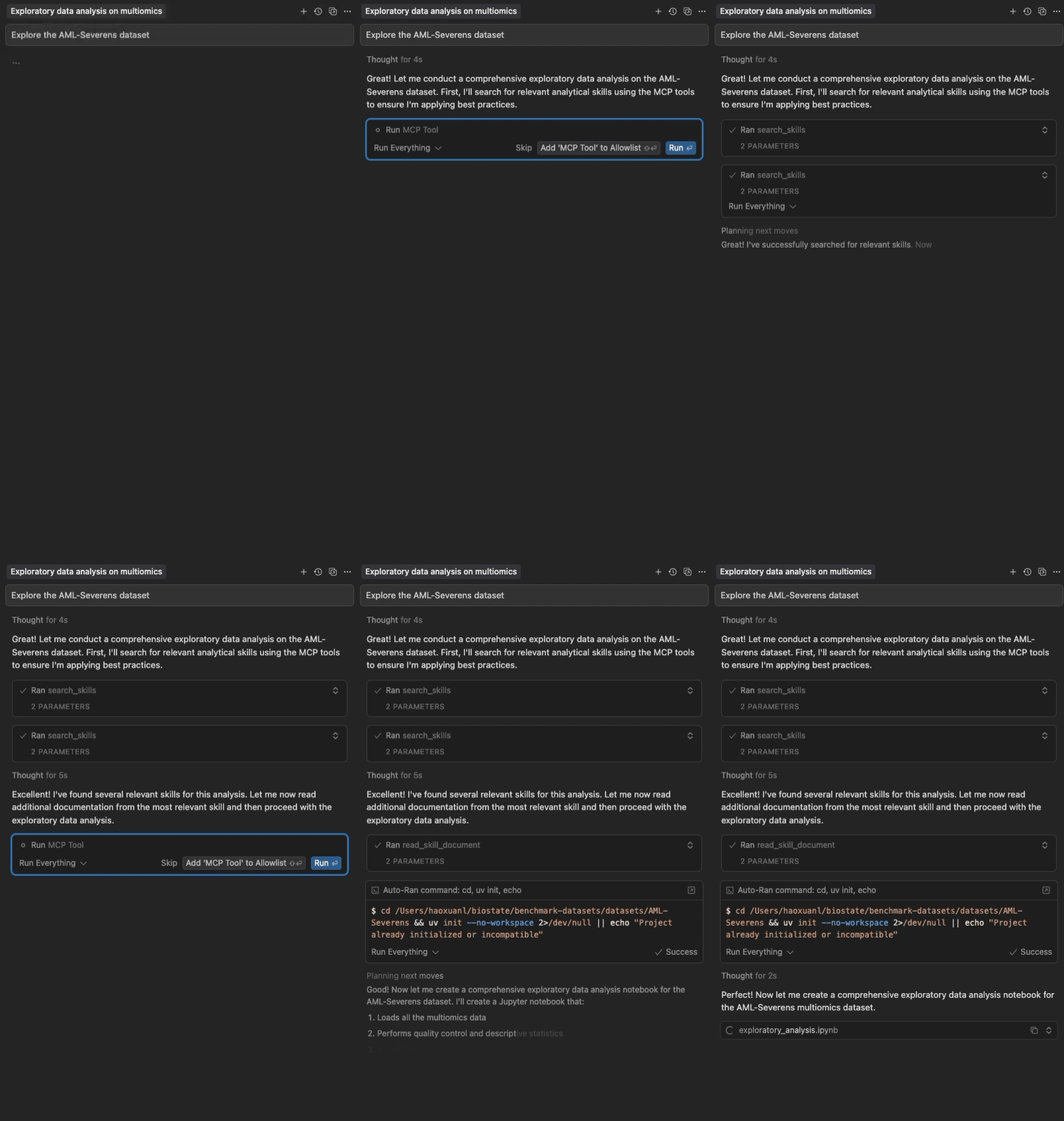
CursorにおけるClaude Agent Skillsのセマンティック検索と段階的読み込み
Related MCP server: skill4agent MCP Server
ハイライト
2パッケージ構成: 軽量なフロントエンド(約15MB)が即座に起動し、バックエンド(約250MB)がバックグラウンドでダウンロードされます
Cursorのタイムアウトなし: フロントエンドが5秒以内に応答し、タイムアウト問題を解決
セマンティック検索: インテリジェントなスキル発見のためのベクトル埋め込み
プログレッシブ・ディスクロージャー: 多段階のスキル読み込み(メタデータ → コンテンツ全体 → ファイル)
設定不要: キュレーションされたスキルですぐに使用可能
マルチソース: GitHubリポジトリやローカルディレクトリから読み込み可能
高速かつローカル: APIキー不要、GitHubの自動キャッシュ機能付き
設定可能: ソース、モデル、コンテンツ制限のカスタマイズが可能
クイックスタート
Cursorユーザー向け
Cursor Directoryから追加するか、Cursorの設定(~/.cursor/mcp.json)に追加してください:
{
"mcpServers": {
"claude-skills": {
"command": "uvx",
"args": ["claude-skills-mcp"]
}
}
}フロントエンドが即座に起動してツールを表示し、バックグラウンドでバックエンドを自動的にダウンロードして起動します(RAGの依存関係により初回のみ約60〜120秒かかります)。2回目以降は即座に動作します。
uvxを使用する場合(スタンドアロン)
デフォルト設定でサーバーを実行します:
uvx claude-skills-mcpこれにより軽量なフロントエンドが起動し、バックエンドを自動ダウンロードして、Anthropicの公式スキルリポジトリおよびK-Dense AIの科学スキルコレクションから約90個のスキルを読み込みます。
カスタム設定を使用する場合
# 1. Print the default configuration
uvx claude-skills-mcp --example-config > config.json
# 2. Edit config.json to your needs
# 3. Run with your custom configuration
uvx claude-skills-mcp --config config.jsonドキュメント
はじめに - インストール、Cursor設定、CLI使用方法、トラブルシューティング
アーキテクチャガイド - 2パッケージ設計、データフロー、コンポーネント
APIドキュメント - ツールパラメータ、例、ベストプラクティス
使用例 - 高度な設定、実際のユースケース、カスタムスキルの作成
テストガイド - 完全なテスト手順、CI/CD、カバレッジ分析
MCPツール
このサーバーは、Claude Agent Skillsを操作するための3つのツールを提供します:
find_helpful_skills- タスクの説明に基づいた関連スキルのセマンティック検索read_skill_document- スキルから特定のファイル(スクリプト、データ、参照)を取得list_skills- 読み込まれたすべてのスキルの完全なインベントリを表示(探索/デバッグ用)
詳細なパラメータ、例、ベストプラクティスについてはAPIドキュメントを参照してください。
アーキテクチャ (v1.0.0)
システムは最適なパフォーマンスのために2パッケージ構成を採用しています:
フロントエンド (
claude-skills-mcp): 軽量プロキシ(約15MB)即座に起動(5秒未満) ✅ Cursorのタイムアウトなし!
初回使用時にバックエンドを自動ダウンロード
Cursor用のMCPサーバー(stdio)
バックエンド (
claude-skills-mcp-backend): ヘビーサーバー(約250MB)PyTorchとsentence-transformersによるベクトル検索
MCPサーバー(ストリーミング可能なHTTP)
フロントエンドによる自動インストール、またはスタンドアロンでのデプロイが可能
利点:
✅ Cursorのタイムアウト問題を解決(フロントエンドが即座に起動)
✅ シンプルなユーザー体験(
uvx claude-skills-mcp)✅ バックエンドはバックグラウンドでダウンロード(Cursorをブロックしない)
✅ リモートホストされたバックエンドに接続可能(ローカルインストール不要)
詳細な設計とデータフローについてはアーキテクチャガイドを参照してください。
スキルソース
GitHubリポジトリ(直接のスキルまたはClaude Codeプラグイン)またはローカルディレクトリからスキルを読み込みます。
デフォルトでは以下から読み込みます:
公式Anthropic Skills - ドキュメント、プレゼンテーション、Webアーティファクトなど、15種類の多様なスキル
K-Dense AI Scientific Skills - バイオインフォマティクス、ケモインフォマティクス、科学分析のための78以上の専門スキル
ローカルディレクトリ
~/.claude/skills(存在する場合)
貢献
貢献を歓迎します!貢献方法:
問題を報告: バグや機能リクエストについてはIssueを開いてください
PRを提出: フォークし、機能ブランチを作成し、テストが通過することを確認(
uv run pytest tests/)してから提出してくださいコードスタイル: コミット前に
uvx ruff check src/を実行してくださいテストを追加: 新機能にはテストを含めてください
開発
バージョン管理: このモノレポは集中型バージョンシステムを使用しています:
リポジトリルートの
VERSIONファイルを編集してバージョンを上げてくださいpython3 scripts/sync-version.pyを実行してすべての参照を同期してください(または--checkで検証)scripts/build-all.shスクリプトはビルド前に自動的にバージョンを同期します
質問がある場合は、orion.li@k-dense.ai までメールしてください。
コミュニティに参加しよう! 🚀
Slackコミュニティへの参加をお待ちしています! 他のユーザーとつながり、ヒントやコツを共有し、スキルのヘルプを得て、新機能やアップデートの情報をいち早く入手しましょう。
カスタムスキルの構築、異なるAIモデルとの統合、あるいは単にAgent Skillsの可能性を探求している場合でも、私たちのコミュニティがあなたをサポートします!
詳細はこちら
Agent Skillsドキュメント - スキル形式に関するAnthropic公式ドキュメント
Agent Skillsブログ投稿 - アナウンスと概要
Model Context Protocol - クロスプラットフォームのスキルを可能にするプロトコル
エンジニアリングブログ: Equipping Agents for the Real World - スキルアーキテクチャに関する技術的な詳細解説
ライセンス
このプロジェクトは Apache License 2.0 の下でライセンスされています。
Copyright 2025 K-Dense AI (https://k-dense.ai)
スターの履歴
Available Tools
3 toolslist_skillsList All Loaded SkillsA
Returns a complete inventory of all loaded skills with their names, descriptions, sources, and document counts. Use this for exploration or debugging to see what skills are available. NOTE: For finding relevant skills for a specific task, use the 'search_skills' tool instead - it performs semantic search to find the most appropriate skills for your needs.
| Name | Required | Description | Default |
|---|---|---|---|
No parameters | |||
TDQS
Does the description disclose side effects, auth requirements, rate limits, or destructive behavior?
With no annotations provided, the description carries full burden of behavioral disclosure. It clearly indicates this is a read operation ('Returns') and specifies the scope ('complete inventory of all loaded skills'). However, it doesn't mention potential limitations like pagination, rate limits, or authentication requirements that might be relevant for a complete behavioral understanding.
Agents need to know what a tool does to the world before calling it. Descriptions should go beyond structured annotations to explain consequences.
Is the description appropriately sized, front-loaded, and free of redundancy?
The description is perfectly structured in two sentences: the first states the purpose and output format, the second provides usage guidance and sibling differentiation. Every sentence adds value with zero wasted words, making it easy to parse and understand quickly.
Shorter descriptions cost fewer tokens and are easier for agents to parse. Every sentence should earn its place.
Given the tool's complexity, does the description cover enough for an agent to succeed on first attempt?
For a simple read-only tool with no parameters and no output schema, the description provides excellent context about what the tool does and when to use it. The main gap is the lack of information about the return format structure, which would be helpful since there's no output schema. However, given the tool's simplicity, the description is largely complete.
Complex tools with many parameters or behaviors need more documentation. Simple tools need less. This dimension scales expectations accordingly.
Does the description clarify parameter syntax, constraints, interactions, or defaults beyond what the schema provides?
With 0 parameters and 100% schema coverage, the baseline would be 4. The description appropriately acknowledges this by not discussing parameters at all, focusing instead on the tool's purpose and usage guidelines. This is efficient and avoids redundancy.
Input schemas describe structure but not intent. Descriptions should explain non-obvious parameter relationships and valid value ranges.
Does the description clearly state what the tool does and how it differs from similar tools?
The description clearly states the specific verb ('Returns') and resource ('complete inventory of all loaded skills'), listing the exact data fields included (names, descriptions, sources, document counts). It explicitly distinguishes this from its sibling 'search_skills' by stating this is for exploration/debugging rather than task-specific relevance.
Agents choose between tools based on descriptions. A clear purpose with a specific verb and resource helps agents select the right tool.
Does the description explain when to use this tool, when not to, or what alternatives exist?
The description provides explicit guidance on when to use this tool ('for exploration or debugging to see what skills are available') and when not to use it, naming the alternative tool 'search_skills' for finding relevant skills for specific tasks. This gives clear context for tool selection.
Agents often have multiple tools that could apply. Explicit usage guidance like "use X instead of Y when Z" prevents misuse.
read_skill_documentRead Skill DocumentA
Retrieve specific documents (scripts, references, assets) from a skill. Use this after searching for skills to access additional resources like Python scripts, example data files, reference materials, or images. Supports pattern matching to retrieve multiple files at once (e.g., 'scripts/*.py' for all Python scripts).
| Name | Required | Description | Default |
|---|---|---|---|
| document_path | No | Path or pattern to match documents. Examples: 'scripts/example.py', 'scripts/*.py', 'references/*', 'assets/diagram.png'. If not provided, returns a list of all available documents. | |
| include_base64 | No | For images: if True, return base64-encoded content; if False, return only URL. Default: False (URL only for efficiency) | |
| skill_name | Yes | Name of the skill (as returned by search_skills) |
TDQS
Does the description disclose side effects, auth requirements, rate limits, or destructive behavior?
With no annotations provided, the description carries the full burden of behavioral disclosure. It describes pattern matching capabilities and the base64 encoding option for images, which are useful behavioral details. However, it doesn't mention error conditions, rate limits, authentication requirements, or what happens when no documents match the pattern.
Agents need to know what a tool does to the world before calling it. Descriptions should go beyond structured annotations to explain consequences.
Is the description appropriately sized, front-loaded, and free of redundancy?
The description is efficiently structured with two sentences that each serve clear purposes: the first states the core function, the second provides usage context and behavioral details. There's no wasted language, and important information is front-loaded.
Shorter descriptions cost fewer tokens and are easier for agents to parse. Every sentence should earn its place.
Given the tool's complexity, does the description cover enough for an agent to succeed on first attempt?
For a tool with 3 parameters, 100% schema coverage, and no output schema, the description provides adequate context about what the tool does and when to use it. However, without annotations or output schema, it could benefit from more information about return formats (beyond the base64 mention), error handling, or performance characteristics.
Complex tools with many parameters or behaviors need more documentation. Simple tools need less. This dimension scales expectations accordingly.
Does the description clarify parameter syntax, constraints, interactions, or defaults beyond what the schema provides?
The schema description coverage is 100%, so the schema already documents all three parameters thoroughly. The description adds some context about what types of documents can be retrieved (scripts, references, assets) and mentions pattern matching, but doesn't provide additional parameter semantics beyond what's in the schema descriptions.
Input schemas describe structure but not intent. Descriptions should explain non-obvious parameter relationships and valid value ranges.
Does the description clearly state what the tool does and how it differs from similar tools?
The description clearly states the specific action ('Retrieve specific documents') and resources ('scripts, references, assets') from a skill. It distinguishes from sibling tools like 'list_skills' and 'search_skills' by focusing on accessing document content rather than listing or searching skills themselves.
Agents choose between tools based on descriptions. A clear purpose with a specific verb and resource helps agents select the right tool.
Does the description explain when to use this tool, when not to, or what alternatives exist?
The description provides explicit guidance on when to use this tool ('Use this after searching for skills to access additional resources') and includes examples of what types of resources it handles (Python scripts, data files, reference materials, images). It clearly positions this as a follow-up to search operations.
Agents often have multiple tools that could apply. Explicit usage guidance like "use X instead of Y when Z" prevents misuse.
search_skillsClaude Agent Skills SearchA
Search and discover proven Claude Agent Skills that provide expert guidance for your tasks. Use this tool whenever you're starting a new task, facing a coding challenge, or need specialized techniques. Returns highly relevant skills with complete implementation guides, code examples, and best practices ranked by relevance. Each result includes detailed step-by-step instructions you can follow immediately. Essential for leveraging battle-tested patterns, avoiding common pitfalls, and accelerating development with proven solutions. Perfect for finding reusable workflows, debugging strategies, API integration patterns, data processing techniques, and domain-specific methodologies.
| Name | Required | Description | Default |
|---|---|---|---|
| list_documents | No | Include a list of available documents (scripts, references, assets) for each skill (default: True) | |
| task_description | Yes | Description of the task you want to accomplish. Be specific about your goal, context, or problem domain for better results (e.g., 'debug Python API errors', 'process genomic data', 'build React dashboard') | |
| top_k | No | Number of skills to return (default: 3). Higher values provide more options but may include less relevant results. |
TDQS
Does the description disclose side effects, auth requirements, rate limits, or destructive behavior?
With no annotations provided, the description carries full burden. It discloses that results are 'ranked by relevance' and include 'complete implementation guides, code examples, and best practices' which adds behavioral context beyond basic search. However, it doesn't mention rate limits, authentication requirements, error conditions, or pagination behavior that would be important for a search tool.
Agents need to know what a tool does to the world before calling it. Descriptions should go beyond structured annotations to explain consequences.
Is the description appropriately sized, front-loaded, and free of redundancy?
The description is appropriately front-loaded with core functionality but contains some redundant phrasing ('proven solutions' vs 'battle-tested patterns'). Sentences like 'Essential for leveraging battle-tested patterns...' and 'Perfect for finding reusable workflows...' could be more concise while maintaining value. The structure flows logically but could be tighter.
Shorter descriptions cost fewer tokens and are easier for agents to parse. Every sentence should earn its place.
Given the tool's complexity, does the description cover enough for an agent to succeed on first attempt?
For a search tool with 3 parameters, 100% schema coverage, but no annotations or output schema, the description provides adequate context about what the tool does and when to use it. However, it lacks details about the return format structure, error handling, or performance characteristics that would be helpful given the absence of an output schema.
Complex tools with many parameters or behaviors need more documentation. Simple tools need less. This dimension scales expectations accordingly.
Does the description clarify parameter syntax, constraints, interactions, or defaults beyond what the schema provides?
Schema description coverage is 100%, so the schema already fully documents all three parameters. The description doesn't add any additional parameter semantics beyond what's in the schema. It mentions 'returns highly relevant skills' which aligns with the task_description parameter but doesn't provide extra guidance on parameter usage or interactions.
Input schemas describe structure but not intent. Descriptions should explain non-obvious parameter relationships and valid value ranges.
Does the description clearly state what the tool does and how it differs from similar tools?
The description clearly states the tool's purpose as searching and discovering Claude Agent Skills with specific outputs (implementation guides, code examples, best practices). It distinguishes from 'list_skills' by emphasizing search functionality and from 'read_skill_document' by returning multiple ranked results rather than reading a single document. However, it doesn't explicitly name these siblings for full differentiation.
Agents choose between tools based on descriptions. A clear purpose with a specific verb and resource helps agents select the right tool.
Does the description explain when to use this tool, when not to, or what alternatives exist?
The description provides clear context for when to use the tool ('starting a new task, facing a coding challenge, or need specialized techniques') and includes examples of appropriate use cases. It doesn't explicitly state when NOT to use it or name alternative tools, but the context strongly implies this is for discovery/search rather than listing or reading specific documents.
Agents often have multiple tools that could apply. Explicit usage guidance like "use X instead of Y when Z" prevents misuse.
Tool Schema Changelog
Recent tool additions, removals, and schema changes observed during successful MCP inspections.
3 tool updates
- First observed
list_skills - First observed
read_skill_document - First observed
search_skills
TDQS
Scored across 3 tools
Each tool has a clearly distinct purpose: list_skills provides an inventory, search_skills performs semantic search for task relevance, and read_skill_document retrieves specific documents. The descriptions explicitly differentiate them, with list_skills even noting to use search_skills for task-specific needs, eliminating overlap.
All tools follow a consistent verb_noun pattern with snake_case: list_skills, search_skills, and read_skill_document. This uniformity makes the set predictable and easy to understand, enhancing usability for agents.
With 3 tools, the count is reasonable for a skills management server, covering exploration, search, and document retrieval. It feels slightly thin but well-scoped for its purpose, as each tool serves a distinct workflow without unnecessary bloat.
The tool surface covers core workflows: inventory listing, semantic search, and document access. Minor gaps exist, such as no direct skill execution or management tools (e.g., load/unload), but agents can work around this by using retrieved documents, making it nearly complete for the domain.
Maintenance
Related MCP Connectors
Capability registry for the agentic economy. Semantic search over verified MCP server listings.
Model Context Protocol server for the Apideck Unified API. Connect any MCP-compatible agent framework to 100+ accounting systems, HRIS platforms, file storage providers, and more through one integration. More information https://www.apideck.com/mcp-server
- UnifAPIOAuthcom.unifapi
Hosted MCP server for live public-data APIs and Skills for AI agents.
Related MCP Servers
- AlicenseNot gradedqualityNot gradedmaintenanceAn MCP server that transforms Claude-style skills and resources into callable tools for any MCP-compatible agent or client. It automatically discovers, exposes, and executes scripts from skills organized in local directories or packaged archives.MIT
- AlicenseBqualityCmaintenanceMCP (Model Context Protocol) Server for skill4agent - Search, view, and install AI skills in AI conversations.319 npm4MIT
- FlicenseNot gradedqualityDmaintenanceLocal MCP server that provides semantic search (RAG) over code repositories, enabling AI clients like Claude and Gemini to access project context without manual re-upload.-
- AlicenseNot gradedqualityDmaintenanceMCP Memory Server for Claude Code that provides persistent context across sessions using semantic search (RAG).Apache 2.0
