Demo HTTP MCP Server
test-http-mcp
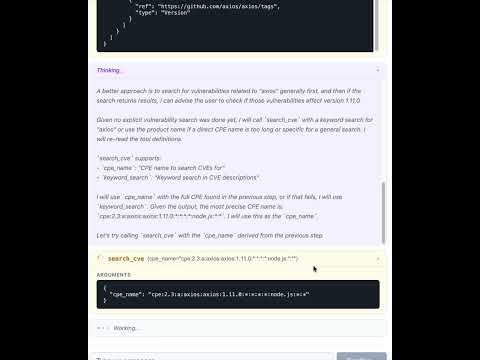
Servidor de Model Context Protocol (MCP) de demostración implementado en Python usando el paquete http-mcp. Puede ejecutarse a través de HTTP (Starlette/Uvicorn) o stdio, exponiendo herramientas y prompts de ejemplo a cualquier cliente compatible con MCP. El proyecto incluye un frontend en React que proporciona una interfaz de chat para consultar vulnerabilidades a través de la NVD (National Vulnerability Database).
Estructura del proyecto
test-http-mcp/
├── backend/ # Python backend (FastAPI + MCP server)
│ ├── app/ # Application source code
│ │ ├── app.py # FastAPI app, routes, MCP mount
│ │ ├── main.py # Entry points (HTTP / stdio)
│ │ ├── agen_memory.py # SQLite message persistence
│ │ ├── config.py # Settings via pydantic-settings
│ │ ├── auth0/ # Auth0 integration
│ │ │ ├── __init__.py # JWT token validator
│ │ │ └── client_store.py # Dynamic client registration (RFC 7591)
│ │ ├── tools/ # MCP tools (CPE/CVE search via NVD)
│ │ └── prompts/ # MCP prompt templates
│ ├── pyproject.toml # Python deps & scripts
│ ├── uv.lock # Locked dependencies
│ ├── ruff.toml # Linter config
│ ├── mypy.ini # Type-checker config
│ └── .envrc # direnv auto-activation
├── frontend/ # React + TypeScript frontend (Vite)
│ ├── src/
│ │ ├── components/ # ChatApp, ChatInput, MessageList, MessageBubble
│ │ ├── api.ts # API client (fetch history, stream messages)
│ │ ├── types.ts # Shared TypeScript types
│ │ ├── App.tsx # Root component
│ │ └── App.css # Styles
│ ├── vite.config.ts # Vite config with dev proxy
│ └── package.json # Node dependencies
├── AGENTS.md
├── LICENSE
└── README.mdAutenticación (Auth0)
El endpoint MCP (/mcp/) está protegido con autenticación OAuth2 de Auth0. Las herramientas requieren que los ámbitos (tool:search_cpe, tool:search_cve) estén presentes en el token de acceso.
Variables de entorno requeridas
Variable | Descripción |
| Dominio del inquilino de Auth0 (ej. |
| Identificador de API para la validación del token |
| ID de cliente de la aplicación Auth0 para la aplicación MCP |
| ID de cliente de la API de gestión (para registro dinámico) |
| Secreto de cliente de la API de gestión |
| Establecer en |
Colóquelas en backend/.env (ignorado por git).
Estructura de montaje de la aplicación
Ruta | Aplicación | Autenticación |
| Servidor MCP protegido | Se requiere token Bearer de Auth0 |
| Registro dinámico de clientes (RFC 7591) | Sin autenticar |
| Metadatos de OAuth/recursos | Sin autenticar |
| Endpoints de la interfaz de chat | Sin autenticar (ver nota) |
| Archivos estáticos del frontend | Sin autenticar |
Nota: Los endpoints de chat están intencionalmente sin autenticar para el desarrollo local. Agregue autenticación antes de exponerlos fuera de localhost.
Requisitos
Python 3.13
Node.js 18+ y npm
uv(recomendado) opip
Instalación
Backend (usando uv):
cd backend
uv run python -V # creates a venv and syncs deps from pyprojectBackend (usando pip):
cd backend
python3.13 -m venv .venv
source .venv/bin/activate
pip install .Frontend:
cd frontend
npm installEjecución
Desarrollo (frontend + backend por separado)
Inicie el backend:
cd backend
uv run run-app
# → API on http://localhost:8000
# → MCP endpoint on http://localhost:8000/mcp/Inicie el servidor de desarrollo del frontend (en una terminal separada):
cd frontend
npm run dev
# → UI on http://localhost:5173 (proxies /api/* → backend)Producción (el backend sirve el frontend compilado)
Compile el frontend e inicie el backend:
cd frontend && npm run build && cd ..
cd backend && uv run run-app
# → Everything on http://localhost:8000Ejecución (modo stdio)
Uso con Cursor u otros clientes MCP
Con Auth0 habilitado, los clientes deben obtener un token de acceso OAuth2. El servidor admite RFC 7591 Dynamic Client Registration en /register, por lo que los clientes MCP que implementan la especificación de autenticación se registrarán automáticamente.
Ejemplo de .cursor/mcp.json para modo HTTP:
{
"mcpServers": {
"test-http-mcp": {
"type": "http",
"url": "http://localhost:8000/mcp/"
}
}
}Uso con Gemini:
{
"mcpServers": {
"test": {
"httpUrl": "http://localhost:8000/mcp/",
"timeout": 5000
}
}
}Ejemplo de entrada en .cursor/mcp.json para conectar a través de stdio:
{
"mcpServers": {
"test_studio": {
"command": "uv",
"args": ["run", "--project", "backend", "run-stdio"],
"env": { "AUTHORIZATION_TOKEN": "Bearer TEST_TOKEN" }
}
}
}Lo que expone este servidor
Herramientas (ver
backend/app/tools/):search_cpe(product, version, vendor)— buscar Common Platform Enumerations a través de NVDsearch_cve(cpe_name)— buscar Common Vulnerabilities and Exposures para un CPE dado
Prompts (ver
backend/app/prompts/):sync_nvd_search(dependency, version)— prompt simple de búsqueda de vulnerabilidadesasync_nvd_search(dependency, version)— prompt avanzado con datos CVE pre-obtenidos
Scripts del proyecto
Se definen dos puntos de entrada de consola en backend/pyproject.toml:
run-app→app.main:run_httprun-stdio→app.main:run_stdiorun-app-local→app.app:main(con recarga automática)
Desarrollo
Tareas comunes (ejecutar desde el directorio backend/):
uv run ruff check . # lint
uv run mypy . # type check
uv run pytest # tests
uv run mdformat . # format markdownTareas del frontend (ejecutar desde el directorio frontend/):
npm run dev # start dev server
npm run build # production build
npm run lint # lint with ESLint
npx tsc --noEmit # type checkNotas de implementación
La aplicación ASGI raíz es una aplicación MCP protegida por Auth0 creada por
auth_mcp, que monta la sub-aplicación FastAPI en/api.El endpoint MCP en
/mcp/requiere un token Bearer de Auth0 válido con los ámbitos de herramienta apropiados.El registro dinámico de clientes en
/registeractúa como proxy hacia una aplicación Auth0 pre-creada, actualizando sus URLs de callback permitidas. Las URIs de redirección se validan (se requiere HTTPS; HTTP solo se permite para localhost).La interfaz de chat utiliza
pydantic-aicon un agente Ollama que puede llamar a herramientas MCP para buscar vulnerabilidades.El historial de chat se persiste en una base de datos SQLite local a través de
agen_memory.py.El frontend de React transmite respuestas como JSON delimitado por nuevas líneas y renderiza markdown con la biblioteca
marked.En producción, el backend sirve el frontend compilado desde
frontend/dist/con enrutamiento de respaldo SPA (protegido contra recorrido de rutas).En desarrollo, Vite actúa como proxy para las solicitudes
/api/*al backend en el puerto 8000.
Licencia
MIT — ver LICENSE.
Available Tools
4 toolsget_called_toolsGet Called ToolsAIdempotent
Get the list of called tools.
| Name | Required | Description | Default |
|---|---|---|---|
No parameters | |||
Output Schema
| Name | Required | Description |
|---|---|---|
| called_tools | Yes | The list of called tools |
TDQS
Does the description disclose side effects, auth requirements, rate limits, or destructive behavior?
The description doesn't contradict annotations and adds some context by specifying 'list of called tools' (implying retrieval of historical tool usage data). However, annotations already provide rich behavioral information: readOnlyHint=false (potentially confusing for a 'get' operation), openWorldHint=true, idempotentHint=true, destructiveHint=false. The description doesn't add significant behavioral details beyond what annotations already cover, but it doesn't contradict them either.
Agents need to know what a tool does to the world before calling it. Descriptions should go beyond structured annotations to explain consequences.
Is the description appropriately sized, front-loaded, and free of redundancy?
The description is a single, clear sentence with zero wasted words. It's front-loaded with the essential information and perfectly sized for a simple tool. Every word earns its place.
Shorter descriptions cost fewer tokens and are easier for agents to parse. Every sentence should earn its place.
Given the tool's complexity, does the description cover enough for an agent to succeed on first attempt?
Given the tool's simplicity (0 parameters, rich annotations, output schema exists), the description is reasonably complete. The annotations cover safety and behavioral traits, and the output schema will document return values. The description could be more specific about what 'called tools' means in context, but for a simple retrieval tool, it's mostly adequate.
Complex tools with many parameters or behaviors need more documentation. Simple tools need less. This dimension scales expectations accordingly.
Does the description clarify parameter syntax, constraints, interactions, or defaults beyond what the schema provides?
With 0 parameters and 100% schema description coverage, the schema already fully documents the lack of inputs. The description doesn't need to explain parameters, and it correctly doesn't mention any. The baseline for 0 parameters is 4, as the description appropriately focuses on the tool's purpose rather than nonexistent parameters.
Input schemas describe structure but not intent. Descriptions should explain non-obvious parameter relationships and valid value ranges.
Does the description clearly state what the tool does and how it differs from similar tools?
The description 'Get the list of called tools' clearly states the verb ('Get') and resource ('list of called tools'), making the purpose understandable. However, it doesn't distinguish this tool from its siblings (get_time, get_weather, tool_that_access_request) - all are 'get' operations but for different data. The description is adequate but lacks sibling differentiation.
Agents choose between tools based on descriptions. A clear purpose with a specific verb and resource helps agents select the right tool.
Does the description explain when to use this tool, when not to, or what alternatives exist?
The description provides no guidance on when to use this tool versus alternatives. There's no mention of context, prerequisites, or comparison with sibling tools. The agent must infer usage from the tool name alone, which offers minimal guidance.
Agents often have multiple tools that could apply. Explicit usage guidance like "use X instead of Y when Z" prevents misuse.
get_timeGet TimeAIdempotent
Get the current time.
| Name | Required | Description | Default |
|---|---|---|---|
No parameters | |||
Output Schema
| Name | Required | Description |
|---|---|---|
| time | Yes | The current time |
TDQS
Does the description disclose side effects, auth requirements, rate limits, or destructive behavior?
Annotations already provide key behavioral hints (readOnlyHint=false, openWorldHint=true, idempotentHint=true, destructiveHint=false), so the description doesn't need to repeat these. The description adds minimal context about what 'current time' means, but doesn't elaborate on format, timezone, or other behavioral details beyond the annotations.
Agents need to know what a tool does to the world before calling it. Descriptions should go beyond structured annotations to explain consequences.
Is the description appropriately sized, front-loaded, and free of redundancy?
The description 'Get the current time' is a single, efficient sentence that front-loads the core purpose with zero wasted words. It's appropriately sized for a simple tool with no parameters.
Shorter descriptions cost fewer tokens and are easier for agents to parse. Every sentence should earn its place.
Given the tool's complexity, does the description cover enough for an agent to succeed on first attempt?
Given the tool's simplicity (0 parameters, annotations covering key behaviors, and an output schema that presumably handles return values), the description is reasonably complete. However, it could slightly improve by hinting at the output format (e.g., timestamp vs. string) since sibling tools suggest varied contexts.
Complex tools with many parameters or behaviors need more documentation. Simple tools need less. This dimension scales expectations accordingly.
Does the description clarify parameter syntax, constraints, interactions, or defaults beyond what the schema provides?
With 0 parameters and 100% schema description coverage, the schema fully documents the lack of inputs. The description doesn't need to add parameter information, so it appropriately avoids redundancy. A baseline of 4 is justified since no parameters exist to explain.
Input schemas describe structure but not intent. Descriptions should explain non-obvious parameter relationships and valid value ranges.
Does the description clearly state what the tool does and how it differs from similar tools?
The description 'Get the current time' clearly states the verb ('Get') and resource ('current time'), making the purpose immediately understandable. However, it doesn't distinguish this tool from potential sibling tools like 'get_called_tools' or 'get_weather', which prevents a perfect score.
Agents choose between tools based on descriptions. A clear purpose with a specific verb and resource helps agents select the right tool.
Does the description explain when to use this tool, when not to, or what alternatives exist?
The description provides no guidance on when to use this tool versus alternatives. There are sibling tools like 'get_weather' that might serve related time/weather queries, but the description doesn't mention any context, prerequisites, or exclusions for usage.
Agents often have multiple tools that could apply. Explicit usage guidance like "use X instead of Y when Z" prevents misuse.
get_weatherGet WeatherBIdempotent
Get the current weather in a given location.
| Name | Required | Description | Default |
|---|---|---|---|
| location | Yes | The location to get the weather for | |
| unit | No | The unit of temperature | celsius |
Output Schema
| Name | Required | Description |
|---|---|---|
| weather | Yes | The weather in the given location |
TDQS
Does the description disclose side effects, auth requirements, rate limits, or destructive behavior?
Annotations already provide key behavioral hints (readOnlyHint=false, openWorldHint=true, idempotentHint=true, destructiveHint=false), so the description doesn't need to repeat these. It adds minimal context by implying real-time data retrieval, but doesn't disclose additional traits like rate limits, error handling, or authentication needs, which would elevate the score.
Agents need to know what a tool does to the world before calling it. Descriptions should go beyond structured annotations to explain consequences.
Is the description appropriately sized, front-loaded, and free of redundancy?
The description is a single, efficient sentence that front-loads the core purpose without unnecessary details. Every word earns its place, making it highly concise and well-structured for quick understanding.
Shorter descriptions cost fewer tokens and are easier for agents to parse. Every sentence should earn its place.
Given the tool's complexity, does the description cover enough for an agent to succeed on first attempt?
Given the tool's low complexity (2 parameters, 100% schema coverage, annotations provided, and an output schema exists), the description is reasonably complete. It states what the tool does, though it could benefit from slight enhancements like mentioning the output includes current conditions, but the output schema likely covers return values, reducing the burden.
Complex tools with many parameters or behaviors need more documentation. Simple tools need less. This dimension scales expectations accordingly.
Does the description clarify parameter syntax, constraints, interactions, or defaults beyond what the schema provides?
Schema description coverage is 100%, so the schema fully documents the parameters (location and unit). The description mentions 'location' but adds no extra meaning beyond what the schema provides, such as format examples or usage nuances, meeting the baseline for high coverage.
Input schemas describe structure but not intent. Descriptions should explain non-obvious parameter relationships and valid value ranges.
Does the description clearly state what the tool does and how it differs from similar tools?
The description clearly states the tool's purpose with a specific verb ('Get') and resource ('current weather'), and it specifies the scope ('in a given location'). However, it doesn't distinguish this tool from potential siblings like 'get_forecast' or 'get_historical_weather', which would require explicit differentiation for a score of 5.
Agents choose between tools based on descriptions. A clear purpose with a specific verb and resource helps agents select the right tool.
Does the description explain when to use this tool, when not to, or what alternatives exist?
The description provides no guidance on when to use this tool versus alternatives. It lacks any mention of prerequisites, exclusions, or comparisons with sibling tools (e.g., 'get_time' or 'get_called_tools'), leaving the agent without context for tool selection.
Agents often have multiple tools that could apply. Explicit usage guidance like "use X instead of Y when Z" prevents misuse.
tool_that_access_requestTool That Access RequestCIdempotent
Access the request.
| Name | Required | Description | Default |
|---|---|---|---|
| username | Yes | The username of the user |
Output Schema
| Name | Required | Description |
|---|---|---|
| message | Yes | The message to the user |
TDQS
Does the description disclose side effects, auth requirements, rate limits, or destructive behavior?
Annotations provide significant behavioral information: readOnlyHint=false (implies mutation), openWorldHint=true (handles unknown inputs), idempotentHint=true (safe to retry), and destructiveHint=false (non-destructive). The description adds no behavioral context beyond these annotations—it doesn't explain what 'access' entails operationally, potential side effects, or any constraints like rate limits. However, it doesn't contradict the annotations, so it meets the lower bar with annotations present.
Agents need to know what a tool does to the world before calling it. Descriptions should go beyond structured annotations to explain consequences.
Is the description appropriately sized, front-loaded, and free of redundancy?
The description is extremely concise at just three words ('Access the request.'), with no wasted language or unnecessary elaboration. It is front-loaded and efficiently communicates the core idea, though this brevity contributes to its vagueness in other dimensions.
Shorter descriptions cost fewer tokens and are easier for agents to parse. Every sentence should earn its place.
Given the tool's complexity, does the description cover enough for an agent to succeed on first attempt?
Given the tool's moderate complexity (1 parameter, annotations provide behavioral hints, output schema exists), the description is minimally adequate but incomplete. It lacks context on what the tool actually does, usage scenarios, or output expectations. The presence of an output schema means return values needn't be explained, but the description should still clarify purpose and guidelines better to be fully helpful.
Complex tools with many parameters or behaviors need more documentation. Simple tools need less. This dimension scales expectations accordingly.
Does the description clarify parameter syntax, constraints, interactions, or defaults beyond what the schema provides?
The input schema has 100% description coverage, with the 'username' parameter fully documented in the schema. The description adds no parameter semantics beyond what the schema provides—it doesn't explain why the username is needed, how it relates to the request, or any contextual details about parameter usage. With high schema coverage, the baseline score of 3 is appropriate.
Input schemas describe structure but not intent. Descriptions should explain non-obvious parameter relationships and valid value ranges.
Does the description clearly state what the tool does and how it differs from similar tools?
The description 'Access the request' is a tautology that essentially restates the tool name 'tool_that_access_request' without adding meaningful specificity. It doesn't clarify what type of request is being accessed, what resource is involved, or what 'access' means in this context (read, modify, submit?). While it includes a verb ('access') and resource ('request'), it remains vague about the actual purpose.
Agents choose between tools based on descriptions. A clear purpose with a specific verb and resource helps agents select the right tool.
Does the description explain when to use this tool, when not to, or what alternatives exist?
The description provides no guidance on when to use this tool versus alternatives. There are sibling tools like 'get_called_tools', 'get_time', and 'get_weather', but the description doesn't explain how this tool differs from them or in what context it should be selected. No prerequisites, exclusions, or comparative context are mentioned.
Agents often have multiple tools that could apply. Explicit usage guidance like "use X instead of Y when Z" prevents misuse.
Tool Schema Changelog
Recent tool additions, removals, and schema changes observed during successful MCP inspections.
4 tool updates
v1.0.0- First observed
get_called_tools - First observed
get_time - First observed
get_weather - First observed
tool_that_access_request
TDQS
Scored across 4 tools
Each tool has a clearly distinct purpose: get_called_tools retrieves internal server usage data, get_time provides current time, get_weather fetches location-based weather, and tool_that_access_request handles request metadata. There is no overlap in functionality, making tool selection unambiguous.
Three tools follow a consistent 'get_*' verb_noun pattern, but tool_that_access_request deviates with a noun_verb structure and uses 'that' as a connector. This mixed convention reduces predictability, though the names remain readable.
With 4 tools, the count is reasonable for a demo HTTP server, covering basic utilities like time, weather, and request handling. It is slightly thin for broader HTTP operations but appropriate for a limited scope.
The server covers basic utilities but lacks core HTTP operations like making requests (GET, POST) or handling responses, which are expected for an HTTP server. The tools are standalone utilities rather than a cohesive HTTP interface, leaving notable gaps in functionality.
Maintenance
Related MCP Connectors
Nifty's MCP server — exposes tasks, projects, messages, and files as tools for AI agents.
MCP server for progressive tool usage at any scale (see https://klavis.ai)
Related MCP Servers
- AlicenseNot gradedqualityDmaintenanceA minimal Model Context Protocol server demo that exposes tools through HTTP API, including greeting, weather lookup, and HTTP request capabilities. Demonstrates MCP server implementation with stdio communication and HTTP gateway functionality.9 npmISC
- FlicenseBqualityDmaintenanceA demonstration server showcasing MCP capabilities with basic tools including addition calculations and weather API integration for fetching city weather data.2-
- FlicenseNot gradedqualityDmaintenanceA basic MCP server for testing with echo, datetime, and calculator tools.38 npm-
- AlicenseAqualityDmaintenanceA minimal MCP server example demonstrating Tools, Resources, and Prompts. It enables calculations, time queries, note management, and code review prompts via stdio transport.38 npmMIT