
F
licenseNot graded
qualityD
maintenanceA Model Context Protocol server that allows integration with Claude Desktop by creating and managing custom tools that can be executed through the MCP framework.
29 npm
-

The Runbook MCP Server enables you to create, manage, and execute runbooks for operational tasks and manual test plans via Claude Desktop.
Create Runbooks: Define new runbooks using markdown or text files with support for environment and variable substitution
Run Runbooks: Execute runbooks by selecting them in Claude Desktop and providing necessary variables
Manage Runbooks: Delete existing runbooks as needed
Integration: Utilize other MCP servers (GitHub, Slack, Kubernetes, web automation) to execute runbook tasks
Future Development: Plans include versioning, approval workflows, execution logging, and improved search capabilities
Enables running operational tasks against Kubernetes clusters, such as listing pods across namespaces and identifying pods that are not in a ready state
Allows sending notifications and alerts to Slack channels, particularly for sharing operational information such as Kubernetes pod status
Click on "Deploy Server".
Wait a few minutes for the server to deploy. Once ready, it will show a "Started" state.
In the chat, type @ followed by the MCP server name and your instructions, e.g., "@Runbook run the deploy_to_production runbook with var.environment=staging"
That's it! The server will respond to your query, and you can continue using it as needed.
Here is a step-by-step guide with screenshots.
Runbook MCP Server enables you to run your own runbooks from Claude Desktop.
Run ops runbooks (e.g., deploy a service, upgrade a Kubernetes cluster)
Run manual test plans (e.g., create a new EC2 instance, ssh into the instance, and run the integration test there).
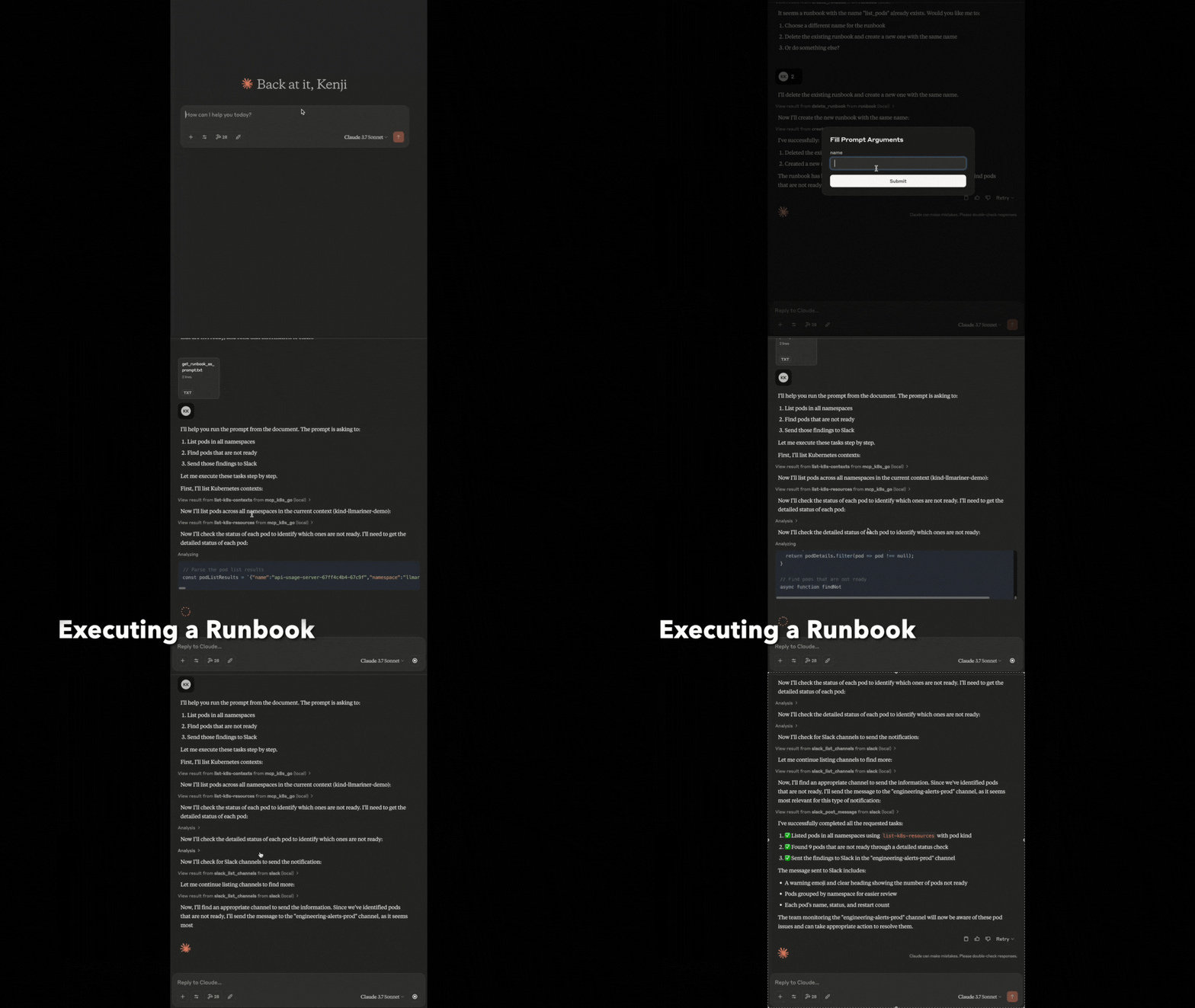
Please watch the demo video below to understand how it works!
Create config.yaml
Put the following configuration to claude_desktop_config.json.
{
  "mcpServers": {
    "runbook": {
      "command": "uv",
      "args": [
        "--directory",
        "<ABSOLUTE_PATH>/runbook-mcp-server",
        "run",
        "runbook_server.py"
      ]
    }
  }
}
Related MCP server: MCP Server Generator
You can use markdown files or text files as runbooks. See examples.
We support env/var substitution.
Define env.yaml.
env:
  key: value
{env[key]} is replaced with value.
{var.name} is replaced with a variable value.
Rebuild the index when files are updated.
You can also create a new runbook, use the create_runbook tool. Here is an example prompt:
Example 1
Create a new runbook:

- name: list_pods
- content: List pods in all namespaces, find pods that are not ready, and send that to Slack.

You don't need to interpret the content. Please just pass it to the tool.To run a runbook, take the following steps:
Click "Attach from MCP" from Claude Desktop.
Select get_runbook_as_prompt from the list of integrations.
Pass the name of the runbook you would like to execute. Also specify variables with a comma-separated list (e.g., var1=key1,var2=key2).
Submit the generated prompt.
Then Claude Desktop will talk to other MCP servers to run the runbook.
Web search and browser automation (link)
Kubernetes. There are several implementations (e.g., mcp-k8s-go)
Instead of saving the content of the runbook in the database, just save as a file. This helps easy editting. People can also simply use GitHub for versioning.
Runbook template X that is instantiated with given inputs.
Maybe this is not needed. A user just needs to put additional prompts when running the runbook.
Save executing log (for auditting and refinement)
Remove secrets
Also pass a past log to the runbook prompt if this helps better execution
Approval flow.
Add a tool request_approval.
This sends a slack message to a channel.
Then the Runbook MCP server watches the channel. If someone responds (yes / no), it proceeeds or returns an error.
Better runbook search
The exact name match is not great
Registrtation to Smithery.
Note: Claude Desktop does not support "Sampling". This puts some limitations.
Sub-runbook and reusable execution block
Rest endpoint + frontend for managing runbooks.
Be able to edit the runbook (with versioning)
show an execution plan for runbook X (dry-run)
Restrict MCP servers and tools
convert a previous conversation into a runbook
fine-tuning.
Be able to refine a runbook. If there is a successful execution, save it as an example and give it to Claude.
Periodic execution
Be able to provision an environment (VM, docker) for running MCP servers.
| Name | Required | Description | Default |
|---|---|---|---|
| content | Yes | ||
| name | Yes |
Does the description disclose side effects, auth requirements, rate limits, or destructive behavior?
Tool has no description.
Agents need to know what a tool does to the world before calling it. Descriptions should go beyond structured annotations to explain consequences.
Is the description appropriately sized, front-loaded, and free of redundancy?
Tool has no description.
Shorter descriptions cost fewer tokens and are easier for agents to parse. Every sentence should earn its place.
Given the tool's complexity, does the description cover enough for an agent to succeed on first attempt?
Tool has no description.
Complex tools with many parameters or behaviors need more documentation. Simple tools need less. This dimension scales expectations accordingly.
Does the description clarify parameter syntax, constraints, interactions, or defaults beyond what the schema provides?
Tool has no description.
Input schemas describe structure but not intent. Descriptions should explain non-obvious parameter relationships and valid value ranges.
Does the description clearly state what the tool does and how it differs from similar tools?
Tool has no description.
Agents choose between tools based on descriptions. A clear purpose with a specific verb and resource helps agents select the right tool.
Does the description explain when to use this tool, when not to, or what alternatives exist?
Tool has no description.
Agents often have multiple tools that could apply. Explicit usage guidance like "use X instead of Y when Z" prevents misuse.
| Name | Required | Description | Default |
|---|---|---|---|
| name | Yes |
Does the description disclose side effects, auth requirements, rate limits, or destructive behavior?
Tool has no description.
Agents need to know what a tool does to the world before calling it. Descriptions should go beyond structured annotations to explain consequences.
Is the description appropriately sized, front-loaded, and free of redundancy?
Tool has no description.
Shorter descriptions cost fewer tokens and are easier for agents to parse. Every sentence should earn its place.
Given the tool's complexity, does the description cover enough for an agent to succeed on first attempt?
Tool has no description.
Complex tools with many parameters or behaviors need more documentation. Simple tools need less. This dimension scales expectations accordingly.
Does the description clarify parameter syntax, constraints, interactions, or defaults beyond what the schema provides?
Tool has no description.
Input schemas describe structure but not intent. Descriptions should explain non-obvious parameter relationships and valid value ranges.
Does the description clearly state what the tool does and how it differs from similar tools?
Tool has no description.
Agents choose between tools based on descriptions. A clear purpose with a specific verb and resource helps agents select the right tool.
Does the description explain when to use this tool, when not to, or what alternatives exist?
Tool has no description.
Agents often have multiple tools that could apply. Explicit usage guidance like "use X instead of Y when Z" prevents misuse.
Recent tool additions, removals, and schema changes observed during successful MCP inspections.
v1.0.0create_runbookdelete_runbookScored across 2 tools
The two tools have clearly distinct purposes: create_runbook for creating a runbook and delete_runbook for deleting one, with no overlap in functionality. This minimal set avoids any ambiguity, as each tool targets a specific, opposite action on the same resource.
Both tools follow a consistent verb_noun pattern (create_runbook and delete_runbook), using snake_case and clear action verbs. This uniformity makes the tool set predictable and easy to understand, with no deviations in naming conventions.
With only two tools, the server feels too thin for a runbook management domain, as it lacks essential operations like listing, retrieving, or updating runbooks. While the tools are well-defined, the count is insufficient for typical CRUD workflows, limiting agent capabilities.
The tool set is severely incomplete for runbook management, missing key operations such as get_runbook, list_runbooks, and update_runbook. This creates significant gaps that will cause agent failures, as users cannot retrieve or modify existing runbooks, leading to dead ends in workflows.
Run your Zenning AI employees and act across 2,000+ connected apps from any MCP client.
Build your own tools from chat: design, test and host them on a shareable MCP server URL.
Automate 1,000+ services from any MCP-compatible AI agent: build Applets, run actions and queries.
Run and manage H Company's Computer-Use Agents from any MCP client.