

F
licenseNot graded
qualityD
maintenanceA Model Context Protocol server that allows integration with Claude Desktop by creating and managing custom tools that can be executed through the MCP framework.
47
-

Runbook MCP Server le permite ejecutar sus propios runbooks desde Claude Desktop.
Ejecutar runbooks de operaciones (por ejemplo, implementar un servicio, actualizar un clúster de Kubernetes)
Ejecutar planes de prueba manuales (por ejemplo, crear una nueva instancia EC2, acceder a la instancia por SSH y ejecutar la prueba de integración allí).
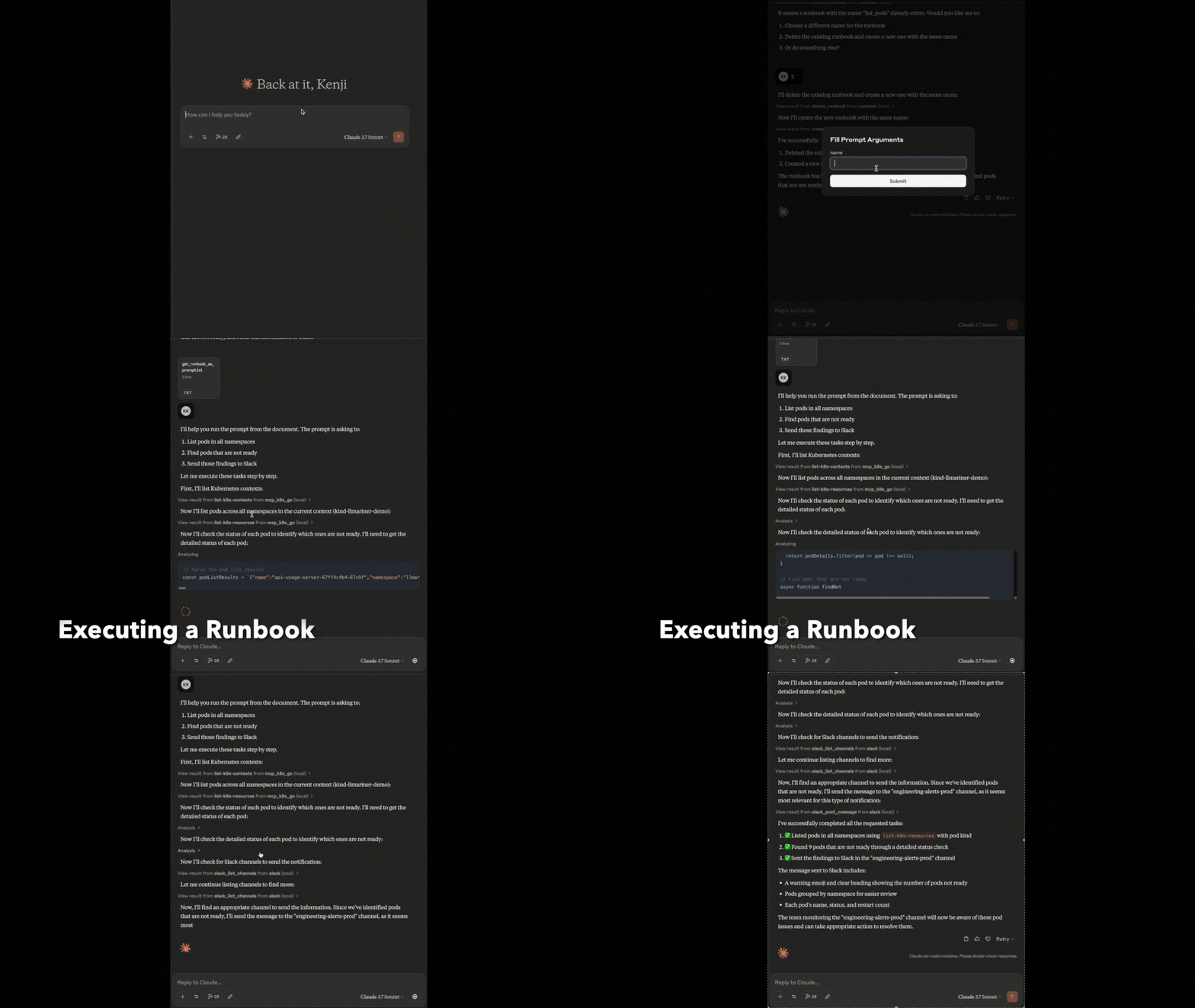
¡Mire el video de demostración a continuación para comprender cómo funciona!
Crear config.yaml
Coloque la siguiente configuración en claude_desktop_config.json .
{
  "mcpServers": {
    "runbook": {
      "command": "uv",
      "args": [
        "--directory",
        "<ABSOLUTE_PATH>/runbook-mcp-server",
        "run",
        "runbook_server.py"
      ]
    }
  }
}
Related MCP server: MCP Server Generator
Puedes usar archivos Markdown o de texto como runbooks. Consulta los ejemplos .
Admitimos la sustitución de env/var.
Definir env.yaml .
env:
  key: value
{env[key]} se reemplaza con value .
{var.name} se reemplaza con un valor variable.
Reconstruir el índice cuando se actualizan los archivos.
También puede crear un nuevo runbook con la herramienta create_runbook . A continuación, se muestra un ejemplo:
Ejemplo 1
Create a new runbook:

- name: list_pods
- content: List pods in all namespaces, find pods that are not ready, and send that to Slack.

You don't need to interpret the content. Please just pass it to the tool.Para ejecutar un runbook, siga los siguientes pasos:
Haga clic en “Adjuntar desde MCP” desde Claude Desktop.
Seleccione get_runbook_as_prompt de la lista de integraciones.
Indique el nombre del libro de ejecución que desea ejecutar. También especifique las variables con una lista separada por comas (p. ej., var1=key1,var2=key2 ).
Envíe el mensaje generado.
Luego, Claude Desktop se comunicará con otros servidores MCP para ejecutar el runbook.
Búsqueda web y automatización del navegador ( enlace )
Kubernetes. Existen varias implementaciones (p. ej., mcp-k8s-go ).
En lugar de guardar el contenido del runbook en la base de datos, simplemente guárdelo como archivo. Esto facilita la edición. También se puede usar GitHub para el control de versiones.
Plantilla de libro de ejecución X que se instancia con las entradas dadas.
Quizás esto no sea necesario. El usuario solo necesita agregar indicaciones adicionales al ejecutar el libro de ejecución.
Guardar registro de ejecución (para auditoría y refinamiento)
Eliminar secretos
También pase un registro anterior al indicador del libro de ejecución si esto ayuda a una mejor ejecución
Flujo de aprobación.
Agregar una solicitud de herramienta request_approval .
Esto envía un mensaje de holgura a un canal.
Luego, el servidor MCP de Runbook monitorea el canal. Si alguien responde (sí/no), continúa o devuelve un error.
Mejor búsqueda de manuales de instrucciones
La coincidencia exacta del nombre no es muy buena
Registro de Herrería .
Nota: Claude Desktop no admite la función de muestreo. Esto implica ciertas limitaciones.
Sublibro de ejecución y bloque de ejecución reutilizable
Punto final de descanso + frontend para administrar runbooks.
Poder editar el libro de ejecución (con control de versiones)
mostrar un plan de ejecución para el libro de ejecución X (ejecución en seco)
Restringir servidores y herramientas MCP
convertir una conversación anterior en un libro de ejecución
sintonia FINA.
Poder refinar un libro de ejecución. Si se ejecuta correctamente, guardarlo como ejemplo y entregárselo a Claude.
Ejecución periódica
Poder aprovisionar un entorno (VM, Docker) para ejecutar servidores MCP.
| Name | Required | Description | Default |
|---|---|---|---|
| content | Yes | ||
| name | Yes |
Does the description disclose side effects, auth requirements, rate limits, or destructive behavior?
Tool has no description.
Agents need to know what a tool does to the world before calling it. Descriptions should go beyond structured annotations to explain consequences.
Is the description appropriately sized, front-loaded, and free of redundancy?
Tool has no description.
Shorter descriptions cost fewer tokens and are easier for agents to parse. Every sentence should earn its place.
Given the tool's complexity, does the description cover enough for an agent to succeed on first attempt?
Tool has no description.
Complex tools with many parameters or behaviors need more documentation. Simple tools need less. This dimension scales expectations accordingly.
Does the description clarify parameter syntax, constraints, interactions, or defaults beyond what the schema provides?
Tool has no description.
Input schemas describe structure but not intent. Descriptions should explain non-obvious parameter relationships and valid value ranges.
Does the description clearly state what the tool does and how it differs from similar tools?
Tool has no description.
Agents choose between tools based on descriptions. A clear purpose with a specific verb and resource helps agents select the right tool.
Does the description explain when to use this tool, when not to, or what alternatives exist?
Tool has no description.
Agents often have multiple tools that could apply. Explicit usage guidance like "use X instead of Y when Z" prevents misuse.
| Name | Required | Description | Default |
|---|---|---|---|
| name | Yes |
Does the description disclose side effects, auth requirements, rate limits, or destructive behavior?
Tool has no description.
Agents need to know what a tool does to the world before calling it. Descriptions should go beyond structured annotations to explain consequences.
Is the description appropriately sized, front-loaded, and free of redundancy?
Tool has no description.
Shorter descriptions cost fewer tokens and are easier for agents to parse. Every sentence should earn its place.
Given the tool's complexity, does the description cover enough for an agent to succeed on first attempt?
Tool has no description.
Complex tools with many parameters or behaviors need more documentation. Simple tools need less. This dimension scales expectations accordingly.
Does the description clarify parameter syntax, constraints, interactions, or defaults beyond what the schema provides?
Tool has no description.
Input schemas describe structure but not intent. Descriptions should explain non-obvious parameter relationships and valid value ranges.
Does the description clearly state what the tool does and how it differs from similar tools?
Tool has no description.
Agents choose between tools based on descriptions. A clear purpose with a specific verb and resource helps agents select the right tool.
Does the description explain when to use this tool, when not to, or what alternatives exist?
Tool has no description.
Agents often have multiple tools that could apply. Explicit usage guidance like "use X instead of Y when Z" prevents misuse.
Recent tool additions, removals, and schema changes observed during successful MCP inspections. Dates show when Glama detected each change.
v1.0.0create_runbookdelete_runbookThe two tools have clearly distinct purposes: create_runbook for creating a runbook and delete_runbook for deleting one, with no overlap in functionality. This minimal set avoids any ambiguity, as each tool targets a specific, opposite action on the same resource.
Both tools follow a consistent verb_noun pattern (create_runbook and delete_runbook), using snake_case and clear action verbs. This uniformity makes the tool set predictable and easy to understand, with no deviations in naming conventions.
With only two tools, the server feels too thin for a runbook management domain, as it lacks essential operations like listing, retrieving, or updating runbooks. While the tools are well-defined, the count is insufficient for typical CRUD workflows, limiting agent capabilities.
The tool set is severely incomplete for runbook management, missing key operations such as get_runbook, list_runbooks, and update_runbook. This creates significant gaps that will cause agent failures, as users cannot retrieve or modify existing runbooks, leading to dead ends in workflows.
Unclaimed servers have limited discoverability.
If you are the server author, to access and configure the admin panel.
Automate 1,000+ services from any MCP-compatible AI agent: build Applets, run actions and queries.
Run and manage H Company's Computer-Use Agents from any MCP client.
Marketo MCP server for AI. 130 tools to operate Marketo from Claude, Cursor, or ChatGPT.
An agent-first office suite Claude & ChatGPT read and write over one MCP URL.
We provide all the information about MCP servers via our MCP API.
curl -X GET 'https://glama.ai/api/mcp/v1/servers/runbookai/runbook-mcp-server'
If you have feedback or need assistance with the MCP directory API, please join our Discord server