

F
licenseNot graded
qualityD
maintenanceA Model Context Protocol server that allows integration with Claude Desktop by creating and managing custom tools that can be executed through the MCP framework.
47
-

Mit dem Runbook MCP Server können Sie Ihre eigenen Runbooks von Claude Desktop aus ausführen.
Ausführen von Ops-Runbooks (z. B. Bereitstellen eines Dienstes, Aktualisieren eines Kubernetes-Clusters)
Führen Sie manuelle Testpläne aus (erstellen Sie beispielsweise eine neue EC2-Instanz, greifen Sie per SSH auf die Instanz zu und führen Sie dort den Integrationstest aus).
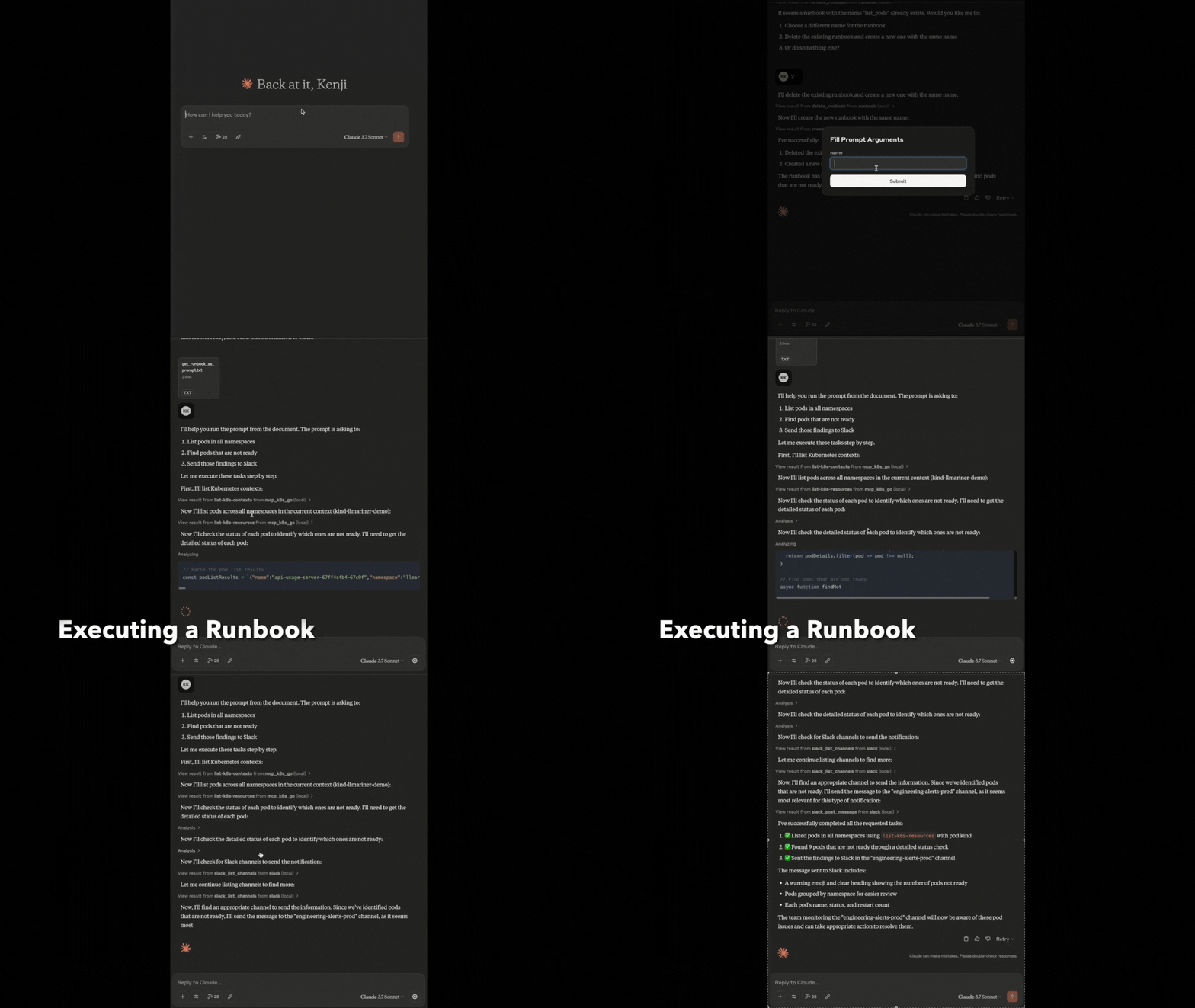
Bitte sehen Sie sich das Demo-Video unten an, um zu verstehen, wie es funktioniert!
Erstellen Sie config.yaml
Fügen Sie die folgende Konfiguration in claude_desktop_config.json ein.
{
  "mcpServers": {
    "runbook": {
      "command": "uv",
      "args": [
        "--directory",
        "<ABSOLUTE_PATH>/runbook-mcp-server",
        "run",
        "runbook_server.py"
      ]
    }
  }
}
Related MCP server: MCP Server Generator
Sie können Markdown-Dateien oder Textdateien als Runbooks verwenden. Siehe Beispiele .
Wir unterstützen die Umgebungs-/Var-Substitution.
Definieren Sie env.yaml .
env:
  key: value
{env[key]} wird durch value ersetzt.
{var.name} wird durch einen Variablenwert ersetzt.
Erstellen Sie den Index neu, wenn Dateien aktualisiert werden.
Sie können auch ein neues Runbook erstellen. Verwenden Sie dazu das Tool create_runbook . Hier ist eine Beispieleingabeaufforderung:
Beispiel 1
Create a new runbook:

- name: list_pods
- content: List pods in all namespaces, find pods that are not ready, and send that to Slack.

You don't need to interpret the content. Please just pass it to the tool.Führen Sie zum Ausführen eines Runbooks die folgenden Schritte aus:
Klicken Sie auf „Von MCP anhängen“ von Claude Desktop.
Wählen Sie get_runbook_as_prompt aus der Liste der Integrationen aus.
Übergeben Sie den Namen des Runbooks, das Sie ausführen möchten. Geben Sie außerdem Variablen in einer durch Kommas getrennten Liste an (z. B. var1=key1,var2=key2 ).
Senden Sie die generierte Eingabeaufforderung.
Anschließend kommuniziert Claude Desktop mit anderen MCP-Servern, um das Runbook auszuführen.
Websuche und Browserautomatisierung ( Link )
Kubernetes. Es gibt mehrere Implementierungen (z. B. mcp-k8s-go ).
Anstatt den Inhalt des Runbooks in der Datenbank zu speichern, speichern Sie ihn einfach als Datei. Dies erleichtert die Bearbeitung. Für die Versionierung können Sie auch einfach GitHub verwenden.
Runbook-Vorlage X, die mit den angegebenen Eingaben instanziiert wird.
Dies ist möglicherweise nicht erforderlich. Ein Benutzer muss beim Ausführen des Runbooks lediglich zusätzliche Eingabeaufforderungen einfügen.
Ausführungsprotokoll speichern (zur Überprüfung und Verfeinerung)
Geheimnisse entfernen
Übergeben Sie außerdem ein früheres Protokoll an die Runbook-Eingabeaufforderung, wenn dies zu einer besseren Ausführung beiträgt
Genehmigungsablauf.
Fügen Sie ein Tool request_approval hinzu.
Dadurch wird eine Slack-Nachricht an einen Kanal gesendet.
Anschließend überwacht der Runbook MCP-Server den Kanal. Wenn jemand antwortet (ja/nein), wird der Kanal fortgesetzt oder ein Fehler zurückgegeben.
Bessere Runbook-Suche
Die genaue Namensübereinstimmung ist nicht besonders gut
Registrierung bei Smithery .
Hinweis: Claude Desktop unterstützt kein „Sampling“. Dies bringt einige Einschränkungen mit sich.
Untergeordnetes Runbook und wiederverwendbarer Ausführungsblock
Rest-Endpunkt + Frontend zum Verwalten von Runbooks.
Das Runbook bearbeiten können (mit Versionierung)
Zeigen Sie einen Ausführungsplan für Runbook X (Trockenlauf).
MCP-Server und -Tools einschränken
Konvertieren einer vorherigen Konversation in ein Runbook
Feinabstimmung.
Sie können ein Runbook verfeinern. Bei erfolgreicher Ausführung speichern Sie es als Beispiel und geben es an Claude weiter.
Periodische Ausführung
Sie müssen in der Lage sein, eine Umgebung (VM, Docker) zum Ausführen von MCP-Servern bereitzustellen.
| Name | Required | Description | Default |
|---|---|---|---|
| content | Yes | ||
| name | Yes |
Does the description disclose side effects, auth requirements, rate limits, or destructive behavior?
Tool has no description.
Agents need to know what a tool does to the world before calling it. Descriptions should go beyond structured annotations to explain consequences.
Is the description appropriately sized, front-loaded, and free of redundancy?
Tool has no description.
Shorter descriptions cost fewer tokens and are easier for agents to parse. Every sentence should earn its place.
Given the tool's complexity, does the description cover enough for an agent to succeed on first attempt?
Tool has no description.
Complex tools with many parameters or behaviors need more documentation. Simple tools need less. This dimension scales expectations accordingly.
Does the description clarify parameter syntax, constraints, interactions, or defaults beyond what the schema provides?
Tool has no description.
Input schemas describe structure but not intent. Descriptions should explain non-obvious parameter relationships and valid value ranges.
Does the description clearly state what the tool does and how it differs from similar tools?
Tool has no description.
Agents choose between tools based on descriptions. A clear purpose with a specific verb and resource helps agents select the right tool.
Does the description explain when to use this tool, when not to, or what alternatives exist?
Tool has no description.
Agents often have multiple tools that could apply. Explicit usage guidance like "use X instead of Y when Z" prevents misuse.
| Name | Required | Description | Default |
|---|---|---|---|
| name | Yes |
Does the description disclose side effects, auth requirements, rate limits, or destructive behavior?
Tool has no description.
Agents need to know what a tool does to the world before calling it. Descriptions should go beyond structured annotations to explain consequences.
Is the description appropriately sized, front-loaded, and free of redundancy?
Tool has no description.
Shorter descriptions cost fewer tokens and are easier for agents to parse. Every sentence should earn its place.
Given the tool's complexity, does the description cover enough for an agent to succeed on first attempt?
Tool has no description.
Complex tools with many parameters or behaviors need more documentation. Simple tools need less. This dimension scales expectations accordingly.
Does the description clarify parameter syntax, constraints, interactions, or defaults beyond what the schema provides?
Tool has no description.
Input schemas describe structure but not intent. Descriptions should explain non-obvious parameter relationships and valid value ranges.
Does the description clearly state what the tool does and how it differs from similar tools?
Tool has no description.
Agents choose between tools based on descriptions. A clear purpose with a specific verb and resource helps agents select the right tool.
Does the description explain when to use this tool, when not to, or what alternatives exist?
Tool has no description.
Agents often have multiple tools that could apply. Explicit usage guidance like "use X instead of Y when Z" prevents misuse.
Recent tool additions, removals, and schema changes observed during successful MCP inspections. Dates show when Glama detected each change.
v1.0.0create_runbookdelete_runbookThe two tools have clearly distinct purposes: create_runbook for creating a runbook and delete_runbook for deleting one, with no overlap in functionality. This minimal set avoids any ambiguity, as each tool targets a specific, opposite action on the same resource.
Both tools follow a consistent verb_noun pattern (create_runbook and delete_runbook), using snake_case and clear action verbs. This uniformity makes the tool set predictable and easy to understand, with no deviations in naming conventions.
With only two tools, the server feels too thin for a runbook management domain, as it lacks essential operations like listing, retrieving, or updating runbooks. While the tools are well-defined, the count is insufficient for typical CRUD workflows, limiting agent capabilities.
The tool set is severely incomplete for runbook management, missing key operations such as get_runbook, list_runbooks, and update_runbook. This creates significant gaps that will cause agent failures, as users cannot retrieve or modify existing runbooks, leading to dead ends in workflows.
Unclaimed servers have limited discoverability.
If you are the server author, to access and configure the admin panel.
Automate 1,000+ services from any MCP-compatible AI agent: build Applets, run actions and queries.
Run and manage H Company's Computer-Use Agents from any MCP client.
Marketo MCP server for AI. 130 tools to operate Marketo from Claude, Cursor, or ChatGPT.
An agent-first office suite Claude & ChatGPT read and write over one MCP URL.
We provide all the information about MCP servers via our MCP API.
curl -X GET 'https://glama.ai/api/mcp/v1/servers/runbookai/runbook-mcp-server'
If you have feedback or need assistance with the MCP directory API, please join our Discord server