

F
licenseNot graded
qualityD
maintenanceA Model Context Protocol server that allows integration with Claude Desktop by creating and managing custom tools that can be executed through the MCP framework.
47
-

Runbook MCP Server 使您能够从 Claude Desktop 运行自己的运行手册。
运行操作手册(例如,部署服务、升级 Kubernetes 集群)
运行手动测试计划(例如,创建一个新的 EC2 实例,通过 ssh 进入该实例,然后在那里运行集成测试)。
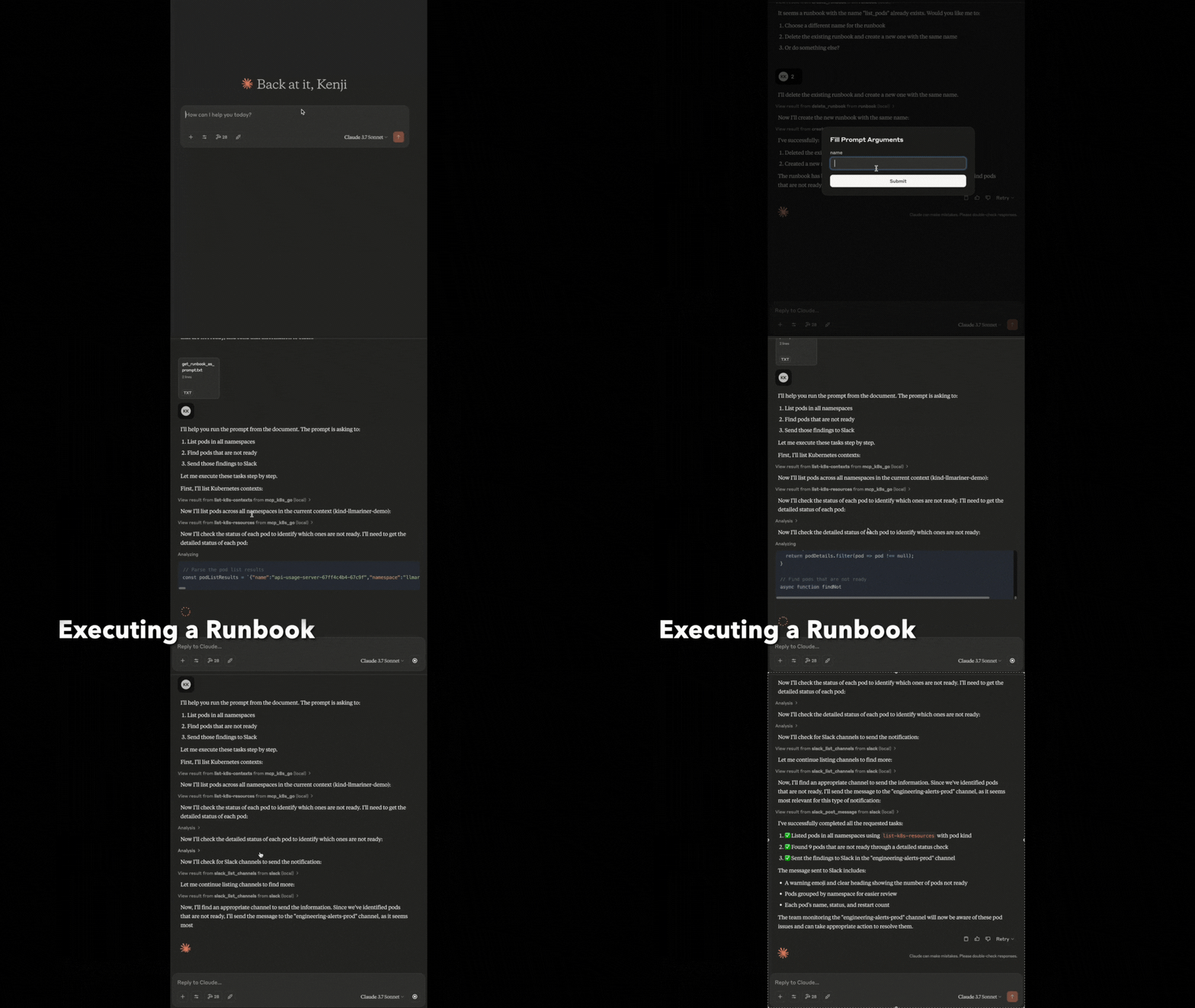
请观看下面的演示视频以了解其工作原理!
创建config.yaml
将以下配置放入claude_desktop_config.json中。
{
  "mcpServers": {
    "runbook": {
      "command": "uv",
      "args": [
        "--directory",
        "<ABSOLUTE_PATH>/runbook-mcp-server",
        "run",
        "runbook_server.py"
      ]
    }
  }
}
Related MCP server: MCP Server Generator
您可以使用 Markdown 文件或文本文件作为 Runbook。请参阅示例。
我们支持 env/var 替换。
定义env.yaml 。
env:
key: value{env[key]}被替换为value 。
{var.name}被替换为变量值。
当文件更新时重建索引。
您还可以创建新的 Runbook,使用create_runbook工具。以下是示例提示:
示例 1
Create a new runbook:

- name: list_pods
- content: List pods in all namespaces, find pods that are not ready, and send that to Slack.

You don't need to interpret the content. Please just pass it to the tool.要运行 Runbook,请执行以下步骤:
在 Claude Desktop 中单击“从 MCP 附加”。
从集成列表中选择get_runbook_as_prompt 。
传递要执行的 Runbook 的名称。同时,请使用逗号分隔的列表指定变量(例如, var1=key1,var2=key2 )。
提交生成的提示。
然后,Claude Desktop 将与其他 MCP 服务器通信以运行运行手册。
网络搜索和浏览器自动化(链接)
Kubernetes。有几种实现(例如mcp-k8s-go )
无需将 Runbook 的内容保存到数据库中,只需将其保存为文件即可。这有助于轻松编辑。此外,用户还可以直接使用 GitHub 进行版本控制。
使用给定输入实例化的 Runbook 模板 X。
也许这不是必需的。用户只需要在运行 Runbook 时添加额外的提示即可。
保存执行日志(用于审计和改进)
删除机密
如果这有助于更好地执行,还可以将过去的日志传递给运行手册提示
审批流程。
添加工具request_approval 。
这会向频道发送一条松弛消息。
然后,Runbook MCP 服务器会监视该通道。如果有人响应(是/否),则继续执行,否则返回错误。
更好的运行手册搜索
名字不太准确
注册至Smithery 。
注意:Claude Desktop 不支持“采样”。这会带来一些限制。
子运行手册和可重复使用的执行块
用于管理运行手册的休息端点 + 前端。
能够编辑运行手册(带版本控制)
显示运行手册 X 的执行计划(试运行)
限制 MCP 服务器和工具
将之前的对话转换成运行手册
微调。
能够完善运行手册。如果执行成功,请将其保存为示例并交给 Claude。
定期执行
能够为运行 MCP 服务器提供环境(VM、docker)。
| Name | Required | Description | Default |
|---|---|---|---|
| content | Yes | ||
| name | Yes |
Does the description disclose side effects, auth requirements, rate limits, or destructive behavior?
Tool has no description.
Agents need to know what a tool does to the world before calling it. Descriptions should go beyond structured annotations to explain consequences.
Is the description appropriately sized, front-loaded, and free of redundancy?
Tool has no description.
Shorter descriptions cost fewer tokens and are easier for agents to parse. Every sentence should earn its place.
Given the tool's complexity, does the description cover enough for an agent to succeed on first attempt?
Tool has no description.
Complex tools with many parameters or behaviors need more documentation. Simple tools need less. This dimension scales expectations accordingly.
Does the description clarify parameter syntax, constraints, interactions, or defaults beyond what the schema provides?
Tool has no description.
Input schemas describe structure but not intent. Descriptions should explain non-obvious parameter relationships and valid value ranges.
Does the description clearly state what the tool does and how it differs from similar tools?
Tool has no description.
Agents choose between tools based on descriptions. A clear purpose with a specific verb and resource helps agents select the right tool.
Does the description explain when to use this tool, when not to, or what alternatives exist?
Tool has no description.
Agents often have multiple tools that could apply. Explicit usage guidance like "use X instead of Y when Z" prevents misuse.
| Name | Required | Description | Default |
|---|---|---|---|
| name | Yes |
Does the description disclose side effects, auth requirements, rate limits, or destructive behavior?
Tool has no description.
Agents need to know what a tool does to the world before calling it. Descriptions should go beyond structured annotations to explain consequences.
Is the description appropriately sized, front-loaded, and free of redundancy?
Tool has no description.
Shorter descriptions cost fewer tokens and are easier for agents to parse. Every sentence should earn its place.
Given the tool's complexity, does the description cover enough for an agent to succeed on first attempt?
Tool has no description.
Complex tools with many parameters or behaviors need more documentation. Simple tools need less. This dimension scales expectations accordingly.
Does the description clarify parameter syntax, constraints, interactions, or defaults beyond what the schema provides?
Tool has no description.
Input schemas describe structure but not intent. Descriptions should explain non-obvious parameter relationships and valid value ranges.
Does the description clearly state what the tool does and how it differs from similar tools?
Tool has no description.
Agents choose between tools based on descriptions. A clear purpose with a specific verb and resource helps agents select the right tool.
Does the description explain when to use this tool, when not to, or what alternatives exist?
Tool has no description.
Agents often have multiple tools that could apply. Explicit usage guidance like "use X instead of Y when Z" prevents misuse.
Recent tool additions, removals, and schema changes observed during successful MCP inspections. Dates show when Glama detected each change.
v1.0.0create_runbookdelete_runbookThe two tools have clearly distinct purposes: create_runbook for creating a runbook and delete_runbook for deleting one, with no overlap in functionality. This minimal set avoids any ambiguity, as each tool targets a specific, opposite action on the same resource.
Both tools follow a consistent verb_noun pattern (create_runbook and delete_runbook), using snake_case and clear action verbs. This uniformity makes the tool set predictable and easy to understand, with no deviations in naming conventions.
With only two tools, the server feels too thin for a runbook management domain, as it lacks essential operations like listing, retrieving, or updating runbooks. While the tools are well-defined, the count is insufficient for typical CRUD workflows, limiting agent capabilities.
The tool set is severely incomplete for runbook management, missing key operations such as get_runbook, list_runbooks, and update_runbook. This creates significant gaps that will cause agent failures, as users cannot retrieve or modify existing runbooks, leading to dead ends in workflows.
Unclaimed servers have limited discoverability.
If you are the server author, to access and configure the admin panel.
Automate 1,000+ services from any MCP-compatible AI agent: build Applets, run actions and queries.
Run and manage H Company's Computer-Use Agents from any MCP client.
Marketo MCP server for AI. 130 tools to operate Marketo from Claude, Cursor, or ChatGPT.
An agent-first office suite Claude & ChatGPT read and write over one MCP URL.
We provide all the information about MCP servers via our MCP API.
curl -X GET 'https://glama.ai/api/mcp/v1/servers/runbookai/runbook-mcp-server'
If you have feedback or need assistance with the MCP directory API, please join our Discord server