MCP Character Counter
MCP文字カウンター
テキストの詳細な文字分析を提供する軽量の Model Context Protocol (MCP) サーバー。このツールは、文字数の合計、スペースのない文字数、文字、数字、記号をカウントします。
特徴
テキスト内の文字数をカウントする
スペースを除いた文字数を数える
文字を数える(az、AZ)
数字を数える(0~9)
記号(英数字以外の文字)を数える
キャラクタータイプの詳細な内訳
Related MCP server: File Analysis MCP Server
インストール
前提条件
Node.js v17以上
Claude DesktopまたはGitHub Copilotまたはその他の MCP 対応クライアント
設定
リポジトリをクローンします。
git clone https://github.com/webreactiva-devs/mcp-character-counter.git cd mcp-character-counter依存関係をインストールします:
npm install
Claude Desktopでの使用
Claude デスクトップ構成を開きます。
macOS :
code ~/Library/Application\ Support/Claude/claude_desktop_config.jsonウィンドウズ:
code %APPDATA%\Claude\claude_desktop_config.jsonMCP サーバーに文字カウンターを追加します。
{ "mcpServers": { "character-counter": { "command": "node", "args": [ "/ABSOLUTE/PATH/TO/webreactiva-devs/mcp-character-counter/mcp/character-counter.js" ] } } }/ABSOLUTE/PATH/TO/システム上の現在のパスに置き換えます。新しい MCP サーバーをロードするには、Claude Desktop を再起動します。
入力ボックスで、利用可能な MCP ツールを示すハンマー アイコンを探します。
Claude にテキストの文字数を分析してもらいます。例:
「この段落の文字数を数えてください」
「このテキスト「123 Main St, Apt 45B」には数字がいくつありますか?」
「私のメールアドレスの文字構成を分析してください」
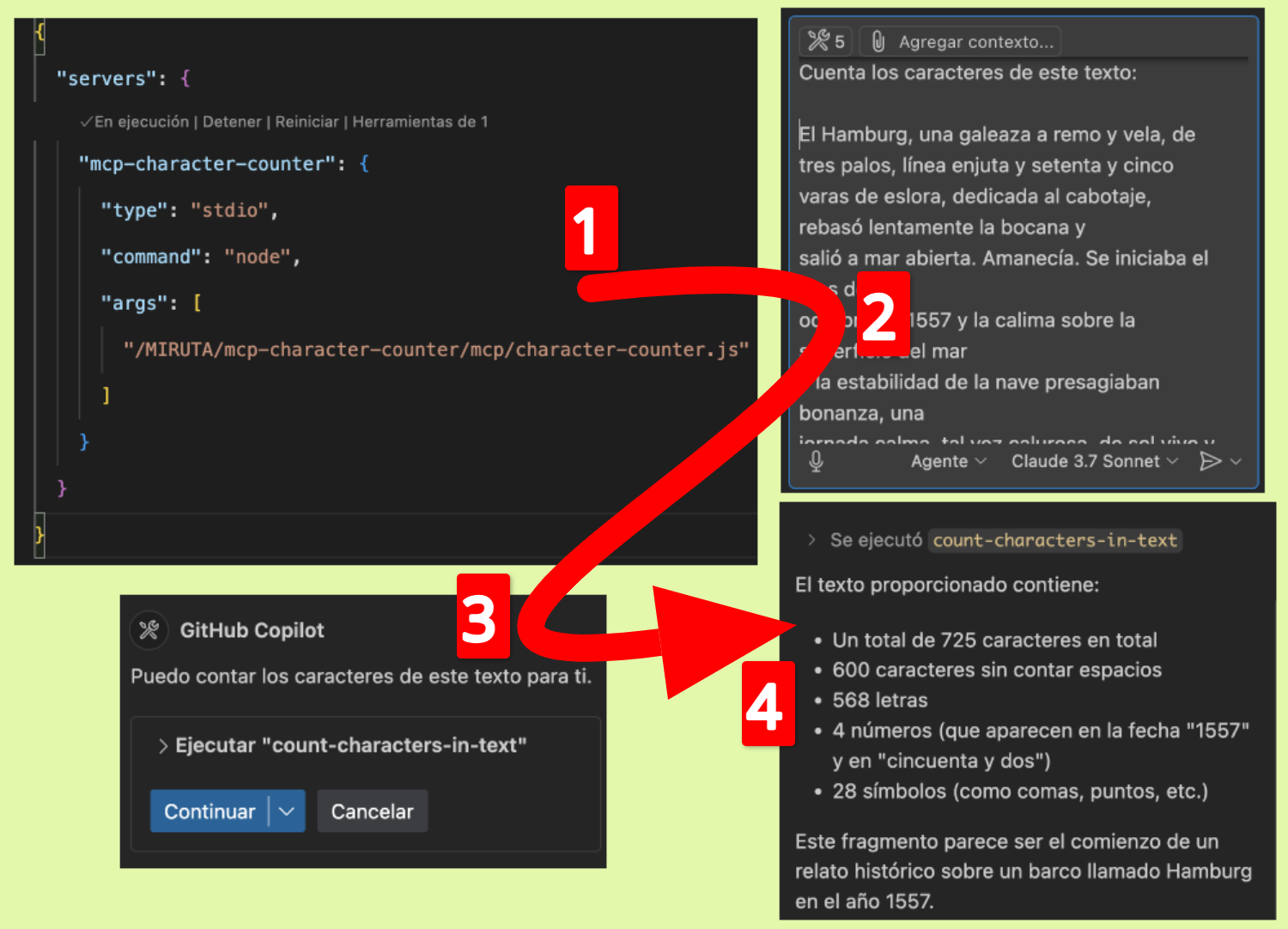
GitHub Copilot での使用
この MCP サーバーを GitHub Copilot で使用するには:
VS Code またはその他の互換性のある IDE に GitHub Copilot がインストールされていることを確認してください。
VS Code 設定を開き、「Copilot MCP」を検索します。
新しい MCP サーバー構成を追加します。
"github.copilot.advanced": { "mcp.servers": [ { "id": "character-counter", "name": "Character Counter", "transport": "stdio", "command": "node", "args": ["/path/to/webreactiva-devs/mcp-character-counter/mcp/character-counter.js"] } ] }VS Code を再起動します。
次のような Copilot Chat コマンドで文字数カウンターを使用できるようになりました。
/mcp count-characters-in-text This is the text I want to analyze
発達
この MCP サーバーを変更または拡張するには:
character-counter.jsに変更を加えますMCPクライアントでサーバーを再起動します
仕組み
この MCP サーバーは、テキスト入力を受け入れて文字構成の詳細な分析を返すcount-characters-in-textと呼ばれる単一のツールを実装します。サーバーはモデルコンテキストプロトコルを使用して、この機能を互換性のある AI アシスタントに公開します。
ライセンス
マサチューセッツ工科大学
貢献
貢献を歓迎します!お気軽にプルリクエストを送信してください。
MCP文字カウンター
テキスト内の詳細な文字分析を提供する軽量の Model Context Protocol (MCP) サーバー。このツールは、文字数の合計、スペースのない文字数、文字、数字、記号をカウントします。
特徴
テキスト内の文字数を数える
スペースを除いた文字数を数える
文字カウンター(az、AZ)
数字を数える(0~9)
記号(英数字以外の文字)を数える
キャラクタータイプの詳細な内訳
施設
前提条件
Node.js v17以上
Claude Desktop 、 GitHub Copilot 、またはその他のMCP互換クライアント
構成
リポジトリをクローンします。
git clone https://github.com/webreactiva-devs/mcp-character-counter.git cd mcp-character-counter依存関係をインストールします。
npm install
Claude Desktop で使用する
Claude デスクトップの設定を開きます:
macOS :
code ~/Library/Application\ Support/Claude/claude_desktop_config.jsonウィンドウズ:
code %APPDATA%\Claude\claude_desktop_config.jsonMCP サーバーに文字カウンターを追加します。
{ "mcpServers": { "character-counter": { "command": "node", "args": [ "/RUTA/ABSOLUTA/A/webreactiva-devs/mcp-character-counter/mcp/character-counter.js" ] } } }/RUTA/ABSOLUTA/A/システム上の現在のパスに置き換えます。新しい MCP サーバーをロードするには、Claude Desktop を再起動します。
入力ボックスで、使用可能な MCP ツールを示すハンマー アイコンを探します。
Claude にテキスト内の文字数を分析してもらいます。例:
「この段落の文字数を数えてください」
「このテキスト「123 Calle Principal, Apto 45B」には数字がいくつありますか?」
「メールアドレスの文字セットを分析する」
GitHub Copilot と併用する
この MCP サーバーを GitHub Copilot で使用するには:
VS Code またはサポートされている別の IDE に GitHub Copilot がインストールされていることを確認してください。
VS Code 設定を開き、「Copilot MCP」を検索します。
新しい MCP サーバー構成を追加します。
"github.copilot.advanced": { "mcp.servers": [ { "id": "character-counter", "name": "Character Counter", "transport": "stdio", "command": "node", "args": ["/ruta/a/webreactiva-devs/mcp-character-counter/mcp/character-counter.js"] } ] }VS Code を再起動します。
次のような Copilot Chat コマンドで文字数カウンターを使用できるようになりました。
/mcp count-characters-in-text Este es el texto que quiero analizar
発達
この MCP サーバーを変更または拡張するには:
character-counter.jsに変更を加えますMCPクライアントでサーバーを再起動します
仕組み
この MCP サーバーは、テキストを入力として受け入れ、文字構成の詳細な分析を返すcount-characters-in-textと呼ばれる単一のツールを実装します。サーバーはモデルコンテキストプロトコルを使用して、この機能を互換性のある AI アシスタントに公開します。
ライセンス
マサチューセッツ工科大学
貢献する
貢献を歓迎します!お気軽にプルリクエストを送信してください。
奥付
webreactiva.com の Malandriner コミュニティのために 🧡 で作成されました
Available Tools
1 toolcount-characters-in-textC
Count characters in a text
| Name | Required | Description | Default |
|---|---|---|---|
| text | Yes | The text whose characters you want to count |
TDQS
Does the description disclose side effects, auth requirements, rate limits, or destructive behavior?
No annotations are provided, so the description carries the full burden of behavioral disclosure. The description only states the basic function without mentioning any behavioral traits such as performance characteristics, error handling, or output format. This is inadequate for a tool with no annotation support.
Agents need to know what a tool does to the world before calling it. Descriptions should go beyond structured annotations to explain consequences.
Is the description appropriately sized, front-loaded, and free of redundancy?
The description is extremely concise—a single, clear sentence that directly states the tool's purpose without any unnecessary words. It is front-loaded and efficiently communicates the core function, making it easy for an agent to parse quickly.
Shorter descriptions cost fewer tokens and are easier for agents to parse. Every sentence should earn its place.
Given the tool's complexity, does the description cover enough for an agent to succeed on first attempt?
Given the lack of annotations and output schema, the description is incomplete. It fails to address behavioral aspects, output format, or any contextual nuances. While the tool is simple, the description does not provide enough information for an agent to fully understand how to use it effectively beyond the basic function.
Complex tools with many parameters or behaviors need more documentation. Simple tools need less. This dimension scales expectations accordingly.
Does the description clarify parameter syntax, constraints, interactions, or defaults beyond what the schema provides?
Schema description coverage is 100%, with the schema fully documenting the single 'text' parameter. The description adds no additional meaning beyond what the schema provides, such as examples or edge cases. The baseline score of 3 reflects adequate coverage by the schema alone.
Input schemas describe structure but not intent. Descriptions should explain non-obvious parameter relationships and valid value ranges.
Does the description clearly state what the tool does and how it differs from similar tools?
The description 'Count characters in a text' clearly states the verb ('count') and resource ('characters in a text'), making the purpose immediately understandable. It's not a tautology since it elaborates beyond the tool name. However, with no sibling tools mentioned, there's no opportunity to differentiate from alternatives, preventing a perfect score.
Agents choose between tools based on descriptions. A clear purpose with a specific verb and resource helps agents select the right tool.
Does the description explain when to use this tool, when not to, or what alternatives exist?
The description provides no guidance on when to use this tool versus alternatives, prerequisites, or contextual constraints. It simply states what the tool does without any usage context, leaving the agent to infer applicability based solely on the tool name and description.
Agents often have multiple tools that could apply. Explicit usage guidance like "use X instead of Y when Z" prevents misuse.
Tool Schema Changelog
Recent tool additions, removals, and schema changes observed during successful MCP inspections.
1 tool update
v1.0.0- First observed
count-characters-in-text
TDQS
Scored across 1 tool
With only one tool, there is no possibility of confusion or overlap between tools. The tool's purpose is singular and clearly defined, eliminating any ambiguity in selection.
The single tool name follows a clear verb_noun pattern (count-characters-in-text), and with only one tool, consistency is inherently perfect as there are no other names to compare against.
A single tool is too few for most practical server purposes, making the server feel thin and limited. While it might suffice for a trivial utility, it lacks the depth expected for broader functionality.
The tool covers its stated purpose of counting characters, but the server's scope is minimal. There are no obvious gaps for this narrow domain, but the surface is inherently limited and may not support more complex workflows.
Maintenance
Related MCP Connectors
Count occurrences of any character in your text instantly. Specify the character and get precise c…
A comprehensive Model Context Protocol (MCP) server that enables AI assistants to interact with yo…
English readability scores (Flesch, Flesch-Kincaid, Fog, SMOG) and text stats. Text never stored.
11MCP Server for Slima - AI Writing IDE for Novel Authors with AI Beta Reader.
Related MCP Servers
- AlicenseBqualityDmaintenanceA Model Context Protocol server that provides tools for analyzing text documents, including counting words and characters. This server helps LLMs perform text analysis tasks by exposing simple document statistics functionality.130 npm10Apache 2.0
- AlicenseNot gradedqualityDmaintenanceProvides tools for text file analysis, including metrics like word counts and character frequencies, alongside file reading and directory browsing capabilities. This server enables LLMs to interact with and process local file content securely through the Model Context Protocol.MIT
- FlicenseAqualityDmaintenanceA lightweight MCP server providing utility tools for math, text processing, data conversion, and URL fetching. It supports both STDIO and SSE communication modes for seamless integration with Claude Desktop and remote AI agents.51-
- AlicenseNot gradedqualityDmaintenanceProvides tools for AI models to count characters and words in text, supporting English and other space-delimited languages.1MIT