MCP Character Counter
The MCP Character Counter server provides detailed character analysis for text:
Count total characters
Count characters excluding spaces
Count letters (a-z, A-Z)
Count numbers (0-9)
Count symbols (non-alphanumeric characters)
Get detailed breakdown of character types
Enables GitHub Copilot to analyze text composition with character counting functionality through Copilot Chat commands
Click on "Deploy Server".
Wait a few minutes for the server to deploy. Once ready, it will show a "Started" state.
In the chat, type
@followed by the MCP server name and your instructions, e.g., "@MCP Character Countercount characters in this paragraph"
That's it! The server will respond to your query, and you can continue using it as needed.
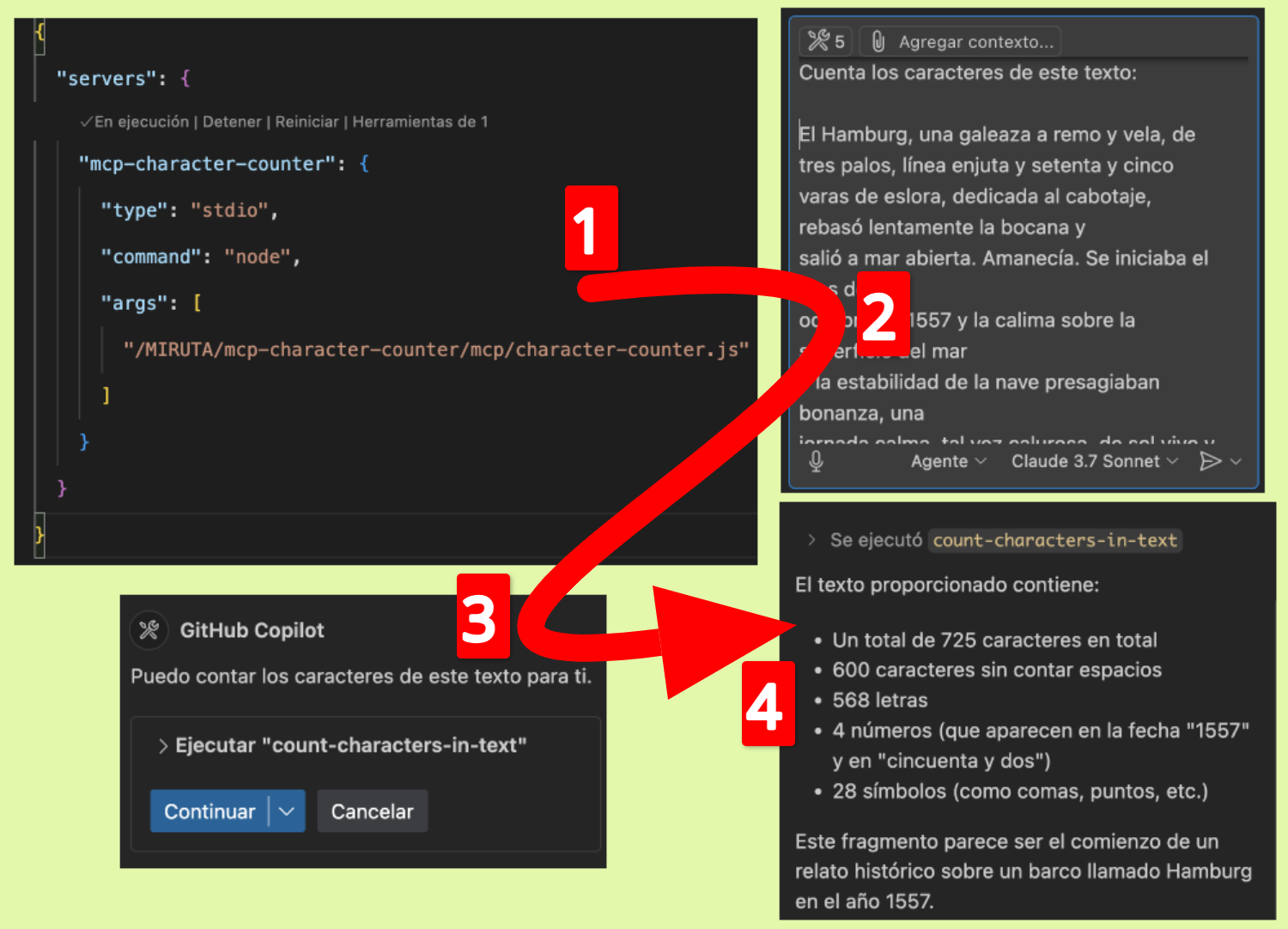
Here is a step-by-step guide with screenshots.
MCP Character Counter
A lightweight Model Context Protocol (MCP) server that provides detailed character analysis for text. This tool counts total characters, characters without spaces, letters, numbers, and symbols.
Features
Count total characters in text
Count characters excluding spaces
Count letters (az, AZ)
Count numbers (0-9)
Count symbols (non-alphanumeric characters)
Detailed breakdown of character types
Related MCP server: File Analysis MCP Server
Installation
Prerequisites
Node.js v17 or higher
Claude Desktop or GitHub Copilot or Other MCP supported clients
Setup
Clone the repository:
git clone https://github.com/webreactiva-devs/mcp-character-counter.git cd mcp-character-counterInstall dependencies:
npm install
Usage with Claude Desktop
Open your Claude Desktop configuration:
macOS :
code ~/Library/Application\ Support/Claude/claude_desktop_config.jsonWindows :
code %APPDATA%\Claude\claude_desktop_config.jsonAdd the character counter to your MCP servers:
{ "mcpServers": { "character-counter": { "command": "node", "args": [ "/ABSOLUTE/PATH/TO/webreactiva-devs/mcp-character-counter/mcp/character-counter.js" ] } } }Replace
/ABSOLUTE/PATH/TO/with the current path on your system.Restart Claude Desktop to load the new MCP server.
Look for the hammer icon in the input box, which indicates available MCP tools.
Ask Claude to analyze text character counts, for example:
"Count the characters in this paragraph"
"How many numbers are in this text: '123 Main St, Apt 45B'?"
"Analyze the character composition of my email address"
Usage with GitHub Copilot
To use this MCP server with GitHub Copilot:
Make sure you have GitHub Copilot installed in your VS Code or other compatible IDE.
Open VS Code settings and search for "Copilot MCP".
Add a new MCP server configuration:
"github.copilot.advanced": { "mcp.servers": [ { "id": "character-counter", "name": "Character Counter", "transport": "stdio", "command": "node", "args": ["/path/to/webreactiva-devs/mcp-character-counter/mcp/character-counter.js"] } ] }Restart VS Code.
You can now use the character counter with Copilot Chat commands like:
/mcp count-characters-in-text This is the text I want to analyze
Development
To modify or extend this MCP server:
Make your changes to
character-counter.jsRestart the server in your MCP client
How It Works
This MCP server implements a single tool called count-characters-in-text that accepts text input and returns a detailed analysis of character composition. The server uses the Model Context Protocol to expose this functionality to compatible AI assistants.
License
MIT
Contributing
Contributions are welcome! Please feel free to submit a Pull Request.
MCP Character Counter
A lightweight Model Context Protocol (MCP) server that provides detailed character analysis of text. This tool counts total characters, non-space characters, letters, numbers, and symbols.
Characteristics
Counts the total number of characters in a text
Count characters excluding spaces
Letter counter (az, AZ)
Count numbers (0-9)
Count symbols (non-alphanumeric characters)
Detailed breakdown of character types
Facility
Prerequisites
Node.js v17 or higher
Claude Desktop or GitHub Copilot or other MCP-compatible clients
Configuration
Clone the repository:
git clone https://github.com/webreactiva-devs/mcp-character-counter.git cd mcp-character-counterInstall the dependencies:
npm install
Use with Claude Desktop
Open Claude Desktop settings:
macOS :
code ~/Library/Application\ Support/Claude/claude_desktop_config.jsonWindows :
code %APPDATA%\Claude\claude_desktop_config.jsonAdd the character counter to your MCP servers:
{ "mcpServers": { "character-counter": { "command": "node", "args": [ "/RUTA/ABSOLUTA/A/webreactiva-devs/mcp-character-counter/mcp/character-counter.js" ] } } }Replace
/RUTA/ABSOLUTA/A/with the current path on your system.Restart Claude Desktop to load the new MCP server.
Look for the hammer icon in the input box, which indicates the available MCP tools.
Ask Claude to analyze the character count in a text, for example:
"Count the characters in this paragraph"
"How many numbers are in this text: '123 Calle Principal, Apto 45B'?"
"Analyze the character set of my email address"
Use with GitHub Copilot
To use this MCP server with GitHub Copilot:
Make sure you have GitHub Copilot installed in VS Code or another supported IDE.
Open VS Code settings and search for "Copilot MCP".
Add a new MCP server configuration:
"github.copilot.advanced": { "mcp.servers": [ { "id": "character-counter", "name": "Character Counter", "transport": "stdio", "command": "node", "args": ["/ruta/a/webreactiva-devs/mcp-character-counter/mcp/character-counter.js"] } ] }Restart VS Code.
You can now use the character counter with Copilot Chat commands like:
/mcp count-characters-in-text Este es el texto que quiero analizar
Development
To modify or extend this MCP server:
Make your changes to
character-counter.jsRestart the server on your MCP client
How it works
This MCP server implements a single tool called count-characters-in-text that accepts text as input and returns a detailed analysis of the character composition. The server uses the Model Context Protocol to expose this functionality to compatible AI assistants.
License
MIT
Contribute
Contributions are welcome! Please feel free to submit a Pull Request.
Colophon
Created with 🧡 for the Malandriner Community of webreactiva.com
Available Tools
1 toolcount-characters-in-textC
Count characters in a text
| Name | Required | Description | Default |
|---|---|---|---|
| text | Yes | The text whose characters you want to count |
TDQS
Does the description disclose side effects, auth requirements, rate limits, or destructive behavior?
No annotations are provided, so the description carries the full burden of behavioral disclosure. The description only states the basic function without mentioning any behavioral traits such as performance characteristics, error handling, or output format. This is inadequate for a tool with no annotation support.
Agents need to know what a tool does to the world before calling it. Descriptions should go beyond structured annotations to explain consequences.
Is the description appropriately sized, front-loaded, and free of redundancy?
The description is extremely concise—a single, clear sentence that directly states the tool's purpose without any unnecessary words. It is front-loaded and efficiently communicates the core function, making it easy for an agent to parse quickly.
Shorter descriptions cost fewer tokens and are easier for agents to parse. Every sentence should earn its place.
Given the tool's complexity, does the description cover enough for an agent to succeed on first attempt?
Given the lack of annotations and output schema, the description is incomplete. It fails to address behavioral aspects, output format, or any contextual nuances. While the tool is simple, the description does not provide enough information for an agent to fully understand how to use it effectively beyond the basic function.
Complex tools with many parameters or behaviors need more documentation. Simple tools need less. This dimension scales expectations accordingly.
Does the description clarify parameter syntax, constraints, interactions, or defaults beyond what the schema provides?
Schema description coverage is 100%, with the schema fully documenting the single 'text' parameter. The description adds no additional meaning beyond what the schema provides, such as examples or edge cases. The baseline score of 3 reflects adequate coverage by the schema alone.
Input schemas describe structure but not intent. Descriptions should explain non-obvious parameter relationships and valid value ranges.
Does the description clearly state what the tool does and how it differs from similar tools?
The description 'Count characters in a text' clearly states the verb ('count') and resource ('characters in a text'), making the purpose immediately understandable. It's not a tautology since it elaborates beyond the tool name. However, with no sibling tools mentioned, there's no opportunity to differentiate from alternatives, preventing a perfect score.
Agents choose between tools based on descriptions. A clear purpose with a specific verb and resource helps agents select the right tool.
Does the description explain when to use this tool, when not to, or what alternatives exist?
The description provides no guidance on when to use this tool versus alternatives, prerequisites, or contextual constraints. It simply states what the tool does without any usage context, leaving the agent to infer applicability based solely on the tool name and description.
Agents often have multiple tools that could apply. Explicit usage guidance like "use X instead of Y when Z" prevents misuse.
Tool Schema Changelog
Recent tool additions, removals, and schema changes observed during successful MCP inspections.
1 tool update
v1.0.0- First observed
count-characters-in-text
TDQS
Scored across 1 tool
With only one tool, there is no possibility of confusion or overlap between tools. The tool's purpose is singular and clearly defined, eliminating any ambiguity in selection.
The single tool name follows a clear verb_noun pattern (count-characters-in-text), and with only one tool, consistency is inherently perfect as there are no other names to compare against.
A single tool is too few for most practical server purposes, making the server feel thin and limited. While it might suffice for a trivial utility, it lacks the depth expected for broader functionality.
The tool covers its stated purpose of counting characters, but the server's scope is minimal. There are no obvious gaps for this narrow domain, but the surface is inherently limited and may not support more complex workflows.
Maintenance
Related MCP Connectors
Count occurrences of any character in your text instantly. Specify the character and get precise c…
A comprehensive Model Context Protocol (MCP) server that enables AI assistants to interact with yo…
MCP Server for Slima - AI Writing IDE for Novel Authors with AI Beta Reader.
Exact Claude API cost calc with real cache economics, plus a tiktoken-misuse scanner.
Related MCP Servers
- AlicenseBqualityDmaintenanceA Model Context Protocol server that provides tools for analyzing text documents, including counting words and characters. This server helps LLMs perform text analysis tasks by exposing simple document statistics functionality.12210Apache 2.0
- AlicenseNot gradedqualityDmaintenanceProvides tools for text file analysis, including metrics like word counts and character frequencies, alongside file reading and directory browsing capabilities. This server enables LLMs to interact with and process local file content securely through the Model Context Protocol.MIT
- FlicenseAqualityDmaintenanceA lightweight MCP server providing utility tools for math, text processing, data conversion, and URL fetching. It supports both STDIO and SSE communication modes for seamless integration with Claude Desktop and remote AI agents.51-
- AlicenseNot gradedqualityDmaintenanceProvides tools for AI models to count characters and words in text, supporting English and other space-delimited languages.1MIT