


A
licenseB
qualityA
maintenanceAn AI-powered tool that generates modern UI components from natural language descriptions, integrating with popular IDEs to streamline UI development workflow.
4
11,918 npm
5,996
ISC

This server powers the Magic Component Platform, allowing you to:
Generate UI Components: Create React components by describing them in natural language or using the /ui command. Outputs ready-to-use code snippets with TypeScript support.
Search for Logos: Find company logos in JSX, TSX, or SVG formats using the /logo command or company names, with SVGL integration for professional brand assets.
Get Component Inspiration: Browse and preview UI components from 21st.dev without generating new code.
All generated components are designed for seamless integration into your codebase and are fully customizable.
Offers community support and feedback through an official Discord server
Provides access to source code and contribution opportunities through GitHub
Requires Node.js as a prerequisite for installation and operation
Generates modern React UI components from natural language descriptions that can be customized and integrated into existing React projects
Integrates with SVGL to provide access to professional brand assets and logos for UI components
Provides full TypeScript support for type-safe UI component development
Click on "Deploy Server".
Wait a few minutes for the server to deploy. Once ready, it will show a "Started" state.
In the chat, type @ followed by the MCP server name and your instructions, e.g., "@Magic Component Platform create a modern login form with dark mode toggle"
That's it! The server will respond to your query, and you can continue using it as needed.
Here is a step-by-step guide with screenshots.
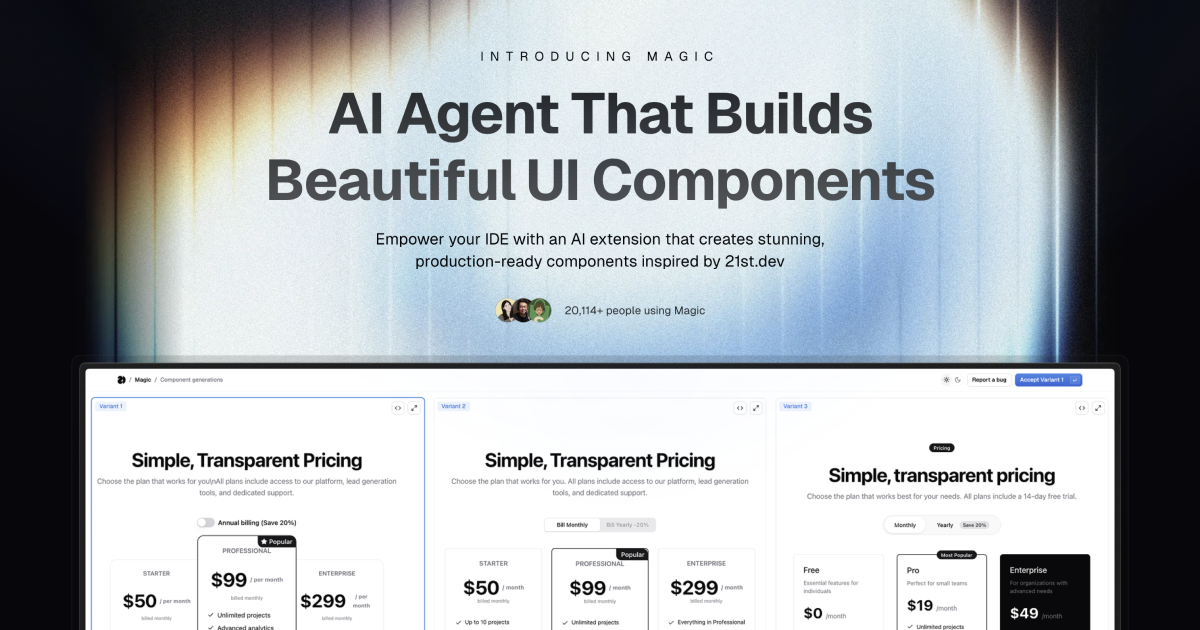
Magic Component Platform (MCP) is a powerful AI-driven tool that helps developers create beautiful, modern UI components instantly through natural language descriptions. It integrates seamlessly with popular IDEs and provides a streamlined workflow for UI development.
AI-Powered UI Generation: Create UI components by describing them in natural language
Multi-IDE Support:
Cursor IDE integration
Windsurf support
VSCode + Cline integration (Beta)
Modern Component Library: Access to a vast collection of pre-built, customizable components inspired by 21st.dev
Real-time Preview: Instantly see your components as you create them
TypeScript Support: Full TypeScript support for type-safe development
SVGL Integration: Access to a vast collection of professional brand assets and logos
Component Enhancement: Improve existing components with advanced features and animations (Coming Soon)
Related MCP server: 21st.dev Magic AI Agent
Tell Agent What You Need
In your AI Agent's chat, just type /ui and describe the component you're looking for
Example: /ui create a modern navigation bar with responsive design
Let Magic Create It
Your IDE prompts you to use Magic
Magic instantly builds a polished UI component
Components are inspired by 21st.dev's library
Seamless Integration
Components are automatically added to your project
Start using your new UI components right away
All components are fully customizable
Node.js (Latest LTS version recommended)
One of the supported IDEs:
Cursor
Windsurf
VSCode (with Cline extension)
Generate API Key
Visit your Magic dashboard
Navigate to the API section
Generate a new API key
IDE Setup
npx -y @smithery/cli@latest run @21st-dev/magic-mcp --config "{\"TWENTY_FIRST_API_KEY\":\"your-api-key\"}"Add to ~/.codeium/windsurf/mcp_config.json:
{
  "mcpServers": {
    "magic": {
      "command": "npx",
      "args": [
        "-y",
        "@smithery/cli@latest",
        "install",
        "@21st-dev/magic-mcp",
        "--client",
        "windsurf"
      ],
      "env": {
        "TWENTY_FIRST_API_KEY": "your-api-key"
      }
    }
  }
}Add to Cline's MCP configuration:
{
  "mcpServers": {
    "magic": {
      "command": "npx",
      "args": [
        "-y",
        "@smithery/cli@latest",
        "install",
        "@21st-dev/magic-mcp",
        "--client",
        "cline"
      ],
      "env": {
        "TWENTY_FIRST_API_KEY": "your-api-key"
      }
    }
  }
}Magic AI Agent only writes or modifies files related to the components it generates. It follows your project's code style and structure, and integrates seamlessly with your existing codebase without affecting other parts of your application.
Yes! All generated components are fully editable and come with well-structured code. You can modify the styling, functionality, and behavior just like any other React component in your codebase.
If you exceed your monthly generation limit, you'll be prompted to upgrade your plan. You can upgrade at any time to continue generating components. Your existing components will remain fully functional.
Authors can publish components to 21st.dev at any time, and Magic Agent will have immediate access to them. This means you'll always have access to the latest components and design patterns from the community.
Magic AI Agent can handle components of varying complexity, from simple buttons to complex interactive forms. However, for best results, we recommend breaking down very complex UIs into smaller, manageable components.
mcp/
├── app/
│   └── components/     # Core UI components
├── types/             # TypeScript type definitions
├── lib/              # Utility functions
└── public/ # Static assetsIdeInstructions: Setup instructions for different IDEs
ApiKeySection: API key management interface
WelcomeOnboarding: Onboarding flow for new users
We welcome contributions! Please join our Discord community and provide feedback to help improve Magic Agent. The source code is available on GitHub.
Discord Community - Join our active community
Twitter - Follow us for updates
Magic Agent is currently in beta. All features are free during this period. We appreciate your feedback and patience as we continue to improve the platform.
MIT License
Thanks to our beta testers and community members
Special thanks to the Cursor, Windsurf, and Cline teams for their collaboration
Integration with 21st.dev for component inspiration
SVGL for logo and brand asset integration
For more information, join our Discord community or visit 21st.dev/magic.
"Use this tool when the user requests a new UI component—e.g., mentions /ui, /21 /21st, or asks for a button, input, dialog, table, form, banner, card, or other React component. This tool ONLY returns the text snippet for that UI component. After calling this tool, you must edit or add files to integrate the snippet into the codebase."
| Name | Required | Description | Default |
|---|---|---|---|
| message | Yes | Full users message | |
| searchQuery | Yes | Generate a search query for 21st.dev (library for searching UI components) to find a UI component that matches the user's message. Must be a two-four words max or phrase |
Does the description disclose side effects, auth requirements, rate limits, or destructive behavior?
With no annotations provided, the description carries the full burden of behavioral disclosure. It explains that the tool returns text snippets and requires manual integration afterward, which is useful context. However, it doesn't disclose important behavioral traits like whether this is a read-only operation, if it makes external API calls, potential rate limits, or error handling for invalid requests.
Agents need to know what a tool does to the world before calling it. Descriptions should go beyond structured annotations to explain consequences.
Is the description appropriately sized, front-loaded, and free of redundancy?
The description is extremely concise and well-structured with only three sentences, each serving a distinct purpose: trigger conditions, tool limitation, and required follow-up actions. There's zero wasted text, and the most important information (when to use the tool) is front-loaded.
Shorter descriptions cost fewer tokens and are easier for agents to parse. Every sentence should earn its place.
Given the tool's complexity, does the description cover enough for an agent to succeed on first attempt?
Given no annotations and no output schema, the description provides adequate context for a simple tool but has gaps. It explains the tool's purpose and usage well but doesn't describe what the output looks like (format, structure, or content of returned snippets) or address potential limitations or error conditions that would help an agent use it correctly.
Complex tools with many parameters or behaviors need more documentation. Simple tools need less. This dimension scales expectations accordingly.
Does the description clarify parameter syntax, constraints, interactions, or defaults beyond what the schema provides?
With 100% schema description coverage, the baseline is 3. The description doesn't add any parameter-specific information beyond what's already in the schema (message and searchQuery parameters are fully documented in the schema). No additional syntax, format, or usage details for parameters are provided in the description.
Input schemas describe structure but not intent. Descriptions should explain non-obvious parameter relationships and valid value ranges.
Does the description clearly state what the tool does and how it differs from similar tools?
The description clearly states the tool's purpose: 'returns the text snippet for that UI component' when users request new UI components. It specifies the exact trigger conditions (mentions of /ui, /21, /21st, or specific component types) and distinguishes it from sibling tools by focusing on returning component snippets rather than inspiration or logo searches.
Agents choose between tools based on descriptions. A clear purpose with a specific verb and resource helps agents select the right tool.
Does the description explain when to use this tool, when not to, or what alternatives exist?
The description provides explicit usage guidelines: 'Use this tool when the user requests a new UI component' with specific trigger examples, and distinguishes it from alternatives by stating 'This tool ONLY returns the text snippet' and requiring follow-up actions. It clearly defines when to use this tool versus other approaches.
Agents often have multiple tools that could apply. Explicit usage guidance like "use X instead of Y when Z" prevents misuse.
"Use this tool when the user wants to see component, get inspiration, or /21st fetch data and previews from 21st.dev. This tool returns the JSON data of matching components without generating new code. This tool ONLY returns the text snippet for that UI component. After calling this tool, you must edit or add files to integrate the snippet into the codebase."
| Name | Required | Description | Default |
|---|---|---|---|
| message | Yes | Full users message | |
| searchQuery | Yes | Search query for 21st.dev (library for searching UI components) to find a UI component that matches the user's message. Must be a two-four words max or phrase |
Does the description disclose side effects, auth requirements, rate limits, or destructive behavior?
With no annotations, the description carries the behavioral disclosure burden. It states that no code is generated, that only the text snippet is returned, and that the agent must edit or add files afterward. It does not cover authentication, limits, or exact return shape, but the key behavioral constraints are disclosed.
Agents need to know what a tool does to the world before calling it. Descriptions should go beyond structured annotations to explain consequences.
Is the description appropriately sized, front-loaded, and free of redundancy?
The description is short and front-loaded with the trigger conditions. There is some redundancy between 'returns the JSON data' and 'ONLY returns the text snippet', but the overall structure is efficient and the post-call instruction earns its place.
Shorter descriptions cost fewer tokens and are easier for agents to parse. Every sentence should earn its place.
Given the tool's complexity, does the description cover enough for an agent to succeed on first attempt?
For a two-parameter fetch-like tool with a rich schema and no output schema, this description provides sufficient context: when to use it, what it returns, what it does not do, and what the agent must do afterward. It could be slightly richer on output formatting, but it is largely complete.
Complex tools with many parameters or behaviors need more documentation. Simple tools need less. This dimension scales expectations accordingly.
Does the description clarify parameter syntax, constraints, interactions, or defaults beyond what the schema provides?
The input schema already documents both required parameters with 100% coverage, so the description adds limited semantic value beyond the schema. The description clarifies that searchQuery is for finding a matching UI component, but this is also reflected in the schema's parameter description.
Input schemas describe structure but not intent. Descriptions should explain non-obvious parameter relationships and valid value ranges.
Does the description clearly state what the tool does and how it differs from similar tools?
The description clearly identifies the action as fetching component data and previews from 21st.dev, and it contrasts itself with code generation by stating it does not generate new code. It does not explicitly distinguish itself from the refiner sibling, so it stops short of full differentiation.
Agents choose between tools based on descriptions. A clear purpose with a specific verb and resource helps agents select the right tool.
Does the description explain when to use this tool, when not to, or what alternatives exist?
The description opens with explicit trigger conditions: 'when the user wants to see component, get inspiration, or /21st'. It does not provide when-not guidance or name alternative tools, but the usage context is clear enough for an agent to select this tool appropriately.
Agents often have multiple tools that could apply. Explicit usage guidance like "use X instead of Y when Z" prevents misuse.
Search and return logos in specified format (JSX, TSX, SVG). Supports single and multiple logo searches with category filtering. Can return logos in different themes (light/dark) if available.
When to use this tool:
When user types "/logo" command (e.g., "/logo GitHub")
When user asks to add a company logo that's not in the local project
Example queries:
Single company: ["discord"]
Multiple companies: ["discord", "github", "slack"]
Specific brand: ["microsoft office"]
Command style: "/logo GitHub" -> ["github"]
Request style: "Add Discord logo to the project" -> ["discord"]
Format options:
TSX: Returns TypeScript React component
JSX: Returns JavaScript React component
SVG: Returns raw SVG markup
Each result includes:
Component name (e.g., DiscordIcon)
Component code
Import instructions
| Name | Required | Description | Default |
|---|---|---|---|
| format | Yes | Output format | |
| queries | Yes | List of company names to search for logos |
Does the description disclose side effects, auth requirements, rate limits, or destructive behavior?
With no annotations to lean on, the description carries the behavioral burden and does well by detailing supported formats, theme variations ('if available'), and the exact structure of results (component name, code, import instructions). It does not cover failure modes or no-result behavior, but the disclosed behavior is sufficient for the agent to anticipate what will happen.
Agents need to know what a tool does to the world before calling it. Descriptions should go beyond structured annotations to explain consequences.
Is the description appropriately sized, front-loaded, and free of redundancy?
The description is well-organized with clear sections for purpose, usage, examples, formats, and output structure. It is slightly longer than strictly necessary because example queries partially repeat the usage triggers, but each section earns its place and the key info is front-loaded in the first sentence.
Shorter descriptions cost fewer tokens and are easier for agents to parse. Every sentence should earn its place.
Given the tool's complexity, does the description cover enough for an agent to succeed on first attempt?
Given there is no output schema and no annotations, the description does a good job of explaining what the tool returns, including output format options and result fields. However, it mentions 'category filtering' even though the input schema has no category parameter, and it does not explain what happens when a logo is not found, leaving minor but real gaps.
Complex tools with many parameters or behaviors need more documentation. Simple tools need less. This dimension scales expectations accordingly.
Does the description clarify parameter syntax, constraints, interactions, or defaults beyond what the schema provides?
The schema already describes both parameters (format and queries), so the baseline is 3; the description adds significant value by defining what each format returns (TSX/JSX/SVG), providing concrete example query arrays, and showing how command-style inputs map to the queries parameter. This goes beyond the schema's minimal descriptions.
Input schemas describe structure but not intent. Descriptions should explain non-obvious parameter relationships and valid value ranges.
Does the description clearly state what the tool does and how it differs from similar tools?
The description opens with a precise verb and resource: 'Search and return logos in specified format (JSX, TSX, SVG).' It clearly distinguishes itself from sibling tools (which concern component inspiration, refining, and building) by focusing on logo lookup and output formats. The example queries and command styles reinforce exactly what the tool does.
Agents choose between tools based on descriptions. A clear purpose with a specific verb and resource helps agents select the right tool.
Does the description explain when to use this tool, when not to, or what alternatives exist?
The 'When to use this tool' section explicitly lists two concrete trigger conditions: user types '/logo' command or asks to add a company logo not in the local project. The phrase 'that's not in the local project' provides a clear when-not-to-use condition, effectively excluding cases where the logo is already available locally.
Agents often have multiple tools that could apply. Explicit usage guidance like "use X instead of Y when Z" prevents misuse.
Recent tool additions, removals, and schema changes observed during successful MCP inspections.
v1.0.021st_magic_component_builder21st_magic_component_inspirationlogo_searchScored across 3 tools
The first two tools have significant overlap in purpose and confusing descriptions. Both '21st_magic_component_builder' and '21st_magic_component_inspiration' claim to return UI component snippets and require integration into the codebase, making it unclear when to use one versus the other. The third tool 'logo_search' is clearly distinct for logo handling, but the ambiguity between the first two tools is problematic.
The naming is inconsistent with mixed conventions. The first two tools use a verbose '21st_magic_component_' prefix with different suffixes ('builder' vs 'inspiration'), while the third tool uses a simple 'logo_search' with underscore. There's no consistent verb_noun pattern, and the styles vary significantly across the set.
With only 3 tools, the count feels thin for a 'Magic Component Platform' that seems to handle UI components and logos. While 3 tools isn't inherently wrong, it suggests limited scope or incomplete coverage for what the server name implies. It's borderline but leans toward under-scoped.
For a component platform, there are significant gaps. The tools cover component building/inspiration and logo search, but lack essential operations like updating existing components, deleting components, managing component libraries, or handling component state/props systematically. The surface feels incomplete for proper component lifecycle management.
Build and manage your design system with AI: tokens, themes, components, icons, Figma and code.
UI design from prompts, screenshots, and URLs for AI coding agents and theme tokens.
The bug mediator for AI-built apps: plain-English diagnosis + a ready fix, in your editor.
AI-powered design and management for Webflow Sites