Africa's Talking Airtime MCP
非洲的谈话广播时间 MCP
该项目实现了一个模型上下文协议 (MCP) 服务器,用于使用Africa's Talking API管理通话时间交易。它提供了一套工具,用于查询账户余额、发送通话时间、查看近期充值交易、汇总近期充值金额以及统计特定电话号码的充值次数。该应用程序使用 SQLite 存储交易数据,并支持使用 Africa's Talking 通话时间服务的非洲国家/地区,并提供正确的电话号码格式。
描述
Africa's Talking Airtime MCP 服务器与 Africa's Talking Airtime API 集成,以方便通话时间转移。主要功能包括:
向指定电话号码发送通话时间。
将交易详细信息存储在 SQLite 数据库中。
检索和汇总交易历史。
检查 Africa's Talking 上的账户余额。
该应用程序支持非洲Talking Airtime服务支持的国家。
Related MCP server: mpesa-mcp
安装
通过 Smithery 安装
要通过Smithery自动为 Claude Desktop 安装非洲的 Talking Airtime 服务器:
npx -y @smithery/cli install @nasoma/africastalking-airtime-mcp --client claude先决条件
Python 3.10 或更高版本
curl -LsSf https://astral.sh/uv/install.sh | sh按照以下步骤在本地设置并运行项目:
克隆存储库:
git clone https://github.com/nasoma/africastalking-airtime-mcp.git
cd africastalking-airtime-mcp通过运行以下命令设置虚拟环境并安装依赖项:
uv sync 一切顺利!
与AI工具一起使用
使用 Claude Desktop
将其添加到您的claude_desktop_config.json中:
{
"mcpServers": {
"Airtime Server": {
"command": "{{PATH_TO_UV}}", // Run `which uv` and place the output here
"args": [
"--directory",
"{{PATH_TO_PROJECT}}", // cd into the repo, run `pwd` and enter the output here
"run",
"main.py"
],
"env": {
"username": "your_africastalking_username",
"api_key": "your_africastalking_api_key",
"country":"your_country", # e.g kenya, uganda, dr congo, rwanda, south africa
"currency_code":"currency-code" # e.g. KES, UGX, NGN
}
}
}
}配鹅
如果您想使用您喜欢的 LLM 并提供 API 密钥, Goose是一个不错的选择。
安装 Goose。
打开设置面板并添加自定义扩展(MCP 服务器)。
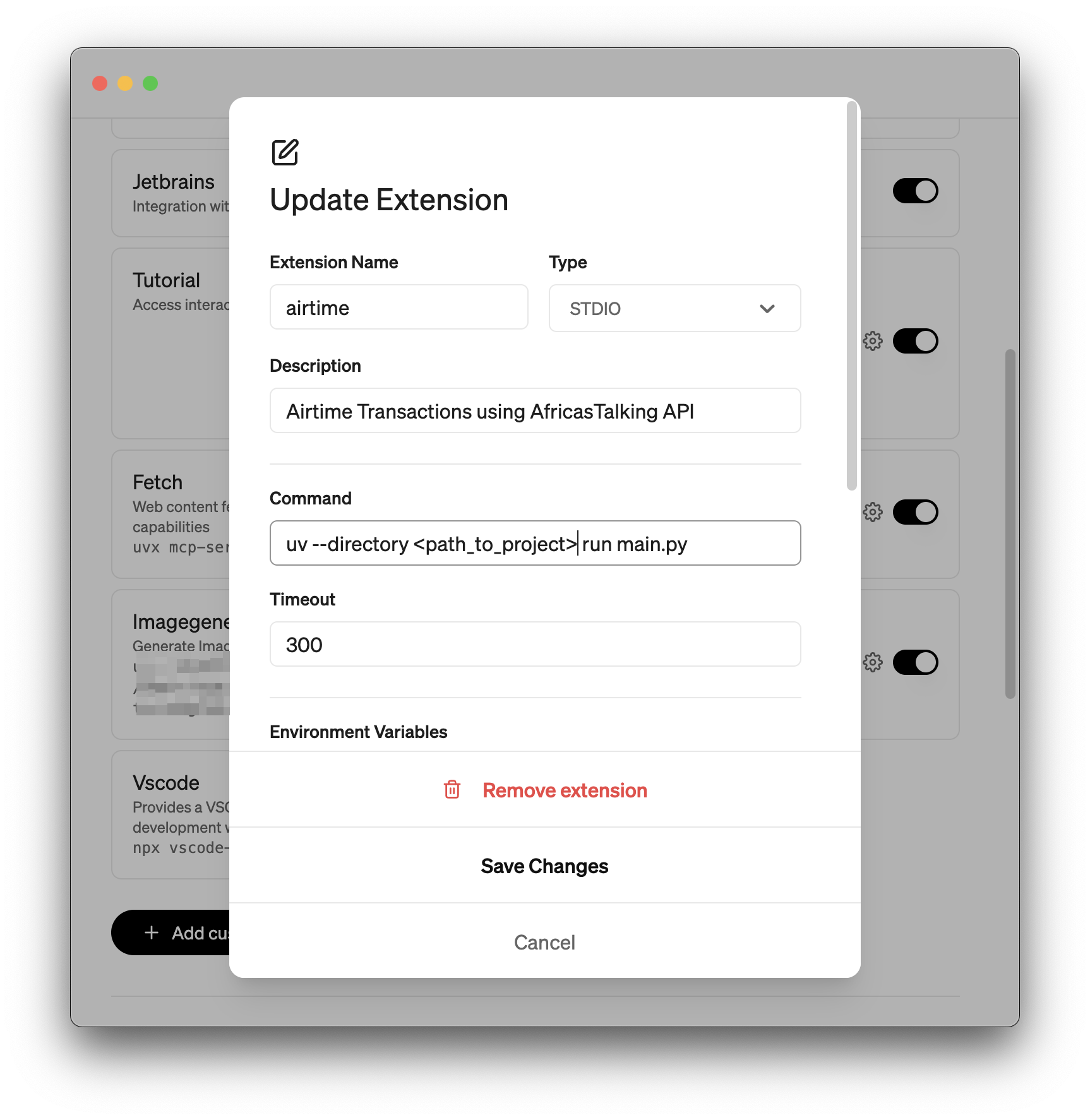
为您的扩展命名。类型为 STDIO。
添加命令。保存更改。

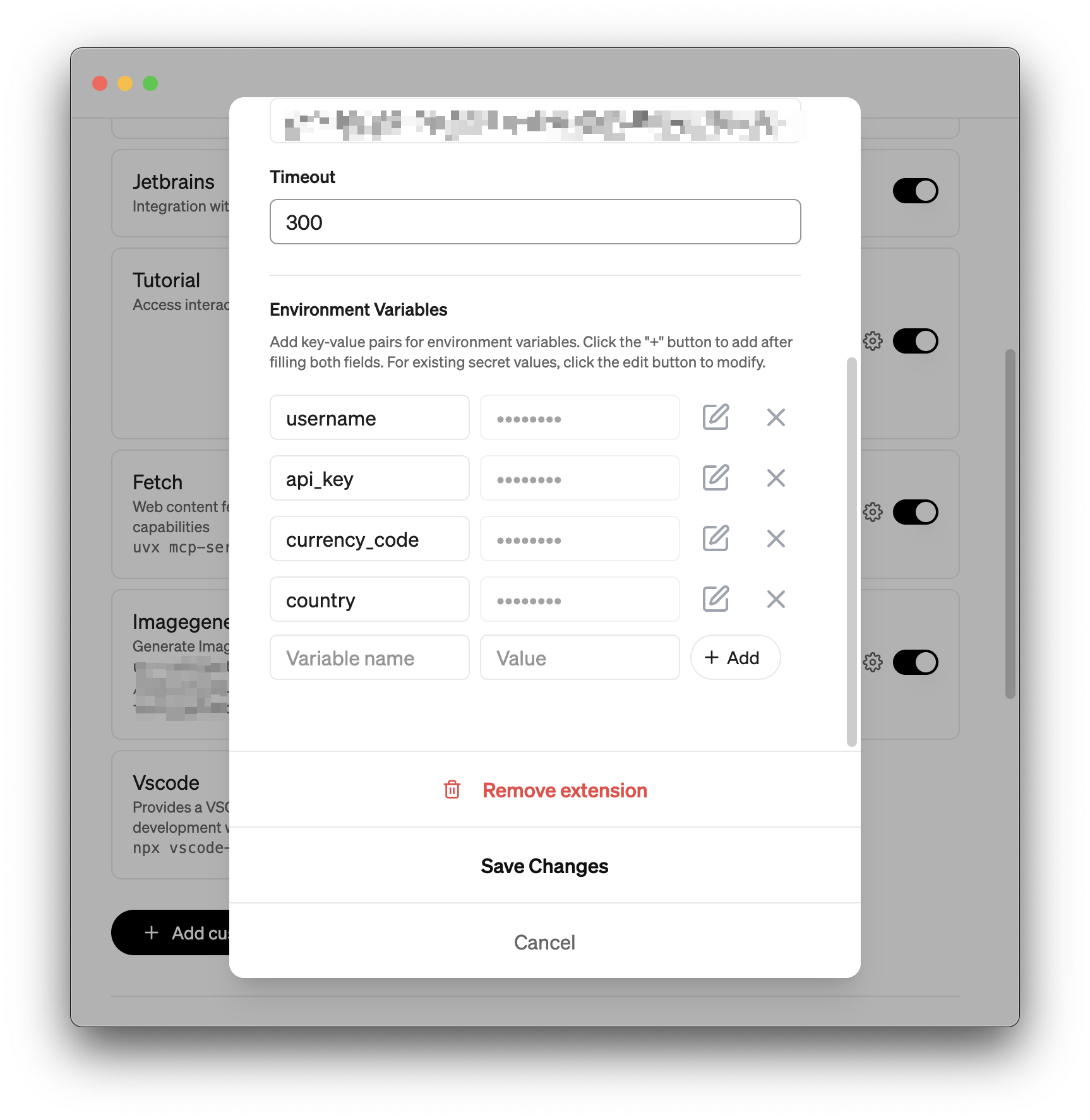
添加您的环境变量:
username、api_key、currency_code和country。保存更改。

工具说明
MCP 提供以下工具来管理通话时间交易:
检查余额:
描述:检索您的 Africa's Talking 帐户的当前通话时间余额。
用法:
check_balance()输出:返回帐户余额(例如,“帐户余额:KES 1234.00”),如果无法获取余额,则返回错误消息。
加载播放时间:
描述:向指定的电话号码发送通话时间并将交易保存在数据库中。
参数:
phone_number:收件人的电话号码(例如“0712345678”或“+254712345678”)。amount:要发送的空中时间量(例如 100)。currency_code:货币代码(例如“KES”)。
用法:
load_airtime("0712345678", 100.00, "KES")输出:确认成功(例如,“已成功向 +254712345678 发送 KES 100.00 通话时间”)或报告错误。
获取上次充值次数:
描述:从数据库中检索最近的
N通话时间充值交易。参数:
limit:要检索的交易数量(默认值:3)。
用法:
get_last_topups(3)输出:列出最近的交易(例如,“最近 3 笔充值交易:...”)或表示未找到交易。
最后 n 次充值总数:
描述:计算最近
N成功充值的总金额,确保它们使用相同的货币。参数:
n:要汇总的交易数量(默认值:3)。
用法:
sum_last_n_topups(3)输出:返回总数(例如,“最近 3 次成功充值的总和:KES 300.00”)或错误(如果货币不同)。
count_topups_by_number :
描述:计算特定电话号码成功充值的次数。
参数:
phone_number:要查询的电话号码(例如“0712345678”)。
用法:
count_topups_by_number("0712345678")输出:返回计数(例如,“成功充值至 +254712345678 的次数:5”)或错误。
示例提示
以下是用户可以根据可用工具向 AI 提出的示例问题或命令,以便与非洲的 Talking Airtime MCP 进行交互:
查看账户余额
我的 Africa's Talking 账户余额是多少?
你能告诉我当前余额吗?
检查我的通话时间余额。
发送通话时间
向 0712345678 发送 100 KES 通话时间。
给我的 0712345678 充值 60。
充值 50 奈拉至 +2348012345678。
您能向 0755123456 充值 200 UGX 吗?
查看最近的充值
显示最近 3 次通话时间交易。
我最近充值了哪些金额?
列出最近 5 次通话时间充值。
近期充值总额
我最近 3 次充值的总金额是多少?
将我最近 4 次通话时间交易的金额加起来。
我最近 5 次充值一共汇了多少钱?
按电话号码计算充值次数
我给0712345678充值过几次?
计算 +254712345678 的充值金额。
请告诉我有多少次成功充值到 0755123456。
笔记
确保您的 Africa's Talking 帐户有足够的资金来发送通话时间。
电话号码根据客户端或
claude_desktop_config.json中设置的country变量自动格式化。初始化时,在项目目录中创建 SQLite 数据库(
airtime_transactions.db)。最适合支持工具调用的模型,例如
Claude 3.7 Sonnet。如果您注重价格,GPT-4.1 Nano与 Goose 等客户端一起使用时是一个不错的、更便宜的选择。
🙏 致谢
非洲的谈话 API非洲的谈话文档。
Available Tools
5 toolscheck_balanceA
Checks the airtime balance of the Africa's Talking account.
This tool connects to the Africa's Talking API to fetch the user's
current application data, which includes the account balance.
Returns:
str: A message displaying the account balance or an error if the
balance cannot be retrieved.
| Name | Required | Description | Default |
|---|---|---|---|
No parameters | |||
TDQS
Does the description disclose side effects, auth requirements, rate limits, or destructive behavior?
With no annotations provided, the description carries the full burden of behavioral disclosure. It effectively describes the tool's behavior: connecting to an external API, fetching application data, and returning either a balance message or an error. It covers the core operation and error handling, though it lacks details like rate limits, authentication requirements, or specific error conditions.
Agents need to know what a tool does to the world before calling it. Descriptions should go beyond structured annotations to explain consequences.
Is the description appropriately sized, front-loaded, and free of redundancy?
The description is appropriately sized and front-loaded, starting with the core purpose. The second sentence adds necessary detail about the API connection, and the 'Returns' section clarifies output behavior. It's efficient with minimal waste, though the 'Returns' formatting could be slightly more concise.
Shorter descriptions cost fewer tokens and are easier for agents to parse. Every sentence should earn its place.
Given the tool's complexity, does the description cover enough for an agent to succeed on first attempt?
Given the tool's low complexity (0 parameters, no output schema, no annotations), the description is reasonably complete. It explains what the tool does, how it operates via API, and what it returns. For a simple balance check tool, this covers essential context, though it could benefit from more detail on error scenarios or API specifics.
Complex tools with many parameters or behaviors need more documentation. Simple tools need less. This dimension scales expectations accordingly.
Does the description clarify parameter syntax, constraints, interactions, or defaults beyond what the schema provides?
The input schema has 0 parameters with 100% coverage, so the schema fully documents the lack of inputs. The description adds value by confirming no parameters are needed ('checks the airtime balance' implies a simple query without inputs), aligning with the schema. Baseline is 4 for 0 parameters, as it provides clear semantic context.
Input schemas describe structure but not intent. Descriptions should explain non-obvious parameter relationships and valid value ranges.
Does the description clearly state what the tool does and how it differs from similar tools?
The description clearly states the specific action ('Checks') and resource ('airtime balance of the Africa's Talking account'), distinguishing it from sibling tools that focus on top-up operations rather than balance inquiry. It precisely defines what the tool does without ambiguity.
Agents choose between tools based on descriptions. A clear purpose with a specific verb and resource helps agents select the right tool.
Does the description explain when to use this tool, when not to, or what alternatives exist?
The description implies usage context by mentioning it fetches 'application data' and 'account balance', suggesting it's for checking current balance status. However, it doesn't explicitly state when to use this tool versus alternatives like checking transaction history through sibling tools, nor does it provide exclusion criteria or prerequisites.
Agents often have multiple tools that could apply. Explicit usage guidance like "use X instead of Y when Z" prevents misuse.
count_topups_by_numberA
Counts the number of top-ups for a specific phone number.
Args:
phone_number (str): The phone number to count transactions for.
Returns:
str: The total count of top-ups for the given number or an error message.
| Name | Required | Description | Default |
|---|---|---|---|
| phone_number | Yes |
TDQS
Does the description disclose side effects, auth requirements, rate limits, or destructive behavior?
With no annotations provided, the description carries the full burden of behavioral disclosure. It states the tool counts top-ups and returns a count or error message, but lacks details on permissions, rate limits, error conditions, or data freshness. For a tool with zero annotation coverage, this is a significant gap in transparency.
Agents need to know what a tool does to the world before calling it. Descriptions should go beyond structured annotations to explain consequences.
Is the description appropriately sized, front-loaded, and free of redundancy?
The description is well-structured and front-loaded with the core purpose, followed by clear sections for arguments and returns. Every sentence earns its place by directly supporting tool understanding, with no redundant or verbose language, making it efficient and easy to parse.
Shorter descriptions cost fewer tokens and are easier for agents to parse. Every sentence should earn its place.
Given the tool's complexity, does the description cover enough for an agent to succeed on first attempt?
Given the tool's low complexity (1 parameter, no output schema, no annotations), the description is adequate but incomplete. It covers the basic purpose and parameter semantics but lacks behavioral details like error handling or usage guidelines. For a simple query tool, it meets minimum viability but has clear gaps in contextual richness.
Complex tools with many parameters or behaviors need more documentation. Simple tools need less. This dimension scales expectations accordingly.
Does the description clarify parameter syntax, constraints, interactions, or defaults beyond what the schema provides?
The description adds meaningful context for the single parameter 'phone_number' by explaining it is 'the phone number to count transactions for,' which clarifies its role beyond the schema's basic type and title. With schema description coverage at 0%, the description effectively compensates by providing semantic value, though it could include format examples (e.g., E.164).
Input schemas describe structure but not intent. Descriptions should explain non-obvious parameter relationships and valid value ranges.
Does the description clearly state what the tool does and how it differs from similar tools?
The description clearly states the tool's purpose with a specific verb ('Counts') and resource ('number of top-ups for a specific phone number'), distinguishing it from siblings like 'check_balance' (balance checking), 'get_last_topups' (retrieving recent transactions), 'load_airtime' (airtime loading), and 'sum_last_n_topups' (summing recent transactions). It precisely defines what the tool does without ambiguity.
Agents choose between tools based on descriptions. A clear purpose with a specific verb and resource helps agents select the right tool.
Does the description explain when to use this tool, when not to, or what alternatives exist?
The description provides no guidance on when to use this tool versus alternatives. It does not mention scenarios where counting top-ups is preferred over other tools like 'get_last_topups' or 'sum_last_n_topups', nor does it specify prerequisites or exclusions. Usage is implied only by the purpose statement, lacking explicit context.
Agents often have multiple tools that could apply. Explicit usage guidance like "use X instead of Y when Z" prevents misuse.
get_last_topupsA
Retrieves the last N top-up transactions from the database.
Args:
limit (int, optional): The number of recent transactions to fetch.
Defaults to 3.
Returns:
str: A formatted string listing the last N transactions or a message
if no transactions are found.
| Name | Required | Description | Default |
|---|---|---|---|
| limit | No |
TDQS
Does the description disclose side effects, auth requirements, rate limits, or destructive behavior?
With no annotations provided, the description carries the full burden of behavioral disclosure. It describes the tool as retrieving transactions and returning a formatted string or message, which covers basic behavior. However, it lacks details on error handling, data format specifics, or performance aspects like rate limits or permissions needed, leaving gaps in transparency.
Agents need to know what a tool does to the world before calling it. Descriptions should go beyond structured annotations to explain consequences.
Is the description appropriately sized, front-loaded, and free of redundancy?
The description is appropriately sized and front-loaded, starting with a clear purpose statement followed by structured sections for arguments and returns. Every sentence adds value without redundancy, making it efficient and easy to parse.
Shorter descriptions cost fewer tokens and are easier for agents to parse. Every sentence should earn its place.
Given the tool's complexity, does the description cover enough for an agent to succeed on first attempt?
Given the tool's low complexity (1 optional parameter, no output schema, no annotations), the description is mostly complete. It covers purpose, parameter semantics, and return behavior. However, it could improve by addressing potential edge cases or linking to sibling tools for better context, slightly reducing completeness.
Complex tools with many parameters or behaviors need more documentation. Simple tools need less. This dimension scales expectations accordingly.
Does the description clarify parameter syntax, constraints, interactions, or defaults beyond what the schema provides?
The description adds meaningful context for the single parameter 'limit,' explaining it as 'the number of recent transactions to fetch' with a default of 3, which goes beyond the input schema's basic type and title. Since schema description coverage is 0%, the description compensates well by providing clear semantics for the parameter.
Input schemas describe structure but not intent. Descriptions should explain non-obvious parameter relationships and valid value ranges.
Does the description clearly state what the tool does and how it differs from similar tools?
The description clearly states the tool's purpose with specific verb ('retrieves') and resource ('last N top-up transactions from the database'). It distinguishes from siblings by focusing on recent transactions rather than checking balances, counting by number, loading airtime, or summing amounts.
Agents choose between tools based on descriptions. A clear purpose with a specific verb and resource helps agents select the right tool.
Does the description explain when to use this tool, when not to, or what alternatives exist?
The description implies usage context by specifying 'last N top-up transactions,' suggesting it's for recent transaction review rather than other operations like checking balances or loading airtime. However, it does not explicitly state when to use this tool versus alternatives like 'sum_last_n_topups' or 'count_topups_by_number,' missing explicit exclusions or comparisons.
Agents often have multiple tools that could apply. Explicit usage guidance like "use X instead of Y when Z" prevents misuse.
load_airtimeA
Sends airtime to a specified phone number and logs the transaction.
This tool formats the phone number, sends the airtime using the
Africa's Talking API, and saves a record of the transaction in the
database.
Args:
phone_number (str): The recipient's phone number.
amount (float): The amount of airtime to send.
currency_code (str): The currency for the transaction (e.g., "KES").
Returns:
str: A message indicating the status of the airtime transaction.
| Name | Required | Description | Default |
|---|---|---|---|
| phone_number | Yes | ||
| amount | Yes | ||
| currency_code | Yes |
TDQS
Does the description disclose side effects, auth requirements, rate limits, or destructive behavior?
With no annotations provided, the description carries full burden. It discloses key behaviors: formatting phone numbers, using Africa's Talking API, and logging to a database. However, it lacks details on error handling, rate limits, authentication needs, or what specific data is logged.
Agents need to know what a tool does to the world before calling it. Descriptions should go beyond structured annotations to explain consequences.
Is the description appropriately sized, front-loaded, and free of redundancy?
The description is well-structured and front-loaded with the core purpose in the first sentence. Each subsequent sentence adds necessary detail without redundancy. The Args/Returns sections are clearly formatted and efficiently convey parameter and return value information.
Shorter descriptions cost fewer tokens and are easier for agents to parse. Every sentence should earn its place.
Given the tool's complexity, does the description cover enough for an agent to succeed on first attempt?
For a mutation tool with no annotations and no output schema, the description does a good job covering purpose, parameters, and basic behavior. However, it lacks details about the return message format, error conditions, or database logging specifics that would be helpful for an agent.
Complex tools with many parameters or behaviors need more documentation. Simple tools need less. This dimension scales expectations accordingly.
Does the description clarify parameter syntax, constraints, interactions, or defaults beyond what the schema provides?
Schema description coverage is 0%, so the description must compensate. It provides clear semantic meaning for all three parameters: phone_number identifies the recipient, amount specifies airtime quantity, and currency_code defines transaction currency with an example ('KES'). This adds significant value beyond the bare schema.
Input schemas describe structure but not intent. Descriptions should explain non-obvious parameter relationships and valid value ranges.
Does the description clearly state what the tool does and how it differs from similar tools?
The description clearly states the tool's purpose with specific verbs ('sends airtime', 'logs the transaction') and identifies the resource (phone number). It distinguishes from sibling tools like check_balance or get_last_topups by focusing on sending rather than querying.
Agents choose between tools based on descriptions. A clear purpose with a specific verb and resource helps agents select the right tool.
Does the description explain when to use this tool, when not to, or what alternatives exist?
The description implies usage for sending airtime via Africa's Talking API, but provides no explicit guidance on when to use this tool versus alternatives like count_topups_by_number or sum_last_n_topups. No prerequisites, exclusions, or comparison to siblings are mentioned.
Agents often have multiple tools that could apply. Explicit usage guidance like "use X instead of Y when Z" prevents misuse.
sum_last_n_topupsA
Calculates the sum of the last 'n' successful top-ups.
This tool retrieves the last 'n' transactions from the database and
calculates their total sum. It ensures that all transactions are in the
same currency before summing.
Args:
n (int, optional): The number of recent top-ups to sum. Defaults to 3.
Returns:
str: The total sum of the last 'n' top-ups or an error message if
the currencies are mixed or no transactions are found.
| Name | Required | Description | Default |
|---|---|---|---|
| n | No |
TDQS
Does the description disclose side effects, auth requirements, rate limits, or destructive behavior?
With no annotations provided, the description carries the full burden and discloses key behavioral traits: it only sums successful top-ups, retrieves from a database, ensures currency consistency, and handles error cases (mixed currencies or no transactions). It doesn't cover aspects like performance, rate limits, or authentication needs, but provides substantial operational context beyond basic functionality.
Agents need to know what a tool does to the world before calling it. Descriptions should go beyond structured annotations to explain consequences.
Is the description appropriately sized, front-loaded, and free of redundancy?
The description is appropriately sized and front-loaded: the first sentence states the core purpose, followed by operational details, then clearly formatted Args and Returns sections. Every sentence adds value—none are redundant or vague—and the structure enhances readability without unnecessary elaboration.
Shorter descriptions cost fewer tokens and are easier for agents to parse. Every sentence should earn its place.
Given the tool's complexity, does the description cover enough for an agent to succeed on first attempt?
Given the tool's moderate complexity (database query with calculations and error handling), no annotations, and no output schema, the description is largely complete: it covers purpose, parameters, behavior, and return values. It could benefit from mentioning prerequisites (e.g., authentication) or performance characteristics, but adequately addresses core functionality and error cases for an agent to use it correctly.
Complex tools with many parameters or behaviors need more documentation. Simple tools need less. This dimension scales expectations accordingly.
Does the description clarify parameter syntax, constraints, interactions, or defaults beyond what the schema provides?
The description adds meaningful semantics beyond the input schema: it explains that 'n' represents 'the number of recent top-ups to sum' with a default of 3, and clarifies it's optional. With 0% schema description coverage (schema only has type and title), the description fully compensates by providing clear parameter meaning and usage context.
Input schemas describe structure but not intent. Descriptions should explain non-obvious parameter relationships and valid value ranges.
Does the description clearly state what the tool does and how it differs from similar tools?
The description clearly states the tool's purpose with specific verbs ('calculates', 'retrieves', 'ensures') and resources ('last n successful top-ups', 'transactions from the database'). It distinguishes from siblings like 'check_balance' (current balance), 'count_topups_by_number' (counts by number), 'get_last_topups' (lists without summing), and 'load_airtime' (different operation).
Agents choose between tools based on descriptions. A clear purpose with a specific verb and resource helps agents select the right tool.
Does the description explain when to use this tool, when not to, or what alternatives exist?
The description implies usage for summing recent top-ups, but doesn't explicitly state when to use this tool versus alternatives like 'get_last_topups' (for listing) or 'count_topups_by_number' (for counting by number). It mentions currency consistency as a requirement, which provides some contextual guidance, but lacks explicit when/when-not scenarios or named alternatives.
Agents often have multiple tools that could apply. Explicit usage guidance like "use X instead of Y when Z" prevents misuse.
Tool Schema Changelog
Recent tool additions, removals, and schema changes observed during successful MCP inspections.
5 tool updates
- First observed
check_balance - First observed
count_topups_by_number - First observed
get_last_topups - First observed
load_airtime - First observed
sum_last_n_topups
TDQS
Scored across 5 tools
Each tool has a clearly distinct purpose with no overlap: check_balance for account status, load_airtime for sending airtime, and three tools (count_topups_by_number, get_last_topups, sum_last_n_topups) for analyzing transaction history from different angles. The descriptions reinforce these distinct roles, making misselection unlikely.
The naming follows a consistent snake_case pattern with clear verb_noun structures (e.g., check_balance, load_airtime). However, there is a minor deviation: 'count_topups_by_number' uses a prepositional phrase instead of a simple noun, slightly breaking the pattern compared to tools like 'get_last_topups' or 'sum_last_n_topups'.
With 5 tools, the count is well-scoped for an airtime management server. It covers core operations (checking balance, sending airtime) and transaction analysis without being overwhelming, ensuring each tool earns its place in the workflow.
The toolset provides good coverage for airtime operations: checking balance, sending airtime, and analyzing transaction history. A minor gap exists in not having tools for managing transaction errors or refunds, but agents can likely work around this with the existing tools for core workflows.
Maintenance
Related MCP Connectors
Send and schedule SMS and WhatsApp messages, manage contacts and templates, and track delivery.
Send WhatsApp, SMS and email for South African businesses: contacts, campaigns, templates, webhooks
Data feeds for AI agents: list products, sign up, check balance, get a top-up link, fetch data.
Create and manage DialNexa AI voice agents, campaigns, calls, phone numbers, workflows, and more.
Related MCP Servers
- AlicenseNot gradedqualityDmaintenanceA unified interface for major African payment providers including M-Pesa, Paystack, and MTN MoMo. It enables users to process payments, request funds, and manage transactions across the continent using natural language commands.7MIT
- AlicenseAqualityAmaintenanceMCP server for East African fintech APIs — trigger M-Pesa STK Push payments, check transaction status, send SMS to 20+ African networks, and top up airtime via Africa's Talking.54MIT
- AlicenseAqualityDmaintenanceEnables AI agents to call x402-gated APIs using a central credit balance, abstracting away blockchain complexity and payment proofs. It provides tools to fetch data from payment-required endpoints, check usage balances, and simulate transaction costs.6362-
- -licenseNot gradedqualityNot gradedmaintenanceField operations agent API for task management, geo-tracking, and team coordination. Built for African logistics, delivery, and field service teams.-