Glama
nasoma

Africa's Talking Airtime MCP

アフリカのトーキングエアタイムMCP

鍛冶屋のバッジ

このプロジェクトは**、Africa's Talking APIを用いて通話時間取引を管理するためのモデルコンテキストプロトコル(MCP)サーバー**を実装します。アカウント残高の確認、通話時間の送信、最近のトップアップ取引の表示、最近のトップアップ金額の合計、特定の電話番号のトップアップ回数のカウントなど、一連のツールを提供します。このアプリケーションはSQLiteを使用して取引データを保存し、Africa's Talking Airtime Service がサポートするアフリカ諸国の電話番号を適切な形式でサポートします。

説明

Africa's Talking Airtime MCPサーバーは、 Africa's Talking Airtime APIと統合されており、通話時間の転送を容易にします。主な機能は以下のとおりです。

  • 指定された電話番号に通話時間を送信します。

  • トランザクションの詳細を SQLite データベースに保存します。

  • 取引履歴の取得と要約。

  • Africa's Talking のアカウント残高を確認します。

このアプリケーションは、アフリカの Talking Airtime サービスがサポートされている国をサポートしています。

Related MCP server: mpesa-mcp

インストール

Smithery経由でインストール

Smithery経由で Claude Desktop に Africa's Talking Airtime Server を自動的にインストールするには:

npx -y @smithery/cli install @nasoma/africastalking-airtime-mcp --client claude

前提条件

  1. Python 3.10以上

  2. uvをインストールする

curl -LsSf https://astral.sh/uv/install.sh | sh

プロジェクトをローカルでセットアップして実行するには、次の手順に従います。

  1. リポジトリをクローンします。

git clone https://github.com/nasoma/africastalking-airtime-mcp.git
cd africastalking-airtime-mcp
  1. 次のコマンドを実行して仮想環境をセットアップし、依存関係をインストールします。

uv sync 
  1. 準備完了です!

AIツールと併用する

クロード・デスクトップ

これをclaude_desktop_config.jsonに追加します:

{
  "mcpServers": {
    "Airtime Server": {
      "command": "{{PATH_TO_UV}}", // Run `which uv` and place the output here
      "args": [
        "--directory",
        "{{PATH_TO_PROJECT}}", // cd into the repo, run `pwd` and enter the output here
        "run",
        "main.py"
      ],
      "env": {
        "username": "your_africastalking_username",
        "api_key": "your_africastalking_api_key",
        "country":"your_country", # e.g kenya, uganda, dr congo, rwanda, south africa
        "currency_code":"currency-code"  # e.g. KES, UGX, NGN
      }
    }
  }
}

ガチョウと

好みの LLM を使用し、API キーを提供する場合は、 Gooseが適切なオプションです。

  • Goose をインストールします。

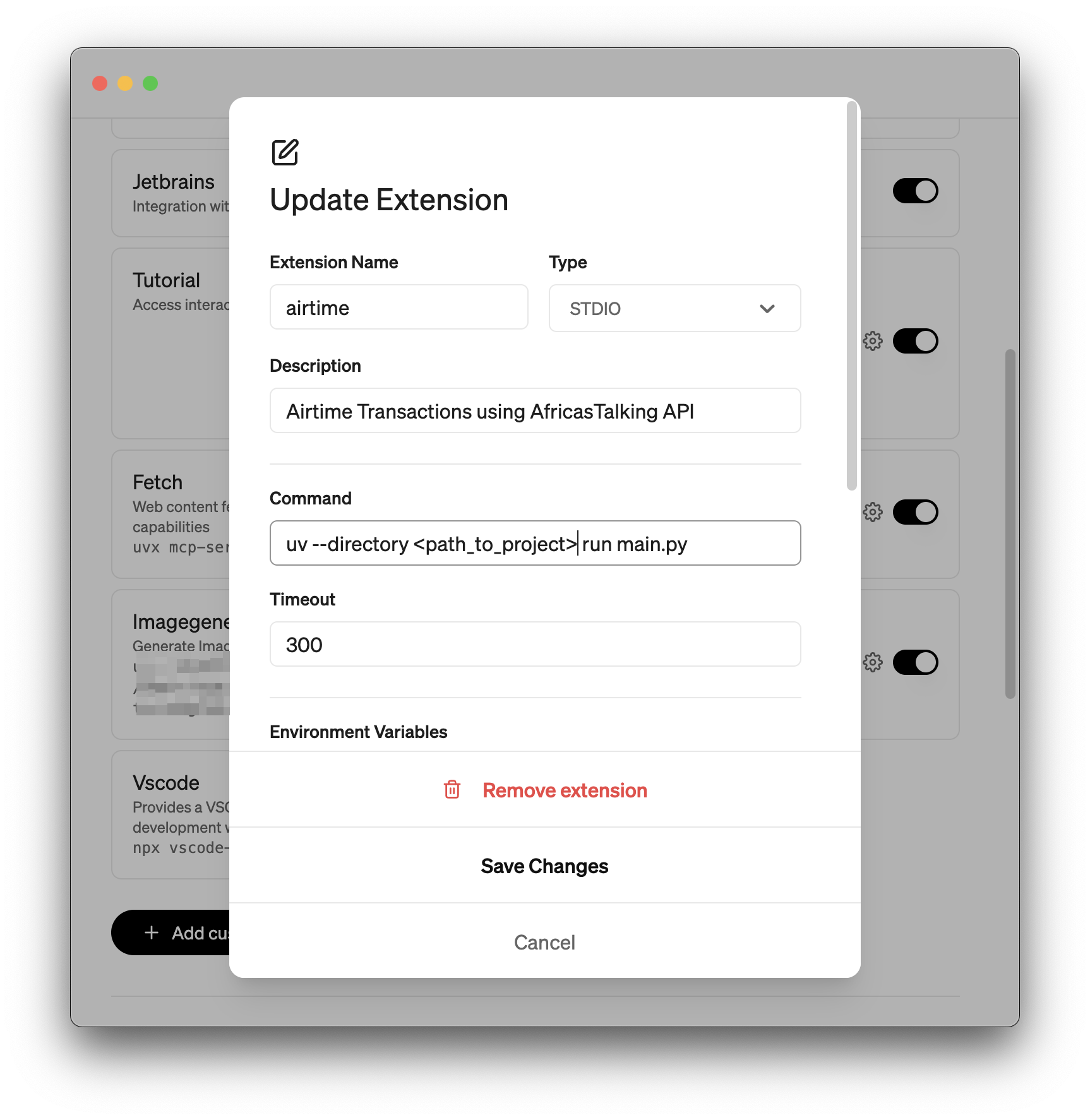
  • 設定パネルを開き、カスタム拡張機能 (MCP サーバー) を追加します。

  • 拡張機能に名前を付けます。タイプは STDIO です。

  • コマンドを追加します。変更を保存します。グースデモ

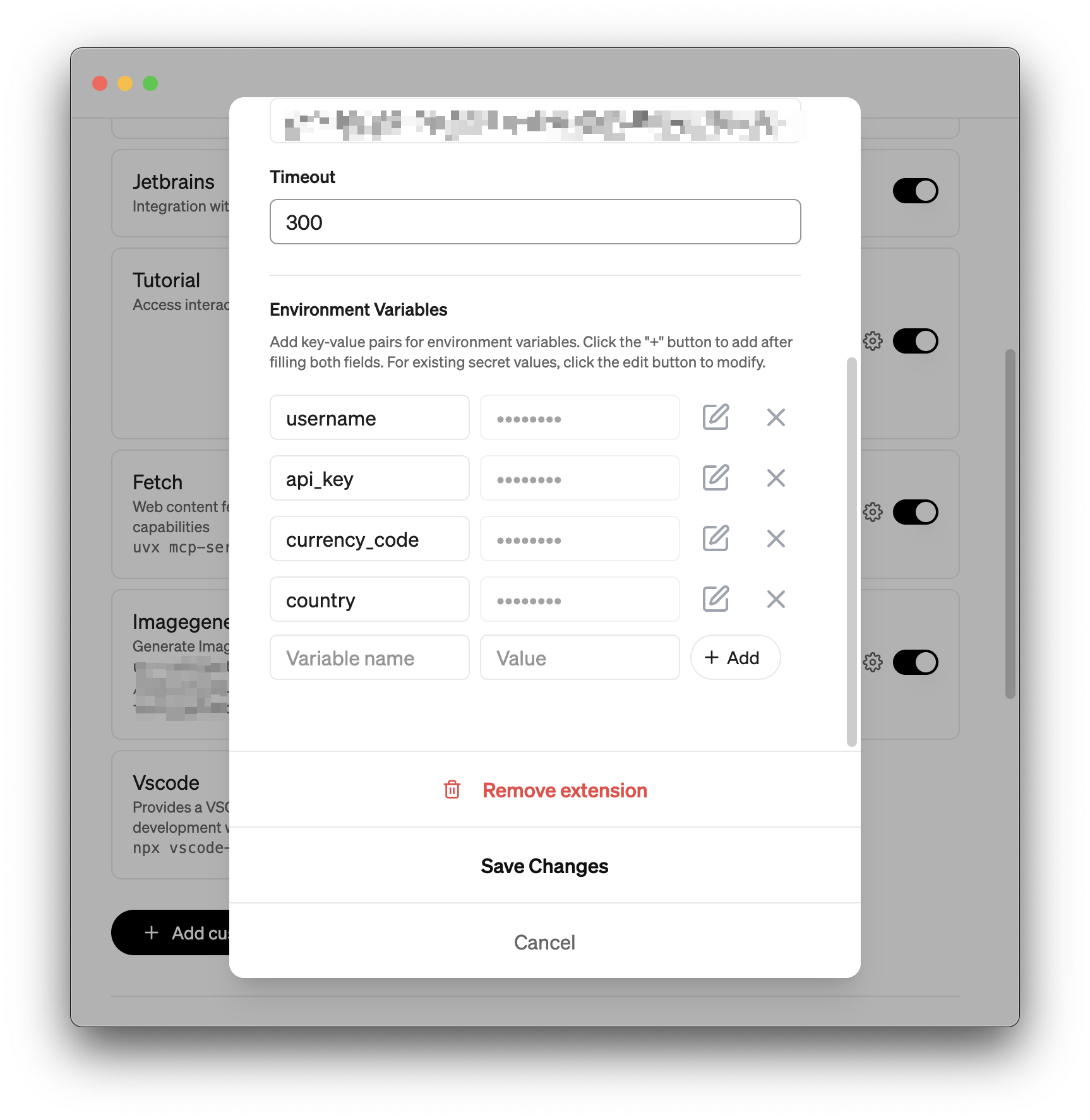
  • 環境変数を追加します: username 、 api_key 、 currency_code 、 country 。

  • 変更を保存します。

グースデモ2

ツールの説明

MCP は、通話時間トランザクションを管理するための次のツールを提供します。

  1. 残高確認:

    • 説明: Africa's Talking アカウントの現在の通話時間残高を取得します。

    • 使用法: check_balance()

    • 出力: アカウント残高 (例: 「アカウント残高: KES 1234.00」) を返します。残高を取得できない場合はエラー メッセージを返します。

  2. ロードエアタイム:

    • 説明: 指定された電話番号に通話時間を送信し、トランザクションをデータベースに保存します。

    • パラメータ:

      • phone_number : 受信者の電話番号(例:「0712345678」または「+254712345678」)。

      • amount : 送信する通信時間の量 (例: 100)。

      • currency_code : 通貨コード (例: "KES")。

    • 使用方法: load_airtime("0712345678", 100.00, "KES")

    • 出力: 成功を確認します (例: 「KES 100.00 の通話時間を +254712345678 に正常に送信しました」)、またはエラーを報告します。

  3. get_last_topups :

    • 説明: データベースから最後のN通話時間トップアップ取引を取得します。

    • パラメータ:

      • limit : 取得するトランザクションの数 (デフォルト: 3)。

    • 使用法: get_last_topups(3)

    • 出力: 最近のトランザクション (例: 「最後の 3 つのトップアップ トランザクション: ...」) を一覧表示するか、トランザクションが見つからないことを示します。

  4. 最後のn個のトップアップの合計:

    • 説明: 同じ通貨が使用されていることを確認しながら、最後のN回の成功したトップアップの合計金額を計算します。

    • パラメータ:

      • n : 合計するトランザクションの数 (デフォルト: 3)。

    • 使用法: sum_last_n_topups(3)

    • 出力: 合計を返します (例: 「過去 3 回の成功したトップアップの合計: KES 300.00」)。通貨が異なる場合はエラーを返します。

  5. カウントトップアップ数:

    • 説明: 特定の電話番号への成功したトップアップの数をカウントします。

    • パラメータ:

      • phone_number : 照会する電話番号 (例: 「0712345678」)。

    • 使用方法: count_topups_by_number("0712345678")

    • 出力: カウント (例: 「+254712345678 への成功したトップアップの数: 5」) またはエラーを返します。

プロンプトの例

以下は、利用可能なツールに基づいて、ユーザーが AI に Africa's Talking Airtime MCP と対話するために尋ねることができる質問またはコマンドの例です。

口座残高を確認する

  • 私のAfrica's Talkingアカウントの残高はいくらですか?

  • 現在の残高を見せてもらえますか?

  • 通話時間の残高を確認してください。

エアタイムを送信

  • 100 KES の通話時間を 0712345678 に送信します。

  • 0712345678 に 60 をチャージします。

  • +2348012345678 に 50 NGN をチャージします。

  • 0755123456に200UGXをチャージできますか?

最近のトップアップを表示

  • 過去 3 件の通話時間取引を表示してください。

  • 最近のトップアップは何ですか?

  • 過去 5 回の通話時間のトップアップを一覧表示します。

最近のトップアップの合計

  • 過去 3 回のトップアップの合計はいくらですか?

  • 過去 4 回の通話時間取引の金額を合計します。

  • 過去 5 回のトップアップでいくら送金しましたか?

電話番号によるトップアップのカウント

  • 0712345678 に何回チャージしましたか?

  • +254712345678 までのトップアップを数えます。

  • 0755123456 へのトップアップが何回成功したか教えてください。

注記

  • 通話時間を送信するには、Africa's Talking アカウントに資金があることを確認してください。

  • 電話番号は、クライアントまたはclaude_desktop_config.jsonで設定されたcountry変数に基づいて自動的にフォーマットされます。

  • 初期化時に、SQLite データベース ( airtime_transactions.db ) がプロジェクト ディレクトリに作成されます。

  • ツール呼び出しをサポートするモデル(例: Claude 3.7 Sonnetに最適です。価格を重視する場合は、Gooseなどのクライアントと併用すると、 GPT-4.1 Nano安価で優れた選択肢となります。

🙏 クレジット

Available Tools

5 tools
check_balanceA

Checks the airtime balance of the Africa's Talking account.

This tool connects to the Africa's Talking API to fetch the user's
current application data, which includes the account balance.

Returns:
    str: A message displaying the account balance or an error if the
         balance cannot be retrieved.
ParametersJSON Schema
NameRequiredDescriptionDefault

No parameters

TDQS

A4.1/5.0
Behavior4/5

Does the description disclose side effects, auth requirements, rate limits, or destructive behavior?

With no annotations provided, the description carries the full burden of behavioral disclosure. It effectively describes the tool's behavior: connecting to an external API, fetching application data, and returning either a balance message or an error. It covers the core operation and error handling, though it lacks details like rate limits, authentication requirements, or specific error conditions.

Agents need to know what a tool does to the world before calling it. Descriptions should go beyond structured annotations to explain consequences.

Conciseness4/5

Is the description appropriately sized, front-loaded, and free of redundancy?

The description is appropriately sized and front-loaded, starting with the core purpose. The second sentence adds necessary detail about the API connection, and the 'Returns' section clarifies output behavior. It's efficient with minimal waste, though the 'Returns' formatting could be slightly more concise.

Shorter descriptions cost fewer tokens and are easier for agents to parse. Every sentence should earn its place.

Completeness4/5

Given the tool's complexity, does the description cover enough for an agent to succeed on first attempt?

Given the tool's low complexity (0 parameters, no output schema, no annotations), the description is reasonably complete. It explains what the tool does, how it operates via API, and what it returns. For a simple balance check tool, this covers essential context, though it could benefit from more detail on error scenarios or API specifics.

Complex tools with many parameters or behaviors need more documentation. Simple tools need less. This dimension scales expectations accordingly.

Parameters4/5

Does the description clarify parameter syntax, constraints, interactions, or defaults beyond what the schema provides?

The input schema has 0 parameters with 100% coverage, so the schema fully documents the lack of inputs. The description adds value by confirming no parameters are needed ('checks the airtime balance' implies a simple query without inputs), aligning with the schema. Baseline is 4 for 0 parameters, as it provides clear semantic context.

Input schemas describe structure but not intent. Descriptions should explain non-obvious parameter relationships and valid value ranges.

Purpose5/5

Does the description clearly state what the tool does and how it differs from similar tools?

The description clearly states the specific action ('Checks') and resource ('airtime balance of the Africa's Talking account'), distinguishing it from sibling tools that focus on top-up operations rather than balance inquiry. It precisely defines what the tool does without ambiguity.

Agents choose between tools based on descriptions. A clear purpose with a specific verb and resource helps agents select the right tool.

Usage Guidelines3/5

Does the description explain when to use this tool, when not to, or what alternatives exist?

The description implies usage context by mentioning it fetches 'application data' and 'account balance', suggesting it's for checking current balance status. However, it doesn't explicitly state when to use this tool versus alternatives like checking transaction history through sibling tools, nor does it provide exclusion criteria or prerequisites.

Agents often have multiple tools that could apply. Explicit usage guidance like "use X instead of Y when Z" prevents misuse.

count_topups_by_numberA

Counts the number of top-ups for a specific phone number.

Args:
    phone_number (str): The phone number to count transactions for.

Returns:
    str: The total count of top-ups for the given number or an error message.
ParametersJSON Schema
NameRequiredDescriptionDefault
phone_numberYes

TDQS

A3.5/5.0
Behavior2/5

Does the description disclose side effects, auth requirements, rate limits, or destructive behavior?

With no annotations provided, the description carries the full burden of behavioral disclosure. It states the tool counts top-ups and returns a count or error message, but lacks details on permissions, rate limits, error conditions, or data freshness. For a tool with zero annotation coverage, this is a significant gap in transparency.

Agents need to know what a tool does to the world before calling it. Descriptions should go beyond structured annotations to explain consequences.

Conciseness5/5

Is the description appropriately sized, front-loaded, and free of redundancy?

The description is well-structured and front-loaded with the core purpose, followed by clear sections for arguments and returns. Every sentence earns its place by directly supporting tool understanding, with no redundant or verbose language, making it efficient and easy to parse.

Shorter descriptions cost fewer tokens and are easier for agents to parse. Every sentence should earn its place.

Completeness3/5

Given the tool's complexity, does the description cover enough for an agent to succeed on first attempt?

Given the tool's low complexity (1 parameter, no output schema, no annotations), the description is adequate but incomplete. It covers the basic purpose and parameter semantics but lacks behavioral details like error handling or usage guidelines. For a simple query tool, it meets minimum viability but has clear gaps in contextual richness.

Complex tools with many parameters or behaviors need more documentation. Simple tools need less. This dimension scales expectations accordingly.

Parameters4/5

Does the description clarify parameter syntax, constraints, interactions, or defaults beyond what the schema provides?

The description adds meaningful context for the single parameter 'phone_number' by explaining it is 'the phone number to count transactions for,' which clarifies its role beyond the schema's basic type and title. With schema description coverage at 0%, the description effectively compensates by providing semantic value, though it could include format examples (e.g., E.164).

Input schemas describe structure but not intent. Descriptions should explain non-obvious parameter relationships and valid value ranges.

Purpose5/5

Does the description clearly state what the tool does and how it differs from similar tools?

The description clearly states the tool's purpose with a specific verb ('Counts') and resource ('number of top-ups for a specific phone number'), distinguishing it from siblings like 'check_balance' (balance checking), 'get_last_topups' (retrieving recent transactions), 'load_airtime' (airtime loading), and 'sum_last_n_topups' (summing recent transactions). It precisely defines what the tool does without ambiguity.

Agents choose between tools based on descriptions. A clear purpose with a specific verb and resource helps agents select the right tool.

Usage Guidelines2/5

Does the description explain when to use this tool, when not to, or what alternatives exist?

The description provides no guidance on when to use this tool versus alternatives. It does not mention scenarios where counting top-ups is preferred over other tools like 'get_last_topups' or 'sum_last_n_topups', nor does it specify prerequisites or exclusions. Usage is implied only by the purpose statement, lacking explicit context.

Agents often have multiple tools that could apply. Explicit usage guidance like "use X instead of Y when Z" prevents misuse.

get_last_topupsA

Retrieves the last N top-up transactions from the database.

Args:
    limit (int, optional): The number of recent transactions to fetch.
                           Defaults to 3.

Returns:
    str: A formatted string listing the last N transactions or a message
         if no transactions are found.
ParametersJSON Schema
NameRequiredDescriptionDefault
limitNo

TDQS

A4.2/5.0
Behavior3/5

Does the description disclose side effects, auth requirements, rate limits, or destructive behavior?

With no annotations provided, the description carries the full burden of behavioral disclosure. It describes the tool as retrieving transactions and returning a formatted string or message, which covers basic behavior. However, it lacks details on error handling, data format specifics, or performance aspects like rate limits or permissions needed, leaving gaps in transparency.

Agents need to know what a tool does to the world before calling it. Descriptions should go beyond structured annotations to explain consequences.

Conciseness5/5

Is the description appropriately sized, front-loaded, and free of redundancy?

The description is appropriately sized and front-loaded, starting with a clear purpose statement followed by structured sections for arguments and returns. Every sentence adds value without redundancy, making it efficient and easy to parse.

Shorter descriptions cost fewer tokens and are easier for agents to parse. Every sentence should earn its place.

Completeness4/5

Given the tool's complexity, does the description cover enough for an agent to succeed on first attempt?

Given the tool's low complexity (1 optional parameter, no output schema, no annotations), the description is mostly complete. It covers purpose, parameter semantics, and return behavior. However, it could improve by addressing potential edge cases or linking to sibling tools for better context, slightly reducing completeness.

Complex tools with many parameters or behaviors need more documentation. Simple tools need less. This dimension scales expectations accordingly.

Parameters4/5

Does the description clarify parameter syntax, constraints, interactions, or defaults beyond what the schema provides?

The description adds meaningful context for the single parameter 'limit,' explaining it as 'the number of recent transactions to fetch' with a default of 3, which goes beyond the input schema's basic type and title. Since schema description coverage is 0%, the description compensates well by providing clear semantics for the parameter.

Input schemas describe structure but not intent. Descriptions should explain non-obvious parameter relationships and valid value ranges.

Purpose5/5

Does the description clearly state what the tool does and how it differs from similar tools?

The description clearly states the tool's purpose with specific verb ('retrieves') and resource ('last N top-up transactions from the database'). It distinguishes from siblings by focusing on recent transactions rather than checking balances, counting by number, loading airtime, or summing amounts.

Agents choose between tools based on descriptions. A clear purpose with a specific verb and resource helps agents select the right tool.

Usage Guidelines4/5

Does the description explain when to use this tool, when not to, or what alternatives exist?

The description implies usage context by specifying 'last N top-up transactions,' suggesting it's for recent transaction review rather than other operations like checking balances or loading airtime. However, it does not explicitly state when to use this tool versus alternatives like 'sum_last_n_topups' or 'count_topups_by_number,' missing explicit exclusions or comparisons.

Agents often have multiple tools that could apply. Explicit usage guidance like "use X instead of Y when Z" prevents misuse.

load_airtimeA

Sends airtime to a specified phone number and logs the transaction.

This tool formats the phone number, sends the airtime using the
Africa's Talking API, and saves a record of the transaction in the
database.

Args:
    phone_number (str): The recipient's phone number.
    amount (float): The amount of airtime to send.
    currency_code (str): The currency for the transaction (e.g., "KES").

Returns:
    str: A message indicating the status of the airtime transaction.
ParametersJSON Schema
NameRequiredDescriptionDefault
phone_numberYes
amountYes
currency_codeYes

TDQS

A4.1/5.0
Behavior3/5

Does the description disclose side effects, auth requirements, rate limits, or destructive behavior?

With no annotations provided, the description carries full burden. It discloses key behaviors: formatting phone numbers, using Africa's Talking API, and logging to a database. However, it lacks details on error handling, rate limits, authentication needs, or what specific data is logged.

Agents need to know what a tool does to the world before calling it. Descriptions should go beyond structured annotations to explain consequences.

Conciseness5/5

Is the description appropriately sized, front-loaded, and free of redundancy?

The description is well-structured and front-loaded with the core purpose in the first sentence. Each subsequent sentence adds necessary detail without redundancy. The Args/Returns sections are clearly formatted and efficiently convey parameter and return value information.

Shorter descriptions cost fewer tokens and are easier for agents to parse. Every sentence should earn its place.

Completeness4/5

Given the tool's complexity, does the description cover enough for an agent to succeed on first attempt?

For a mutation tool with no annotations and no output schema, the description does a good job covering purpose, parameters, and basic behavior. However, it lacks details about the return message format, error conditions, or database logging specifics that would be helpful for an agent.

Complex tools with many parameters or behaviors need more documentation. Simple tools need less. This dimension scales expectations accordingly.

Parameters5/5

Does the description clarify parameter syntax, constraints, interactions, or defaults beyond what the schema provides?

Schema description coverage is 0%, so the description must compensate. It provides clear semantic meaning for all three parameters: phone_number identifies the recipient, amount specifies airtime quantity, and currency_code defines transaction currency with an example ('KES'). This adds significant value beyond the bare schema.

Input schemas describe structure but not intent. Descriptions should explain non-obvious parameter relationships and valid value ranges.

Purpose5/5

Does the description clearly state what the tool does and how it differs from similar tools?

The description clearly states the tool's purpose with specific verbs ('sends airtime', 'logs the transaction') and identifies the resource (phone number). It distinguishes from sibling tools like check_balance or get_last_topups by focusing on sending rather than querying.

Agents choose between tools based on descriptions. A clear purpose with a specific verb and resource helps agents select the right tool.

Usage Guidelines3/5

Does the description explain when to use this tool, when not to, or what alternatives exist?

The description implies usage for sending airtime via Africa's Talking API, but provides no explicit guidance on when to use this tool versus alternatives like count_topups_by_number or sum_last_n_topups. No prerequisites, exclusions, or comparison to siblings are mentioned.

Agents often have multiple tools that could apply. Explicit usage guidance like "use X instead of Y when Z" prevents misuse.

sum_last_n_topupsA

Calculates the sum of the last 'n' successful top-ups.

This tool retrieves the last 'n' transactions from the database and
calculates their total sum. It ensures that all transactions are in the
same currency before summing.

Args:
    n (int, optional): The number of recent top-ups to sum. Defaults to 3.

Returns:
    str: The total sum of the last 'n' top-ups or an error message if
         the currencies are mixed or no transactions are found.
ParametersJSON Schema
NameRequiredDescriptionDefault
nNo

TDQS

A4.2/5.0
Behavior4/5

Does the description disclose side effects, auth requirements, rate limits, or destructive behavior?

With no annotations provided, the description carries the full burden and discloses key behavioral traits: it only sums successful top-ups, retrieves from a database, ensures currency consistency, and handles error cases (mixed currencies or no transactions). It doesn't cover aspects like performance, rate limits, or authentication needs, but provides substantial operational context beyond basic functionality.

Agents need to know what a tool does to the world before calling it. Descriptions should go beyond structured annotations to explain consequences.

Conciseness5/5

Is the description appropriately sized, front-loaded, and free of redundancy?

The description is appropriately sized and front-loaded: the first sentence states the core purpose, followed by operational details, then clearly formatted Args and Returns sections. Every sentence adds value—none are redundant or vague—and the structure enhances readability without unnecessary elaboration.

Shorter descriptions cost fewer tokens and are easier for agents to parse. Every sentence should earn its place.

Completeness4/5

Given the tool's complexity, does the description cover enough for an agent to succeed on first attempt?

Given the tool's moderate complexity (database query with calculations and error handling), no annotations, and no output schema, the description is largely complete: it covers purpose, parameters, behavior, and return values. It could benefit from mentioning prerequisites (e.g., authentication) or performance characteristics, but adequately addresses core functionality and error cases for an agent to use it correctly.

Complex tools with many parameters or behaviors need more documentation. Simple tools need less. This dimension scales expectations accordingly.

Parameters4/5

Does the description clarify parameter syntax, constraints, interactions, or defaults beyond what the schema provides?

The description adds meaningful semantics beyond the input schema: it explains that 'n' represents 'the number of recent top-ups to sum' with a default of 3, and clarifies it's optional. With 0% schema description coverage (schema only has type and title), the description fully compensates by providing clear parameter meaning and usage context.

Input schemas describe structure but not intent. Descriptions should explain non-obvious parameter relationships and valid value ranges.

Purpose5/5

Does the description clearly state what the tool does and how it differs from similar tools?

The description clearly states the tool's purpose with specific verbs ('calculates', 'retrieves', 'ensures') and resources ('last n successful top-ups', 'transactions from the database'). It distinguishes from siblings like 'check_balance' (current balance), 'count_topups_by_number' (counts by number), 'get_last_topups' (lists without summing), and 'load_airtime' (different operation).

Agents choose between tools based on descriptions. A clear purpose with a specific verb and resource helps agents select the right tool.

Usage Guidelines3/5

Does the description explain when to use this tool, when not to, or what alternatives exist?

The description implies usage for summing recent top-ups, but doesn't explicitly state when to use this tool versus alternatives like 'get_last_topups' (for listing) or 'count_topups_by_number' (for counting by number). It mentions currency consistency as a requirement, which provides some contextual guidance, but lacks explicit when/when-not scenarios or named alternatives.

Agents often have multiple tools that could apply. Explicit usage guidance like "use X instead of Y when Z" prevents misuse.

Tool Schema Changelog

Recent tool additions, removals, and schema changes observed during successful MCP inspections.

  1. 5 tool updates
    • First observedcheck_balance
    • First observedcount_topups_by_number
    • First observedget_last_topups
    • First observedload_airtime
    • First observedsum_last_n_topups

TDQS

A4/5.0

Scored across 5 tools

Disambiguation5/5

Each tool has a clearly distinct purpose with no overlap: check_balance for account status, load_airtime for sending airtime, and three tools (count_topups_by_number, get_last_topups, sum_last_n_topups) for analyzing transaction history from different angles. The descriptions reinforce these distinct roles, making misselection unlikely.

Naming Consistency4/5

The naming follows a consistent snake_case pattern with clear verb_noun structures (e.g., check_balance, load_airtime). However, there is a minor deviation: 'count_topups_by_number' uses a prepositional phrase instead of a simple noun, slightly breaking the pattern compared to tools like 'get_last_topups' or 'sum_last_n_topups'.

Tool Count5/5

With 5 tools, the count is well-scoped for an airtime management server. It covers core operations (checking balance, sending airtime) and transaction analysis without being overwhelming, ensuring each tool earns its place in the workflow.

Completeness4/5

The toolset provides good coverage for airtime operations: checking balance, sending airtime, and analyzing transaction history. A minor gap exists in not having tools for managing transaction errors or refunds, but agents can likely work around this with the existing tools for core workflows.

Maintenance

ActivityInactive
ResponsivenessNo issues

Related MCP Connectors

Related MCP Servers

  • A
    license
    Not graded
    quality
    D
    maintenance
    A unified interface for major African payment providers including M-Pesa, Paystack, and MTN MoMo. It enables users to process payments, request funds, and manage transactions across the continent using natural language commands.
    7 npm
    MIT
  • A
    license
    A
    quality
    A
    maintenance
    MCP server for East African fintech APIs — trigger M-Pesa STK Push payments, check transaction status, send SMS to 20+ African networks, and top up airtime via Africa's Talking.
    5
    34 PyPI
    4
    MIT
  • -
    license
    Not graded
    quality
    Not graded
    maintenance
    Field operations agent API for task management, geo-tracking, and team coordination. Built for African logistics, delivery, and field service teams.
    -
  • F
    license
    B
    quality
    C
    maintenance
    Enables AI agents to interact with the BulkClix platform for SMS, OTP, airtime, mobile money, bank transfers, data bundles, KYC, contacts, and account management via natural language.
    25
    -