


PayLink MCP Serverofficial
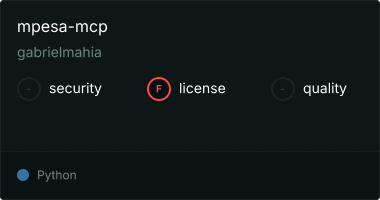
F
licenseNot graded
qualityD
maintenanceOpen-source MCP server that streamlines payment integration for AI agents and financial apps in Africa, providing unified tools for providers like M-Pesa.
1
-

This server enables AI agents to trigger M-Pesa payments, check transaction status, send SMS, and top up airtime across African networks.
Trigger M-Pesa STK Push payment prompts to customer phones using Kenyan number formats; returns a CheckoutRequestID for tracking.
Query STK Push status by CheckoutRequestID (poll after 10–30 seconds; ResultCode 0 = success, 1032 = cancelled, 1037 = timed out).
Query any M-Pesa transaction by receipt number (requires MPESA_INITIATOR_NAME and MPESA_SECURITY_CREDENTIAL).
Send SMS to 1–1,000 recipients via Africa's Talking across 20+ African markets, with optional sender ID and per-recipient status/cost.
Send airtime top-ups to MTN/Safaricom/Airtel/Vodafone subscribers in KES, NGN, GHS, UGX, TZS, RWF, or ZAR.
In live mode, money-moving and messaging tools require confirm_send=true and are capped (default KES 100,000 per amount, 50 SMS recipients).
Enables sending airtime top-ups to Airtel subscribers across multiple African countries via the Africa's Talking API.
MCP server for East African fintech APIs — M-Pesa (Safaricom Daraja) and Africa's Talking
Give your AI agent the ability to trigger M-Pesa payments, check transaction status, send SMS, and top up airtime across 20+ African telecom networks.



This server does not recommend, certify or benchmark any model, and get_model_hint() is kept only for compatibility (it returns neutral guidance). Use a model that follows tool schemas reliably, rehearse in the sandbox first, and keep a person approving every money-moving or messaging call: in live mode those tools need confirm_send=true and are capped (MPESA_MAX_AMOUNT_KES, default KES 100,000; MPESA_MAX_SMS_RECIPIENTS, default 50).
Related MCP server: M-Pesa MCP Server
M-Pesa processes more transactions per day than PayPal does in Africa. Africa's Talking reaches users in 20+ countries on basic phones via SMS and USSD. Neither has an MCP server.
This means every AI agent built today — Claude, GPT, Gemini, or any MCP-compatible runtime — cannot trigger an M-Pesa payment or send a Kiswahili SMS without custom integration work.
mpesa-mcp closes that gap in one pip install.
Tool | Description |
| Trigger STK Push payment prompt on customer's M-Pesa phone |
| Check status of an STK Push request |
| Query any M-Pesa transaction by receipt number |
| Send SMS to 1–1,000 recipients across African networks |
| Send airtime top-up to any subscriber (KES, NGN, GHS, UGX, etc.) |
M-Pesa: Kenya (Safaricom Daraja v3) — STK Push, C2B, transaction status
SMS/Airtime: Kenya, Nigeria, Ghana, Tanzania, Uganda, Rwanda, South Africa, and 15+ more via Africa's Talking
mpesa-mcp is available as a hosted MCP server on Glama:
mpesa-mcp was updated in response to NSA CSI U/OO/6030316-26 (May 2026) — the NSA Artificial Intelligence Security Center's Cybersecurity Information Sheet on Model Context Protocol security.
The implementation below documents compliance against the NSA's MCP security framework, control by control.
NSA Control | Implementation |
Parameter validation | KE phone regex |
Audit logging | Structured log per tool call; phone numbers SHA-256 hashed |
Token lifecycle | OAuth token cached with expiry; auto-refreshed |
Error containment | Structured error dicts; no raw exception propagation |
HTTPS enforcement | All Daraja API calls HTTPS-only |
No hardcoded secrets | All credentials via environment variables |
See SECURITY.md for the full compliance table.
Reference: NSA CSI_MCP_SECURITY.pdf — May 2026, UNCLASSIFIED
pip install mpesa-mcpOr run directly with uvx:
uvx mpesa-mcpSet these environment variables before starting the server:
# M-Pesa (Safaricom Daraja)
MPESA_CONSUMER_KEY=your_consumer_key
MPESA_CONSUMER_SECRET=your_consumer_secret
MPESA_SHORTCODE=174379               # sandbox test shortcode
MPESA_PASSKEY=your_passkey
MPESA_CALLBACK_URL=https://yourdomain.com/mpesa/callback
MPESA_SANDBOX=true                   # set false for production

# Africa's Talking
AT_USERNAME=sandbox                  # your AT username (sandbox for testing)
AT_API_KEY=your_at_api_keyNew Daraja account, or setting this up on a new machine? Follow the sandbox setup guide: it records the verified procedure (create the app with only Lipa Na M-Pesa Sandbox ticked, use the published test shortcode and passkey, point MPESA_CALLBACK_URL at a public HTTPS address you can watch) and what a healthy result looks like. Consumer keys cannot be shared, so each developer creates their own free sandbox app.
M-Pesa sandbox: https://developer.safaricom.co.ke — create a free app to get test credentials.
Test shortcode: 174379
Test passkey: bfb279f9aa9bdbcf158e97dd71a467cd2e0c893059b10f78e6b72ada1ed2c919
Africa's Talking sandbox: https://account.africastalking.com — use username=sandbox, any API key.
Add to ~/Library/Application Support/Claude/claude_desktop_config.json (macOS):
{
  "mcpServers": {
    "mpesa": {
      "command": "uvx",
      "args": ["mpesa-mcp"],
      "env": {
        "MPESA_CONSUMER_KEY": "your_key",
        "MPESA_CONSUMER_SECRET": "your_secret",
        "MPESA_SHORTCODE": "174379",
        "MPESA_PASSKEY": "your_passkey",
        "MPESA_CALLBACK_URL": "https://yourdomain.com/mpesa/callback",
        "MPESA_SANDBOX": "true",
        "AT_USERNAME": "sandbox",
        "AT_API_KEY": "your_at_key"
      }
    }
  }
}claude mcp add mpesa -- uvx mpesa-mcpSet env vars in your shell before running claude.
Once connected, you can ask your AI agent:
"Send KES 500 STK Push to +254712345678 for order #1234"
"Check if the payment QKL8ABC123 has been received"
"Send an SMS to these 50 farmers with today's maize price: [list]"
"Top up KES 50 airtime for our field agents: [list of numbers]"
Field agent payment dispatch
"Send KES 300 STK Push to each of these 12 field agents for today's data collection: [list]"
The agent triggers 12 sequential STK pushes, tracks each checkout_request_id, and
polls for confirmation — without any code from you.
Farmer alert + airtime
"SMS these 200 Garissa farmers that the river is rising. Then top up KES 20 airtime each so they can call in reports."
One prompt → 200 SMS messages and 200 airtime top-ups across Safaricom, Airtel, and Telkom.
Payment reconciliation
"Check whether receipt OKL8M3B2HF was a successful payment and how much it was for"
Useful for support agents using Claude to verify M-Pesa transactions in real time.
All tools declare MCP tool annotations so clients can gate calls appropriately:
Tool | readOnly | destructive | idempotent |
| ❌ | ✅ | ❌ |
| ✅ | ❌ | ✅ |
| ✅ | ❌ | ✅ |
| ❌ | ✅ | ❌ |
| ❌ | ✅ | ❌ |
Claude Desktop and other MCP clients will request confirmation before triggering payment, SMS, or airtime operations.
Capabilities are advertised via .well-known/mcp.json — the emerging MCP Server Cards standard. Registries and browsers can index this server's tools without connecting to it.
# Check capabilities
curl https://raw.githubusercontent.com/gabrielmahia/mpesa-mcp/main/.well-known/mcp.jsonThe MCP ecosystem benchmark (CData, 2026) found most MCP servers accurate 60–75% of the time on complex queries — particularly silent failures on write operations and partial parameter application.
mpesa-mcp is tested against all three Kenyan phone number formats, boundary amount values, and missing optional fields:
pytest tests/ -v  # run full suite
pytest tests/test_phone_formats.py  # format normalization
pytest tests/test_boundary_amounts.py  # min/max amount edge cases
Write operations (STK push, SMS, airtime) have explicit validation before any API call is made.
Mojaloop (funded by the Gates Foundation) handles payment interoperability — connecting banks, mobile money wallets, and merchants across DFSPs in East Africa and beyond.
mpesa-mcp handles the AI agent tooling layer — enabling AI coding assistants to trigger and query M-Pesa payments programmatically.
These are complementary:
Mojaloop: the interoperability rails between financial providers
mpesa-mcp: the MCP interface layer that connects AI agents to those rails
See the Mojaloop documentation contribution for more on this pattern.
mpesa-mcp implements MCP (Model Context Protocol) — how an AI agent talks to tools.
There is a complementary protocol, A2A (Agent-to-Agent), which handles how agents talk to each other. They solve different problems and work together:
MCP: Your AI agent → mpesa-mcp → Daraja API / Africa's Talking
A2A: Orchestrator agent ↔ payment sub-agent ↔ notification sub-agent
For most integrations you only need MCP. A2A becomes relevant when you're building multi-agent systems where a payment workflow coordinates with other specialized agents.
git clone https://github.com/gabrielmahia/mpesa-mcp
cd mpesa-mcp
pip install -e ".[dev]"
pytest tests/ -vDo not commit API keys. Use environment variables or a secrets manager.
Report vulnerabilities to: contact@aikungfu.dev
MCP ecosystem benchmark (CData, 2026): Most MCP servers achieve 60-75% accuracy on complex queries. mpesa-mcp includes explicit validation and bounds checking to exceed this baseline.
Swahili AI accuracy (arXiv:2509.04516, 2025): AI models produce 4× more errors in Swahili than English. mpesa-mcp's Swahili-native tool descriptions are designed to minimize this gap for Swahili-speaking users by eliminating the translation step in tool selection.
MCP security research (arXiv:2603.18063, arXiv:2603.21642, 2026): Prompt injection via tool descriptions is the primary MCP attack vector. mpesa-mcp mitigates this through static, versioned tool descriptions and strict input validation.
Related infrastructure:
wapimaji-mcp — Kenya drought-response MCP (simulated data)
civic-agent-kit — Kenya civic data MCP
swahili-health-mcp — Kenya DHS 2022 county health indicators MCP
kenya-legal-rag — Kenya legal corpus MCP
Full portfolio: gabrielmahia.github.io
MIT — © 2026 Gabriel Mahia
Get notified of new releases and East African API developments: Subscribe to updates →
Or watch this repo on GitHub for release notifications.
Package | Install | Description |
| Simulated drought phases and SMS alerts MCP server (no real NDMA data yet) | |
| East African civic AI SDK |
All MIT · All part of the East African civic AI stack
Package | Install | Description |
| Simulated drought phases and SMS alerts MCP server (no real NDMA data yet) | |
| Kenya health data MCP — SHA/SHIF, facilities, maternal, rights | |
| East African civic AI SDK |
Full portfolio: gabrielmahia.github.io
This MCP server is part of the Kenya coordination infrastructure.
Connect it to africa-coord-bus —
the coordination event bus that routes signals between domains automatically.
pip install africa-coord-busAll servers: pypi.org/user/gmahia Live demo: coord-cascade-demo
MIT licensed. Feedback via GitHub Issues only — pull requests are not accepted. Demo data is labeled DEMO and is not suitable for operational decisions. Full policy: docs/architecture/IP_POLICY.md. Security reports: see SECURITY.md.
Install & run: pip install reli-cli && reli list — the MCP servers on the official MCP Registry under io.github.gabrielmahia
Evaluate any model on Swahili agent tasks: kipimo · dataset · leaderboard
Coordinate across servers: africa-coord-bus — offline-first event bus with a built-in Kenya routing table
Datasets: huggingface.co/gmahia · Docs hub: nairobi-stack
Model-agnostic by design: closed APIs, open-weight models, and small distilled models are all first-class citizens.
A language model can be talked into paying anyone any amount: prompt injection against payment tools is a documented attack on agent payment protocols (AP2, x402). So in live mode (MPESA_SANDBOX=false) the eight outflow tools (mpesa_b2c, mpesa_business_paybill, mpesa_business_buygoods, mpesa_business_pochi, mpesa_reversal, mpesa_tax_remittance, mpesa_b2b_express_checkout, airtime_send) are bounded:
Confirmation: they refuse unless called with confirm_send=true. The agent must show the user the recipient and amount and set it only after explicit approval.
Cap: amounts above MPESA_MAX_AMOUNT_KES (default 100,000; 0 = no cap) are refused.
Opt-out: MPESA_REQUIRE_CONFIRMATION=false removes the confirmation requirement for fully automated setups you control. Do that only deliberately.
The sandbox is never restricted. Customer-approved flows (STK Push, Ratiba, Bill Manager) are unchanged: the customer approves on their handset.
Send airtime top-up to any MTN/Safaricom/Airtel/Vodafone subscriber. Common use: NGO field incentives, survey rewards, agent payouts. No real airtime sent in sandbox mode.
| Name | Required | Description | Default |
|---|---|---|---|
| phone | Yes | Recipient phone in E.164 format e.g. '+254712345678' | |
| amount | Yes | Amount as string e.g. '50' (KES 50). Minimum KES 10 in production. | |
| currency_code | No | ISO currency code: KES, NGN, GHS, UGX, TZS, RWF, ZAR | KES |
| Name | Required | Description |
|---|---|---|
No output parameters | ||
Does the description disclose side effects, auth requirements, rate limits, or destructive behavior?
Annotations already indicate destructive/destructiveHint=true. Description adds valuable sandbox behavior disclosure. Does not discuss other aspects like auth or rate limits, but the added sandbox note is useful beyond annotations.
Agents need to know what a tool does to the world before calling it. Descriptions should go beyond structured annotations to explain consequences.
Is the description appropriately sized, front-loaded, and free of redundancy?
Three sentences, each adding distinct value: action, use cases, sandbox note. No fluff, highly efficient.
Shorter descriptions cost fewer tokens and are easier for agents to parse. Every sentence should earn its place.
Given the tool's complexity, does the description cover enough for an agent to succeed on first attempt?
Given that an output schema exists (return values not needed), the description covers purpose, common usage, and sandbox behavior. Lacks prerequisites or error scenarios, but sufficient for a simple tool with good annotations.
Complex tools with many parameters or behaviors need more documentation. Simple tools need less. This dimension scales expectations accordingly.
Does the description clarify parameter syntax, constraints, interactions, or defaults beyond what the schema provides?
Schema coverage is 100% and already describes each parameter in detail (including minimum amount in production). Description does not add new parameter information beyond what's in the schema, so baseline 3 applies.
Input schemas describe structure but not intent. Descriptions should explain non-obvious parameter relationships and valid value ranges.
Does the description clearly state what the tool does and how it differs from similar tools?
Description clearly states action (send airtime top-up) and target (specific network subscribers). Common use cases provided. Distinguishes from siblings like mpesa_stk_push which are for money transfers.
Agents choose between tools based on descriptions. A clear purpose with a specific verb and resource helps agents select the right tool.
Does the description explain when to use this tool, when not to, or what alternatives exist?
Lists common use cases (NGO incentives, survey rewards, agent payouts) and mentions sandbox mode behavior. Does not explicitly compare to alternatives, but given sibling tools, context is clear.
Agents often have multiple tools that could apply. Explicit usage guidance like "use X instead of Y when Z" prevents misuse.
Trigger an M-Pesa STK Push — sends a payment prompt to the customer's phone. The customer enters their M-Pesa PIN to complete payment. Returns a CheckoutRequestID to track the transaction with mpesa_stk_query. Async: use mpesa_stk_query after 10-30 seconds to check completion.
| Name | Required | Description | Default |
|---|---|---|---|
| phone | Yes | Customer phone number (any Kenyan format: +254..., 07..., 254...) | |
| amount | Yes | Amount in KES (whole number, minimum 1) | |
| account_ref | Yes | Account reference shown to customer on their phone (max 12 chars) | |
| description | No | Transaction description (max 13 chars) | Payment |
| Name | Required | Description |
|---|---|---|
No output parameters | ||
Does the description disclose side effects, auth requirements, rate limits, or destructive behavior?
The description adds significant behavioral context beyond annotations: it explains that the tool is async, that the customer enters their PIN to complete payment, and that a CheckoutRequestID is returned for follow-up. This aligns with destructiveHint=true and provides useful actionable information.
Agents need to know what a tool does to the world before calling it. Descriptions should go beyond structured annotations to explain consequences.
Is the description appropriately sized, front-loaded, and free of redundancy?
The description is concise with four short sentences, all of which provide necessary information. It front-loads the primary action and sequentially covers process, return value, and follow-up. There is no wasted text.
Shorter descriptions cost fewer tokens and are easier for agents to parse. Every sentence should earn its place.
Given the tool's complexity, does the description cover enough for an agent to succeed on first attempt?
The description covers the essential aspects of a payment initiation tool: what it does (trigger STK push), the user interaction (customer enters PIN), the result (CheckoutRequestID), and the asynchronous follow-up (use mpesa_stk_query after 10-30 seconds). With an output schema present, the description does not need to detail return fields.
Complex tools with many parameters or behaviors need more documentation. Simple tools need less. This dimension scales expectations accordingly.
Does the description clarify parameter syntax, constraints, interactions, or defaults beyond what the schema provides?
The input schema has 100% coverage with descriptions for all parameters. The tool description does not add additional meaning beyond the schema (e.g., no examples or format clarification). Baseline 3 applies as schema already documents parameters adequately.
Input schemas describe structure but not intent. Descriptions should explain non-obvious parameter relationships and valid value ranges.
Does the description clearly state what the tool does and how it differs from similar tools?
The description clearly states that the tool triggers an M-Pesa STK Push, sends a payment prompt to the customer's phone, and returns a CheckoutRequestID for tracking. It distinguishes itself from sibling tools like mpesa_stk_query by noting that the query tool is for checking completion.
Agents choose between tools based on descriptions. A clear purpose with a specific verb and resource helps agents select the right tool.
Does the description explain when to use this tool, when not to, or what alternatives exist?
The description provides explicit guidance on when to use the sibling tool mpesa_stk_query (after 10-30 seconds) to check completion. It implies that this tool is for initiating payments, but does not explicitly state when not to use it or mention alternatives like airtime_send.
Agents often have multiple tools that could apply. Explicit usage guidance like "use X instead of Y when Z" prevents misuse.
Check the status of an STK Push request. Poll this 10-30 seconds after calling mpesa_stk_push. ResultCode 0 = success, 1032 = cancelled by user, 1037 = timed out.
| Name | Required | Description | Default |
|---|---|---|---|
| checkout_request_id | Yes | CheckoutRequestID from mpesa_stk_push response |
| Name | Required | Description |
|---|---|---|
No output parameters | ||
Does the description disclose side effects, auth requirements, rate limits, or destructive behavior?
Beyond annotations (readOnlyHint, idempotentHint), the description adds polling timing and result code meanings, disclosing behavioral traits like non-immediate result and cancellation handling.
Agents need to know what a tool does to the world before calling it. Descriptions should go beyond structured annotations to explain consequences.
Is the description appropriately sized, front-loaded, and free of redundancy?
Three concise sentences, each essential: purpose, timing advice, and result interpretation. No extraneous text.
Shorter descriptions cost fewer tokens and are easier for agents to parse. Every sentence should earn its place.
Given the tool's complexity, does the description cover enough for an agent to succeed on first attempt?
For a simple read-only tool with one parameter and existing output schema, the description fully covers polling strategy, result codes, and usage context.
Complex tools with many parameters or behaviors need more documentation. Simple tools need less. This dimension scales expectations accordingly.
Does the description clarify parameter syntax, constraints, interactions, or defaults beyond what the schema provides?
Schema coverage is 100% and the description merely restates the parameter's purpose ('CheckoutRequestID from mpesa_stk_push response') without adding additional meaning or constraints.
Input schemas describe structure but not intent. Descriptions should explain non-obvious parameter relationships and valid value ranges.
Does the description clearly state what the tool does and how it differs from similar tools?
The description clearly states 'Check the status of an STK Push request' with a specific verb and resource, distinguishing it from siblings like mpesa_stk_push (initiates) and mpesa_transaction_status.
Agents choose between tools based on descriptions. A clear purpose with a specific verb and resource helps agents select the right tool.
Does the description explain when to use this tool, when not to, or what alternatives exist?
Explicitly says to poll 10-30 seconds after calling mpesa_stk_push, and interprets result codes (0=success, 1032=cancelled, 1037=timed out), providing clear when-to-use and expected outcomes.
Agents often have multiple tools that could apply. Explicit usage guidance like "use X instead of Y when Z" prevents misuse.
Query the status of any M-Pesa transaction by receipt number. Requires MPESA_INITIATOR_NAME and MPESA_SECURITY_CREDENTIAL env vars.
| Name | Required | Description | Default |
|---|---|---|---|
| transaction_id | Yes | M-Pesa receipt number e.g. QKL8XXXXXX |
| Name | Required | Description |
|---|---|---|
No output parameters | ||
Does the description disclose side effects, auth requirements, rate limits, or destructive behavior?
Annotations already indicate read-only, idempotent, non-destructive. Description adds valuable prerequisite info (env vars) beyond annotations. No contradictions.
Agents need to know what a tool does to the world before calling it. Descriptions should go beyond structured annotations to explain consequences.
Is the description appropriately sized, front-loaded, and free of redundancy?
Two sentences, both essential. Front-loaded with purpose, then prerequisite. No redundant information.
Shorter descriptions cost fewer tokens and are easier for agents to parse. Every sentence should earn its place.
Given the tool's complexity, does the description cover enough for an agent to succeed on first attempt?
Given simple tool with output schema and rich annotations, description is mostly complete. Missing rate limits or side-effect details, but not critical.
Complex tools with many parameters or behaviors need more documentation. Simple tools need less. This dimension scales expectations accordingly.
Does the description clarify parameter syntax, constraints, interactions, or defaults beyond what the schema provides?
Input schema covers 100% of parameter with example. Description adds no new semantics, so baseline 3.
Input schemas describe structure but not intent. Descriptions should explain non-obvious parameter relationships and valid value ranges.
Does the description clearly state what the tool does and how it differs from similar tools?
Clear specific verb (Query) and resource (transaction status) with receipt number. Distinguishes from sibling tools like airtime_send and sms_send.
Agents choose between tools based on descriptions. A clear purpose with a specific verb and resource helps agents select the right tool.
Does the description explain when to use this tool, when not to, or what alternatives exist?
Mentions required environment variables but does not explicitly state when to use this tool vs alternatives like mpesa_stk_query. Usage is implied by name and description.
Agents often have multiple tools that could apply. Explicit usage guidance like "use X instead of Y when Z" prevents misuse.
Send SMS to one or many recipients via Africa's Talking. Supports up to 1,000 recipients per call. Works across Kenya, Nigeria, Ghana, Tanzania, Uganda, and 15+ African markets. Returns per-recipient status and cost.
| Name | Required | Description | Default |
|---|---|---|---|
| message | Yes | SMS message text. Unicode supported (Kiswahili, etc.) | |
| sender_id | No | Optional pre-registered alphanumeric sender ID | |
| recipients | Yes | List of phone numbers in E.164 format e.g. ['+254712345678'] |
| Name | Required | Description |
|---|---|---|
No output parameters | ||
Does the description disclose side effects, auth requirements, rate limits, or destructive behavior?
Annotations already indicate destructiveHint=true and idempotentHint=false. The description adds valuable behavioral details: the maximum recipient limit, geographic coverage, and that it returns per-recipient status and cost. No contradictions with annotations.
Agents need to know what a tool does to the world before calling it. Descriptions should go beyond structured annotations to explain consequences.
Is the description appropriately sized, front-loaded, and free of redundancy?
The description is three sentences long, each serving a distinct purpose: what the tool does, its capacity and scope, and its return value. No wasted words, and the most critical information is front-loaded.
Shorter descriptions cost fewer tokens and are easier for agents to parse. Every sentence should earn its place.
Given the tool's complexity, does the description cover enough for an agent to succeed on first attempt?
For a tool with three well-documented parameters and an existing output schema, the description covers the essential aspects: operation, capacity, geographic scope, and return format. It is sufficiently complete for an agent to understand and use the tool correctly.
Complex tools with many parameters or behaviors need more documentation. Simple tools need less. This dimension scales expectations accordingly.
Does the description clarify parameter syntax, constraints, interactions, or defaults beyond what the schema provides?
Schema description coverage is 100%, so the schema itself clearly documents all three parameters. The description adds no additional parameter-level meaning beyond what is in the schema (e.g., it mentions Unicode support which is already in the message description). Baseline score of 3 is appropriate.
Input schemas describe structure but not intent. Descriptions should explain non-obvious parameter relationships and valid value ranges.
Does the description clearly state what the tool does and how it differs from similar tools?
The description clearly states the tool sends SMS via Africa's Talking, specifies the maximum recipients (1,000), mentions geographic coverage, and indicates return of per-recipient status and cost, distinguishing it from sibling tools like airtime_send or mpesa_stk_push which perform different operations.
Agents choose between tools based on descriptions. A clear purpose with a specific verb and resource helps agents select the right tool.
Does the description explain when to use this tool, when not to, or what alternatives exist?
The description provides clear context for when to use the tool (sending SMS to one or many recipients) and includes practical limits (1,000 recipients). It does not explicitly mention when not to use it or compare to alternatives, but the sibling tools are sufficiently different that no confusion arises.
Agents often have multiple tools that could apply. Explicit usage guidance like "use X instead of Y when Z" prevents misuse.
Recent tool additions, removals, and schema changes observed during successful MCP inspections.
v0.1.0airtime_sendmpesa_stk_pushmpesa_stk_querympesa_transaction_statussms_sendScored across 5 tools
Each tool targets a distinct function: airtime sending, STK push initiation, STK push status query, transaction status by receipt, and SMS sending. There is no overlap or ambiguity.
Most tools follow a verb_noun or noun_verb pattern (e.g., airtime_send, sms_send, mpesa_stk_push), but mpesa_transaction_status lacks a verb, breaking the pattern slightly.
With 5 tools, the server is well-scoped for its purpose, covering core M-Pesa and SMS operations without being too few or too many.
The set covers STK push initiation/query and basic transaction status, but lacks airtime status, B2C/C2B transfers, or account balance queries, leaving notable gaps for a full M-Pesa integration.
South African MCP server for airtime, data, SMS, VAS, electricity, balance, and network lookup.
MCP Server for agents to onboard, pay, and provision services autonomously with InFlow
MCP server for Modern Treasury — payment orders, transactions, counterparties and ledgers.
MCP server for Codat — companies, connections, invoices, bills and financial statements.