LSD MCP Server
엘에스디 엠씨피
LSD 용 업데이트된 MCP 서버입니다. 이번 업데이트의 목적은 SDK를 사용하여 트립 으로 정의된 동적 도구를 효과적으로 활용하기 위한 것입니다.
내용물
Related MCP server: superhighway-mcp
시작하기
인증 중
이는 SDK를 사용하여 실행 중인 MCP 서버를 귀하의 계정 과 연결하는 것입니다.
user 와 password 용어를 사용하는 이유는 연결하려는 대상이 postgres와 호환되는 데이터베이스 이기 때문입니다.
구성 파일
홈 디렉토리에서 .lsd 라는 이름의 파일에 JSON을 작성합니다. 이때 속성은 user , password , 이메일 주소와 프로필 의 API 키가 포함됩니다.
지엑스피1
환경 변수
또는 LSD_USER 및 LSD_PASSWORD 환경 변수를 설정할 수 있습니다.
$ export LSD_USER='you@email.domain'
$ export LSD_PASSWORD='<api_key>'중요: 이 방법을 사용할 때 오류가 발생하면 PATH 또는 MCP 클라이언트가 호출하는 프로세스에서 설정된 환경 변수에 액세스할 수 있는지 확인하세요.
MCP 레지스트리 사용
맥박
https://www.pulsemcp.com/servers/lsd-so-internetdata
곧 더 많은 내용이 나올 예정입니다.
출처에서
이 저장소를 복제하세요
$ git clone https://github.com/lsd-so/mcp.gitClaude desktop을 사용하는 경우
claude_desktop_config.json파일을 업데이트하세요(파일 생성 가이드는 여기 참조 ).
{
"mcpServers": {
// other MCP servers configured here...
"lsd": {
"command": "node",
"args": [
"/<path>/<to>/mcp/build/index.js"
]
}
}
}사용 예
상호 작용

추출

LSD로 기능 확장
MCP 고객에게 "기술"을 가르치고 싶은 경우 LSD 트립(LSD 트립 이란 무엇일까요? )을 통해 가르칠 수 있습니다.
여행이란 무엇인가?
"여행"은 로컬 브라우저와의 상호작용을 통해 파생되었거나 여행을 직접 게시하여 파생된 LSD 프로그램으로 구성된 게시된 모듈 입니다.
자전거 브라우저에서
Bicycle 브라우저에서 "클릭 언어"를 사용하여 LSD를 추출할 수 있습니다. 오른쪽 상단의 필사자 아이콘을 클릭하면 활성화됩니다.

또는 Command+k (Linux/Windows의 경우 Ctrl+k )를 누르세요. 이렇게 하면 반복되는 컨테이너와 관심 필드를 대화형으로 "추출"할 수 있습니다.

생성된 LSD를 사용하면 다음과 같이 별칭을 편집할 수 있습니다.
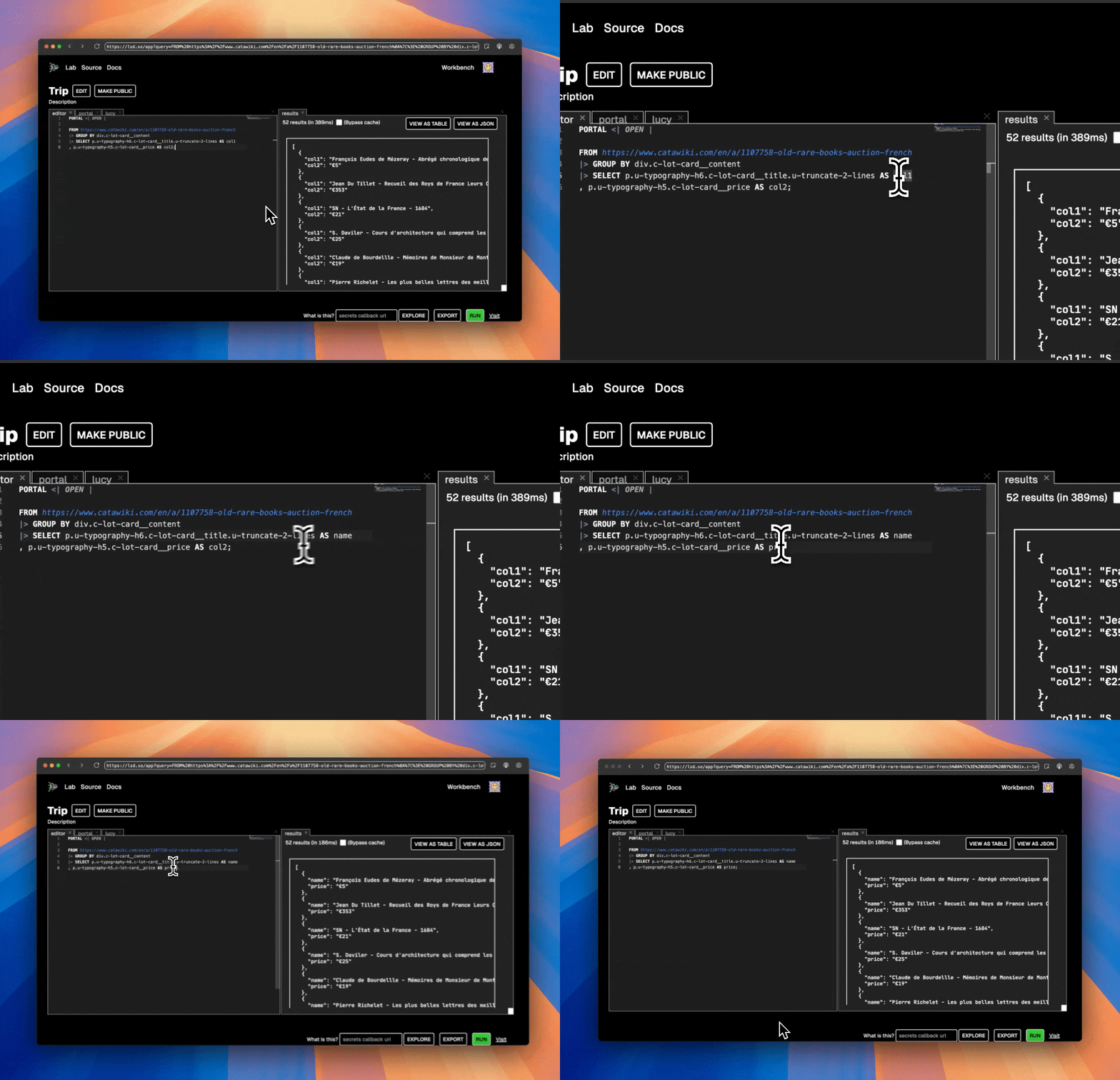
그런 다음 해당 언어를 사용하여 게시할 수 있습니다.
언어 사용
워크벤치에서 간단히 편집하여 여행을 게시하세요.
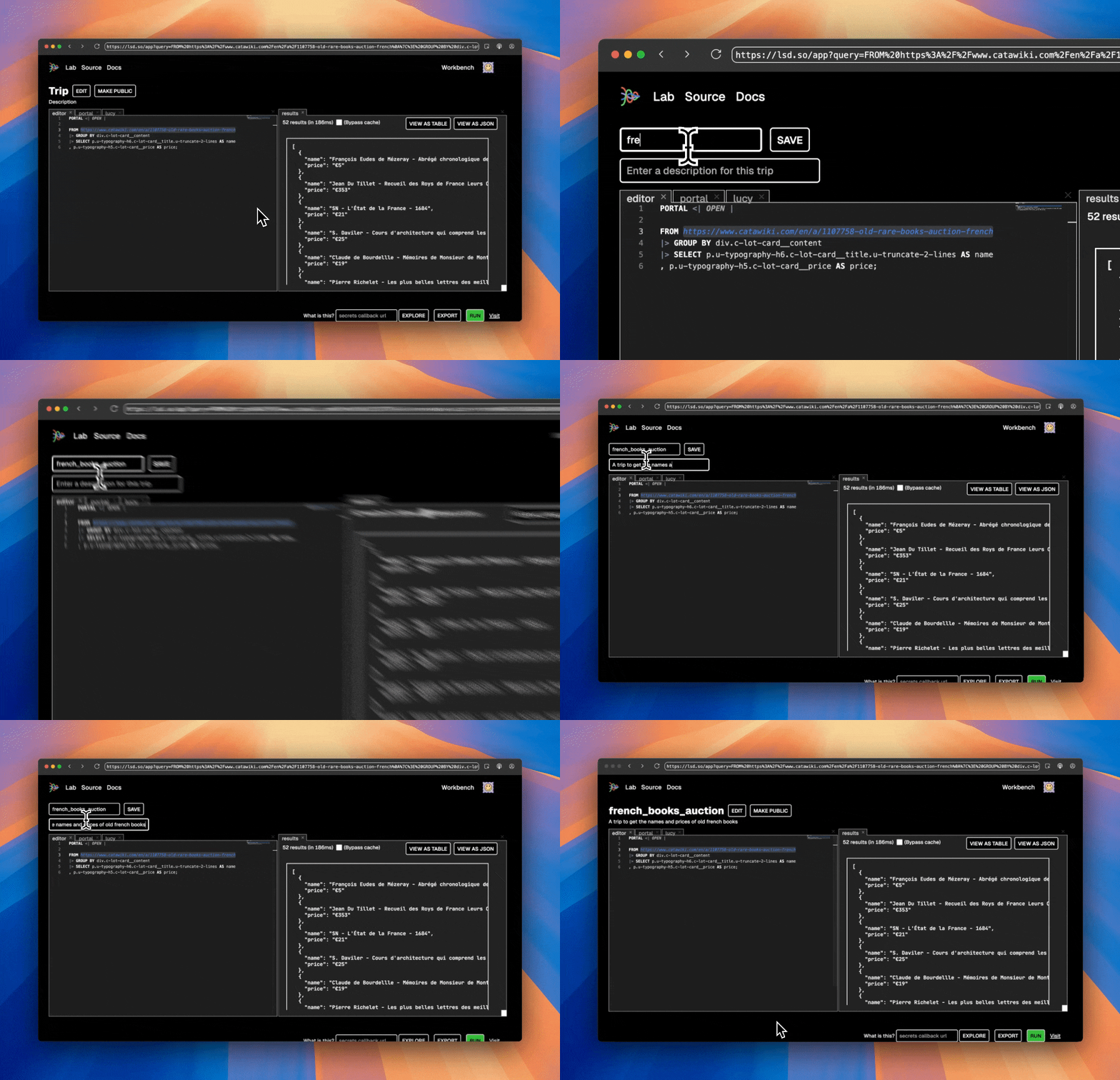
TypeScript를 사용하여 기능 확장
웹과 연결하는 데 사용되는 internetdata SDK를 확인해 보세요. 또는, 'create-your-internet'이라는 단축어를 사용해 보세요.
$ yarn create your-internet또는 npm을 선호하는 경우
$ npm create your-internetAvailable Tools
3 toolsbrave_searchC
Search Brave for possibly relevant links to a query
| Name | Required | Description | Default |
|---|---|---|---|
| query | Yes |
TDQS
Does the description disclose side effects, auth requirements, rate limits, or destructive behavior?
With no annotations provided, the description carries the full burden of behavioral disclosure. It mentions the tool searches for 'possibly relevant links,' which implies it's a read-only operation that returns search results, but doesn't disclose critical behaviors like rate limits, authentication needs, result format, pagination, or error handling. For a search tool with zero annotation coverage, this is insufficient.
Agents need to know what a tool does to the world before calling it. Descriptions should go beyond structured annotations to explain consequences.
Is the description appropriately sized, front-loaded, and free of redundancy?
The description is extremely concise and front-loaded, consisting of a single sentence that directly states the tool's function. Every word earns its place with no wasted information, making it easy for an agent to parse quickly.
Shorter descriptions cost fewer tokens and are easier for agents to parse. Every sentence should earn its place.
Given the tool's complexity, does the description cover enough for an agent to succeed on first attempt?
Given the tool's complexity (a search operation with no output schema and no annotations), the description is incomplete. It lacks details on result structure, error cases, performance characteristics, or any behavioral context needed for effective use. The description alone doesn't provide enough information for reliable tool invocation.
Complex tools with many parameters or behaviors need more documentation. Simple tools need less. This dimension scales expectations accordingly.
Does the description clarify parameter syntax, constraints, interactions, or defaults beyond what the schema provides?
The description adds minimal meaning beyond the input schema. It implies the 'query' parameter is used to search Brave, but with 0% schema description coverage and only one parameter, the baseline is 4 for zero parameters; however, since there is one parameter and the description doesn't elaborate on its format, constraints, or examples, it doesn't fully compensate, warranting a score of 3.
Input schemas describe structure but not intent. Descriptions should explain non-obvious parameter relationships and valid value ranges.
Does the description clearly state what the tool does and how it differs from similar tools?
The description clearly states the tool's purpose with a specific verb ('Search') and resource ('Brave'), and identifies the output ('links to a query'). It distinguishes the tool's function from its siblings (find_trips, run_lsd) by focusing on web search. However, it doesn't explicitly differentiate from potential alternative search tools, keeping it at a 4 rather than a 5.
Agents choose between tools based on descriptions. A clear purpose with a specific verb and resource helps agents select the right tool.
Does the description explain when to use this tool, when not to, or what alternatives exist?
The description provides no guidance on when to use this tool versus alternatives. It mentions 'possibly relevant links' but gives no context about when this search method is preferred over others, what types of queries it handles best, or any prerequisites for use. This leaves the agent without usage direction.
Agents often have multiple tools that could apply. Explicit usage guidance like "use X instead of Y when Z" prevents misuse.
find_tripsD
| Name | Required | Description | Default |
|---|---|---|---|
| query | Yes |
TDQS
Does the description disclose side effects, auth requirements, rate limits, or destructive behavior?
Tool has no description.
Agents need to know what a tool does to the world before calling it. Descriptions should go beyond structured annotations to explain consequences.
Is the description appropriately sized, front-loaded, and free of redundancy?
Tool has no description.
Shorter descriptions cost fewer tokens and are easier for agents to parse. Every sentence should earn its place.
Given the tool's complexity, does the description cover enough for an agent to succeed on first attempt?
Tool has no description.
Complex tools with many parameters or behaviors need more documentation. Simple tools need less. This dimension scales expectations accordingly.
Does the description clarify parameter syntax, constraints, interactions, or defaults beyond what the schema provides?
Tool has no description.
Input schemas describe structure but not intent. Descriptions should explain non-obvious parameter relationships and valid value ranges.
Does the description clearly state what the tool does and how it differs from similar tools?
Tool has no description.
Agents choose between tools based on descriptions. A clear purpose with a specific verb and resource helps agents select the right tool.
Does the description explain when to use this tool, when not to, or what alternatives exist?
Tool has no description.
Agents often have multiple tools that could apply. Explicit usage guidance like "use X instead of Y when Z" prevents misuse.
run_lsdD
| Name | Required | Description | Default |
|---|---|---|---|
| code | Yes |
TDQS
Does the description disclose side effects, auth requirements, rate limits, or destructive behavior?
Tool has no description.
Agents need to know what a tool does to the world before calling it. Descriptions should go beyond structured annotations to explain consequences.
Is the description appropriately sized, front-loaded, and free of redundancy?
Tool has no description.
Shorter descriptions cost fewer tokens and are easier for agents to parse. Every sentence should earn its place.
Given the tool's complexity, does the description cover enough for an agent to succeed on first attempt?
Tool has no description.
Complex tools with many parameters or behaviors need more documentation. Simple tools need less. This dimension scales expectations accordingly.
Does the description clarify parameter syntax, constraints, interactions, or defaults beyond what the schema provides?
Tool has no description.
Input schemas describe structure but not intent. Descriptions should explain non-obvious parameter relationships and valid value ranges.
Does the description clearly state what the tool does and how it differs from similar tools?
Tool has no description.
Agents choose between tools based on descriptions. A clear purpose with a specific verb and resource helps agents select the right tool.
Does the description explain when to use this tool, when not to, or what alternatives exist?
Tool has no description.
Agents often have multiple tools that could apply. Explicit usage guidance like "use X instead of Y when Z" prevents misuse.
Tool Schema Changelog
Recent tool additions, removals, and schema changes observed during successful MCP inspections.
3 tool updates
- First observed
brave_search - First observed
find_trips - First observed
run_lsd
TDQS
Scored across 3 tools
The tools have unclear boundaries and overlapping purposes. 'brave_search' and 'find_trips' could both be interpreted as search tools, with the latter's lack of description making it ambiguous whether it searches for trips or performs another function. 'run_lsd' is completely opaque without a description, potentially overlapping with execution or processing roles.
The naming is mixed but readable. 'brave_search' and 'find_trips' follow a verb_noun pattern, while 'run_lsd' uses a verb_prefix style. There is no chaotic mixing of cases, but the conventions are not fully consistent across all tools.
With only 3 tools, the server feels thin for a general-purpose 'LSD MCP Server', suggesting an incomplete surface. The lack of descriptions for two tools makes it hard to assess scope, but the count is borderline too few for meaningful coverage of any substantial domain.
The server is severely incomplete. Based on the tool names, it appears to cover search and execution, but with no descriptions for 'find_trips' and 'run_lsd', there are significant gaps. It lacks any CRUD operations, lifecycle management, or clear domain coverage, making it impossible for agents to perform coherent workflows.
Maintenance
Related MCP Connectors
Driflyte MCP server which lets AI assistants query topic-specific knowledge from web and GitHub.
The Remote MCP server acts as a standardized bridge between LLM applications (like Claude, ChatGPT, and Cursor) and external services, enabling AI agents to access external tools and resources. Its primary capability is providing a centralized search tool to discover other MCP servers and their respective tools. Unlike local implementations, it runs remotely with OAuth authentication and permission controls for security.
- UnifAPIOAuthcom.unifapi
Hosted MCP server for live public-data APIs and Skills for AI agents.
Related MCP Servers
- FlicenseNot gradedqualityDmaintenanceAn MCP server that enables web search and document retrieval capabilities through Tavily API and LangConnect vector database, supporting AI agents in gathering information for comprehensive report generation.23-
- AlicenseAqualityDmaintenanceAn MCP server that provides real-time web search to AI agents via a pay-per-search USDC microtransaction system.556 npm1MIT
- FlicenseNot gradedqualityDmaintenanceAn MCP server that enables deep internet research through natural language, supporting stdio and HTTP/SSE modes for flexible integration.3-
- AlicenseNot gradedqualityDmaintenanceMCP tool server that gives any AI agent the ability to search, scrape, and analyze content across the internet.42MIT