LSD MCP Server
LSD MCP
Dies ist der aktualisierte MCP-Server für LSD . Der Grund für dieses Update ist die effektive Nutzung dynamischer Tools, die mit unserem SDK als Trips definiert sind.
Inhalt
Related MCP server: superhighway-mcp
Erste Schritte
Authentifizierung
Dies dient dazu, den laufenden MCP-Server mithilfe unseres SDK mit Ihrem Konto zu verbinden.
Der Grund für die Verwendung der Begriffe user und password liegt darin, dass Sie eine Verbindung zu unserer Postgres-kompatiblen Datenbank herstellen.
Konfigurationsdatei
Schreiben Sie in Ihrem Home-Verzeichnis ein JSON in eine Datei namens .lsd mit den Eigenschaften user und password mit Ihrer E-Mail und einem API-Schlüssel aus Ihrem Profil .
{
"user": "<you@email.domain>",
"password": "<api_key>"
}Umgebungsvariablen
Alternativ können Sie die Umgebungsvariablen LSD_USER und LSD_PASSWORD festlegen.
$ export LSD_USER='you@email.domain'
$ export LSD_PASSWORD='<api_key>'Wichtig: Wenn bei diesem Ansatz Fehler auftreten, überprüfen Sie, ob die festgelegten Umgebungsvariablen über den Pfad oder Prozess zugänglich sind, von dem aus der MCP-Client sie aufruft.
Verwenden einer MCP-Registrierung
Impuls
https://www.pulsemcp.com/servers/lsd-so-internetdata
Mehr folgt in Kürze.
Aus der Quelle
Dieses Repository klonen
$ git clone https://github.com/lsd-so/mcp.gitWenn Sie Claude Desktop verwenden, aktualisieren Sie Ihre Datei
claude_desktop_config.json( hier finden Sie eine Anleitung zum Erstellen).
{
"mcpServers": {
// other MCP servers configured here...
"lsd": {
"command": "node",
"args": [
"/<path>/<to>/mcp/build/index.js"
]
}
}
}Anwendungsbeispiel
Interaktion

Extraktion

Erweiterte Funktionen mit LSD
In Szenarien, in denen Sie dem MCP-Client eine „Fähigkeit“ beibringen möchten, können Sie dies mit einem LSD-Trip ( was ist das? ) tun.
Was ist eine Reise?
Ein „Trip“ ist ein veröffentlichtes Modul , das aus einem LSD-Programm besteht, unabhängig davon, ob es durch die Interaktion mit unserem lokalen Browser oder durch die direkte Veröffentlichung eines Trips abgeleitet wurde.
Aus dem Fahrradbrowser
Aus dem Bicycle-Browser können Sie LSD mithilfe unserer „Klicksprache“ ableiten. Diese lässt sich durch einen Klick auf das Transkribierer-Symbol oben rechts aktivieren:

Oder drücken Sie Command+k (bzw. Ctrl+k unter Linux/Windows). Anschließend können Sie sich wiederholende Container sowie Interessensfelder interaktiv „picken“:
Mit dem generierten LSD können Sie die Aliase wie folgt bearbeiten:
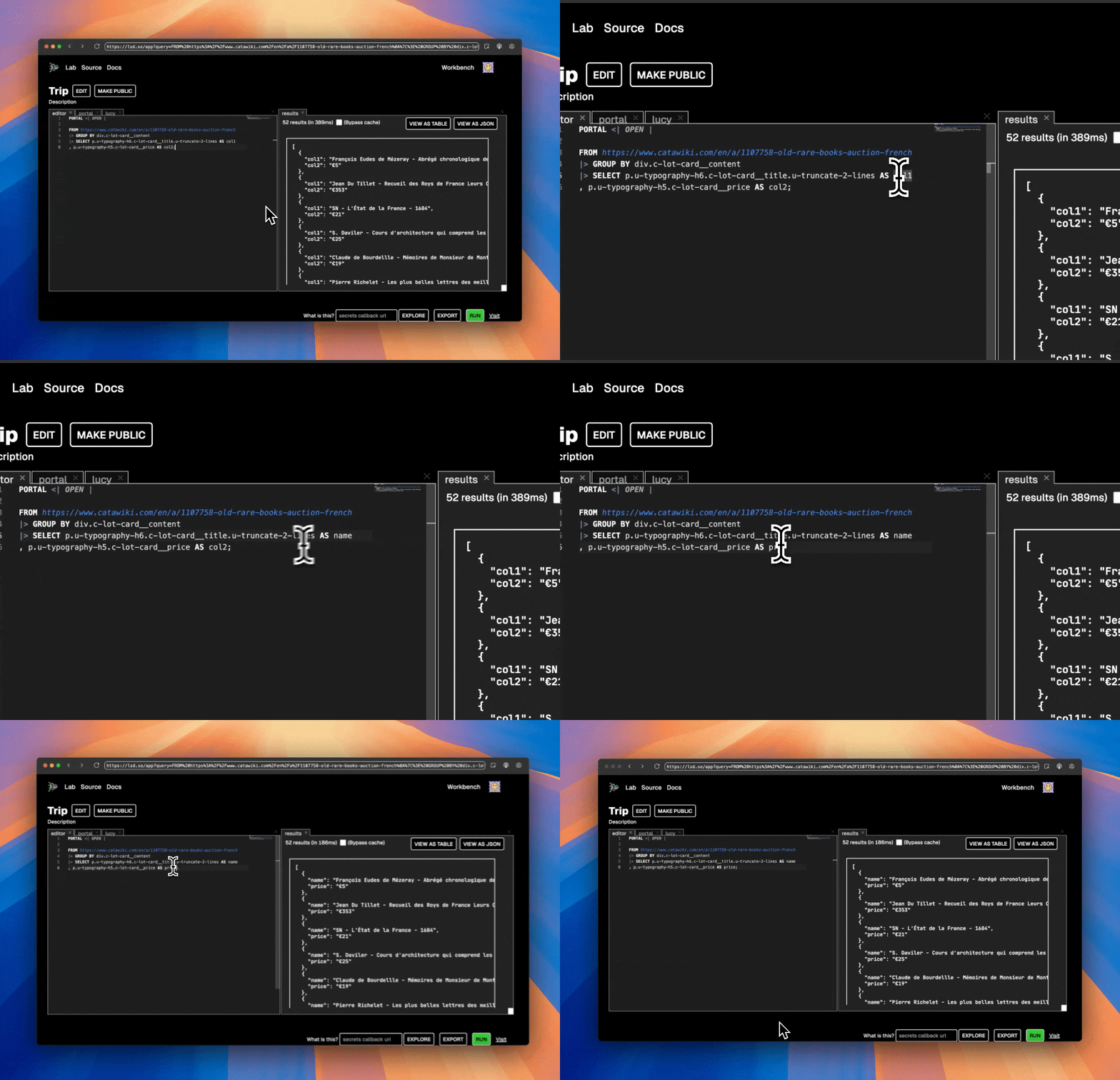
Danach können Sie in der Sprache veröffentlichen.
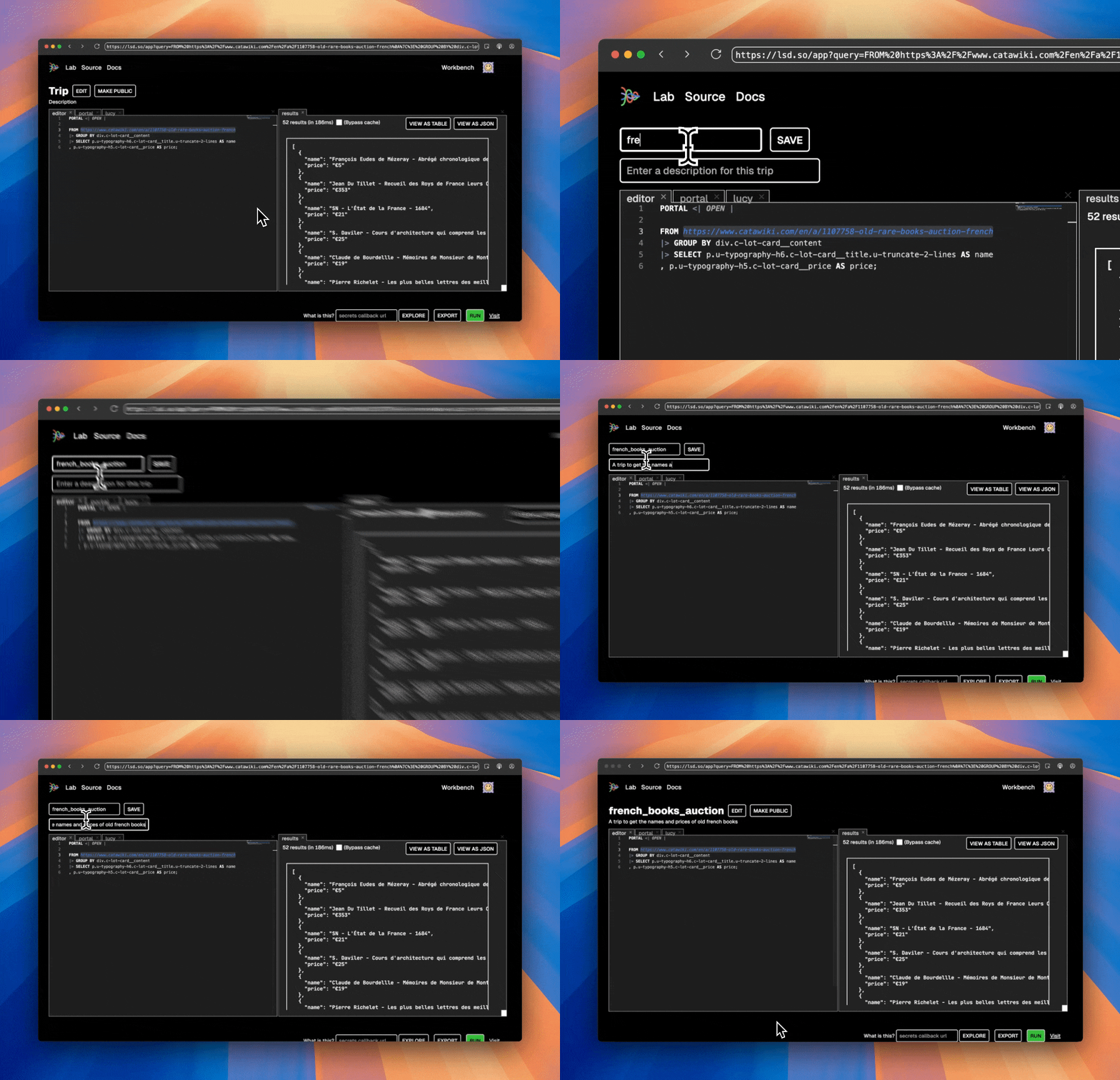
Die Sprache verwenden
Bearbeiten Sie die Reise einfach von der Workbench aus, um sie zu veröffentlichen.
Erweitern der Funktionen mit TypeScript
Schauen Sie sich das Internetdata SDK an, das im Hintergrund für die Verbindung zum Web verwendet wird. Alternativ können Sie auch die Kurzform „Erstellen Sie Ihr Internet“ verwenden.
$ yarn create your-internetOder, wenn Sie npm bevorzugen
$ npm create your-internetAvailable Tools
3 toolsbrave_searchC
Search Brave for possibly relevant links to a query
| Name | Required | Description | Default |
|---|---|---|---|
| query | Yes |
TDQS
Does the description disclose side effects, auth requirements, rate limits, or destructive behavior?
With no annotations provided, the description carries the full burden of behavioral disclosure. It mentions the tool searches for 'possibly relevant links,' which implies it's a read-only operation that returns search results, but doesn't disclose critical behaviors like rate limits, authentication needs, result format, pagination, or error handling. For a search tool with zero annotation coverage, this is insufficient.
Agents need to know what a tool does to the world before calling it. Descriptions should go beyond structured annotations to explain consequences.
Is the description appropriately sized, front-loaded, and free of redundancy?
The description is extremely concise and front-loaded, consisting of a single sentence that directly states the tool's function. Every word earns its place with no wasted information, making it easy for an agent to parse quickly.
Shorter descriptions cost fewer tokens and are easier for agents to parse. Every sentence should earn its place.
Given the tool's complexity, does the description cover enough for an agent to succeed on first attempt?
Given the tool's complexity (a search operation with no output schema and no annotations), the description is incomplete. It lacks details on result structure, error cases, performance characteristics, or any behavioral context needed for effective use. The description alone doesn't provide enough information for reliable tool invocation.
Complex tools with many parameters or behaviors need more documentation. Simple tools need less. This dimension scales expectations accordingly.
Does the description clarify parameter syntax, constraints, interactions, or defaults beyond what the schema provides?
The description adds minimal meaning beyond the input schema. It implies the 'query' parameter is used to search Brave, but with 0% schema description coverage and only one parameter, the baseline is 4 for zero parameters; however, since there is one parameter and the description doesn't elaborate on its format, constraints, or examples, it doesn't fully compensate, warranting a score of 3.
Input schemas describe structure but not intent. Descriptions should explain non-obvious parameter relationships and valid value ranges.
Does the description clearly state what the tool does and how it differs from similar tools?
The description clearly states the tool's purpose with a specific verb ('Search') and resource ('Brave'), and identifies the output ('links to a query'). It distinguishes the tool's function from its siblings (find_trips, run_lsd) by focusing on web search. However, it doesn't explicitly differentiate from potential alternative search tools, keeping it at a 4 rather than a 5.
Agents choose between tools based on descriptions. A clear purpose with a specific verb and resource helps agents select the right tool.
Does the description explain when to use this tool, when not to, or what alternatives exist?
The description provides no guidance on when to use this tool versus alternatives. It mentions 'possibly relevant links' but gives no context about when this search method is preferred over others, what types of queries it handles best, or any prerequisites for use. This leaves the agent without usage direction.
Agents often have multiple tools that could apply. Explicit usage guidance like "use X instead of Y when Z" prevents misuse.
find_tripsD
| Name | Required | Description | Default |
|---|---|---|---|
| query | Yes |
TDQS
Does the description disclose side effects, auth requirements, rate limits, or destructive behavior?
Tool has no description.
Agents need to know what a tool does to the world before calling it. Descriptions should go beyond structured annotations to explain consequences.
Is the description appropriately sized, front-loaded, and free of redundancy?
Tool has no description.
Shorter descriptions cost fewer tokens and are easier for agents to parse. Every sentence should earn its place.
Given the tool's complexity, does the description cover enough for an agent to succeed on first attempt?
Tool has no description.
Complex tools with many parameters or behaviors need more documentation. Simple tools need less. This dimension scales expectations accordingly.
Does the description clarify parameter syntax, constraints, interactions, or defaults beyond what the schema provides?
Tool has no description.
Input schemas describe structure but not intent. Descriptions should explain non-obvious parameter relationships and valid value ranges.
Does the description clearly state what the tool does and how it differs from similar tools?
Tool has no description.
Agents choose between tools based on descriptions. A clear purpose with a specific verb and resource helps agents select the right tool.
Does the description explain when to use this tool, when not to, or what alternatives exist?
Tool has no description.
Agents often have multiple tools that could apply. Explicit usage guidance like "use X instead of Y when Z" prevents misuse.
run_lsdD
| Name | Required | Description | Default |
|---|---|---|---|
| code | Yes |
TDQS
Does the description disclose side effects, auth requirements, rate limits, or destructive behavior?
Tool has no description.
Agents need to know what a tool does to the world before calling it. Descriptions should go beyond structured annotations to explain consequences.
Is the description appropriately sized, front-loaded, and free of redundancy?
Tool has no description.
Shorter descriptions cost fewer tokens and are easier for agents to parse. Every sentence should earn its place.
Given the tool's complexity, does the description cover enough for an agent to succeed on first attempt?
Tool has no description.
Complex tools with many parameters or behaviors need more documentation. Simple tools need less. This dimension scales expectations accordingly.
Does the description clarify parameter syntax, constraints, interactions, or defaults beyond what the schema provides?
Tool has no description.
Input schemas describe structure but not intent. Descriptions should explain non-obvious parameter relationships and valid value ranges.
Does the description clearly state what the tool does and how it differs from similar tools?
Tool has no description.
Agents choose between tools based on descriptions. A clear purpose with a specific verb and resource helps agents select the right tool.
Does the description explain when to use this tool, when not to, or what alternatives exist?
Tool has no description.
Agents often have multiple tools that could apply. Explicit usage guidance like "use X instead of Y when Z" prevents misuse.
Tool Schema Changelog
Recent tool additions, removals, and schema changes observed during successful MCP inspections.
3 tool updates
- First observed
brave_search - First observed
find_trips - First observed
run_lsd
TDQS
Scored across 3 tools
The tools have unclear boundaries and overlapping purposes. 'brave_search' and 'find_trips' could both be interpreted as search tools, with the latter's lack of description making it ambiguous whether it searches for trips or performs another function. 'run_lsd' is completely opaque without a description, potentially overlapping with execution or processing roles.
The naming is mixed but readable. 'brave_search' and 'find_trips' follow a verb_noun pattern, while 'run_lsd' uses a verb_prefix style. There is no chaotic mixing of cases, but the conventions are not fully consistent across all tools.
With only 3 tools, the server feels thin for a general-purpose 'LSD MCP Server', suggesting an incomplete surface. The lack of descriptions for two tools makes it hard to assess scope, but the count is borderline too few for meaningful coverage of any substantial domain.
The server is severely incomplete. Based on the tool names, it appears to cover search and execution, but with no descriptions for 'find_trips' and 'run_lsd', there are significant gaps. It lacks any CRUD operations, lifecycle management, or clear domain coverage, making it impossible for agents to perform coherent workflows.
Maintenance
Related MCP Connectors
Driflyte MCP server which lets AI assistants query topic-specific knowledge from web and GitHub.
The Remote MCP server acts as a standardized bridge between LLM applications (like Claude, ChatGPT, and Cursor) and external services, enabling AI agents to access external tools and resources. Its primary capability is providing a centralized search tool to discover other MCP servers and their respective tools. Unlike local implementations, it runs remotely with OAuth authentication and permission controls for security.
- UnifAPIOAuthcom.unifapi
Hosted MCP server for live public-data APIs and Skills for AI agents.
Related MCP Servers
- FlicenseNot gradedqualityDmaintenanceAn MCP server that enables web search and document retrieval capabilities through Tavily API and LangConnect vector database, supporting AI agents in gathering information for comprehensive report generation.23-
- AlicenseAqualityDmaintenanceAn MCP server that provides real-time web search to AI agents via a pay-per-search USDC microtransaction system.556 npm1MIT
- FlicenseNot gradedqualityDmaintenanceAn MCP server that enables deep internet research through natural language, supporting stdio and HTTP/SSE modes for flexible integration.3-
- AlicenseNot gradedqualityDmaintenanceMCP tool server that gives any AI agent the ability to search, scrape, and analyze content across the internet.42MIT