Glama
chargebee

@chargebee/mcp

Official
by chargebee

Chargebee 模型上下文协议 (MCP) 服务器

MCP Chargebeenpm 版本

模型上下文协议 (MCP) 是一种标准化协议,旨在管理大型语言模型 (LLM) 和外部系统之间的上下文。

Chargebee MCP 服务器提供一套强大的工具来提高开发人员的效率。它集成了 Cursor、Windsurf 和 Cline 等 AI 代码编辑器,以及 Claude Desktop 等通用工具。它与任何 MCP 客户端兼容。

使用此 MCP 服务器,您可以:
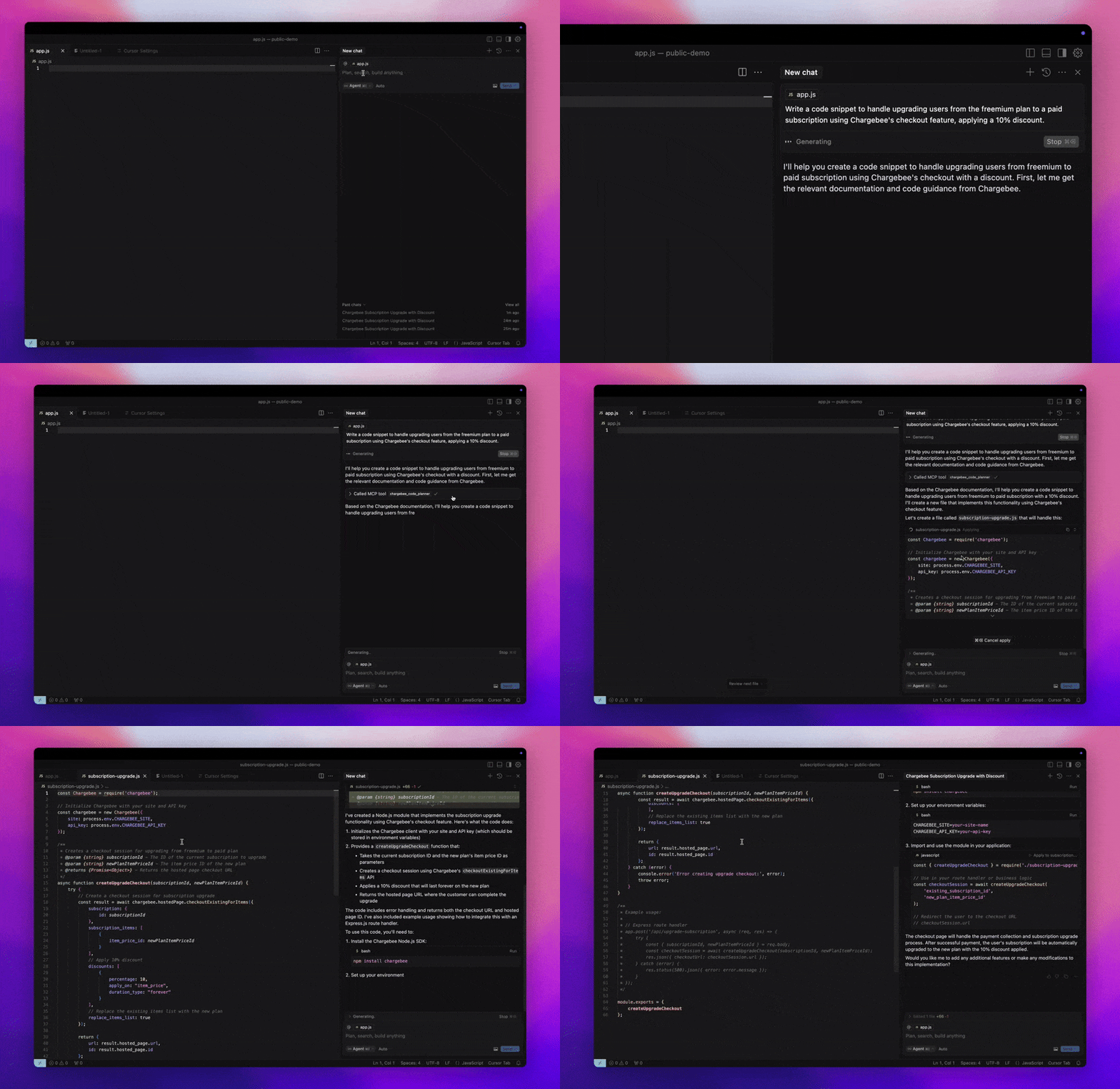
  • 立即获得有关 Chargebee 产品和 API 服务的答案。

  • 接收根据您的集成需求定制的上下文感知代码片段。

  • 访问 Chargebee 的知识库,包括:

    • 文档

    • 常见问题解答

    • 发行说明

    • 以及更多

MCP 演示

先决条件

  • Node.js LTS - Chargebee MCP 服务器需要 Node.js LTS 版本才能正常运行。

Related MCP server: Codinfy MCP

设置

要使用Node.js npx运行 Chargebee MCP 服务器,请执行以下命令:

npx -y @chargebee/mcp@latest

可用工具

工具

描述

chargebee_documentation_search

搜索 Chargebee 的文档以检索详细信息和使用指南。

chargebee_code_planner

生成结构化代码大纲和示例代码以集成 Chargebee 的 API 和功能。

安装

光标

要将此服务器添加到 Cursor IDE:

  1. 导航到Cursor Settings > MCP 。

  2. 单击+ Add new Global MCP Server 。

  3. 将以下配置添加到全局.cursor/mcp.json文件:

{
  "mcpServers": {
    "chargebee": {
      "command": "npx",
      "args": [
          "-y",
          "@chargebee/mcp"
      ]
    }
  }
}

有关更多详细信息,请参阅Cursor 文档。注意:您也可以将其添加到项目特定的 Cursor 配置中(Cursor 0.46+ 版本支持)。

风帆冲浪

要使用 Cascade 设置 MCP:

  1. 打开 Windsurf 并导航至Settings > Advanced Settings或使用“命令面板”> Open Windsurf Settings Page 。

  2. 滚动到 Cascade 部分以添加新服务器、查看现有服务器或访问mcp_config.json上的原始 JSON 配置文件。

  3. 单击“添加自定义服务器 +”将 Chargebee MCP 服务器直接包含在mcp_config.json中:

{
  "mcpServers": {
    "chargebee": {
      "command": "npx",
      "args": [
          "-y",
          "@chargebee/mcp"
      ]
    }
  }
}

请参阅Windsurf 文档以了解更多信息。

克莱恩

通过 Cline MCP 服务器设置手动将以下 JSON 添加到您的cline_mcp_settings.json文件中:

{
  "mcpServers": {
    "chargebee": {
      "command": "npx",
      "args": [
          "-y",
          "@chargebee/mcp"
      ]
    }
  }
}

罗奥代码

通过选择 Roo Code 设置中的Edit MCP Settings或使用 VS Code 命令面板中的Roo Code: Open MCP Config命令来访问 MCP 设置:

{
  "mcpServers": {
    "chargebee": {
      "command": "npx",
      "args": [
          "-y",
          "@chargebee/mcp"
      ]
    }
  }
}

克劳德

将以下配置添加到claude_desktop_config.json文件。更多详细信息,请参阅Claude Desktop 文档:

{
  "mcpServers": {
    "chargebee": {
      "command": "npx",
      "args": [
          "-y",
          "@chargebee/mcp"
      ]
    }
  }
}

命令行界面

您还可以通过执行以下命令将服务器作为 CLI 运行:

npx -y @chargebee/mcp@latest

贡献

要为该项目做出贡献,请参阅贡献指南。

执照

麻省理工学院

Available Tools

2 tools
chargebee_code_plannerA

Use this tool for any Chargebee integration questions or implementation needs.

Always use this tool to get the accurate integration code guide for Chargebee. This is the main tool developers need when asking about implementing Chargebee functionality (like "how to update billing address", "how to create subscription", "how to handle webhooks", etc.).

This tool will take in parameters about integrating with Chargebee in their application and generates an integration workflow along with the code snippets.

It takes the following arguments:

  • goal (string): What is the user's goal?

  • language (enum): Programming language the code to be generated in. Check the user's application language.

ParametersJSON Schema
NameRequiredDescriptionDefault
goalYesWhat is the user's goal?
languageNoProgramming language the code to be generated in. Check the user's application language.

TDQS

A3.5/5.0
Behavior2/5

Does the description disclose side effects, auth requirements, rate limits, or destructive behavior?

No annotations are provided, so the description must disclose behavioral traits. It only describes the tool as generating code but does not clarify that it is a read-only operation with no side effects or data mutations. Such information is essential for safe invocation.

Agents need to know what a tool does to the world before calling it. Descriptions should go beyond structured annotations to explain consequences.

Conciseness3/5

Is the description appropriately sized, front-loaded, and free of redundancy?

The description contains redundant phrasing (e.g., 'Use this tool' and 'Always use this tool') and could be more streamlined. However, it is not excessively long and includes necessary details.

Shorter descriptions cost fewer tokens and are easier for agents to parse. Every sentence should earn its place.

Completeness3/5

Given the tool's complexity, does the description cover enough for an agent to succeed on first attempt?

The description covers the tool's inputs and high-level output (workflow and code snippets) but lacks details on the output structure, error handling, or limitations. With no output schema, more specifics would improve completeness.

Complex tools with many parameters or behaviors need more documentation. Simple tools need less. This dimension scales expectations accordingly.

Parameters3/5

Does the description clarify parameter syntax, constraints, interactions, or defaults beyond what the schema provides?

Schema coverage is 100%, and the descriptions in the schema are adequate. The tool description reiterates the parameter meanings without adding new context or examples, meeting the baseline for high coverage.

Input schemas describe structure but not intent. Descriptions should explain non-obvious parameter relationships and valid value ranges.

Purpose5/5

Does the description clearly state what the tool does and how it differs from similar tools?

The description clearly states the tool's purpose: generating integration workflows and code snippets for Chargebee. It explicitly differentiates from the sibling tool 'chargebee_documentation_search' by positioning itself as the main tool for implementation questions.

Agents choose between tools based on descriptions. A clear purpose with a specific verb and resource helps agents select the right tool.

Usage Guidelines4/5

Does the description explain when to use this tool, when not to, or what alternatives exist?

The description advises to use this tool for Chargebee integration needs and to check the user's language. It implies a context for use but does not explicitly exclude scenarios or mention alternatives beyond the sibling.

Agents often have multiple tools that could apply. Explicit usage guidance like "use X instead of Y when Z" prevents misuse.

Tool Schema Changelog

Recent tool additions, removals, and schema changes observed during successful MCP inspections.

  1. 2 tool updates
    • First observedchargebee_code_planner
    • First observedchargebee_documentation_search

TDQS

A4.1/5.0

Scored across 2 tools

Disambiguation5/5

The two tools have explicitly distinct purposes: one for implementation guidance and code generation, the other for general documentation queries. Descriptions clearly separate their use cases, eliminating ambiguity.

Naming Consistency5/5

Both tools follow a consistent 'chargebee_<descriptive_noun>' pattern, making it easy to infer their roles. The naming is uniform and predictable.

Tool Count4/5

With only two tools, the server is very focused, but that matches its specific purpose of handling integration assistance and documentation search. While minimal, the count is reasonable for the intended scope.

Completeness5/5

The tool set covers both implementation needs (code planner) and conceptual understanding (documentation search), leaving no obvious gaps for its stated goal of answering Chargebee integration questions.

Maintenance

ActivityInactive
ResponsivenessNo issues

Related MCP Connectors

Related MCP Servers

  • A
    license
    A
    quality
    D
    maintenance
    MCP server that connects AI agents to Codinfy platform APIs for validating licenses, creating checkouts, listing products, tracking analytics, managing OAuth identity, and handling ad placements.
    17
    MIT
  • F
    license
    A
    quality
    D
    maintenance
    MCP server for RevenueCat that lets AI agents query subscriber data, check entitlements, fetch offerings, and manage subscriptions via natural language.
    6
    -
  • A
    license
    B
    quality
    B
    maintenance
    MCP server that connects AI assistants to the Conexa business management system, enabling CRUD operations on sales, customers, plans, contracts, charges, and more via 83 tools.
    83
    121 npm
    1
    MIT