
F
licenseNot graded
qualityD
maintenanceThis server implements the Model Context Protocol to facilitate meaningful interaction and understanding development between humans and AI through structured tools and progressive interaction patterns.
57
-

The ESA MCP Server provides a convenient interface to manage Alibaba Cloud ESA services via the MCP protocol, primarily focusing on Edge Routines and related configurations.
Key capabilities include:
Manage Edge Routines: Create, delete, list, and get details of Edge Routines
Deploy Code: Commit and deploy code versions to staging or production environments, and delete deployments
Manage Routes: Create, update, delete, and list routes associated with Edge Routines or sites
Handle Records: Create, delete, and list records related to Edge Routines and sites
Manage Sites: List active sites, match sites based on criteria, and create DNS records
Canary Deployment: List available canary areas and deploy code with canary release options
Click on "Deploy Server".
Wait a few minutes for the server to deploy. Once ready, it will show a "Started" state.
In the chat, type @ followed by the MCP server name and your instructions, e.g., "@ESA MCP Server list all active sites in my Alibaba Cloud account"
That's it! The server will respond to your query, and you can continue using it as needed.
Here is a step-by-step guide with screenshots.


MCP server for Alibaba Cloud ESA — deploy to the edge, manage DNS, certificates, and Edge Routines, all from your AI-powered IDE.
🚀 Pages — One-command deploy HTML or static folders (dist/, build/) to the edge
⚡ Edge Routine — Full lifecycle management: create, commit, deploy, route, and tear down
🌐 Site — DNS records, SSL certificates, IPv6, managed transforms, and site configuration
🧩 Modular — Load all 40+ tools or pick only the module you need
🔌 Works everywhere — Cursor, Claude Desktop, Cline, and any MCP-compatible client
Related MCP server: MCP Server Demo
Get your AccessKey ID and Secret from the Alibaba Cloud AccessKey page
Enable the Edge Routine service
Add to your MCP client config (e.g., Cursor ~/.cursor/mcp.json, Claude Desktop, Cline):
Pages (recommended) — deploy static sites to the edge in seconds:
{
  "mcpServers": {
    "esa-pages": {
      "command": "npx",
      "args": ["-y", "-p", "mcp-server-esa", "mcp-server-esa-pages"],
      "env": {
        "ALIBABA_CLOUD_ACCESS_KEY_ID": "your AK",
        "ALIBABA_CLOUD_ACCESS_KEY_SECRET": "your SK"
      }
    }
  }
}
All-in-one — includes Pages, ER, and Site tools:
{
  "mcpServers": {
    "esa-mcp-server": {
      "command": "npx",
      "args": ["-y", "mcp-server-esa"],
      "env": {
        "ALIBABA_CLOUD_ACCESS_KEY_ID": "your AK",
        "ALIBABA_CLOUD_ACCESS_KEY_SECRET": "your SK",
        "ALIBABA_CLOUD_SECURITY_TOKEN": "optional, required when using STS Token"
      }
    }
  }
}
Modular — load only what you need:
Module | Binary | Best for |
Pages |
| Frontend devs — deploy HTML/static files to the edge |
ER |
| Edge developers — full Edge Routine lifecycle |
Site |
| DevOps / SREs — DNS, certificates, IPv6, site config |
Run a specific module:
npx -p mcp-server-esa <binary>Pin a version:npx -p mcp-server-esa@1.1.0 <binary>
Edge Routine — full lifecycle management for serverless edge functions:
{
  "mcpServers": {
    "esa-er": {
      "command": "npx",
      "args": ["-y", "-p", "mcp-server-esa", "mcp-server-esa-er"],
      "env": {
        "ALIBABA_CLOUD_ACCESS_KEY_ID": "your AK",
        "ALIBABA_CLOUD_ACCESS_KEY_SECRET": "your SK"
      }
    }
  }
}
Site — DNS, certificates, IPv6, and site configuration:
{
  "mcpServers": {
    "esa-site": {
      "command": "npx",
      "args": ["-y", "-p", "mcp-server-esa", "mcp-server-esa-site"],
      "env": {
        "ALIBABA_CLOUD_ACCESS_KEY_ID": "your AK",
        "ALIBABA_CLOUD_ACCESS_KEY_SECRET": "your SK"
      }
    }
  }
}
Multiple modules:
{
  "mcpServers": {
    "esa-pages": {
      "command": "npx",
      "args": ["-y", "-p", "mcp-server-esa", "mcp-server-esa-pages"],
      "env": {
        "ALIBABA_CLOUD_ACCESS_KEY_ID": "your AK",
        "ALIBABA_CLOUD_ACCESS_KEY_SECRET": "your SK"
      }
    },
    "esa-site": {
      "command": "npx",
      "args": ["-y", "-p", "mcp-server-esa", "mcp-server-esa-site"],
      "env": {
        "ALIBABA_CLOUD_ACCESS_KEY_ID": "your AK",
        "ALIBABA_CLOUD_ACCESS_KEY_SECRET": "your SK"
      }
    }
  }
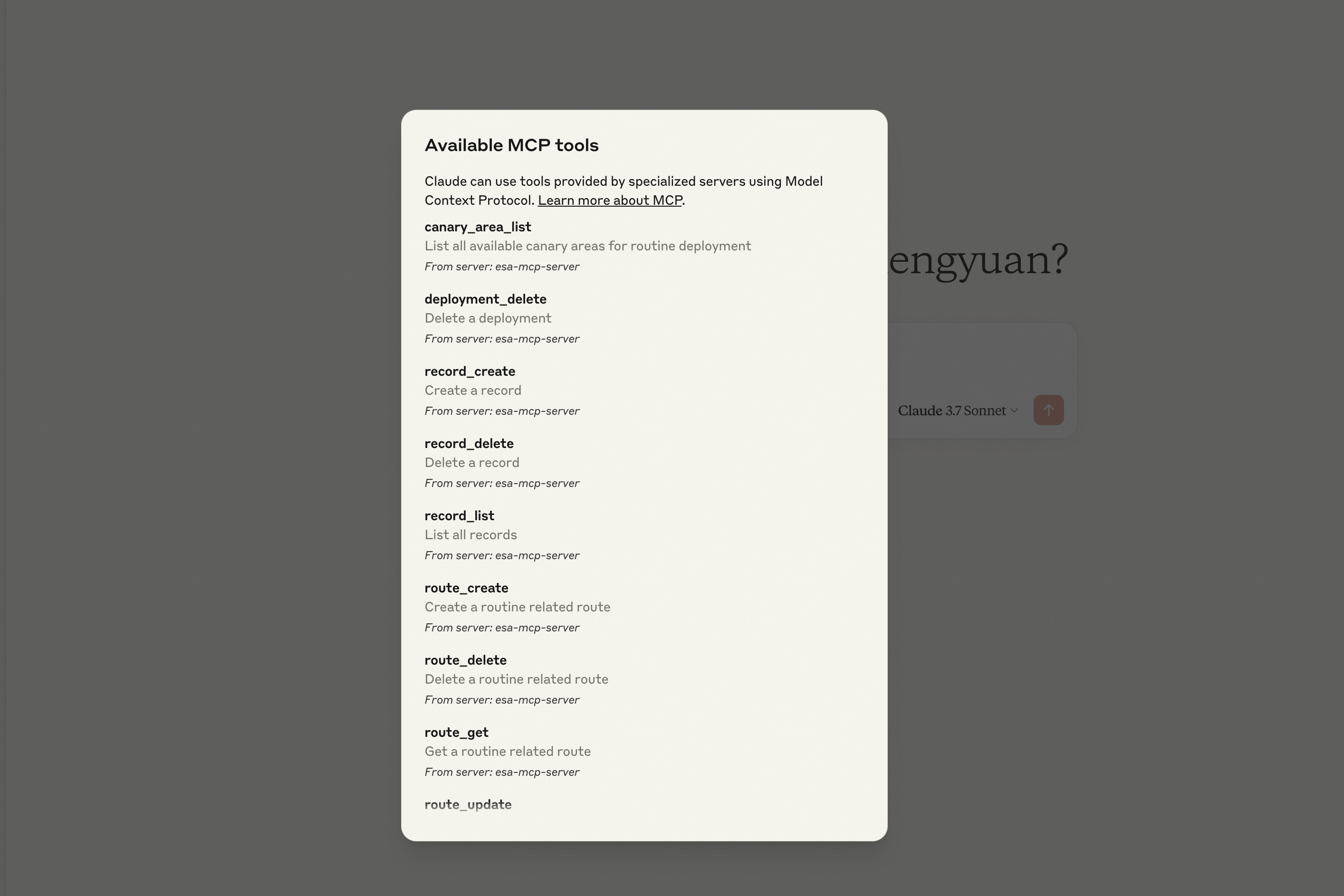
}Claude Desktop

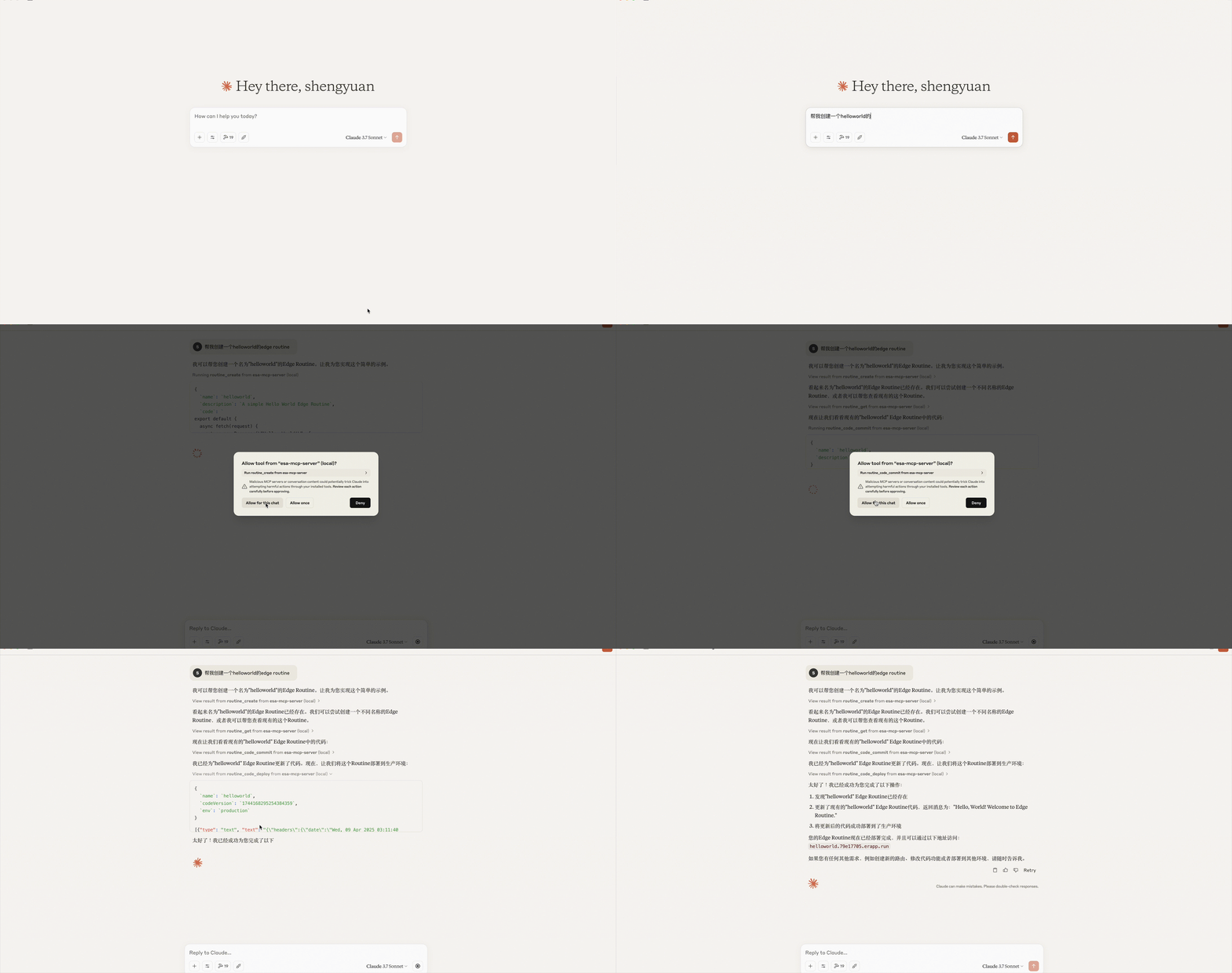
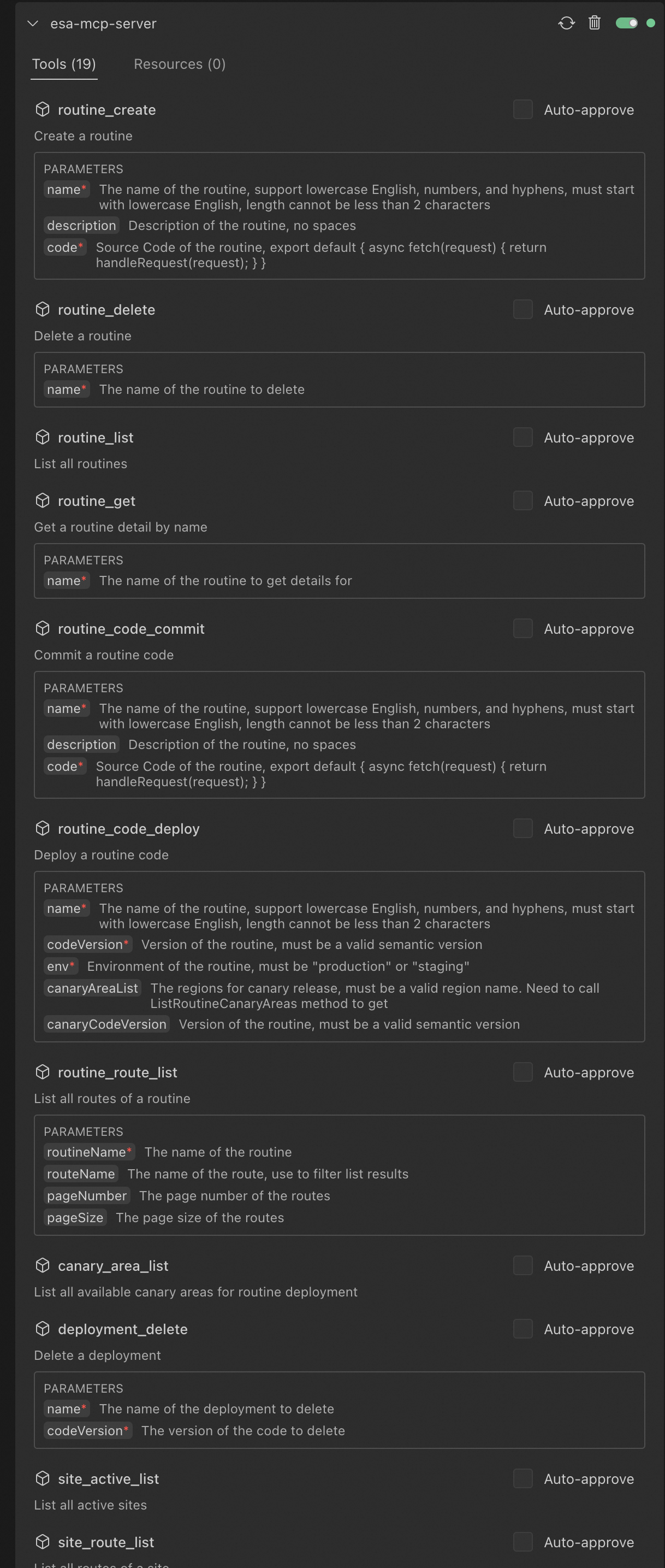
Cline
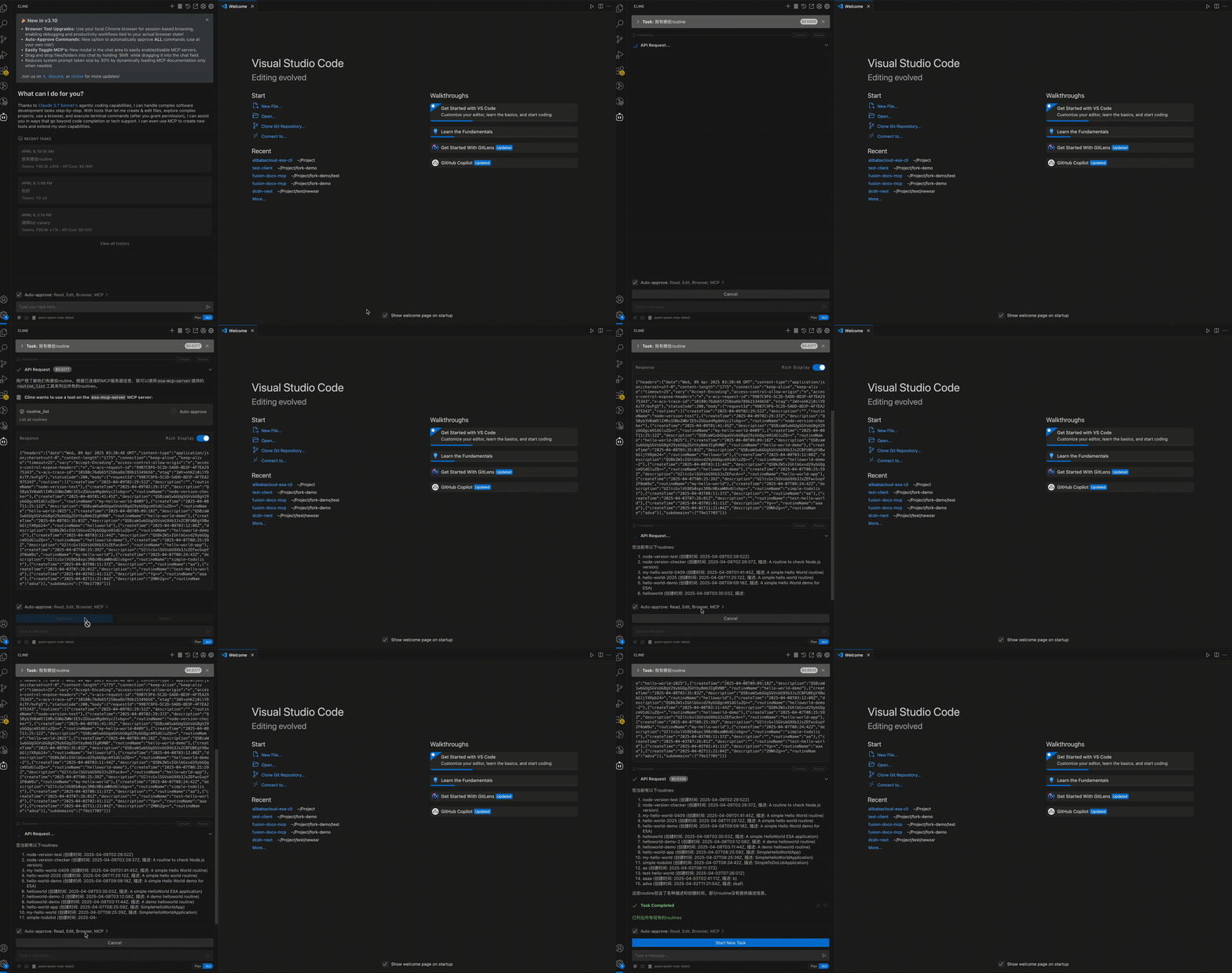
Cline configured successfully:
Claude Desktop configured successfully:
Tool | Description |
| Deploy an HTML page to ESA Pages, returns a default access URL |
| Deploy a local folder of static files (HTML/CSS/JS/images) to ESA Pages, auto-packaged |
Category | Tool | Description |
Routines |
| Create a new Edge Routine |
| Delete an Edge Routine | |
| List all Edge Routines | |
| Get Edge Routine details | |
Deployments |
| Save a code version for an Edge Routine |
| Deploy a code version to staging or production | |
| Delete a code version | |
Routes |
| Create a route for an Edge Routine |
| Update a route configuration | |
| Delete a route | |
| Get route details | |
| List routes for an Edge Routine | |
| List routes for a site | |
Records |
| Create a record for an Edge Routine |
| Delete a record | |
| List records for an Edge Routine |
Category | Tool | Description |
Sites |
| List all sites |
| List active sites | |
| Find a site matching given criteria | |
| Create a new site | |
| Query ESA proxy configuration | |
| Update ESA proxy configuration | |
DNS |
| List DNS records for a site |
| Create an A/AAAA record | |
| Create a CNAME record | |
| Create a TXT record | |
| Create an NS record | |
| Create an MX record | |
| Update a DNS record | |
| Get a DNS record | |
| List DNS records | |
| Delete a DNS record | |
IPv6 |
| Update IPv6 configuration |
| Query IPv6 configuration | |
Transform |
| Update managed transform configuration |
| Query managed transform configuration | |
Certificate |
| Enable/update certificate for a site |
| Apply for a free SSL certificate | |
| Get certificate details | |
| Delete a certificate | |
| List certificates for a site | |
| Query certificate quota and usage |
Write a 2048 game and deploy it on Edge Routine, show me the access URL.
Deploy the ./dist folder to ESA Pages.
List all Edge Routines under my account.
Delete Edge Routines created after May 2025.
What is the default access URL for my Edge Routine "hello-world"?
Create a CNAME record for test.example.com pointing to example2.com.
Create an A record for test.example.com with value 1.1.1.1.
Apply a free SSL certificate for my site example.com.
Show me the IPv6 configuration for my site.MIT
Applies for a free SSL certificate.
| Name | Required | Description | Default |
|---|---|---|---|
| siteId | Yes | Site ID. Example: 1234567890123. Reference Value Source: list_sites | |
| domains | Yes | The list of domain names, separated by commas. Example: "example.com,www.example.com" | |
| type | Yes | The type of certificate. Possible values: - lets_encrypt (Let's Encrypt certificate) - digicert_single (Digicert single-domain certificate) - digicert_wildcard (Digicert wildcard certificate) |
Does the description disclose side effects, auth requirements, rate limits, or destructive behavior?
With no annotations provided, the description carries the full burden of behavioral disclosure. It mentions 'Applies for' which implies a write operation, but doesn't specify if it's idempotent, requires specific permissions, has rate limits, or what happens on failure. This leaves significant gaps in understanding the tool's behavior.
Agents need to know what a tool does to the world before calling it. Descriptions should go beyond structured annotations to explain consequences.
Is the description appropriately sized, front-loaded, and free of redundancy?
The description is a single, clear sentence with zero waste. It's front-loaded and efficiently conveys the core action without unnecessary elaboration, making it easy for an agent to parse quickly.
Shorter descriptions cost fewer tokens and are easier for agents to parse. Every sentence should earn its place.
Given the tool's complexity, does the description cover enough for an agent to succeed on first attempt?
Given the complexity of applying for an SSL certificate, no annotations, and no output schema, the description is insufficient. It doesn't explain what the tool returns, potential errors, or dependencies on other tools like 'list_sites', leaving the agent with incomplete context for effective use.
Complex tools with many parameters or behaviors need more documentation. Simple tools need less. This dimension scales expectations accordingly.
Does the description clarify parameter syntax, constraints, interactions, or defaults beyond what the schema provides?
The input schema has 100% description coverage, detailing each parameter's purpose and examples. The description adds no additional meaning beyond the schema, such as explaining interactions between parameters or edge cases. Baseline 3 is appropriate since the schema does the heavy lifting.
Input schemas describe structure but not intent. Descriptions should explain non-obvious parameter relationships and valid value ranges.
Does the description clearly state what the tool does and how it differs from similar tools?
The description clearly states the action ('Applies for') and resource ('a free SSL certificate'), making the purpose evident. However, it doesn't differentiate from sibling tools like 'set_certificate' or 'get_certificate', which might handle certificate operations differently, so it doesn't reach the highest score.
Agents choose between tools based on descriptions. A clear purpose with a specific verb and resource helps agents select the right tool.
Does the description explain when to use this tool, when not to, or what alternatives exist?
No guidance is provided on when to use this tool versus alternatives like 'set_certificate' or 'delete_certificate'. The description lacks context about prerequisites, such as needing a site from 'list_sites', or exclusions, leaving the agent with minimal usage direction.
Agents often have multiple tools that could apply. Explicit usage guidance like "use X instead of Y when Z" prevents misuse.
Adds a website. Make sure that you have an available plan before you add a website. Make sure that your website domain name has an ICP filing if the location you want to specify covers the Chinese mainland.
| Name | Required | Description | Default |
|---|---|---|---|
| siteName | Yes | The website name. | |
| coverage | Yes | The service location. Valid values: - domestic: the Chinese mainland - global: global - overseas: outside the Chinese mainland | |
| accessType | Yes | The DNS setup. Valid values: - NS; - CNAME | |
| instanceId | Yes | The instance ID, which can be obtained by calling the [ListUserRatePlanInstances] operation. Specify at least one of the instance ID and website ID. If you specify both of them, the instance ID is used. | |
| resourceGroupId | No | The ID of the resource group. If you leave this parameter empty, the system uses the default resource group ID. |
Does the description disclose side effects, auth requirements, rate limits, or destructive behavior?
No annotations are provided, so the description carries the full burden. It mentions important behavioral constraints (plan availability and ICP filing requirements), which adds value beyond basic functionality. However, it doesn't disclose other potential behavioral traits like error conditions, response format, whether the operation is idempotent, or what happens on failure.
Agents need to know what a tool does to the world before calling it. Descriptions should go beyond structured annotations to explain consequences.
Is the description appropriately sized, front-loaded, and free of redundancy?
The description is appropriately concise with two sentences that both provide valuable information. The first sentence states the core purpose, and the second adds crucial prerequisites. There's no wasted text, though it could be slightly more structured with bullet points for the prerequisites.
Shorter descriptions cost fewer tokens and are easier for agents to parse. Every sentence should earn its place.
Given the tool's complexity, does the description cover enough for an agent to succeed on first attempt?
For a creation tool with no annotations and no output schema, the description provides adequate context about prerequisites but lacks information about what happens after creation (e.g., what is returned, whether the site becomes immediately active, error handling). Given the complexity of website creation with location-specific requirements, more completeness would be beneficial.
Complex tools with many parameters or behaviors need more documentation. Simple tools need less. This dimension scales expectations accordingly.
Does the description clarify parameter syntax, constraints, interactions, or defaults beyond what the schema provides?
With 100% schema description coverage, the input schema already documents all parameters thoroughly. The description doesn't add any parameter-specific information beyond what's in the schema, so it meets the baseline of 3 where the schema does the heavy lifting.
Input schemas describe structure but not intent. Descriptions should explain non-obvious parameter relationships and valid value ranges.
Does the description clearly state what the tool does and how it differs from similar tools?
The description clearly states the action ('Adds a website') and resource ('a website'), making the purpose unambiguous. However, it doesn't differentiate this tool from sibling tools like 'create_site_cname_record' or 'create_site_ns_record' which also create site-related resources, so it doesn't achieve full sibling differentiation.
Agents choose between tools based on descriptions. A clear purpose with a specific verb and resource helps agents select the right tool.
Does the description explain when to use this tool, when not to, or what alternatives exist?
The description provides clear contextual prerequisites ('Make sure that you have an available plan' and 'Make sure that your website domain name has an ICP filing if the location... covers the Chinese mainland'), which effectively guide when to use this tool. However, it doesn't explicitly mention when NOT to use it or name specific alternative tools for different scenarios.
Agents often have multiple tools that could apply. Explicit usage guidance like "use X instead of Y when Z" prevents misuse.
Creates a DNS record for a specific website. Only A/AAAA records are supported.
| Name | Required | Description | Default |
|---|---|---|---|
| siteId | Yes | The website ID, which can be obtained by calling the [ListSites] operation. | |
| recordName | Yes | The record name. | |
| proxied | No | Specifies whether to proxy the record. Only CNAME and A/AAAA records can be proxied. Valid values: - true - false | |
| bizName | No | The business scenario of the record for acceleration. The parameter cannot be empty if your record is proxied. Valid values: - image_video - api - web | |
| ttl | No | The TTL of the record. Unit: seconds. If the value is 1, the TTL of the record is determined by the system. Default: 1. | |
| data | Yes | The DNS record information. The format of this field varies based on the record type. For more information, see https://www.alibabacloud.com/help/doc-detail/2708761.html | |
| comment | No | The comment of the record. The maximum length is 100 characters. |
Does the description disclose side effects, auth requirements, rate limits, or destructive behavior?
No annotations are provided, so the description carries full burden. It states 'Creates' which implies a write operation, but doesn't disclose any behavioral traits: no information about permissions required, rate limits, idempotency, whether the operation is reversible, what happens on conflicts, or what the response looks like. For a mutation tool with zero annotation coverage, this is a significant gap.
Agents need to know what a tool does to the world before calling it. Descriptions should go beyond structured annotations to explain consequences.
Is the description appropriately sized, front-loaded, and free of redundancy?
The description is extremely concise with just two sentences that directly state the tool's purpose and limitation. Every word earns its place with zero redundancy or unnecessary elaboration. It's front-loaded with the core functionality.
Shorter descriptions cost fewer tokens and are easier for agents to parse. Every sentence should earn its place.
Given the tool's complexity, does the description cover enough for an agent to succeed on first attempt?
Given this is a mutation tool (creates DNS records) with 7 parameters, no annotations, and no output schema, the description is insufficiently complete. It doesn't explain what happens after creation, how to verify success, error conditions, or relationship to other DNS operations. The agent would need to infer too much about this write operation's behavior.
Complex tools with many parameters or behaviors need more documentation. Simple tools need less. This dimension scales expectations accordingly.
Does the description clarify parameter syntax, constraints, interactions, or defaults beyond what the schema provides?
Schema description coverage is 100%, so the schema already documents all 7 parameters thoroughly. The description adds no parameter-specific information beyond what's in the schema. It mentions 'A/AAAA records' which relates to the implicit 'type' parameter, but this is already covered in the schema's required parameters. Baseline 3 is appropriate when the schema does all the work.
Input schemas describe structure but not intent. Descriptions should explain non-obvious parameter relationships and valid value ranges.
Does the description clearly state what the tool does and how it differs from similar tools?
The description clearly states the action ('Creates a DNS record') and the resource ('for a specific website'), with specificity about supported record types ('Only A/AAAA records are supported'). It distinguishes from sibling tools like 'create_site_cname_record' by explicitly limiting to A/AAAA records. However, it doesn't fully differentiate from other DNS record creation tools beyond type restriction.
Agents choose between tools based on descriptions. A clear purpose with a specific verb and resource helps agents select the right tool.
Does the description explain when to use this tool, when not to, or what alternatives exist?
The description provides no guidance on when to use this tool versus alternatives like 'create_site_cname_record' or 'update_record'. It mentions 'Only A/AAAA records are supported' which implies exclusion of other types, but offers no context about prerequisites, dependencies, or typical scenarios for A/AAAA record creation versus other DNS operations.
Agents often have multiple tools that could apply. Explicit usage guidance like "use X instead of Y when Z" prevents misuse.
Creates a DNS record for a specific website. Only supports records with type=CNAME and sourceType=Domain.
| Name | Required | Description | Default |
|---|---|---|---|
| siteId | Yes | The website ID, which can be obtained by calling the [ListSites] operation. | |
| recordName | Yes | The record name. | |
| sourceType | No | The origin type for the CNAME record. This parameter is required when you add a CNAME record. Valid values: - Domain: domain name If you do not pass this parameter or if you leave its value empty, Domain is used by default. | |
| bizName | No | The business scenario of the record for acceleration. Leave the parameter empty if your record is not proxied. Valid values: - image_video - api - web | |
| ttl | No | The TTL of the record. Unit: seconds. If the value is 1, the TTL of the record is determined by the system. Default: 1. | |
| data | Yes | The DNS record information. The format of this field varies based on the record type. For more information, see https://www.alibabacloud.com/help/doc-detail/2708761.html | |
| comment | No | The comment of the record. The maximum length is 100 characters. | |
| hostPolicy | No | The origin host policy. This policy takes effect when the record type is CNAME. Required. You can set the policy in two modes: - follow_hostname - follow_origin_domain |
Does the description disclose side effects, auth requirements, rate limits, or destructive behavior?
No annotations are provided, so the description carries the full burden. It states 'Creates a DNS record,' which implies a write operation, but does not disclose behavioral traits such as required permissions, whether the operation is idempotent, potential side effects, or error conditions. This is a significant gap for a mutation tool with zero annotation coverage.
Agents need to know what a tool does to the world before calling it. Descriptions should go beyond structured annotations to explain consequences.
Is the description appropriately sized, front-loaded, and free of redundancy?
The description is a single, efficient sentence that front-loads the purpose and constraints with zero waste. Every word earns its place, making it easy to parse quickly.
Shorter descriptions cost fewer tokens and are easier for agents to parse. Every sentence should earn its place.
Given the tool's complexity, does the description cover enough for an agent to succeed on first attempt?
For a mutation tool with no annotations and no output schema, the description is minimally adequate. It specifies the tool's purpose and constraints, but lacks details on behavioral aspects (e.g., permissions, idempotency) and does not explain return values or error handling, leaving gaps in completeness.
Complex tools with many parameters or behaviors need more documentation. Simple tools need less. This dimension scales expectations accordingly.
Does the description clarify parameter syntax, constraints, interactions, or defaults beyond what the schema provides?
Schema description coverage is 100%, so the schema already documents all 8 parameters thoroughly. The description adds no additional parameter semantics beyond what the schema provides, such as explaining interactions between parameters or usage examples. Baseline 3 is appropriate when the schema does the heavy lifting.
Input schemas describe structure but not intent. Descriptions should explain non-obvious parameter relationships and valid value ranges.
Does the description clearly state what the tool does and how it differs from similar tools?
The description clearly states the action ('Creates a DNS record') and the specific resource ('for a specific website'), with explicit constraints ('Only supports records with type=CNAME and sourceType=Domain'). This distinguishes it from sibling tools like create_site_a_or_aaaa_record or create_site_txt_record, which handle different DNS record types.
Agents choose between tools based on descriptions. A clear purpose with a specific verb and resource helps agents select the right tool.
Does the description explain when to use this tool, when not to, or what alternatives exist?
The description provides clear context on when to use this tool by specifying the supported record types (CNAME with sourceType=Domain). It implies alternatives through sibling tools for other record types, but does not explicitly name them or state when not to use this tool (e.g., for non-CNAME records).
Agents often have multiple tools that could apply. Explicit usage guidance like "use X instead of Y when Z" prevents misuse.
Creates a DNS record for a specific website. Only MX records are supported.
| Name | Required | Description | Default |
|---|---|---|---|
| siteId | Yes | The website ID, which can be obtained by calling the [ListSites] operation. | |
| recordName | Yes | The record name. | |
| bizName | No | The business scenario of the record for acceleration. Leave the parameter empty if your record is not proxied. Valid values: - image_video - api - web | |
| ttl | No | The TTL of the record. Unit: seconds. If the value is 1, the TTL of the record is determined by the system. Default: 1. | |
| data | Yes | The DNS record information. The format of this field varies based on the record type. For more information, see https://www.alibabacloud.com/help/doc-detail/2708761.html | |
| comment | No | The comment of the record. The maximum length is 100 characters. |
Does the description disclose side effects, auth requirements, rate limits, or destructive behavior?
No annotations are provided, so the description carries the full burden of behavioral disclosure. It states it's a creation operation but doesn't cover permissions needed, whether it's idempotent, potential side effects, error conditions, or what the response looks like. For a mutation tool with zero annotation coverage, this is a significant gap.
Agents need to know what a tool does to the world before calling it. Descriptions should go beyond structured annotations to explain consequences.
Is the description appropriately sized, front-loaded, and free of redundancy?
The description is extremely concise with just two sentences that directly state the tool's purpose and limitation. Every word earns its place, and it's front-loaded with the core functionality.
Shorter descriptions cost fewer tokens and are easier for agents to parse. Every sentence should earn its place.
Given the tool's complexity, does the description cover enough for an agent to succeed on first attempt?
For a mutation tool with 6 parameters, no annotations, and no output schema, the description is inadequate. It doesn't explain what happens after creation, error handling, or provide context about MX records versus other DNS types. The schema covers parameters well, but behavioral and usage context is missing.
Complex tools with many parameters or behaviors need more documentation. Simple tools need less. This dimension scales expectations accordingly.
Does the description clarify parameter syntax, constraints, interactions, or defaults beyond what the schema provides?
Schema description coverage is 100%, so the schema already documents all 6 parameters thoroughly. The description adds no additional parameter information beyond what's in the schema, such as explaining the relationship between parameters or providing usage examples. Baseline 3 is appropriate when the schema does the heavy lifting.
Input schemas describe structure but not intent. Descriptions should explain non-obvious parameter relationships and valid value ranges.
Does the description clearly state what the tool does and how it differs from similar tools?
The description clearly states the verb ('Creates') and resource ('DNS record for a specific website'), and specifies the record type limitation ('Only MX records are supported'). However, it doesn't explicitly differentiate from sibling tools like create_site_a_or_aaaa_record or create_site_cname_record, though the MX specificity provides some implicit distinction.
Agents choose between tools based on descriptions. A clear purpose with a specific verb and resource helps agents select the right tool.
Does the description explain when to use this tool, when not to, or what alternatives exist?
The description provides no guidance on when to use this tool versus alternatives like create_site_a_or_aaaa_record or create_site_cname_record. It doesn't mention prerequisites, such as needing a siteId from list_sites, or explain MX record use cases versus other DNS record types.
Agents often have multiple tools that could apply. Explicit usage guidance like "use X instead of Y when Z" prevents misuse.
Creates a DNS record for a specific website. Only NS records are supported.
| Name | Required | Description | Default |
|---|---|---|---|
| siteId | No | The website ID, which can be obtained by calling the [ListSites] operation. | |
| recordName | No | The record name. | |
| ttl | No | The TTL of the record. Unit: seconds. If the value is 1, the TTL of the record is determined by the system. Default: 1. | |
| data | No | The DNS record information. The format of this field varies based on the record type. For more information, see https://www.alibabacloud.com/help/doc-detail/2708761.html | |
| comment | No | The comment of the record. The maximum length is 100 characters. | |
| required | No | ||
| annotations | No |
Does the description disclose side effects, auth requirements, rate limits, or destructive behavior?
No annotations are provided, so the description carries full burden for behavioral disclosure. While 'Creates' implies a write/mutation operation, the description doesn't disclose important behavioral traits like authentication requirements, rate limits, whether the operation is idempotent, what happens on conflict, or what the response looks like. For a creation tool with zero annotation coverage, this is a significant gap.
Agents need to know what a tool does to the world before calling it. Descriptions should go beyond structured annotations to explain consequences.
Is the description appropriately sized, front-loaded, and free of redundancy?
The description is perfectly concise with two sentences that each earn their place: the first states the core purpose, the second adds critical constraint information. There's zero waste or redundancy, and the most important information is front-loaded.
Shorter descriptions cost fewer tokens and are easier for agents to parse. Every sentence should earn its place.
Given the tool's complexity, does the description cover enough for an agent to succeed on first attempt?
For a creation tool with 7 parameters, no annotations, and no output schema, the description is incomplete. It doesn't address what happens after creation, error conditions, authentication requirements, or provide context about the broader DNS management system. The description covers the 'what' but misses the 'how' and 'what happens next' that an agent needs for reliable tool invocation.
Complex tools with many parameters or behaviors need more documentation. Simple tools need less. This dimension scales expectations accordingly.
Does the description clarify parameter syntax, constraints, interactions, or defaults beyond what the schema provides?
With 71% schema description coverage, the schema already documents most parameters well. The description adds no parameter-specific information beyond what's in the schema. The baseline is 3 when schema coverage is high (>80%), but at 71% it's borderline - the description doesn't compensate for the remaining 29% gap, nor does it add meaningful context about parameter relationships or usage patterns.
Input schemas describe structure but not intent. Descriptions should explain non-obvious parameter relationships and valid value ranges.
Does the description clearly state what the tool does and how it differs from similar tools?
The description clearly states the specific action ('Creates a DNS record') and resource ('for a specific website'), and explicitly distinguishes this tool from siblings by specifying 'Only NS records are supported', which differentiates it from other create_site_*_record tools like create_site_a_or_aaaa_record or create_site_cname_record.
Agents choose between tools based on descriptions. A clear purpose with a specific verb and resource helps agents select the right tool.
Does the description explain when to use this tool, when not to, or what alternatives exist?
The description provides clear context about when to use this tool ('Only NS records are supported'), which implicitly distinguishes it from other DNS record creation tools. However, it doesn't explicitly mention when NOT to use it or name specific alternatives, though the sibling tool names make the alternatives obvious.
Agents often have multiple tools that could apply. Explicit usage guidance like "use X instead of Y when Z" prevents misuse.
Creates a DNS record for a specific website. Only TXT records are supported.
| Name | Required | Description | Default |
|---|---|---|---|
| siteId | Yes | The website ID, which can be obtained by calling the [ListSites] operation. | |
| recordName | Yes | The record name. | |
| ttl | No | The TTL of the record. Unit: seconds. If the value is 1, the TTL of the record is determined by the system. Default: 1. | |
| data | Yes | The DNS record information. The format of this field varies based on the record type. For more information, see https://www.alibabacloud.com/help/doc-detail/2708761.html | |
| comment | No | The comment of the record. The maximum length is 100 characters. |
Does the description disclose side effects, auth requirements, rate limits, or destructive behavior?
No annotations are provided, so the description carries the full burden. It states 'Creates a DNS record,' which implies a write operation, but doesn't disclose behavioral traits such as whether it requires specific permissions, if it's idempotent, what happens on conflicts, or error conditions. The description adds minimal context beyond the basic action.
Agents need to know what a tool does to the world before calling it. Descriptions should go beyond structured annotations to explain consequences.
Is the description appropriately sized, front-loaded, and free of redundancy?
The description is two sentences with zero waste: it states the purpose and constraint efficiently. It's appropriately sized and front-loaded, with every sentence earning its place by clarifying the tool's scope.
Shorter descriptions cost fewer tokens and are easier for agents to parse. Every sentence should earn its place.
Given the tool's complexity, does the description cover enough for an agent to succeed on first attempt?
Given the tool's complexity (5 parameters, nested objects, no output schema) and lack of annotations, the description is minimal. It covers the basic purpose and record type constraint but doesn't address behavioral aspects, error handling, or output expectations. For a creation tool with no annotations, this leaves significant gaps.
Complex tools with many parameters or behaviors need more documentation. Simple tools need less. This dimension scales expectations accordingly.
Does the description clarify parameter syntax, constraints, interactions, or defaults beyond what the schema provides?
Schema description coverage is 100%, so the schema already documents all parameters thoroughly. The description adds no additional meaning about parameters beyond what the schema provides, such as explaining the 'siteId' dependency or 'data' format specifics. Baseline 3 is appropriate when schema coverage is high.
Input schemas describe structure but not intent. Descriptions should explain non-obvious parameter relationships and valid value ranges.
Does the description clearly state what the tool does and how it differs from similar tools?
The description clearly states the action ('Creates a DNS record') and resource ('for a specific website'), and specifies that 'Only TXT records are supported.' However, it doesn't explicitly differentiate from sibling tools like create_site_a_or_aaaa_record or create_site_cname_record, which handle different DNS record types.
Agents choose between tools based on descriptions. A clear purpose with a specific verb and resource helps agents select the right tool.
Does the description explain when to use this tool, when not to, or what alternatives exist?
The description implies usage by specifying 'Only TXT records are supported,' which suggests this tool should be used for TXT records rather than other DNS record types. However, it doesn't provide explicit guidance on when to use this versus alternatives like create_site_cname_record, nor does it mention prerequisites or exclusions.
Agents often have multiple tools that could apply. Explicit usage guidance like "use X instead of Y when Z" prevents misuse.
Deletes a certificate for a website.
| Name | Required | Description | Default |
|---|---|---|---|
| siteId | Yes | The website ID, which can be obtained by calling the ListSites operation. Example: 1234567890123 | |
| id | Yes | The ID of the certificate. Example: 30001303 |
Does the description disclose side effects, auth requirements, rate limits, or destructive behavior?
With no annotations provided, the description carries the full burden of behavioral disclosure. While 'Deletes' implies a destructive operation, it doesn't specify whether this action is reversible, what permissions are required, or what happens to the website after deletion. For a destructive tool with zero annotation coverage, this leaves significant behavioral gaps.
Agents need to know what a tool does to the world before calling it. Descriptions should go beyond structured annotations to explain consequences.
Is the description appropriately sized, front-loaded, and free of redundancy?
The description is a single, clear sentence that efficiently communicates the core purpose without any unnecessary words. It's appropriately sized and front-loaded with the essential information, making it easy to parse quickly.
Shorter descriptions cost fewer tokens and are easier for agents to parse. Every sentence should earn its place.
Given the tool's complexity, does the description cover enough for an agent to succeed on first attempt?
Given this is a destructive operation with no annotations and no output schema, the description is incomplete. It doesn't address critical context like what the tool returns (e.g., success/failure confirmation), error conditions, or side effects on the website. For a deletion tool, this leaves too many unknowns for safe and effective use.
Complex tools with many parameters or behaviors need more documentation. Simple tools need less. This dimension scales expectations accordingly.
Does the description clarify parameter syntax, constraints, interactions, or defaults beyond what the schema provides?
Schema description coverage is 100%, so the input schema already fully documents both parameters (siteId and id) with descriptions and examples. The description adds no additional parameter information beyond what's in the schema, which is acceptable given the high schema coverage, resulting in the baseline score of 3.
Input schemas describe structure but not intent. Descriptions should explain non-obvious parameter relationships and valid value ranges.
Does the description clearly state what the tool does and how it differs from similar tools?
The description clearly states the action ('Deletes') and the resource ('a certificate for a website'), making the purpose immediately understandable. However, it doesn't differentiate this tool from sibling tools like 'delete_record' or 'deployment_delete', which also perform deletion operations on different resources.
Agents choose between tools based on descriptions. A clear purpose with a specific verb and resource helps agents select the right tool.
Does the description explain when to use this tool, when not to, or what alternatives exist?
The description provides no guidance on when to use this tool versus alternatives. There's no mention of prerequisites (e.g., needing to list certificates first), when not to use it, or how it differs from other deletion tools like 'delete_record' or 'set_certificate' which might handle certificate-related operations differently.
Agents often have multiple tools that could apply. Explicit usage guidance like "use X instead of Y when Z" prevents misuse.
Deletes a DNS record of a website based on the specified RecordId.
| Name | Required | Description | Default |
|---|---|---|---|
| recordId | Yes | The record ID, which can be obtained by calling ListRecords . |
Does the description disclose side effects, auth requirements, rate limits, or destructive behavior?
No annotations are provided, so the description carries the full burden of behavioral disclosure. While 'Deletes' implies a destructive mutation, the description fails to address critical behavioral aspects such as whether the deletion is permanent, requires specific permissions, has side effects on the website, or what happens if the record doesn't exist. This leaves significant gaps in understanding the tool's behavior beyond the basic action.
Agents need to know what a tool does to the world before calling it. Descriptions should go beyond structured annotations to explain consequences.
Is the description appropriately sized, front-loaded, and free of redundancy?
The description is a single, direct sentence that efficiently states the tool's action and key parameter without unnecessary words. It is front-loaded with the core purpose ('Deletes a DNS record'), making it easy to parse. However, it could be slightly more structured by separating usage notes (e.g., prerequisites) into a second sentence for better clarity.
Shorter descriptions cost fewer tokens and are easier for agents to parse. Every sentence should earn its place.
Given the tool's complexity, does the description cover enough for an agent to succeed on first attempt?
Given the tool's destructive nature (implied by 'Deletes'), lack of annotations, and absence of an output schema, the description is incomplete. It doesn't cover behavioral risks (e.g., irreversibility), error conditions, or response format, which are critical for safe and effective use. The context signals indicate a simple parameter structure, but the description fails to address the higher-stakes aspects of a deletion operation.
Complex tools with many parameters or behaviors need more documentation. Simple tools need less. This dimension scales expectations accordingly.
Does the description clarify parameter syntax, constraints, interactions, or defaults beyond what the schema provides?
Schema description coverage is 100%, with the parameter 'recordId' fully documented in the schema (including its type, description, and examples). The description adds no additional semantic information about the parameter beyond what the schema provides, such as format constraints or validation rules. With high schema coverage, the baseline score of 3 is appropriate, as the description doesn't compensate but also doesn't need to given the schema's completeness.
Input schemas describe structure but not intent. Descriptions should explain non-obvious parameter relationships and valid value ranges.
Does the description clearly state what the tool does and how it differs from similar tools?
The description clearly states the verb ('Deletes') and resource ('a DNS record of a website'), making the purpose specific and understandable. However, it doesn't explicitly distinguish this tool from sibling deletion tools like 'delete_certificate' or 'er_record_delete', which would require mentioning the specific resource type (DNS record vs. certificate vs. ER record) to achieve full differentiation.
Agents choose between tools based on descriptions. A clear purpose with a specific verb and resource helps agents select the right tool.
Does the description explain when to use this tool, when not to, or what alternatives exist?
The description provides minimal guidance by mentioning that the RecordId 'can be obtained by calling ListRecords', which hints at a prerequisite but doesn't constitute explicit usage instructions. It lacks guidance on when to use this tool versus alternatives (e.g., 'delete_certificate' for certificates, 'er_record_delete' for ER records), or any warnings about irreversible effects, leaving the agent with insufficient context for optimal tool selection.
Agents often have multiple tools that could apply. Explicit usage guidance like "use X instead of Y when Z" prevents misuse.
Delete a specified code version associated with an Edge Routine (ER).
| Name | Required | Description | Default |
|---|---|---|---|
| name | Yes | The name of the deployment to delete | |
| codeVersion | Yes | The version of the code to delete |
Does the description disclose side effects, auth requirements, rate limits, or destructive behavior?
With no annotations provided, the description carries the full burden of behavioral disclosure. It states the tool deletes a code version, implying a destructive operation, but does not mention critical details like permissions required, whether the deletion is reversible, side effects on associated resources, or error handling. This is inadequate for a mutation tool.
Agents need to know what a tool does to the world before calling it. Descriptions should go beyond structured annotations to explain consequences.
Is the description appropriately sized, front-loaded, and free of redundancy?
The description is a single, direct sentence that efficiently conveys the core action without unnecessary words. It is front-loaded with the verb 'Delete' and specifies the resource clearly, making it easy to parse and understand quickly.
Shorter descriptions cost fewer tokens and are easier for agents to parse. Every sentence should earn its place.
Given the tool's complexity, does the description cover enough for an agent to succeed on first attempt?
Given the tool's destructive nature, lack of annotations, and no output schema, the description is insufficient. It does not cover behavioral aspects like safety warnings, return values, or error conditions, leaving significant gaps for an AI agent to use it correctly in context.
Complex tools with many parameters or behaviors need more documentation. Simple tools need less. This dimension scales expectations accordingly.
Does the description clarify parameter syntax, constraints, interactions, or defaults beyond what the schema provides?
The input schema has 100% description coverage, clearly documenting both parameters ('name' and 'codeVersion'). The description does not add any semantic details beyond what the schema provides, such as format examples or constraints, so it meets the baseline score for high schema coverage.
Input schemas describe structure but not intent. Descriptions should explain non-obvious parameter relationships and valid value ranges.
Does the description clearly state what the tool does and how it differs from similar tools?
The description clearly states the action ('Delete') and the target ('a specified code version associated with an Edge Routine (ER)'), making the purpose unambiguous. However, it does not explicitly differentiate this tool from sibling tools like 'routine_delete' or 'delete_record', which could handle similar deletion operations in different contexts.
Agents choose between tools based on descriptions. A clear purpose with a specific verb and resource helps agents select the right tool.
Does the description explain when to use this tool, when not to, or what alternatives exist?
The description provides no guidance on when to use this tool versus alternatives, such as 'routine_delete' for deleting entire routines or 'delete_record' for other record types. It lacks context about prerequisites, dependencies, or scenarios where this deletion is appropriate, leaving usage unclear.
Agents often have multiple tools that could apply. Explicit usage guidance like "use X instead of Y when Z" prevents misuse.
Create a new record associated with an Edge Routine (ER)
| Name | Required | Description | Default |
|---|---|---|---|
| name | Yes | The name of the routine | |
| siteId | Yes | The ID of the site | |
| recordName | Yes | The name of the record |
Does the description disclose side effects, auth requirements, rate limits, or destructive behavior?
No annotations are provided, so the description carries the full burden of behavioral disclosure. It states 'Create' implies a write operation, but it doesn't cover permissions, side effects, error handling, or response format. This is a significant gap for a mutation tool with zero annotation coverage.
Agents need to know what a tool does to the world before calling it. Descriptions should go beyond structured annotations to explain consequences.
Is the description appropriately sized, front-loaded, and free of redundancy?
The description is a single, efficient sentence that directly states the tool's purpose without unnecessary words. It's front-loaded and appropriately sized, making it easy to parse quickly.
Shorter descriptions cost fewer tokens and are easier for agents to parse. Every sentence should earn its place.
Given the tool's complexity, does the description cover enough for an agent to succeed on first attempt?
Given this is a mutation tool with no annotations and no output schema, the description is incomplete. It lacks details on behavioral traits, return values, and usage context, which are critical for an agent to invoke it correctly. The high schema coverage doesn't compensate for these gaps.
Complex tools with many parameters or behaviors need more documentation. Simple tools need less. This dimension scales expectations accordingly.
Does the description clarify parameter syntax, constraints, interactions, or defaults beyond what the schema provides?
Schema description coverage is 100%, so the schema already documents all three parameters. The description adds no additional meaning beyond the schema, such as explaining relationships between parameters or usage examples. Baseline 3 is appropriate when the schema handles parameter documentation.
Input schemas describe structure but not intent. Descriptions should explain non-obvious parameter relationships and valid value ranges.
Does the description clearly state what the tool does and how it differs from similar tools?
The description clearly states the action ('Create') and resource ('new record associated with an Edge Routine'), making the purpose understandable. However, it doesn't distinguish this tool from sibling tools like 'create_site' or 'routine_create', which also create resources but different types, so it misses full sibling differentiation.
Agents choose between tools based on descriptions. A clear purpose with a specific verb and resource helps agents select the right tool.
Does the description explain when to use this tool, when not to, or what alternatives exist?
The description provides no guidance on when to use this tool versus alternatives. For example, it doesn't mention when to choose 'er_record_create' over 'create_site' or 'routine_create', nor does it specify prerequisites or exclusions, leaving usage context unclear.
Agents often have multiple tools that could apply. Explicit usage guidance like "use X instead of Y when Z" prevents misuse.
Delete a specified record associated with an Edge Routine (ER).
| Name | Required | Description | Default |
|---|---|---|---|
| name | Yes | The name of the routine | |
| recordId | No | The ID of the record | |
| siteId | Yes | The ID of the site | |
| recordName | Yes | The name of the record |
Does the description disclose side effects, auth requirements, rate limits, or destructive behavior?
No annotations are provided, so the description carries the full burden of behavioral disclosure. While 'Delete' implies a destructive operation, it doesn't specify whether this action is irreversible, requires specific permissions, has side effects, or includes confirmation steps. This is a significant gap for a mutation tool with zero annotation coverage.
Agents need to know what a tool does to the world before calling it. Descriptions should go beyond structured annotations to explain consequences.
Is the description appropriately sized, front-loaded, and free of redundancy?
The description is a single, clear sentence that efficiently conveys the tool's purpose without unnecessary words. It's front-loaded and wastes no space, making it easy to parse quickly.
Shorter descriptions cost fewer tokens and are easier for agents to parse. Every sentence should earn its place.
Given the tool's complexity, does the description cover enough for an agent to succeed on first attempt?
For a destructive tool with no annotations and no output schema, the description is inadequate. It lacks critical information about behavioral traits, error handling, return values, and differentiation from sibling tools, leaving significant gaps for an AI agent to understand proper usage.
Complex tools with many parameters or behaviors need more documentation. Simple tools need less. This dimension scales expectations accordingly.
Does the description clarify parameter syntax, constraints, interactions, or defaults beyond what the schema provides?
The input schema has 100% description coverage, so the schema already documents all four parameters. The description doesn't add any meaning beyond what's in the schema, such as explaining relationships between parameters or providing examples. The baseline score of 3 is appropriate when the schema handles parameter documentation.
Input schemas describe structure but not intent. Descriptions should explain non-obvious parameter relationships and valid value ranges.
Does the description clearly state what the tool does and how it differs from similar tools?
The description clearly states the action ('Delete') and the target ('a specified record associated with an Edge Routine'), which is specific and unambiguous. However, it doesn't explicitly differentiate from sibling tools like 'delete_record' or 'routine_delete', which handle similar deletion operations but for different resources.
Agents choose between tools based on descriptions. A clear purpose with a specific verb and resource helps agents select the right tool.
Does the description explain when to use this tool, when not to, or what alternatives exist?
The description provides no guidance on when to use this tool versus alternatives like 'delete_record' or 'routine_delete', nor does it mention prerequisites or exclusions. It merely states what the tool does without contextual usage information.
Agents often have multiple tools that could apply. Explicit usage guidance like "use X instead of Y when Z" prevents misuse.
List all records associated with a specific Edge Routine (ER).
| Name | Required | Description | Default |
|---|---|---|---|
| Name | Yes | The name of the routine | |
| PageNumber | No | The page number of the records | |
| PageSize | No | The page size of the records | |
| SearchKeyWord | No | The search key word of the records |
Does the description disclose side effects, auth requirements, rate limits, or destructive behavior?
With no annotations provided, the description carries the full burden of behavioral disclosure. It states it's a list operation, implying read-only behavior, but doesn't mention pagination details, rate limits, authentication needs, or what the output looks like. This leaves significant gaps for a tool with 4 parameters.
Agents need to know what a tool does to the world before calling it. Descriptions should go beyond structured annotations to explain consequences.
Is the description appropriately sized, front-loaded, and free of redundancy?
The description is a single, clear sentence with no wasted words. It's front-loaded with the core purpose and efficiently conveys the essential action and resource scope.
Shorter descriptions cost fewer tokens and are easier for agents to parse. Every sentence should earn its place.
Given the tool's complexity, does the description cover enough for an agent to succeed on first attempt?
For a tool with 4 parameters, no annotations, and no output schema, the description is inadequate. It doesn't explain behavioral aspects like pagination, search functionality, or output format, leaving the agent with insufficient context to use the tool effectively.
Complex tools with many parameters or behaviors need more documentation. Simple tools need less. This dimension scales expectations accordingly.
Does the description clarify parameter syntax, constraints, interactions, or defaults beyond what the schema provides?
The schema description coverage is 100%, so the schema already documents all parameters. The description adds no additional meaning beyond implying filtering by Edge Routine, which is covered by the 'Name' parameter in the schema. This meets the baseline for high schema coverage.
Input schemas describe structure but not intent. Descriptions should explain non-obvious parameter relationships and valid value ranges.
Does the description clearly state what the tool does and how it differs from similar tools?
The description clearly states the verb ('List') and resource ('records associated with a specific Edge Routine'), making the purpose understandable. However, it doesn't distinguish this tool from sibling tools like 'list_records' or 'er_record_create', which would require more specific differentiation.
Agents choose between tools based on descriptions. A clear purpose with a specific verb and resource helps agents select the right tool.
Does the description explain when to use this tool, when not to, or what alternatives exist?
The description provides no guidance on when to use this tool versus alternatives like 'list_records' or 'er_record_create'. It mentions the resource scope but doesn't explain prerequisites, exclusions, or comparative contexts with sibling tools.
Agents often have multiple tools that could apply. Explicit usage guidance like "use X instead of Y when Z" prevents misuse.
Retrieve the certificate, private key, and certificate information
| Name | Required | Description | Default |
|---|---|---|---|
| siteId | Yes | The website ID. Reference Value Source: list_sites | |
| id | Yes | Certificate ID. Example: babaded901474b9693acf530e0fb1d95 |
Does the description disclose side effects, auth requirements, rate limits, or destructive behavior?
No annotations are provided, so the description carries the full burden. It states the action 'retrieve' but lacks critical behavioral details: whether this requires authentication, rate limits, if it's idempotent, what happens if the certificate doesn't exist, or the format of returned information. For a tool handling sensitive data like private keys, this is a significant gap.
Agents need to know what a tool does to the world before calling it. Descriptions should go beyond structured annotations to explain consequences.
Is the description appropriately sized, front-loaded, and free of redundancy?
The description is a single, efficient sentence that front-loads the core action and resources. There's no wasted wording, though it could be slightly more structured (e.g., separating key components). It earns its place by clearly stating what the tool does.
Shorter descriptions cost fewer tokens and are easier for agents to parse. Every sentence should earn its place.
Given the tool's complexity, does the description cover enough for an agent to succeed on first attempt?
Given no annotations and no output schema, the description is incomplete for a tool that retrieves sensitive data (certificate and private key). It doesn't cover authentication needs, error conditions, return format, or security implications. For a 2-parameter tool with zero annotation coverage, this leaves significant gaps for an AI agent.
Complex tools with many parameters or behaviors need more documentation. Simple tools need less. This dimension scales expectations accordingly.
Does the description clarify parameter syntax, constraints, interactions, or defaults beyond what the schema provides?
Schema description coverage is 100%, with both parameters ('siteId' and 'id') well-documented in the schema. The description adds no additional parameter context beyond implying retrieval of certificate-related data. Since the schema handles parameter documentation adequately, the baseline score of 3 is appropriate.
Input schemas describe structure but not intent. Descriptions should explain non-obvious parameter relationships and valid value ranges.
Does the description clearly state what the tool does and how it differs from similar tools?
The description clearly states the verb 'retrieve' and specifies the resources: 'certificate, private key, and certificate information'. It distinguishes from sibling tools like 'list_certificates' (which lists certificates) and 'delete_certificate' (which removes them). However, it doesn't explicitly differentiate from 'set_certificate' or 'apply_certificate', which might involve similar resources.
Agents choose between tools based on descriptions. A clear purpose with a specific verb and resource helps agents select the right tool.
Does the description explain when to use this tool, when not to, or what alternatives exist?
The description provides no guidance on when to use this tool versus alternatives. It doesn't mention prerequisites (e.g., needing a certificate ID from 'list_certificates'), exclusions, or comparisons to siblings like 'get_certificate_quota' or 'list_certificates'. Usage is implied only by the action 'retrieve'.
Agents often have multiple tools that could apply. Explicit usage guidance like "use X instead of Y when Z" prevents misuse.
Query certificate quota and usage.
| Name | Required | Description | Default |
|---|---|---|---|
| siteId | Yes | The website ID. Reference Value Source: list_sites. Example: 1234567890123 | |
| type | Yes | The type of certificate quota. Example: free |
Does the description disclose side effects, auth requirements, rate limits, or destructive behavior?
No annotations are provided, so the description carries the full burden. It states 'query', implying a read-only operation, but doesn't disclose behavioral traits such as authentication needs, rate limits, error conditions, or what the response includes (e.g., quota details vs. usage statistics). This leaves significant gaps for an agent to understand how to interact with the tool effectively.
Agents need to know what a tool does to the world before calling it. Descriptions should go beyond structured annotations to explain consequences.
Is the description appropriately sized, front-loaded, and free of redundancy?
The description is a single, efficient sentence with zero waste. It's front-loaded and appropriately sized for the tool's complexity, making it easy to parse without unnecessary elaboration.
Shorter descriptions cost fewer tokens and are easier for agents to parse. Every sentence should earn its place.
Given the tool's complexity, does the description cover enough for an agent to succeed on first attempt?
Given the tool has no annotations and no output schema, the description is incomplete. It doesn't explain what the query returns (e.g., quota limits, current usage), behavioral aspects, or usage context relative to siblings. For a tool with two required parameters and no structured output information, more detail is needed to guide an agent effectively.
Complex tools with many parameters or behaviors need more documentation. Simple tools need less. This dimension scales expectations accordingly.
Does the description clarify parameter syntax, constraints, interactions, or defaults beyond what the schema provides?
The input schema has 100% description coverage, with clear documentation for both parameters ('siteId' and 'type'). The description adds no additional meaning beyond the schema, such as explaining parameter interactions or providing examples. Since the schema does the heavy lifting, a baseline score of 3 is appropriate.
Input schemas describe structure but not intent. Descriptions should explain non-obvious parameter relationships and valid value ranges.
Does the description clearly state what the tool does and how it differs from similar tools?
The description clearly states the verb 'query' and the resource 'certificate quota and usage', making the purpose understandable. However, it doesn't differentiate from siblings like 'get_certificate' or 'list_certificates', which might also retrieve certificate-related information, so it lacks specific sibling distinction.
Agents choose between tools based on descriptions. A clear purpose with a specific verb and resource helps agents select the right tool.
Does the description explain when to use this tool, when not to, or what alternatives exist?
The description provides no guidance on when to use this tool versus alternatives. With siblings like 'get_certificate' and 'list_certificates', there's no indication of context, prerequisites, or exclusions for selecting this tool over others.
Agents often have multiple tools that could apply. Explicit usage guidance like "use X instead of Y when Z" prevents misuse.
Queries the IPv6 configuration of a website.
| Name | Required | Description | Default |
|---|---|---|---|
| siteId | Yes | The website ID, which can be obtained by calling the ListSites operation. |
Does the description disclose side effects, auth requirements, rate limits, or destructive behavior?
No annotations are provided, so the description carries the full burden. It mentions 'Queries' which implies a read operation, but doesn't disclose behavioral traits like whether it requires authentication, rate limits, error conditions, or what the output format looks like. This is inadequate for a tool with no annotation coverage.
Agents need to know what a tool does to the world before calling it. Descriptions should go beyond structured annotations to explain consequences.
Is the description appropriately sized, front-loaded, and free of redundancy?
The description is a single, clear sentence with no wasted words. It's appropriately sized and front-loaded, making it easy to understand at a glance.
Shorter descriptions cost fewer tokens and are easier for agents to parse. Every sentence should earn its place.
Given the tool's complexity, does the description cover enough for an agent to succeed on first attempt?
Given no annotations and no output schema, the description is incomplete. It doesn't explain what the query returns (e.g., IPv6 addresses, configuration details), error handling, or dependencies. For a query tool with no structured support, more context is needed.
Complex tools with many parameters or behaviors need more documentation. Simple tools need less. This dimension scales expectations accordingly.
Does the description clarify parameter syntax, constraints, interactions, or defaults beyond what the schema provides?
The description doesn't add any parameter semantics beyond what's in the input schema, which has 100% coverage. The schema already documents 'siteId' with its description and example. Baseline 3 is appropriate as the schema does the heavy lifting.
Input schemas describe structure but not intent. Descriptions should explain non-obvious parameter relationships and valid value ranges.
Does the description clearly state what the tool does and how it differs from similar tools?
The description clearly states the action ('Queries') and resource ('IPv6 configuration of a website'), making the purpose evident. However, it doesn't explicitly differentiate from sibling tools like 'update_ipv6' or 'get_record', which would be needed for a perfect score.
Agents choose between tools based on descriptions. A clear purpose with a specific verb and resource helps agents select the right tool.
Does the description explain when to use this tool, when not to, or what alternatives exist?
No guidance is provided on when to use this tool versus alternatives like 'get_record' or 'list_sites', nor does it mention prerequisites such as needing a siteId from 'list_sites'. The description only states what it does, not when to use it.
Agents often have multiple tools that could apply. Explicit usage guidance like "use X instead of Y when Z" prevents misuse.
Query Managed Transform Configuration.
| Name | Required | Description | Default |
|---|---|---|---|
| siteId | Yes | Site ID, which can be obtained by calling ListSites. | |
| siteVersion | No | The version number of the site. For sites with version management enabled, you can use this parameter to specify the effective version of the configuration, defaulting to version 0. |
Does the description disclose side effects, auth requirements, rate limits, or destructive behavior?
No annotations are provided, so the description carries the full burden. 'Query' implies a read-only operation, which is accurate, but it doesn't disclose behavioral traits like authentication needs, rate limits, error conditions, or what the query returns. The description is minimal and lacks operational context.
Agents need to know what a tool does to the world before calling it. Descriptions should go beyond structured annotations to explain consequences.
Is the description appropriately sized, front-loaded, and free of redundancy?
The description is a single, efficient sentence with zero waste. It's front-loaded and appropriately sized for a simple query tool, making it easy to parse quickly.
Shorter descriptions cost fewer tokens and are easier for agents to parse. Every sentence should earn its place.
Given the tool's complexity, does the description cover enough for an agent to succeed on first attempt?
Given the complexity (a read operation with required parameters), lack of annotations, and no output schema, the description is incomplete. It doesn't explain what 'Managed Transform Configuration' entails, what data is returned, or any prerequisites, leaving significant gaps for the agent to understand the tool's full context.
Complex tools with many parameters or behaviors need more documentation. Simple tools need less. This dimension scales expectations accordingly.
Does the description clarify parameter syntax, constraints, interactions, or defaults beyond what the schema provides?
Schema description coverage is 100%, so the schema fully documents both parameters (siteId and siteVersion). The description adds no additional meaning beyond what's in the schema, such as explaining the relationship between these parameters or typical use cases. Baseline 3 is appropriate when the schema does the heavy lifting.
Input schemas describe structure but not intent. Descriptions should explain non-obvious parameter relationships and valid value ranges.
Does the description clearly state what the tool does and how it differs from similar tools?
The description clearly states the verb ('Query') and resource ('Managed Transform Configuration'), making the purpose understandable. However, it doesn't differentiate from sibling tools like 'update_managed_transform' or explain what 'Managed Transform Configuration' specifically refers to in this context.
Agents choose between tools based on descriptions. A clear purpose with a specific verb and resource helps agents select the right tool.
Does the description explain when to use this tool, when not to, or what alternatives exist?
The description provides no guidance on when to use this tool versus alternatives. It doesn't mention sibling tools like 'update_managed_transform' for modifications or 'list_sites' to obtain the required siteId, leaving the agent without context for tool selection.
Agents often have multiple tools that could apply. Explicit usage guidance like "use X instead of Y when Z" prevents misuse.
Queries the configuration of a single DNS record, such as the record value, priority, and origin authentication setting (exclusive to CNAME records).
| Name | Required | Description | Default |
|---|---|---|---|
| recordId | Yes | The record ID, which can be obtained by calling ListRecords. |
Does the description disclose side effects, auth requirements, rate limits, or destructive behavior?
No annotations are provided, so the description carries the full burden of behavioral disclosure. It describes a read operation ('queries'), which implies non-destructive behavior, but does not address potential side effects, error conditions, authentication needs, or rate limits. For a tool with zero annotation coverage, this leaves significant gaps in understanding its behavior.
Agents need to know what a tool does to the world before calling it. Descriptions should go beyond structured annotations to explain consequences.
Is the description appropriately sized, front-loaded, and free of redundancy?
The description is a single, well-structured sentence that efficiently conveys the tool's purpose and key details without unnecessary words. It is front-loaded with the main action and includes specific examples, making it easy to parse and understand quickly.
Shorter descriptions cost fewer tokens and are easier for agents to parse. Every sentence should earn its place.
Given the tool's complexity, does the description cover enough for an agent to succeed on first attempt?
Given the tool's low complexity (one parameter, no output schema) and high schema coverage, the description is somewhat complete but lacks depth. It covers the basic purpose but misses usage guidelines and behavioral details, which are important for a tool without annotations. This results in a minimal viable description with clear gaps.
Complex tools with many parameters or behaviors need more documentation. Simple tools need less. This dimension scales expectations accordingly.
Does the description clarify parameter syntax, constraints, interactions, or defaults beyond what the schema provides?
The input schema has 100% description coverage, with the 'recordId' parameter fully documented in the schema. The description adds no additional parameter semantics beyond what the schema provides, such as format constraints or examples. According to the rules, with high schema coverage, the baseline score is 3, as the description does not compensate but also does not detract.
Input schemas describe structure but not intent. Descriptions should explain non-obvious parameter relationships and valid value ranges.
Does the description clearly state what the tool does and how it differs from similar tools?
The description clearly states the tool's purpose with a specific verb ('queries') and resource ('configuration of a single DNS record'), and it lists example attributes like record value, priority, and origin authentication setting. However, it does not explicitly distinguish this tool from sibling tools like 'list_records' or 'get_certificate', which slightly reduces clarity in context.
Agents choose between tools based on descriptions. A clear purpose with a specific verb and resource helps agents select the right tool.
Does the description explain when to use this tool, when not to, or what alternatives exist?
The description provides no guidance on when to use this tool versus alternatives, such as 'list_records' for multiple records or other 'get_' tools for different resources. It mentions that the record ID can be obtained from 'ListRecords', but this is a parameter detail rather than usage context, leaving the agent without explicit when-to-use instructions.
Agents often have multiple tools that could apply. Explicit usage guidance like "use X instead of Y when Z" prevents misuse.
Queries the ESA proxy configuration of a website.
| Name | Required | Description | Default |
|---|---|---|---|
| siteId | Yes | The website ID, which can be obtained by calling the [ListSites] operation. |
Does the description disclose side effects, auth requirements, rate limits, or destructive behavior?
The description adds minimal behavioral context beyond the input schema annotations. It implies a read-only query operation, which aligns with the annotations (readOnlyHint: true, destructiveHint: false, idempotentHint: true), but doesn't disclose additional traits like rate limits, authentication needs, or what 'ESA proxy configuration' entails. With annotations covering safety and idempotency, the description meets a baseline by not contradicting them but offers little extra insight.
Agents need to know what a tool does to the world before calling it. Descriptions should go beyond structured annotations to explain consequences.
Is the description appropriately sized, front-loaded, and free of redundancy?
The description is a single, efficient sentence that front-loads the core action ('Queries') and resource ('ESA proxy configuration of a website'), with zero wasted words. It's appropriately sized for a simple query tool, making it easy to parse and understand quickly.
Shorter descriptions cost fewer tokens and are easier for agents to parse. Every sentence should earn its place.
Given the tool's complexity, does the description cover enough for an agent to succeed on first attempt?
Given the tool's low complexity (1 parameter, 100% schema coverage, annotations provided), the description is minimally adequate but lacks depth. It doesn't explain the return values (no output schema exists) or how the ESA proxy configuration relates to other site operations, leaving gaps in full contextual understanding despite the structured data covering basics.
Complex tools with many parameters or behaviors need more documentation. Simple tools need less. This dimension scales expectations accordingly.
Does the description clarify parameter syntax, constraints, interactions, or defaults beyond what the schema provides?
The description doesn't add any parameter-specific information beyond what's in the input schema, which has 100% coverage and fully documents the single 'siteId' parameter. Since the schema does the heavy lifting, the baseline score of 3 is appropriate, as the description neither compensates for gaps nor enhances understanding of the parameter's role in the query.
Input schemas describe structure but not intent. Descriptions should explain non-obvious parameter relationships and valid value ranges.
Does the description clearly state what the tool does and how it differs from similar tools?
The description clearly states the tool's purpose with a specific verb ('Queries') and resource ('ESA proxy configuration of a website'), making it immediately understandable. However, it doesn't explicitly differentiate from sibling tools like 'get_certificate' or 'get_record', which also query configurations but for different resources, leaving room for slight ambiguity in sibling context.
Agents choose between tools based on descriptions. A clear purpose with a specific verb and resource helps agents select the right tool.
Does the description explain when to use this tool, when not to, or what alternatives exist?
The description provides no guidance on when to use this tool versus alternatives. It doesn't mention related tools like 'list_sites' (which might be needed to obtain siteId) or 'update_site_pause' (which modifies the same configuration), nor does it specify any prerequisites or contextual triggers for usage.
Agents often have multiple tools that could apply. Explicit usage guidance like "use X instead of Y when Z" prevents misuse.
Quickly deploy an HTML page to ESA Edge Routine (ER) and return a default access URL to the user.
| Name | Required | Description | Default |
|---|---|---|---|
| name | Yes | The name of the routine, supports lowercase English letters, numbers, and hyphens, must start with a lowercase letter, and must be at least 2 characters long. For example: hello-world | |
| html | Yes | An HTML string which user want to deploy. For example: <html><body>Hello World</body></html> |
Does the description disclose side effects, auth requirements, rate limits, or destructive behavior?
Annotations indicate this is not read-only and not idempotent, which the description aligns with by implying a deployment action. The description adds value by specifying that it returns 'a default access URL,' providing context on output behavior. However, it lacks details on side effects, error handling, or rate limits, leaving gaps in behavioral understanding.
Agents need to know what a tool does to the world before calling it. Descriptions should go beyond structured annotations to explain consequences.
Is the description appropriately sized, front-loaded, and free of redundancy?
The description is a single, well-structured sentence that efficiently conveys the core functionality and outcome. It's front-loaded with the main action and result, with no redundant or verbose language, making it easy to parse quickly.
Shorter descriptions cost fewer tokens and are easier for agents to parse. Every sentence should earn its place.
Given the tool's complexity, does the description cover enough for an agent to succeed on first attempt?
Given the tool's moderate complexity (deployment action with 2 parameters) and lack of output schema, the description is minimally adequate. It covers the basic purpose and result but omits details on error cases, dependencies, or integration with sibling tools. With annotations providing some safety context, it meets a baseline level of completeness but could be more informative.
Complex tools with many parameters or behaviors need more documentation. Simple tools need less. This dimension scales expectations accordingly.
Does the description clarify parameter syntax, constraints, interactions, or defaults beyond what the schema provides?
Schema description coverage is 100%, with clear documentation for both parameters ('name' and 'html'). The description doesn't add any semantic details beyond what the schema provides, such as explaining the relationship between parameters or usage nuances. Baseline score of 3 is appropriate since the schema adequately covers parameter information.
Input schemas describe structure but not intent. Descriptions should explain non-obvious parameter relationships and valid value ranges.
Does the description clearly state what the tool does and how it differs from similar tools?
The description clearly states the action ('deploy an HTML page') and target resource ('ESA Edge Routine (ER)'), specifying what the tool does. However, it doesn't differentiate from sibling tools like 'routine_code_deploy' or 'routine_create', which appear related to similar deployment or routine management functions, leaving some ambiguity about when to choose this specific tool.
Agents choose between tools based on descriptions. A clear purpose with a specific verb and resource helps agents select the right tool.
Does the description explain when to use this tool, when not to, or what alternatives exist?
The description provides no guidance on when to use this tool versus alternatives. With siblings like 'routine_code_deploy' and 'routine_create' that likely handle similar tasks, there's no indication of prerequisites, scenarios, or exclusions. The phrase 'quickly deploy' implies a simple use case but offers no concrete decision criteria.
Agents often have multiple tools that could apply. Explicit usage guidance like "use X instead of Y when Z" prevents misuse.
Lists certificates of a website.
| Name | Required | Description | Default |
|---|---|---|---|
| siteId | Yes | The website ID. Reference Value Source: list_sites. Example: 1234567890123 | |
| keyword | No | The search keyword. | |
| validOnly | No | Whether to return only valid certificates. | |
| pageNumber | No | The page number of the returned data. | |
| pageSize | No | The number of records per page. |
Does the description disclose side effects, auth requirements, rate limits, or destructive behavior?
No annotations are provided, so the description carries full burden for behavioral disclosure. It states it's a list operation, implying read-only behavior, but doesn't cover critical aspects like pagination handling (implied by pageNumber/pageSize parameters), rate limits, authentication requirements, or what constitutes a 'valid' certificate. This leaves significant gaps for agent understanding.
Agents need to know what a tool does to the world before calling it. Descriptions should go beyond structured annotations to explain consequences.
Is the description appropriately sized, front-loaded, and free of redundancy?
The description is a single, clear sentence that efficiently communicates the core functionality without unnecessary words. It's front-loaded with the main action and resource, making it easy to parse quickly.
Shorter descriptions cost fewer tokens and are easier for agents to parse. Every sentence should earn its place.
Given the tool's complexity, does the description cover enough for an agent to succeed on first attempt?
Given no annotations, no output schema, and 5 parameters (including pagination and filtering), the description is insufficient. It doesn't explain return format, pagination behavior, or how filtering works (e.g., what 'valid' means), leaving the agent with incomplete context for proper tool invocation.
Complex tools with many parameters or behaviors need more documentation. Simple tools need less. This dimension scales expectations accordingly.
Does the description clarify parameter syntax, constraints, interactions, or defaults beyond what the schema provides?
Schema description coverage is 100%, providing full parameter documentation. The description adds no additional parameter semantics beyond implying the tool lists certificates for websites. This meets the baseline score of 3 since the schema adequately covers parameter meanings without needing description compensation.
Input schemas describe structure but not intent. Descriptions should explain non-obvious parameter relationships and valid value ranges.
Does the description clearly state what the tool does and how it differs from similar tools?
The description clearly states the action ('Lists') and resource ('certificates of a website'), making the purpose immediately understandable. However, it doesn't differentiate from sibling tools like 'get_certificate' (singular retrieval) or 'apply_certificate' (application action), which would require more specificity for a perfect score.
Agents choose between tools based on descriptions. A clear purpose with a specific verb and resource helps agents select the right tool.
Does the description explain when to use this tool, when not to, or what alternatives exist?
No guidance is provided on when to use this tool versus alternatives. The description doesn't mention prerequisites (e.g., needing a site ID from 'list_sites'), exclusions, or comparisons to similar tools like 'get_certificate' for single certificate retrieval or 'list_sites' for broader site listing.
Agents often have multiple tools that could apply. Explicit usage guidance like "use X instead of Y when Z" prevents misuse.
Queries a list of Domain Name System (DNS) records of a website, including the record value, priority, and authentication configurations. Supports filtering by specifying parameters such as RecordName and RecordMatchType.
| Name | Required | Description | Default |
|---|---|---|---|
| siteId | Yes | The website ID, which can be obtained by calling the ListSites operation. | |
| recordName | No | The record name. This parameter specifies a filter condition for the query. | |
| recordMatchType | No | The match mode to search for the record name. Default value: exact. Valid values: prefix: match by prefix.suffix: match by suffix. exact: exact match. fuzzy: fuzzy match. | |
| pageNumber | No | The page number. Default value: 1. | |
| pageSize | No | The number of entries per page. Default value: 500. | |
| sourceType | No | The origin type of the record. Only CNAME records can be filtered by using this field. Valid values: OSS: OSS bucket. S3: S3 bucket. LB: load balancer. OP: origin pool. Domain: domain name. | |
| bizName | No | The business scenario of the record for acceleration. Valid values: image_video: video and image. api: API.web: web page. | |
| proxied | No | Filters by whether the record is proxied. Valid values:true, false | |
| type | No | The DNS record type. |
Does the description disclose side effects, auth requirements, rate limits, or destructive behavior?
No annotations are provided, so the description carries full burden. It discloses that this is a query operation (implied read-only) and mentions filtering capabilities, which is useful. However, it doesn't describe pagination behavior (implied by pageNumber/pageSize parameters but not explained), rate limits, authentication requirements, or error conditions. For a tool with 9 parameters and no annotation coverage, this leaves significant behavioral gaps.
Agents need to know what a tool does to the world before calling it. Descriptions should go beyond structured annotations to explain consequences.
Is the description appropriately sized, front-loaded, and free of redundancy?
The description is two sentences that efficiently state the core purpose and key capability (filtering). Every phrase adds value: 'Domain Name System (DNS) records of a website' specifies the resource, 'including the record value, priority, and authentication configurations' adds detail, and the filtering sentence highlights important parameters. It's appropriately sized and front-loaded with the main function.
Shorter descriptions cost fewer tokens and are easier for agents to parse. Every sentence should earn its place.
Given the tool's complexity, does the description cover enough for an agent to succeed on first attempt?
Given the tool's complexity (9 parameters, no output schema, no annotations), the description is moderately complete. It covers the basic purpose and filtering capability but lacks information about return format, pagination behavior, error handling, and relationship to sibling tools. With no output schema, the description should ideally mention what the query returns, but it only hints at it ('including the record value, priority, and authentication configurations'). This leaves gaps for effective agent usage.
Complex tools with many parameters or behaviors need more documentation. Simple tools need less. This dimension scales expectations accordingly.
Does the description clarify parameter syntax, constraints, interactions, or defaults beyond what the schema provides?
Schema description coverage is 100%, so the schema already documents all 9 parameters thoroughly. The description adds marginal value by mentioning 'RecordName and RecordMatchType' as filtering examples, but doesn't provide additional context beyond what's in the schema. It doesn't explain parameter interactions or usage patterns. Baseline 3 is appropriate when the schema does the heavy lifting.
Input schemas describe structure but not intent. Descriptions should explain non-obvious parameter relationships and valid value ranges.
Does the description clearly state what the tool does and how it differs from similar tools?
The description clearly states the tool's purpose: 'Queries a list of Domain Name System (DNS) records of a website' with specific details about what information is included (record value, priority, authentication configurations). It distinguishes itself from sibling tools like 'get_record' (singular) and 'er_record_list' (different scope), but doesn't explicitly contrast with all filtering alternatives. The verb 'queries' is specific and appropriate.
Agents choose between tools based on descriptions. A clear purpose with a specific verb and resource helps agents select the right tool.
Does the description explain when to use this tool, when not to, or what alternatives exist?
The description implies usage context through 'Supports filtering by specifying parameters such as RecordName and RecordMatchType,' suggesting this is for filtered listing operations. However, it doesn't explicitly state when to use this tool versus alternatives like 'list_sites' (for site enumeration) or 'get_record' (for single record retrieval), nor does it mention prerequisites like needing a siteId first. The guidance is present but incomplete.
Agents often have multiple tools that could apply. Explicit usage guidance like "use X instead of Y when Z" prevents misuse.
用于查询当前用户下的站点列表 ,包括站点的名称、状态、配置等信息。
| Name | Required | Description | Default |
|---|---|---|---|
| siteName | No | 站点名称。用于查询的过滤条件。 | |
| siteSearchType | No | 站点名称的搜索匹配模式。默认为精确匹配,取值:; - **prefix**:前缀匹配。; - **suffix**:后缀匹配。; - **exact**:精确匹配。; - **fuzzy**:模糊匹配。 | |
| pageNumber | No | 页码。默认值:**1**。 | |
| pageSize | No | 分页大小。默认值:**500**。 | |
| tagFilter | No | 标签过滤规则。 | |
| resourceGroupId | No | 资源组ID。用于查询的过滤条件。 | |
| status | No | 站点状态。用于查询的过滤条件。 | |
| onlyEnterprise | No | 仅企业版,传**true**时代表仅查询企业版的站点。 | |
| planSubscribeType | No | 套餐订阅类型。取值:; - **basicplan**: 基础版。; - **standardplan**:标准版。; - **advancedplan**:高级版。; - **enterpriseplan**:企业版。 | |
| coverage | No | 加速区域。取值:; - **domestic**:仅中国内地。; - **global**:全球。; - **overseas**:全球(不包含中国内地)。 | |
| accessType | No | 接入类型。取值:; - **NS**:通过NS托管接入。; - **CNAME**:通过CNAME接入。 | |
| orderBy | No | 排序字段,默认按照创建时间排序,支持; - gmtCreate:站点创建时间; - visitTime:站点访问时间 |
Does the description disclose side effects, auth requirements, rate limits, or destructive behavior?
No annotations are provided, so the description carries the full burden of behavioral disclosure. It states this is a query operation ('查询'), implying it's read-only, but doesn't confirm if it's safe, reversible, or has side effects. It mentions the scope ('当前用户下' - under the current user) but doesn't describe authentication needs, rate limits, pagination behavior (beyond parameters), error conditions, or what '配置等信息' (configuration, etc.) entails. For a tool with 12 parameters and no annotations, this is a significant gap in behavioral context.
Agents need to know what a tool does to the world before calling it. Descriptions should go beyond structured annotations to explain consequences.
Is the description appropriately sized, front-loaded, and free of redundancy?
The description is a single, efficient sentence in Chinese that front-loads the core purpose ('查询当前用户下的站点列表') and adds clarifying details ('包括站点的名称、状态、配置等信息'). There's no wasted verbiage or redundancy. However, it could be slightly more structured by separating scope from output details, but it remains highly concise.
Shorter descriptions cost fewer tokens and are easier for agents to parse. Every sentence should earn its place.
Given the tool's complexity, does the description cover enough for an agent to succeed on first attempt?
Given the complexity (12 parameters, no annotations, no output schema), the description is incomplete. It adequately states the purpose but fails to provide behavioral context (e.g., pagination behavior, error handling, authentication), usage guidelines relative to siblings, or details on return values. For a list/query tool with many filtering options, more guidance on output structure and tool selection would be beneficial to compensate for the lack of structured metadata.
Complex tools with many parameters or behaviors need more documentation. Simple tools need less. This dimension scales expectations accordingly.
Does the description clarify parameter syntax, constraints, interactions, or defaults beyond what the schema provides?
Schema description coverage is 100%, so the schema already documents all 12 parameters thoroughly with descriptions, enums, and defaults. The description adds no parameter-specific information beyond implying filtering capabilities through '包括站点的名称、状态、配置等信息' (including site name, status, configuration, etc.), which loosely maps to some parameters like 'siteName', 'status', and 'tagFilter'. However, it doesn't explain parameter interactions, required combinations, or semantics beyond what the schema provides, meeting the baseline for high schema coverage.
Input schemas describe structure but not intent. Descriptions should explain non-obvious parameter relationships and valid value ranges.
Does the description clearly state what the tool does and how it differs from similar tools?
The description clearly states the tool's purpose: '查询当前用户下的站点列表' (query the list of sites under the current user) and specifies what information is included: '站点的名称、状态、配置等信息' (site name, status, configuration, etc.). It uses a specific verb ('查询' - query) and resource ('站点列表' - site list), making the purpose unambiguous. However, it doesn't explicitly differentiate from sibling tools like 'site_active_list' or 'site_route_list', which might have overlapping functionality.
Agents choose between tools based on descriptions. A clear purpose with a specific verb and resource helps agents select the right tool.
Does the description explain when to use this tool, when not to, or what alternatives exist?
The description provides no guidance on when to use this tool versus alternatives. It doesn't mention sibling tools like 'site_active_list' (which might list active sites) or 'site_route_list' (which might list site routes), nor does it specify prerequisites, exclusions, or contextual triggers. The agent must infer usage from the tool name and parameters alone.
Agents often have multiple tools that could apply. Explicit usage guidance like "use X instead of Y when Z" prevents misuse.
Create a new route associated with an Edge Routine (ER).
| Name | Required | Description | Default |
|---|---|---|---|
| siteId | Yes | The ID of the site | |
| mode | Yes | The mode of the route, default is simple | |
| route | No | The route of the route, if mode is simple, this field is required. For example: test.example.com/* | |
| rule | Yes | The rule of the route, if mode is custom, this field is required | |
| routineName | Yes | The name of the routine | |
| routeName | Yes | The name of the route, use to identify the route. For example: test-route | |
| bypass | Yes | The bypass of the route, default is off | |
| routeEnable | Yes | The enable of the route, default is on | |
| sequence | No | The sequence of the route, if not passed, default is the current number of routes |
Does the description disclose side effects, auth requirements, rate limits, or destructive behavior?
No annotations are provided, so the description carries the full burden. It states this is a creation operation, implying a write/mutation, but doesn't disclose behavioral traits such as required permissions, whether it's idempotent, error handling, or what happens on success (e.g., returns a route ID). This is a significant gap for a mutation tool with no annotation coverage.
Agents need to know what a tool does to the world before calling it. Descriptions should go beyond structured annotations to explain consequences.
Is the description appropriately sized, front-loaded, and free of redundancy?
The description is a single, clear sentence with zero waste—it directly states the tool's purpose without redundancy. It's appropriately sized and front-loaded, making it easy to parse quickly.
Shorter descriptions cost fewer tokens and are easier for agents to parse. Every sentence should earn its place.
Given the tool's complexity, does the description cover enough for an agent to succeed on first attempt?
Given the complexity (9 parameters, 7 required, mutation operation) and lack of annotations or output schema, the description is incomplete. It doesn't explain the context of what a 'route' is, how it integrates with Edge Routines, or what the tool returns. For a creation tool with no structured output information, more detail is needed to guide effective use.
Complex tools with many parameters or behaviors need more documentation. Simple tools need less. This dimension scales expectations accordingly.
Does the description clarify parameter syntax, constraints, interactions, or defaults beyond what the schema provides?
Schema description coverage is 100%, so the schema already documents all 9 parameters thoroughly with descriptions and requirements. The description adds no additional meaning about parameters beyond implying association with an Edge Routine, which is partially covered by the 'routineName' parameter in the schema. Baseline 3 is appropriate as the schema does the heavy lifting.
Input schemas describe structure but not intent. Descriptions should explain non-obvious parameter relationships and valid value ranges.
Does the description clearly state what the tool does and how it differs from similar tools?
The description clearly states the action ('Create') and resource ('a new route associated with an Edge Routine'), making the purpose understandable. However, it doesn't differentiate from sibling tools like 'routine_route_list' or 'site_route_list' which might list routes, nor does it explain what a 'route' is in this context beyond the association with ER.
Agents choose between tools based on descriptions. A clear purpose with a specific verb and resource helps agents select the right tool.
Does the description explain when to use this tool, when not to, or what alternatives exist?
The description provides no guidance on when to use this tool versus alternatives. It doesn't mention prerequisites (e.g., needing an existing Edge Routine or site), nor does it reference sibling tools like 'route_update' or 'route_delete' for related operations. Usage is implied only by the action 'Create'.
Agents often have multiple tools that could apply. Explicit usage guidance like "use X instead of Y when Z" prevents misuse.
Delete a specified route associated with an Edge Routine (ER).
| Name | Required | Description | Default |
|---|---|---|---|
| siteId | Yes | The ID of the site | |
| configId | Yes | The ID of the config |
Does the description disclose side effects, auth requirements, rate limits, or destructive behavior?
With no annotations provided, the description carries the full burden of behavioral disclosure. It states it's a deletion operation, implying it's destructive, but doesn't specify if the deletion is permanent, reversible, requires specific permissions, or has side effects (e.g., impacting associated configurations). This is a significant gap for a mutation tool.
Agents need to know what a tool does to the world before calling it. Descriptions should go beyond structured annotations to explain consequences.
Is the description appropriately sized, front-loaded, and free of redundancy?
The description is a single, efficient sentence with zero wasted words. It's front-loaded with the core action ('Delete') and resource, making it easy to scan and understand quickly.
Shorter descriptions cost fewer tokens and are easier for agents to parse. Every sentence should earn its place.
Given the tool's complexity, does the description cover enough for an agent to succeed on first attempt?
Given this is a destructive mutation tool with no annotations and no output schema, the description is incomplete. It lacks critical details like what happens post-deletion, error conditions, or confirmation requirements, which are essential for safe and effective use by an AI agent.
Complex tools with many parameters or behaviors need more documentation. Simple tools need less. This dimension scales expectations accordingly.
Does the description clarify parameter syntax, constraints, interactions, or defaults beyond what the schema provides?
Schema description coverage is 100%, so the schema fully documents the two required parameters (siteId and configId). The description adds no additional meaning beyond implying these parameters identify the route to delete, which is already clear from the schema. This meets the baseline for high coverage.
Input schemas describe structure but not intent. Descriptions should explain non-obvious parameter relationships and valid value ranges.
Does the description clearly state what the tool does and how it differs from similar tools?
The description clearly states the action ('Delete') and the resource ('a specified route associated with an Edge Routine'), making the purpose unambiguous. However, it doesn't explicitly differentiate from sibling tools like 'route_update' or 'route_get', which would require mentioning it's specifically for removal rather than modification or retrieval.
Agents choose between tools based on descriptions. A clear purpose with a specific verb and resource helps agents select the right tool.
Does the description explain when to use this tool, when not to, or what alternatives exist?
The description provides no guidance on when to use this tool versus alternatives. It doesn't mention prerequisites (e.g., needing an existing route), exclusions, or related tools like 'route_create' for creation or 'route_get' for checking before deletion, leaving usage context implied at best.
Agents often have multiple tools that could apply. Explicit usage guidance like "use X instead of Y when Z" prevents misuse.
Get details of a specific route associated with an Edge Routine (ER).
| Name | Required | Description | Default |
|---|---|---|---|
| siteId | Yes | The ID of the site | |
| configId | Yes | The ID of the config |
Does the description disclose side effects, auth requirements, rate limits, or destructive behavior?
No annotations are provided, so the description carries the full burden of behavioral disclosure. It states this is a 'Get' operation, implying read-only behavior, but doesn't specify whether it requires authentication, rate limits, error conditions, or what details are returned (e.g., route configuration, status). For a tool with no annotation coverage, this leaves significant gaps in understanding its behavior.
Agents need to know what a tool does to the world before calling it. Descriptions should go beyond structured annotations to explain consequences.
Is the description appropriately sized, front-loaded, and free of redundancy?
The description is a single, efficient sentence that front-loads the core purpose ('Get details of a specific route') without unnecessary words. Every part of the sentence earns its place by specifying the resource and context, making it appropriately sized for the tool's complexity.
Shorter descriptions cost fewer tokens and are easier for agents to parse. Every sentence should earn its place.
Given the tool's complexity, does the description cover enough for an agent to succeed on first attempt?
Given the tool's moderate complexity (2 required parameters, no output schema, no annotations), the description is minimally adequate. It covers the basic purpose but lacks details on usage context, behavioral traits, or output format. Without annotations or output schema, more completeness would be beneficial, but it meets a bare minimum for a read operation.
Complex tools with many parameters or behaviors need more documentation. Simple tools need less. This dimension scales expectations accordingly.
Does the description clarify parameter syntax, constraints, interactions, or defaults beyond what the schema provides?
The input schema has 100% description coverage, with clear documentation for siteId and configId parameters. The description adds no additional parameter semantics beyond implying these IDs identify 'a specific route,' but this is minimal value. With high schema coverage, the baseline score of 3 is appropriate as the schema does the heavy lifting.
Input schemas describe structure but not intent. Descriptions should explain non-obvious parameter relationships and valid value ranges.
Does the description clearly state what the tool does and how it differs from similar tools?
The description clearly states the action ('Get details') and target ('a specific route associated with an Edge Routine'), providing a specific verb+resource combination. However, it doesn't explicitly differentiate from sibling tools like 'routine_route_list' or 'site_route_list', which might also retrieve route information but with different scopes or parameters.
Agents choose between tools based on descriptions. A clear purpose with a specific verb and resource helps agents select the right tool.
Does the description explain when to use this tool, when not to, or what alternatives exist?
The description provides no guidance on when to use this tool versus alternatives. It doesn't mention prerequisites (e.g., needing a route ID, though parameters suggest siteId and configId), exclusions, or compare to siblings like 'route_list' tools that might retrieve multiple routes. Usage is implied only by the action 'Get details of a specific route'.
Agents often have multiple tools that could apply. Explicit usage guidance like "use X instead of Y when Z" prevents misuse.
Modify the configuration of an existing Edge Routine route.
| Name | Required | Description | Default |
|---|---|---|---|
| siteId | Yes | The ID of the site | |
| configId | Yes | The ID of the config | |
| routeName | Yes | The name of the route, use to identify the route. | |
| routeEnable | Yes | The enable of the route | |
| rule | Yes | The rule of the route | |
| routineName | Yes | The name of the routine | |
| bypass | Yes | The bypass of the route | |
| sequence | No | The sequence of the route, if not passed, default is the current number of routes |
Does the description disclose side effects, auth requirements, rate limits, or destructive behavior?
With no annotations provided, the description carries the full burden of behavioral disclosure. It states 'Modify' implying a mutation, but doesn't cover permissions, side effects, error handling, or response format. This is inadequate for a tool with 8 parameters and no output schema.
Agents need to know what a tool does to the world before calling it. Descriptions should go beyond structured annotations to explain consequences.
Is the description appropriately sized, front-loaded, and free of redundancy?
The description is a single, efficient sentence that front-loads the core action and resource. It wastes no words and is appropriately sized for the tool's complexity.
Shorter descriptions cost fewer tokens and are easier for agents to parse. Every sentence should earn its place.
Given the tool's complexity, does the description cover enough for an agent to succeed on first attempt?
Given the tool's complexity (8 parameters, 7 required, mutation operation), no annotations, and no output schema, the description is insufficient. It lacks behavioral context, usage guidelines, and details on what the modification entails or returns, making it incomplete for effective agent use.
Complex tools with many parameters or behaviors need more documentation. Simple tools need less. This dimension scales expectations accordingly.
Does the description clarify parameter syntax, constraints, interactions, or defaults beyond what the schema provides?
Schema description coverage is 100%, so the schema fully documents all parameters. The description adds no additional meaning beyond the schema, such as explaining relationships between parameters or usage examples. Baseline 3 is appropriate when schema does the heavy lifting.
Input schemas describe structure but not intent. Descriptions should explain non-obvious parameter relationships and valid value ranges.
Does the description clearly state what the tool does and how it differs from similar tools?
The description clearly states the action ('Modify') and resource ('configuration of an existing Edge Routine route'), making the purpose evident. However, it doesn't explicitly differentiate from sibling tools like 'route_create' or 'route_get', which would require a 5.
Agents choose between tools based on descriptions. A clear purpose with a specific verb and resource helps agents select the right tool.
Does the description explain when to use this tool, when not to, or what alternatives exist?
The description provides no guidance on when to use this tool versus alternatives like 'route_create' for new routes or 'route_delete' for removal. It lacks context about prerequisites or exclusions, leaving usage unclear.
Agents often have multiple tools that could apply. Explicit usage guidance like "use X instead of Y when Z" prevents misuse.
Save a code version for future modifications or release within an Edge Routine (ER).
| Name | Required | Description | Default |
|---|---|---|---|
| name | Yes | The name of the routine, support lowercase English, numbers, and hyphens, must start with lowercase English, length cannot be less than 2 characters | |
| description | No | Description of the routine, no spaces | |
| code | Yes | Source Code of the routine, export default { async fetch(request) { return handleRequest(request); } } |
Does the description disclose side effects, auth requirements, rate limits, or destructive behavior?
No annotations are provided, so the description carries full burden. It states 'Save a code version', implying a write operation that persists code, but doesn't disclose behavioral traits like whether this overwrites existing versions, requires specific permissions, has rate limits, returns a version ID, or what happens on failure. For a mutation tool with zero annotation coverage, this is inadequate.
Agents need to know what a tool does to the world before calling it. Descriptions should go beyond structured annotations to explain consequences.
Is the description appropriately sized, front-loaded, and free of redundancy?
The description is a single, efficient sentence that front-loads the core purpose ('Save a code version') and adds context ('for future modifications or release within an Edge Routine'). Every word earns its place with zero waste, making it appropriately sized for the tool's complexity.
Shorter descriptions cost fewer tokens and are easier for agents to parse. Every sentence should earn its place.
Given the tool's complexity, does the description cover enough for an agent to succeed on first attempt?
Given no annotations, no output schema, and a mutation tool with 3 parameters, the description is incomplete. It doesn't cover behavioral aspects (e.g., idempotency, error handling), output format, or usage context. For a tool that saves code versions—a potentially complex operation—this lacks necessary detail for an agent to use it confidently.
Complex tools with many parameters or behaviors need more documentation. Simple tools need less. This dimension scales expectations accordingly.
Does the description clarify parameter syntax, constraints, interactions, or defaults beyond what the schema provides?
Schema description coverage is 100%, so the schema already documents all three parameters (name, description, code) with their types, constraints, and examples. The description adds no parameter-specific information beyond what's in the schema, such as explaining relationships between parameters or usage nuances. Baseline 3 is appropriate when schema does the heavy lifting.
Input schemas describe structure but not intent. Descriptions should explain non-obvious parameter relationships and valid value ranges.
Does the description clearly state what the tool does and how it differs from similar tools?
The description clearly states the action ('Save a code version') and resource ('within an Edge Routine'), specifying it's for 'future modifications or release'. It distinguishes from obvious siblings like 'routine_code_deploy' (which likely deploys rather than saves) and 'routine_create' (which likely creates rather than saves versions). However, it doesn't explicitly differentiate from all siblings, keeping it at 4 rather than 5.
Agents choose between tools based on descriptions. A clear purpose with a specific verb and resource helps agents select the right tool.
Does the description explain when to use this tool, when not to, or what alternatives exist?
The description provides no guidance on when to use this tool versus alternatives like 'routine_code_deploy' (for deployment) or 'routine_create' (for initial creation). It mentions 'future modifications or release' but doesn't specify prerequisites, timing, or exclusions. Without explicit when/when-not instructions, this scores 2.
Agents often have multiple tools that could apply. Explicit usage guidance like "use X instead of Y when Z" prevents misuse.
Deploy a selected code version to the staging or production environment. If version is not exist, should call routine_code_commit first
| Name | Required | Description | Default |
|---|---|---|---|
| name | Yes | The name of the routine, support lowercase English, numbers, and hyphens, must start with lowercase English, length cannot be less than 2 characters | |
| codeVersion | Yes | Version of the routine, must be a valid semantic version | |
| env | Yes | Environment of the routine, must be "production" or "staging". If the user has no special requirements, it will be deployed to the production environment by default |
Does the description disclose side effects, auth requirements, rate limits, or destructive behavior?
No annotations are provided, so the description carries full burden. It mentions the dependency on 'routine_code_commit' for non-existent versions, which adds some behavioral context. However, it lacks critical details like whether this is a destructive operation, what permissions are needed, if it triggers downtime, or what happens on success/failure. For a deployment tool with zero annotation coverage, this is insufficient.
Agents need to know what a tool does to the world before calling it. Descriptions should go beyond structured annotations to explain consequences.
Is the description appropriately sized, front-loaded, and free of redundancy?
The description is two concise sentences with zero waste. The first sentence states the core purpose, and the second provides essential prerequisite guidance, making it front-loaded and efficiently structured.
Shorter descriptions cost fewer tokens and are easier for agents to parse. Every sentence should earn its place.
Given the tool's complexity, does the description cover enough for an agent to succeed on first attempt?
Given this is a deployment tool with no annotations and no output schema, the description is incomplete. It doesn't cover behavioral aspects like safety (e.g., rollback capabilities), side effects, or response format, which are critical for such an operation. The dependency note is useful but insufficient for full contextual understanding.
Complex tools with many parameters or behaviors need more documentation. Simple tools need less. This dimension scales expectations accordingly.
Does the description clarify parameter syntax, constraints, interactions, or defaults beyond what the schema provides?
Schema description coverage is 100%, so the schema fully documents all three parameters (name, codeVersion, env) with their constraints. The description adds no additional parameter semantics beyond what's in the schema, such as explaining the relationship between parameters or deployment implications. Baseline 3 is appropriate when schema does the heavy lifting.
Input schemas describe structure but not intent. Descriptions should explain non-obvious parameter relationships and valid value ranges.
Does the description clearly state what the tool does and how it differs from similar tools?
The description clearly states the action ('Deploy') and resource ('a selected code version to the staging or production environment'), making the purpose understandable. However, it doesn't explicitly differentiate from sibling tools like 'html_deploy' or 'deployment_delete', which might have overlapping deployment contexts.
Agents choose between tools based on descriptions. A clear purpose with a specific verb and resource helps agents select the right tool.
Does the description explain when to use this tool, when not to, or what alternatives exist?
The description provides clear context on when to use this tool (deploying code versions) and includes an explicit alternative ('should call routine_code_commit first' if version doesn't exist), which is helpful. However, it doesn't specify when NOT to use it compared to other deployment-related siblings like 'html_deploy'.
Agents often have multiple tools that could apply. Explicit usage guidance like "use X instead of Y when Z" prevents misuse.
Create a new Edge Routine (ER) in your Alibaba Cloud account.
| Name | Required | Description | Default |
|---|---|---|---|
| name | Yes | The name of the routine, support lowercase English, numbers, and hyphens, must start with lowercase English, length cannot be less than 2 characters | |
| description | No | Description of the routine, no spaces |
Does the description disclose side effects, auth requirements, rate limits, or destructive behavior?
With no annotations provided, the description carries full burden for behavioral disclosure. It states it's a creation operation but doesn't cover permissions needed, whether it's idempotent, error conditions, or what happens on success (e.g., returns a routine ID). This is inadequate for a mutation tool with zero annotation coverage.
Agents need to know what a tool does to the world before calling it. Descriptions should go beyond structured annotations to explain consequences.
Is the description appropriately sized, front-loaded, and free of redundancy?
The description is a single, efficient sentence that directly states the tool's purpose without unnecessary words. It's appropriately sized and front-loaded, with every part earning its place.
Shorter descriptions cost fewer tokens and are easier for agents to parse. Every sentence should earn its place.
Given the tool's complexity, does the description cover enough for an agent to succeed on first attempt?
For a creation tool with no annotations and no output schema, the description is incomplete. It doesn't explain what the tool returns, error handling, or behavioral nuances. Given the complexity of creating a cloud resource, more context is needed to guide the agent effectively.
Complex tools with many parameters or behaviors need more documentation. Simple tools need less. This dimension scales expectations accordingly.
Does the description clarify parameter syntax, constraints, interactions, or defaults beyond what the schema provides?
Schema description coverage is 100%, so the schema fully documents both parameters. The description adds no parameter-specific information beyond implying creation involves a 'name' and possibly a 'description', which is already covered by the schema. Baseline 3 is appropriate when the schema does all the work.
Input schemas describe structure but not intent. Descriptions should explain non-obvious parameter relationships and valid value ranges.
Does the description clearly state what the tool does and how it differs from similar tools?
The description clearly states the action ('Create') and resource ('new Edge Routine in your Alibaba Cloud account'), making the purpose unambiguous. It doesn't explicitly differentiate from siblings like 'routine_code_commit' or 'routine_delete', but the verb 'Create' is distinct enough from other operations in the sibling list.
Agents choose between tools based on descriptions. A clear purpose with a specific verb and resource helps agents select the right tool.
Does the description explain when to use this tool, when not to, or what alternatives exist?
The description provides no guidance on when to use this tool versus alternatives. It doesn't mention prerequisites, when not to use it, or how it relates to sibling tools like 'routine_list' or 'routine_delete', leaving the agent to infer usage context.
Agents often have multiple tools that could apply. Explicit usage guidance like "use X instead of Y when Z" prevents misuse.
Delete an existing Edge Routine (ER) from your Alibaba Cloud account.
| Name | Required | Description | Default |
|---|---|---|---|
| name | Yes | The name of the routine to delete |
Does the description disclose side effects, auth requirements, rate limits, or destructive behavior?
No annotations are provided, so the description carries the full burden of behavioral disclosure. While 'Delete' implies a destructive mutation, the description doesn't specify whether this action is reversible, requires specific permissions, has side effects (e.g., on associated resources), or includes confirmation steps. For a destructive tool with zero annotation coverage, this is inadequate.
Agents need to know what a tool does to the world before calling it. Descriptions should go beyond structured annotations to explain consequences.
Is the description appropriately sized, front-loaded, and free of redundancy?
The description is a single, efficient sentence that directly states the tool's purpose without unnecessary words. It's front-loaded with the key action ('Delete') and resource, making it easy to parse. Every part of the sentence earns its place by specifying the resource type and context.
Shorter descriptions cost fewer tokens and are easier for agents to parse. Every sentence should earn its place.
Given the tool's complexity, does the description cover enough for an agent to succeed on first attempt?
Given this is a destructive mutation tool with no annotations and no output schema, the description is incomplete. It lacks critical context such as what happens upon deletion (e.g., if it's permanent, if associated data is removed), error conditions, or return values. For a tool that permanently removes resources, more behavioral and safety information is warranted.
Complex tools with many parameters or behaviors need more documentation. Simple tools need less. This dimension scales expectations accordingly.
Does the description clarify parameter syntax, constraints, interactions, or defaults beyond what the schema provides?
The input schema has 100% description coverage, with the 'name' parameter fully documented in the schema. The description doesn't add any parameter-specific information beyond implying the 'name' is for an existing routine, which is already clear from the schema. With high schema coverage and only one parameter, a baseline of 4 is appropriate as no additional parameter semantics are needed.
Input schemas describe structure but not intent. Descriptions should explain non-obvious parameter relationships and valid value ranges.
Does the description clearly state what the tool does and how it differs from similar tools?
The description clearly states the action ('Delete') and resource ('an existing Edge Routine (ER) from your Alibaba Cloud account'), making the purpose unambiguous. It distinguishes from siblings like 'routine_create' or 'routine_get' by specifying deletion. However, it doesn't explicitly differentiate from similar destructive tools like 'delete_certificate' or 'deployment_delete' beyond naming the specific resource.
Agents choose between tools based on descriptions. A clear purpose with a specific verb and resource helps agents select the right tool.
Does the description explain when to use this tool, when not to, or what alternatives exist?
The description provides no guidance on when to use this tool versus alternatives. It doesn't mention prerequisites (e.g., the routine must exist), consequences (e.g., irreversible deletion), or when to choose other tools like 'routine_list' for verification first. With many sibling tools, especially other deletion tools, this lack of context is a significant gap.
Agents often have multiple tools that could apply. Explicit usage guidance like "use X instead of Y when Z" prevents misuse.
Get a the details of a Edge Routine (ER).
| Name | Required | Description | Default |
|---|---|---|---|
| name | Yes | The name of the routine to get details for |
Does the description disclose side effects, auth requirements, rate limits, or destructive behavior?
No annotations are provided, so the description carries the full burden of behavioral disclosure. It states this is a 'Get' operation, implying read-only behavior, but doesn't clarify permissions required, error conditions (e.g., what happens if the routine doesn't exist), rate limits, or response format. For a tool with no annotation coverage, this leaves significant behavioral gaps.
Agents need to know what a tool does to the world before calling it. Descriptions should go beyond structured annotations to explain consequences.
Is the description appropriately sized, front-loaded, and free of redundancy?
The description is a single, straightforward sentence that efficiently conveys the core action. There's no wasted verbiage or redundancy. However, it could be slightly more front-loaded with key distinctions (e.g., 'Get detailed metadata for a single Edge Routine by name') to improve immediate clarity.
Shorter descriptions cost fewer tokens and are easier for agents to parse. Every sentence should earn its place.
Given the tool's complexity, does the description cover enough for an agent to succeed on first attempt?
Given the lack of annotations and output schema, the description is incomplete for effective tool use. It doesn't explain what 'details' are returned (e.g., configuration, status, metadata), error handling, or how this differs from sibling tools. For a read operation in a complex environment with many related tools, more contextual information is needed to ensure proper agent selection.
Complex tools with many parameters or behaviors need more documentation. Simple tools need less. This dimension scales expectations accordingly.
Does the description clarify parameter syntax, constraints, interactions, or defaults beyond what the schema provides?
The input schema has 100% description coverage, with the 'name' parameter clearly documented. The description doesn't add any parameter-specific information beyond what's in the schema (e.g., format examples, constraints, or relationship to other tools). Since schema coverage is high, the baseline score of 3 is appropriate—the description doesn't compensate but doesn't need to given the schema's completeness.
Input schemas describe structure but not intent. Descriptions should explain non-obvious parameter relationships and valid value ranges.
Does the description clearly state what the tool does and how it differs from similar tools?
The description states the verb ('Get') and resource ('details of a Edge Routine'), which clarifies the basic purpose. However, it's somewhat vague about what 'details' includes and doesn't distinguish this tool from similar siblings like 'routine_list' or 'routine_route_list' that might also retrieve routine-related information. The description is functional but lacks specificity about the scope of returned information.
Agents choose between tools based on descriptions. A clear purpose with a specific verb and resource helps agents select the right tool.
Does the description explain when to use this tool, when not to, or what alternatives exist?
The description provides no guidance on when to use this tool versus alternatives. With siblings like 'routine_list' (likely listing multiple routines) and 'routine_route_list' (likely listing routes associated with routines), there's no indication of when 'routine_get' is appropriate versus these other tools. No prerequisites, exclusions, or contextual usage information is provided.
Agents often have multiple tools that could apply. Explicit usage guidance like "use X instead of Y when Z" prevents misuse.
List all Edge Routines (ERs) in your Alibaba Cloud account.
| Name | Required | Description | Default |
|---|---|---|---|
No parameters | |||
Does the description disclose side effects, auth requirements, rate limits, or destructive behavior?
With no annotations provided, the description carries the full burden of behavioral disclosure. It states the action ('List all') but does not mention critical details like pagination, rate limits, authentication needs, or what 'all' entails (e.g., active vs. inactive). This leaves significant gaps for an agent to understand the tool's behavior.
Agents need to know what a tool does to the world before calling it. Descriptions should go beyond structured annotations to explain consequences.
Is the description appropriately sized, front-loaded, and free of redundancy?
The description is a single, clear sentence that directly states the tool's purpose without any unnecessary words. It is front-loaded and appropriately sized, making it easy to parse and understand quickly.
Shorter descriptions cost fewer tokens and are easier for agents to parse. Every sentence should earn its place.
Given the tool's complexity, does the description cover enough for an agent to succeed on first attempt?
Given the tool's complexity as a list operation with no annotations and no output schema, the description is incomplete. It does not explain what the output includes (e.g., routine IDs, names, statuses) or behavioral aspects like ordering or limits, which are crucial for an agent to use it effectively.
Complex tools with many parameters or behaviors need more documentation. Simple tools need less. This dimension scales expectations accordingly.
Does the description clarify parameter syntax, constraints, interactions, or defaults beyond what the schema provides?
The input schema has 0 parameters with 100% coverage, so no parameter documentation is needed. The description appropriately does not add parameter details, avoiding redundancy. A baseline of 4 is applied as it efficiently handles the lack of parameters without over-explaining.
Input schemas describe structure but not intent. Descriptions should explain non-obvious parameter relationships and valid value ranges.
Does the description clearly state what the tool does and how it differs from similar tools?
The description clearly states the verb ('List') and resource ('Edge Routines (ERs) in your Alibaba Cloud account'), making the purpose specific and understandable. However, it does not explicitly differentiate from sibling tools like 'er_record_list' or 'routine_get', which might cause confusion about scope or detail level.
Agents choose between tools based on descriptions. A clear purpose with a specific verb and resource helps agents select the right tool.
Does the description explain when to use this tool, when not to, or what alternatives exist?
The description provides no guidance on when to use this tool versus alternatives, such as 'er_record_list' for records within a routine or 'routine_get' for details of a specific routine. It lacks context about prerequisites, timing, or exclusions, leaving usage unclear.
Agents often have multiple tools that could apply. Explicit usage guidance like "use X instead of Y when Z" prevents misuse.
List all routes associated with a specific Edge Routine (ER).
| Name | Required | Description | Default |
|---|---|---|---|
| routineName | Yes | The name of the routine | |
| routeName | No | The name of the route, use to filter list results | |
| pageNumber | No | The page number of the routes | |
| pageSize | No | The page size of the routes |
Does the description disclose side effects, auth requirements, rate limits, or destructive behavior?
No annotations are provided, so the description carries the full burden of behavioral disclosure. While 'List' implies a read-only operation, the description doesn't mention pagination behavior (though pagination parameters exist in the schema), rate limits, authentication requirements, or what format the returned data takes. For a tool with 4 parameters and no annotation coverage, this leaves significant behavioral gaps.
Agents need to know what a tool does to the world before calling it. Descriptions should go beyond structured annotations to explain consequences.
Is the description appropriately sized, front-loaded, and free of redundancy?
The description is a single, clear sentence that efficiently communicates the core purpose without unnecessary words. It's appropriately sized for a listing operation and gets straight to the point.
Shorter descriptions cost fewer tokens and are easier for agents to parse. Every sentence should earn its place.
Given the tool's complexity, does the description cover enough for an agent to succeed on first attempt?
For a tool with 4 parameters, no annotations, and no output schema, the description is insufficient. It doesn't explain the pagination behavior (despite having pageNumber and pageSize parameters), doesn't mention what data format is returned, and provides no context about error conditions or prerequisites. The description should do more to compensate for the lack of structured metadata.
Complex tools with many parameters or behaviors need more documentation. Simple tools need less. This dimension scales expectations accordingly.
Does the description clarify parameter syntax, constraints, interactions, or defaults beyond what the schema provides?
Schema description coverage is 100%, so all parameters are documented in the schema itself. The description doesn't add any meaningful parameter semantics beyond what's already in the schema (e.g., it doesn't explain how pagination works together or provide examples of routine names). With complete schema coverage, the baseline score of 3 is appropriate.
Input schemas describe structure but not intent. Descriptions should explain non-obvious parameter relationships and valid value ranges.
Does the description clearly state what the tool does and how it differs from similar tools?
The description clearly states the action ('List all routes') and the target resource ('associated with a specific Edge Routine'), which provides a specific verb+resource combination. However, it doesn't explicitly differentiate from sibling tools like 'site_route_list' or 'route_get', which appear to handle similar route-related operations.
Agents choose between tools based on descriptions. A clear purpose with a specific verb and resource helps agents select the right tool.
Does the description explain when to use this tool, when not to, or what alternatives exist?
The description provides no guidance on when to use this tool versus alternatives like 'site_route_list' or 'route_get' from the sibling list. It mentions filtering by route name in the input schema but doesn't explain when this filtering capability should be used versus other tools.
Agents often have multiple tools that could apply. Explicit usage guidance like "use X instead of Y when Z" prevents misuse.
Configures whether to enable certificates and update certificate information for a website.
| Name | Required | Description | Default |
|---|---|---|---|
| siteId | Yes | The website ID. Reference Value Source: list_sites | |
| name | No | The name of the certificate. | |
| casId | No | The ID of the cloud certificate. | |
| type | Yes | The type of certificate. Possible values: - cas (Cloud Certificate) - upload (Custom Upload Certificate) | |
| certificate | No | The content of the certificate. | |
| privateKey | No | The private key of the certificate. | |
| region | No | The region. | |
| id | No | The ID of the certificate. |
Does the description disclose side effects, auth requirements, rate limits, or destructive behavior?
With no annotations provided, the description carries the full burden of behavioral disclosure. It states the tool configures and updates certificates, implying a mutation operation, but doesn't specify whether this requires specific permissions, if changes are reversible, potential side effects, or rate limits. For a mutation tool with zero annotation coverage, this is a significant gap in transparency.
Agents need to know what a tool does to the world before calling it. Descriptions should go beyond structured annotations to explain consequences.
Is the description appropriately sized, front-loaded, and free of redundancy?
The description is a single, clear sentence that efficiently conveys the tool's purpose without unnecessary words. It's front-loaded with the core action and resource, making it easy to parse. Every part of the sentence earns its place by specifying key details like enabling and updating certificates for websites.
Shorter descriptions cost fewer tokens and are easier for agents to parse. Every sentence should earn its place.
Given the tool's complexity, does the description cover enough for an agent to succeed on first attempt?
Given the tool's complexity (8 parameters, mutation operation) and lack of annotations or output schema, the description is minimally adequate. It covers the basic purpose but doesn't address behavioral aspects like permissions, side effects, or return values. For a mutation tool, more context would be beneficial, but the clear purpose and schema coverage keep it from being inadequate.
Complex tools with many parameters or behaviors need more documentation. Simple tools need less. This dimension scales expectations accordingly.
Does the description clarify parameter syntax, constraints, interactions, or defaults beyond what the schema provides?
The input schema has 100% description coverage, so the schema already documents all 8 parameters thoroughly. The description adds no additional parameter semantics beyond what's in the schema, such as explaining interactions between parameters or providing examples. This meets the baseline of 3 when the schema does the heavy lifting.
Input schemas describe structure but not intent. Descriptions should explain non-obvious parameter relationships and valid value ranges.
Does the description clearly state what the tool does and how it differs from similar tools?
The description clearly states the tool's purpose: 'Configures whether to enable certificates and update certificate information for a website.' It specifies the action ('configures'), resource ('certificates'), and scope ('for a website'), making it easy to understand. However, it doesn't explicitly differentiate from sibling tools like 'apply_certificate' or 'delete_certificate', which would require a 5.
Agents choose between tools based on descriptions. A clear purpose with a specific verb and resource helps agents select the right tool.
Does the description explain when to use this tool, when not to, or what alternatives exist?
The description provides no guidance on when to use this tool versus alternatives like 'apply_certificate' or 'delete_certificate'. It mentions enabling and updating certificates but doesn't specify prerequisites, exclusions, or scenarios where other tools might be more appropriate. This lack of context leaves the agent to infer usage from the tool name alone.
Agents often have multiple tools that could apply. Explicit usage guidance like "use X instead of Y when Z" prevents misuse.
List all active sites
| Name | Required | Description | Default |
|---|---|---|---|
No parameters | |||
Does the description disclose side effects, auth requirements, rate limits, or destructive behavior?
With no annotations provided, the description carries full burden for behavioral disclosure. 'List all active sites' implies a read-only operation but doesn't specify format, pagination, sorting, or what 'active' means operationally. For a tool with zero annotation coverage, this is insufficient behavioral context.
Agents need to know what a tool does to the world before calling it. Descriptions should go beyond structured annotations to explain consequences.
Is the description appropriately sized, front-loaded, and free of redundancy?
The description is maximally concise at just three words - 'List all active sites' - with zero wasted language. It's front-loaded with the core action and resource, making it immediately scannable and efficient.
Shorter descriptions cost fewer tokens and are easier for agents to parse. Every sentence should earn its place.
Given the tool's complexity, does the description cover enough for an agent to succeed on first attempt?
Given no annotations, no output schema, and multiple similar sibling tools (especially 'list_sites'), the description is incomplete. It doesn't explain what 'active' means, how results are formatted, or when to choose this over 'list_sites'. For a tool in a crowded namespace, more context is needed.
Complex tools with many parameters or behaviors need more documentation. Simple tools need less. This dimension scales expectations accordingly.
Does the description clarify parameter syntax, constraints, interactions, or defaults beyond what the schema provides?
The tool has 0 parameters with 100% schema description coverage, so the schema already fully documents the parameter situation. The description appropriately doesn't discuss parameters since none exist, earning a baseline 4 for not adding unnecessary information.
Input schemas describe structure but not intent. Descriptions should explain non-obvious parameter relationships and valid value ranges.
Does the description clearly state what the tool does and how it differs from similar tools?
The description 'List all active sites' clearly states the verb ('List') and resource ('active sites'), making the tool's purpose immediately understandable. However, it doesn't differentiate from sibling 'list_sites' - we can infer 'active' is the differentiator but this isn't explicitly stated.
Agents choose between tools based on descriptions. A clear purpose with a specific verb and resource helps agents select the right tool.
Does the description explain when to use this tool, when not to, or what alternatives exist?
The description provides no guidance on when to use this tool versus alternatives like 'list_sites'. There's no mention of prerequisites, context, or comparison with sibling tools, leaving the agent to guess based on the 'active' qualifier alone.
Agents often have multiple tools that could apply. Explicit usage guidance like "use X instead of Y when Z" prevents misuse.
Identify which site in the account matches the provided input criteria.
| Name | Required | Description | Default |
|---|---|---|---|
| recordName | Yes | The name of the site to match |
Does the description disclose side effects, auth requirements, rate limits, or destructive behavior?
With no annotations provided, the description carries the full burden of behavioral disclosure. It states the tool 'identifies' a site, implying a read-only lookup, but doesn't specify what happens if no match is found (e.g., returns null, error), the matching logic (exact vs. partial), or any performance considerations like rate limits. This leaves significant gaps in understanding the tool's behavior.
Agents need to know what a tool does to the world before calling it. Descriptions should go beyond structured annotations to explain consequences.
Is the description appropriately sized, front-loaded, and free of redundancy?
The description is a single, efficient sentence that front-loads the core purpose without unnecessary details. It avoids redundancy and wastes no words, making it easy for an agent to parse quickly and understand the tool's intent.
Shorter descriptions cost fewer tokens and are easier for agents to parse. Every sentence should earn its place.
Given the tool's complexity, does the description cover enough for an agent to succeed on first attempt?
For a tool with no annotations, no output schema, and a single parameter, the description is incomplete. It doesn't explain the return value (e.g., site details or null), error conditions, or how it differs from similar siblings like 'list_sites.' This leaves the agent with insufficient context to use the tool effectively in complex scenarios.
Complex tools with many parameters or behaviors need more documentation. Simple tools need less. This dimension scales expectations accordingly.
Does the description clarify parameter syntax, constraints, interactions, or defaults beyond what the schema provides?
The input schema has 100% description coverage, with 'recordName' documented as 'The name of the site to match.' The description adds no additional parameter semantics beyond this, as it doesn't explain format constraints or matching rules. Given the high schema coverage, a baseline score of 3 is appropriate, as the description doesn't compensate but also doesn't detract.
Input schemas describe structure but not intent. Descriptions should explain non-obvious parameter relationships and valid value ranges.
Does the description clearly state what the tool does and how it differs from similar tools?
The description clearly states the tool's purpose as 'identify which site in the account matches the provided input criteria,' which is a specific verb+resource combination. It distinguishes itself from siblings like 'list_sites' (which presumably lists all sites) by focusing on matching against criteria. However, it doesn't explicitly contrast with other potential matching tools, keeping it from a perfect score.
Agents choose between tools based on descriptions. A clear purpose with a specific verb and resource helps agents select the right tool.
Does the description explain when to use this tool, when not to, or what alternatives exist?
The description provides no guidance on when to use this tool versus alternatives. It doesn't mention prerequisites, such as whether the site must exist in the account, or compare it to siblings like 'get_record' or 'list_sites' for different lookup needs. This lack of contextual direction leaves the agent without clear usage rules.
Agents often have multiple tools that could apply. Explicit usage guidance like "use X instead of Y when Z" prevents misuse.
List all routes associated with a specific site.
| Name | Required | Description | Default |
|---|---|---|---|
| siteId | Yes | The ID of the site | |
| routeName | No | The name of the route, use to filter list results | |
| pageNumber | No | The page number of the routes | |
| pageSize | No | The page size of the routes |
Does the description disclose side effects, auth requirements, rate limits, or destructive behavior?
With no annotations provided, the description carries the full burden of behavioral disclosure. While 'List' implies a read-only operation, the description doesn't address important behavioral aspects like pagination behavior (implied by pageNumber/pageSize parameters but not explained), rate limits, authentication requirements, error conditions, or what format the returned routes will have. This leaves significant gaps for a tool with pagination parameters.
Agents need to know what a tool does to the world before calling it. Descriptions should go beyond structured annotations to explain consequences.
Is the description appropriately sized, front-loaded, and free of redundancy?
The description is a single, efficient sentence that gets straight to the point with zero wasted words. It's appropriately sized for a straightforward listing operation and front-loads the core functionality.
Shorter descriptions cost fewer tokens and are easier for agents to parse. Every sentence should earn its place.
Given the tool's complexity, does the description cover enough for an agent to succeed on first attempt?
For a tool with pagination parameters (pageNumber, pageSize) and no output schema, the description is insufficient. It doesn't explain the pagination behavior, return format, or what constitutes a 'route' in this context. With no annotations and no output schema, the description should provide more context about the operation's behavior and results.
Complex tools with many parameters or behaviors need more documentation. Simple tools need less. This dimension scales expectations accordingly.
Does the description clarify parameter syntax, constraints, interactions, or defaults beyond what the schema provides?
The schema has 100% description coverage, so all parameters are documented in the schema itself. The description doesn't add any meaningful parameter semantics beyond what's already in the schema - it mentions filtering by site but doesn't explain the relationship between siteId and routeName filtering or how pagination works. This meets the baseline for high schema coverage.
Input schemas describe structure but not intent. Descriptions should explain non-obvious parameter relationships and valid value ranges.
Does the description clearly state what the tool does and how it differs from similar tools?
The description clearly states the action ('List all routes') and the target resource ('associated with a specific site'), providing a specific verb+resource combination. However, it doesn't distinguish this tool from sibling tools like 'routine_route_list' or 'er_record_list', which appear to perform similar listing operations for different resources.
Agents choose between tools based on descriptions. A clear purpose with a specific verb and resource helps agents select the right tool.
Does the description explain when to use this tool, when not to, or what alternatives exist?
The description provides no guidance on when to use this tool versus alternatives. There's no mention of prerequisites, when-not-to-use scenarios, or comparisons to sibling tools like 'route_get' (for single routes) or 'routine_route_list' (which might list routes for routines rather than sites).
Agents often have multiple tools that could apply. Explicit usage guidance like "use X instead of Y when Z" prevents misuse.
Modifies the IPv6 configuration of a website.
| Name | Required | Description | Default |
|---|---|---|---|
| siteId | Yes | The website ID, which can be obtained by calling the ListSites operation. | |
| enable | Yes | Specifies whether to enable IPv6. | |
| region | No | Enable IPV6 in the region. |
Does the description disclose side effects, auth requirements, rate limits, or destructive behavior?
No annotations are provided, so the description carries full burden. It states 'Modifies,' implying a mutation, but fails to disclose behavioral traits like required permissions, side effects, error handling, or rate limits. This is inadequate for a mutation tool with zero annotation coverage.
Agents need to know what a tool does to the world before calling it. Descriptions should go beyond structured annotations to explain consequences.
Is the description appropriately sized, front-loaded, and free of redundancy?
The description is a single, efficient sentence that directly states the tool's purpose without unnecessary words. It is appropriately sized and front-loaded, with zero waste.
Shorter descriptions cost fewer tokens and are easier for agents to parse. Every sentence should earn its place.
Given the tool's complexity, does the description cover enough for an agent to succeed on first attempt?
Given this is a mutation tool with no annotations, no output schema, and incomplete behavioral disclosure, the description is insufficient. It should cover more about effects, errors, or prerequisites to be complete for safe agent use.
Complex tools with many parameters or behaviors need more documentation. Simple tools need less. This dimension scales expectations accordingly.
Does the description clarify parameter syntax, constraints, interactions, or defaults beyond what the schema provides?
Schema description coverage is 100%, with clear descriptions for all parameters (siteId, enable, region). The description adds no additional meaning beyond the schema, such as explaining interactions between parameters or default behaviors, so it meets the baseline for high schema coverage.
Input schemas describe structure but not intent. Descriptions should explain non-obvious parameter relationships and valid value ranges.
Does the description clearly state what the tool does and how it differs from similar tools?
The description clearly states the action ('Modifies') and resource ('IPv6 configuration of a website'), making the purpose understandable. However, it does not explicitly differentiate from sibling tools like 'get_ipv6' or 'update_record', which could handle related configurations, so it doesn't reach the highest score.
Agents choose between tools based on descriptions. A clear purpose with a specific verb and resource helps agents select the right tool.
Does the description explain when to use this tool, when not to, or what alternatives exist?
The description provides no guidance on when to use this tool versus alternatives, such as 'get_ipv6' for reading configuration or 'update_record' for other DNS updates. It lacks explicit context, prerequisites, or exclusions, leaving usage unclear.
Agents often have multiple tools that could apply. Explicit usage guidance like "use X instead of Y when Z" prevents misuse.
Modifies the configuration of managed transforms for your website.
| Name | Required | Description | Default |
|---|---|---|---|
| siteId | Yes | The website ID, which can be obtained by calling the ListSites operation. | |
| addClientGeolocationHeader | No | Specifies whether to include the header that indicates the geographical location of a client in an origin request. | |
| siteVersion | No | The version number of the website. You can use this parameter to specify a version of your website to apply the feature settings. By default, version 0 is used. | |
| addRealClientIpHeader | No | Specifies whether to include the 'ali-real-client-ip' header that indicates the 's real IP address in an origin request. | |
| realClientIpHeaderName | No | The actual client IP header name. |
Does the description disclose side effects, auth requirements, rate limits, or destructive behavior?
With no annotations provided, the description carries full burden for behavioral disclosure. While 'Modifies' implies mutation, it doesn't disclose whether this requires specific permissions, what happens to existing settings not mentioned, whether changes are reversible, or any rate limits. For a configuration mutation tool with zero annotation coverage, this is a significant gap.
Agents need to know what a tool does to the world before calling it. Descriptions should go beyond structured annotations to explain consequences.
Is the description appropriately sized, front-loaded, and free of redundancy?
The description is a single, efficient sentence that states the core purpose without unnecessary words. It's appropriately sized and front-loaded with the essential information.
Shorter descriptions cost fewer tokens and are easier for agents to parse. Every sentence should earn its place.
Given the tool's complexity, does the description cover enough for an agent to succeed on first attempt?
For a configuration mutation tool with 5 parameters and no annotations or output schema, the description is insufficient. It doesn't explain what 'managed transforms' are, what the expected response looks like, error conditions, or provide any context about the broader system. The agent would need to guess about important behavioral aspects.
Complex tools with many parameters or behaviors need more documentation. Simple tools need less. This dimension scales expectations accordingly.
Does the description clarify parameter syntax, constraints, interactions, or defaults beyond what the schema provides?
Schema description coverage is 100%, meaning all parameters are documented in the schema itself. The description doesn't add any meaningful parameter semantics beyond what's already in the schema descriptions. The baseline score of 3 reflects adequate coverage through the schema alone.
Input schemas describe structure but not intent. Descriptions should explain non-obvious parameter relationships and valid value ranges.
Does the description clearly state what the tool does and how it differs from similar tools?
The description clearly states the action ('Modifies') and target ('configuration of managed transforms for your website'), providing a specific verb+resource combination. However, it doesn't differentiate this tool from potential siblings like 'get_managed_transform' or other update tools, which would require explicit comparison.
Agents choose between tools based on descriptions. A clear purpose with a specific verb and resource helps agents select the right tool.
Does the description explain when to use this tool, when not to, or what alternatives exist?
The description provides no guidance on when to use this tool versus alternatives. There's no mention of prerequisites (like needing to first get managed transforms), when this operation is appropriate, or what distinguishes it from other configuration tools in the sibling list.
Agents often have multiple tools that could apply. Explicit usage guidance like "use X instead of Y when Z" prevents misuse.
This operation allows you to update multiple types of DNS records, including but not limited to A/AAAA, CNAME, NS, MX, TXT, CAA, SRV, and URI. You can modify the record content by providing the necessary fields such as Value, Priority, and Flag. For origins added in CNAME records such as OSS and S3, the API enables you to configure authentication details to ensure secure access. Usage notes: The record value (Value) must match the record type. For example, the CNAME record should correspond to the target domain name. You must specify a priority (Priority) for some record types, such as MX and SRV. You must specify specific fields such as Flag and Tag for CAA records. When you update security records such as CERT and SSHFP, you must accurately set fields such as Type and Algorithm.If your origin type is OSS or S3, configure the authentication details in AuthConf based on the permissions.
| Name | Required | Description | Default |
|---|---|---|---|
| recordId | Yes | The record ID, which can be obtained by calling ListRecords . | |
| ttl | No | The TTL of the record. Unit: seconds. The range is 30 to 86,400, or 1. If the value is 1, the TTL of the record is determined by the system. | |
| proxied | No | Specifies whether to proxy the record. Only CNAME and A/AAAA records can be proxied. Valid values: true,false | |
| type | No | The type of the DNS record. For example, A/AAAA, TXT, MX, NS, SRV, CAA, CERT, SMIMEA, SSHFP, TLSA, URI or CNAME. | |
| data | Yes | The DNS record information. The format of this field varies based on the record type. For more information, see https://www.alibabacloud.com/help/doc-detail/2708761.html | |
| sourceType | No | The type of the origin for the CNAME record. This parameter is required when you add a CNAME record. Valid values: OSS : OSS origin. S3 : S3 origin. LB: Load Balancer origin. OP: origin in an origin pool. Domain: common domain name. If you leave the parameter empty or set its value as null, the default is Domain, which is common domain name. | |
| bizName | No | The business scenario of the record for acceleration. Leave the parameter empty if your record is not proxied. Valid values: video_image: video and image. api: API. web: web page. | |
| comment | No | The comments of the record. | |
| authConf | No | The origin authentication information of the CNAME record. | |
| hostPolicy | No | The origin host policy. This policy takes effect when the record type is CNAME. You can set the policy in two modes: follow_hostname: match the requested domain name. follow_origin_domain: match the origin's domain name. |
Does the description disclose side effects, auth requirements, rate limits, or destructive behavior?
No annotations are provided, so the description carries full burden. It mentions authentication needs for OSS/S3 origins and record-type constraints, but doesn't disclose critical behavioral traits: whether this is idempotent, what permissions are required, error handling, rate limits, or what happens to unspecified fields during updates. For a complex mutation tool with 10 parameters, this is a significant gap.
Agents need to know what a tool does to the world before calling it. Descriptions should go beyond structured annotations to explain consequences.
Is the description appropriately sized, front-loaded, and free of redundancy?
The description is verbose and poorly structured: it mixes general capabilities with specific requirements across multiple sentences without clear organization. It front-loads record types but buries important constraints in the middle. Several sentences could be condensed or eliminated since the schema already covers parameter details.
Shorter descriptions cost fewer tokens and are easier for agents to parse. Every sentence should earn its place.
Given the tool's complexity, does the description cover enough for an agent to succeed on first attempt?
For a complex mutation tool with 10 parameters, nested objects, no annotations, and no output schema, the description is inadequate. It doesn't explain what the tool returns, error conditions, side effects, or provide a complete picture of behavioral expectations. The schema covers parameter mechanics, but the description fails to provide the necessary operational context.
Complex tools with many parameters or behaviors need more documentation. Simple tools need less. This dimension scales expectations accordingly.
Does the description clarify parameter syntax, constraints, interactions, or defaults beyond what the schema provides?
Schema description coverage is 100%, so the schema already documents all parameters thoroughly. The description adds minimal value beyond the schema: it mentions 'Value, Priority, and Flag' fields and some type-specific requirements, but doesn't provide additional semantic context or usage examples that aren't already in the parameter descriptions. Baseline 3 is appropriate when schema does the heavy lifting.
Input schemas describe structure but not intent. Descriptions should explain non-obvious parameter relationships and valid value ranges.
Does the description clearly state what the tool does and how it differs from similar tools?
The description clearly states the tool's purpose: updating DNS records with a specific list of record types (A/AAAA, CNAME, NS, MX, TXT, CAA, SRV, URI). It distinguishes from siblings like create_site_*_record tools (which create specific record types) and delete_record (which deletes). However, it doesn't explicitly differentiate from get_record or list_records beyond the verb 'update'.
Agents choose between tools based on descriptions. A clear purpose with a specific verb and resource helps agents select the right tool.
Does the description explain when to use this tool, when not to, or what alternatives exist?
The description provides implicit usage context through record-type-specific requirements (e.g., 'You must specify a priority for MX and SRV'), but lacks explicit guidance on when to use this vs. alternatives like create_site_*_record tools for new records or delete_record for removal. No when-not-to-use or prerequisite information is given.
Agents often have multiple tools that could apply. Explicit usage guidance like "use X instead of Y when Z" prevents misuse.
Modifies the ESA proxy configuration of a website.
| Name | Required | Description | Default |
|---|---|---|---|
| siteId | Yes | The website ID, which can be obtained by calling the [ListSites] operation. | |
| paused | Yes | Specifies whether to temporarily pause ESA on the website. If you set this parameter to true, all requests to the domains in your DNS records go directly to your origin server. Valid values: true, false |
Does the description disclose side effects, auth requirements, rate limits, or destructive behavior?
No annotations are provided, so the description carries the full burden. 'Modifies' implies a mutation, but it doesn't disclose critical behavioral traits like whether it's idempotent, destructive, requires specific permissions, or has rate limits. The description adds minimal context beyond the basic action, leaving gaps in safety and operational understanding.
Agents need to know what a tool does to the world before calling it. Descriptions should go beyond structured annotations to explain consequences.
Is the description appropriately sized, front-loaded, and free of redundancy?
The description is a single, efficient sentence with zero waste. It's front-loaded with the core action and resource, making it easy to parse. Every word earns its place, and there's no redundancy or unnecessary elaboration.
Shorter descriptions cost fewer tokens and are easier for agents to parse. Every sentence should earn its place.
Given the tool's complexity, does the description cover enough for an agent to succeed on first attempt?
Given the complexity of a mutation tool with no annotations and no output schema, the description is incomplete. It lacks behavioral details (e.g., idempotency, destructiveness), usage context, and information on return values or errors. For a tool that modifies site configurations, this leaves significant gaps for an AI agent to operate safely and effectively.
Complex tools with many parameters or behaviors need more documentation. Simple tools need less. This dimension scales expectations accordingly.
Does the description clarify parameter syntax, constraints, interactions, or defaults beyond what the schema provides?
Schema description coverage is 100%, with clear documentation for both parameters (siteId and paused), including examples and validation. The description doesn't add any meaning beyond what the schema provides, such as explaining the impact of pausing ESA or how to obtain the siteId. Baseline 3 is appropriate since the schema does the heavy lifting.
Input schemas describe structure but not intent. Descriptions should explain non-obvious parameter relationships and valid value ranges.
Does the description clearly state what the tool does and how it differs from similar tools?
The description clearly states the action ('Modifies') and the resource ('ESA proxy configuration of a website'), which is specific and distinguishes it from siblings like 'get_site_pause' (read) or 'create_site' (create). However, it doesn't explicitly differentiate from other update tools like 'update_record' or 'update_ipv6' beyond the resource focus.
Agents choose between tools based on descriptions. A clear purpose with a specific verb and resource helps agents select the right tool.
Does the description explain when to use this tool, when not to, or what alternatives exist?
The description provides no guidance on when to use this tool versus alternatives. It doesn't mention prerequisites (e.g., needing a site ID from 'list_sites'), exclusions, or comparisons to related tools like 'get_site_pause' for checking status or other site modification tools. Usage is implied only by the action and resource.
Agents often have multiple tools that could apply. Explicit usage guidance like "use X instead of Y when Z" prevents misuse.
Recent tool additions, removals, and schema changes observed during successful MCP inspections.
apply_certificatecreate_sitecreate_site_a_or_aaaa_recordcreate_site_cname_recordcreate_site_mx_recordcreate_site_ns_recordcreate_site_txt_recorddelete_certificatedelete_recorddeployment_deleteer_record_createer_record_deleteer_record_listget_certificateget_certificate_quotaget_ipv6get_managed_transformget_recordget_site_pausehtml_deploylist_certificateslist_recordslist_sitesroute_createroute_deleteroute_getroute_updateroutine_code_commitroutine_code_deployroutine_createroutine_deleteroutine_getroutine_listroutine_route_listset_certificatesite_active_listsite_matchsite_route_listupdate_ipv6update_managed_transformupdate_recordupdate_site_pauseScored across 42 tools
Most tools have distinct purposes, but there is some overlap in DNS record creation tools (e.g., create_site_a_or_aaaa_record, create_site_cname_record, etc.), which could cause confusion as they all create DNS records but for different types. The descriptions help differentiate them, but the naming doesn't clearly indicate the record type in all cases.
The naming is mixed with some consistency within groups (e.g., create_site_*_record for DNS, er_record_* for Edge Routine records), but there are deviations like html_deploy, site_active_list, and site_match that don't follow a clear pattern. Overall, it's readable but lacks a uniform convention across all tools.
With 42 tools, the count is too high for the apparent scope of managing websites, DNS, certificates, and Edge Routines. This many tools can overwhelm agents and suggests fragmentation, such as separate tools for each DNS record type instead of a unified create_record with parameters.
The tool set provides comprehensive coverage for the domain, including site management (create, list, pause), DNS operations (create, get, list, update, delete for various record types), certificate handling (apply, get, set, delete, list), and Edge Routine lifecycle (create, get, list, delete, code commit/deploy, route management). No obvious gaps are present for core workflows.
A Model Context Protocol server for Wix AI tools
Model Context Protocol server for the Apideck Unified API. Connect any MCP-compatible agent framework to 100+ accounting systems, HRIS platforms, file storage providers, and more through one integration. More information https://www.apideck.com/mcp-server
A comprehensive Model Context Protocol (MCP) server that enables AI assistants to interact with yo…
Enable secure connectivity between Sentry issues and debugging data, and LLM clients, using a Model Context Protocol (MCP) server.