Supabase MCP Server
查询 | Supabase 的 MCP 服务器
🌅 通过 pypi 安装量超过 1.7 万次,在 Smithery.ai 上的下载量接近 3 万次——总之,这真是太有趣了!🥳 感谢过去几个月使用这个服务器的所有人,希望它对你们有所帮助。由于 Supabase 发布了他们自己的官方 MCP 服务器,我决定不再主动维护这个服务器。官方 MCP 服务器功能丰富,未来还会添加更多功能。快来体验吧!
目录
Related MCP server: Self-Hosted Supabase MCP Server
✨ 主要特点
💻 兼容 Cursor、Windsurf、Cline 和其他支持
stdio协议的 MCP 客户端🔐 控制 SQL 查询执行的只读和读写模式
🔍 运行时 SQL 查询验证与风险级别评估
🛡️ SQL 操作的三层安全系统:安全、写入和破坏性
🔄 针对直接和池数据库连接提供强大的事务处理
📝 数据库架构更改的自动版本控制
💻 使用 Supabase 管理 API 管理您的 Supabase 项目
🧑💻通过 Python SDK 使用 Supabase Auth Admin 方法管理用户
🔨 预建工具可帮助 Cursor & Windsurf 更有效地与 MCP 配合使用
📦通过包管理器(uv、pipx 等)进行极其简单的安装和设置
入门
先决条件
安装服务器需要您的系统具备以下条件:
Python 3.12+
如果您计划通过uv安装,请确保它已安装。
PostgreSQL 安装
MCP 服务器本身不再需要安装 PostgreSQL,因为它现在使用不依赖于 PostgreSQL 开发库的 asyncpg。
但是,如果您正在运行本地 Supabase 实例,则仍然需要 PostgreSQL:
MacOS
brew install postgresql@16视窗
从https://www.postgresql.org/download/windows/下载并安装 PostgreSQL 16+
确保在安装过程中选择了“PostgreSQL 服务器”和“命令行工具”
步骤1.安装
从 v0.2.0 开始,我引入了对软件包安装的支持。你可以使用你最喜欢的 Python 包管理器通过以下方式安装服务器:
# if pipx is installed (recommended)
pipx install supabase-mcp-server
# if uv is installed
uv pip install supabase-mcp-server推荐使用pipx ,因为它为每个包创建了隔离的环境。
您还可以通过克隆存储库并从根目录运行pipx install -e .来手动安装服务器。
从源代码安装
如果您想从源代码安装,例如用于本地开发:
uv venv
# On Mac
source .venv/bin/activate
# On Windows
.venv\Scripts\activate
# Install package in editable mode
uv pip install -e .通过 Smithery.ai 安装
您可以在此处找到有关如何使用 Smithery.ai 连接到此 MCP 服务器的完整说明。
步骤2.配置
Supabase MCP 服务器需要进行配置才能连接到您的 Supabase 数据库、访问 Management API 以及使用 Auth Admin SDK。本节介绍所有可用的配置选项以及如何设置它们。
🔑重要提示:自 v0.4 起,MCP 服务器需要 API 密钥,您可以在thequery.dev免费获取该密钥以使用此 MCP 服务器。
环境变量
服务器使用以下环境变量:
多变的 | 必需的 | 默认 | 描述 |
| 是的 |
| 您的 Supabase 项目参考 ID(或本地主机:端口) |
| 是的 |
| 您的数据库密码 |
| 是的* |
| 您的 Supabase 项目所在的 AWS 区域 |
| 不 | 没有任何 | Supabase 管理 API 的个人访问令牌 |
| 不 | 没有任何 | Auth Admin SDK 的服务角色密钥 |
| 是的 | 没有任何 | thequery.dev 的 API 密钥(所有操作都需要) |
注意:默认值是为本地 Supabase 开发配置的。对于远程 Supabase 项目,您必须为
SUPABASE_PROJECT_REF和SUPABASE_DB_PASSWORD提供自己的值。
🚨关键配置说明:对于远程 Supabase 项目,您必须使用
SUPABASE_REGION指定项目托管的正确区域。如果您遇到“未找到租户或用户”错误,这几乎肯定是因为您的区域设置与项目的实际区域不匹配。您可以在 Supabase 仪表板的“项目设置”下找到项目的区域。
连接类型
数据库连接
服务器使用事务池端点连接到您的 Supabase PostgreSQL 数据库
本地开发使用直接连接到
127.0.0.1:54322远程项目使用以下格式:
postgresql://postgres.[project_ref]:[password]@aws-0-[region].pooler.supabase.com:6543/postgres
⚠️重要提示:不支持会话池连接。服务器仅使用事务池,以便更好地兼容 MCP 服务器架构。
管理 API 连接
需要设置
SUPABASE_ACCESS_TOKEN连接到 Supabase 管理 API,网址为
https://api.supabase.com仅适用于远程 Supabase 项目(不适用于本地开发)
Auth Admin SDK 连接
需要设置
SUPABASE_SERVICE_ROLE_KEY对于本地开发,连接到
http://127.0.0.1:54321对于远程项目,连接到
https://[project_ref].supabase.co
配置方法
服务器按以下顺序查找配置(优先级从高到低):
环境变量:直接在您的环境中设置的值
本地
.env文件:当前工作目录中的.env文件(仅从源运行时有效)全局配置文件:
Windows:
%APPDATA%\supabase-mcp\.envmacOS/Linux:
~/.config/supabase-mcp/.env
默认设置:本地开发默认值(如果未找到其他配置)
⚠️重要提示:使用通过 pipx 或 uv 安装的包时,项目目录中的本地
.env文件不会被检测到。您必须使用环境变量或全局配置文件。
设置配置
选项 1:客户端特定配置(推荐)
直接在 MCP 客户端配置中设置环境变量(请参阅步骤 3 中客户端相关的设置说明)。大多数 MCP 客户端都支持此方法,这样可以使您的配置与客户端设置保持一致。
选项 2:全局配置
创建一个全局的.env配置文件,用于所有 MCP 服务器实例:
# Create config directory
# On macOS/Linux
mkdir -p ~/.config/supabase-mcp
# On Windows (PowerShell)
mkdir -Force "$env:APPDATA\supabase-mcp"
# Create and edit .env file
# On macOS/Linux
nano ~/.config/supabase-mcp/.env
# On Windows (PowerShell)
notepad "$env:APPDATA\supabase-mcp\.env"将您的配置值添加到文件中:
QUERY_API_KEY=your-api-key
SUPABASE_PROJECT_REF=your-project-ref
SUPABASE_DB_PASSWORD=your-db-password
SUPABASE_REGION=us-east-1
SUPABASE_ACCESS_TOKEN=your-access-token
SUPABASE_SERVICE_ROLE_KEY=your-service-role-key选项 3:项目特定配置(仅限源安装)
如果您从源代码(而不是通过包)运行服务器,则可以在项目目录中创建一个与上述格式相同的.env文件。
查找您的 Supabase 项目信息
项目参考:在您的 Supabase 项目 URL 中找到:
https://supabase.com/dashboard/project/<project-ref>数据库密码:在项目创建期间设置或在项目设置→数据库中找到
服务角色密钥:在项目设置 → API → 项目 API 密钥中找到
支持地区
该服务器支持所有 Supabase 区域:
us-west-1- 美国西部(北加利福尼亚)us-east-1- 美国东部(北弗吉尼亚)- 默认us-east-2- 美国东部(俄亥俄州)ca-central-1- 加拿大(中部)eu-west-1- 西欧(爱尔兰)eu-west-2- 西欧(伦敦)eu-west-3- 西欧(巴黎)eu-central-1- 欧盟中部(法兰克福)eu-central-2- 中欧(苏黎世)eu-north-1- 北欧(斯德哥尔摩)ap-south-1- 南亚(孟买)ap-southeast-1- 东南亚(新加坡)ap-northeast-1- 东北亚(东京)ap-northeast-2- 东北亚(首尔)ap-southeast-2- 大洋洲(悉尼)sa-east-1- 南美洲(圣保罗)
限制
不支持自托管:服务器仅支持官方 Supabase.com 托管项目和本地开发
不支持连接字符串:不支持自定义连接字符串
无会话池:数据库连接仅支持事务池
API 和 SDK 功能:管理 API 和 Auth Admin SDK 功能仅适用于远程 Supabase 项目,不适用于本地开发
步骤3.使用
一般来说,任何支持stdio协议的 MCP 客户端都应该可以与此 MCP 服务器兼容。此服务器已明确测试可与以下平台兼容:
光标
风帆冲浪
克莱恩
克劳德桌面
此外,您还可以使用 smithery.ai 为该服务器安装多个客户端,包括上述客户端。
按照以下指南在您的客户端安装此 MCP 服务器。
光标
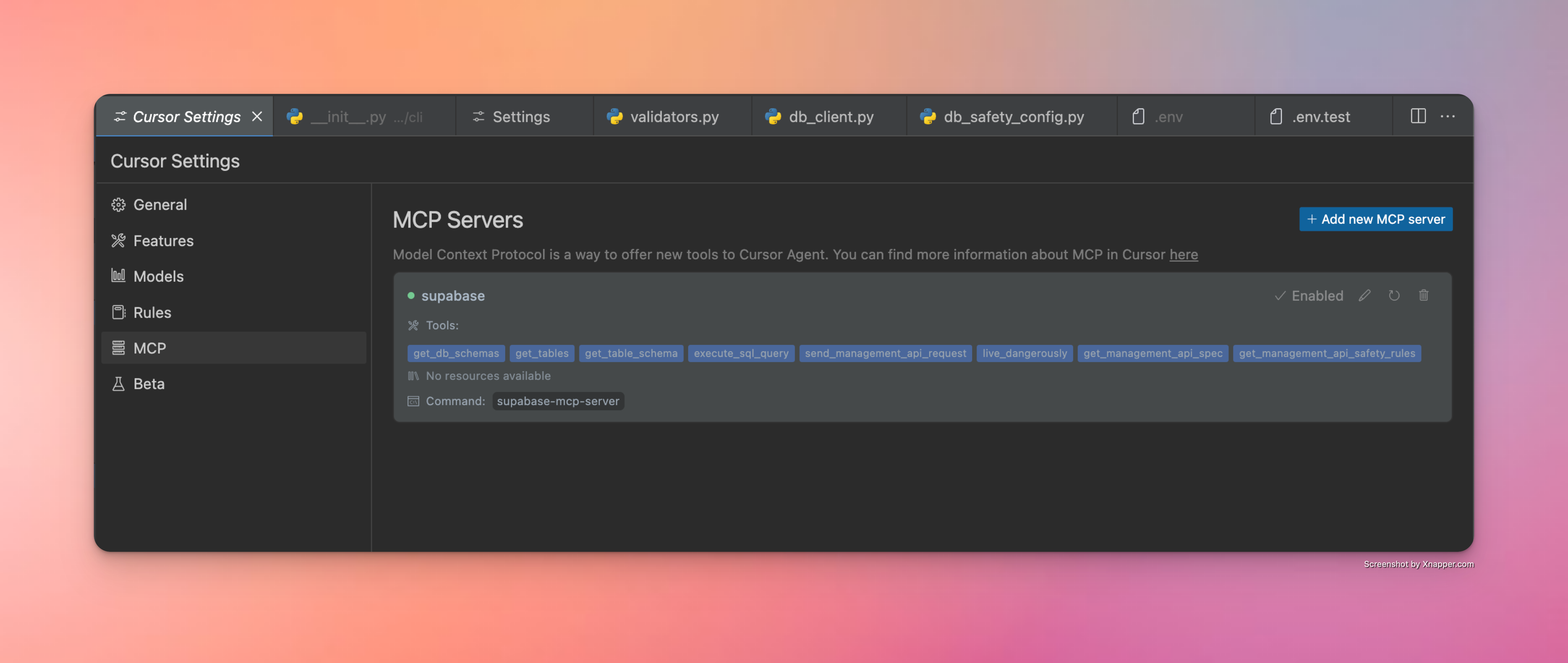
转到设置 -> 功能 -> MCP 服务器并添加具有以下配置的新服务器:
# can be set to any name
name: supabase
type: command
# if you installed with pipx
command: supabase-mcp-server
# if you installed with uv
command: uv run supabase-mcp-server
# if the above doesn't work, use the full path (recommended)
command: /full/path/to/supabase-mcp-server # Find with 'which supabase-mcp-server' (macOS/Linux) or 'where supabase-mcp-server' (Windows)如果配置正确,您应该会看到一个绿点指示器和服务器公开的工具数量。
风帆冲浪
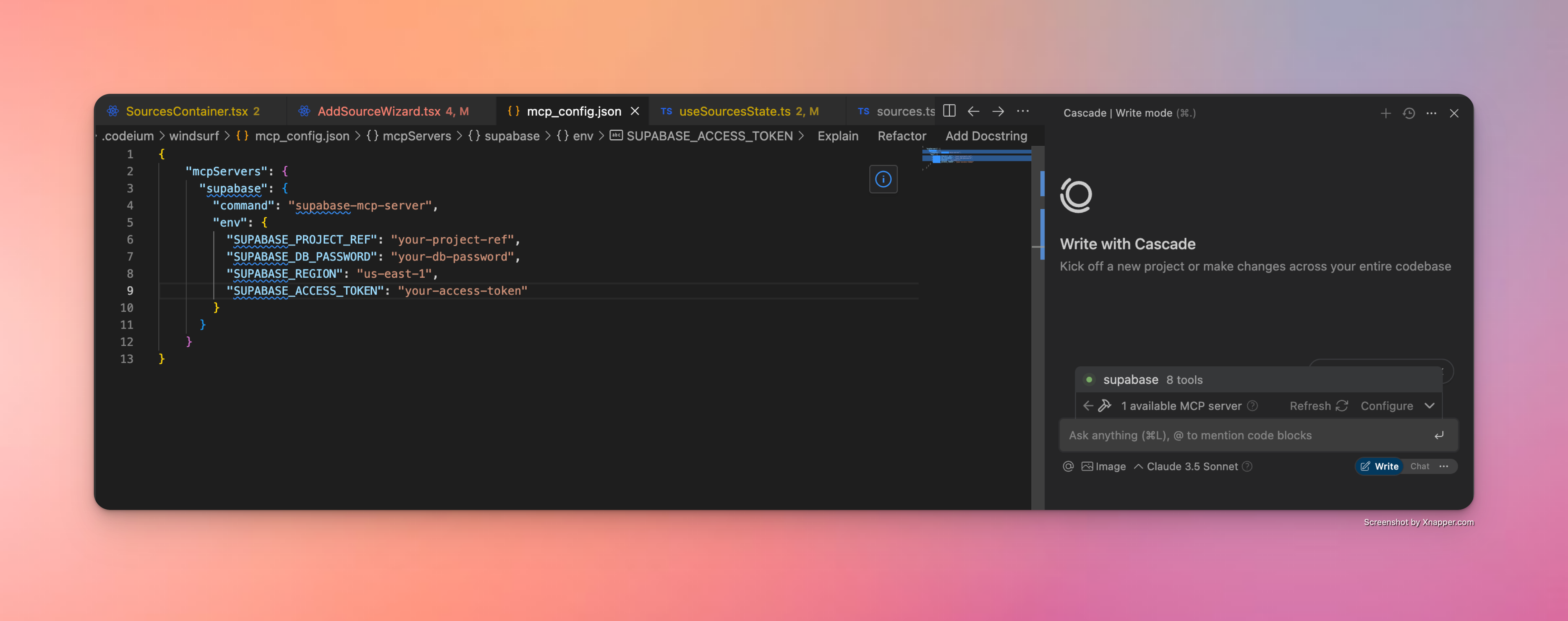
进入Cascade->点击锤子图标->配置->填写配置:
{
"mcpServers": {
"supabase": {
"command": "/Users/username/.local/bin/supabase-mcp-server", // update path
"env": {
"QUERY_API_KEY": "your-api-key", // Required - get your API key at thequery.dev
"SUPABASE_PROJECT_REF": "your-project-ref",
"SUPABASE_DB_PASSWORD": "your-db-password",
"SUPABASE_REGION": "us-east-1", // optional, defaults to us-east-1
"SUPABASE_ACCESS_TOKEN": "your-access-token", // optional, for management API
"SUPABASE_SERVICE_ROLE_KEY": "your-service-role-key" // optional, for Auth Admin SDK
}
}
}
}如果配置正确,您应该在可用服务器列表中看到绿点指示器和可点击的 supabase 服务器。
克劳德桌面
Claude Desktop 还通过 JSON 配置支持 MCP 服务器。请按照以下步骤设置 Supabase MCP 服务器:
找到可执行文件的完整路径(此步骤至关重要):
# On macOS/Linux which supabase-mcp-server # On Windows where supabase-mcp-server复制返回的完整路径(例如,
/Users/username/.local/bin/supabase-mcp-server)。在 Claude Desktop 中配置 MCP 服务器:
打开 Claude 桌面
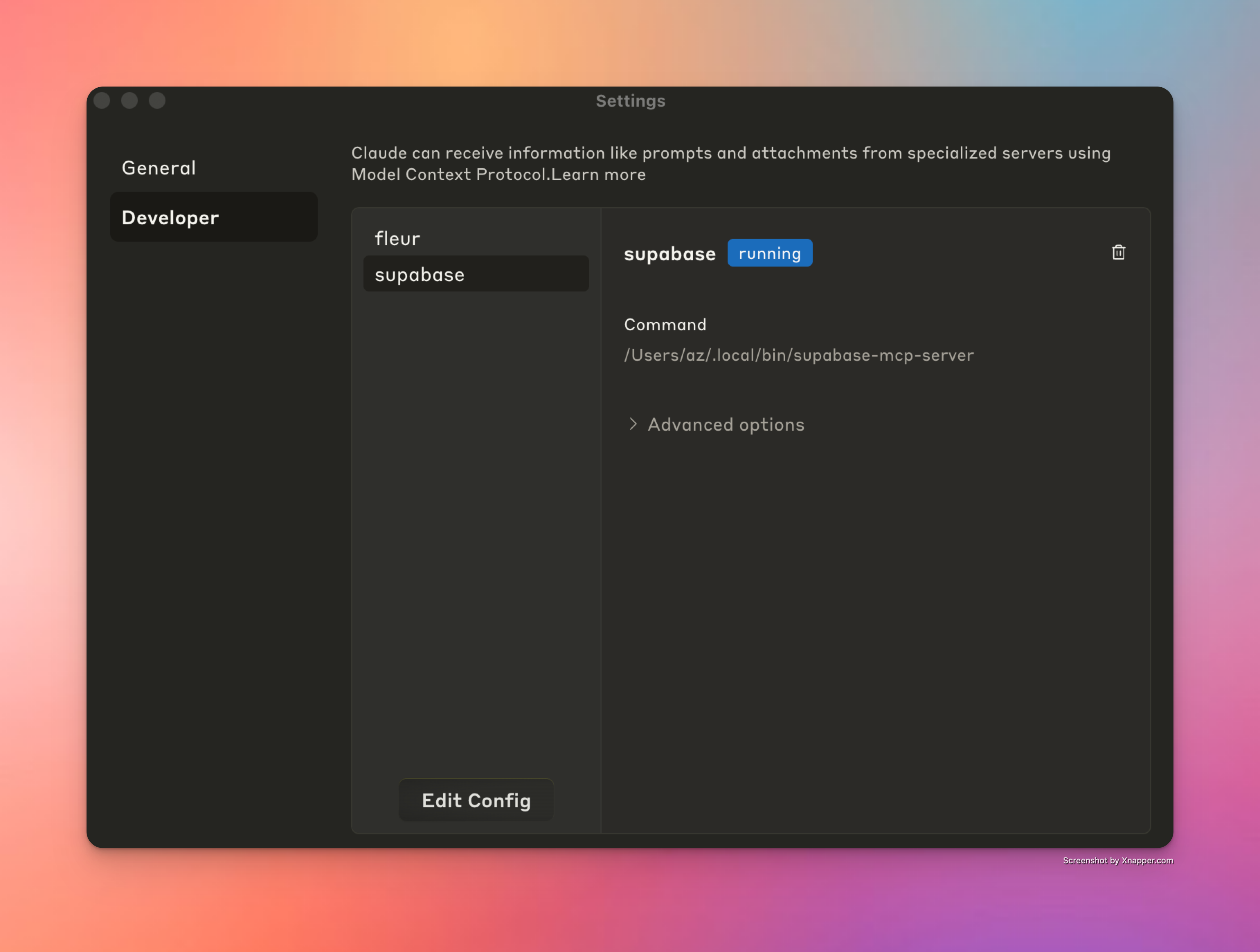
前往“设置”→“开发者”→“编辑配置 MCP 服务器”
使用以下 JSON 添加新配置:
{ "mcpServers": { "supabase": { "command": "/full/path/to/supabase-mcp-server", // Replace with the actual path from step 1 "env": { "QUERY_API_KEY": "your-api-key", // Required - get your API key at thequery.dev "SUPABASE_PROJECT_REF": "your-project-ref", "SUPABASE_DB_PASSWORD": "your-db-password", "SUPABASE_REGION": "us-east-1", // optional, defaults to us-east-1 "SUPABASE_ACCESS_TOKEN": "your-access-token", // optional, for management API "SUPABASE_SERVICE_ROLE_KEY": "your-service-role-key" // optional, for Auth Admin SDK } } } }
⚠️重要提示:与 Windsurf 和 Cursor 不同,Claude Desktop 需要可执行文件的完整绝对路径。仅使用命令名称 (
supabase-mcp-server) 将导致“spawn ENOENT”错误。
如果配置正确,您应该会看到 Supabase MCP 服务器在 Claude Desktop 中列为可用。
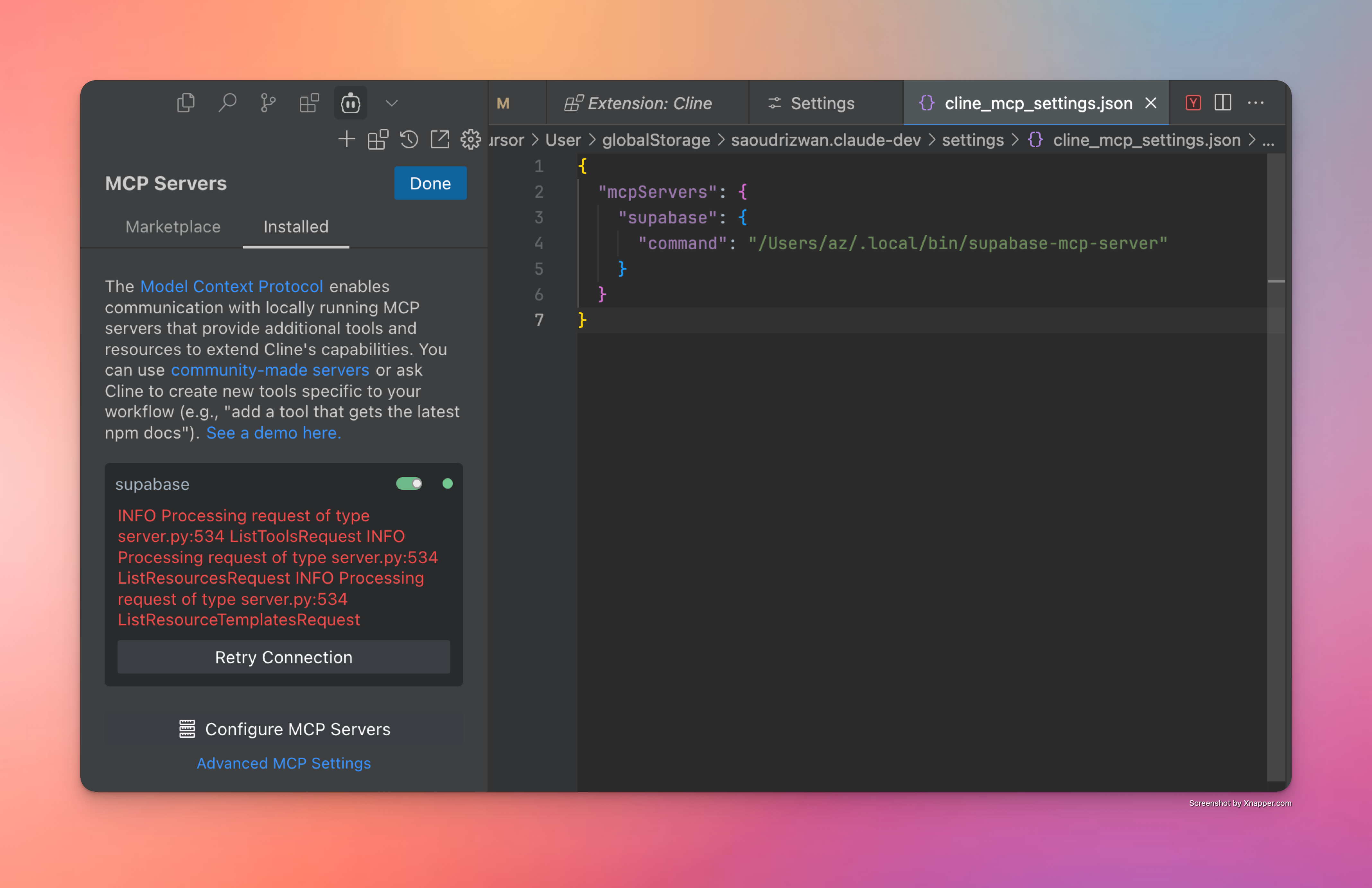
克莱恩
Cline 也通过类似的 JSON 配置支持 MCP 服务器。请按照以下步骤设置 Supabase MCP 服务器:
找到可执行文件的完整路径(此步骤至关重要):
# On macOS/Linux which supabase-mcp-server # On Windows where supabase-mcp-server复制返回的完整路径(例如,
/Users/username/.local/bin/supabase-mcp-server)。在 Cline 中配置 MCP 服务器:
在 VS Code 中打开 Cline
点击 Cline 侧栏中的“MCP 服务器”选项卡
点击“配置 MCP 服务器”
这将打开
cline_mcp_settings.json文件添加以下配置:
{ "mcpServers": { "supabase": { "command": "/full/path/to/supabase-mcp-server", // Replace with the actual path from step 1 "env": { "QUERY_API_KEY": "your-api-key", // Required - get your API key at thequery.dev "SUPABASE_PROJECT_REF": "your-project-ref", "SUPABASE_DB_PASSWORD": "your-db-password", "SUPABASE_REGION": "us-east-1", // optional, defaults to us-east-1 "SUPABASE_ACCESS_TOKEN": "your-access-token", // optional, for management API "SUPABASE_SERVICE_ROLE_KEY": "your-service-role-key" // optional, for Auth Admin SDK } } } }
如果配置正确,您应该会在 Cline MCP 服务器列表中的 Supabase MCP 服务器旁边看到一个绿色指示器,并在面板底部看到一条确认“supabase MCP 服务器已连接”的消息。
故障排除
以下是一些可能对您有帮助的提示和技巧:
调试安装- 直接从终端运行
supabase-mcp-server看看它是否正常工作。如果不行,则安装可能有问题。MCP 服务器配置- 如果上述步骤成功,则表示服务器已正确安装和配置。只要您输入了正确的命令,IDE 就应该能够连接。请确保提供正确的服务器可执行文件路径。
“未找到工具”错误- 尽管软件包已安装,但如果您看到 Cursor 中显示“客户端已关闭 - 没有可用工具”:
通过运行
which supabase-mcp-server(macOS/Linux) 或where supabase-mcp-server(Windows) 找到可执行文件的完整路径在 MCP 服务器配置中使用完整路径,而不仅仅是
supabase-mcp-server例如:
/Users/username/.local/bin/supabase-mcp-server或C:\Users\username\.local\bin\supabase-mcp-server.exe
环境变量- 要连接到正确的数据库,请确保在
mcp_config.json或全局配置目录中的.env文件(macOS/Linux 上为~/.config/supabase-mcp/.env,Windows 上为%APPDATA%\supabase-mcp\.env)中设置环境变量。访问日志- MCP 服务器将详细日志写入文件:
日志文件位置:
macOS/Linux:
~/.local/share/supabase-mcp/mcp_server.logWindows:
%USERPROFILE%\.local\share\supabase-mcp\mcp_server.log
日志包括连接状态、配置详情、操作结果
使用任何文本编辑器或终端命令查看日志:
# On macOS/Linux cat ~/.local/share/supabase-mcp/mcp_server.log # On Windows (PowerShell) Get-Content "$env:USERPROFILE\.local\share\supabase-mcp\mcp_server.log"
如果您遇到困难或者上述任何说明不正确,请提出问题。
MCP 检查器
MCP Inspector 是一款非常实用的工具,可以帮助调试 MCP 服务器问题。如果您是从源代码安装的,则可以从项目仓库运行supabase-mcp-inspector ,它会运行检查器实例。结合日志,它可以让您全面了解服务器的运行情况。
📝 如果从包中安装,则运行
supabase-mcp-inspector将无法正常工作 - 我将在即将发布的版本中验证并修复。
功能概述
数据库查询工具
由于 v0.3+ 服务器提供了全面的数据库管理功能并内置了安全控制:
SQL 查询执行:执行 PostgreSQL 查询并进行风险评估
三层安全体系:
safe:只读操作(SELECT)- 始终允许write:数据修改(插入、更新、删除) - 需要不安全模式destructive:架构更改(DROP、CREATE) - 需要不安全模式+确认
SQL解析和验证:
使用 PostgreSQL 的解析器(pglast)进行准确分析,并提供有关安全要求的明确反馈
自动迁移版本控制:
数据库修改操作会自动进行版本控制
根据操作类型和目标生成描述性名称
安全控制:
默认 SAFE 模式仅允许只读操作
所有语句均通过
asyncpg以事务模式运行高风险操作两步确认
可用工具:
get_schemas:列出模式的大小和表数get_tables:列出表、外部表和带有元数据的视图get_table_schema:获取详细的表结构(列、键、关系)execute_postgresql:对数据库执行SQL语句confirm_destructive_operation:确认后执行高风险操作retrieve_migrations:获取带有过滤和分页选项的迁移live_dangerously:在安全和不安全模式之间切换
管理 API 工具
自 v0.3.0 服务器提供对 Supabase 管理 API 的安全访问,并内置安全控制:
可用工具:
send_management_api_request:向 Supabase Management API 发送任意请求,并自动注入项目引用get_management_api_spec:获取包含安全信息的丰富 API 规范支持多种查询模式:按域、按特定路径/方法或所有路径
包括每个端点的风险评估信息
提供详细的参数要求和响应格式
帮助 LLM 了解 Supabase 管理 API 的全部功能
get_management_api_safety_rules:获取所有安全规则,并提供人类可读的解释live_dangerously:在安全和不安全操作模式之间切换
安全控制:
使用与数据库操作相同的安全管理器,实现一致的风险管理
按风险等级分类的操作:
safe:只读操作(GET)- 始终允许unsafe:状态改变操作(POST、PUT、PATCH、DELETE) - 需要不安全模式blocked:破坏性操作(删除项目等)- 绝不允许
默认安全模式可防止意外状态更改
基于路径的模式匹配,实现精确的安全规则
注意:管理 API 工具仅适用于远程 Supabase 实例,与本地 Supabase 开发设置不兼容。
授权管理工具
我原本计划在 MCP 服务器中添加对 Python SDK 方法的支持。经过深思熟虑,我决定只添加对 Auth Admin 方法的支持,因为我经常手动创建测试用户,这很容易出错,而且耗时。现在我可以直接使用 Cursor 创建测试用户,整个过程无缝衔接。查看完整的 Auth Admin SDK 方法文档,了解它的功能。
自 v0.3.6 版本起,服务器支持通过 Python SDK 直接访问 Supabase Auth Admin 方法:
包括以下工具:
get_auth_admin_methods_spec检索所有可用的 Auth Admin 方法的文档call_auth_admin_method直接调用 Auth Admin 方法并进行适当的参数处理
支持的方法:
get_user_by_id:通过 ID 检索用户list_users:列出所有用户并分页create_user:创建新用户delete_user:通过 ID 删除用户invite_user_by_email:将邀请链接发送到用户的电子邮件generate_link:生成用于各种身份验证目的的电子邮件链接update_user_by_id:通过 ID 更新用户属性delete_factor:删除用户的一个因素(目前 SDK 中尚未实现)
为什么使用 Auth Admin SDK 而不是原始 SQL 查询?
与直接 SQL 操作相比,Auth Admin SDK 具有几个主要优势:
功能:实现仅使用 SQL 无法实现的操作(邀请、魔术链接、MFA)
准确性:比在身份验证模式上创建和执行原始 SQL 查询更可靠
简单性:提供清晰的方法,并进行适当的验证和错误处理
响应格式:
所有方法都返回结构化的 Python 对象,而不是原始字典
可以使用点符号访问对象属性(例如,
user.id而不是user["id"])
边缘情况和限制:
UUID 验证:许多方法要求用户 ID 具有有效的 UUID 格式,并将返回特定的验证错误
电子邮件配置:
invite_user_by_email和generate_link等方法需要在您的 Supabase 项目中配置电子邮件发送链接类型:生成链接时,不同的链接类型有不同的要求:
signup链接不需要用户存在magiclink和recovery链接要求用户已经存在于系统中
错误处理:服务器提供来自 Supabase API 的详细错误消息,这可能与仪表板界面不同
方法可用性:某些方法(例如
delete_factor在 API 中公开,但未在 SDK 中完全实现
日志和分析
该服务器提供对 Supabase 日志和分析数据的访问,从而更轻松地监控和排除应用程序故障:
可用工具:
retrieve_logs- 从任何 Supabase 服务访问日志日志收集:
postgres:数据库服务器日志api_gateway:API 网关请求auth:身份验证事件postgrest:RESTful API 服务日志pooler:连接池日志storage:对象存储操作realtime:WebSocket 订阅日志edge_functions:无服务器函数执行cron:计划作业日志pgbouncer:连接池日志
功能:按时间过滤、搜索文本、应用字段过滤器或使用自定义 SQL 查询
简化 Supabase 堆栈中的调试,无需在界面之间切换或编写复杂的查询。
数据库更改的自动版本控制
“能力越大,责任越大。” 虽然execute_postgresql工具与恰如其名的live_dangerously工具相结合,提供了一种强大而简便的Supabase数据库管理方法,但这也意味着删除表或修改表只需一条聊天消息即可。为了降低不可逆更改的风险,自v0.3.8版本起,服务器支持:
为数据库上执行的所有写入和破坏性 SQL 操作自动创建迁移脚本
改进了查询执行的安全模式,其中所有查询都分为以下几类:
safe类型:始终允许。包括所有只读操作。write类型:需要用户启用write模式。destructive类型:需要用户启用write模式,并且对于不自动执行工具的客户端,需要两步确认查询执行。
通用安全模式
自 v0.3.8 版本起,安全模式已在所有服务(数据库、API、SDK)中实现标准化,并使用通用安全管理器。这为整个 MCP 服务器提供了一致的风险管理和统一的安全设置控制界面。
所有操作(SQL 查询、API 请求、SDK 方法)都分为以下风险级别:
Low风险:不修改数据或结构的只读操作(SELECT 查询、GET API 请求)Medium风险:修改数据但不修改结构的写入操作(INSERT/UPDATE/DELETE,大多数 POST/PUT API 请求)High风险:修改数据库结构或可能导致数据丢失的破坏性操作(DROP/TRUNCATE、DELETE API 端点)Extreme风险:后果严重的操作将被彻底阻止(删除项目)
根据风险级别应用安全控制:
始终允许低风险操作
中等风险操作需要启用不安全模式
高风险操作需要不安全模式和明确确认
绝不允许极端风险操作
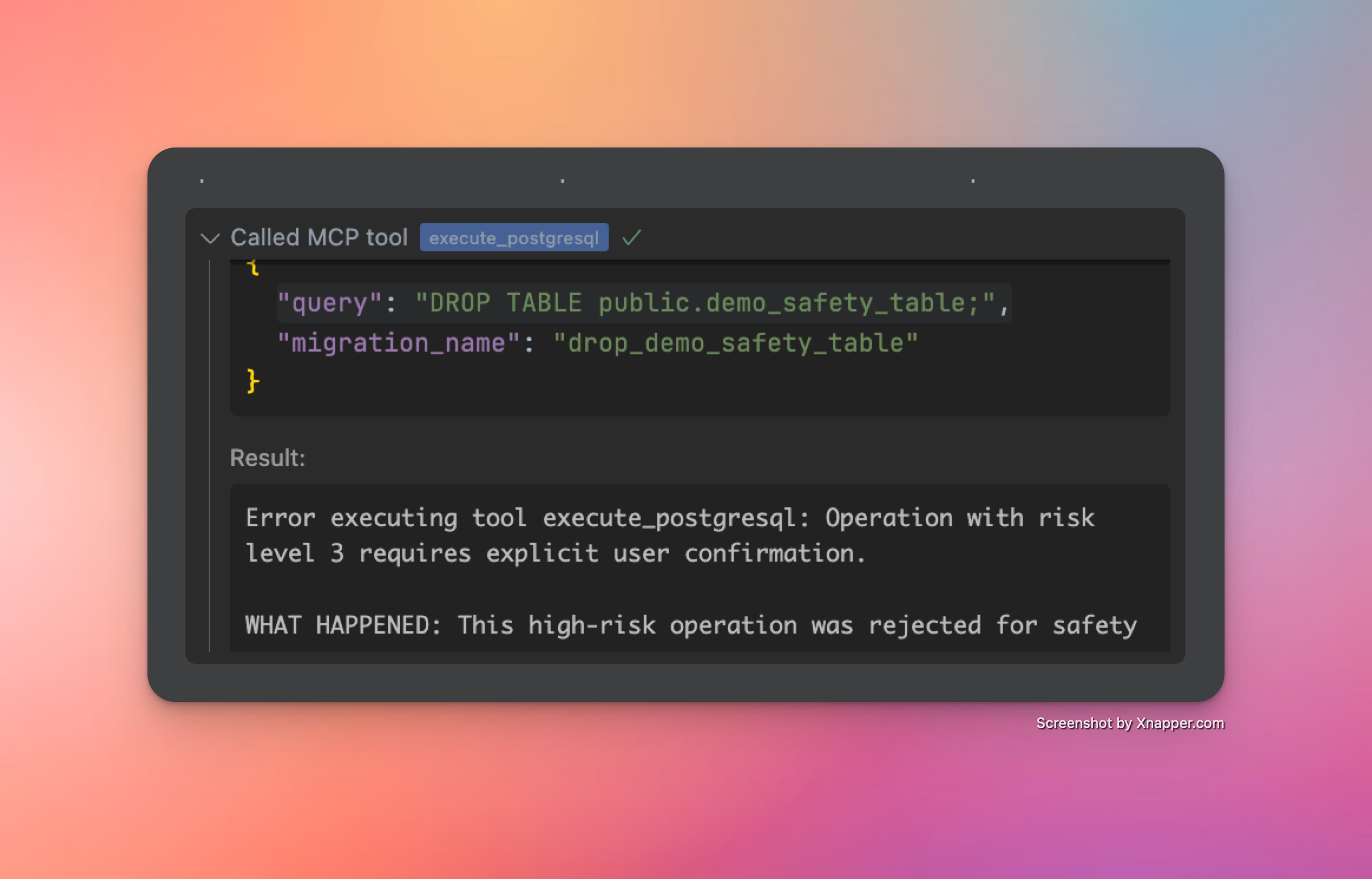
确认流程如何运作
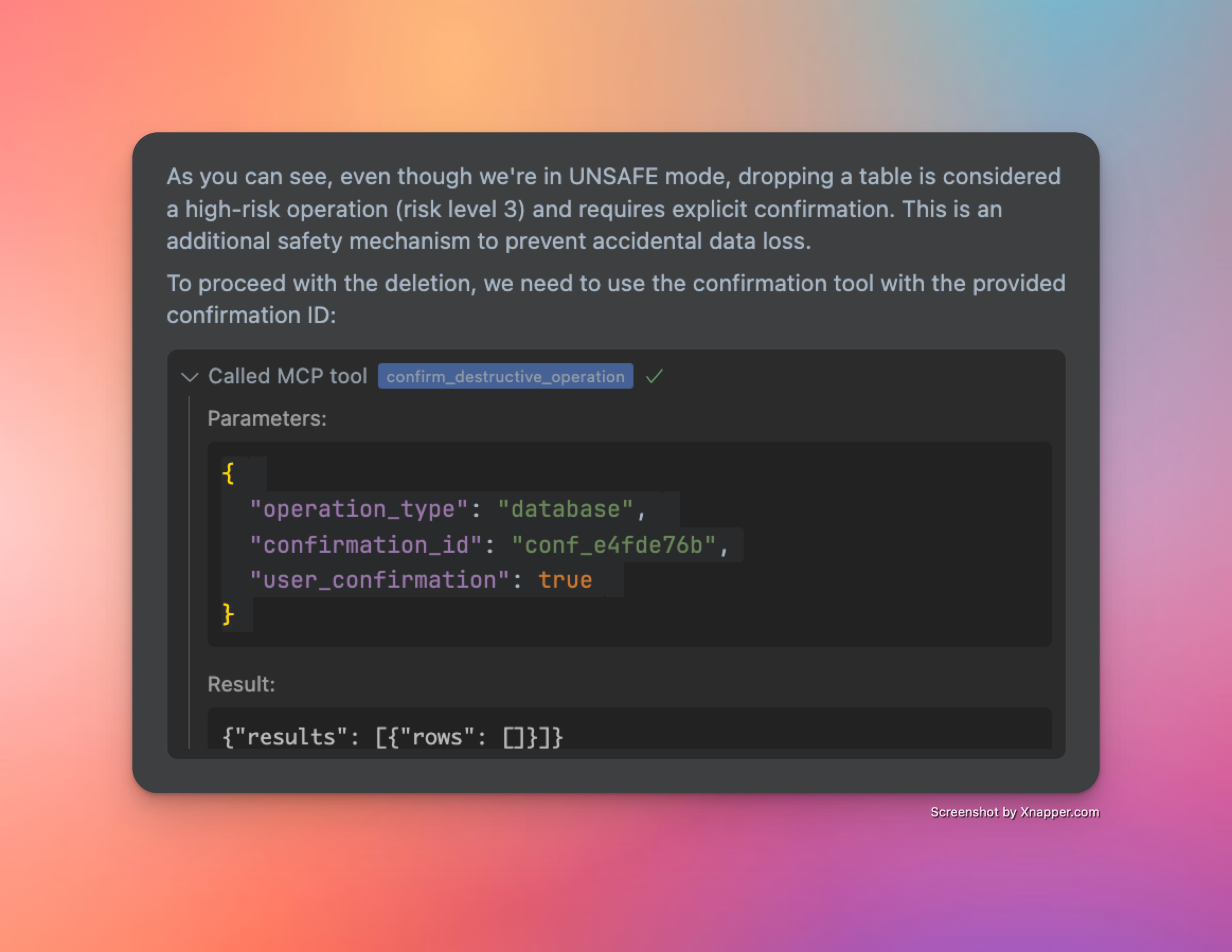
即使在unsafe模式下,任何高风险操作(无论是 postgresql 还是 api 请求)都会被阻止。 您必须明确确认并批准每个高风险操作才能执行。
变更日志
📦通过包管理器简化安装 - ✅(v0.2.0)
🌎 支持不同的 Supabase 区域 - ✅ (v0.2.2)
🎮 通过安全控制以编程方式访问 Supabase 管理 API - ✅ (v0.3.0)
👷♂️ 具有安全控制的读取和读写数据库 SQL 查询 - ✅(v0.3.0)
🔄 针对直接连接和池连接的强大事务处理 - ✅(v0.3.2)
🐍 支持原生 Python SDK 中可用的方法和对象 - ✅ (v0.3.6)
🔍 更强大的 SQL 查询验证✅(v0.3.8)
📝 数据库更改的自动版本控制✅(v0.3.8)
📖 从根本上改进了 api 规范的知识和工具✅(v0.3.8)
✍️ 改进了与迁移相关的工具的一致性,以实现更有条理的数据库 vcs✅(v0.3.10)
🥳 查询 MCP 已发布 (v0.4.0)
有关更详细的路线图,请参阅 GitHub 上的讨论。
星史
尽情享受吧!☺️
Available Tools
12 toolscall_auth_admin_methodA
Call an Auth Admin method from Supabase Python SDK.
This tool provides a safe, validated interface to the Supabase Auth Admin SDK, allowing you to:
Manage users (create, update, delete)
List and search users
Generate authentication links
Manage multi-factor authentication
And more
IMPORTANT NOTES:
Request bodies must adhere to the Python SDK specification
Some methods may have nested parameter structures
The tool validates all parameters against Pydantic models
Extra fields not defined in the models will be rejected
AVAILABLE METHODS:
get_user_by_id: Retrieve a user by their ID
list_users: List all users with pagination
create_user: Create a new user
delete_user: Delete a user by their ID
invite_user_by_email: Send an invite link to a user's email
generate_link: Generate an email link for various authentication purposes
update_user_by_id: Update user attributes by ID
delete_factor: Delete a factor on a user
EXAMPLES:
Get user by ID: method: "get_user_by_id" params: {"uid": "user-uuid-here"}
Create user: method: "create_user" params: { "email": "user@example.com", "password": "secure-password" }
Update user by ID: method: "update_user_by_id" params: { "uid": "user-uuid-here", "attributes": { "email": "new@email.com" } }
For complete documentation of all methods and their parameters, use the get_auth_admin_methods_spec tool.
| Name | Required | Description | Default |
|---|---|---|---|
| method | Yes | ||
| params | Yes |
TDQS
Does the description disclose side effects, auth requirements, rate limits, or destructive behavior?
With no annotations provided, the description carries the full burden of behavioral disclosure. It effectively describes key traits: it's a 'safe, validated interface' that validates parameters against Pydantic models and rejects extra fields. It mentions that 'some methods may have nested parameter structures' and provides examples of destructive operations (delete_user, delete_factor). However, it doesn't cover rate limits, authentication requirements, or error handling.
Agents need to know what a tool does to the world before calling it. Descriptions should go beyond structured annotations to explain consequences.
Is the description appropriately sized, front-loaded, and free of redundancy?
The description is appropriately front-loaded with the core purpose and key capabilities, but it includes extensive lists and examples that could be streamlined. The 'AVAILABLE METHODS' section and multiple examples add value but make the description lengthy. Every sentence earns its place, but the structure could be more concise by integrating examples more tightly or referencing external documentation earlier.
Shorter descriptions cost fewer tokens and are easier for agents to parse. Every sentence should earn its place.
Given the tool's complexity, does the description cover enough for an agent to succeed on first attempt?
Given the complexity (2 parameters with nested objects, no output schema, no annotations), the description is largely complete. It covers purpose, usage, behavioral traits, and parameter semantics thoroughly. However, it lacks details on return values (since no output schema exists) and doesn't mention authentication or error scenarios. The reference to 'get_auth_admin_methods_spec' for full documentation helps mitigate gaps.
Complex tools with many parameters or behaviors need more documentation. Simple tools need less. This dimension scales expectations accordingly.
Does the description clarify parameter syntax, constraints, interactions, or defaults beyond what the schema provides?
The input schema has 0% description coverage and only defines 'method' (string) and 'params' (object) without semantic details. The description compensates fully by listing all available methods with brief explanations (e.g., 'get_user_by_id: Retrieve a user by their ID'), providing detailed examples with parameter structures, and explaining that parameters must adhere to Python SDK specifications. This adds substantial meaning beyond the minimal schema.
Input schemas describe structure but not intent. Descriptions should explain non-obvious parameter relationships and valid value ranges.
Does the description clearly state what the tool does and how it differs from similar tools?
The description clearly states the tool's purpose: 'Call an Auth Admin method from Supabase Python SDK' with a specific verb ('call') and resource ('Auth Admin method'). It distinguishes from siblings like 'get_auth_admin_methods_spec' (which retrieves documentation) and 'send_management_api_request' (which handles different API types). The bullet points further clarify capabilities like user management and authentication tasks.
Agents choose between tools based on descriptions. A clear purpose with a specific verb and resource helps agents select the right tool.
Does the description explain when to use this tool, when not to, or what alternatives exist?
The description provides explicit guidance on when to use this tool vs alternatives. It states to 'use the get_auth_admin_methods_spec tool' for complete documentation of methods and parameters, distinguishing it from that sibling. The 'IMPORTANT NOTES' section also outlines prerequisites like adhering to Python SDK specifications and validation rules, though it doesn't explicitly mention when not to use it.
Agents often have multiple tools that could apply. Explicit usage guidance like "use X instead of Y when Z" prevents misuse.
confirm_destructive_operationA
Execute a destructive database or API operation after confirmation. Use this only after reviewing the risks with the user.
HOW IT WORKS:
This tool executes a previously rejected high-risk operation using its confirmation ID
The operation will be exactly the same as the one that generated the ID
No need to retype the query or api request params - the system remembers it
STEPS:
Explain the risks to the user and get their approval
Use this tool with the confirmation ID from the error message
The original query will be executed as-is
PARAMETERS:
operation_type: Type of operation ("api" or "database")
confirmation_id: The ID provided in the error message (required)
user_confirmation: Set to true to confirm execution (default: false)
NOTE: Confirmation IDs expire after 5 minutes for security
| Name | Required | Description | Default |
|---|---|---|---|
| confirmation_id | Yes | ||
| operation_type | Yes | ||
| user_confirmation | No |
TDQS
Does the description disclose side effects, auth requirements, rate limits, or destructive behavior?
With no annotations provided, the description carries the full burden of behavioral disclosure. It effectively describes key traits: it's for executing high-risk operations, requires user confirmation, uses a confirmation ID from a previous error, executes the original query as-is, and includes a security note about 5-minute expiration. However, it doesn't detail potential side effects (e.g., data loss specifics) or error handling, leaving some gaps in full transparency.
Agents need to know what a tool does to the world before calling it. Descriptions should go beyond structured annotations to explain consequences.
Is the description appropriately sized, front-loaded, and free of redundancy?
The description is well-structured with clear sections (HOW IT WORKS, STEPS, PARAMETERS, NOTE), making it easy to scan. Each sentence adds value, such as explaining the confirmation process and security constraints. It could be slightly more concise by integrating some details (e.g., merging the STEPS and PARAMETERS sections), but overall, it's efficient and front-loaded with the core purpose.
Shorter descriptions cost fewer tokens and are easier for agents to parse. Every sentence should earn its place.
Given the tool's complexity, does the description cover enough for an agent to succeed on first attempt?
Given the tool's complexity (destructive operations, confirmation flow) and lack of annotations or output schema, the description does a good job of covering essential context: purpose, usage steps, parameters, and security notes. It addresses the high-risk nature and user interaction requirements. However, it doesn't specify what happens after execution (e.g., success/failure responses or side effects), which is a minor gap for such a critical tool.
Complex tools with many parameters or behaviors need more documentation. Simple tools need less. This dimension scales expectations accordingly.
Does the description clarify parameter syntax, constraints, interactions, or defaults beyond what the schema provides?
Schema description coverage is 0%, so the description must compensate. It adds meaningful context for all three parameters: 'operation_type' is explained as 'Type of operation ("api" or "database")', 'confirmation_id' as 'The ID provided in the error message (required)', and 'user_confirmation' as 'Set to true to confirm execution (default: false)'. This goes beyond the schema's basic titles and enums, clarifying usage and requirements. A point is deducted because it doesn't elaborate on the implications of each operation_type choice.
Input schemas describe structure but not intent. Descriptions should explain non-obvious parameter relationships and valid value ranges.
Does the description clearly state what the tool does and how it differs from similar tools?
The description clearly states the tool's purpose: 'Execute a destructive database or API operation after confirmation.' It specifies the verb ('execute'), resource ('destructive database or API operation'), and the key condition ('after confirmation'). The title 'confirm_destructive_operation' reinforces this, and it distinguishes itself from siblings like 'live_dangerously' or 'execute_postgresql' by focusing on confirmation of previously rejected high-risk operations.
Agents choose between tools based on descriptions. A clear purpose with a specific verb and resource helps agents select the right tool.
Does the description explain when to use this tool, when not to, or what alternatives exist?
The description provides explicit guidance on when to use this tool: 'Use this only after reviewing the risks with the user.' It outlines a clear process (explain risks, get approval, use confirmation ID) and specifies prerequisites (confirmation ID from an error message). It also distinguishes usage from alternatives by noting that no retyping of queries is needed, which sets it apart from tools like 'execute_postgresql' or 'send_management_api_request' that might require full parameter input.
Agents often have multiple tools that could apply. Explicit usage guidance like "use X instead of Y when Z" prevents misuse.
execute_postgresqlA
Execute PostgreSQL statements against your Supabase database.
IMPORTANT: All SQL statements must end with a semicolon (;).
OPERATION TYPES AND REQUIREMENTS:
READ Operations (SELECT, EXPLAIN, etc.):
Can be executed directly without special requirements
Example: SELECT * FROM public.users LIMIT 10;
WRITE Operations (INSERT, UPDATE, DELETE):
Require UNSAFE mode (use live_dangerously('database', True) first)
Example: INSERT INTO public.users (email) VALUES ('user@example.com');
SCHEMA Operations (CREATE, ALTER, DROP):
Require UNSAFE mode (use live_dangerously('database', True) first)
Destructive operations (DROP, TRUNCATE) require additional confirmation
Example: CREATE TABLE public.test_table (id SERIAL PRIMARY KEY, name TEXT);
MIGRATION HANDLING: All queries that modify the database will be automatically version controlled by the server. You can provide optional migration name, if you want to name the migration.
Respect the following format: verb_noun_detail. Be descriptive and concise.
Examples:
create_users_table
add_email_to_profiles
enable_rls_on_users
If you don't provide a migration name, the server will generate one based on the SQL statement
The system will sanitize your provided name to ensure compatibility with database systems
Migration names are prefixed with a timestamp in the format YYYYMMDDHHMMSS
SAFETY SYSTEM: Operations are categorized by risk level:
LOW RISK: Read operations (SELECT, EXPLAIN) - allowed in SAFE mode
MEDIUM RISK: Write operations (INSERT, UPDATE, DELETE) - require UNSAFE mode
HIGH RISK: Schema operations (CREATE, ALTER) - require UNSAFE mode
EXTREME RISK: Destructive operations (DROP, TRUNCATE) - require UNSAFE mode and confirmation
TRANSACTION HANDLING:
DO NOT use transaction control statements (BEGIN, COMMIT, ROLLBACK)
The database client automatically wraps queries in transactions
The SQL validator will reject queries containing transaction control statements
This ensures atomicity and provides rollback capability for data modifications
MULTIPLE STATEMENTS:
You can send multiple SQL statements in a single query
Each statement will be executed in order within the same transaction
Example: CREATE TABLE public.test_table (id SERIAL PRIMARY KEY, name TEXT); INSERT INTO public.test_table (name) VALUES ('test');
CONFIRMATION FLOW FOR HIGH-RISK OPERATIONS:
High-risk operations (DROP TABLE, TRUNCATE, etc.) will be rejected with a confirmation ID
The error message will explain what happened and provide a confirmation ID
Review the risks with the user before proceeding
Use the confirm_destructive_operation tool with the provided ID to execute the operation
IMPORTANT GUIDELINES:
The database client starts in SAFE mode by default for safety
Only enable UNSAFE mode when you need to modify data or schema
Never mix READ and WRITE operations in the same transaction
For destructive operations, be prepared to confirm with the confirm_destructive_operation tool
WHEN TO USE OTHER TOOLS INSTEAD:
For Auth operations (users, authentication, etc.): Use call_auth_admin_method instead of direct SQL The Auth Admin SDK provides safer, validated methods for user management
For project configuration, functions, storage, etc.: Use send_management_api_request The Management API handles Supabase platform features that aren't directly in the database
Note: This tool operates on the PostgreSQL database only. API operations use separate safety controls.
| Name | Required | Description | Default |
|---|---|---|---|
| migration_name | No | ||
| query | Yes |
TDQS
Does the description disclose side effects, auth requirements, rate limits, or destructive behavior?
With no annotations provided, the description carries the full burden of behavioral disclosure and does so comprehensively. It details safety modes (SAFE/UNSAFE), risk categorization (LOW/MEDIUM/HIGH/EXTREME), transaction handling restrictions, migration version control, confirmation flows for destructive operations, and important operational guidelines. This provides rich behavioral context beyond basic functionality.
Agents need to know what a tool does to the world before calling it. Descriptions should go beyond structured annotations to explain consequences.
Is the description appropriately sized, front-loaded, and free of redundancy?
The description is well-structured with clear sections (OPERATION TYPES, MIGRATION HANDLING, SAFETY SYSTEM, etc.) but is quite lengthy. While most content is valuable, some redundancy exists (e.g., multiple mentions of UNSAFE mode requirements). The front-loading is good with purpose and immediate requirements, but the length may challenge quick comprehension.
Shorter descriptions cost fewer tokens and are easier for agents to parse. Every sentence should earn its place.
Given the tool's complexity, does the description cover enough for an agent to succeed on first attempt?
Given the complexity of a database execution tool with 2 parameters, no annotations, and no output schema, the description provides exceptional completeness. It covers purpose, usage guidelines, behavioral traits, parameter semantics, safety systems, transaction handling, migration control, confirmation flows, and sibling tool relationships. This fully compensates for the lack of structured metadata.
Complex tools with many parameters or behaviors need more documentation. Simple tools need less. This dimension scales expectations accordingly.
Does the description clarify parameter syntax, constraints, interactions, or defaults beyond what the schema provides?
With 0% schema description coverage for the 2 parameters, the description compensates well by explaining both parameters' semantics. It describes 'migration_name' in detail (format requirements, examples, what happens if not provided, sanitization, timestamp prefixing) and 'query' through extensive examples and requirements (semicolon termination, operation types). While comprehensive, it doesn't explicitly map all schema properties like the default value for migration_name.
Input schemas describe structure but not intent. Descriptions should explain non-obvious parameter relationships and valid value ranges.
Does the description clearly state what the tool does and how it differs from similar tools?
The description clearly states the tool's purpose: 'Execute PostgreSQL statements against your Supabase database.' It specifies the exact action (execute) and resource (PostgreSQL statements/Supabase database), distinguishing it from sibling tools like call_auth_admin_method or send_management_api_request that handle different aspects of the system.
Agents choose between tools based on descriptions. A clear purpose with a specific verb and resource helps agents select the right tool.
Does the description explain when to use this tool, when not to, or what alternatives exist?
The description provides explicit guidance on when to use this tool versus alternatives. It includes a dedicated section 'WHEN TO USE OTHER TOOLS INSTEAD' that names specific sibling tools (call_auth_admin_method, send_management_api_request) and explains what operations they handle instead. It also provides detailed context about different operation types and their requirements.
Agents often have multiple tools that could apply. Explicit usage guidance like "use X instead of Y when Z" prevents misuse.
get_auth_admin_methods_specA
Get Python SDK methods specification for Auth Admin.
Returns a comprehensive dictionary of all Auth Admin methods available in the Supabase Python SDK, including:
Method names and descriptions
Required and optional parameters for each method
Parameter types and constraints
Return value information
This tool is useful for exploring the capabilities of the Auth Admin SDK and understanding how to properly format parameters for the call_auth_admin_method tool.
No parameters required.
| Name | Required | Description | Default |
|---|---|---|---|
No parameters | |||
TDQS
Does the description disclose side effects, auth requirements, rate limits, or destructive behavior?
With no annotations provided, the description carries the full burden. It describes what the tool returns ('comprehensive dictionary' with method details) and clarifies it requires no parameters, which is helpful. However, it doesn't mention behavioral aspects like whether this is a read-only operation, if it makes external API calls, potential rate limits, or error conditions.
Agents need to know what a tool does to the world before calling it. Descriptions should go beyond structured annotations to explain consequences.
Is the description appropriately sized, front-loaded, and free of redundancy?
The description is well-structured and front-loaded with the core purpose. Every sentence adds value: the first states what it does, the second details the return content, the third explains usage context, and the fourth clarifies no parameters needed. There is no wasted text.
Shorter descriptions cost fewer tokens and are easier for agents to parse. Every sentence should earn its place.
Given the tool's complexity, does the description cover enough for an agent to succeed on first attempt?
Given the tool has 0 parameters, no annotations, and no output schema, the description does a good job explaining the purpose, return format, and usage context. However, it could be more complete by specifying the exact structure of the returned dictionary or any prerequisites, though the lack of output schema lowers the bar.
Complex tools with many parameters or behaviors need more documentation. Simple tools need less. This dimension scales expectations accordingly.
Does the description clarify parameter syntax, constraints, interactions, or defaults beyond what the schema provides?
The tool has 0 parameters with 100% schema description coverage, so the baseline is 4. The description explicitly states 'No parameters required,' which reinforces this clearly and adds value by preventing parameter confusion.
Input schemas describe structure but not intent. Descriptions should explain non-obvious parameter relationships and valid value ranges.
Does the description clearly state what the tool does and how it differs from similar tools?
The description clearly states the specific action ('Get Python SDK methods specification for Auth Admin') and resource ('Auth Admin methods available in the Supabase Python SDK'). It distinguishes from sibling tools by focusing exclusively on Auth Admin SDK methods, unlike broader tools like get_management_api_spec or get_schemas.
Agents choose between tools based on descriptions. A clear purpose with a specific verb and resource helps agents select the right tool.
Does the description explain when to use this tool, when not to, or what alternatives exist?
The description explicitly states when to use this tool ('useful for exploring the capabilities of the Auth Admin SDK and understanding how to properly format parameters for the call_auth_admin_method tool'), providing clear context and naming the specific alternative tool (call_auth_admin_method) it prepares for.
Agents often have multiple tools that could apply. Explicit usage guidance like "use X instead of Y when Z" prevents misuse.
get_management_api_specA
Get the complete Supabase Management API specification.
Returns the full OpenAPI specification for the Supabase Management API, including:
All available endpoints and operations
Required and optional parameters for each operation
Request and response schemas
Authentication requirements
Safety information for each operation
This tool can be used in four different ways:
Without parameters: Returns all domains (default)
With path and method: Returns the full specification for a specific API endpoint
With domain only: Returns all paths and methods within that domain
With all_paths=True: Returns all paths and methods
Parameters:
params: Dictionary containing optional parameters:
path: Optional API path (e.g., "/v1/projects/{ref}/functions")
method: Optional HTTP method (e.g., "GET", "POST")
domain: Optional domain/tag name (e.g., "Auth", "Storage")
all_paths: Optional boolean, if True returns all paths and methods
Available domains:
Analytics: Analytics-related endpoints
Auth: Authentication and authorization endpoints
Database: Database management endpoints
Domains: Custom domain configuration endpoints
Edge Functions: Serverless function management endpoints
Environments: Environment configuration endpoints
OAuth: OAuth integration endpoints
Organizations: Organization management endpoints
Projects: Project management endpoints
Rest: RESTful API endpoints
Secrets: Secret management endpoints
Storage: Storage management endpoints
This specification is useful for understanding:
What operations are available through the Management API
How to properly format requests for each endpoint
Which operations require unsafe mode
What data structures to expect in responses
SAFETY: This is a low-risk read operation that can be executed in SAFE mode.
| Name | Required | Description | Default |
|---|---|---|---|
| params | No |
TDQS
Does the description disclose side effects, auth requirements, rate limits, or destructive behavior?
With no annotations provided, the description carries full burden and does an excellent job disclosing behavioral traits. It explicitly states this is a 'low-risk read operation that can be executed in SAFE mode,' describes what information is returned (endpoints, parameters, schemas, auth requirements, safety info), and explains the four different usage patterns. The only minor gap is lack of information about rate limits or pagination, but overall it provides comprehensive behavioral context.
Agents need to know what a tool does to the world before calling it. Descriptions should go beyond structured annotations to explain consequences.
Is the description appropriately sized, front-loaded, and free of redundancy?
The description is well-structured and appropriately sized, with clear sections for purpose, usage patterns, parameters, domains, and utility. While comprehensive, every sentence earns its place by adding value. The only minor issue is some redundancy in the safety statement at the end, but overall it's front-loaded with the core purpose and efficiently organized.
Shorter descriptions cost fewer tokens and are easier for agents to parse. Every sentence should earn its place.
Given the tool's complexity, does the description cover enough for an agent to succeed on first attempt?
Given the complexity of a tool that returns API specifications with multiple usage patterns, and with no annotations and no output schema, the description provides complete context. It explains what the tool does, how to use it in different scenarios, what parameters mean, what domains are available, what information the specification contains, and safety considerations. This fully compensates for the lack of structured metadata.
Complex tools with many parameters or behaviors need more documentation. Simple tools need less. This dimension scales expectations accordingly.
Does the description clarify parameter syntax, constraints, interactions, or defaults beyond what the schema provides?
With 0% schema description coverage (the schema only shows 'params' as an object with no properties documented), the description fully compensates by providing detailed parameter semantics. It explains all four optional parameters (path, method, domain, all_paths) with examples and clear descriptions of what each does. It also lists available domain values with explanations, effectively documenting what would normally be in the schema's enum or property descriptions.
Input schemas describe structure but not intent. Descriptions should explain non-obvious parameter relationships and valid value ranges.
Does the description clearly state what the tool does and how it differs from similar tools?
The description clearly states the tool's purpose: 'Get the complete Supabase Management API specification' with specific details about what it returns (OpenAPI spec including endpoints, parameters, schemas, auth requirements, safety info). It distinguishes from sibling tools like 'get_auth_admin_methods_spec' by covering the entire Management API rather than just auth methods, and from 'send_management_api_request' by providing documentation rather than executing requests.
Agents choose between tools based on descriptions. A clear purpose with a specific verb and resource helps agents select the right tool.
Does the description explain when to use this tool, when not to, or what alternatives exist?
The description provides explicit usage guidelines with four distinct scenarios: 1) without parameters returns all domains, 2) with path and method returns specific endpoint spec, 3) with domain only returns all paths/methods in that domain, 4) with all_paths=True returns all paths/methods. It also explains when this tool is useful (understanding available operations, request formatting, unsafe mode requirements, response structures), giving clear context for when to use it versus alternatives.
Agents often have multiple tools that could apply. Explicit usage guidance like "use X instead of Y when Z" prevents misuse.
get_schemasB
List all database schemas with their sizes and table counts.
| Name | Required | Description | Default |
|---|---|---|---|
No parameters | |||
TDQS
Does the description disclose side effects, auth requirements, rate limits, or destructive behavior?
With no annotations provided, the description carries the full burden of behavioral disclosure. It states this is a read operation ('List'), implying it's non-destructive, but doesn't cover other important aspects like authentication requirements, rate limits, error handling, or what the output format looks like. For a tool with zero annotation coverage, this is insufficient.
Agents need to know what a tool does to the world before calling it. Descriptions should go beyond structured annotations to explain consequences.
Is the description appropriately sized, front-loaded, and free of redundancy?
The description is a single, efficient sentence that states exactly what the tool does with zero wasted words. It's front-loaded with the core purpose and includes key details (sizes and table counts) without unnecessary elaboration.
Shorter descriptions cost fewer tokens and are easier for agents to parse. Every sentence should earn its place.
Given the tool's complexity, does the description cover enough for an agent to succeed on first attempt?
Given the tool's simplicity (0 parameters, no output schema, no annotations), the description is adequate but has clear gaps. It explains what the tool returns (schemas with sizes and table counts), but without annotations or output schema, it doesn't specify the return format, data types, or any behavioral constraints. This is a minimal viable description.
Complex tools with many parameters or behaviors need more documentation. Simple tools need less. This dimension scales expectations accordingly.
Does the description clarify parameter syntax, constraints, interactions, or defaults beyond what the schema provides?
The tool has 0 parameters, and the schema description coverage is 100% (though empty). The description doesn't need to add parameter semantics, so it meets the baseline of 4 for tools with no parameters. It appropriately doesn't mention any parameters.
Input schemas describe structure but not intent. Descriptions should explain non-obvious parameter relationships and valid value ranges.
Does the description clearly state what the tool does and how it differs from similar tools?
The description clearly states the tool's purpose with a specific verb ('List') and resource ('database schemas'), along with what information is included ('sizes and table counts'). It distinguishes from siblings like 'get_tables' and 'get_table_schema' by focusing on schemas rather than tables. However, it doesn't explicitly differentiate from all siblings, so it's not a perfect 5.
Agents choose between tools based on descriptions. A clear purpose with a specific verb and resource helps agents select the right tool.
Does the description explain when to use this tool, when not to, or what alternatives exist?
The description provides no guidance on when to use this tool versus alternatives. It doesn't mention when to choose this over 'get_tables' or 'get_table_schema', nor does it specify any prerequisites or exclusions. The agent must infer usage from the purpose alone.
Agents often have multiple tools that could apply. Explicit usage guidance like "use X instead of Y when Z" prevents misuse.
get_tablesA
List all tables, foreign tables, and views in a schema with their sizes, row counts, and metadata.
Provides detailed information about all database objects in the specified schema:
Table/view names
Object types (table, view, foreign table)
Row counts
Size on disk
Column counts
Index information
Last vacuum/analyze times
Parameters:
schema_name: Name of the schema to inspect (e.g., 'public', 'auth', etc.)
SAFETY: This is a low-risk read operation that can be executed in SAFE mode.
| Name | Required | Description | Default |
|---|---|---|---|
| schema_name | Yes |
TDQS
Does the description disclose side effects, auth requirements, rate limits, or destructive behavior?
With no annotations provided, the description carries the full burden. It discloses that this is a 'low-risk read operation' and can be executed in 'SAFE mode', which clarifies safety and behavioral traits. However, it lacks details on rate limits, permissions needed, or potential performance impacts.
Agents need to know what a tool does to the world before calling it. Descriptions should go beyond structured annotations to explain consequences.
Is the description appropriately sized, front-loaded, and free of redundancy?
The description is well-structured with a clear summary, bulleted details, and a dedicated safety note. It is appropriately sized, but could be slightly more concise by integrating the safety note into the main text.
Shorter descriptions cost fewer tokens and are easier for agents to parse. Every sentence should earn its place.
Given the tool's complexity, does the description cover enough for an agent to succeed on first attempt?
Given no annotations and no output schema, the description does a good job explaining the tool's purpose, parameters, and safety. It lists the information returned (e.g., row counts, sizes), but could benefit from clarifying the output format or any limitations.
Complex tools with many parameters or behaviors need more documentation. Simple tools need less. This dimension scales expectations accordingly.
Does the description clarify parameter syntax, constraints, interactions, or defaults beyond what the schema provides?
The schema description coverage is 0%, so the description must compensate. It explicitly defines the single parameter 'schema_name' with meaning ('Name of the schema to inspect') and examples ('public', 'auth'), adding significant value beyond the bare schema.
Input schemas describe structure but not intent. Descriptions should explain non-obvious parameter relationships and valid value ranges.
Does the description clearly state what the tool does and how it differs from similar tools?
The description clearly states the verb ('List') and resource ('all tables, foreign tables, and views in a schema') with specific attributes ('sizes, row counts, and metadata'). It distinguishes from siblings like get_schemas (which lists schemas) and get_table_schema (which provides schema details for a single table).
Agents choose between tools based on descriptions. A clear purpose with a specific verb and resource helps agents select the right tool.
Does the description explain when to use this tool, when not to, or what alternatives exist?
The description implies usage for inspecting database objects in a schema, but does not explicitly state when to use this tool versus alternatives like get_schemas or get_table_schema. No exclusions or prerequisites are mentioned, leaving some ambiguity in context.
Agents often have multiple tools that could apply. Explicit usage guidance like "use X instead of Y when Z" prevents misuse.
get_table_schemaA
Get detailed table structure including columns, keys, and relationships.
Returns comprehensive information about a specific table's structure:
Column definitions (names, types, constraints)
Primary key information
Foreign key relationships
Indexes
Constraints
Triggers
Parameters:
schema_name: Name of the schema (e.g., 'public', 'auth')
table: Name of the table to inspect
SAFETY: This is a low-risk read operation that can be executed in SAFE mode.
| Name | Required | Description | Default |
|---|---|---|---|
| schema_name | Yes | ||
| table | Yes |
TDQS
Does the description disclose side effects, auth requirements, rate limits, or destructive behavior?
With no annotations provided, the description carries full burden and does well by explicitly stating 'This is a low-risk read operation that can be executed in SAFE mode.' It discloses safety profile and operational mode, though it could add more about rate limits, permissions needed, or response format.
Agents need to know what a tool does to the world before calling it. Descriptions should go beyond structured annotations to explain consequences.
Is the description appropriately sized, front-loaded, and free of redundancy?
Perfectly structured with purpose statement, bulleted return details, parameter section, and safety note. Every sentence earns its place, and information is front-loaded with the core purpose first.
Shorter descriptions cost fewer tokens and are easier for agents to parse. Every sentence should earn its place.
Given the tool's complexity, does the description cover enough for an agent to succeed on first attempt?
For a read operation with 2 parameters and no output schema, the description provides good coverage of purpose, parameters, and safety. It could benefit from more detail about the return format or example output, but given the context signals, it's mostly complete.
Complex tools with many parameters or behaviors need more documentation. Simple tools need less. This dimension scales expectations accordingly.
Does the description clarify parameter syntax, constraints, interactions, or defaults beyond what the schema provides?
Schema description coverage is 0%, so the description must compensate. It provides clear semantic meaning for both parameters with examples (schema_name: 'public', 'auth') and clarifies that 'table' is the specific table to inspect. This adds significant value beyond the bare schema.
Input schemas describe structure but not intent. Descriptions should explain non-obvious parameter relationships and valid value ranges.
Does the description clearly state what the tool does and how it differs from similar tools?
The description clearly states the verb 'Get' and resource 'detailed table structure', specifying what information is returned (columns, keys, relationships). It distinguishes from sibling tools like get_schemas and get_tables by focusing on detailed structural metadata rather than lists of objects.
Agents choose between tools based on descriptions. A clear purpose with a specific verb and resource helps agents select the right tool.
Does the description explain when to use this tool, when not to, or what alternatives exist?
The description implies usage context through the parameter descriptions and safety note, but doesn't explicitly state when to use this tool versus alternatives like get_tables or execute_postgresql. It provides clear context for inspecting table structure but lacks explicit exclusions or named alternatives.
Agents often have multiple tools that could apply. Explicit usage guidance like "use X instead of Y when Z" prevents misuse.
live_dangerouslyA
Toggle unsafe mode for either Management API or Database operations.
WHAT THIS TOOL DOES: This tool switches between safe (default) and unsafe operation modes for either the Management API or Database operations.
SAFETY MODES EXPLAINED:
Database Safety Modes:
SAFE mode (default): Only low-risk operations like SELECT queries are allowed
UNSAFE mode: Higher-risk operations including INSERT, UPDATE, DELETE, and schema changes are permitted
API Safety Modes:
SAFE mode (default): Only low-risk operations that don't modify state are allowed
UNSAFE mode: Higher-risk state-changing operations are permitted (except those explicitly blocked for safety)
OPERATION RISK LEVELS: The system categorizes operations by risk level:
LOW: Safe read operations with minimal impact
MEDIUM: Write operations that modify data but don't change structure
HIGH: Operations that modify database structure or important system settings
EXTREME: Destructive operations that could cause data loss or service disruption
WHEN TO USE THIS TOOL:
Use this tool BEFORE attempting write operations or schema changes
Enable unsafe mode only when you need to perform data modifications
Always return to safe mode after completing write operations
USAGE GUIDELINES:
Start in safe mode by default for exploration and analysis
Switch to unsafe mode only when you need to make changes
Be specific about which service you're enabling unsafe mode for
Consider the risks before enabling unsafe mode, especially for database operations
For database operations requiring schema changes, you'll need to enable unsafe mode first
Parameters:
service: Which service to toggle ("api" or "database")
enable_unsafe_mode: True to enable unsafe mode, False for safe mode (default: False)
Examples:
Enable database unsafe mode: live_dangerously(service="database", enable_unsafe_mode=True)
Return to safe mode after operations: live_dangerously(service="database", enable_unsafe_mode=False)
Enable API unsafe mode: live_dangerously(service="api", enable_unsafe_mode=True)
Note: This tool affects ALL subsequent operations for the specified service until changed again.
| Name | Required | Description | Default |
|---|---|---|---|
| enable_unsafe_mode | No | ||
| service | Yes |
TDQS
Does the description disclose side effects, auth requirements, rate limits, or destructive behavior?
With no annotations provided, the description carries the full burden of behavioral disclosure and does so comprehensively. It explains the safety modes in detail (SAFE vs. UNSAFE for both Database and API), describes risk levels (LOW, MEDIUM, HIGH, EXTREME), and explicitly states that the tool 'affects ALL subsequent operations for the specified service until changed again,' which is crucial behavioral context not evident from the schema alone.
Agents need to know what a tool does to the world before calling it. Descriptions should go beyond structured annotations to explain consequences.
Is the description appropriately sized, front-loaded, and free of redundancy?
The description is well-structured with clear sections (WHAT THIS TOOL DOES, SAFETY MODES EXPLAINED, etc.) and front-loads the core purpose. While comprehensive, some sections like OPERATION RISK LEVELS could be slightly more concise, but every sentence adds valuable context for a safety-critical tool.
Shorter descriptions cost fewer tokens and are easier for agents to parse. Every sentence should earn its place.
Given the tool's complexity, does the description cover enough for an agent to succeed on first attempt?
For a tool with 2 parameters, 0% schema description coverage, no annotations, and no output schema, the description provides complete context. It explains what the tool does, when to use it, detailed behavioral implications, parameter meanings, examples, and important notes about persistence of the mode change. No additional information is needed for an agent to use this tool correctly.
Complex tools with many parameters or behaviors need more documentation. Simple tools need less. This dimension scales expectations accordingly.
Does the description clarify parameter syntax, constraints, interactions, or defaults beyond what the schema provides?
With 0% schema description coverage, the description fully compensates by explaining both parameters in detail. It defines 'service' as 'api' or 'database' with clear explanations of what each service controls, and explains 'enable_unsafe_mode' as a boolean with default False, including specific examples of how to use both parameters together in different scenarios.
Input schemas describe structure but not intent. Descriptions should explain non-obvious parameter relationships and valid value ranges.
Does the description clearly state what the tool does and how it differs from similar tools?
The description clearly states the tool 'switches between safe (default) and unsafe operation modes for either the Management API or Database operations,' providing a specific verb ('toggle'/'switch') and resources (API/Database). It distinguishes from siblings by focusing on safety mode configuration rather than direct operations like execute_postgresql or send_management_api_request.
Agents choose between tools based on descriptions. A clear purpose with a specific verb and resource helps agents select the right tool.
Does the description explain when to use this tool, when not to, or what alternatives exist?
The description explicitly states when to use this tool ('BEFORE attempting write operations or schema changes'), when not to use it ('Start in safe mode by default for exploration and analysis'), and provides clear alternatives (safe vs. unsafe modes). It also gives specific guidance on risk considerations and returning to safe mode after operations.
Agents often have multiple tools that could apply. Explicit usage guidance like "use X instead of Y when Z" prevents misuse.
retrieve_logsA
Retrieve logs from your Supabase project's services for debugging and monitoring.
Returns log entries from various Supabase services with timestamps, messages, and metadata. This tool provides access to the same logs available in the Supabase dashboard's Logs & Analytics section.
AVAILABLE LOG COLLECTIONS:
postgres: Database server logs including queries, errors, warnings, and system messages
api_gateway: API requests, responses, and errors processed by the Kong API gateway
auth: Authentication and authorization logs for sign-ups, logins, and token operations
postgrest: Logs from the RESTful API service that exposes your PostgreSQL database
pooler: Connection pooling logs from pgbouncer and supavisor services
storage: Object storage service logs for file uploads, downloads, and permissions
realtime: Logs from the real-time subscription service for WebSocket connections
edge_functions: Serverless function execution logs including invocations and errors
cron: Scheduled job logs (can be queried through postgres logs with specific filters)
pgbouncer: Connection pooler logs
PARAMETERS:
collection: The log collection to query (required, one of the values listed above)
limit: Maximum number of log entries to return (default: 20)
hours_ago: Retrieve logs from the last N hours (default: 1)
filters: List of filter objects with field, operator, and value (default: []) Format: [{"field": "field_name", "operator": "=", "value": "value"}]
search: Text to search for in event messages (default: "")
custom_query: Complete custom SQL query to execute instead of the pre-built queries (default: "")
HOW IT WORKS: This tool makes a request to the Supabase Management API endpoint for logs, sending either a pre-built optimized query for the selected collection or your custom query. Each log collection has a specific table structure and metadata format that requires appropriate CROSS JOIN UNNEST operations to access nested fields.
EXAMPLES:
Using pre-built parameters: collection: "postgres" limit: 20 hours_ago: 24 filters: [{"field": "parsed.error_severity", "operator": "=", "value": "ERROR"}] search: "connection"
Using a custom query: collection: "edge_functions" custom_query: "SELECT id, timestamp, event_message, m.function_id, m.execution_time_ms FROM function_edge_logs CROSS JOIN unnest(metadata) AS m WHERE m.execution_time_ms > 1000 ORDER BY timestamp DESC LIMIT 10"
METADATA STRUCTURE: The metadata structure is important because it determines how to access nested fields in filters:
postgres_logs: Use "parsed.field_name" for fields like error_severity, query, application_name
edge_logs: Use "request.field_name" or "response.field_name" for HTTP details
function_edge_logs: Use "function_id", "execution_time_ms" for function metrics
NOTE FOR LLM CLIENTS: When encountering errors with field access, examine the error message to see what fields are actually available in the structure. Start with basic fields before accessing nested metadata.
SAFETY CONSIDERATIONS:
This is a low-risk read operation that can be executed in SAFE mode
Requires a valid Supabase Personal Access Token to be configured
Not available for local Supabase instances (requires cloud deployment)
| Name | Required | Description | Default |
|---|---|---|---|
| collection | Yes | ||
| custom_query | No | ||
| filters | No | ||
| hours_ago | No | ||
| limit | No | ||
| search | No |
TDQS
Does the description disclose side effects, auth requirements, rate limits, or destructive behavior?
With no annotations provided, the description carries the full burden of behavioral disclosure and does so comprehensively. It explains the tool's operation ('makes a request to the Supabase Management API endpoint'), includes safety considerations (low-risk read operation, requires Personal Access Token, not available for local instances), and provides metadata structure details crucial for effective use. The 'HOW IT WORKS' and 'SAFETY CONSIDERATIONS' sections add significant value beyond basic functionality.
Agents need to know what a tool does to the world before calling it. Descriptions should go beyond structured annotations to explain consequences.
Is the description appropriately sized, front-loaded, and free of redundancy?
The description is well-structured with clear sections (PARAMETERS, HOW IT WORKS, EXAMPLES, METADATA STRUCTURE, SAFETY CONSIDERATIONS) that make information easy to find. While comprehensive, some sections like the detailed log collection list (10 items) could be more concise, though each serves a purpose in helping users select the right collection. The front-loaded purpose statement is clear and effective.
Shorter descriptions cost fewer tokens and are easier for agents to parse. Every sentence should earn its place.
Given the tool's complexity, does the description cover enough for an agent to succeed on first attempt?
For a tool with 6 parameters, 0% schema coverage, no annotations, and no output schema, the description provides complete contextual information. It covers purpose, parameters with semantics, usage examples, operational mechanics, metadata structure, safety considerations, and even troubleshooting guidance ('NOTE FOR LLM CLIENTS'). This fully compensates for the lack of structured documentation elsewhere.
Complex tools with many parameters or behaviors need more documentation. Simple tools need less. This dimension scales expectations accordingly.
Does the description clarify parameter syntax, constraints, interactions, or defaults beyond what the schema provides?
Given 0% schema description coverage for 6 parameters, the description compensates exceptionally well. It provides detailed explanations for each parameter including required status, default values, format specifications (especially for the complex 'filters' array), and practical examples showing how to use them. The 'AVAILABLE LOG COLLECTIONS' section effectively documents the valid values for the 'collection' parameter despite no enum in the schema.
Input schemas describe structure but not intent. Descriptions should explain non-obvious parameter relationships and valid value ranges.
Does the description clearly state what the tool does and how it differs from similar tools?
The description clearly states the tool's purpose as 'Retrieve logs from your Supabase project's services for debugging and monitoring' with specific verb ('retrieve') and resource ('logs'), and distinguishes it from siblings like 'execute_postgresql' or 'retrieve_migrations' by focusing on log retrieval across multiple services rather than database queries or migration history.
Agents choose between tools based on descriptions. A clear purpose with a specific verb and resource helps agents select the right tool.
Does the description explain when to use this tool, when not to, or what alternatives exist?
The description provides clear context for when to use this tool (debugging and monitoring Supabase services) and mentions it provides 'access to the same logs available in the Supabase dashboard's Logs & Analytics section,' giving users a familiar reference point. However, it doesn't explicitly state when not to use it or name specific alternatives among the sibling tools.
Agents often have multiple tools that could apply. Explicit usage guidance like "use X instead of Y when Z" prevents misuse.
retrieve_migrationsA
Retrieve a list of all migrations a user has from Supabase.
Returns a list of migrations with the following information:
Version (timestamp)
Name
SQL statements (if requested)
Statement count
Version type (named or numbered)
Parameters:
limit: Maximum number of migrations to return (default: 50, max: 100)
offset: Number of migrations to skip for pagination (default: 0)
name_pattern: Optional pattern to filter migrations by name. Uses SQL ILIKE pattern matching (case-insensitive). The pattern is automatically wrapped with '%' wildcards, so "users" will match "create_users_table", "add_email_to_users", etc. To search for an exact match, use the complete name.
include_full_queries: Whether to include the full SQL statements in the result (default: false)
SAFETY: This is a low-risk read operation that can be executed in SAFE mode.
| Name | Required | Description | Default |
|---|---|---|---|
| include_full_queries | No | ||
| limit | No | ||
| name_pattern | No | ||
| offset | No |
TDQS
Does the description disclose side effects, auth requirements, rate limits, or destructive behavior?
With no annotations provided, the description carries full burden and does well by disclosing the SAFE mode operation, pagination behavior (limit/offset defaults), and pattern matching behavior for name_pattern. It doesn't mention rate limits, authentication needs, or error conditions, but provides solid behavioral context.
Agents need to know what a tool does to the world before calling it. Descriptions should go beyond structured annotations to explain consequences.
Is the description appropriately sized, front-loaded, and free of redundancy?
Well-structured with purpose statement, return format details, parameter explanations, and safety note. Every sentence earns its place with no redundancy. The information is front-loaded with the core purpose first.
Shorter descriptions cost fewer tokens and are easier for agents to parse. Every sentence should earn its place.
Given the tool's complexity, does the description cover enough for an agent to succeed on first attempt?
For a read operation with no annotations and no output schema, the description provides good completeness: clear purpose, detailed parameter semantics, safety context, and return format details. It could mention authentication requirements or error scenarios, but covers the essential context well.
Complex tools with many parameters or behaviors need more documentation. Simple tools need less. This dimension scales expectations accordingly.
Does the description clarify parameter syntax, constraints, interactions, or defaults beyond what the schema provides?
With 0% schema description coverage, the description fully compensates by explaining all 4 parameters in detail: default values, constraints (max: 100), and behavioral semantics (especially the ILIKE pattern matching with automatic wildcards for name_pattern). This adds significant value beyond the bare schema.
Input schemas describe structure but not intent. Descriptions should explain non-obvious parameter relationships and valid value ranges.
Does the description clearly state what the tool does and how it differs from similar tools?
The description clearly states the verb ('Retrieve') and resource ('list of all migrations a user has from Supabase'), with specific details about what information is returned. It distinguishes itself from sibling tools like 'retrieve_logs' or 'get_tables' by focusing specifically on migrations.
Agents choose between tools based on descriptions. A clear purpose with a specific verb and resource helps agents select the right tool.
Does the description explain when to use this tool, when not to, or what alternatives exist?
The description implies usage through the SAFE mode note and parameter explanations, but doesn't explicitly state when to use this tool versus alternatives like 'retrieve_logs' or 'get_schemas'. No explicit when-not-to-use guidance or named alternatives are provided.
Agents often have multiple tools that could apply. Explicit usage guidance like "use X instead of Y when Z" prevents misuse.
send_management_api_requestA
Execute a Supabase Management API request.
This tool allows you to make direct calls to the Supabase Management API, which provides programmatic access to manage your Supabase project settings, resources, and configurations.
REQUEST FORMATTING:
Use paths exactly as defined in the API specification
The {ref} parameter will be automatically injected from settings
Format request bodies according to the API specification
PARAMETERS:
method: HTTP method (GET, POST, PUT, PATCH, DELETE)
path: API path (e.g. /v1/projects/{ref}/functions)
path_params: Path parameters as dict (e.g. {"function_slug": "my-function"}) - use empty dict {} if not needed
request_params: Query parameters as dict (e.g. {"key": "value"}) - use empty dict {} if not needed
request_body: Request body as dict (e.g. {"name": "test"}) - use empty dict {} if not needed
PATH PARAMETERS HANDLING:
The {ref} placeholder (project reference) is automatically injected - you don't need to provide it
All other path placeholders must be provided in the path_params dictionary
Common placeholders include:
{function_slug}: For Edge Functions operations
{id}: For operations on specific resources (API keys, auth providers, etc.)
{slug}: For organization operations
{branch_id}: For database branch operations
{provider_id}: For SSO provider operations
{tpa_id}: For third-party auth operations
EXAMPLES:
GET request with path and query parameters: method: "GET" path: "/v1/projects/{ref}/functions/{function_slug}" path_params: {"function_slug": "my-function"} request_params: {"version": "1"} request_body: {}
POST request with body: method: "POST" path: "/v1/projects/{ref}/functions" path_params: {} request_params: {} request_body: {"name": "test-function", "slug": "test-function"}
SAFETY SYSTEM: API operations are categorized by risk level:
LOW RISK: Read operations (GET) - allowed in SAFE mode
MEDIUM/HIGH RISK: Write operations (POST, PUT, PATCH, DELETE) - require UNSAFE mode
EXTREME RISK: Destructive operations - require UNSAFE mode and confirmation
BLOCKED: Some operations are completely blocked for safety reasons
SAFETY CONSIDERATIONS:
By default, the API client starts in SAFE mode, allowing only read operations
To perform write operations, first use live_dangerously(service="api", enable=True)
High-risk operations will be rejected with a confirmation ID
Use confirm_destructive_operation with the provided ID after reviewing risks
Some operations may be completely blocked for safety reasons
For a complete list of available API endpoints and their parameters, use the get_management_api_spec tool. For details on safety rules, use the get_management_api_safety_rules tool.
| Name | Required | Description | Default |
|---|---|---|---|
| method | Yes | ||
| path | Yes | ||
| path_params | Yes | ||
| request_body | Yes | ||
| request_params | Yes |
TDQS
Does the description disclose side effects, auth requirements, rate limits, or destructive behavior?
With no annotations provided, the description carries the full burden of behavioral disclosure and does so comprehensively. It details the safety system with risk categories (LOW, MEDIUM/HIGH, EXTREME, BLOCKED), explains the default SAFE mode, specifies that write operations require UNSAFE mode, describes confirmation requirements for destructive operations, and mentions automatic injection of the {ref} parameter.
Agents need to know what a tool does to the world before calling it. Descriptions should go beyond structured annotations to explain consequences.
Is the description appropriately sized, front-loaded, and free of redundancy?
The description is well-structured with clear sections (REQUEST FORMATTING, PARAMETERS, PATH PARAMETERS HANDLING, EXAMPLES, SAFETY SYSTEM, SAFETY CONSIDERATIONS) but is quite lengthy. While every section adds value, it could be more concise by integrating some safety information more tightly with usage guidance.
Shorter descriptions cost fewer tokens and are easier for agents to parse. Every sentence should earn its place.
Given the tool's complexity, does the description cover enough for an agent to succeed on first attempt?
Given the complexity of a 5-parameter API request tool with no annotations and no output schema, the description provides complete context. It covers purpose, usage, parameters, safety considerations, examples, and references to related tools, leaving no significant gaps for an agent to understand and use this tool correctly.
Complex tools with many parameters or behaviors need more documentation. Simple tools need less. This dimension scales expectations accordingly.
Does the description clarify parameter syntax, constraints, interactions, or defaults beyond what the schema provides?
With 0% schema description coverage for 5 parameters, the description fully compensates by providing detailed parameter explanations. It defines each parameter's purpose, provides examples of valid values, explains how path parameters work with placeholders, and gives concrete usage examples showing all parameters in action.
Input schemas describe structure but not intent. Descriptions should explain non-obvious parameter relationships and valid value ranges.
Does the description clearly state what the tool does and how it differs from similar tools?
The description clearly states the tool's purpose as 'Execute a Supabase Management API request' and specifies it provides 'programmatic access to manage your Supabase project settings, resources, and configurations.' This is a specific verb+resource combination that distinguishes it from sibling tools like execute_postgresql or get_management_api_spec.
Agents choose between tools based on descriptions. A clear purpose with a specific verb and resource helps agents select the right tool.
Does the description explain when to use this tool, when not to, or what alternatives exist?
The description provides explicit guidance on when to use this tool versus alternatives, directing users to 'use the get_management_api_spec tool' for endpoint details and 'use the get_management_api_safety_rules tool' for safety specifics. It also clearly explains when write operations require enabling UNSAFE mode via live_dangerously.
Agents often have multiple tools that could apply. Explicit usage guidance like "use X instead of Y when Z" prevents misuse.
Tool Schema Changelog
Recent tool additions, removals, and schema changes observed during successful MCP inspections.
12 tool updates
v1.0.0- First observed
call_auth_admin_method - First observed
confirm_destructive_operation - First observed
execute_postgresql - First observed
get_auth_admin_methods_spec - First observed
get_management_api_spec - First observed
get_schemas - First observed
get_table_schema - First observed
get_tables - First observed
live_dangerously - First observed
retrieve_logs - First observed
retrieve_migrations - First observed
send_management_api_request
TDQS
Scored across 12 tools
Most tools have distinct purposes, such as call_auth_admin_method for auth operations, execute_postgresql for SQL queries, and send_management_api_request for API calls. However, get_auth_admin_methods_spec and get_management_api_spec are both specification-fetching tools that could be confused, and confirm_destructive_operation overlaps with safety mechanisms in other tools like execute_postgresql and send_management_api_request, causing minor ambiguity.
The naming is mixed with some consistent patterns (e.g., get_* for read operations like get_schemas, get_tables) but deviations like call_auth_admin_method (verb_noun_noun), live_dangerously (phrase), and confirm_destructive_operation (verb_adjective_noun). While readable, the lack of a uniform verb_noun convention across all tools reduces consistency.
With 12 tools, the count is well-scoped for a Supabase server covering database operations, auth management, API requests, logs, migrations, and safety controls. Each tool serves a clear purpose, such as execute_postgresql for SQL and retrieve_logs for monitoring, making the set comprehensive without being overwhelming.
The tool set provides broad coverage for Supabase domains, including CRUD for auth (via call_auth_admin_method), database queries, API management, and monitoring. Minor gaps exist, such as no direct tool for managing storage or edge functions beyond API requests, but agents can work around this using send_management_api_request with specifications from get_management_api_spec.
Maintenance
Related MCP Connectors
- SupabaseOAuthcom.supabase
MCP server for interacting with the Supabase platform
Your Supabase account in natural language: run SQL, apply migrations, manage tables, storage, edge f
- XataOAuthio.github.xataio
Xata MCP server lets AI agents interact with your Xata projects, and Postgres database branches.
Related MCP Servers
- FlicenseAqualityDmaintenanceA protocol server that enables interaction with self-hosted Supabase instances directly from development environments, allowing database introspection, management of migrations, auth users, and storage through MCP clients like IDE extensions.21138-
- FlicenseAqualityDmaintenanceA Model Context Protocol server that enables interaction with self-hosted Supabase instances, allowing developers to query database schemas, manage migrations, inspect statistics, and interact with Supabase features directly from MCP-compatible development environments.211-
- AlicenseNot gradedqualityDmaintenanceA general-purpose PostgreSQL MCP server with full read-write SQL access, atomic multi-statement transactions, and schema inspection. Works with any PostgreSQL instance — local, Supabase, AWS RDS, or self-hosted — and connects to Claude, Cursor, Windsurf, or any MCP-compatible AI client.202 npm3ISC
- AlicenseNot gradedqualityFmaintenanceMCP server for self-hosted Supabase with RLS-aware PostgreSQL and PostgREST layers, enabling safe database introspection, SQL queries, and PostgREST access via natural language.MIT