Glama
aarora79

AWS Cost Explorer MCP Server

by aarora79

AWS Cost Explorer and Amazon Bedrock Model Invocation Logs MCP Server & Client

An MCP server for getting AWS spend data via Cost Explorer and Amazon Bedrock usage data via Model invocation logs in Amazon Cloud Watch through Anthropic's MCP (Model Control Protocol). See section on "secure" remote MCP server to see how you can run your MCP server over HTTPS.

flowchart LR
    User([User]) --> UserApp[User Application]
    UserApp --> |Queries| Host[Host]
    
    subgraph "Claude Desktop"
        Host --> MCPClient[MCP Client]
    end
    
    MCPClient --> |MCP Protocol over HTTPS| MCPServer[AWS Cost Explorer MCP Server]
    
    subgraph "AWS Services"
        MCPServer --> |API Calls| CostExplorer[(AWS Cost Explorer)]
        MCPServer --> |API Calls| CloudWatchLogs[(AWS CloudWatch Logs)]
    end

You can run the MCP server locally and access it via the Claude Desktop or you could also run a Remote MCP server on Amazon EC2 and access it via a MCP client built into a LangGraph Agent.

🚨You can also use this MCP server to get AWS spend information from other accounts as long as the IAM role used by the MCP server can assume roles in those other accounts🚨

Demo video
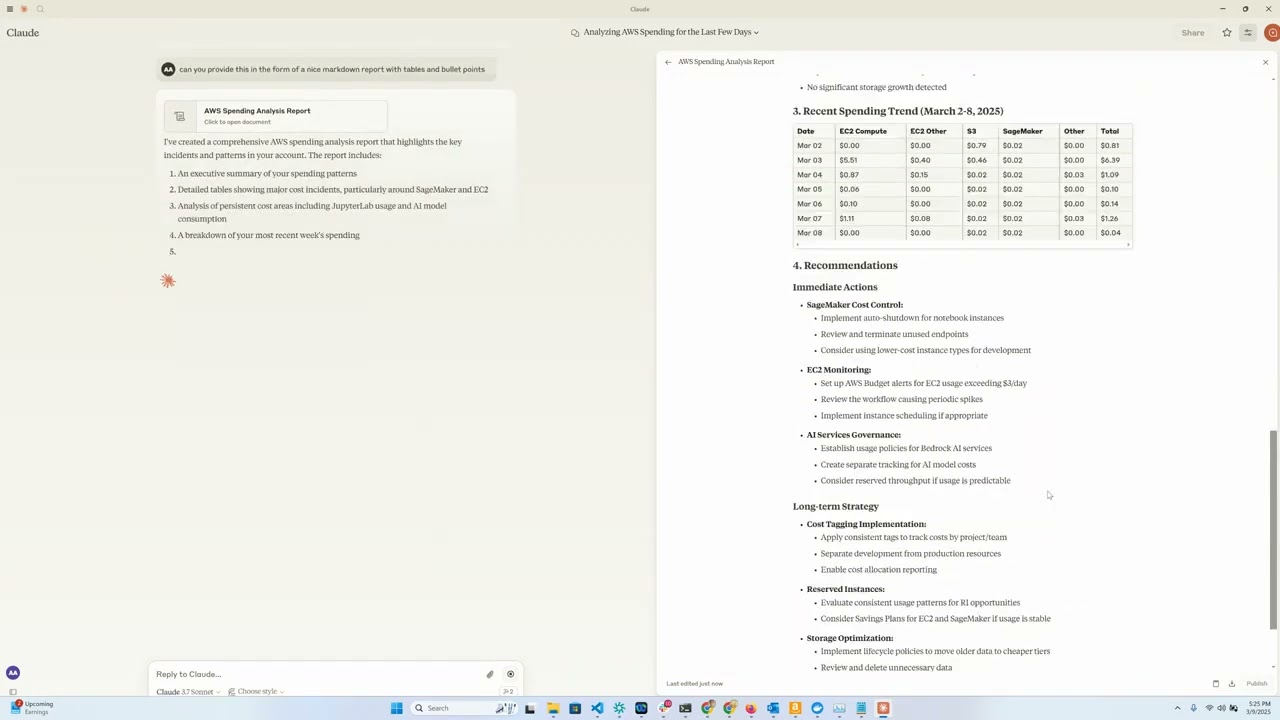
AWS Cost Explorer MCP Server Deep Dive

Overview

This tool provides a convenient way to analyze and visualize AWS cloud spending data using Anthropic's Claude model as an interactive interface. It functions as an MCP server that exposes AWS Cost Explorer API functionality to Claude Desktop, allowing you to ask questions about your AWS spend in natural language.

Related MCP server: AWS FinOps MCP Server

Features

  • Amazon EC2 Spend Analysis: View detailed breakdowns of EC2 spending for the last day

  • Amazon Bedrock Spend Analysis: View breakdown by region, users and models over the last 30 days

  • Service Spend Reports: Analyze spending across all AWS services for the last 30 days

  • Detailed Cost Breakdown: Get granular cost data by day, region, service, and instance type

  • Interactive Interface: Use Claude to query your cost data through natural language

Requirements

  • Python 3.12

  • AWS credentials with Cost Explorer access

  • Anthropic API access (for Claude integration)

  • [Optional] Amazon Bedrock access (for LangGraph Agent)

  • [Optional] Amazon EC2 for running a remote MCP server

Installation

  1. Install uv:

    # On macOS and Linux
    curl -LsSf https://astral.sh/uv/install.sh | sh
    # On Windows
    powershell -ExecutionPolicy ByPass -c "irm https://astral.sh/uv/install.ps1 | iex"

    Additional installation options are documented here

  2. Clone this repository: (assuming this will be updated to point to aws-samples?)

    git clone https://github.com/aarora79/aws-cost-explorer-mcp.git
    cd aws-cost-explorer-mcp
  3. Set up the Python virtual environment and install dependencies:

    uv venv --python 3.12 && source .venv/bin/activate && uv pip install --requirement pyproject.toml
  4. Configure your AWS credentials:

    mkdir -p ~/.aws
    # Set up your credentials in ~/.aws/credentials and ~/.aws/config

    If you useAWS IAM Identity Center, follow the docs to configure your short-term credentials

Usage

Prerequisites

  1. Setup model invocation logs in Amazon CloudWatch.

  2. Ensure that the IAM user/role being used has full read-only access to Amazon Cost Explorer and Amazon CloudWatch, this is required for the MCP server to retrieve data from these services. See here and here for sample policy examples that you can use & modify as per your requirements.

  3. To allow your MCP server to access AWS spend information from other accounts set the the CROSS_ACCOUNT_ROLE_NAME parameter while starting the server and now you can provide the account AWS account id for another account while interacting with your agent and then agent will pass the account id to the server.

Local setup

Uses stdio as a transport for MCP, both the MCP server and client are running on your local machine.

Starting the Server (local)

Run the server using:

export MCP_TRANSPORT=stdio
export BEDROCK_LOG_GROUP_NAME=YOUR_BEDROCK_CW_LOG_GROUP_NAME
export CROSS_ACCOUNT_ROLE_NAME=ROLE_NAME_FOR_THE_ROLE_TO_ASSUME_IN_OTHER_ACCOUNTS # can be ignored if you do not want AWS spend info from other accounts
python server.py

Claude Desktop Configuration

There are two ways to configure this tool with Claude Desktop:

Option 1: Using Docker

Add the following to your Claude Desktop configuration file. The file can be found out these paths depending upon you operating system.

  • macOS: ~/Library/Application Support/Claude/claude_desktop_config.json.

  • Windows: %APPDATA%\Claude\claude_desktop_config.json.

  • Linux: ~/.config/Claude/claude_desktop_config.json.

{
  "mcpServers": {
    "aws-cost-explorer": {
      "command": "docker",
      "args": [ "run", "-i", "--rm", "-e", "AWS_ACCESS_KEY_ID", "-e", "AWS_SECRET_ACCESS_KEY", "-e", "AWS_REGION", "-e", "BEDROCK_LOG_GROUP_NAME", "-e", "MCP_TRANSPORT", "-e", "CROSS_ACCOUNT_ROLE_NAME", "aws-cost-explorer-mcp:latest" ],
      "env": {
        "AWS_ACCESS_KEY_ID": "YOUR_ACCESS_KEY_ID",
        "AWS_SECRET_ACCESS_KEY": "YOUR_SECRET_ACCESS_KEY",
        "AWS_REGION": "us-east-1",
        "BEDROCK_LOG_GROUP_NAME": "YOUR_CLOUDWATCH_BEDROCK_MODEL_INVOCATION_LOG_GROUP_NAME",
        "CROSS_ACCOUNT_ROLE_NAME": "ROLE_NAME_FOR_THE_ROLE_TO_ASSUME_IN_OTHER_ACCOUNTS",
        "MCP_TRANSPORT": "stdio"
      }
    }
  }
}

IMPORTANT: Replace YOUR_ACCESS_KEY_ID and YOUR_SECRET_ACCESS_KEY with your actual AWS credentials. Never commit actual credentials to version control.

Option 2: Using UV (without Docker)

If you prefer to run the server directly without Docker, you can use UV:

{
  "mcpServers": {
    "aws_cost_explorer": {
      "command": "uv",
      "args": [
          "--directory",
          "/path/to/aws-cost-explorer-mcp-server",
          "run",
          "server.py"
      ],
      "env": {
        "AWS_ACCESS_KEY_ID": "YOUR_ACCESS_KEY_ID",
        "AWS_SECRET_ACCESS_KEY": "YOUR_SECRET_ACCESS_KEY",
        "AWS_REGION": "us-east-1",
        "BEDROCK_LOG_GROUP_NAME": "YOUR_CLOUDWATCH_BEDROCK_MODEL_INVOCATION_LOG_GROUP_NAME",
        "CROSS_ACCOUNT_ROLE_NAME": "ROLE_NAME_FOR_THE_ROLE_TO_ASSUME_IN_OTHER_ACCOUNTS",
        "MCP_TRANSPORT": "stdio"
      }
    }
  }
}

Make sure to replace the directory path with the actual path to your repository on your system.

Remote setup

Uses sse as a transport for MCP, the MCP servers on EC2 and the client is running on your local machine. Note that Claude Desktop does not support remote MCP servers at this time (see this GitHub issue).

Starting the Server (remote)

You can start a remote MCP server on Amazon EC2 by following the same instructions as above. Make sure to set the MCP_TRANSPORT as sse (server side events) as shown below. Note that the MCP uses JSON-RPC 2.0 as its wire format, therefore the protocol itself does not include authorization and authentication (see this GitHub issue), do not send or receive sensitive data over MCP.

Run the server using:

export MCP_TRANSPORT=sse
export BEDROCK_LOG_GROUP_NAME=YOUR_BEDROCK_CW_LOG_GROUP_NAME
export CROSS_ACCOUNT_ROLE_NAME=ROLE_NAME_FOR_THE_ROLE_TO_ASSUME_IN_OTHER_ACCOUNTS # can be ignored if you do not want AWS spend info from other accounts
python server.py
  1. The MCP server will start listening on TCP port 8000.

  2. Configure an ingress rule in the security group associated with your EC2 instance to allow access to TCP port 8000 from your local machine (where you are running the MCP client/LangGraph based app) to your EC2 instance.

Also see section on running a "secure" remote MCP server i.e. a server to which your MCP clients can connect over HTTPS.

Testing with a CLI MCP client

You can test your remote MCP server with the mcp_sse_client.py script. Running this script will print the list of tools available from the MCP server and an output for the get_bedrock_daily_usage_stats tool.

# set the hostname for your MCP server
MCP_SERVER_HOSTNAME=YOUR_MCP_SERVER_EC2_HOSTNAME
# or localhost if your MCP server is running locally
# MCP_SERVER_HOSTNAME=localhost 
AWS_ACCOUNT_ID=AWS_ACCOUNT_ID_TO_GET_INFO_ABOUT # if set to empty or if the --aws-account-id switch is not specified then it gets the info about the AWS account MCP server is running in
python mcp_sse_client.py --host $MCP_SERVER_HOSTNAME --aws-account-id $AWS_ACCOUNT_ID

Testing with Chainlit app

The app.py file in this repo provides a Chainlit app (chatbot) which creates a LangGraph agent that uses the LangChain MCP Adapter to import the tools provided by the MCP server as tools in a LangGraph Agent. The Agent is then able to use an LLM to respond to user questions and use the tools available to it as needed. Thus if the user asks a question such as "What was my Bedrock usage like in the last one week?" then the Agent will use the tools available to it via the remote MCP server to answer that question. We use Claude 3.5 Haiku model available via Amazon Bedrock to power this agent.

Run the Chainlit app using:

chainlit run app.py --port 8080 

A browser window should open up on localhost:8080 and you should be able to use the chatbot to get details about your AWS spend.

Available Tools

The server exposes the following tools that Claude can use:

  1. get_ec2_spend_last_day(): Retrieves EC2 spending data for the previous day

  2. get_detailed_breakdown_by_day(days=7): Delivers a comprehensive analysis of costs by region, service, and instance type

  3. get_bedrock_daily_usage_stats(days=7, region='us-east-1', log_group_name='BedrockModelInvocationLogGroup'): Delivers a per-day breakdown of model usage by region and users.

  4. get_bedrock_hourly_usage_stats(days=7, region='us-east-1', log_group_name='BedrockModelInvocationLogGroup'): Delivers a per-day per-hour breakdown of model usage by region and users.

Example Queries

Once connected to Claude through an MCP-enabled interface, you can ask questions like:

  • "Help me understand my Bedrock spend over the last few weeks"

  • "What was my EC2 spend yesterday?"

  • "Show me my top 5 AWS services by cost for the last month"

  • "Analyze my spending by region for the past 14 days"

  • "Which instance types are costing me the most money?"

  • "Which services had the highest month-over-month cost increase?"

Docker Support

A Dockerfile is included for containerized deployment:

docker build -t aws-cost-explorer-mcp .
docker run -v ~/.aws:/root/.aws aws-cost-explorer-mcp

Development

Project Structure

  • server.py: Main server implementation with MCP tools

  • pyproject.toml: Project dependencies and metadata

  • Dockerfile: Container definition for deployments

Adding New Cost Analysis Tools

To extend the functionality:

  1. Add new functions to server.py

  2. Annotate them with @mcp.tool()

  3. Implement the AWS Cost Explorer API calls

  4. Format the results for easy readability

Secure "remote" MCP server

We can use nginx as a reverse-proxy so that it can provide an HTTPS endpoint for connecting to the MCP server. Remote MCP clients can connect to nginx over HTTPS and then it can proxy traffic internally to http://localhost:8000. The following steps describe how to do this.

  1. Enable access to TCP port 443 from the IP address of your MCP client (your laptop, or anywhere) in the inbound rules in the security group associated with your EC2 instance.

  2. You would need to have an HTTPS certificate and private key to proceed. Let's say you use your-mcp-server-domain-name.com as the domain for your MCP server then you will need an SSL cert for your-mcp-server-domain-name.com and it will be accessible to MCP clients as https://your-mcp-server-domain-name.com/sse. While you can use a self-signed cert but it would require disabling SSL verification on the MCP client, we DO NOT recommend you do that. If you are hosting your MCP server on EC2 then you could generate an SSL cert using no-ip or Let' Encrypt or other similar services. Place the SSL cert and private key files in /etc/ssl/certs and /etc/ssl/privatekey folders respectively on your EC2 machine.

  3. Install nginx on your EC2 machine using the following commands.

    sudo apt-get install nginx
    sudo nginx -t
    sudo systemctl reload nginx
  4. Get the hostname for your EC2 instance, this would be needed for configuring the nginx reverse proxy.

    TOKEN=$(curl -X PUT "http://169.254.169.254/latest/api/token" -H "X-aws-ec2-metadata-token-ttl-seconds: 21600") && curl -H "X-aws-ec2-metadata-token: $TOKEN" -s http://169.254.169.254/latest/meta-data/public-hostname
  5. Copy the following content into a new file /etc/nginx/conf.d/ec2.conf. Replace YOUR_EC2_HOSTNAME, /etc/ssl/certs/cert.pem and /etc/ssl/privatekey/privkey.pem with values appropriate for your setup.

    server {
     listen 80;
     server_name YOUR_EC2_HOSTNAME;
    
     # Optional: Redirect HTTP to HTTPS
     return 301 https://$host$request_uri;
     }
    
     server {
         listen 443 ssl;
         server_name YOUR_EC2_HOSTNAME;
    
         # Self-signed certificate paths
         ssl_certificate     /etc/ssl/certs/cert.pem;
         ssl_certificate_key /etc/ssl/privatekey/privkey.pem; 
    
         # Optional: Good practice
         ssl_protocols       TLSv1.2 TLSv1.3;
         ssl_ciphers         HIGH:!aNULL:!MD5;
    
         location / {
             # Reverse proxy to your local app (e.g., port 8000)
             proxy_pass http://127.0.0.1:8000;
             proxy_http_version 1.1;
             proxy_set_header Host $host;
             proxy_set_header X-Real-IP $remote_addr;
             proxy_set_header X-Forwarded-For $proxy_add_x_forwarded_for;
         }
     }
    
  6. Restart nginx.

    sudo systemctl start nginx
  7. Start your MCP server as usual as described in the remote setup section.

  8. Your MCP server is now accessible over HTTPS as https://your-mcp-server-domain-name.com/sse to your MCP client.

  9. On the client side now (say on your laptop or in your Agent) configure your MCP client to communicate to your MCP server as follows.

    MCP_SERVER_HOSTNAME=YOUR_MCP_SERVER_DOMAIN_NAME
    AWS_ACCOUNT_ID=AWS_ACCOUNT_ID_TO_GET_INFO_ABOUT # if set to empty or if the --aws-account-id switch is not specified then it gets the info about the AWS account MCP server is running in
    python mcp_sse_client.py --host $MCP_SERVER_HOSTNAME --port 443 --aws-account-id $AWS_ACCOUNT_ID

    Similarly you could run the chainlit app to talk to remote MCP server over HTTPS.

    export MCP_SERVER_URL=YOUR_MCP_SERVER_DOMAIN_NAME
    export MCP_SERVER_PORT=443
    chainlit run app.py --port 8080

    Similarly you could run the LangGraph Agent to talk to remote MCP server over HTTPS.

    python langgraph_agent_mcp_sse_client.py --host $MCP_SERVER_HOSTNAME --port 443 --aws-account-id $AWS_ACCOUNT_ID

License

MIT License

Acknowledgments

  • This tool uses Anthropic's MCP framework

  • Powered by AWS Cost Explorer API

  • Built with FastMCP for server implementation

  • README was generated by providing a text dump of the repo via GitIngest to Claude

Available Tools

4 tools
get_bedrock_daily_usage_statsC
Get daily usage statistics with detailed breakdowns.

Args:
    params: Parameters specifying the number of days to look back and region

Returns:
    str: Formatted string representation of daily usage statistics
ParametersJSON Schema
NameRequiredDescriptionDefault
paramsYes

TDQS

C2.7/5.0
Behavior2/5

Does the description disclose side effects, auth requirements, rate limits, or destructive behavior?

No annotations are provided, so the description carries full burden. It mentions 'detailed breakdowns' and that it returns a 'formatted string representation,' but doesn't disclose important behavioral traits like whether this is a read-only operation, requires specific AWS permissions, has rate limits, or what format the string output takes. For a tool with no annotation coverage, this leaves significant gaps in understanding how it behaves.

Agents need to know what a tool does to the world before calling it. Descriptions should go beyond structured annotations to explain consequences.

Conciseness4/5

Is the description appropriately sized, front-loaded, and free of redundancy?

The description is appropriately concise with three sentences that are front-loaded: the first states the purpose, followed by Args and Returns sections. There's minimal waste, though the parameter explanation could be more informative. The structure is clear but could better integrate parameter details into the flow.

Shorter descriptions cost fewer tokens and are easier for agents to parse. Every sentence should earn its place.

Completeness2/5

Given the tool's complexity, does the description cover enough for an agent to succeed on first attempt?

Given the complexity (4 nested parameters, no annotations, no output schema), the description is incomplete. It doesn't adequately explain the parameters, behavioral aspects, or output format. For a tool that likely interacts with AWS Bedrock and returns usage statistics, more context on permissions, data scope, and result interpretation is needed to be fully helpful.

Complex tools with many parameters or behaviors need more documentation. Simple tools need less. This dimension scales expectations accordingly.

Parameters2/5

Does the description clarify parameter syntax, constraints, interactions, or defaults beyond what the schema provides?

The schema description coverage is 0%, meaning parameters are undocumented in the schema. The description only vaguely mentions 'Parameters specifying the number of days to look back and region,' but doesn't explain the actual parameters (days, region, log_group_name, aws_account_id) or their purposes. It fails to compensate for the schema's lack of descriptions, leaving most parameters semantically unclear.

Input schemas describe structure but not intent. Descriptions should explain non-obvious parameter relationships and valid value ranges.

Purpose4/5

Does the description clearly state what the tool does and how it differs from similar tools?

The description clearly states the tool's purpose: 'Get daily usage statistics with detailed breakdowns.' It specifies the verb ('Get') and resource ('daily usage statistics'), and distinguishes from the hourly sibling tool by emphasizing 'daily' usage. However, it doesn't explicitly differentiate from 'get_detailed_breakdown_by_day' which might provide similar functionality.

Agents choose between tools based on descriptions. A clear purpose with a specific verb and resource helps agents select the right tool.

Usage Guidelines2/5

Does the description explain when to use this tool, when not to, or what alternatives exist?

The description provides no guidance on when to use this tool versus alternatives. It doesn't mention the sibling tools (get_bedrock_hourly_usage_stats, get_detailed_breakdown_by_day, get_ec2_spend_last_day) or explain when daily statistics are preferred over hourly ones or other breakdowns. The only implied context is the need for 'daily' statistics, but no explicit usage rules are provided.

Agents often have multiple tools that could apply. Explicit usage guidance like "use X instead of Y when Z" prevents misuse.

get_bedrock_hourly_usage_statsC
Get hourly usage statistics with detailed breakdowns.

Args:
    params: Parameters specifying the number of days to look back and region

Returns:
    str: Formatted string representation of hourly usage statistics
ParametersJSON Schema
NameRequiredDescriptionDefault
paramsYes

TDQS

C2.4/5.0
Behavior2/5

Does the description disclose side effects, auth requirements, rate limits, or destructive behavior?

No annotations are provided, so the description carries full burden. While it mentions the tool returns 'Formatted string representation of hourly usage statistics,' it doesn't disclose important behavioral traits like whether this is a read-only operation, authentication requirements, rate limits, data freshness, or what happens if parameters are invalid. The description is minimal and lacks operational context.

Agents need to know what a tool does to the world before calling it. Descriptions should go beyond structured annotations to explain consequences.

Conciseness3/5

Is the description appropriately sized, front-loaded, and free of redundancy?

The description is brief (4 sentences) and front-loaded with the core purpose. However, the 'Args' and 'Returns' sections are redundant since they don't add value beyond the tool name and basic function. The structure is clear but includes unnecessary boilerplate that doesn't enhance understanding.

Shorter descriptions cost fewer tokens and are easier for agents to parse. Every sentence should earn its place.

Completeness2/5

Given the tool's complexity, does the description cover enough for an agent to succeed on first attempt?

Given the complexity (4 parameters with 0% schema coverage, no annotations, no output schema), the description is inadequate. It doesn't explain what 'hourly usage statistics' includes, how data is aggregated, what format the returned string uses, or provide context about the Bedrock service. For a tool with multiple parameters and no structured documentation, the description should do much more to compensate.

Complex tools with many parameters or behaviors need more documentation. Simple tools need less. This dimension scales expectations accordingly.

Parameters1/5

Does the description clarify parameter syntax, constraints, interactions, or defaults beyond what the schema provides?

The description states 'Parameters specifying the number of days to look back and region,' but the actual input schema shows 4 parameters (days, region, log_group_name, aws_account_id) with 0% schema description coverage. The description fails to mention two parameters entirely (log_group_name and aws_account_id) and provides no meaningful semantic context beyond what's minimally implied by parameter names.

Input schemas describe structure but not intent. Descriptions should explain non-obvious parameter relationships and valid value ranges.

Purpose4/5

Does the description clearly state what the tool does and how it differs from similar tools?

The description clearly states the tool's purpose: 'Get hourly usage statistics with detailed breakdowns.' It specifies the verb ('Get'), resource ('hourly usage statistics'), and scope ('detailed breakdowns'). However, it doesn't explicitly differentiate from sibling tools like 'get_bedrock_daily_usage_stats' or 'get_detailed_breakdown_by_day'.

Agents choose between tools based on descriptions. A clear purpose with a specific verb and resource helps agents select the right tool.

Usage Guidelines2/5

Does the description explain when to use this tool, when not to, or what alternatives exist?

No guidance is provided on when to use this tool versus alternatives. The description doesn't mention sibling tools, specify use cases, or provide any context about when this hourly breakdown is preferred over daily statistics or other available tools.

Agents often have multiple tools that could apply. Explicit usage guidance like "use X instead of Y when Z" prevents misuse.

get_detailed_breakdown_by_dayC
Retrieve daily spend breakdown by region, service, and instance type.

Args:
    params: Parameters specifying the number of days to look back

Returns:
    Dict[str, Any]: A tuple containing:
        - A nested dictionary with cost data organized by date, region, and service
        - A string containing the formatted output report
    or (None, error_message) if an error occurs.
ParametersJSON Schema
NameRequiredDescriptionDefault
paramsYes

TDQS

C2.9/5.0
Behavior2/5

Does the description disclose side effects, auth requirements, rate limits, or destructive behavior?

With no annotations provided, the description carries full burden. It mentions the tool retrieves cost data and returns a nested dictionary or error, but lacks critical behavioral details: authentication requirements, rate limits, whether it's read-only/destructive, or how errors manifest. This is inadequate for a tool with potential complexity.

Agents need to know what a tool does to the world before calling it. Descriptions should go beyond structured annotations to explain consequences.

Conciseness4/5

Is the description appropriately sized, front-loaded, and free of redundancy?

The description is reasonably concise with three sections (purpose, args, returns) and no wasted sentences. However, the return value explanation is somewhat verbose and could be streamlined for better front-loading of key information.

Shorter descriptions cost fewer tokens and are easier for agents to parse. Every sentence should earn its place.

Completeness2/5

Given the tool's complexity, does the description cover enough for an agent to succeed on first attempt?

Given no annotations, 0% schema coverage, no output schema, and sibling tools with similar names, the description is incomplete. It doesn't explain the tool's scope (e.g., EC2-specific vs. general AWS costs), error handling details, or how results differ from siblings, leaving significant gaps for agent understanding.

Complex tools with many parameters or behaviors need more documentation. Simple tools need less. This dimension scales expectations accordingly.

Parameters3/5

Does the description clarify parameter syntax, constraints, interactions, or defaults beyond what the schema provides?

Schema description coverage is 0%, so the description must compensate. It mentions 'Parameters specifying the number of days to look back', which partially explains the 'params' object but omits details about 'region' and 'aws_account_id' sub-parameters. This adds some value but doesn't fully bridge the coverage gap.

Input schemas describe structure but not intent. Descriptions should explain non-obvious parameter relationships and valid value ranges.

Purpose4/5

Does the description clearly state what the tool does and how it differs from similar tools?

The description clearly states the verb ('Retrieve') and resource ('daily spend breakdown') with specific dimensions (region, service, instance type). However, it doesn't explicitly differentiate from sibling tools like 'get_ec2_spend_last_day' which might overlap in purpose, preventing a perfect score.

Agents choose between tools based on descriptions. A clear purpose with a specific verb and resource helps agents select the right tool.

Usage Guidelines2/5

Does the description explain when to use this tool, when not to, or what alternatives exist?

The description provides no guidance on when to use this tool versus alternatives like 'get_ec2_spend_last_day' or 'get_bedrock_daily_usage_stats'. There's no mention of prerequisites, context, or exclusions, leaving the agent to guess based on tool names alone.

Agents often have multiple tools that could apply. Explicit usage guidance like "use X instead of Y when Z" prevents misuse.

get_ec2_spend_last_dayC
Retrieve EC2 spend for the last day using standard AWS Cost Explorer API.

Returns:
    Dict[str, Any]: The raw response from the AWS Cost Explorer API, or None if an error occurs.
ParametersJSON Schema
NameRequiredDescriptionDefault
paramsYes

TDQS

C2.9/5.0
Behavior2/5

Does the description disclose side effects, auth requirements, rate limits, or destructive behavior?

With no annotations, the description carries the full burden of behavioral disclosure. It mentions the API used and error handling (returns None on error), but lacks details on permissions, rate limits, cost implications, or what 'last day' means precisely (e.g., UTC day, rolling 24h). This is inadequate for a tool that likely requires AWS credentials and has financial implications.

Agents need to know what a tool does to the world before calling it. Descriptions should go beyond structured annotations to explain consequences.

Conciseness4/5

Is the description appropriately sized, front-loaded, and free of redundancy?

The description is front-loaded with the core purpose in the first sentence, followed by a concise return value note. It's appropriately sized with no wasted words, though the return type detail could be more integrated.

Shorter descriptions cost fewer tokens and are easier for agents to parse. Every sentence should earn its place.

Completeness3/5

Given the tool's complexity, does the description cover enough for an agent to succeed on first attempt?

Given no annotations, no output schema, and 0% schema description coverage, the description is incomplete. It covers the basic purpose and error handling but misses critical context like authentication needs, cost behavior, and sibling tool differentiation, making it only minimally viable for this AWS cost tool.

Complex tools with many parameters or behaviors need more documentation. Simple tools need less. This dimension scales expectations accordingly.

Parameters3/5

Does the description clarify parameter syntax, constraints, interactions, or defaults beyond what the schema provides?

Schema description coverage is 0%, so the description must compensate, but it provides no parameter information. The baseline is 3 because the schema fully documents the single 'params' object with its nested fields (days, region, aws_account_id), including defaults and constraints, making the description's lack of param details less critical.

Input schemas describe structure but not intent. Descriptions should explain non-obvious parameter relationships and valid value ranges.

Purpose4/5

Does the description clearly state what the tool does and how it differs from similar tools?

The description clearly states the verb 'Retrieve' and resource 'EC2 spend for the last day', specifying the AWS Cost Explorer API as the method. It distinguishes from siblings by focusing on EC2 spend rather than Bedrock usage or detailed breakdowns, though it doesn't explicitly contrast them.

Agents choose between tools based on descriptions. A clear purpose with a specific verb and resource helps agents select the right tool.

Usage Guidelines2/5

Does the description explain when to use this tool, when not to, or what alternatives exist?

No guidance on when to use this tool versus alternatives is provided. The description doesn't mention sibling tools or suggest scenarios for choosing this tool over others, leaving the agent without usage context.

Agents often have multiple tools that could apply. Explicit usage guidance like "use X instead of Y when Z" prevents misuse.

Tool Schema Changelog

Recent tool additions, removals, and schema changes observed during successful MCP inspections.

  1. 4 tool updates
    • First observedget_bedrock_daily_usage_stats
    • First observedget_bedrock_hourly_usage_stats
    • First observedget_detailed_breakdown_by_day
    • First observedget_ec2_spend_last_day

TDQS

C2.7/5.0

Scored across 4 tools

Disambiguation3/5

The tools have some overlap in purpose, particularly between the two Bedrock usage tools and the daily breakdown tool, which all involve daily cost/usage data. However, the descriptions clarify distinctions: get_bedrock_daily_usage_stats and get_bedrock_hourly_usage_stats focus on Bedrock service usage (daily vs. hourly), while get_detailed_breakdown_by_day covers broader cost breakdowns across services. The EC2 tool is distinct but limited to a single day.

Naming Consistency4/5

The naming follows a consistent verb_noun pattern (get_*_*) throughout, with clear action-object structure. Minor deviations exist, such as get_detailed_breakdown_by_day using 'by_day' instead of a noun like 'daily_breakdown', but overall the pattern is predictable and readable.

Tool Count2/5

With only 4 tools, the server feels under-scoped for an 'AWS Cost Explorer' purpose, which typically involves querying costs across multiple services, time ranges, and dimensions. The tools are narrowly focused on Bedrock and EC2, lacking coverage for other AWS services or flexible time-range queries, making the set feel incomplete for general cost exploration.

Completeness2/5

There are significant gaps in the tool surface for cost exploration. The server lacks tools for querying costs by service, region, or account over custom time periods, and it misses core operations like filtering, grouping, or forecasting. The tools are limited to specific services (Bedrock, EC2) and fixed time frames, which will cause agent failures when broader cost analysis is needed.

Maintenance

ActivityInactive
ResponsivenessUnresponsive

Resources

Unclaimed servers have limited discoverability.

Looking for Admin?

If you are the server author, to access and configure the admin panel.

Related MCP Connectors

Related MCP Servers

  • F
    license
    Not graded
    quality
    D
    maintenance
    Enables users to analyze AWS costs, track spending trends, and detect anomalies directly within Claude Desktop using the AWS Cost Explorer API. It provides tools to identify major cost drivers and compare usage across different time periods through natural language queries.
    -
  • A
    license
    Not graded
    quality
    C
    maintenance
    Enables natural language analysis of AWS costs, automated FinOps waste audits, and budget monitoring across multiple profiles and regions while keeping credentials secure locally.
    182
    MIT
  • A
    license
    A
    quality
    B
    maintenance
    Enables analyzing AWS cloud costs through natural language queries, providing cost summaries, anomaly detection, idle resource identification, rightsizing recommendations, and tagging compliance via Claude.
    10
    9
    MIT