MCP-Smallest.ai

MCP-Smallest.ai
Smallest.ai API 통합을 위한 모델 컨텍스트 프로토콜(MCP) 서버 구현입니다. 이 프로젝트는 Smallest.ai의 지식 기반 관리 시스템과 상호 작용하기 위한 표준화된 인터페이스를 제공합니다.
건축학
시스템 개요
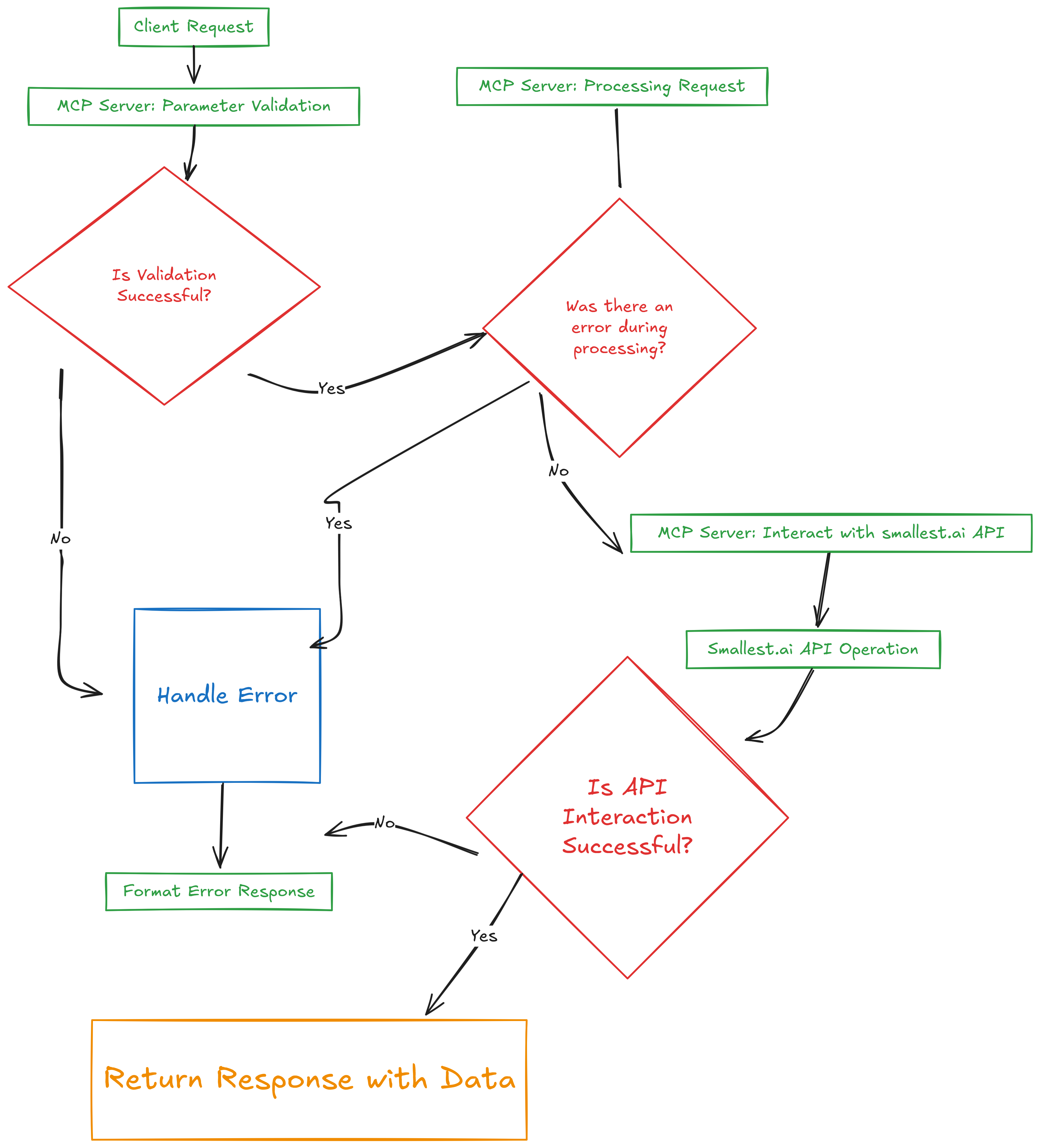
지엑스피1
구성 요소 세부 정보
1. 클라이언트 애플리케이션 계층
MCP 클라이언트 프로토콜을 구현합니다
요청 형식을 처리합니다
응답 구문 분석을 관리합니다
오류 처리를 제공합니다
2. MCP 서버 계층
프로토콜 핸들러
MCP 프로토콜 통신을 관리합니다
클라이언트 연결을 처리합니다
적절한 도구로 요청을 라우팅합니다.
도구 구현
지식 기반 관리 도구
매개변수 검증
응답 형식
오류 처리
API 통합
Smallest.ai API 통신
인증 관리
요청/응답 처리
3. Smallest.ai API 계층
지식 기반 관리
데이터 저장 및 검색
인증 및 권한 부여
데이터 흐름
1. Client Request
└─► MCP Protocol Validation
└─► Tool Parameter Validation
└─► API Request Formation
└─► Smallest.ai API Call
└─► Response Processing
└─► Client Response보안 아키텍처
┌─────────────────┐
│ Client Auth │
└────────┬────────┘
│
┌────────▼────────┐
│ MCP Validation │
└────────┬────────┘
│
┌────────▼────────┐
│ API Auth │
└────────┬────────┘
│
┌────────▼────────┐
│ Smallest.ai │
└─────────────────┘Related MCP server: Rememberizer MCP Server
개요
이 프로젝트는 클라이언트와 Smallest.ai API 사이의 미들웨어 역할을 하는 MCP 서버를 구현합니다. Model Context Protocol을 통해 Smallest.ai의 지식 기반 관리 기능과 상호 작용하는 표준화된 방법을 제공합니다.
건축학
[Client Application] <---> [MCP Server] <---> [Smallest.ai API]구성 요소
MCP 서버
클라이언트 요청을 처리합니다
API 통신을 관리합니다
표준화된 응답을 제공합니다
오류 처리를 구현합니다
지식 기반 도구
listKnowledgeBases: 모든 지식 기반을 나열합니다.createKnowledgeBase: 새로운 지식 기반을 생성합니다.getKnowledgeBase: 특정 지식 기반 세부 정보를 검색합니다.
문서 리소스
docs://smallest.ai에서 사용 가능사용 지침과 예를 제공합니다
필수 조건
Node.js 18+ 또는 Bun 런타임
Smallest.ai API 키
TypeScript 지식
설치
저장소를 복제합니다.
git clone https://github.com/yourusername/MCP-smallest.ai.git
cd MCP-smallest.ai종속성 설치:
bun install루트 디렉토리에
.env파일을 만듭니다.
SMALLEST_AI_API_KEY=your_api_key_here구성
Smallest.ai API 구성을 사용하여 config.ts 파일을 만듭니다.
export const config = {
API_KEY: process.env.SMALLEST_AI_API_KEY,
BASE_URL: 'https://atoms-api.smallest.ai/api/v1'
};용법
서버 시작
bun run index.ts서버 테스트
bun run test-client.ts사용 가능한 도구
지식 기반 목록
await client.callTool({
name: "listKnowledgeBases",
arguments: {}
});지식 기반 만들기
await client.callTool({
name: "createKnowledgeBase",
arguments: {
name: "My Knowledge Base",
description: "Description of the knowledge base"
}
});지식 기반 얻기
await client.callTool({
name: "getKnowledgeBase",
arguments: {
id: "knowledge_base_id"
}
});응답 형식
모든 응답은 다음 구조를 따릅니다.
{
content: [{
type: "text",
text: JSON.stringify(data, null, 2)
}]
}오류 처리
서버는 포괄적인 오류 처리를 구현합니다.
HTTP 오류
API 오류
매개변수 검증 오류
유형 안전 오류 응답
개발
프로젝트 구조
MCP-smallest.ai/
├── index.ts # MCP server implementation
├── test-client.ts # Test client implementation
├── config.ts # Configuration file
├── package.json # Project dependencies
├── tsconfig.json # TypeScript configuration
└── README.md # This file새로운 도구 추가
index.ts에 도구를 정의합니다.
server.tool(
"toolName",
{
param1: z.string(),
param2: z.number()
},
async (args) => {
// Implementation
}
);리소스의 문서를 업데이트하세요:
server.resource(
"documentation",
"docs://smallest.ai",
async (uri) => ({
contents: [{
uri: uri.href,
text: `Updated documentation...`
}]
})
);보안
API 키는 환경 변수에 저장됩니다.
모든 요청은 인증됩니다
매개변수 검증이 구현되었습니다
오류 메시지가 정리되었습니다.
기여하다
저장소를 포크하세요
기능 브랜치를 생성합니다(
git checkout -b feature/amazing-feature)변경 사항을 커밋하세요(
git commit -m 'Add some amazing feature')브랜치에 푸시(
git push origin feature/amazing-feature)풀 리퀘스트 열기
특허
이 프로젝트는 MIT 라이선스에 따라 라이선스가 부여되었습니다. 자세한 내용은 라이선스 파일을 참조하세요.
감사의 말
Available Tools
3 toolscreateKnowledgeBaseD
| Name | Required | Description | Default |
|---|---|---|---|
| description | Yes | ||
| name | Yes |
TDQS
Does the description disclose side effects, auth requirements, rate limits, or destructive behavior?
Tool has no description.
Agents need to know what a tool does to the world before calling it. Descriptions should go beyond structured annotations to explain consequences.
Is the description appropriately sized, front-loaded, and free of redundancy?
Tool has no description.
Shorter descriptions cost fewer tokens and are easier for agents to parse. Every sentence should earn its place.
Given the tool's complexity, does the description cover enough for an agent to succeed on first attempt?
Tool has no description.
Complex tools with many parameters or behaviors need more documentation. Simple tools need less. This dimension scales expectations accordingly.
Does the description clarify parameter syntax, constraints, interactions, or defaults beyond what the schema provides?
Tool has no description.
Input schemas describe structure but not intent. Descriptions should explain non-obvious parameter relationships and valid value ranges.
Does the description clearly state what the tool does and how it differs from similar tools?
Tool has no description.
Agents choose between tools based on descriptions. A clear purpose with a specific verb and resource helps agents select the right tool.
Does the description explain when to use this tool, when not to, or what alternatives exist?
Tool has no description.
Agents often have multiple tools that could apply. Explicit usage guidance like "use X instead of Y when Z" prevents misuse.
getKnowledgeBaseD
| Name | Required | Description | Default |
|---|---|---|---|
| id | Yes |
TDQS
Does the description disclose side effects, auth requirements, rate limits, or destructive behavior?
Tool has no description.
Agents need to know what a tool does to the world before calling it. Descriptions should go beyond structured annotations to explain consequences.
Is the description appropriately sized, front-loaded, and free of redundancy?
Tool has no description.
Shorter descriptions cost fewer tokens and are easier for agents to parse. Every sentence should earn its place.
Given the tool's complexity, does the description cover enough for an agent to succeed on first attempt?
Tool has no description.
Complex tools with many parameters or behaviors need more documentation. Simple tools need less. This dimension scales expectations accordingly.
Does the description clarify parameter syntax, constraints, interactions, or defaults beyond what the schema provides?
Tool has no description.
Input schemas describe structure but not intent. Descriptions should explain non-obvious parameter relationships and valid value ranges.
Does the description clearly state what the tool does and how it differs from similar tools?
Tool has no description.
Agents choose between tools based on descriptions. A clear purpose with a specific verb and resource helps agents select the right tool.
Does the description explain when to use this tool, when not to, or what alternatives exist?
Tool has no description.
Agents often have multiple tools that could apply. Explicit usage guidance like "use X instead of Y when Z" prevents misuse.
listKnowledgeBasesD
| Name | Required | Description | Default |
|---|---|---|---|
No parameters | |||
TDQS
Does the description disclose side effects, auth requirements, rate limits, or destructive behavior?
Tool has no description.
Agents need to know what a tool does to the world before calling it. Descriptions should go beyond structured annotations to explain consequences.
Is the description appropriately sized, front-loaded, and free of redundancy?
Tool has no description.
Shorter descriptions cost fewer tokens and are easier for agents to parse. Every sentence should earn its place.
Given the tool's complexity, does the description cover enough for an agent to succeed on first attempt?
Tool has no description.
Complex tools with many parameters or behaviors need more documentation. Simple tools need less. This dimension scales expectations accordingly.
Does the description clarify parameter syntax, constraints, interactions, or defaults beyond what the schema provides?
Tool has no description.
Input schemas describe structure but not intent. Descriptions should explain non-obvious parameter relationships and valid value ranges.
Does the description clearly state what the tool does and how it differs from similar tools?
Tool has no description.
Agents choose between tools based on descriptions. A clear purpose with a specific verb and resource helps agents select the right tool.
Does the description explain when to use this tool, when not to, or what alternatives exist?
Tool has no description.
Agents often have multiple tools that could apply. Explicit usage guidance like "use X instead of Y when Z" prevents misuse.
Tool Schema Changelog
Recent tool additions, removals, and schema changes observed during successful MCP inspections.
3 tool updates
v1.0.0- First observed
createKnowledgeBase - First observed
getKnowledgeBase - First observed
listKnowledgeBases
TDQS
Scored across 3 tools
Each tool has a clearly distinct purpose: create, get, and list operations on knowledge bases. There is no overlap in functionality, and the action verbs (create, get, list) are unambiguous and standard for CRUD operations.
All tool names follow a consistent camelCase pattern with a verb-noun structure (createKnowledgeBase, getKnowledgeBase, listKnowledgeBases). The naming is predictable and uniform across all three tools.
With only 3 tools, the set feels thin for a knowledge base management server, as it lacks update and delete operations. However, it covers basic create, retrieve, and list functions, which is minimal but functional for a small scope.
The tools provide create, get, and list operations, but there are notable gaps such as update and delete for knowledge bases. This limits full lifecycle management, though core retrieval and creation are covered.
Maintenance
Related MCP Connectors
A Model Context Protocol server for Wix AI tools
A comprehensive Model Context Protocol (MCP) server that enables AI assistants to interact with yo…
Model Context Protocol server for the Apideck Unified API. Connect any MCP-compatible agent framework to 100+ accounting systems, HRIS platforms, file storage providers, and more through one integration. More information https://www.apideck.com/mcp-server
DocBase MCP server for AI agents
Related MCP Servers
- AlicenseBqualityDmaintenanceA Model Context Protocol server that enables AI models to interact with SourceSync.ai's knowledge management platform for managing documents, ingesting content from various sources, and performing semantic searches.2559 npm1ISC
- AlicenseNot gradedqualityBmaintenanceA Model Context Protocol server enabling LLMs to search, retrieve, and manage documents through Rememberizer's knowledge management API.36Apache 2.0
- AlicenseNot gradedqualityDmaintenanceA Model Context Protocol server implementation that provides a standardized interface for applications to interact with OpenRouter's language models through a unified conversation management system.5 npm2MIT
- AlicenseAqualityDmaintenanceA comprehensive Model Context Protocol server that integrates Elasticsearch search with file operations, document validation, and version control to transform AI assistants into powerful knowledge management systems.2793 PyPI27MIT