MCP-Smallest.ai

MCP-Smallest.ai
Реализация сервера Model Context Protocol (MCP) для интеграции API Smallest.ai. Этот проект предоставляет стандартизированный интерфейс для взаимодействия с системой управления базой знаний Smallest.ai.
Архитектура
Обзор системы
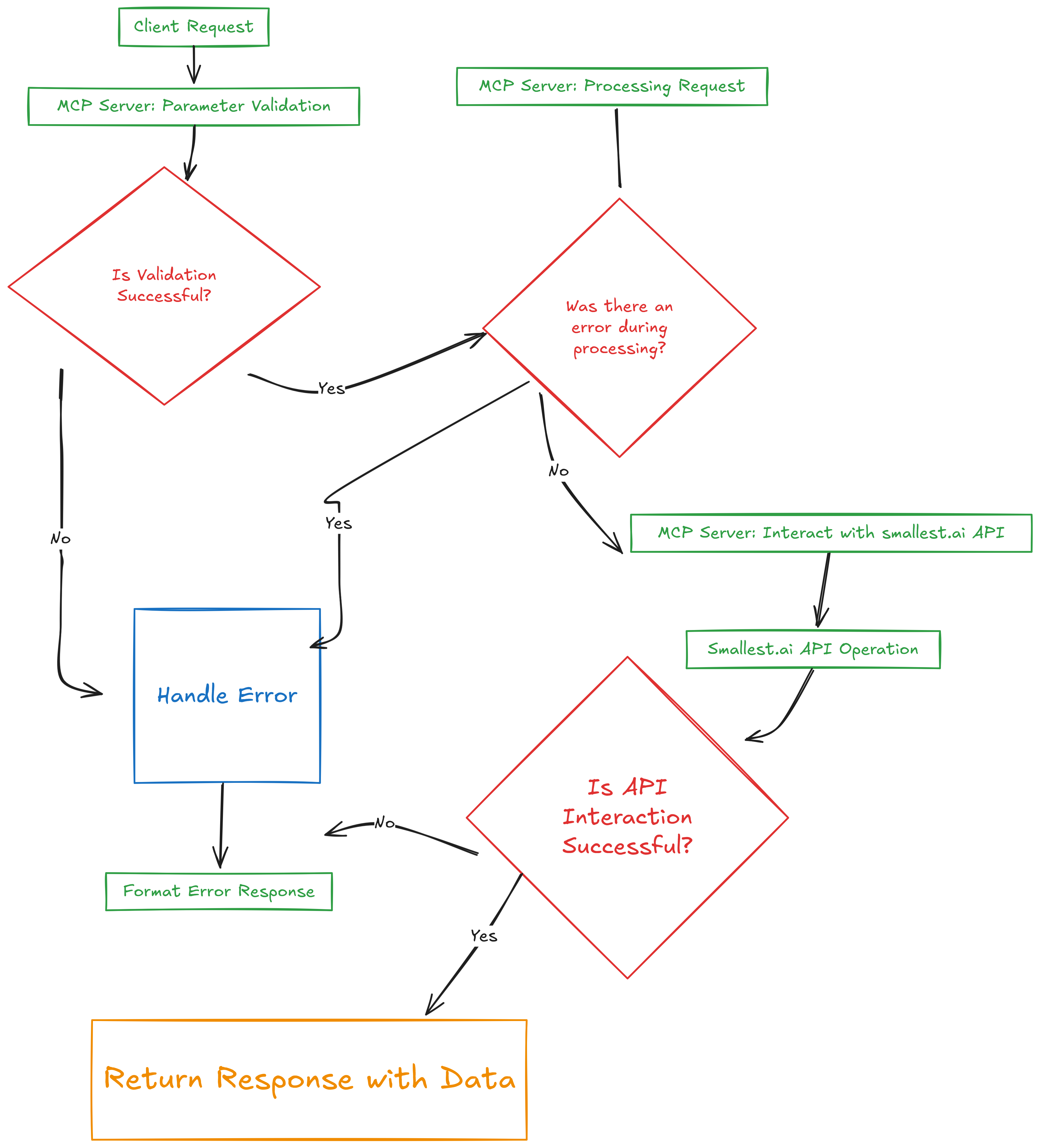
┌─────────────────┐ ┌─────────────────┐ ┌─────────────────┐
│ │ │ │ │ │
│ Client App │◄────┤ MCP Server │◄────┤ Smallest.ai │
│ │ │ │ │ API │
└─────────────────┘ └─────────────────┘ └─────────────────┘Детали компонента
1. Уровень клиентского приложения
Реализует клиентский протокол MCP
Обрабатывает форматирование запроса
Управляет анализом ответов
Обеспечивает обработку ошибок
2. Уровень сервера MCP
Обработчик протоколов
Управляет коммуникацией по протоколу MCP
Обрабатывает клиентские соединения
Направляет запросы соответствующим инструментам
Реализация инструмента
Инструменты управления базой знаний
Проверка параметров
Форматирование ответа
Обработка ошибок
API-интеграция
API-коммуникация Smallest.ai
Управление аутентификацией
Обработка запросов/ответов
3. Уровень API Smallest.ai
Управление базой знаний
Хранение и извлечение данных
Аутентификация и авторизация
Поток данных
1. Client Request
└─► MCP Protocol Validation
└─► Tool Parameter Validation
└─► API Request Formation
└─► Smallest.ai API Call
└─► Response Processing
└─► Client ResponseАрхитектура безопасности
┌─────────────────┐
│ Client Auth │
└────────┬────────┘
│
┌────────▼────────┐
│ MCP Validation │
└────────┬────────┘
│
┌────────▼────────┐
│ API Auth │
└────────┬────────┘
│
┌────────▼────────┐
│ Smallest.ai │
└─────────────────┘Related MCP server: Rememberizer MCP Server
Обзор
Этот проект реализует сервер MCP, который действует как промежуточное ПО между клиентами и API Smallest.ai. Он предоставляет стандартизированный способ взаимодействия с функциями управления базой знаний Smallest.ai через протокол контекста модели.
Архитектура
[Client Application] <---> [MCP Server] <---> [Smallest.ai API]Компоненты
MCP-сервер
Обрабатывает запросы клиентов
Управляет коммуникацией API
Предоставляет стандартизированные ответы
Реализует обработку ошибок
Инструменты базы знаний
listKnowledgeBases: список всех баз знанийcreateKnowledgeBase: создает новые базы знанийgetKnowledgeBase: извлекает конкретные сведения из базы знаний
Ресурс документации
Доступно на
docs://smallest.aiПредоставляет инструкции по использованию и примеры
Предпосылки
Node.js 18+ или среда выполнения Bun
API-ключ Smallest.ai
Знание TypeScript
Установка
Клонируйте репозиторий:
git clone https://github.com/yourusername/MCP-smallest.ai.git
cd MCP-smallest.aiУстановите зависимости:
bun installСоздайте файл
.envв корневом каталоге:
SMALLEST_AI_API_KEY=your_api_key_hereКонфигурация
Создайте файл config.ts с конфигурацией API Smallest.ai:
export const config = {
API_KEY: process.env.SMALLEST_AI_API_KEY,
BASE_URL: 'https://atoms-api.smallest.ai/api/v1'
};Использование
Запуск сервера
bun run index.tsТестирование сервера
bun run test-client.tsДоступные инструменты
Список баз знаний
await client.callTool({
name: "listKnowledgeBases",
arguments: {}
});Создать базу знаний
await client.callTool({
name: "createKnowledgeBase",
arguments: {
name: "My Knowledge Base",
description: "Description of the knowledge base"
}
});Получить базу знаний
await client.callTool({
name: "getKnowledgeBase",
arguments: {
id: "knowledge_base_id"
}
});Формат ответа
Все ответы имеют следующую структуру:
{
content: [{
type: "text",
text: JSON.stringify(data, null, 2)
}]
}Обработка ошибок
На сервере реализована комплексная обработка ошибок:
HTTP-ошибки
Ошибки API
Ошибки проверки параметров
Типобезопасные ответы на ошибки
Разработка
Структура проекта
MCP-smallest.ai/
├── index.ts # MCP server implementation
├── test-client.ts # Test client implementation
├── config.ts # Configuration file
├── package.json # Project dependencies
├── tsconfig.json # TypeScript configuration
└── README.md # This fileДобавление новых инструментов
Определите инструмент в
index.ts:
server.tool(
"toolName",
{
param1: z.string(),
param2: z.number()
},
async (args) => {
// Implementation
}
);Обновление документации в ресурсе:
server.resource(
"documentation",
"docs://smallest.ai",
async (uri) => ({
contents: [{
uri: uri.href,
text: `Updated documentation...`
}]
})
);Безопасность
Ключи API хранятся в переменных среды.
Все запросы аутентифицированы.
Реализована проверка параметров
Сообщения об ошибках очищаются
Внося вклад
Форк репозитория
Создайте ветку функций (
git checkout -b feature/amazing-feature)Зафиксируйте свои изменения (
git commit -m 'Add some amazing feature')Отправить в ветку (
git push origin feature/amazing-feature)Открыть запрос на извлечение
Лицензия
Данный проект лицензирован по лицензии MIT — подробности см. в файле LICENSE .
Благодарности
Available Tools
3 toolscreateKnowledgeBaseD
| Name | Required | Description | Default |
|---|---|---|---|
| description | Yes | ||
| name | Yes |
TDQS
Does the description disclose side effects, auth requirements, rate limits, or destructive behavior?
Tool has no description.
Agents need to know what a tool does to the world before calling it. Descriptions should go beyond structured annotations to explain consequences.
Is the description appropriately sized, front-loaded, and free of redundancy?
Tool has no description.
Shorter descriptions cost fewer tokens and are easier for agents to parse. Every sentence should earn its place.
Given the tool's complexity, does the description cover enough for an agent to succeed on first attempt?
Tool has no description.
Complex tools with many parameters or behaviors need more documentation. Simple tools need less. This dimension scales expectations accordingly.
Does the description clarify parameter syntax, constraints, interactions, or defaults beyond what the schema provides?
Tool has no description.
Input schemas describe structure but not intent. Descriptions should explain non-obvious parameter relationships and valid value ranges.
Does the description clearly state what the tool does and how it differs from similar tools?
Tool has no description.
Agents choose between tools based on descriptions. A clear purpose with a specific verb and resource helps agents select the right tool.
Does the description explain when to use this tool, when not to, or what alternatives exist?
Tool has no description.
Agents often have multiple tools that could apply. Explicit usage guidance like "use X instead of Y when Z" prevents misuse.
getKnowledgeBaseD
| Name | Required | Description | Default |
|---|---|---|---|
| id | Yes |
TDQS
Does the description disclose side effects, auth requirements, rate limits, or destructive behavior?
Tool has no description.
Agents need to know what a tool does to the world before calling it. Descriptions should go beyond structured annotations to explain consequences.
Is the description appropriately sized, front-loaded, and free of redundancy?
Tool has no description.
Shorter descriptions cost fewer tokens and are easier for agents to parse. Every sentence should earn its place.
Given the tool's complexity, does the description cover enough for an agent to succeed on first attempt?
Tool has no description.
Complex tools with many parameters or behaviors need more documentation. Simple tools need less. This dimension scales expectations accordingly.
Does the description clarify parameter syntax, constraints, interactions, or defaults beyond what the schema provides?
Tool has no description.
Input schemas describe structure but not intent. Descriptions should explain non-obvious parameter relationships and valid value ranges.
Does the description clearly state what the tool does and how it differs from similar tools?
Tool has no description.
Agents choose between tools based on descriptions. A clear purpose with a specific verb and resource helps agents select the right tool.
Does the description explain when to use this tool, when not to, or what alternatives exist?
Tool has no description.
Agents often have multiple tools that could apply. Explicit usage guidance like "use X instead of Y when Z" prevents misuse.
listKnowledgeBasesD
| Name | Required | Description | Default |
|---|---|---|---|
No parameters | |||
TDQS
Does the description disclose side effects, auth requirements, rate limits, or destructive behavior?
Tool has no description.
Agents need to know what a tool does to the world before calling it. Descriptions should go beyond structured annotations to explain consequences.
Is the description appropriately sized, front-loaded, and free of redundancy?
Tool has no description.
Shorter descriptions cost fewer tokens and are easier for agents to parse. Every sentence should earn its place.
Given the tool's complexity, does the description cover enough for an agent to succeed on first attempt?
Tool has no description.
Complex tools with many parameters or behaviors need more documentation. Simple tools need less. This dimension scales expectations accordingly.
Does the description clarify parameter syntax, constraints, interactions, or defaults beyond what the schema provides?
Tool has no description.
Input schemas describe structure but not intent. Descriptions should explain non-obvious parameter relationships and valid value ranges.
Does the description clearly state what the tool does and how it differs from similar tools?
Tool has no description.
Agents choose between tools based on descriptions. A clear purpose with a specific verb and resource helps agents select the right tool.
Does the description explain when to use this tool, when not to, or what alternatives exist?
Tool has no description.
Agents often have multiple tools that could apply. Explicit usage guidance like "use X instead of Y when Z" prevents misuse.
Tool Schema Changelog
Recent tool additions, removals, and schema changes observed during successful MCP inspections.
3 tool updates
v1.0.0- First observed
createKnowledgeBase - First observed
getKnowledgeBase - First observed
listKnowledgeBases
TDQS
Scored across 3 tools
Each tool has a clearly distinct purpose: create, get, and list operations on knowledge bases. There is no overlap in functionality, and the action verbs (create, get, list) are unambiguous and standard for CRUD operations.
All tool names follow a consistent camelCase pattern with a verb-noun structure (createKnowledgeBase, getKnowledgeBase, listKnowledgeBases). The naming is predictable and uniform across all three tools.
With only 3 tools, the set feels thin for a knowledge base management server, as it lacks update and delete operations. However, it covers basic create, retrieve, and list functions, which is minimal but functional for a small scope.
The tools provide create, get, and list operations, but there are notable gaps such as update and delete for knowledge bases. This limits full lifecycle management, though core retrieval and creation are covered.
Maintenance
Related MCP Connectors
A Model Context Protocol server for Wix AI tools
A comprehensive Model Context Protocol (MCP) server that enables AI assistants to interact with yo…
Model Context Protocol server for the Apideck Unified API. Connect any MCP-compatible agent framework to 100+ accounting systems, HRIS platforms, file storage providers, and more through one integration. More information https://www.apideck.com/mcp-server
DocBase MCP server for AI agents
Related MCP Servers
- AlicenseBqualityDmaintenanceA Model Context Protocol server that enables AI models to interact with SourceSync.ai's knowledge management platform for managing documents, ingesting content from various sources, and performing semantic searches.2559 npm1ISC
- AlicenseNot gradedqualityBmaintenanceA Model Context Protocol server enabling LLMs to search, retrieve, and manage documents through Rememberizer's knowledge management API.36Apache 2.0
- AlicenseNot gradedqualityDmaintenanceA Model Context Protocol server implementation that provides a standardized interface for applications to interact with OpenRouter's language models through a unified conversation management system.5 npm2MIT
- AlicenseAqualityDmaintenanceA comprehensive Model Context Protocol server that integrates Elasticsearch search with file operations, document validation, and version control to transform AI assistants into powerful knowledge management systems.2793 PyPI27MIT