MCP-Smallest.ai

MCP-Smallest.ai
Smallest.ai API統合のためのモデルコンテキストプロトコル(MCP)サーバー実装。このプロジェクトは、Smallest.aiのナレッジベース管理システムと連携するための標準化されたインターフェースを提供します。
建築
システムの概要
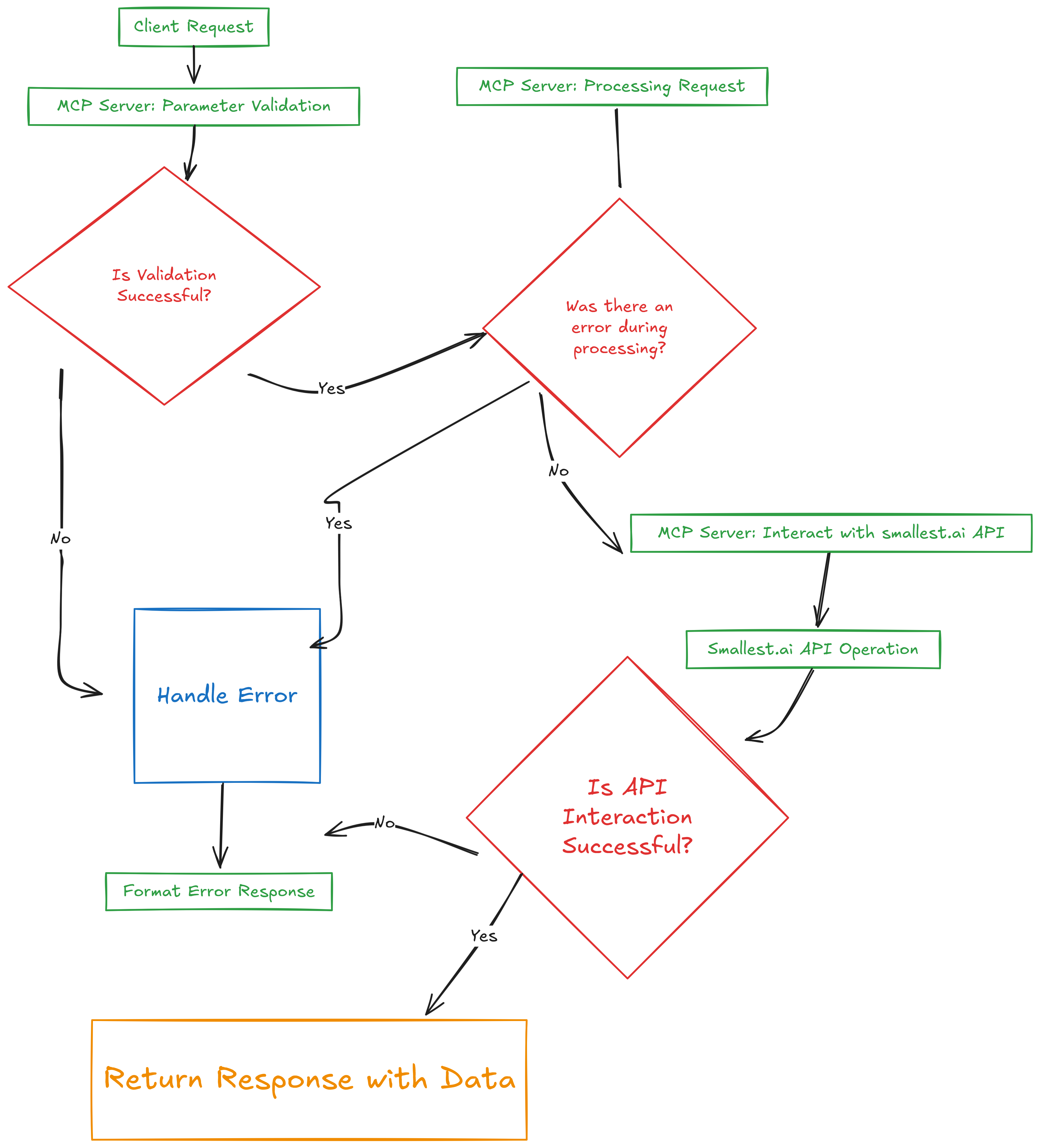
┌─────────────────┐ ┌─────────────────┐ ┌─────────────────┐
│ │ │ │ │ │
│ Client App │◄────┤ MCP Server │◄────┤ Smallest.ai │
│ │ │ │ │ API │
└─────────────────┘ └─────────────────┘ └─────────────────┘コンポーネントの詳細
1. クライアントアプリケーション層
MCPクライアントプロトコルを実装
リクエストのフォーマットを処理する
レスポンス解析を管理する
エラー処理を提供します
2. MCPサーバー層
プロトコルハンドラー
MCPプロトコル通信を管理する
クライアント接続を処理する
リクエストを適切なツールにルーティングします
ツールの実装
ナレッジベース管理ツール
パラメータ検証
応答のフォーマット
エラー処理
API統合
Smallest.ai API通信
認証管理
リクエスト/レスポンス処理
3. Smallest.ai APIレイヤー
ナレッジベース管理
データの保存と検索
認証と承認
データフロー
1. Client Request
└─► MCP Protocol Validation
└─► Tool Parameter Validation
└─► API Request Formation
└─► Smallest.ai API Call
└─► Response Processing
└─► Client Responseセキュリティアーキテクチャ
┌─────────────────┐
│ Client Auth │
└────────┬────────┘
│
┌────────▼────────┐
│ MCP Validation │
└────────┬────────┘
│
┌────────▼────────┐
│ API Auth │
└────────┬────────┘
│
┌────────▼────────┐
│ Smallest.ai │
└─────────────────┘Related MCP server: Rememberizer MCP Server
概要
このプロジェクトは、クライアントとSmallest.ai API間のミドルウェアとして機能するMCPサーバーを実装します。モデルコンテキストプロトコル(MCP)を介してSmallest.aiのナレッジベース管理機能とやり取りするための標準化された方法を提供します。
建築
[Client Application] <---> [MCP Server] <---> [Smallest.ai API]コンポーネント
MCPサーバー
クライアントのリクエストを処理する
API通信を管理する
標準化された応答を提供する
エラー処理を実装する
ナレッジベースツール
listKnowledgeBases: すべてのナレッジベースを一覧表示しますcreateKnowledgeBase: 新しいナレッジベースを作成するgetKnowledgeBase: 特定のナレッジベースの詳細を取得します
ドキュメントリソース
docs://smallest.aiで入手可能使用方法と例を示します
前提条件
Node.js 18+ または Bun ランタイム
Smallest.ai APIキー
TypeScriptの知識
インストール
リポジトリをクローンします。
git clone https://github.com/yourusername/MCP-smallest.ai.git
cd MCP-smallest.ai依存関係をインストールします:
bun installルート ディレクトリに
.envファイルを作成します。
SMALLEST_AI_API_KEY=your_api_key_here構成
Smallest.ai API 構成を含むconfig.tsファイルを作成します。
export const config = {
API_KEY: process.env.SMALLEST_AI_API_KEY,
BASE_URL: 'https://atoms-api.smallest.ai/api/v1'
};使用法
サーバーの起動
bun run index.tsサーバーのテスト
bun run test-client.ts利用可能なツール
ナレッジベースのリスト
await client.callTool({
name: "listKnowledgeBases",
arguments: {}
});ナレッジベースを作成する
await client.callTool({
name: "createKnowledgeBase",
arguments: {
name: "My Knowledge Base",
description: "Description of the knowledge base"
}
});ナレッジベースを入手
await client.callTool({
name: "getKnowledgeBase",
arguments: {
id: "knowledge_base_id"
}
});応答フォーマット
すべての応答は次の構造に従います。
{
content: [{
type: "text",
text: JSON.stringify(data, null, 2)
}]
}エラー処理
サーバーは包括的なエラー処理を実装します。
HTTPエラー
APIエラー
パラメータ検証エラー
型安全なエラー応答
発達
プロジェクト構造
MCP-smallest.ai/
├── index.ts # MCP server implementation
├── test-client.ts # Test client implementation
├── config.ts # Configuration file
├── package.json # Project dependencies
├── tsconfig.json # TypeScript configuration
└── README.md # This file新しいツールの追加
index.tsでツールを定義します。
server.tool(
"toolName",
{
param1: z.string(),
param2: z.number()
},
async (args) => {
// Implementation
}
);リソース内のドキュメントを更新します。
server.resource(
"documentation",
"docs://smallest.ai",
async (uri) => ({
contents: [{
uri: uri.href,
text: `Updated documentation...`
}]
})
);安全
APIキーは環境変数に保存されます
すべてのリクエストは認証されます
パラメータ検証が実装されています
エラーメッセージはサニタイズされる
貢献
リポジトリをフォークする
機能ブランチを作成します(
git checkout -b feature/amazing-feature)変更をコミットします (
git commit -m 'Add some amazing feature')ブランチにプッシュする (
git push origin feature/amazing-feature)プルリクエストを開く
ライセンス
このプロジェクトは MIT ライセンスに基づいてライセンスされています - 詳細についてはLICENSEファイルを参照してください。
謝辞
Available Tools
3 toolscreateKnowledgeBaseD
| Name | Required | Description | Default |
|---|---|---|---|
| description | Yes | ||
| name | Yes |
TDQS
Does the description disclose side effects, auth requirements, rate limits, or destructive behavior?
Tool has no description.
Agents need to know what a tool does to the world before calling it. Descriptions should go beyond structured annotations to explain consequences.
Is the description appropriately sized, front-loaded, and free of redundancy?
Tool has no description.
Shorter descriptions cost fewer tokens and are easier for agents to parse. Every sentence should earn its place.
Given the tool's complexity, does the description cover enough for an agent to succeed on first attempt?
Tool has no description.
Complex tools with many parameters or behaviors need more documentation. Simple tools need less. This dimension scales expectations accordingly.
Does the description clarify parameter syntax, constraints, interactions, or defaults beyond what the schema provides?
Tool has no description.
Input schemas describe structure but not intent. Descriptions should explain non-obvious parameter relationships and valid value ranges.
Does the description clearly state what the tool does and how it differs from similar tools?
Tool has no description.
Agents choose between tools based on descriptions. A clear purpose with a specific verb and resource helps agents select the right tool.
Does the description explain when to use this tool, when not to, or what alternatives exist?
Tool has no description.
Agents often have multiple tools that could apply. Explicit usage guidance like "use X instead of Y when Z" prevents misuse.
getKnowledgeBaseD
| Name | Required | Description | Default |
|---|---|---|---|
| id | Yes |
TDQS
Does the description disclose side effects, auth requirements, rate limits, or destructive behavior?
Tool has no description.
Agents need to know what a tool does to the world before calling it. Descriptions should go beyond structured annotations to explain consequences.
Is the description appropriately sized, front-loaded, and free of redundancy?
Tool has no description.
Shorter descriptions cost fewer tokens and are easier for agents to parse. Every sentence should earn its place.
Given the tool's complexity, does the description cover enough for an agent to succeed on first attempt?
Tool has no description.
Complex tools with many parameters or behaviors need more documentation. Simple tools need less. This dimension scales expectations accordingly.
Does the description clarify parameter syntax, constraints, interactions, or defaults beyond what the schema provides?
Tool has no description.
Input schemas describe structure but not intent. Descriptions should explain non-obvious parameter relationships and valid value ranges.
Does the description clearly state what the tool does and how it differs from similar tools?
Tool has no description.
Agents choose between tools based on descriptions. A clear purpose with a specific verb and resource helps agents select the right tool.
Does the description explain when to use this tool, when not to, or what alternatives exist?
Tool has no description.
Agents often have multiple tools that could apply. Explicit usage guidance like "use X instead of Y when Z" prevents misuse.
listKnowledgeBasesD
| Name | Required | Description | Default |
|---|---|---|---|
No parameters | |||
TDQS
Does the description disclose side effects, auth requirements, rate limits, or destructive behavior?
Tool has no description.
Agents need to know what a tool does to the world before calling it. Descriptions should go beyond structured annotations to explain consequences.
Is the description appropriately sized, front-loaded, and free of redundancy?
Tool has no description.
Shorter descriptions cost fewer tokens and are easier for agents to parse. Every sentence should earn its place.
Given the tool's complexity, does the description cover enough for an agent to succeed on first attempt?
Tool has no description.
Complex tools with many parameters or behaviors need more documentation. Simple tools need less. This dimension scales expectations accordingly.
Does the description clarify parameter syntax, constraints, interactions, or defaults beyond what the schema provides?
Tool has no description.
Input schemas describe structure but not intent. Descriptions should explain non-obvious parameter relationships and valid value ranges.
Does the description clearly state what the tool does and how it differs from similar tools?
Tool has no description.
Agents choose between tools based on descriptions. A clear purpose with a specific verb and resource helps agents select the right tool.
Does the description explain when to use this tool, when not to, or what alternatives exist?
Tool has no description.
Agents often have multiple tools that could apply. Explicit usage guidance like "use X instead of Y when Z" prevents misuse.
Tool Schema Changelog
Recent tool additions, removals, and schema changes observed during successful MCP inspections.
3 tool updates
v1.0.0- First observed
createKnowledgeBase - First observed
getKnowledgeBase - First observed
listKnowledgeBases
TDQS
Scored across 3 tools
Each tool has a clearly distinct purpose: create, get, and list operations on knowledge bases. There is no overlap in functionality, and the action verbs (create, get, list) are unambiguous and standard for CRUD operations.
All tool names follow a consistent camelCase pattern with a verb-noun structure (createKnowledgeBase, getKnowledgeBase, listKnowledgeBases). The naming is predictable and uniform across all three tools.
With only 3 tools, the set feels thin for a knowledge base management server, as it lacks update and delete operations. However, it covers basic create, retrieve, and list functions, which is minimal but functional for a small scope.
The tools provide create, get, and list operations, but there are notable gaps such as update and delete for knowledge bases. This limits full lifecycle management, though core retrieval and creation are covered.
Maintenance
Related MCP Connectors
A Model Context Protocol server for Wix AI tools
A comprehensive Model Context Protocol (MCP) server that enables AI assistants to interact with yo…
Model Context Protocol server for the Apideck Unified API. Connect any MCP-compatible agent framework to 100+ accounting systems, HRIS platforms, file storage providers, and more through one integration. More information https://www.apideck.com/mcp-server
DocBase MCP server for AI agents
Related MCP Servers
- AlicenseBqualityDmaintenanceA Model Context Protocol server that enables AI models to interact with SourceSync.ai's knowledge management platform for managing documents, ingesting content from various sources, and performing semantic searches.2559 npm1ISC
- AlicenseNot gradedqualityBmaintenanceA Model Context Protocol server enabling LLMs to search, retrieve, and manage documents through Rememberizer's knowledge management API.36Apache 2.0
- AlicenseNot gradedqualityDmaintenanceA Model Context Protocol server implementation that provides a standardized interface for applications to interact with OpenRouter's language models through a unified conversation management system.5 npm2MIT
- AlicenseAqualityDmaintenanceA comprehensive Model Context Protocol server that integrates Elasticsearch search with file operations, document validation, and version control to transform AI assistants into powerful knowledge management systems.2793 PyPI27MIT