A
licenseA
qualityD
maintenanceScans MCP servers for prompt-injection, tool-poisoning, and SSRF vulnerabilities using 30+ canonical rules across 5 severity tiers, with optional signed safety reports for procurement.
5
MIT

Provides a dedicated GitHub Action to automate the security auditing of MCP servers within CI/CD pipelines.
Supports integration as a Git pre-commit hook to ensure MCP configurations are scanned for security vulnerabilities before being committed to a repository.
Every MCP tool your agent calls is an attack surface — prompt injection, data exfiltration, privilege escalation, supply-chain backdoors. ToolTrust scans tool definitions before your agent trusts them and assigns a trust grade (A–F) so you know the risk. ToolTrust is an MCP Server and a CLI/CI tool — not a host, gateway, or runtime proxy. Coverage is expanding beyond today’s MCP-focused workflows; skills and additional agent tool formats are on the roadmap.
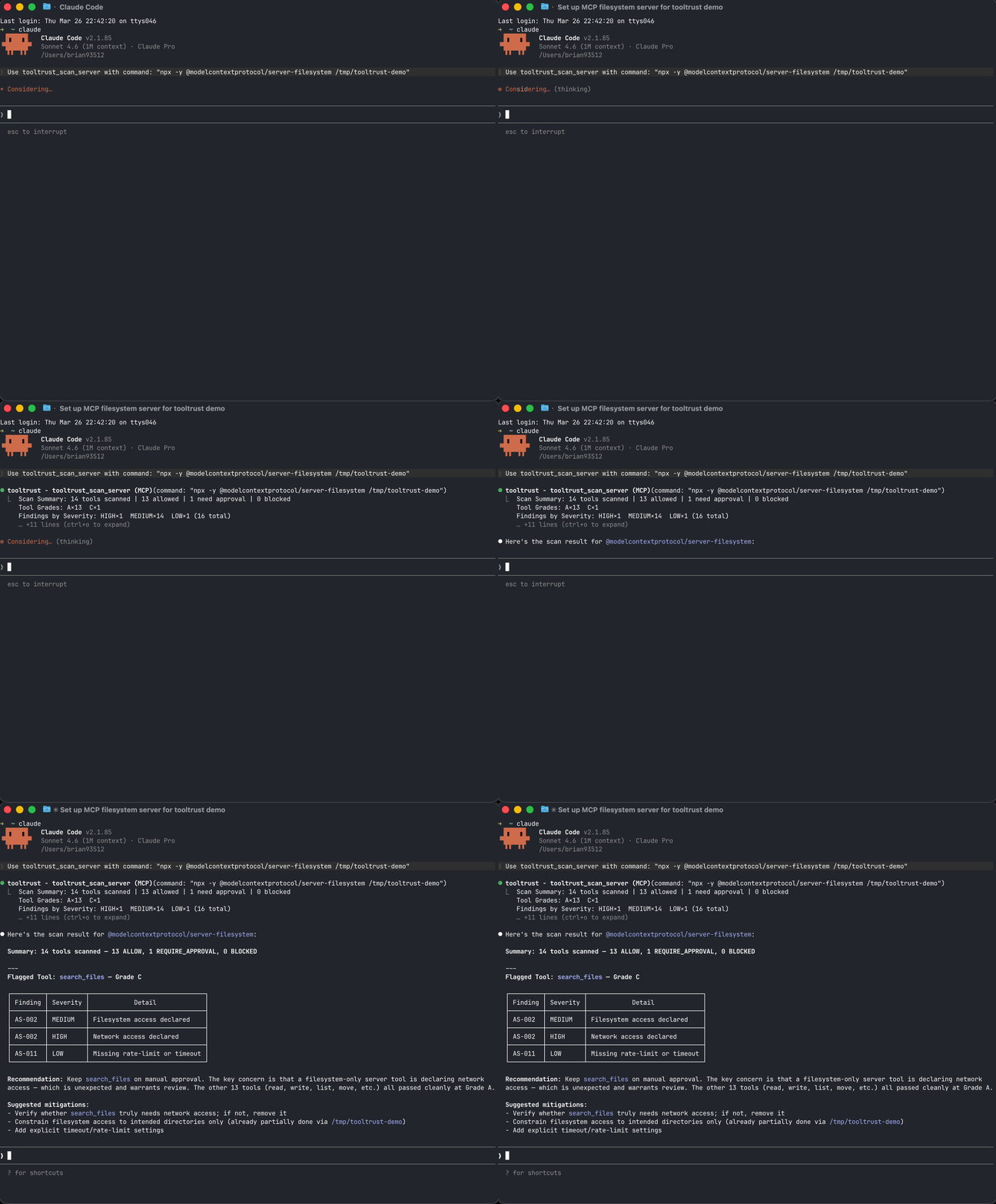
Add ToolTrust as an MCP server and let your agent audit its own tools (stdio transport — no network listener; your host launches it as a subprocess):
{
  "mcpServers": {
    "tooltrust": {
      "command": "npx",
      "args": ["-y", "tooltrust-mcp"]
    }
  }
}
Then ask your agent: "Run tooltrust_scan_config"
It reads your MCP config, connects to each server in parallel, scans every tool, and returns a risk report with grades and enforcement decisions — all in seconds.
Or use the CLI:
curl -sfL https://raw.githubusercontent.com/AgentSafe-AI/tooltrust-scanner/main/install.sh | bash
tooltrust-scanner scan --server "npx -y @modelcontextprotocol/server-filesystem /tmp"
Related MCP server: mcp-security-audit
The public ToolTrust Directory holds current grades and aggregates as scanning scales. One published research pass illustrates the shape of the problem — 207 MCP servers, 3,235 tools — not an exhaustive count of everything we scan today:
Metric | Count |
MCP servers in cohort | 207 |
Individual tools analyzed | 3,235 |
Total security findings | 3,613 |
Servers with at least one finding | 145 (70%) |
Servers with a clean Grade A | 22 (10%) |
Servers with arbitrary code execution | 16 |
Only 10% of servers in that cohort had a clean Grade A. See tooltrust.dev for up-to-date directory-wide results (and use this table only as a labeled snapshot).
ToolTrust runs 16 static tool-definition rules in this repo (AS-001–AS-011, AS-013–AS-017) plus 2 source-scan rules for embedded MCP implementations (AS-018, AS-019). AS-012 (tool drift) is evaluated in the ToolTrust Directory when new scan results are compared to previous runs.
ID | Severity | Detects |
🛡️ AS‑001 |
| Tool Poisoning — Adversarial prompts hidden in tool descriptions ( |
🔑 AS‑002 |
| Permission Surface — |
📐 AS‑003 |
| Scope Mismatch — Tool name contradicts its permissions (e.g. |
📦 AS‑004 |
| Supply Chain CVEs — Known CVEs in bundled dependencies via OSV |
🔓 AS‑005 |
| Privilege Escalation — |
⚡ AS‑006 |
| Arbitrary Code Execution — |
ℹ️ AS‑007 |
| Insufficient Tool Data — Tool lacks a valid description or schema |
🚨 AS‑008 |
| Known Compromised Package — Offline embedded blacklist of confirmed supply-chain attacks (LiteLLM 1.82.7/1.82.8, Trivy v0.69.4-v0.69.6, Langflow <1.9.0, Axios 1.14.1/0.30.4). Zero-latency, no network required. |
🔤 AS‑009 |
| Typosquatting — Tool name within edit-distance 2 of a well-known MCP tool, suggesting impersonation |
🗝️ AS‑010 |
| Secret Handling — Input params accepting API keys/passwords; credentials logged insecurely |
⚡ AS‑011 |
| DoS Resilience — No rate-limit, timeout, or retry config on network/exec tools |
🔄 AS‑012 |
| Rug-Pull — Tool set changed between scans of the same version without a version bump (directory pipeline only) |
👥 AS‑013 |
| Tool Shadowing — Duplicate or near-duplicate tool name hijacks calls intended for a trusted tool |
ℹ️ AS‑014 |
| Dependency Inventory Unavailable — MCP server exposed neither |
⚠️ AS‑015 |
| Suspicious NPM Lifecycle Script — npm dependency publishes |
🚨 AS‑016 |
| Suspicious NPM IOC Dependency — published npm metadata or install-time scripts reference a known malicious IOC package, domain, URL, or reviewed script pattern such as |
⚠️ AS‑017 |
| Suspicious Data Exfiltration Description — tool description explicitly suggests sending user data, content, or conversation history to external / remote endpoints, without classifying it as prompt injection |
ℹ️ AS‑018 |
| Embedded MCP Server Detected — source-level MCP SDK usage was found, but tools could not be enumerated from a manifest or live handshake, so manual review is still required |
🔓 AS‑019 |
| Unauthenticated MCP Route Exposure — embedded MCP HTTP routes expose the same handler without equivalent authentication middleware |
Full rule details: docs/RULES.md
Parse — Connects to a live MCP server (or reads a JSON file) and extracts every tool definition
Analyze — Runs tool-definition rules against each tool's name, description, schema, and permissions; source scans add embedded MCP implementation checks
Grade — Assigns a numeric risk score and letter grade (A–F) per tool
Enforce — Maps each grade to a gateway policy: ALLOW, REQUIRE_APPROVAL, or BLOCK
Pure static analysis. No LLM calls. No data leaves your machine (except optional CVE lookups). Runs in milliseconds. Deterministic and reproducible.
# One-line install (macOS / Linux)
curl -sfL https://raw.githubusercontent.com/AgentSafe-AI/tooltrust-scanner/main/install.sh | bash

# Go
go install github.com/AgentSafe-AI/tooltrust-scanner/cmd/tooltrust-scanner@latest

# npx (no install needed)
npx -y tooltrust-mcpWhen running as an MCP server, ToolTrust exposes these tools to your agent:
Tool | What it does | Data access |
| Scan all MCP servers in your | Reads local config; spawns each server as subprocess |
| Launch and scan a specific MCP server by command | Runs user-supplied command as subprocess (stdio) |
| Scan a raw JSON blob of tool definitions | In-memory only; no subprocess or network |
| Look up a server's trust grade from the ToolTrust Directory | Network request to ToolTrust Directory API |
| List all built-in security rules | Local catalog only |
Block risky MCP servers in your pipeline:
- name: Audit MCP Server
  uses: AgentSafe-AI/tooltrust-scanner@main
  with:
    server: "npx -y @modelcontextprotocol/server-filesystem /tmp"
fail-on: "approval"For deployment, use the install paths in Install or the workflow example in CI / GitHub Actions. For vulnerability reporting and disclosure policy, see docs/SECURITY.md.
Never add an untrusted MCP server to your config again:
# Scans the server, then auto-installs if Grade A/B, prompts on C/D, blocks on F
tooltrust-scanner gate @modelcontextprotocol/server-memory -- /tmp

# Replace `claude mcp add` with a scanned install
alias mcp-add='tooltrust-scanner gate'
Full gate options and pre-commit hook setup: docs/USAGE.md
If your MCP server passes ToolTrust, let people know:
[](https://www.tooltrust.dev/)Supply-chain alert: ToolTrust detects and blocks confirmed compromised packages including LiteLLM v1.82.7/8 (TeamPCP backdoor), Trivy v0.69.4–v0.69.6, and Langflow < 1.9.0. If you encounter a Grade F with rule AS-008, remove the package immediately and rotate all credentials.
Usage guide · Developer guide · Contributing · Deployment & security · Changelog · Security · License: MIT
If an OSV lookup fails (including rate limiting, service errors, malformed responses or timeouts), the scan fails with scan incomplete instead of issuing a success report or security grade. Partial lookup failure also fails the scan. CLI exits nonzero, MCP scan calls return tool errors, and gate does not install the server. This deliberately favors explicit incomplete results over availability; an OSV outage can prevent scans of tools with declared dependencies.
TOOLTRUST_OSV_URL optionally selects an OSV-compatible query endpoint (default: https://api.osv.dev/v1/query). Use only a trusted service: declared dependency names and versions are sent there. HTTPS is required, except numeric loopback HTTP for local integration fixtures; embedded credentials and fragments are rejected. There is no fallback to the public API when an override fails.
The project-local verification skill runs in GitHub Actions as CLI and MCP Verification, covering baseline paths, discovery regressions, and an owned loopback OSV fixture. Reports and command transcripts are uploaded even on failure. Live public OSV availability and MCP HTTP transport are not part of this job.
This server cannot be deployed
Security scanner for MCP servers. Detect vulnerabilities, prompt injection, and tool poisoning.
Scan any MCP server for tool-poisoning, security, auth & license. Trust score before install.
Zero-config MCP security scanner for AI-generated apps. 25K+ vulnerability patterns.
Scan any public GitHub MCP-server repo for security issues. 37 MCP-specific L1 rules, 8 languages.