

A
licenseA
qualityD
maintenanceAn MCP server that enables analyzing and querying GitHub repositories through the GitHub Chat API, allowing users to index repositories and ask questions about their code, architecture and tech stack.
2
88
MIT

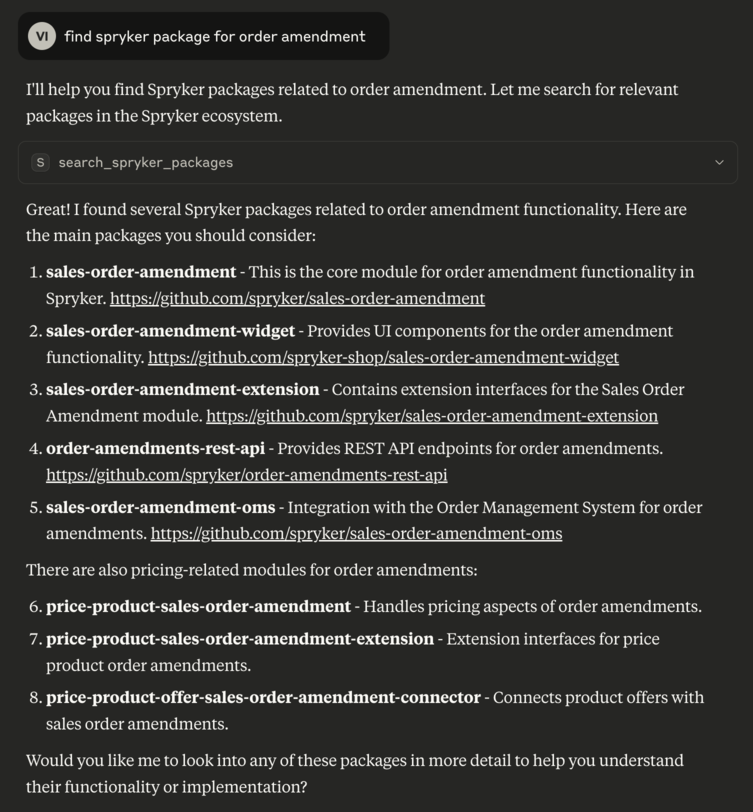
Spryker GitHub 저장소에 대한 패키지 검색 기능을 제공하기 위해 MCP(Model Context Protocol) 서버를 초기화하는 명령줄 도구입니다.
이 도구를 사용하면 자연어 쿼리를 사용하여 Spryker 패키지 또는 해당 코드 내용을 검색할 수 있습니다. 특정 GitHub 조직으로 필터링하는 기능도 지원합니다.
GitHub에서 Spryker 패키지 검색
Spryker 저장소 전반의 코드 수준 검색
조직별 필터링 지원( spryker , spryker-eco , spryker-sdk , spryker-shop )
stdio 전송을 사용하여 MCP 서버로 실행됩니다.
Related MCP server: Spryker Search Tool MCP Server
npm 과 npx가 설치되어 있는지 확인하세요.
지엑스피1
cd spryker-module-finder && npm install프로젝트 이름만 사용해서 서버를 적절히 구성하면 프로젝트만큼 서버를 추가할 수 있습니다.
{
  "mcpServers": {
      "sprykerPackageSearch": {
          "command": "npx",
          "args": [
              "-y",
              "/FULL_PATH/spryker-module-finder"
          ],
          "env": {
              "GITHUB_PERSONAL_ACCESS_TOKEN":"token"
          }
      }
  }
}npx @modelcontextprotocol/inspector npx node src/index.jsnpm testnpx eslint . --fix자연어 쿼리를 기반으로 Spryker 패키지를 검색합니다.
매개변수:
쿼리(문자열, 필수): GitHub 저장소를 검색하기 위한 자연어 쿼리입니다.
organization(문자열 배열, 선택 사항): 필터링 기준으로 사용할 GitHub 조직 목록입니다. 예: ["spryker", "spryker-eco", "spryker-sdk", "spryker-shop"]
Spryker GitHub 저장소에서 PHP 코드를 검색합니다.
매개변수:
쿼리(문자열, 필수): 코드 내에서 검색할 자연어 쿼리입니다.
organization(문자열 배열, 선택 사항): 필터링 기준으로 사용할 GitHub 조직 목록입니다. 예: ["spryker", "spryker-eco", "spryker-sdk", "spryker-shop"]
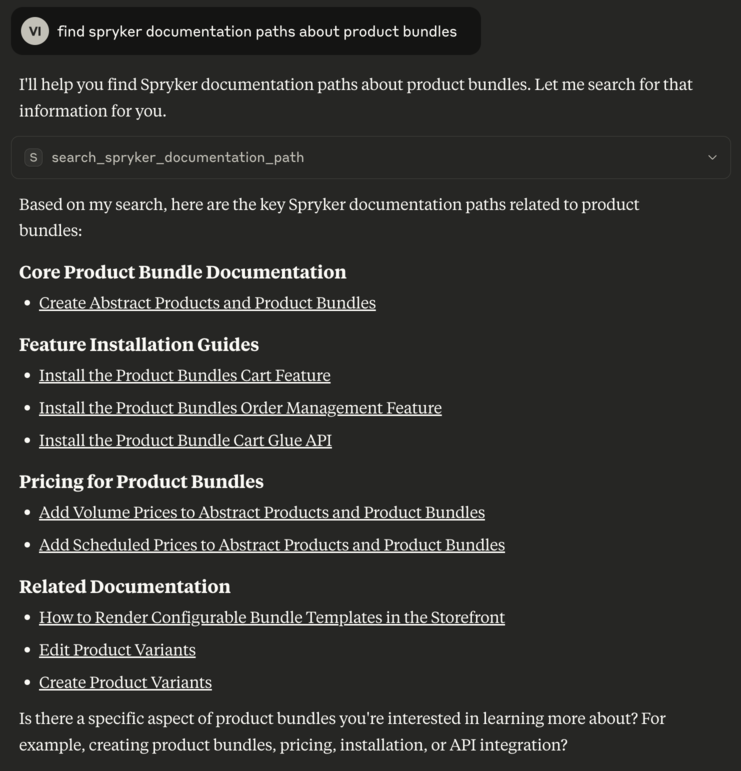
Spryker 문서 링크 검색.
매개변수:
쿼리(문자열, 필수): Spryker 문서 링크를 검색하기 위한 자연어 쿼리입니다.
모델 컨텍스트 프로토콜 SDK로 구축됨
통신을 위해 StdioServerTransport를 사용합니다.
zod로 입력을 검증합니다.
저장소 및 코드 검색을 위한 GitHub API 통합을 처리합니다.
📄 라이센스
To search Spryker documentation path urls by query
| Name | Required | Description | Default |
|---|---|---|---|
| query | Yes | The natural language query to search Spryker documentation path url |
Does the description disclose side effects, auth requirements, rate limits, or destructive behavior?
No annotations are provided, so the description carries the full burden of behavioral disclosure. It states the tool searches documentation path URLs but doesn't describe what the search returns (e.g., list of URLs, relevance scores, pagination), how results are ranked, or any limitations (e.g., rate limits, authentication needs). This leaves critical behavioral aspects unspecified.
Agents need to know what a tool does to the world before calling it. Descriptions should go beyond structured annotations to explain consequences.
Is the description appropriately sized, front-loaded, and free of redundancy?
The description is a single, efficient sentence that directly states the tool's function without unnecessary words. It's front-loaded with the core purpose and appropriately sized for a simple search tool, earning full marks for conciseness.
Shorter descriptions cost fewer tokens and are easier for agents to parse. Every sentence should earn its place.
Given the tool's complexity, does the description cover enough for an agent to succeed on first attempt?
Given the lack of annotations and output schema, the description is incomplete. It doesn't explain what the tool returns (e.g., search results format), behavioral traits like search scope or limitations, or how it differs from sibling tools. For a search tool with no structured output documentation, this leaves significant gaps for an AI agent.
Complex tools with many parameters or behaviors need more documentation. Simple tools need less. This dimension scales expectations accordingly.
Does the description clarify parameter syntax, constraints, interactions, or defaults beyond what the schema provides?
The input schema has 100% description coverage, with the 'query' parameter documented as 'The natural language query to search Spryker documentation path url'. The description adds no additional parameter semantics beyond what the schema provides, so it meets the baseline for high schema coverage without compensating value.
Input schemas describe structure but not intent. Descriptions should explain non-obvious parameter relationships and valid value ranges.
Does the description clearly state what the tool does and how it differs from similar tools?
The description clearly states the tool's purpose: 'search Spryker documentation path urls by query'. It specifies the verb (search), resource (Spryker documentation path urls), and mechanism (by query). However, it doesn't explicitly differentiate from sibling tools like 'search_spryker_package_code' or 'search_spryker_packages', which likely search different resources.
Agents choose between tools based on descriptions. A clear purpose with a specific verb and resource helps agents select the right tool.
Does the description explain when to use this tool, when not to, or what alternatives exist?
The description provides no guidance on when to use this tool versus alternatives. It doesn't mention sibling tools, prerequisites, or specific contexts where this search is appropriate. The agent must infer usage based on the name alone, which is insufficient for optimal tool selection.
Agents often have multiple tools that could apply. Explicit usage guidance like "use X instead of Y when Z" prevents misuse.
To search code in Spryker GitHub repositories
| Name | Required | Description | Default |
|---|---|---|---|
| query | Yes | The natural language query to search in code of Spryker packages | |
| organisations | No | Optional array of organisations to filter by [`spryker`, `spryker-eco`, `spryker-sdk`, `spryker-shop` |
Does the description disclose side effects, auth requirements, rate limits, or destructive behavior?
No annotations are present, so the description must disclose behavioral traits. The description only says 'search code' but does not mention whether the operation is read-only, destructive, or requires specific permissions. Given the lack of annotation, this is a significant gap.
Agents need to know what a tool does to the world before calling it. Descriptions should go beyond structured annotations to explain consequences.
Is the description appropriately sized, front-loaded, and free of redundancy?
The description is a single sentence with no extraneous information, making it concise and easy to process.
Shorter descriptions cost fewer tokens and are easier for agents to parse. Every sentence should earn its place.
Given the tool's complexity, does the description cover enough for an agent to succeed on first attempt?
For a simple search tool, the description barely covers the purpose but lacks essential context such as whether results are returned, the format, pagination, or any output structure. Since there is no output schema, the description should compensate, but it does not.
Complex tools with many parameters or behaviors need more documentation. Simple tools need less. This dimension scales expectations accordingly.
Does the description clarify parameter syntax, constraints, interactions, or defaults beyond what the schema provides?
Schema documentation coverage is 100%, with clear descriptions for both parameters (query and organisations). The description adds no additional parameter information, but per guidelines, baseline is 3 when schema coverage is high.
Input schemas describe structure but not intent. Descriptions should explain non-obvious parameter relationships and valid value ranges.
Does the description clearly state what the tool does and how it differs from similar tools?
The description clearly states the tool searches code in Spryker GitHub repositories, which is a specific verb-resource combination. While it doesn't explicitly distinguish from siblings, the name 'package_code' and context from sibling names imply it is for code-level search, not package metadata or documentation.
Agents choose between tools based on descriptions. A clear purpose with a specific verb and resource helps agents select the right tool.
Does the description explain when to use this tool, when not to, or what alternatives exist?
No guidance is provided on when to use this tool versus alternatives like search_spryker_packages or search_spryker_documentation. The description only states the purpose without explaining how it differs or when to prefer it.
Agents often have multiple tools that could apply. Explicit usage guidance like "use X instead of Y when Z" prevents misuse.
To search the Spryker package repository in Github
| Name | Required | Description | Default |
|---|---|---|---|
| query | Yes | The natural language query to search in Github | |
| organisations | No | Optional array of organisations to filter by [`spryker`, `spryker-eco`, `spryker-sdk`, `spryker-shop` |
Does the description disclose side effects, auth requirements, rate limits, or destructive behavior?
No annotations are provided, so the description carries full burden. It only states the purpose without disclosing behavioral traits such as read-only nature, rate limits, or authentication needs. The tool is essentially a black box.
Agents need to know what a tool does to the world before calling it. Descriptions should go beyond structured annotations to explain consequences.
Is the description appropriately sized, front-loaded, and free of redundancy?
The description is a single, well-formed sentence that front-loads the purpose. It is concise with zero wasted words.
Shorter descriptions cost fewer tokens and are easier for agents to parse. Every sentence should earn its place.
Given the tool's complexity, does the description cover enough for an agent to succeed on first attempt?
Despite having only 2 parameters with full schema coverage, the description lacks details about return format, error handling, or prerequisites. For a search tool with siblings, more context on scope and output would be helpful.
Complex tools with many parameters or behaviors need more documentation. Simple tools need less. This dimension scales expectations accordingly.
Does the description clarify parameter syntax, constraints, interactions, or defaults beyond what the schema provides?
Schema description coverage is 100%, so the baseline is 3. The description does not add any additional parameter meaning beyond what the schema already provides.
Input schemas describe structure but not intent. Descriptions should explain non-obvious parameter relationships and valid value ranges.
Does the description clearly state what the tool does and how it differs from similar tools?
The description 'To search the Spryker package repository in Github' clearly states the verb (search) and resource (Spryker package repository), and it distinguishes from sibling tools that search code or documentation.
Agents choose between tools based on descriptions. A clear purpose with a specific verb and resource helps agents select the right tool.
Does the description explain when to use this tool, when not to, or what alternatives exist?
The description provides no guidance on when to use this tool versus alternatives like search_spryker_package_code or search_spryker_documentation. No when-not-to-use or context hints.
Agents often have multiple tools that could apply. Explicit usage guidance like "use X instead of Y when Z" prevents misuse.
Recent tool additions, removals, and schema changes observed during successful MCP inspections.
search_spryker_documentation_pathsearch_spryker_package_codesearch_spryker_packagesScored across 3 tools
The three tools have distinct primary targets: documentation paths, package code, and package repository search. However, 'search_spryker_package_code' and 'search_spryker_packages' could be slightly confusing as both involve GitHub repositories, though their descriptions clarify one searches code within repositories and the other searches the package repository itself.
All tool names follow a consistent snake_case pattern with the verb 'search' followed by a specific noun phrase (spryker_documentation_path, spryker_package_code, spryker_packages). This uniformity makes the tool set predictable and easy to understand.
With only 3 tools, the server feels thin for a 'Package Search Tool' that might imply broader functionality like installing or managing packages. While the tools cover key search aspects, the limited count may restrict agent workflows, especially if additional operations like package installation or version checking are needed.
The tools provide search capabilities across documentation, code, and packages, which aligns with the server's name. However, there are notable gaps: no tools for actions like installing packages, checking package versions, or managing dependencies, which are common in package management contexts. This limits the server to read-only search operations.
An MCP server that gives your AI access to the source code and docs of all public github repos
Driflyte MCP server which lets AI assistants query topic-specific knowledge from web and GitHub.
Capability registry for the agentic economy. Semantic search over verified MCP server listings.
The Needle MCP server enables semantic search on documents stored in files like PDFs, DOCX, and XLSX by connecting AI applications to external data sources. It provides capabilities to create and manage document collections, perform natural language searches on stored content, and retrieve relevant information without requiring exact keyword matches.