

Glama

brainstorm-mcp

npm npm downloads IdeaCred Product Hunt

向一个模型提出设计问题,你会得到一个自信的答案,却无法得知它哪些部分不确定。问三个模型,分歧本身就是信号。

brainstorm-mcp 在你的编辑器内运行 GPT、Gemini、DeepSeek、Claude 和本地 Ollama 模型之间的多轮辩论:它们会看到并互相批评彼此的答案,经过多轮后,你会得到一份 3 条要点的综合结论——建议、关键权衡、最强烈的分歧。它还支持即时快速模式、带裁决的多模型代码审查,以及红队/苏格拉底式风格。托管模式无需任何 API 密钥。

不要相信单一 AI。让它们争论。

演示
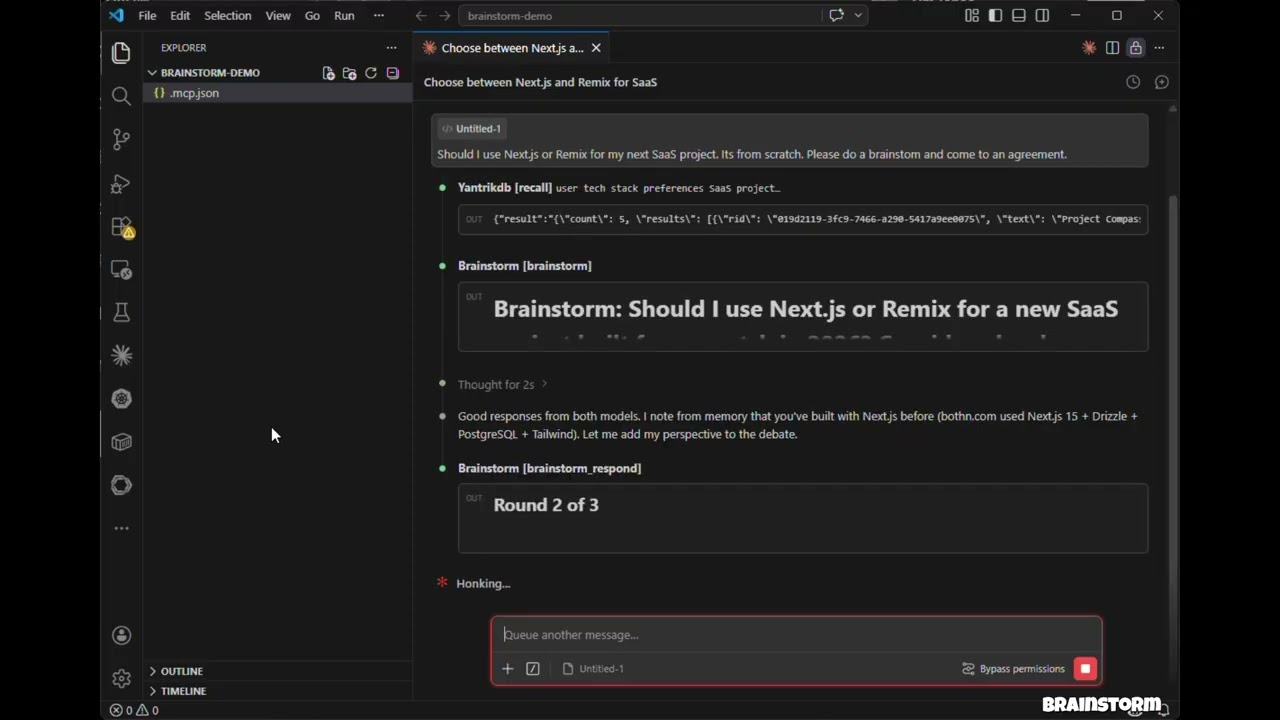
Watch the demo

点击观看:3 个模型辩论、交叉质询,并产生结构化裁决——全部在 Claude Code 内完成。

功能

  • 托管模式 — 无需 API 密钥。通过子代理使用你环境中的模型(Claude Opus/Sonnet/Haiku)

  • API 模式 — 直接调用模型 API,在 OpenAI、Gemini、DeepSeek、Groq、Ollama 之间并行执行

  • CLI 模式 — 通过你已有的代理 CLI(claude、codex 等)进行辩论,因此辩论使用你的订阅而非 API 额度

  • brainstorm_quick — 10 秒内获得即时多模型视角

  • brainstorm_review — 多模型代码审查,包含结构化发现、严重性评级和裁决

  • 辩论风格 — 自由形式、红队(对抗性)和苏格拉底式(追问式)

  • 上下文注入 — 将辩论基于实际代码、差异或架构文档

  • 3 条要点综合裁决 — 建议、关键权衡、最强烈的分歧

  • Claude 作为参与者 — Claude 与外部模型一起辩论,拥有完整对话上下文

  • 多轮辩论 — 模型在多轮中看到并批评彼此的回应

  • 并行执行 — 每轮中所有模型同时响应

  • 弹性 — 一个模型失败不会中止辩论

  • 跨平台 — 支持 macOS、Windows 和 Linux

Related MCP server: roundtable-mcp

安装(60秒)

claude mcp add brainstorm -- npx -y brainstorm-mcp

这足以用于托管模式(无需 API 密钥——它使用你环境中已有的模型进行辩论)。添加提供者密钥,即可将 GPT、Gemini、DeepSeek、Groq 或 Ollama 引入辩论。

Claude Code

添加到项目的 .mcp.json:

{
  "mcpServers": {
    "brainstorm": {
      "command": "npx",
      "args": ["-y", "brainstorm-mcp"],
      "env": {
        "OPENAI_API_KEY": "sk-...",
        "GEMINI_API_KEY": "AIza...",
        "DEEPSEEK_API_KEY": "sk-..."
      }
    }
  }
}

Claude Desktop

添加到 claude_desktop_config.json:

{
  "mcpServers": {
    "brainstorm": {
      "command": "npx",
      "args": ["-y", "brainstorm-mcp"],
      "env": {
        "OPENAI_API_KEY": "sk-...",
        "DEEPSEEK_API_KEY": "sk-..."
      }
    }
  }
}

手动安装

npm install -g brainstorm-mcp
brainstorm-mcp

托管模式无需 API 密钥——安装即可使用。宿主(Claude Code)使用自己的模型访问权限执行提示。

配置

选项 1:环境变量(最简单)

OPENAI_API_KEY=sk-...
GEMINI_API_KEY=AIza...
DEEPSEEK_API_KEY=sk-...

选项 2:配置文件(完全控制)

设置 BRAINSTORM_CONFIG 指向一个 JSON 配置:

{
  "providers": {
    "openai": { "model": "gpt-5.4", "apiKeyEnv": "OPENAI_API_KEY" },
    "gemini": { "model": "gemini-2.5-flash", "apiKeyEnv": "GEMINI_API_KEY" },
    "deepseek": { "model": "deepseek-chat", "apiKeyEnv": "DEEPSEEK_API_KEY" },
    "ollama": { "model": "llama3.1", "baseURL": "http://localhost:11434/v1" }
  }
}

已知提供者(openai、gemini、deepseek、groq、mistral、together、moonshot、minimax、glm、qwen)不需要 baseURL。

选项 3:CLI 提供者(使用订阅,而非 API 额度)

如果你已经为 Claude Code、Codex、Gemini CLI 等付费,brainstorm 可以调用这些 CLI,而不是购买 API 额度。任何在你的 PATH 中找到的代理 CLI 都会在启动时自动注册——无需配置:

[brainstorm] Detected CLI provider(s) on PATH: claude, codex (subscription-based, no API cost)

像使用任何其他提供者一样使用它们:

{ "topic": "GraphQL vs REST", "models": ["claude:sonnet", "codex:default", "openai:gpt-5.4"] }

内置适配器:

Provider

Command

Default model

Status

claude

claude -p

sonnet

已验证

codex

codex exec

default

已验证

gemini

gemini -p

gemini-2.5-pro

尽力而为,请在本地验证

cursor-agent

cursor-agent -p

default

尽力而为

opencode

opencode run

default

尽力而为

qwen

qwen -p

qwen3-coder-plus

尽力而为

kimi

kimi --print

default

尽力而为

droid

droid exec

default

尽力而为

<provider>:default 表示“让 CLI 使用它配置的任何模型”。CLI 调用在禁用工具的情况下运行,并在 CLI 支持的地方使用只读沙箱——它们生成文本,不会触碰你的仓库。提供者特定的 API 密钥环境变量(ANTHROPIC_API_KEY、OPENAI_API_KEY)会从子进程中剥离,因此 CLI 会回退到你的订阅登录。

环境变量选项:

Variable

Effect

BRAINSTORM_CLI_PROVIDERS

auto(默认)、off 或逗号分隔的适配器列表,用于检测

BRAINSTORM_PREFER_CLI

1 — 没有显式 models 的辩论仅使用 CLI 提供者,跳过计量 API

BRAINSTORM_CLI_TIMEOUT_MS

CLI 提供者的每次调用超时(默认 300000)

要固定模型或添加未内置的 CLI,请使用配置文件:

{
  "providers": {
    "claude": { "type": "cli", "model": "opus" },
    "my-cli": {
      "type": "cli",
      "adapter": "custom",
      "command": "some-agent-cli",
      "args": ["run", "--model", "{{model}}", "--quiet", "{{prompt}}"],
      "promptVia": "arg",
      "model": "some-model"
    }
  }
}

模板占位符:{{model}}、{{system}}、{{prompt}}、{{outfile}}。一个解析为空的单独占位符会连同引入它的标志一起从命令行中删除,因此 ["--model", "{{model}}"] 即使对于 provider:default 也能正常工作。设置 "promptVia": "stdin" 以通过管道传递提示,而不是作为参数传递。

通过 Claude CLI 使用编码计划后端

Moonshot (Kimi)、MiniMax 和 Z.ai (GLM) 销售支持 Anthropic API 的编码计划订阅。将 claude 二进制指向其中一个,该供应商就会在你已付费的计划上加入辩论:

{
  "providers": {
    "moonshot": { "type": "cli", "backend": "moonshot", "model": "kimi-k2-thinking" },
    "minimax":  { "type": "cli", "backend": "minimax",  "model": "MiniMax-M2" },
    "glm":      { "type": "cli", "backend": "glm",      "model": "glm-4.6" }
  }
}

Backend

Endpoint

Token env var

moonshot

https://api.moonshot.ai/anthropic

MOONSHOT_API_KEY

minimax

https://api.minimax.io/anthropic

MINIMAX_API_KEY

glm

https://api.z.ai/api/anthropic

ZAI_API_KEY

令牌在调用时从你的环境中读取——配置文件保存的是变量名,而不是秘密。ANTHROPIC_API_KEY 会从子进程中剥离,因此你的 Anthropic 账户绝不会为这些调用付费。任何 CLI 提供者还接受 "env" 块来手动覆盖后端;值为 "$NAME" 时通过服务器的环境间接引用。

这些供应商也可以作为普通的计量 API 访问——moonshot、minimax、glm 和 qwen 有已知的基础 URL,因此仅凭 MOONSHOT_API_KEY 就足以将 moonshot 注册为 API 提供者。

工具

Tool

Description

Annotation

brainstorm

AI 模型之间的多轮辩论(API 或托管模式)

readOnly

brainstorm_quick

即时多模型视角——并行,无轮次

readOnly

brainstorm_review

多模型代码审查,包含发现、严重性和裁决

readOnly

brainstorm_respond

在交互式会话中提交 Claude 的回应

readOnly

brainstorm_collect

在托管会话中提交模型回应

readOnly

list_providers

显示已配置的提供者、API 密钥状态和检测到的 CLI

readOnly

add_provider

在运行时添加新的 API 或 CLI 提供者

non-destructive

使用示例

示例 1:快速多模型视角

提示: “使用 brainstorm_quick 比较 Redis 与 PostgreSQL 用于会话存储”

调用的工具: brainstorm_quick

{ "topic": "Redis vs PostgreSQL for session storage in a Node.js app" }

输出: 每个配置的模型独立并行响应。你会在 10 秒内获得并排比较,包含模型名称、响应、时间和成本。

错误处理: 如果某个模型失败(速率限制、超时),工具会继续使用其余模型,并显示哪些模型失败。


示例 2:多模型代码审查

提示: “审查此差异是否存在安全问题”(粘贴 git diff)

调用的工具: brainstorm_review

{
  "diff": "diff --git a/src/auth.ts ...",
  "title": "Add JWT authentication middleware",
  "focus": ["security", "correctness"]
}

输出: 结构化裁决(批准 / 带警告批准 / 需要更改),包含发现表,显示严重性、类别、文件、行号和建议。还包括模型一致性分析——多个模型标记的问题具有更高的置信度。

错误处理: 如果综合失败,仍会返回原始模型审查。


示例 3:托管模式头脑风暴(无需 API 密钥)

提示: “使用 opus、sonnet 和 haiku 进行头脑风暴,讨论我们应该使用 GraphQL 还是 REST”

调用的工具: brainstorm

{
  "topic": "GraphQL vs REST for our public API",
  "models": ["opus", "sonnet", "haiku"],
  "mode": "hosted",
  "rounds": 2,
  "style": "redteam"
}

输出: 工具为每个模型返回提示。宿主(Claude Code)生成使用不同模型的子代理,收集响应,并通过 brainstorm_collect 反馈。所有轮次结束后,综合模型产生 3 条要点裁决:建议、关键权衡、最强烈的分歧。

错误处理: 会话在 10 分钟后过期。如果找不到会话,会返回清晰的错误消息,并附有启动新会话的说明。

工作原理

API / CLI 模式

  1. 你要求 Claude 对一个主题进行头脑风暴

  2. 工具将主题并行发送给所有配置的提供者——API 提供者使用 HTTP,CLI 提供者使用生成的子进程

  3. Claude 阅读它们的响应,并贡献自己的视角

  4. 模型看到彼此的响应,并在多轮中完善

  5. 综合器产生最终裁决

托管模式

  1. 你要求 Claude 使用特定模型(例如 opus、sonnet、haiku)进行头脑风暴

  2. 工具返回提示——不进行任何 API 调用

  3. Claude 生成使用不同模型的子代理来执行提示

  4. 收集响应并反馈给下一轮

  5. 重复直到综合

隐私政策

brainstorm-mcp 完全在你的机器上运行,不收集、存储或传输任何个人数据、遥测或分析。

在 API 模式下,提示直接从你的机器发送到你配置的模型提供者(OpenAI、Gemini、DeepSeek 等),使用你自己的 API 密钥。在 CLI 模式下,提示传递给你机器上安装的代理 CLI,它们在你现有的订阅下与各自的供应商通信。在 托管模式下,不进行任何外部 API 调用。

辩论会话仅存储在内存中,TTL 为 10 分钟。除非你明确保存结果,否则不会向磁盘写入任何数据。

完整隐私政策:PRIVACY.md

支持

开发

git clone https://github.com/spranab/brainstorm-mcp.git
cd brainstorm-mcp
npm install
npm run build
npm start

相关项目

同一作者的其他代理基础设施,设计为一起使用:

  • saga-mcp — 基于 SQLite 的项目追踪器:一旦讨论尘埃落定,决策就会存入持久化存储。

  • yantrikdb-mcp — 持久化认知记忆,让代理记住你做了什么决定以及为什么。

  • swarmcode — 不同机器上 Claude Code 实例之间的实时通道。

  • truenas-mcp — 278 个 TrueNAS SCALE 操作,统一封装在一个分层工具中。

  • mcpier — 自托管的 MCP 控制平面,让 API 密钥远离你的客户端。

许可证

MIT

Available Tools

7 tools
add_providerA

Add a new AI provider for brainstorming. Supports any OpenAI-compatible API, or a locally installed agent CLI (kind='cli') that runs on an existing subscription instead of API credits.

ParametersJSON Schema
NameRequiredDescriptionDefault
argsNocli only ('custom' adapter): argv template. Placeholders: {{model}}, {{system}}, {{prompt}}, {{outfile}}.
kindNo'api' (default) for an OpenAI-compatible HTTP endpoint, 'cli' for a local agent CLI.
nameYesProvider name, e.g. 'groq', 'ollama', 'mistral', 'claude'
adapterNocli only: built-in adapter — claude, codex, gemini, qwen, kimi, cursor-agent, opencode, droid — or 'custom'. Defaults to the provider name.
backendNocli only: run the Claude CLI against another vendor's coding plan — moonshot, minimax, glm. Overrides 'adapter'.
baseURLNoapi only: base URL, e.g. 'http://localhost:11434/v1' for Ollama
commandNocli only: executable to run. Required for adapter 'custom'.
promptViaNocli only ('custom' adapter): how the prompt reaches the CLI.
apiKeyEnvVarNoapi only: environment variable holding the API key. Use 'NONE' if no key required.
defaultModelYesDefault model for this provider, e.g. 'llama3', 'sonnet'. Use 'default' to let a CLI pick its own.

TDQS

A4/5.0
Behavior3/5

Does the description disclose side effects, auth requirements, rate limits, or destructive behavior?

Annotations only provide destructiveHint=false, leaving the behavioral burden mostly on the description. The description usefully conveys that the tool supports API and CLI modes and that CLI mode uses an existing subscription instead of API credits. However, it doesn't disclose side effects like whether the provider is persisted, whether it overrides existing providers, or what happens on invalid configurations.

Agents need to know what a tool does to the world before calling it. Descriptions should go beyond structured annotations to explain consequences.

Conciseness5/5

Is the description appropriately sized, front-loaded, and free of redundancy?

The description is exactly two sentences and immediately states the purpose and the two supported modes. There is no redundancy, and the most valuable scope information is front-loaded.

Shorter descriptions cost fewer tokens and are easier for agents to parse. Every sentence should earn its place.

Completeness4/5

Given the tool's complexity, does the description cover enough for an agent to succeed on first attempt?

Given the high complexity (10 params, no output schema), the description provides a helpful high-level framing that complements the fully self-describing schema. The only clear gap is that the description doesn't cover return values or post-add confirmation behavior, but the schema details all parameters well.

Complex tools with many parameters or behaviors need more documentation. Simple tools need less. This dimension scales expectations accordingly.

Parameters3/5

Does the description clarify parameter syntax, constraints, interactions, or defaults beyond what the schema provides?

Schema description coverage is 100%, so the baseline is 3. The description doesn't add significant value beyond the schema; it merely echoes the CLI/API distinction already present in field descriptions. It does not clarify conditional requirements or the relationship between adapter, backend, and command beyond what the schema contains.

Input schemas describe structure but not intent. Descriptions should explain non-obvious parameter relationships and valid value ranges.

Purpose5/5

Does the description clearly state what the tool does and how it differs from similar tools?

The description uses a specific verb (Add) and explicit resource (new AI provider for brainstorming), and distinguishes this from siblings like list_providers and brainstorm tools. It clearly identifies both supported modes: OpenAI-compatible APIs and local CLI providers.

Agents choose between tools based on descriptions. A clear purpose with a specific verb and resource helps agents select the right tool.

Usage Guidelines4/5

Does the description explain when to use this tool, when not to, or what alternatives exist?

The description gives clear context for when to use the tool: adding a provider for brainstorming, with either API or CLI. It doesn't explicitly say when not to use it or name alternatives like list_providers, but the context is specific enough for an agent to select it over purely brainstorming or listing tools.

Agents often have multiple tools that could apply. Explicit usage guidance like "use X instead of Y when Z" prevents misuse.

brainstormA
Read-only

Run a multi-round brainstorming debate between multiple AI models. IMPORTANT: Before calling this tool, you MUST ask the user to choose a mode:

  1. API mode — Calls configured providers. These are either HTTP APIs billed per token (OpenAI, Gemini, DeepSeek, ...) or locally installed agent CLIs such as 'claude' and 'codex', which run on the user's existing subscription at no API cost. Call list_providers to see which of each are available.

  2. Hosted mode — No API keys needed. You execute prompts using sub-agents with models available in your environment (opus/sonnet/haiku, GPT, Gemini, etc.). Same model can be used multiple times — each run produces different perspectives.

Present these two options to the user with a one-liner explanation, then proceed based on their choice.

For API mode: set mode='api'. When participate=true (default), YOU also participate as a debater alongside external models via brainstorm_respond. For Hosted mode: set mode='hosted'. Ask the user which models to use, then spawn sub-agents for each model, collect responses, and call brainstorm_collect.

ParametersJSON Schema
NameRequiredDescriptionDefault
modeNoExecution mode. Must be provided — if not, the tool will return options for the user to choose. 'api' — MCP server calls model APIs directly using configured API keys. 'hosted' — No API keys needed. Returns prompts for the HOST to execute using sub-agents with models available in the environment (opus/sonnet/haiku, GPT, Gemini, etc.).
styleNoDebate style. 'freeform' (default): open brainstorming. 'redteam': adversarial — models find flaws, risks, and weaknesses. 'socratic': probing questions that expose assumptions and push for deeper understanding.freeform
topicYesThe topic, question, or prompt to brainstorm about
modelsNoOptional: specific models to use as 'provider:model' (e.g. 'openai:gpt-4o', or 'claude:sonnet' / 'codex:default' for subscription-backed CLI providers). If not provided, all configured providers are used with their default models.
roundsNoNumber of debate rounds (default: 3)
contextNoOptional context to ground the debate — code snippets, PR diffs, error logs, architecture docs, etc. Models will see this alongside the topic.
participateNoWhether Claude should actively participate as a debater in each round (default: true). Set to false for a non-interactive debate between external models only.
synthesizerNoOptional: model for final synthesis as 'provider:model'. Defaults to the first model.
systemPromptNoOptional system prompt to guide the brainstorming style or constraints

TDQS

A4.8/5.0
Behavior5/5

Does the description disclose side effects, auth requirements, rate limits, or destructive behavior?

The description discloses detailed side effects beyond annotations: API mode calls external APIs with billing implications, hosted mode spawns sub-agents with environment models, and participation behavior via brainstorm_respond when participate=true. It also notes that if mode is omitted, the tool returns options. This is far richer than the readOnlyHint alone.

Agents need to know what a tool does to the world before calling it. Descriptions should go beyond structured annotations to explain consequences.

Conciseness4/5

Is the description appropriately sized, front-loaded, and free of redundancy?

The description is long but well-structured with clear sections, bolding, and lists. Every sentence conveys required operational details—nothing is redundant. While it could arguably be trimmed, the complexity of the tool's dual modes justifies the length. It is not flabby; it is dense and purposeful.

Shorter descriptions cost fewer tokens and are easier for agents to parse. Every sentence should earn its place.

Completeness5/5

Given the tool's complexity, does the description cover enough for an agent to succeed on first attempt?

Given 9 parameters, no output schema, and complex branching (API vs hosted), the description covers prerequisites, alternatives, and step-by-step invocation guidance. It explains the full flow including how to use sibling tools (list_providers, brainstorm_respond, brainstorm_collect) and the host's role. It does not describe return values, but that is acceptable since no output schema is provided and the focus is on executing the tool properly.

Complex tools with many parameters or behaviors need more documentation. Simple tools need less. This dimension scales expectations accordingly.

Parameters4/5

Does the description clarify parameter syntax, constraints, interactions, or defaults beyond what the schema provides?

The schema already provides 100% coverage for all parameters, so the baseline is 3. The description adds extra meaning by explaining how mode interacts with user choice, prompts the use of list_providers, and clarifies the participate flag's role (via brainstorm_respond in API mode). It also clarifies the models format ('provider:model') implicitly through examples in the schema description. This elevates it above the baseline.

Input schemas describe structure but not intent. Descriptions should explain non-obvious parameter relationships and valid value ranges.

Purpose5/5

Does the description clearly state what the tool does and how it differs from similar tools?

The description clearly states the tool runs a multi-round brainstorming debate between multiple AI models. It specifies the verb (run), the resource (debate), and distinguishes itself from sibling tools like brainstorm_quick (presented as a quick version) and brainstorm_respond/collect (which are sub-components).

Agents choose between tools based on descriptions. A clear purpose with a specific verb and resource helps agents select the right tool.

Usage Guidelines5/5

Does the description explain when to use this tool, when not to, or what alternatives exist?

It explicitly instructs the agent to ask the user to choose a mode before calling, explains both modes with one-liners, and directs the agent to use list_providers for available providers. It also tells what to do in hosted mode (ask which models to use, spawn sub-agents) and clarifies when to set mode='api' vs 'hosted'. Clear guidance on when to use and how to proceed.

Agents often have multiple tools that could apply. Explicit usage guidance like "use X instead of Y when Z" prevents misuse.

brainstorm_collectA
Read-only

Submit collected model responses for a hosted brainstorm session. After receiving prompts from brainstorm (mode='hosted') or a previous brainstorm_collect call, execute each prompt by spawning a sub-agent for EACH model (use the model parameter to select the right model, e.g., model='sonnet' or model='haiku'). Collect all responses and submit them here. This tool returns either: (1) the next round's prompt to execute, (2) a synthesis prompt for a single model, or (3) the final formatted debate result when complete.

ParametersJSON Schema
NameRequiredDescriptionDefault
responsesYesArray of model responses collected by the host
session_idYesThe session ID from the brainstorm tool

TDQS

A4.6/5.0
Behavior4/5

Does the description disclose side effects, auth requirements, rate limits, or destructive behavior?

Annotations include readOnlyHint: true, which already signals a non-destructive operation. The description adds transparency by explaining the three return outcomes (next prompt, synthesis prompt, final result) and the nested structure of responses required, without conflicting with the annotation. It could mention whether the session state is updated, but the return-value description suffices.

Agents need to know what a tool does to the world before calling it. Descriptions should go beyond structured annotations to explain consequences.

Conciseness4/5

Is the description appropriately sized, front-loaded, and free of redundancy?

The description is verbose but appropriately detailed for a multi-step workflow. It avoids redundancy and clearly structures the steps and return types. Some minor redundancy exists (e.g., repeating 'brainstorm' mode), but it remains readable and direct.

Shorter descriptions cost fewer tokens and are easier for agents to parse. Every sentence should earn its place.

Completeness4/5

Given the tool's complexity, does the description cover enough for an agent to succeed on first attempt?

With readOnlyHint already provided, the description covers the tool's purpose, usage sequence, return types, and parameter details. It lacks mention of error conditions or session expiration, but for the tool's complexity, this is sufficient. Overall, it gives the agent enough context to use the tool correctly.

Complex tools with many parameters or behaviors need more documentation. Simple tools need less. This dimension scales expectations accordingly.

Parameters5/5

Does the description clarify parameter syntax, constraints, interactions, or defaults beyond what the schema provides?

All two required parameters (session_id and responses) are fully described in the schema with clear semantics. The description further clarifies the 'model' parameter by giving examples ('sonnet' or 'haiku') and emphasizes the requirement to collect responses for each model, enhancing the schema's clarity. Coverage is 100%.

Input schemas describe structure but not intent. Descriptions should explain non-obvious parameter relationships and valid value ranges.

Purpose5/5

Does the description clearly state what the tool does and how it differs from similar tools?

The description clearly states the tool's purpose: 'Submit collected model responses for a hosted brainstorm session.' It specifies the exact action (submit responses) and the resource (brainstorm session), and distinguishes it from siblings by referencing the workflow of the `brainstorm` tool.

Agents choose between tools based on descriptions. A clear purpose with a specific verb and resource helps agents select the right tool.

Usage Guidelines5/5

Does the description explain when to use this tool, when not to, or what alternatives exist?

The description provides explicit when-to-use guidance: after receiving prompts from `brainstorm` (mode='hosted') or a previous `brainstorm_collect` call. It also explains the required workflow (execute each prompt per model using the model parameter) and lists the three possible return types, giving clear context for invocation.

Agents often have multiple tools that could apply. Explicit usage guidance like "use X instead of Y when Z" prevents misuse.

brainstorm_quickA
Read-only

Get instant multi-model perspectives on any question — no debate rounds, no synthesis delay. Fires all models in parallel and returns a compact comparison. Under 10 seconds. Use this for quick second opinions, snap decisions, or when you want diverse perspectives fast. For deeper analysis with multiple rounds and synthesis, use the brainstorm tool instead.

ParametersJSON Schema
NameRequiredDescriptionDefault
styleNoPerspective style (default: freeform)freeform
topicYesThe question or topic to get quick perspectives on
modelsNoOptional: specific models as 'provider:model' (API providers, or CLI providers like 'claude:sonnet' that use a subscription instead of API credits). If not provided, all configured providers are used.
contextNoOptional context — code snippets, error logs, etc. Models will see this alongside the topic.

TDQS

A4.5/5.0
Behavior4/5

Does the description disclose side effects, auth requirements, rate limits, or destructive behavior?

Annotation `readOnlyHint: true` tells the agent this is a read operation. The description adds useful behavioral context: parallel model firing, compact comparison output, no debate rounds, no synthesis delay, and the under-10-second expectation. It does not mention potential rate limiting or model failure behavior, but this is beyond the essential disclosure for this tool.

Agents need to know what a tool does to the world before calling it. Descriptions should go beyond structured annotations to explain consequences.

Conciseness5/5

Is the description appropriately sized, front-loaded, and free of redundancy?

The description is three sentences, front-loaded with the core behavior, and each sentence earns its place: what it does, the key guarantees, and when to use it vs. the alternative.

Shorter descriptions cost fewer tokens and are easier for agents to parse. Every sentence should earn its place.

Completeness5/5

Given the tool's complexity, does the description cover enough for an agent to succeed on first attempt?

Given the 4-parameter schema, readOnlyHint annotation, and no output schema, this description is sufficiently complete. It covers the tool's behavior, timing, return format (compact comparison), and the sibling-tool boundary. No critical context for selection or invocation is missing.

Complex tools with many parameters or behaviors need more documentation. Simple tools need less. This dimension scales expectations accordingly.

Parameters3/5

Does the description clarify parameter syntax, constraints, interactions, or defaults beyond what the schema provides?

Schema description coverage is 100%, so all four parameters are already well-documented. The description adds little parameter-level meaning beyond what the schema states, though it indirectly emphasizes the default behavior of firing all models in parallel.

Input schemas describe structure but not intent. Descriptions should explain non-obvious parameter relationships and valid value ranges.

Purpose5/5

Does the description clearly state what the tool does and how it differs from similar tools?

The description clearly states the tool's purpose: getting instant multi-model perspectives via parallel calls. It explicitly distinguishes this from the `brainstorm` sibling tool by contrasting quick versus deep analysis with rounds and synthesis.

Agents choose between tools based on descriptions. A clear purpose with a specific verb and resource helps agents select the right tool.

Usage Guidelines5/5

Does the description explain when to use this tool, when not to, or what alternatives exist?

Provides explicit usage guidance: use for quick second opinions, snap decisions, or diverse perspectives fast. It also names the alternative `brainstorm` for deeper analysis, making the decision between siblings clear.

Agents often have multiple tools that could apply. Explicit usage guidance like "use X instead of Y when Z" prevents misuse.

brainstorm_respondA
Read-only

Submit YOUR (Claude's) response for the current round of an interactive brainstorm session. After the brainstorm tool returns external models' responses, call this tool with your substantive contribution. Read all responses carefully and engage with specific points — agree, disagree, build upon, or challenge ideas. Do not just summarize. After your response, the next round runs automatically (or synthesis if final round).

ParametersJSON Schema
NameRequiredDescriptionDefault
responseYesYour substantive contribution to this round of the debate. Engage deeply with the other models' responses. Minimum 50 characters.
session_idYesThe session ID returned by the brainstorm tool

TDQS

A3.7/5.0
Behavior1/5

Does the description disclose side effects, auth requirements, rate limits, or destructive behavior?

The description says 'Submit' and 'call' implying a write operation, but the annotation readOnlyHint: true indicates read-only. This contradiction makes the score 1 per instructions.

Agents need to know what a tool does to the world before calling it. Descriptions should go beyond structured annotations to explain consequences.

Conciseness4/5

Is the description appropriately sized, front-loaded, and free of redundancy?

The description is moderately concise, front-loads the main purpose, but includes instructional details (like 'Read all responses carefully') that could be trimmed without losing clarity.

Shorter descriptions cost fewer tokens and are easier for agents to parse. Every sentence should earn its place.

Completeness4/5

Given the tool's complexity, does the description cover enough for an agent to succeed on first attempt?

Given the schema descriptions, the description provides sufficient context on when to use the tool and what to do, though it does not address edge cases like multiple calls or error handling.

Complex tools with many parameters or behaviors need more documentation. Simple tools need less. This dimension scales expectations accordingly.

Parameters3/5

Does the description clarify parameter syntax, constraints, interactions, or defaults beyond what the schema provides?

The schema already provides descriptions for both session_id and response, and the description adds contextual flavor (e.g., 'substantive contribution') but no new semantic information beyond the schema.

Input schemas describe structure but not intent. Descriptions should explain non-obvious parameter relationships and valid value ranges.

Purpose5/5

Does the description clearly state what the tool does and how it differs from similar tools?

Clearly states the tool submits Claude's response for the current round, and distinguishes from siblings by referencing the brainstorm tool and the condition after external models return.

Agents choose between tools based on descriptions. A clear purpose with a specific verb and resource helps agents select the right tool.

Usage Guidelines5/5

Does the description explain when to use this tool, when not to, or what alternatives exist?

Explicitly says to call this tool after the brainstorm tool returns external models' responses, and provides guidance on what to do (read, engage, not summarize) and the automatic next-round behavior.

Agents often have multiple tools that could apply. Explicit usage guidance like "use X instead of Y when Z" prevents misuse.

brainstorm_reviewA
Read-only

Multi-model code review. Pass a diff and get structured findings with severity, file/line references, and a verdict (approve / approve with warnings / needs changes). Multiple models review independently, then findings are synthesized and deduplicated. Use this for PR reviews, code audits, or pre-commit checks.

ParametersJSON Schema
NameRequiredDescriptionDefault
diffYesThe unified diff to review (e.g., output of `git diff`)
focusNoOptional: focus areas for the review. Default: all categories.
titleNoOptional: PR title or change summary for context
modelsNoOptional: specific models as 'provider:model'. Default: all configured providers.
descriptionNoOptional: PR description or commit message
instructionsNoOptional: repo-specific review instructions (e.g., 'we use strict null checks', 'focus on SQL injection risks')

TDQS

A4.2/5.0
Behavior4/5

Does the description disclose side effects, auth requirements, rate limits, or destructive behavior?

Annotations already declare readOnlyHint: true, so the safety profile is clear. The description adds process transparency: multiple models review independently, findings are synthesized and deduplicated, and it states the output verdict types. This enriches understanding beyond the annotation without contradiction.

Agents need to know what a tool does to the world before calling it. Descriptions should go beyond structured annotations to explain consequences.

Conciseness5/5

Is the description appropriately sized, front-loaded, and free of redundancy?

The description is concise—three sentences with a clear front-loaded purpose. Each sentence adds value: what it does, how it works, and when to use it. No filler or redundancy.

Shorter descriptions cost fewer tokens and are easier for agents to parse. Every sentence should earn its place.

Completeness4/5

Given the tool's complexity, does the description cover enough for an agent to succeed on first attempt?

Without an output schema, the description compensates by outlining the output structure (severity, file/line refs, verdict). It covers the main workflow and use cases, leaving parameter specifics to the schema. Adequate for an agent to invoke correctly, though it could mention how to format the diff or handle errors.

Complex tools with many parameters or behaviors need more documentation. Simple tools need less. This dimension scales expectations accordingly.

Parameters3/5

Does the description clarify parameter syntax, constraints, interactions, or defaults beyond what the schema provides?

Schema description coverage is 100% with all six parameters explained. The description itself adds minimal parameter detail beyond stating 'Pass a diff' and mentioning the verdict values. Since the schema already covers parameter meaning, the description does not significantly enhance understanding, matching the baseline.

Input schemas describe structure but not intent. Descriptions should explain non-obvious parameter relationships and valid value ranges.

Purpose5/5

Does the description clearly state what the tool does and how it differs from similar tools?

The description clearly states 'Multi-model code review' and specifies the action: pass a diff and receive structured findings with severity, file/line references, and a verdict. It also lists concrete use cases (PR reviews, code audits, pre-commit checks), distinguishing it from sibling brainstorming tools.

Agents choose between tools based on descriptions. A clear purpose with a specific verb and resource helps agents select the right tool.

Usage Guidelines4/5

Does the description explain when to use this tool, when not to, or what alternatives exist?

The description explicitly says 'Use this for PR reviews, code audits, or pre-commit checks,' providing clear when-to-use guidance. It does not explicitly mention when not to use it or alternative tools, but the context is specific enough for typical scenarios.

Agents often have multiple tools that could apply. Explicit usage guidance like "use X instead of Y when Z" prevents misuse.

list_providersA
Read-only

List all configured AI providers and their default models for brainstorming. Includes locally installed agent CLIs (claude, codex, ...) which run on an existing subscription instead of metered API credits.

ParametersJSON Schema
NameRequiredDescriptionDefault

No parameters

TDQS

A4.2/5.0
Behavior3/5

Does the description disclose side effects, auth requirements, rate limits, or destructive behavior?

The annotations already declare readOnlyHint=true, so the read-only behavior is covered, leaving the description free to add detail about the inclusion of locally installed CLIs and their subscription-based billing, which is useful. It doesn't describe the response structure or pagination, but the absence of parameters suggests a simple listing, so this is adequate.

Agents need to know what a tool does to the world before calling it. Descriptions should go beyond structured annotations to explain consequences.

Conciseness5/5

Is the description appropriately sized, front-loaded, and free of redundancy?

Two sentences, no fluff. The first clearly states the primary purpose, and the second adds crucial context about the local CLIs and billing model. Every word earns its place, and it's front-loaded with the key action.

Shorter descriptions cost fewer tokens and are easier for agents to parse. Every sentence should earn its place.

Completeness4/5

Given the tool's complexity, does the description cover enough for an agent to succeed on first attempt?

The tool is simple (no params, no output schema), but the description covers the essential details: what is listed, the nuance of local CLIs versus API-based, and the billing context. It could mention that the output is in a structured format, but the lack of output schema and the simplicity of the task don't demand more.

Complex tools with many parameters or behaviors need more documentation. Simple tools need less. This dimension scales expectations accordingly.

Parameters4/5

Does the description clarify parameter syntax, constraints, interactions, or defaults beyond what the schema provides?

With zero parameters, the description's job is to clarify what the tool returns, which it does by specifying the content: providers, default models, and the local CLI variants. Since there are no parameters, it maximizes clarity about the output, making this a strong score.

Input schemas describe structure but not intent. Descriptions should explain non-obvious parameter relationships and valid value ranges.

Purpose5/5

Does the description clearly state what the tool does and how it differs from similar tools?

The description clearly states the tool lists configured AI providers and their default models, and it explicitly distinguishes its scope by including locally installed agent CLIs. This differentiates it from sibling tools like brainstorm (which likely generates ideas) and add_provider (which modifies providers).

Agents choose between tools based on descriptions. A clear purpose with a specific verb and resource helps agents select the right tool.

Usage Guidelines4/5

Does the description explain when to use this tool, when not to, or what alternatives exist?

It implies usage as a discovery tool for available providers, noting that some run on subscriptions rather than metered API credits, which helps in selecting providers for brainstorming. However, it doesn't explicitly state when not to use it or brand it as a read-only complement to add_provider; the context is clear but exclusions are absent.

Agents often have multiple tools that could apply. Explicit usage guidance like "use X instead of Y when Z" prevents misuse.

Tool Schema Changelog

Recent tool additions, removals, and schema changes observed during successful MCP inspections.

  1. 6 tool updatesv1.6.0
    • Changedadd_provider11 fields changed
      • addedInput schema / properties / adapter
        Added value: +{
        +  "description": "cli only: built-in adapter — claude, codex, gemini, qwen, kimi, cursor-agent, opencode, droid — or 'custom'. Defaults to the provider name.",
        +  "type": "string"
        +}
      • changedInput schema / properties / apiKeyEnvVar / description
        Previous value: -"Environment variable name for the API key. Use 'NONE' if no key required."New value: +"api only: environment variable holding the API key. Use 'NONE' if no key required."
      • addedInput schema / properties / args
        Added value: +{
        +  "description": "cli only ('custom' adapter): argv template. Placeholders: {{model}}, {{system}}, {{prompt}}, {{outfile}}.",
        +  "items": {
        +    "type": "string"
        +  },
        +  "type": "array"
        +}
      • addedInput schema / properties / backend
        Added value: +{
        +  "description": "cli only: run the Claude CLI against another vendor's coding plan — moonshot, minimax, glm. Overrides 'adapter'.",
        +  "type": "string"
        +}
      • changedInput schema / properties / baseURL / description
        Previous value: -"API base URL, e.g. 'http://localhost:11434/v1' for Ollama"New value: +"api only: base URL, e.g. 'http://localhost:11434/v1' for Ollama"
      • addedInput schema / properties / command
        Added value: +{
        +  "description": "cli only: executable to run. Required for adapter 'custom'.",
        +  "type": "string"
        +}
      • changedInput schema / properties / defaultModel / description
        Previous value: -"Default model to use for this provider, e.g. 'llama3', 'mixtral-8x7b-32768'"New value: +"Default model for this provider, e.g. 'llama3', 'sonnet'. Use 'default' to let a CLI pick its own."
      • addedInput schema / properties / kind
        Added value: +{
        +  "description": "'api' (default) for an OpenAI-compatible HTTP endpoint, 'cli' for a local agent CLI.",
        +  "enum": [
        +    "api",
        +    "cli"
        +  ],
        +  "type": "string"
        +}
      • changedInput schema / properties / name / description
        Previous value: -"Provider name, e.g. 'groq', 'ollama', 'mistral'"New value: +"Provider name, e.g. 'groq', 'ollama', 'mistral', 'claude'"
      • addedInput schema / properties / promptVia
        Added value: +{
        +  "description": "cli only ('custom' adapter): how the prompt reaches the CLI.",
        +  "enum": [
        +    "arg",
        +    "stdin"
        +  ],
        +  "type": "string"
        +}
      • changedInput schema / required
        Previous value: -[
        -  "name",
        -  "baseURL",
        -  "apiKeyEnvVar",
        -  "defaultModel"
        -]New value: +[
        +  "name",
        +  "defaultModel"
        +]
    • Changedbrainstorm5 fields changed
      • addedInput schema / properties / context
        Added value: +{
        +  "description": "Optional context to ground the debate — code snippets, PR diffs, error logs, architecture docs, etc. Models will see this alongside the topic.",
        +  "type": "string"
        +}
      • addedInput schema / properties / mode
        Added value: +{
        +  "description": "Execution mode. Must be provided — if not, the tool will return options for the user to choose.\n'api' — MCP server calls model APIs directly using configured API keys.\n'hosted' — No API keys needed. Returns prompts for the HOST to execute using sub-agents with models available in the environment (opus/sonnet/haiku, GPT, Gemini, etc.).",
        +  "enum": [
        +    "api",
        +    "hosted"
        +  ],
        +  "type": "string"
        +}
      • changedInput schema / properties / models / description
        Previous value: -"Optional: specific models to use as 'provider:model' (e.g. 'openai:gpt-4o'). If not provided, all configured providers are used with their default models."New value: +"Optional: specific models to use as 'provider:model' (e.g. 'openai:gpt-4o', or 'claude:sonnet' / 'codex:default' for subscription-backed CLI providers). If not provided, all configured providers are used with their default models."
      • addedInput schema / properties / participate
        Added value: +{
        +  "default": true,
        +  "description": "Whether Claude should actively participate as a debater in each round (default: true). Set to false for a non-interactive debate between external models only.",
        +  "type": "boolean"
        +}
      • addedInput schema / properties / style
        Added value: +{
        +  "default": "freeform",
        +  "description": "Debate style. 'freeform' (default): open brainstorming. 'redteam': adversarial — models find flaws, risks, and weaknesses. 'socratic': probing questions that expose assumptions and push for deeper understanding.",
        +  "enum": [
        +    "freeform",
        +    "redteam",
        +    "socratic"
        +  ],
        +  "type": "string"
        +}
    • Addedbrainstorm_collect
    • Addedbrainstorm_quick
    • Addedbrainstorm_respond
    • Addedbrainstorm_review
  2. 3 tool updatesv1.0.1
    • First observedadd_provider
    • First observedbrainstorm
    • First observedlist_providers

TDQS

A4.3/5.0

Scored across 7 tools

Disambiguation5/5

Each tool has a clearly distinct role: the main brainstorm tool handles debate setup, with dedicated helpers for API (brainstorm_respond) and hosted (brainstorm_collect) modes. Brainstorm_quick is a fast parallel mode, brainstorm_review is code-specific, and list/add_provider manage providers. No overlapping purposes.

Naming Consistency5/5

All tools follow a consistent snake_case verb_noun pattern. Core brainstorming actions are prefixed with 'brainstorm_', while provider management uses list_providers and add_provider. Naming is predictable and clear.

Tool Count5/5

Seven tools is well-scoped for a brainstorming server. It covers the core debate workflow (main, respond, collect), a quick alternative, a specialized code review mode, and provider management, without unnecessary bloat or missing essentials.

Completeness4/5

The surface covers the full brainstorming workflow—multi-round debate, quick requests, code review, and provider setup. Minor gaps exist in provider management (no update/delete) and no explicit session management, but these are non-critical and easily worked around.

Maintenance

ActivityActive
ResponsivenessNo issues

Related MCP Connectors

Related MCP Servers

  • F
    license
    Not graded
    quality
    Not graded
    maintenance
    Orchestrates multiple AI models (Gemini, OpenAI, Claude, local models) within a single conversation context, enabling collaborative workflows like multi-model code reviews, consensus building, and CLI-to-CLI bridging for specialized tasks.
    -
  • A
    license
    Not graded
    quality
    Not graded
    maintenance
    Enables Claude to orchestrate multi-model AI roundtable discussions between GPT-4o, Gemini, Grok, and DeepSeek through independent responses and cross-critique rounds. It supports various discussion presets such as debate, brainstorm, and consensus to facilitate diverse perspectives and synthesis.
    MIT
  • A
    license
    Not graded
    quality
    D
    maintenance
    Enables AI assistants to facilitate structured multi-model debates that synthesize multiple perspectives into clear categories like ground truths and blind spots. It provides tools for running real-time debates, checking model health, and managing history via the Model Context Protocol.
    58 npm
    1
    MIT
  • A
    license
    A
    quality
    C
    maintenance
    Facilitates structured multi-agent debates with arguments, rebuttals, and judgments across multiple rounds, enabling diverse AI personas to engage in formal debate and collaborative problem-solving.
    1
    19 npm
    17
    MIT