CMR Model Context Protocol
Official用于 NASA 地球数据搜索 (CMR) 的模型上下文协议 (MCP)
该模块是 NASA EarthData 通用元数据存储库 (CMR) 的模型上下文协议(MCP)。该 MCP 服务器的目标是通过 EarthAccess 将 AI 检索与 NASA 数据集目录集成。
依赖项
uv - 基于 rust 的 python 包管理器 LLM 客户端,例如 Claude 桌面或 chatGPT 桌面(用于使用 MCP)
Related MCP server: Google Earth Engine MCP Server
安装并运行
将存储库克隆到您的本地环境或 LLM 客户端正在运行的地方。
git clone https://github.com/podaac/cmr-mcp.git
cd cmr-mcp安装 uv
curl -LsSf https://astral.sh/uv/install.sh | shuv venv
source .venv/bin/activate使用 uv 安装软件包
uv sync使用which uv (UV_LIB) 和PWD (CMR_MCP_INSTALL) 的输出来更新以下配置。
添加到AI框架
在这个例子中,我们将使用 Claude 桌面。
更新claude_desktop_config.json文件(有时必须创建)。在 Mac 上,该文件通常位于~/Library/Application\ Support/Claude/claude_desktop_config.json
添加以下配置,填写 UV_LIB 和 CMR_MCP_INSTALL 的值 - 这里不要使用环境变量。
{
"mcpServers": {
"cmr": {
"command": "$UV_LIB$",
"args": [
"--directory",
"$CMR_MCP_INSTALL$",
"run",
"cmr-search.py"
]
}
}
}使用 MCP 服务器
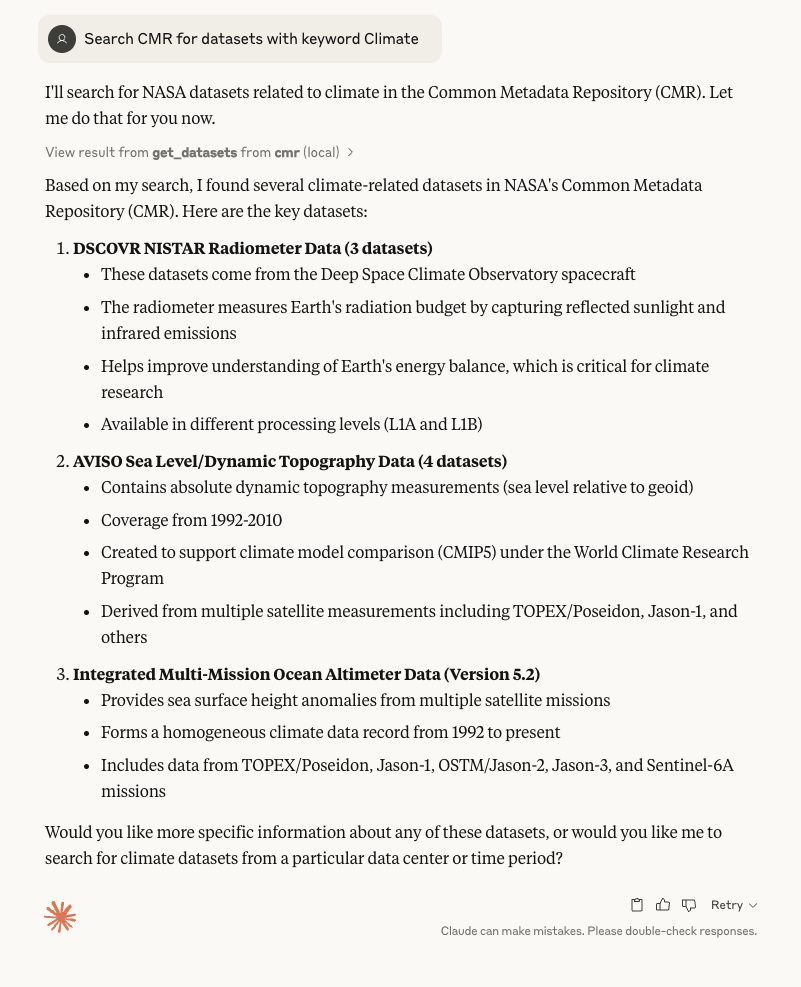
只需提示您的代理在search cmr for...数据即可。以下是一个简单的实际操作示例。

其他可以起作用的提示:
在 CMR 中搜索 2024 年至 2025 年的数据集
使用关键词“气候”在 CMR 中搜索 2020 年至 2024 年的 PO.DAAC 数据集
Available Tools
1 toolget_datasetsB
Get a list of datasets form CMR based on keywords.
Args:
startdate: (Optional) Start date of search request (like "2002" or "2022-03-22")
stopdate: (Optional) Stop date of search request (like "2002" or "2022-03-22")
daac: the daac to search, e.g. NSIDC or PODAAC
keywords: A list of keyword arguments to search collections for.
| Name | Required | Description | Default |
|---|---|---|---|
| daac | No | ||
| keyword | No | ||
| startdate | No | ||
| stopdate | No |
TDQS
Does the description disclose side effects, auth requirements, rate limits, or destructive behavior?
With no annotations provided, the description carries the full burden of behavioral disclosure. It mentions the tool retrieves data ('Get a list'), implying a read-only operation, but fails to detail critical behaviors like error handling, rate limits, authentication needs, or response format. This leaves significant gaps in understanding how the tool behaves in practice.
Agents need to know what a tool does to the world before calling it. Descriptions should go beyond structured annotations to explain consequences.

Is the description appropriately sized, front-loaded, and free of redundancy?
The description is efficiently structured with a clear purpose statement followed by parameter explanations. Each sentence adds value without redundancy. However, the minor typo ('form' instead of 'from') slightly detracts from polish, and the parameter list could be more integrated into the flow rather than a separate block.
Shorter descriptions cost fewer tokens and are easier for agents to parse. Every sentence should earn its place.
Given the tool's complexity, does the description cover enough for an agent to succeed on first attempt?
Given the tool's moderate complexity (4 parameters, no output schema, no annotations), the description is partially complete. It covers the purpose and parameters adequately but lacks details on behavioral traits, usage context, and return values. This makes it functional but insufficient for fully informed use without additional assumptions or trial-and-error.
Complex tools with many parameters or behaviors need more documentation. Simple tools need less. This dimension scales expectations accordingly.
Does the description clarify parameter syntax, constraints, interactions, or defaults beyond what the schema provides?
The description adds meaningful context for all parameters beyond the schema, which has 0% coverage. It explains that 'startdate' and 'stopdate' are for search requests with format examples, 'daac' specifies the source to search, and 'keywords' are for searching collections. This compensates well for the lack of schema descriptions, though it could clarify parameter interactions or constraints.
Input schemas describe structure but not intent. Descriptions should explain non-obvious parameter relationships and valid value ranges.
Does the description clearly state what the tool does and how it differs from similar tools?
The description clearly states the tool's purpose: 'Get a list of datasets from CMR based on keywords.' It specifies the verb ('Get'), resource ('datasets'), and source ('CMR'), making it easy to understand what the tool does. However, with no sibling tools mentioned, there's no explicit differentiation from alternatives, preventing a perfect score.
Agents choose between tools based on descriptions. A clear purpose with a specific verb and resource helps agents select the right tool.
Does the description explain when to use this tool, when not to, or what alternatives exist?
The description provides no guidance on when to use this tool versus alternatives, prerequisites, or context for its application. It only lists parameters without explaining the tool's role in workflows or decision criteria for invocation, leaving users to infer usage from the purpose alone.
Agents often have multiple tools that could apply. Explicit usage guidance like "use X instead of Y when Z" prevents misuse.
Tool Schema Changelog
Recent tool additions, removals, and schema changes observed during successful MCP inspections.
1 tool update
v1.0.0- First observed
get_datasets
TDQS
Scored across 1 tool
With only one tool, there is no possibility of confusion or overlap between tools. The tool has a clear, singular purpose of retrieving datasets from CMR based on search parameters.
The single tool name 'get_datasets' follows a clear verb_noun pattern, and there are no other tools to create inconsistency. The naming is straightforward and descriptive.
A single tool is too few for a server named 'CMR Model Context Protocol', which suggests a broader scope for interacting with CMR datasets. This minimal toolset feels thin and incomplete for the apparent domain.
The tool surface is severely incomplete for a CMR dataset server. There are obvious gaps: no tools for creating, updating, deleting, or managing datasets, and no support for operations like filtering, sorting, or detailed metadata retrieval beyond basic search.
Maintenance
Related MCP Connectors
Discover, verify, and access NASA Earth science datasets via the Common Metadata Repository (CMR)
MCP server for searching Airweave collections with natural language queries.
Cloud-hosted MCP server for secure AI access to enterprise data sources via CData Connect AI.
Related MCP Servers
- AlicenseBqualityCmaintenanceAn MCP server that enables LLMs to query data from various NASA APIs, allowing access to astronomical data, space weather information, Earth imagery, and exoplanet information directly from compatible AI clients.216MIT
- AlicenseNot gradedqualityDmaintenanceMCP server for interacting with Google Earth Engine, enabling geospatial analysis such as dataset visualization, statistics computation, and search via AI assistants.15MIT
- AlicenseAqualityCmaintenanceA Python MCP server that provides unified access to satellite and geospatial data through natural language queries, with automatic place name geocoding and support for raster, vector, and Zarr formats.24Apache 2.0
- FlicenseNot gradedqualityDmaintenanceMCP server for accessing SPEAR model output from various sources (AWS, STAC API, local) and integrating with AI assistants like Claude Desktop or a SPEAR Climate Chatbot.-