CMR Model Context Protocol
OfficialThe CMR Model Context Protocol (MCP) server enables integration of AI retrievers with NASA's Earthdata Common Metadata Repository (CMR) to search and retrieve datasets. With this server, you can:
Search datasets based on specific criteria or keywords
Filter results by date range using
startdateandstopdateparametersNarrow searches by specifying a particular DAAC (Distributed Active Archive Center), such as NSIDC or PO.DAAC
Use AI agents (like Claude or ChatGPT) to interact with CMR and fetch relevant datasets
Provides access to NASA's Common Metadata Repository (CMR) for Earthdata Search, allowing users to query and retrieve dataset metadata from NASA's catalog based on keywords, time periods, and data providers like PO.DAAC.
Click on "Install Server".
Wait a few minutes for the server to deploy. Once ready, it will show a "Started" state.
In the chat, type
@followed by the MCP server name and your instructions, e.g., "@CMR Model Context Protocolsearch for sea surface temperature datasets from the last 5 years"
That's it! The server will respond to your query, and you can continue using it as needed.
Here is a step-by-step guide with screenshots.
Model Context Protocol (MCP) for NASA Earthdata Search (CMR)
This module is a model context protocol (MCP) for NASA's earthdata common metedata repository (CMR). The goal of this MCP server is to integrate AI retrievals with NASA Catalog of datasets by way of Earthaccess.
Dependencies
uv - a rust based python package manager a LLM client, such as Claude desktop or chatGPT desktop (for consuming the MCP)
Related MCP server: Google Earth Engine MCP Server
Install and Run
Clone the repository to your local environment, or where your LLM client is running.
git clone https://github.com/podaac/cmr-mcp.git
cd cmr-mcpInstall uv
curl -LsSf https://astral.sh/uv/install.sh | shuv venv
source .venv/bin/activateInstall packages with uv
uv syncuse the outputs of which uv (UV_LIB) and PWD (CMR_MCP_INSTALL) to update the following configuration.
Adding to AI Framework
In this example we'll use Claude desktop.
Update the claude_desktop_config.json file (sometimes this must be created). On a mac, this is often found in ~/Library/Application\ Support/Claude/claude_desktop_config.json
Add the following configuration, filling in the values of UV_LIB and CMR_MCP_INSTALL - don't use environment variables here.
{
"mcpServers": {
"cmr": {
"command": "$UV_LIB$",
"args": [
"--directory",
"$CMR_MCP_INSTALL$",
"run",
"cmr-search.py"
]
}
}
}Use the MCP Server
Simply prompt your agent to search cmr for... data. Below is a simple example of this in action.
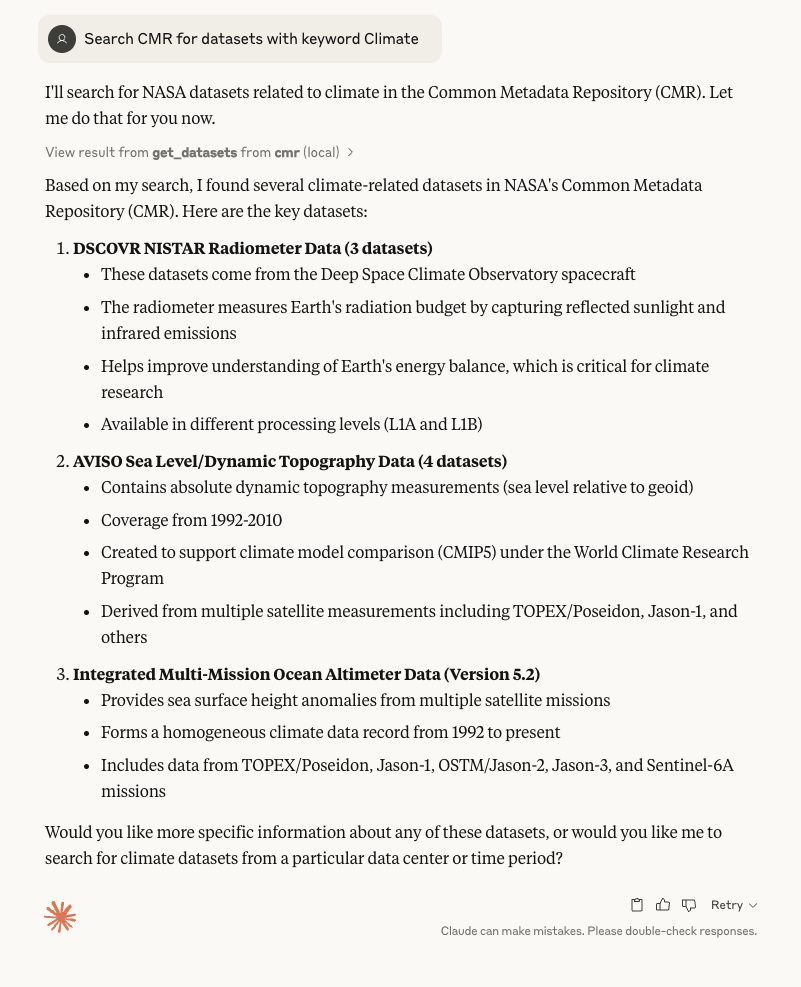
Other prompts that can work:
Search CMR for datasets from 2024 to 2025
Search CMR for PO.DAAC datasets from 2020 to 2024 with keyword Climate

Available Tools
1 toolget_datasetsB
Get a list of datasets form CMR based on keywords.
Args:
startdate: (Optional) Start date of search request (like "2002" or "2022-03-22")
stopdate: (Optional) Stop date of search request (like "2002" or "2022-03-22")
daac: the daac to search, e.g. NSIDC or PODAAC
keywords: A list of keyword arguments to search collections for.
| Name | Required | Description | Default |
|---|---|---|---|
| daac | No | ||
| keyword | No | ||
| startdate | No | ||
| stopdate | No |
TDQS
Does the description disclose side effects, auth requirements, rate limits, or destructive behavior?
With no annotations provided, the description carries the full burden of behavioral disclosure. It mentions the tool retrieves data ('Get a list'), implying a read-only operation, but fails to detail critical behaviors like error handling, rate limits, authentication needs, or response format. This leaves significant gaps in understanding how the tool behaves in practice.
Agents need to know what a tool does to the world before calling it. Descriptions should go beyond structured annotations to explain consequences.
Is the description appropriately sized, front-loaded, and free of redundancy?
The description is efficiently structured with a clear purpose statement followed by parameter explanations. Each sentence adds value without redundancy. However, the minor typo ('form' instead of 'from') slightly detracts from polish, and the parameter list could be more integrated into the flow rather than a separate block.
Shorter descriptions cost fewer tokens and are easier for agents to parse. Every sentence should earn its place.
Given the tool's complexity, does the description cover enough for an agent to succeed on first attempt?
Given the tool's moderate complexity (4 parameters, no output schema, no annotations), the description is partially complete. It covers the purpose and parameters adequately but lacks details on behavioral traits, usage context, and return values. This makes it functional but insufficient for fully informed use without additional assumptions or trial-and-error.
Complex tools with many parameters or behaviors need more documentation. Simple tools need less. This dimension scales expectations accordingly.
Does the description clarify parameter syntax, constraints, interactions, or defaults beyond what the schema provides?
The description adds meaningful context for all parameters beyond the schema, which has 0% coverage. It explains that 'startdate' and 'stopdate' are for search requests with format examples, 'daac' specifies the source to search, and 'keywords' are for searching collections. This compensates well for the lack of schema descriptions, though it could clarify parameter interactions or constraints.
Input schemas describe structure but not intent. Descriptions should explain non-obvious parameter relationships and valid value ranges.
Does the description clearly state what the tool does and how it differs from similar tools?
The description clearly states the tool's purpose: 'Get a list of datasets from CMR based on keywords.' It specifies the verb ('Get'), resource ('datasets'), and source ('CMR'), making it easy to understand what the tool does. However, with no sibling tools mentioned, there's no explicit differentiation from alternatives, preventing a perfect score.
Agents choose between tools based on descriptions. A clear purpose with a specific verb and resource helps agents select the right tool.
Does the description explain when to use this tool, when not to, or what alternatives exist?
The description provides no guidance on when to use this tool versus alternatives, prerequisites, or context for its application. It only lists parameters without explaining the tool's role in workflows or decision criteria for invocation, leaving users to infer usage from the purpose alone.
Agents often have multiple tools that could apply. Explicit usage guidance like "use X instead of Y when Z" prevents misuse.
TDQS
With only one tool, there is no possibility of confusion or overlap between tools. The tool has a clear, singular purpose of retrieving datasets from CMR based on search parameters.
The single tool name 'get_datasets' follows a clear verb_noun pattern, and there are no other tools to create inconsistency. The naming is straightforward and descriptive.
A single tool is too few for a server named 'CMR Model Context Protocol', which suggests a broader scope for interacting with CMR datasets. This minimal toolset feels thin and incomplete for the apparent domain.
The tool surface is severely incomplete for a CMR dataset server. There are obvious gaps: no tools for creating, updating, deleting, or managing datasets, and no support for operations like filtering, sorting, or detailed metadata retrieval beyond basic search.
Maintenance
Resources
Unclaimed servers have limited discoverability.
Looking for Admin?
If you are the server author, to access and configure the admin panel.
Related MCP Connectors
MCP server for searching Airweave collections with natural language queries.
Cloud-hosted MCP server for secure AI access to enterprise data sources via CData Connect AI.
Related MCP Servers
- AlicenseBqualityCmaintenanceAn MCP server that enables LLMs to query data from various NASA APIs, allowing access to astronomical data, space weather information, Earth imagery, and exoplanet information directly from compatible AI clients.216MIT
- AlicenseNot gradedqualityDmaintenanceMCP server for interacting with Google Earth Engine, enabling geospatial analysis such as dataset visualization, statistics computation, and search via AI assistants.14MIT
- AlicenseAqualityCmaintenanceA Python MCP server that provides unified access to satellite and geospatial data through natural language queries, with automatic place name geocoding and support for raster, vector, and Zarr formats.24Apache 2.0
- FlicenseNot gradedqualityDmaintenanceMCP server for accessing SPEAR model output from various sources (AWS, STAC API, local) and integrating with AI assistants like Claude Desktop or a SPEAR Climate Chatbot.
Latest Blog Posts
- Who's Calling? MCP Hosts Are an Identity Blind Spot (And the Spec Knows It)By Om-Shree-0709 on .mcpAgent IdentityOAuth 2.1
- Your AI Chatbot Just Exposed Your CEO's Salary to an InternBy Om-Shree-0709 on .Agent IdentityMCP SecurityOAuth Delegation
- Why MCP Servers Need Execution Sandboxing (And Why Your Current Stack Isn't Enough)By Om-Shree-0709 on .Agentic AiPrompt InjectionWebAssembly
MCP directory API
We provide all the information about MCP servers via our MCP API.
curl -X GET 'https://glama.ai/api/mcp/v1/servers/podaac/cmr-mcp'
If you have feedback or need assistance with the MCP directory API, please join our Discord server