

A
licenseB
qualityD
maintenanceA simple template for creating custom tools for Cursor IDE using Model Context Protocol, deployable via Heroku, Docker, or directly within Cursor IDE.
2
5
MIT

Una plantilla sencilla para crear herramientas personalizadas para Cursor IDE mediante el Protocolo de Contexto de Modelo (MCP). Cree su propio repositorio a partir de esta plantilla, modifique las herramientas y conéctelas a su Cursor IDE.
Haga clic en el botón "Implementar en Heroku".

Después de la implementación, configure Cursor:
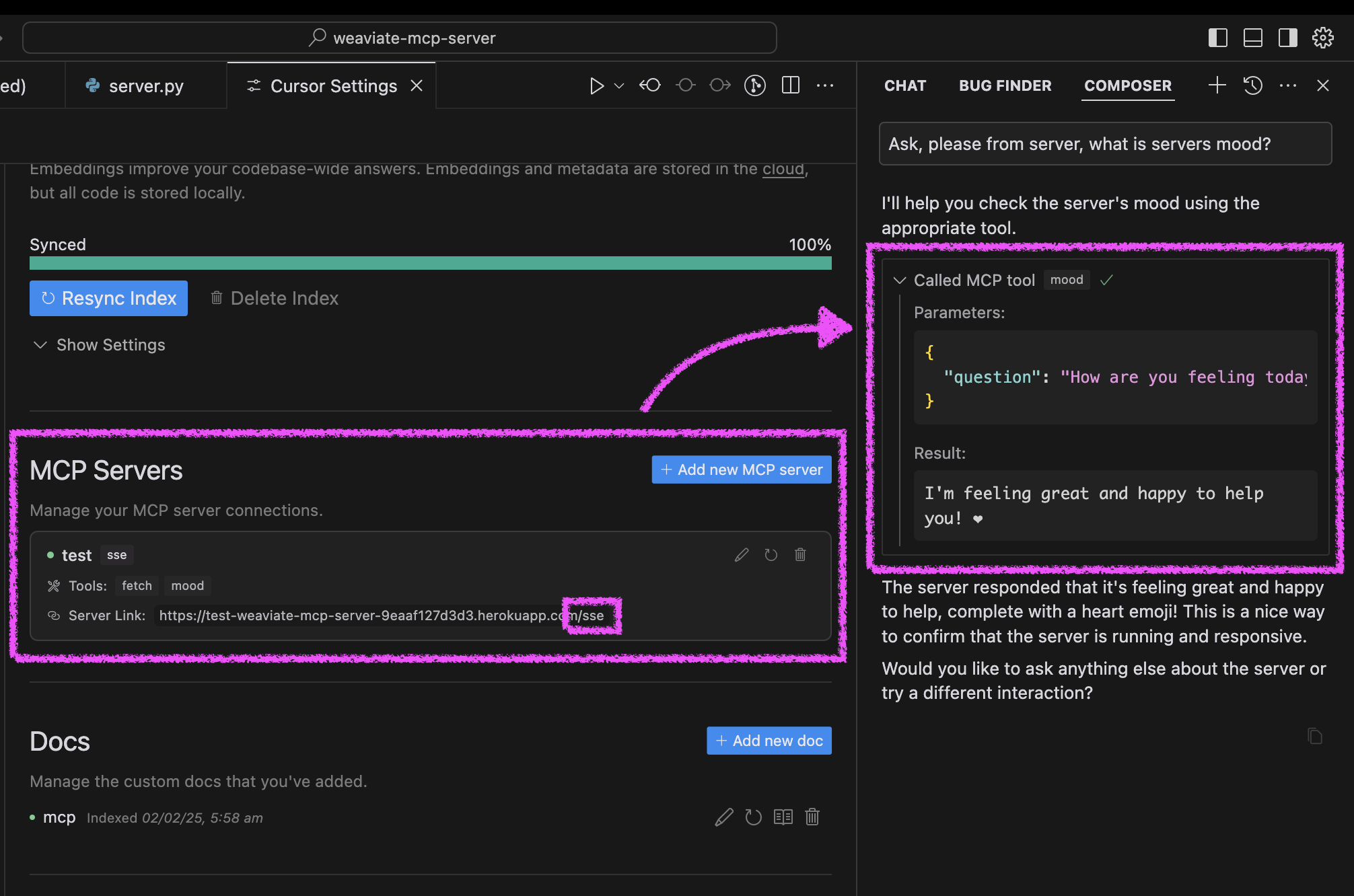
Abrir Configuración del cursor → Características
Agregar nuevo servidor MCP
Utilice su URL de Heroku con la ruta /sse (por ejemplo, https://<your-app-name>.herokuapp.com/sse )
Pon a prueba el estado de ánimo de tu agente en Cursor:
Pregúntele a su agente: "Por favor, pregunte sobre el estado de ánimo de nuestro servidor y déjeme saber cómo está".
El servidor responderá con un mensaje alegre y un corazón ❤️
Related MCP server: MCP Server Template for Cursor IDE
Puede ejecutar el servidor de tres maneras: usando Docker, la configuración tradicional de Python o directamente en Cursor IDE.
El proyecto incluye soporte para Docker para una fácil implementación:
Configuración inicial:
# Clone the repository
git clone https://github.com/kirill-markin/weaviate-mcp-server.git
cd weaviate-mcp-server

# Create environment file
cp .env.example .env
Construya y ejecute usando Docker Compose:
# Build and start the server
docker compose up --build -d

# View logs
docker compose logs -f

# Check server status
docker compose ps

# Stop the server
docker compose down
El servidor estará disponible en:
Punto final SSE: http://localhost:8000/sse
Prueba rápida:
# Test the server endpoint
curl -i http://localhost:8000/sse
Conectarse a Cursor IDE:
Abrir Configuración del cursor → Características
Agregar nuevo servidor MCP
Tipo: Seleccione "sse"
URL: Ingrese http://localhost:8000/sse
Primero, instale el administrador de paquetes uv:
# Install uv on macOS
brew install uv
# Or install via pip (any OS)
pip install uv
Inicie el servidor utilizando stdio (predeterminado) o el transporte SSE:
# Install the package with development dependencies
uv pip install -e ".[dev]"

# Using stdio transport (default)
uv run mcp-hitchcode

# Using SSE transport on custom port
uv run mcp-hitchcode --transport sse --port 8000

# Run tests
uv run pytest -v
Después de la instalación, puede conectar el servidor directamente a Cursor IDE:
Haga clic derecho en el archivo cursor-run-mcp-server.sh en Cursor
Seleccione "Copiar ruta" para copiar la ruta absoluta
Abrir la configuración del cursor (icono de engranaje)
Vaya a la pestaña Características
Desplácese hacia abajo hasta "Servidores MCP"
Haga clic en "Agregar nuevo servidor MCP"
Rellene el formulario:
Nombre: Elija cualquier nombre (por ejemplo, "mi-servidor-mcp-1")
Tipo: Seleccione "stdio" (no "sse" porque ejecutamos el servidor localmente)
Comando: Pegue la ruta absoluta de cursor-run-mcp-server.sh que copió anteriormente. Por ejemplo: /Users/kirillmarkin/weaviate-mcp-server/cursor-run-mcp-server.sh
Variables de entorno disponibles (se pueden configurar en .env ):
MCP_SERVER_PORT (predeterminado: 8000): puerto donde se ejecutará el servidor
MCP_SERVER_HOST (predeterminado: 0.0.0.0): host al que vincular el servidor
DEBUG (predeterminado: falso): habilita el modo de depuración
MCP_USER_AGENT - Agente de usuario personalizado para la obtención de sitios web
Para instalar automáticamente la plantilla de servidor MCP para Cursor IDE para Claude Desktop a través de Smithery :
npx -y @smithery/cli install @kirill-markin/example-mcp-server --client claudeProvides a prompt for systematically handling change requests
Inputs: change_request (required), specific_instructions, version.
Provides a prompt template for Docker container configurations and orchestration
Inputs: containerization_objective (required), specific_instructions, version.
Provides a prompt for performing root cause analysis and fixing issues
Inputs: issue (required), specific_instructions, version.
Provides a prompt for analyzing and fixing linter errors
Inputs: issue (required), specific_instructions, version.
Provides a prompt template for laying out system infrastructure and tool stack information
Inputs: infrastructure_info (required), specific_instructions, version.
Provides an initial prompt template for starting a new project
Inputs: objective (required), specific_instructions, version.
Provides a prompt template for proceeding with a task or project
Inputs: task (required), specific_instructions, version.
Provides a prompt for generating unit tests for code
Inputs: code_to_test (required), specific_instructions, version.
Fetches the most recent Railway CLI documentation. Optionally, provide a custom URL.
Inputs: url.
Fetches the most recent Railway CLI documentation. Optionally, provide a custom URL.
Inputs: url.
Fetches a website and returns its content
Inputs: url (required).
Ask the server about its mood - it's always happy!
Inputs: question (required).
Recent tool additions, removals, and schema changes observed during successful MCP inspections.
Loading tool schema changelog…
Scored across 12 tools
The tool set has significant ambiguity, particularly between the 'apply_prompt_*' tools which all provide prompt templates for different contexts but could easily be confused by an agent due to overlapping purposes (e.g., 'apply_prompt_fix' vs 'apply_prompt_fix_linter' for fixing issues). Additionally, 'fetch_railway_docs' and 'fetch_railway_docs_optimized' appear to do the same thing with unclear distinctions, leading to potential misselection.
Most tools follow a consistent snake_case pattern with clear verb_noun structures (e.g., 'apply_prompt_change', 'fetch_railway_docs'), which aids readability. However, there are minor deviations: 'mood' breaks the pattern by being a single noun without a verb, and the duplication in 'fetch_railway_docs' vs 'fetch_railway_docs_optimized' introduces inconsistency in naming for similar functions.
With 12 tools, the count is borderline but reasonable for a template server aimed at Cursor IDE, which might cover various development tasks. However, the set feels slightly heavy due to redundant tools like the two Railway docs fetchers and multiple similar prompt tools, suggesting some consolidation could improve coherence without losing functionality.
The server's domain appears to be development assistance with prompt templates and documentation fetching, but there are significant gaps. For example, it lacks tools for code generation, debugging, or version control integration, which are common in IDE contexts. The inclusion of a trivial 'mood' tool further detracts from covering essential workflows, making the surface incomplete for practical agent use in development tasks.
A comprehensive Model Context Protocol (MCP) server that enables AI assistants to interact with yo…
The Mercado Pago MCP Server implements the Model Context Protocol to provide AI agents and LLMs with access to Mercado Pago's APIs and tools within compatible development environments. It acts as an intermediary that translates Mercado Pago resources into executable functions (tools) that AI applications can invoke to perform actions and automate flows. The server simplifies integration, enables using documentation to implement or improve code, and optimizes operations through natural language interactions without manual implementations.
A Model Context Protocol server for Wix AI tools
The OpenRouter MCP server plugs OpenRouter into the AI tools you already use. Once connected, your assistant can pull live OpenRouter data (models, prices, your credits, rankings, and docs) and send quick test messages, all without leaving your editor.