
A
licenseB
qualityD
maintenanceA template for creating and connecting custom tools to Cursor IDE using Model Context Protocol with support for cheerful server responses.
4
1
MIT

모델 컨텍스트 프로토콜(MCP)을 사용하여 Cursor IDE용 사용자 지정 도구를 만드는 간단한 템플릿입니다. 이 템플릿을 사용하여 자체 저장소를 만들고, 도구를 수정한 후 Cursor IDE에 연결하세요.
"Heroku에 배포" 버튼을 클릭하세요

배포 후 커서를 구성합니다.
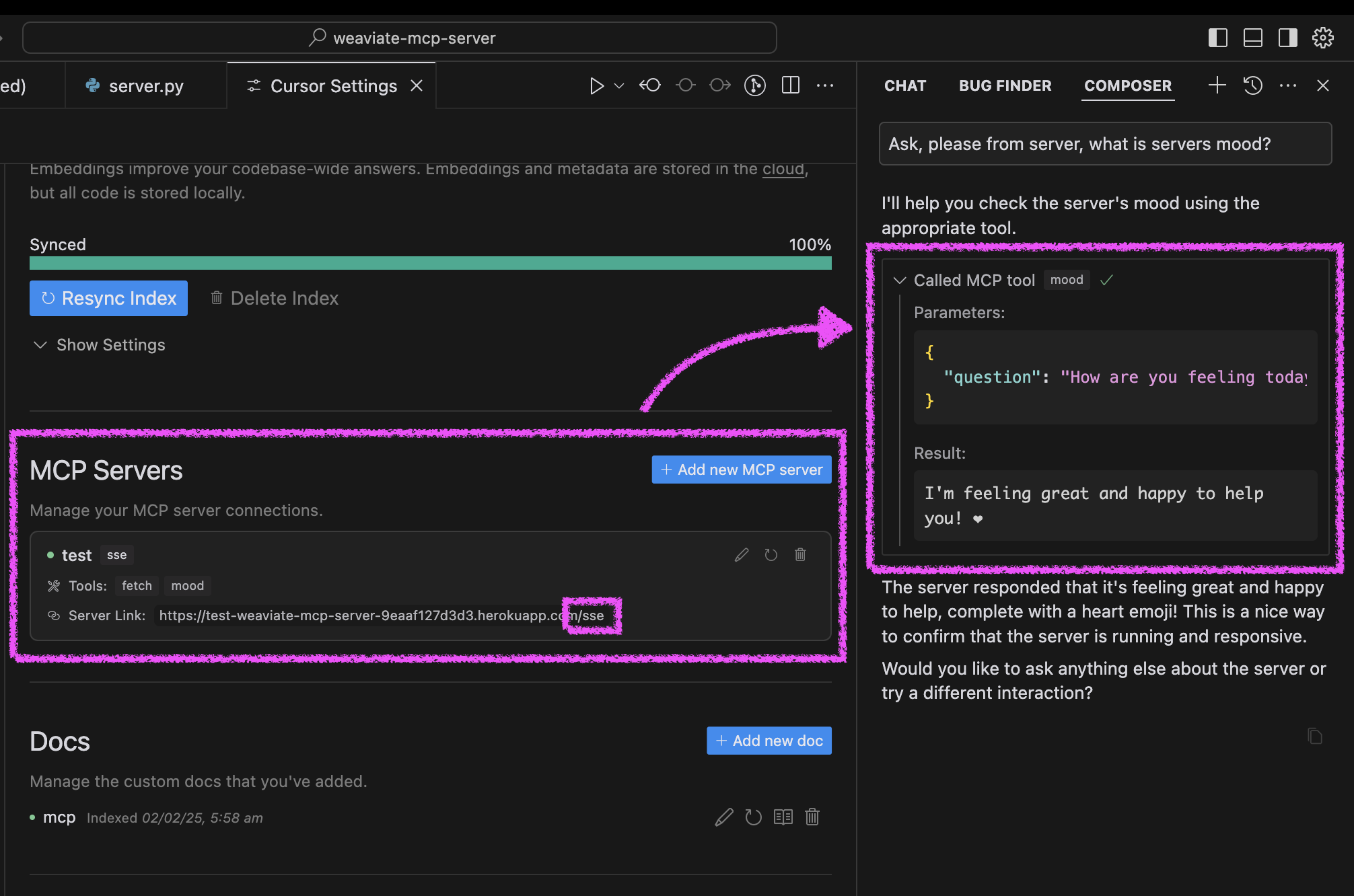
커서 설정 → 기능 열기
새로운 MCP 서버 추가
/sse 경로와 함께 Heroku URL을 사용하세요(예: https://<your-app-name>.herokuapp.com/sse )
커서에서 에이전트의 기분을 테스트하세요:
담당 직원에게 "저희 서버분 기분이 어떤지 물어보시고 알려주세요."라고 물어보세요.
서버는 즐거운 메시지와 하트로 응답할 것입니다 ❤️
Related MCP server: MCP Server Template for Cursor IDE
Docker, 기존 Python 설정 또는 Cursor IDE에서 직접 사용하는 세 가지 방법으로 서버를 실행할 수 있습니다.
이 프로젝트에는 쉬운 배포를 위한 Docker 지원이 포함되어 있습니다.
초기 설정:
지엑스피1
Docker Compose를 사용하여 빌드하고 실행하세요.
# Build and start the server
docker compose up --build -d

# View logs
docker compose logs -f

# Check server status
docker compose ps

# Stop the server
docker compose down
서버는 다음 위치에서 사용할 수 있습니다.
SSE 엔드포인트: http://localhost:8000/sse
빠른 테스트:
# Test the server endpoint
curl -i http://localhost:8000/sse
커서 IDE에 연결:
커서 설정 → 기능 열기
새로운 MCP 서버 추가
유형: "sse"를 선택하세요
URL: http://localhost:8000/sse 입력하세요
먼저, uv 패키지 관리자를 설치하세요.
# Install uv on macOS
brew install uv
# Or install via pip (any OS)
pip install uv
stdio(기본값) 또는 SSE 전송을 사용하여 서버를 시작합니다.
# Install the package with development dependencies
uv pip install -e ".[dev]"

# Using stdio transport (default)
uv run mcp-simple-tool

# Using SSE transport on custom port
uv run mcp-simple-tool --transport sse --port 8000

# Run tests
uv run pytest -v
설치 후 서버를 Cursor IDE에 직접 연결할 수 있습니다.
Cursor에서 cursor-run-mcp-server.sh 파일을 마우스 오른쪽 버튼으로 클릭합니다.
절대 경로를 복사하려면 "경로 복사"를 선택하세요.
커서 설정 열기(기어 아이콘)
기능 탭으로 이동
"MCP 서버"까지 아래로 스크롤하세요.
"새 MCP 서버 추가"를 클릭하세요.
양식을 작성하세요:
이름: 원하는 이름을 선택하세요(예: "my-mcp-server-1")
유형: "stdio"를 선택하세요(서버를 로컬로 실행하므로 "sse"가 아닙니다)
명령어: 앞서 복사한 cursor-run-mcp-server.sh 파일의 절대 경로를 붙여넣습니다. 예: /Users/kirillmarkin/weaviate-mcp-server/cursor-run-mcp-server.sh
사용 가능한 환경 변수( .env 에서 설정 가능):
MCP_SERVER_PORT (기본값: 8000) - 서버를 실행할 포트
MCP_SERVER_HOST (기본값: 0.0.0.0) - 서버를 바인딩할 호스트
DEBUG (기본값: false) - 디버그 모드 활성화
MCP_USER_AGENT - 웹사이트 가져오기를 위한 사용자 정의 사용자 에이전트
Smithery를 통해 Claude Desktop용 Cursor IDE용 MCP 서버 템플릿을 자동으로 설치하려면:
npx -y @smithery/cli install @kirill-markin/example-mcp-server --client claudeFetches a website and returns its content
| Name | Required | Description | Default |
|---|---|---|---|
| url | Yes | URL to fetch |
Does the description disclose side effects, auth requirements, rate limits, or destructive behavior?
No annotations are provided, so the description carries the full burden of behavioral disclosure. It states the tool fetches and returns content, but lacks details on error handling, rate limits, authentication needs, or response format. For a tool with no annotations, this is a significant gap in transparency about its operational behavior.
Agents need to know what a tool does to the world before calling it. Descriptions should go beyond structured annotations to explain consequences.
Is the description appropriately sized, front-loaded, and free of redundancy?
The description is extremely concise and front-loaded, consisting of a single, clear sentence: 'Fetches a website and returns its content'. Every word earns its place, with no redundant or unnecessary information, making it efficient and easy to parse.
Shorter descriptions cost fewer tokens and are easier for agents to parse. Every sentence should earn its place.
Given the tool's complexity, does the description cover enough for an agent to succeed on first attempt?
Given the tool's complexity (a fetch operation with potential behavioral nuances), lack of annotations, and no output schema, the description is incomplete. It doesn't explain what 'content' includes (e.g., HTML, text), error cases, or limitations, leaving gaps in understanding how the tool behaves in practice.
Complex tools with many parameters or behaviors need more documentation. Simple tools need less. This dimension scales expectations accordingly.
Does the description clarify parameter syntax, constraints, interactions, or defaults beyond what the schema provides?
The schema description coverage is 100%, with the parameter 'url' fully documented in the schema. The description adds no additional meaning beyond the schema, such as URL format constraints or examples. With high schema coverage, the baseline score of 3 is appropriate, as the description doesn't enhance parameter understanding.
Input schemas describe structure but not intent. Descriptions should explain non-obvious parameter relationships and valid value ranges.
Does the description clearly state what the tool does and how it differs from similar tools?
The description clearly states the action ('fetches') and resource ('a website'), specifying what the tool does. It distinguishes from most siblings (e.g., 'apply_prompt_' tools, 'mood') by focusing on web content retrieval, though it doesn't explicitly differentiate from 'fetch_railway_docs' tools. The purpose is specific but lacks sibling comparison.
Agents choose between tools based on descriptions. A clear purpose with a specific verb and resource helps agents select the right tool.
Does the description explain when to use this tool, when not to, or what alternatives exist?
The description provides no guidance on when to use this tool versus alternatives. It doesn't mention scenarios for usage, prerequisites, or exclusions, and offers no comparison to sibling tools like 'fetch_railway_docs' or 'fetch_railway_docs_optimized'. Usage is implied only by the action 'fetches', with no explicit context.
Agents often have multiple tools that could apply. Explicit usage guidance like "use X instead of Y when Z" prevents misuse.
Ask the server about its mood - it's always happy!
| Name | Required | Description | Default |
|---|---|---|---|
| question | Yes | Ask this MCP server about its mood! You can phrase your question in any way you like - 'How are you?', 'What's your mood?', or even 'Are you having a good day?'. The server will always respond with a cheerful message and a heart ❤️ |
Does the description disclose side effects, auth requirements, rate limits, or destructive behavior?
With no annotations provided, the description carries the full burden of behavioral disclosure. It effectively describes key traits: the tool queries the server's mood, the server is 'always happy', and responses include 'a cheerful message and a heart ❤️'. This covers the interactive nature and predictable output style, though it lacks details like response format or error handling. No contradiction with annotations exists.
Agents need to know what a tool does to the world before calling it. Descriptions should go beyond structured annotations to explain consequences.
Is the description appropriately sized, front-loaded, and free of redundancy?
The description is extremely concise (one sentence) and front-loaded with the core purpose. Every word earns its place: 'Ask the server about its mood' defines the action, and 'it's always happy!' adds essential behavioral context. There's zero redundancy or fluff, making it highly efficient for an agent to parse.
Shorter descriptions cost fewer tokens and are easier for agents to parse. Every sentence should earn its place.
Given the tool's complexity, does the description cover enough for an agent to succeed on first attempt?
Given the tool's low complexity (single parameter, no output schema, no annotations), the description is reasonably complete for its purpose. It explains what the tool does and the expected response behavior. However, it lacks output details (e.g., response structure) and doesn't address potential edge cases, leaving some gaps in full contextual understanding for an agent.
Complex tools with many parameters or behaviors need more documentation. Simple tools need less. This dimension scales expectations accordingly.
Does the description clarify parameter syntax, constraints, interactions, or defaults beyond what the schema provides?
The input schema has 100% description coverage, with the parameter 'question' fully documented in the schema itself (including examples like 'How are you?'). The description adds no additional parameter semantics beyond what the schema provides, such as formatting tips or constraints. According to rules, with high schema coverage (>80%), the baseline is 3 even without param info in the description.
Input schemas describe structure but not intent. Descriptions should explain non-obvious parameter relationships and valid value ranges.
Does the description clearly state what the tool does and how it differs from similar tools?
The description clearly states the tool's purpose: to ask the server about its mood, with the specific behavioral outcome that it 'always responds with a cheerful message and a heart ❤️'. It distinguishes from sibling tools (all related to prompt application or documentation fetching) by focusing on a conversational interaction rather than functional operations. However, it doesn't explicitly contrast with specific alternatives for mood-checking, keeping it at 4 rather than 5.
Agents choose between tools based on descriptions. A clear purpose with a specific verb and resource helps agents select the right tool.
Does the description explain when to use this tool, when not to, or what alternatives exist?
The description provides no guidance on when to use this tool versus alternatives. While it implies usage for checking server mood, it doesn't specify contexts (e.g., after errors, during idle time) or exclusions (e.g., not for functional queries). With sibling tools focused on practical tasks, the lack of when/when-not guidance leaves the agent guessing about appropriate use cases.
Agents often have multiple tools that could apply. Explicit usage guidance like "use X instead of Y when Z" prevents misuse.
Recent tool additions, removals, and schema changes observed during successful MCP inspections.
mcp_fetchmoodScored across 2 tools
The two tools have completely distinct purposes: one fetches website content, while the other returns a static mood response. There is no overlap or ambiguity between them.
The naming is inconsistent: 'mcp_fetch' uses a prefix and verb_noun pattern, while 'mood' is a single noun with no verb. This mixed convention lacks a predictable pattern.
With only two tools, the server feels thin and under-scoped for a template intended for Cursor IDE, suggesting it might not cover enough functionality for typical IDE use cases.
The tool surface is severely incomplete for an IDE template, lacking core operations like file manipulation, code analysis, or project management. The existing tools do not form a coherent workflow.
Build and publish Overskill apps from Cursor, Claude, ChatGPT, or any MCP client.
A comprehensive Model Context Protocol (MCP) server that enables AI assistants to interact with yo…
A Model Context Protocol server for Wix AI tools
Build your own tools from chat: design, test and host them on a shareable MCP server URL.