Web3 Research MCP
Web3 Research MCP
Глубокое исследование криптовалют — бесплатно и полностью локально 🧠
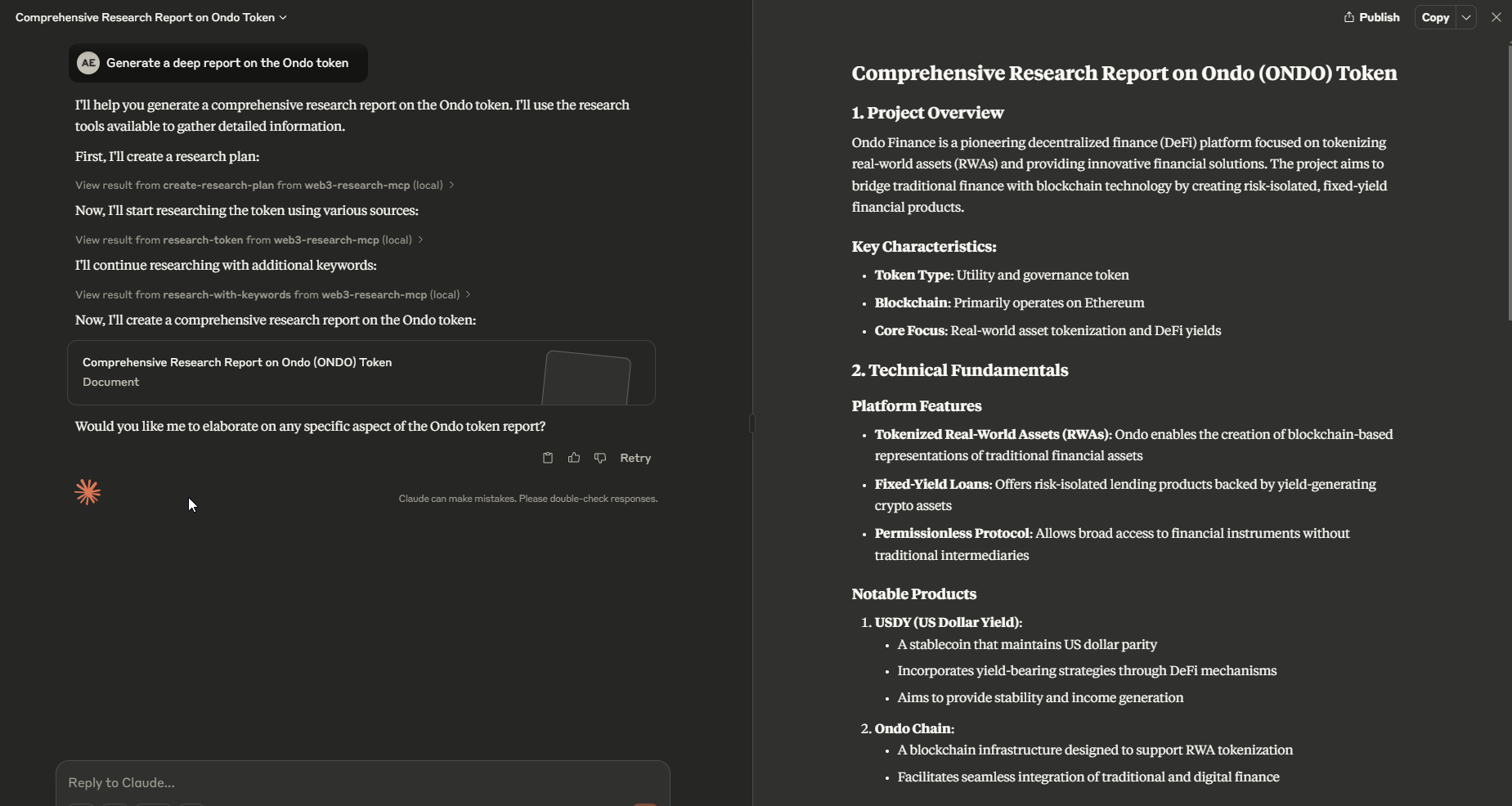
🚀 Предварительный просмотр

Related MCP server: deeplook
🧠 Возможности
Комплексное исследование: Сбор подробной информации о любом криптовалютном токене
Анализ из нескольких источников: Исследование по множеству источников, включая CoinGecko, CoinMarketCap, DeFiLlama и другие
Структурированная отчетность: Создание подробных отчетов, охватывающих технические основы, рыночные данные, социальные настроения и многое другое
Управление ресурсами: Автоматическое сохранение результатов поиска и контента для справки
Отслеживание статуса: Отслеживание прогресса исследования по различным этапам и разделам
📋 Требования
Node.js (v16 или выше)
🔧 Установка и настройка
Установка через Smithery
Чтобы автоматически установить web3-research-mcp для Claude Desktop через Smithery:
npx -y @smithery/cli install web3-research-mcp --client claude🔌 Использование с Claude Desktop
Отредактируйте файл конфигурации Claude Desktop
Windows: %APPDATA%\Claude\claude_desktop_config.json
macOS: ~/Library/Application Support/Claude/claude_desktop_config.json
Добавьте это в ваш файл конфигурации Claude Desktop:
{
"mcpServers": {
"web3-research-mcp": {
"command": "npx",
"args": ["-y", "web3-research-mcp@latest"]
}
}
}Затем перезапустите Claude Desktop
🔌 Использование с Cursor
Перейдите в: Settings -> Cursor Settings -> MCP -> Add new global MCP server Вставьте это в ваш файл Cursor ~/.cursor/mcp.json. Дополнительную информацию см. в документации Cursor MCP.
{
"mcpServers": {
"web3-research-mcp": {
"command": "npx",
"args": ["-y", "web3-research-mcp@latest"]
}
}
}Затем перезапустите Cursor
🛠️ Инструменты
create-research-plan
Создает структурированный план исследования для токена.
Параметры:
tokenName: Полное название токена
tokenTicker: Тикер токена
search
Выполняет веб-поиск и возвращает результаты.
Параметры:
query: Поисковый запрос
searchType: Тип поиска (web, news, images, videos)
research-with-keywords
Ищет токен по определенным ключевым словам и сохраняет результаты.
Параметры:
tokenName: Название токена
tokenTicker: Тикер токена
keywords: Массив ключевых слов для поиска
update-status
Обновляет статус раздела исследования.
Параметры:
section: Название раздела для обновления (например, 'projectInfo', 'technicalFundamentals')
status: Новый статус раздела (planned, in_progress, completed)
fetch-content
Получает контент по URL и сохраняет его как ресурс.
Параметры:
url: URL для получения контента
format: Формат вывода (text, html, markdown, json)
list-resources
Выводит список всех сохраненных ресурсов.
search-source
Ищет информацию о токене из конкретного источника.
Параметры:
tokenName: Название токена
tokenTicker: Тикер токена
source: Источник для поиска (например, 'CoinGecko', 'DeFiLlama', 'News')
coingecko-data
Получает рыночные данные в реальном времени напрямую из публичного API CoinGecko — цена, рыночная капитализация, изменения за 24ч/7д/30д, ATH/ATL, оборотное предложение, адреса контрактов в разных сетях, а также социальные/разработческие ссылки. Обходит ошибки 403 при HTML-парсинге.
Параметры:
tokenName: Полное название токена (например, 'Bitcoin')
tokenTicker: Тикер токена (например, 'BTC')
API-ключ не требуется. Используется бесплатный публичный уровень (~30 запросов/мин).
Опционально: установите COINGECKO_API_KEY в переменных окружения, чтобы использовать API-ключ CoinGecko Pro. Если он установлен, запросы отправляются на https://pro-api.coingecko.com/api/v3 с заголовком x-cg-pro-api-key. Время ожидания запроса — 15 секунд.
coingecko-search
Ищет в индексе монет CoinGecko и возвращает подходящие варианты с их ID CoinGecko. Полезно, когда тикер неоднозначен (например, несколько токенов с одинаковым символом).
Параметры:
query: Поисковый запрос — название, тикер или адрес контракта
defillama-data
Получает данные протокола напрямую из публичного API DeFiLlama — общий TVL, распределение TVL по сетям, комиссии (24ч/7д/30д/за все время), адреса токенов, раунды финансирования и ссылки. Обходит HTML-парсинг для наиболее распространенных запросов DeFi-протоколов.
Параметры:
tokenName: Полное название протокола/токена (например, 'Uniswap')
tokenTicker: Тикер токена (например, 'UNI')
API-ключ не требуется. Используется бесплатный публичный API. Время ожидания запроса — 15 секунд. Индекс протоколов кэшируется на 5 минут для каждого процесса, чтобы избежать перегрузки /protocols при каждом вызове.
defillama-search
Ищет в индексе протоколов DeFiLlama и возвращает подходящие варианты с их слагами, TVL и категорией. Полезно, когда тикер неоднозначен (например, несколько протоколов с похожими названиями).
Параметры:
query: Поисковый запрос — название протокола, тикер или слаг
📝 Промпты
token-research
Инициирует комплексное исследование криптовалютного токена.
Параметры:
tokenName: Полное название криптовалютного токена
tokenTicker: Тикер токена (например, BTC, ETH)
🧠 Как это работает
Когда исследование начинается, создается структурированный план, охватывающий все аспекты токена
Сервер выполняет поиск информации по нескольким источникам
Результаты поиска сохраняются как ресурсы, на которые можно ссылаться
Исследование продвигается по различным разделам с отслеживанием статуса
Генерируется комплексный отчет, охватывающий все аспекты токена
⚠️ Ограничения
Некоторые веб-сайты блокируют веб-скрейпинг, поэтому прямое получение контента может завершиться ошибкой 403
Зависит от результатов поиска, которые не всегда могут быть исчерпывающими
К операциям поиска могут применяться лимиты по количеству запросов
📄 Лицензия
Этот проект лицензирован по лицензии Apache License 2.0 — подробности см. в файле LICENSE.
Available Tools
14 toolscoingecko-dataD
| Name | Required | Description | Default |
|---|---|---|---|
| tokenName | Yes | Full name of the token (e.g., 'Bitcoin') | |
| tokenTicker | Yes | Ticker symbol (e.g., 'BTC') |
TDQS
Does the description disclose side effects, auth requirements, rate limits, or destructive behavior?
Tool has no description.
Agents need to know what a tool does to the world before calling it. Descriptions should go beyond structured annotations to explain consequences.
Is the description appropriately sized, front-loaded, and free of redundancy?
Tool has no description.
Shorter descriptions cost fewer tokens and are easier for agents to parse. Every sentence should earn its place.
Given the tool's complexity, does the description cover enough for an agent to succeed on first attempt?
Tool has no description.
Complex tools with many parameters or behaviors need more documentation. Simple tools need less. This dimension scales expectations accordingly.
Does the description clarify parameter syntax, constraints, interactions, or defaults beyond what the schema provides?
Tool has no description.
Input schemas describe structure but not intent. Descriptions should explain non-obvious parameter relationships and valid value ranges.
Does the description clearly state what the tool does and how it differs from similar tools?
Tool has no description.
Agents choose between tools based on descriptions. A clear purpose with a specific verb and resource helps agents select the right tool.
Does the description explain when to use this tool, when not to, or what alternatives exist?
Tool has no description.
Agents often have multiple tools that could apply. Explicit usage guidance like "use X instead of Y when Z" prevents misuse.
coingecko-searchD
| Name | Required | Description | Default |
|---|---|---|---|
| query | Yes | Search query — name, ticker, or contract address. Returns candidate CoinGecko IDs. |
TDQS
Does the description disclose side effects, auth requirements, rate limits, or destructive behavior?
Tool has no description.
Agents need to know what a tool does to the world before calling it. Descriptions should go beyond structured annotations to explain consequences.
Is the description appropriately sized, front-loaded, and free of redundancy?
Tool has no description.
Shorter descriptions cost fewer tokens and are easier for agents to parse. Every sentence should earn its place.
Given the tool's complexity, does the description cover enough for an agent to succeed on first attempt?
Tool has no description.
Complex tools with many parameters or behaviors need more documentation. Simple tools need less. This dimension scales expectations accordingly.
Does the description clarify parameter syntax, constraints, interactions, or defaults beyond what the schema provides?
Tool has no description.
Input schemas describe structure but not intent. Descriptions should explain non-obvious parameter relationships and valid value ranges.
Does the description clearly state what the tool does and how it differs from similar tools?
Tool has no description.
Agents choose between tools based on descriptions. A clear purpose with a specific verb and resource helps agents select the right tool.
Does the description explain when to use this tool, when not to, or what alternatives exist?
Tool has no description.
Agents often have multiple tools that could apply. Explicit usage guidance like "use X instead of Y when Z" prevents misuse.
coingecko-tickersD
| Name | Required | Description | Default |
|---|---|---|---|
| limit | No | How many top venues to return (sorted by 24h USD volume) | |
| tokenName | Yes | Full name of the token (e.g., 'Bitcoin') | |
| tokenTicker | Yes | Ticker symbol (e.g., 'BTC') |
TDQS
Does the description disclose side effects, auth requirements, rate limits, or destructive behavior?
Tool has no description.
Agents need to know what a tool does to the world before calling it. Descriptions should go beyond structured annotations to explain consequences.
Is the description appropriately sized, front-loaded, and free of redundancy?
Tool has no description.
Shorter descriptions cost fewer tokens and are easier for agents to parse. Every sentence should earn its place.
Given the tool's complexity, does the description cover enough for an agent to succeed on first attempt?
Tool has no description.
Complex tools with many parameters or behaviors need more documentation. Simple tools need less. This dimension scales expectations accordingly.
Does the description clarify parameter syntax, constraints, interactions, or defaults beyond what the schema provides?
Tool has no description.
Input schemas describe structure but not intent. Descriptions should explain non-obvious parameter relationships and valid value ranges.
Does the description clearly state what the tool does and how it differs from similar tools?
Tool has no description.
Agents choose between tools based on descriptions. A clear purpose with a specific verb and resource helps agents select the right tool.
Does the description explain when to use this tool, when not to, or what alternatives exist?
Tool has no description.
Agents often have multiple tools that could apply. Explicit usage guidance like "use X instead of Y when Z" prevents misuse.
create-research-planD
| Name | Required | Description | Default |
|---|---|---|---|
| tokenName | Yes | Token name | |
| tokenTicker | Yes | Token ticker symbol |
TDQS
Does the description disclose side effects, auth requirements, rate limits, or destructive behavior?
Tool has no description.
Agents need to know what a tool does to the world before calling it. Descriptions should go beyond structured annotations to explain consequences.
Is the description appropriately sized, front-loaded, and free of redundancy?
Tool has no description.
Shorter descriptions cost fewer tokens and are easier for agents to parse. Every sentence should earn its place.
Given the tool's complexity, does the description cover enough for an agent to succeed on first attempt?
Tool has no description.
Complex tools with many parameters or behaviors need more documentation. Simple tools need less. This dimension scales expectations accordingly.
Does the description clarify parameter syntax, constraints, interactions, or defaults beyond what the schema provides?
Tool has no description.
Input schemas describe structure but not intent. Descriptions should explain non-obvious parameter relationships and valid value ranges.
Does the description clearly state what the tool does and how it differs from similar tools?
Tool has no description.
Agents choose between tools based on descriptions. A clear purpose with a specific verb and resource helps agents select the right tool.
Does the description explain when to use this tool, when not to, or what alternatives exist?
Tool has no description.
Agents often have multiple tools that could apply. Explicit usage guidance like "use X instead of Y when Z" prevents misuse.
defillama-dataD
| Name | Required | Description | Default |
|---|---|---|---|
| tokenName | Yes | Full protocol/token name (e.g., 'Uniswap') | |
| tokenTicker | Yes | Ticker symbol (e.g., 'UNI') |
TDQS
Does the description disclose side effects, auth requirements, rate limits, or destructive behavior?
Tool has no description.
Agents need to know what a tool does to the world before calling it. Descriptions should go beyond structured annotations to explain consequences.
Is the description appropriately sized, front-loaded, and free of redundancy?
Tool has no description.
Shorter descriptions cost fewer tokens and are easier for agents to parse. Every sentence should earn its place.
Given the tool's complexity, does the description cover enough for an agent to succeed on first attempt?
Tool has no description.
Complex tools with many parameters or behaviors need more documentation. Simple tools need less. This dimension scales expectations accordingly.
Does the description clarify parameter syntax, constraints, interactions, or defaults beyond what the schema provides?
Tool has no description.
Input schemas describe structure but not intent. Descriptions should explain non-obvious parameter relationships and valid value ranges.
Does the description clearly state what the tool does and how it differs from similar tools?
Tool has no description.
Agents choose between tools based on descriptions. A clear purpose with a specific verb and resource helps agents select the right tool.
Does the description explain when to use this tool, when not to, or what alternatives exist?
Tool has no description.
Agents often have multiple tools that could apply. Explicit usage guidance like "use X instead of Y when Z" prevents misuse.
defillama-searchD
| Name | Required | Description | Default |
|---|---|---|---|
| query | Yes | Search query — protocol name, ticker, or slug. Returns candidate DeFiLlama protocols with their slugs. |
TDQS
Does the description disclose side effects, auth requirements, rate limits, or destructive behavior?
Tool has no description.
Agents need to know what a tool does to the world before calling it. Descriptions should go beyond structured annotations to explain consequences.
Is the description appropriately sized, front-loaded, and free of redundancy?
Tool has no description.
Shorter descriptions cost fewer tokens and are easier for agents to parse. Every sentence should earn its place.
Given the tool's complexity, does the description cover enough for an agent to succeed on first attempt?
Tool has no description.
Complex tools with many parameters or behaviors need more documentation. Simple tools need less. This dimension scales expectations accordingly.
Does the description clarify parameter syntax, constraints, interactions, or defaults beyond what the schema provides?
Tool has no description.
Input schemas describe structure but not intent. Descriptions should explain non-obvious parameter relationships and valid value ranges.
Does the description clearly state what the tool does and how it differs from similar tools?
Tool has no description.
Agents choose between tools based on descriptions. A clear purpose with a specific verb and resource helps agents select the right tool.
Does the description explain when to use this tool, when not to, or what alternatives exist?
Tool has no description.
Agents often have multiple tools that could apply. Explicit usage guidance like "use X instead of Y when Z" prevents misuse.
fetch-contentD
| Name | Required | Description | Default |
|---|---|---|---|
| url | Yes | URL to fetch content from (can be a resource:// URL) | |
| format | No | Output format | markdown |
TDQS
Does the description disclose side effects, auth requirements, rate limits, or destructive behavior?
Tool has no description.
Agents need to know what a tool does to the world before calling it. Descriptions should go beyond structured annotations to explain consequences.
Is the description appropriately sized, front-loaded, and free of redundancy?
Tool has no description.
Shorter descriptions cost fewer tokens and are easier for agents to parse. Every sentence should earn its place.
Given the tool's complexity, does the description cover enough for an agent to succeed on first attempt?
Tool has no description.
Complex tools with many parameters or behaviors need more documentation. Simple tools need less. This dimension scales expectations accordingly.
Does the description clarify parameter syntax, constraints, interactions, or defaults beyond what the schema provides?
Tool has no description.
Input schemas describe structure but not intent. Descriptions should explain non-obvious parameter relationships and valid value ranges.
Does the description clearly state what the tool does and how it differs from similar tools?
Tool has no description.
Agents choose between tools based on descriptions. A clear purpose with a specific verb and resource helps agents select the right tool.
Does the description explain when to use this tool, when not to, or what alternatives exist?
Tool has no description.
Agents often have multiple tools that could apply. Explicit usage guidance like "use X instead of Y when Z" prevents misuse.
list-resourcesD
| Name | Required | Description | Default |
|---|---|---|---|
No parameters | |||
TDQS
Does the description disclose side effects, auth requirements, rate limits, or destructive behavior?
Tool has no description.
Agents need to know what a tool does to the world before calling it. Descriptions should go beyond structured annotations to explain consequences.
Is the description appropriately sized, front-loaded, and free of redundancy?
Tool has no description.
Shorter descriptions cost fewer tokens and are easier for agents to parse. Every sentence should earn its place.
Given the tool's complexity, does the description cover enough for an agent to succeed on first attempt?
Tool has no description.
Complex tools with many parameters or behaviors need more documentation. Simple tools need less. This dimension scales expectations accordingly.
Does the description clarify parameter syntax, constraints, interactions, or defaults beyond what the schema provides?
Tool has no description.
Input schemas describe structure but not intent. Descriptions should explain non-obvious parameter relationships and valid value ranges.
Does the description clearly state what the tool does and how it differs from similar tools?
Tool has no description.
Agents choose between tools based on descriptions. A clear purpose with a specific verb and resource helps agents select the right tool.
Does the description explain when to use this tool, when not to, or what alternatives exist?
Tool has no description.
Agents often have multiple tools that could apply. Explicit usage guidance like "use X instead of Y when Z" prevents misuse.
research-sourceD
| Name | Required | Description | Default |
|---|---|---|---|
| source | Yes | Single source to research | |
| tokenName | Yes | Name of the token | |
| tokenTicker | Yes | Ticker symbol of the token |
TDQS
Does the description disclose side effects, auth requirements, rate limits, or destructive behavior?
Tool has no description.
Agents need to know what a tool does to the world before calling it. Descriptions should go beyond structured annotations to explain consequences.
Is the description appropriately sized, front-loaded, and free of redundancy?
Tool has no description.
Shorter descriptions cost fewer tokens and are easier for agents to parse. Every sentence should earn its place.
Given the tool's complexity, does the description cover enough for an agent to succeed on first attempt?
Tool has no description.
Complex tools with many parameters or behaviors need more documentation. Simple tools need less. This dimension scales expectations accordingly.
Does the description clarify parameter syntax, constraints, interactions, or defaults beyond what the schema provides?
Tool has no description.
Input schemas describe structure but not intent. Descriptions should explain non-obvious parameter relationships and valid value ranges.
Does the description clearly state what the tool does and how it differs from similar tools?
Tool has no description.
Agents choose between tools based on descriptions. A clear purpose with a specific verb and resource helps agents select the right tool.
Does the description explain when to use this tool, when not to, or what alternatives exist?
Tool has no description.
Agents often have multiple tools that could apply. Explicit usage guidance like "use X instead of Y when Z" prevents misuse.
research-tokenD
| Name | Required | Description | Default |
|---|---|---|---|
| source | Yes | Source to research (e.g., 'IQ Wiki', 'CoinMarketCap') | |
| tokenName | Yes | Name of the token | |
| tokenTicker | Yes | Ticker symbol of the token |
TDQS
Does the description disclose side effects, auth requirements, rate limits, or destructive behavior?
Tool has no description.
Agents need to know what a tool does to the world before calling it. Descriptions should go beyond structured annotations to explain consequences.
Is the description appropriately sized, front-loaded, and free of redundancy?
Tool has no description.
Shorter descriptions cost fewer tokens and are easier for agents to parse. Every sentence should earn its place.
Given the tool's complexity, does the description cover enough for an agent to succeed on first attempt?
Tool has no description.
Complex tools with many parameters or behaviors need more documentation. Simple tools need less. This dimension scales expectations accordingly.
Does the description clarify parameter syntax, constraints, interactions, or defaults beyond what the schema provides?
Tool has no description.
Input schemas describe structure but not intent. Descriptions should explain non-obvious parameter relationships and valid value ranges.
Does the description clearly state what the tool does and how it differs from similar tools?
Tool has no description.
Agents choose between tools based on descriptions. A clear purpose with a specific verb and resource helps agents select the right tool.
Does the description explain when to use this tool, when not to, or what alternatives exist?
Tool has no description.
Agents often have multiple tools that could apply. Explicit usage guidance like "use X instead of Y when Z" prevents misuse.
research-with-keywordsD
| Name | Required | Description | Default |
|---|---|---|---|
| keywords | Yes | Keywords to search for | |
| tokenName | Yes | Name of the token | |
| tokenTicker | Yes | Ticker symbol of the token |
TDQS
Does the description disclose side effects, auth requirements, rate limits, or destructive behavior?
Tool has no description.
Agents need to know what a tool does to the world before calling it. Descriptions should go beyond structured annotations to explain consequences.
Is the description appropriately sized, front-loaded, and free of redundancy?
Tool has no description.
Shorter descriptions cost fewer tokens and are easier for agents to parse. Every sentence should earn its place.
Given the tool's complexity, does the description cover enough for an agent to succeed on first attempt?
Tool has no description.
Complex tools with many parameters or behaviors need more documentation. Simple tools need less. This dimension scales expectations accordingly.
Does the description clarify parameter syntax, constraints, interactions, or defaults beyond what the schema provides?
Tool has no description.
Input schemas describe structure but not intent. Descriptions should explain non-obvious parameter relationships and valid value ranges.
Does the description clearly state what the tool does and how it differs from similar tools?
Tool has no description.
Agents choose between tools based on descriptions. A clear purpose with a specific verb and resource helps agents select the right tool.
Does the description explain when to use this tool, when not to, or what alternatives exist?
Tool has no description.
Agents often have multiple tools that could apply. Explicit usage guidance like "use X instead of Y when Z" prevents misuse.
searchD
| Name | Required | Description | Default |
|---|---|---|---|
| query | Yes | Search query | |
| searchType | No | Type of search | web |
TDQS
Does the description disclose side effects, auth requirements, rate limits, or destructive behavior?
Tool has no description.
Agents need to know what a tool does to the world before calling it. Descriptions should go beyond structured annotations to explain consequences.
Is the description appropriately sized, front-loaded, and free of redundancy?
Tool has no description.
Shorter descriptions cost fewer tokens and are easier for agents to parse. Every sentence should earn its place.
Given the tool's complexity, does the description cover enough for an agent to succeed on first attempt?
Tool has no description.
Complex tools with many parameters or behaviors need more documentation. Simple tools need less. This dimension scales expectations accordingly.
Does the description clarify parameter syntax, constraints, interactions, or defaults beyond what the schema provides?
Tool has no description.
Input schemas describe structure but not intent. Descriptions should explain non-obvious parameter relationships and valid value ranges.
Does the description clearly state what the tool does and how it differs from similar tools?
Tool has no description.
Agents choose between tools based on descriptions. A clear purpose with a specific verb and resource helps agents select the right tool.
Does the description explain when to use this tool, when not to, or what alternatives exist?
Tool has no description.
Agents often have multiple tools that could apply. Explicit usage guidance like "use X instead of Y when Z" prevents misuse.
search-sourceD
| Name | Required | Description | Default |
|---|---|---|---|
| source | Yes | Source to search (e.g., 'Dune', 'IQ Wiki', 'News') | |
| tokenName | Yes | Name of the token | |
| tokenTicker | Yes | Ticker symbol of the token |
TDQS
Does the description disclose side effects, auth requirements, rate limits, or destructive behavior?
Tool has no description.
Agents need to know what a tool does to the world before calling it. Descriptions should go beyond structured annotations to explain consequences.
Is the description appropriately sized, front-loaded, and free of redundancy?
Tool has no description.
Shorter descriptions cost fewer tokens and are easier for agents to parse. Every sentence should earn its place.
Given the tool's complexity, does the description cover enough for an agent to succeed on first attempt?
Tool has no description.
Complex tools with many parameters or behaviors need more documentation. Simple tools need less. This dimension scales expectations accordingly.
Does the description clarify parameter syntax, constraints, interactions, or defaults beyond what the schema provides?
Tool has no description.
Input schemas describe structure but not intent. Descriptions should explain non-obvious parameter relationships and valid value ranges.
Does the description clearly state what the tool does and how it differs from similar tools?
Tool has no description.
Agents choose between tools based on descriptions. A clear purpose with a specific verb and resource helps agents select the right tool.
Does the description explain when to use this tool, when not to, or what alternatives exist?
Tool has no description.
Agents often have multiple tools that could apply. Explicit usage guidance like "use X instead of Y when Z" prevents misuse.
update-statusD
| Name | Required | Description | Default |
|---|---|---|---|
| status | Yes | New status for the section | |
| section | Yes | Section name to update (e.g., 'projectInfo', 'technicalFundamentals') |
TDQS
Does the description disclose side effects, auth requirements, rate limits, or destructive behavior?
Tool has no description.
Agents need to know what a tool does to the world before calling it. Descriptions should go beyond structured annotations to explain consequences.
Is the description appropriately sized, front-loaded, and free of redundancy?
Tool has no description.
Shorter descriptions cost fewer tokens and are easier for agents to parse. Every sentence should earn its place.
Given the tool's complexity, does the description cover enough for an agent to succeed on first attempt?
Tool has no description.
Complex tools with many parameters or behaviors need more documentation. Simple tools need less. This dimension scales expectations accordingly.
Does the description clarify parameter syntax, constraints, interactions, or defaults beyond what the schema provides?
Tool has no description.
Input schemas describe structure but not intent. Descriptions should explain non-obvious parameter relationships and valid value ranges.
Does the description clearly state what the tool does and how it differs from similar tools?
Tool has no description.
Agents choose between tools based on descriptions. A clear purpose with a specific verb and resource helps agents select the right tool.
Does the description explain when to use this tool, when not to, or what alternatives exist?
Tool has no description.
Agents often have multiple tools that could apply. Explicit usage guidance like "use X instead of Y when Z" prevents misuse.
Tool Schema Changelog
Recent tool additions, removals, and schema changes observed during successful MCP inspections.
5 tool updates
v1.0.4- Added
coingecko-data - Added
coingecko-search - Added
coingecko-tickers - Added
defillama-data - Added
defillama-search
1 tool update
v1.0.0- Changed
list-resources1 field changed- removed
Input schema / additionalPropertiesRemoved value: -false
9 tool updates
- First observed
create-research-plan - First observed
fetch-content - First observed
list-resources - First observed
research-source - First observed
research-token - First observed
research-with-keywords - First observed
search - First observed
search-source - First observed
update-status
TDQS
Scored across 14 tools
Multiple tools appear to serve overlapping purposes: 'search', 'search-source', 'coingecko-search', and 'defillama-search' are hard to distinguish by name alone. Similarly, 'research-source', 'research-token', and 'research-with-keywords' blur together without descriptions to clarify their exact roles.
Tool names mix kebab-case verbs like 'fetch-content' and 'create-research-plan' with noun-only names like 'coingecko-data' and 'defillama-search', plus a bare generic 'search'. There is no consistent verb_noun or domain-prefixed pattern across the set.
Fourteen tools is within a reasonable range for a research-oriented server, but several names appear to cover nearly identical actions, making the set feel padded. The count itself is not extreme, but the apparent duplication reduces the sense that each tool earns its place.
The set covers a plausible web3 research workflow: planning, searching, fetching content, researching tokens/sources, status updates, and pulling market data. However, there are notable gaps in explicit output/result management and no clear end-to-end lifecycle, making completeness mediocre.
Maintenance
Related MCP Connectors
Multi-LLM AI Research & Analysis — smart routing, consensus analysis, due diligence reports
Evidence-backed crypto due diligence with sources, freshness, and a runtime receipt on every call.
Agentic AI runtime: persistent memory, vault, autonomous agents, deep research, DeFi execution.
Signed BTC and macro market intelligence for autonomous research, risk, and trading agents.
Related MCP Servers
- AlicenseDqualityDmaintenanceEnables deep research into cryptocurrency tokens by gathering data from multiple sources like CoinGecko and DeFiLlama to generate structured reports. It allows users to track research progress, fetch web content, and manage resources locally for comprehensive crypto analysis.995 npm4Apache 2.0
- AlicenseAqualityCmaintenanceResearches any company in ~10 seconds using 10 data sources. Returns structured reports with bull/bear verdict for stocks, crypto, and private companies.212AGPL 3.0
- FlicenseAqualityDmaintenanceProvides real-time Web3 research digest with macro news, KOL sentiment, market data, and personalized on-chain wallet analysis through four AI tools.4-
- AlicenseBqualityDmaintenanceProvides AI agents with research tools for AI agent ecosystem analysis, DeFi protocol analysis, and general market research.329 npmMIT