Glama

stars forks npm license

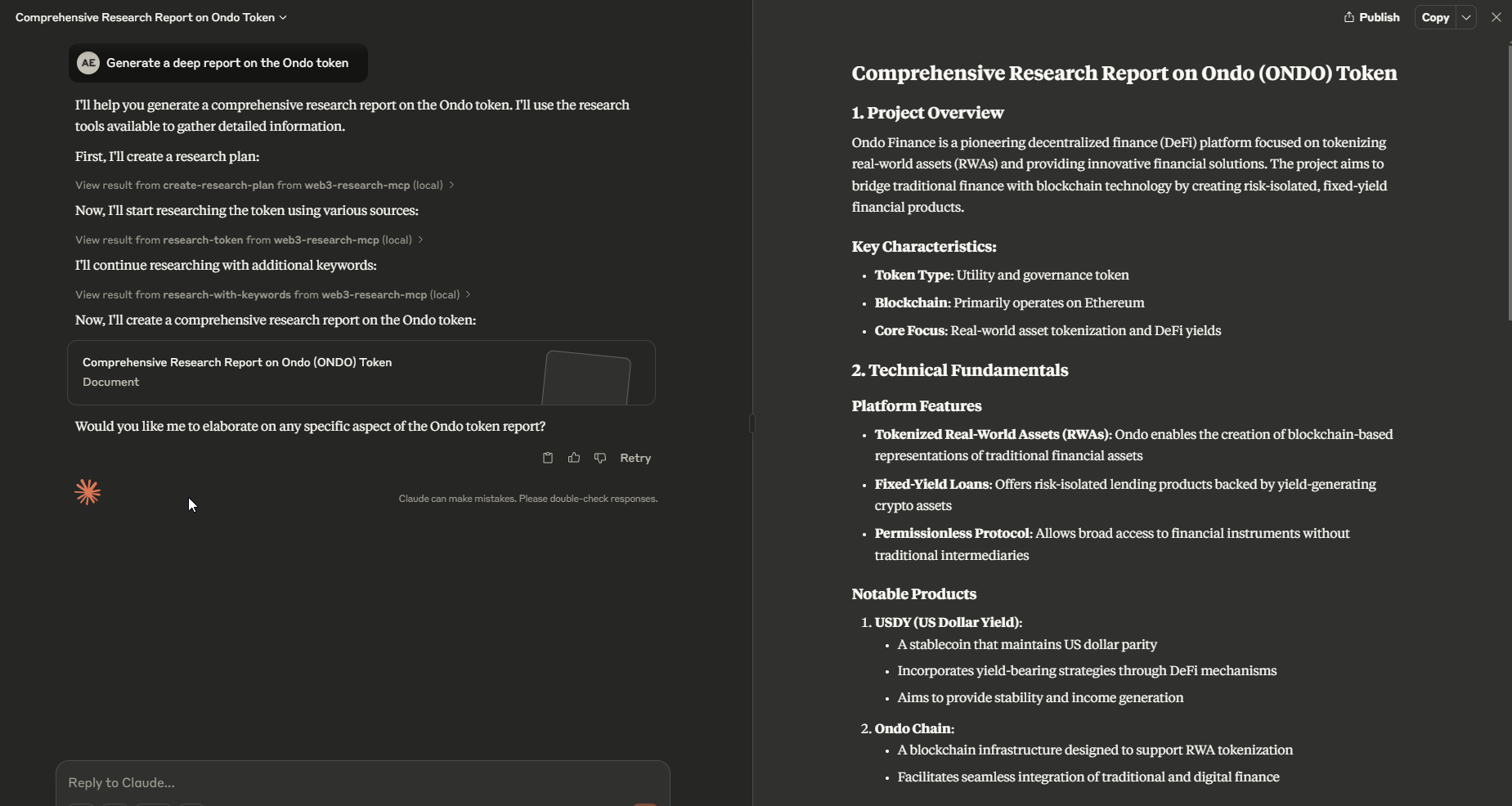
Preview Preview2

๐Ÿง  Features

  • Comprehensive Research: Gather detailed information about any cryptocurrency token

  • Multi-Source Analysis: Research across multiple sources including CoinGecko, CoinMarketCap, DeFiLlama, and more

  • Structured Reporting: Generate detailed reports covering technical fundamentals, market data, social sentiment, and more

  • Resource Management: Automatically stores search results and content for reference

  • Status Tracking: Track research progress through different stages and sections

Related MCP server: deeplook

๐Ÿ“‹ Requirements

  • Node.js (v16 or higher)

๐Ÿ”ง Installation & Setup

Installing via Smithery

To install web3-research-mcp for Claude Desktop automatically via Smithery:

npx -y @smithery/cli install web3-research-mcp --client claude

๐Ÿ”Œ Using with Claude Desktop

Edit your Claude Desktop config file

  • Windows: %APPDATA%\Claude\claude_desktop_config.json

  • macOS: ~/Library/Application Support/Claude/claude_desktop_config.json

Add this to your Claude Desktop configuration file:

{
  "mcpServers": {
    "web3-research-mcp": {
      "command": "npx",
      "args": ["-y", "web3-research-mcp@latest"]
    }
  }
}

Then restart Claude Desktop

๐Ÿ”Œ Using with Cursor

Go to: Settings -> Cursor Settings -> MCP -> Add new global MCP server Paste this into your Cursor ~/.cursor/mcp.json file. See Cursor MCP docs for more info.

{
  "mcpServers": {
    "web3-research-mcp": {
      "command": "npx",
      "args": ["-y", "web3-research-mcp@latest"]
    }
  }
}

Then restart Cursor

๐Ÿ› ๏ธ Tools

create-research-plan

Creates a structured research plan for a token.

Parameters:

  • tokenName: Full name of the token

  • tokenTicker: Ticker symbol of the token

Performs a web search and returns the results.

Parameters:

  • query: Search query

  • searchType: Type of search (web, news, images, videos)

research-with-keywords

Searches for a token with specific keywords and saves the results.

Parameters:

  • tokenName: Name of the token

  • tokenTicker: Ticker symbol

  • keywords: Array of keywords to search for

update-status

Updates the status of a research section.

Parameters:

  • section: Section name to update (e.g., 'projectInfo', 'technicalFundamentals')

  • status: New status for the section (planned, in_progress, completed)

fetch-content

Fetches content from a URL and saves it as a resource.

Parameters:

  • url: URL to fetch content from

  • format: Output format (text, html, markdown, json)

list-resources

Lists all available resources that have been saved.

search-source

Searches for information about a token from a specific source.

Parameters:

  • tokenName: Name of the token

  • tokenTicker: Ticker symbol

  • source: Source to search (e.g., 'CoinGecko', 'DeFiLlama', 'News')

research-source

Searches a specific source for a token and saves the top result's page content as a markdown resource.

Parameters:

  • tokenName: Name of the token

  • tokenTicker: Ticker symbol of the token

  • source: Source to research (e.g., 'IQ Wiki', 'CoinMarketCap')

coingecko-data

Fetches live market data directly from the CoinGecko public API โ€” price, market cap, 24h/7d/30d changes, ATH/ATL, circulating supply, contract addresses across chains, and social/dev links. Bypasses the 403 issues of HTML scraping.

Parameters:

  • tokenName: Full name of the token (e.g., 'Bitcoin')

  • tokenTicker: Ticker symbol (e.g., 'BTC')

No API key required. Uses the free public tier (~30 req/min).

Optional: set COINGECKO_API_KEY in the environment to use a CoinGecko Pro API key. When set, requests are sent to https://pro-api.coingecko.com/api/v3 with the x-cg-pro-api-key header. Requests time out after 15s.

Searches CoinGecko's coin index and returns candidate matches with their CoinGecko IDs. Useful when the ticker is ambiguous (e.g., multiple tokens with the same symbol).

Parameters:

  • query: Search query โ€” name, ticker, or contract address

coingecko-tickers

Fetches active exchange listings for a token from CoinGecko โ€” which CEXs/DEXs trade the pair, per-venue 24h USD volume, last price, bid-ask spread, trust score, and trade URL. Sorted by 24h USD volume desc; anomalies and stale prints are filtered out. Bypasses HTML scraping for the "where does this token actually trade" question.

Parameters:

  • tokenName: Full name of the token (e.g., 'Bitcoin')

  • tokenTicker: Ticker symbol (e.g., 'BTC')

  • limit: How many top venues to return (default 15, max 50)

No API key required. Uses the free public tier. Requests time out after 15s.

defillama-data

Fetches protocol data directly from the DeFiLlama public API โ€” total TVL, ATH TVL with date, 30/90/365-day TVL change vs current, market cap (when available โ€” DeFiLlama omits it for many protocols), per-chain TVL breakdown, fees (24h/7d/30d/all-time), token addresses, fundraising rounds, and links. Bypasses HTML scraping for the most common DeFi-protocol lookup.

Parameters:

  • tokenName: Full protocol/token name (e.g., 'Uniswap')

  • tokenTicker: Ticker symbol (e.g., 'UNI')

No API key required. Uses the free public API. Requests time out after 15s. The protocol index is cached for 5 minutes per process to avoid hammering /protocols on every call.

Searches DeFiLlama's protocol index and returns candidate matches with their slugs, TVL, and category. Useful when the ticker is ambiguous (e.g., multiple protocols with similar names).

Parameters:

  • query: Search query โ€” protocol name, ticker, or slug

๐Ÿ“ Prompts

token-research

Initiates comprehensive research on a cryptocurrency token.

Parameters:

  • tokenName: Full name of the cryptocurrency token

  • tokenTicker: Ticker symbol of the token (e.g., BTC, ETH)

๐Ÿง  How It Works

  1. When research begins, a structured plan is created covering all aspects of the token

  2. The server performs searches across multiple sources for information

  3. Search results are stored as resources that can be referenced

  4. The research progresses through different sections, with status tracking

  5. A comprehensive report is generated covering all aspects of the token

โš ๏ธ Limitations

  • Some websites block web scraping, so direct content fetching may fail with 403 errors

  • Relies on search results which may not always be comprehensive

  • Rate limits may apply to search operations

๐Ÿ“„ License

This project is licensed under the MIT License - see the LICENSE file for details.


Built by Aaron Elijah Mars, founder of Aeon and MiroShark ยท @aaronjmars

Available Tools

14 tools
coingecko-dataD
ParametersJSON Schema
NameRequiredDescriptionDefault
tokenNameYesFull name of the token (e.g., 'Bitcoin')
tokenTickerYesTicker symbol (e.g., 'BTC')

TDQS

D1/5.0
Behavior1/5

Does the description disclose side effects, auth requirements, rate limits, or destructive behavior?

Tool has no description.

Agents need to know what a tool does to the world before calling it. Descriptions should go beyond structured annotations to explain consequences.

Conciseness1/5

Is the description appropriately sized, front-loaded, and free of redundancy?

Tool has no description.

Shorter descriptions cost fewer tokens and are easier for agents to parse. Every sentence should earn its place.

Completeness1/5

Given the tool's complexity, does the description cover enough for an agent to succeed on first attempt?

Tool has no description.

Complex tools with many parameters or behaviors need more documentation. Simple tools need less. This dimension scales expectations accordingly.

Parameters1/5

Does the description clarify parameter syntax, constraints, interactions, or defaults beyond what the schema provides?

Tool has no description.

Input schemas describe structure but not intent. Descriptions should explain non-obvious parameter relationships and valid value ranges.

Purpose1/5

Does the description clearly state what the tool does and how it differs from similar tools?

Tool has no description.

Agents choose between tools based on descriptions. A clear purpose with a specific verb and resource helps agents select the right tool.

Usage Guidelines1/5

Does the description explain when to use this tool, when not to, or what alternatives exist?

Tool has no description.

Agents often have multiple tools that could apply. Explicit usage guidance like "use X instead of Y when Z" prevents misuse.

coingecko-tickersD
ParametersJSON Schema
NameRequiredDescriptionDefault
limitNoHow many top venues to return (sorted by 24h USD volume)
tokenNameYesFull name of the token (e.g., 'Bitcoin')
tokenTickerYesTicker symbol (e.g., 'BTC')

TDQS

D1/5.0
Behavior1/5

Does the description disclose side effects, auth requirements, rate limits, or destructive behavior?

Tool has no description.

Agents need to know what a tool does to the world before calling it. Descriptions should go beyond structured annotations to explain consequences.

Conciseness1/5

Is the description appropriately sized, front-loaded, and free of redundancy?

Tool has no description.

Shorter descriptions cost fewer tokens and are easier for agents to parse. Every sentence should earn its place.

Completeness1/5

Given the tool's complexity, does the description cover enough for an agent to succeed on first attempt?

Tool has no description.

Complex tools with many parameters or behaviors need more documentation. Simple tools need less. This dimension scales expectations accordingly.

Parameters1/5

Does the description clarify parameter syntax, constraints, interactions, or defaults beyond what the schema provides?

Tool has no description.

Input schemas describe structure but not intent. Descriptions should explain non-obvious parameter relationships and valid value ranges.

Purpose1/5

Does the description clearly state what the tool does and how it differs from similar tools?

Tool has no description.

Agents choose between tools based on descriptions. A clear purpose with a specific verb and resource helps agents select the right tool.

Usage Guidelines1/5

Does the description explain when to use this tool, when not to, or what alternatives exist?

Tool has no description.

Agents often have multiple tools that could apply. Explicit usage guidance like "use X instead of Y when Z" prevents misuse.

create-research-planD
ParametersJSON Schema
NameRequiredDescriptionDefault
tokenNameYesToken name
tokenTickerYesToken ticker symbol

TDQS

D1/5.0
Behavior1/5

Does the description disclose side effects, auth requirements, rate limits, or destructive behavior?

Tool has no description.

Agents need to know what a tool does to the world before calling it. Descriptions should go beyond structured annotations to explain consequences.

Conciseness1/5

Is the description appropriately sized, front-loaded, and free of redundancy?

Tool has no description.

Shorter descriptions cost fewer tokens and are easier for agents to parse. Every sentence should earn its place.

Completeness1/5

Given the tool's complexity, does the description cover enough for an agent to succeed on first attempt?

Tool has no description.

Complex tools with many parameters or behaviors need more documentation. Simple tools need less. This dimension scales expectations accordingly.

Parameters1/5

Does the description clarify parameter syntax, constraints, interactions, or defaults beyond what the schema provides?

Tool has no description.

Input schemas describe structure but not intent. Descriptions should explain non-obvious parameter relationships and valid value ranges.

Purpose1/5

Does the description clearly state what the tool does and how it differs from similar tools?

Tool has no description.

Agents choose between tools based on descriptions. A clear purpose with a specific verb and resource helps agents select the right tool.

Usage Guidelines1/5

Does the description explain when to use this tool, when not to, or what alternatives exist?

Tool has no description.

Agents often have multiple tools that could apply. Explicit usage guidance like "use X instead of Y when Z" prevents misuse.

defillama-dataD
ParametersJSON Schema
NameRequiredDescriptionDefault
tokenNameYesFull protocol/token name (e.g., 'Uniswap')
tokenTickerYesTicker symbol (e.g., 'UNI')

TDQS

D1/5.0
Behavior1/5

Does the description disclose side effects, auth requirements, rate limits, or destructive behavior?

Tool has no description.

Agents need to know what a tool does to the world before calling it. Descriptions should go beyond structured annotations to explain consequences.

Conciseness1/5

Is the description appropriately sized, front-loaded, and free of redundancy?

Tool has no description.

Shorter descriptions cost fewer tokens and are easier for agents to parse. Every sentence should earn its place.

Completeness1/5

Given the tool's complexity, does the description cover enough for an agent to succeed on first attempt?

Tool has no description.

Complex tools with many parameters or behaviors need more documentation. Simple tools need less. This dimension scales expectations accordingly.

Parameters1/5

Does the description clarify parameter syntax, constraints, interactions, or defaults beyond what the schema provides?

Tool has no description.

Input schemas describe structure but not intent. Descriptions should explain non-obvious parameter relationships and valid value ranges.

Purpose1/5

Does the description clearly state what the tool does and how it differs from similar tools?

Tool has no description.

Agents choose between tools based on descriptions. A clear purpose with a specific verb and resource helps agents select the right tool.

Usage Guidelines1/5

Does the description explain when to use this tool, when not to, or what alternatives exist?

Tool has no description.

Agents often have multiple tools that could apply. Explicit usage guidance like "use X instead of Y when Z" prevents misuse.

fetch-contentD
ParametersJSON Schema
NameRequiredDescriptionDefault
urlYesURL to fetch content from (can be a resource:// URL)
formatNoOutput formatmarkdown

TDQS

D1/5.0
Behavior1/5

Does the description disclose side effects, auth requirements, rate limits, or destructive behavior?

Tool has no description.

Agents need to know what a tool does to the world before calling it. Descriptions should go beyond structured annotations to explain consequences.

Conciseness1/5

Is the description appropriately sized, front-loaded, and free of redundancy?

Tool has no description.

Shorter descriptions cost fewer tokens and are easier for agents to parse. Every sentence should earn its place.

Completeness1/5

Given the tool's complexity, does the description cover enough for an agent to succeed on first attempt?

Tool has no description.

Complex tools with many parameters or behaviors need more documentation. Simple tools need less. This dimension scales expectations accordingly.

Parameters1/5

Does the description clarify parameter syntax, constraints, interactions, or defaults beyond what the schema provides?

Tool has no description.

Input schemas describe structure but not intent. Descriptions should explain non-obvious parameter relationships and valid value ranges.

Purpose1/5

Does the description clearly state what the tool does and how it differs from similar tools?

Tool has no description.

Agents choose between tools based on descriptions. A clear purpose with a specific verb and resource helps agents select the right tool.

Usage Guidelines1/5

Does the description explain when to use this tool, when not to, or what alternatives exist?

Tool has no description.

Agents often have multiple tools that could apply. Explicit usage guidance like "use X instead of Y when Z" prevents misuse.

list-resourcesD
ParametersJSON Schema
NameRequiredDescriptionDefault

No parameters

TDQS

D1/5.0
Behavior1/5

Does the description disclose side effects, auth requirements, rate limits, or destructive behavior?

Tool has no description.

Agents need to know what a tool does to the world before calling it. Descriptions should go beyond structured annotations to explain consequences.

Conciseness1/5

Is the description appropriately sized, front-loaded, and free of redundancy?

Tool has no description.

Shorter descriptions cost fewer tokens and are easier for agents to parse. Every sentence should earn its place.

Completeness1/5

Given the tool's complexity, does the description cover enough for an agent to succeed on first attempt?

Tool has no description.

Complex tools with many parameters or behaviors need more documentation. Simple tools need less. This dimension scales expectations accordingly.

Parameters1/5

Does the description clarify parameter syntax, constraints, interactions, or defaults beyond what the schema provides?

Tool has no description.

Input schemas describe structure but not intent. Descriptions should explain non-obvious parameter relationships and valid value ranges.

Purpose1/5

Does the description clearly state what the tool does and how it differs from similar tools?

Tool has no description.

Agents choose between tools based on descriptions. A clear purpose with a specific verb and resource helps agents select the right tool.

Usage Guidelines1/5

Does the description explain when to use this tool, when not to, or what alternatives exist?

Tool has no description.

Agents often have multiple tools that could apply. Explicit usage guidance like "use X instead of Y when Z" prevents misuse.

research-sourceD
ParametersJSON Schema
NameRequiredDescriptionDefault
sourceYesSingle source to research
tokenNameYesName of the token
tokenTickerYesTicker symbol of the token

TDQS

D1/5.0
Behavior1/5

Does the description disclose side effects, auth requirements, rate limits, or destructive behavior?

Tool has no description.

Agents need to know what a tool does to the world before calling it. Descriptions should go beyond structured annotations to explain consequences.

Conciseness1/5

Is the description appropriately sized, front-loaded, and free of redundancy?

Tool has no description.

Shorter descriptions cost fewer tokens and are easier for agents to parse. Every sentence should earn its place.

Completeness1/5

Given the tool's complexity, does the description cover enough for an agent to succeed on first attempt?

Tool has no description.

Complex tools with many parameters or behaviors need more documentation. Simple tools need less. This dimension scales expectations accordingly.

Parameters1/5

Does the description clarify parameter syntax, constraints, interactions, or defaults beyond what the schema provides?

Tool has no description.

Input schemas describe structure but not intent. Descriptions should explain non-obvious parameter relationships and valid value ranges.

Purpose1/5

Does the description clearly state what the tool does and how it differs from similar tools?

Tool has no description.

Agents choose between tools based on descriptions. A clear purpose with a specific verb and resource helps agents select the right tool.

Usage Guidelines1/5

Does the description explain when to use this tool, when not to, or what alternatives exist?

Tool has no description.

Agents often have multiple tools that could apply. Explicit usage guidance like "use X instead of Y when Z" prevents misuse.

research-tokenD
ParametersJSON Schema
NameRequiredDescriptionDefault
sourceYesSource to research (e.g., 'IQ Wiki', 'CoinMarketCap')
tokenNameYesName of the token
tokenTickerYesTicker symbol of the token

TDQS

D1/5.0
Behavior1/5

Does the description disclose side effects, auth requirements, rate limits, or destructive behavior?

Tool has no description.

Agents need to know what a tool does to the world before calling it. Descriptions should go beyond structured annotations to explain consequences.

Conciseness1/5

Is the description appropriately sized, front-loaded, and free of redundancy?

Tool has no description.

Shorter descriptions cost fewer tokens and are easier for agents to parse. Every sentence should earn its place.

Completeness1/5

Given the tool's complexity, does the description cover enough for an agent to succeed on first attempt?

Tool has no description.

Complex tools with many parameters or behaviors need more documentation. Simple tools need less. This dimension scales expectations accordingly.

Parameters1/5

Does the description clarify parameter syntax, constraints, interactions, or defaults beyond what the schema provides?

Tool has no description.

Input schemas describe structure but not intent. Descriptions should explain non-obvious parameter relationships and valid value ranges.

Purpose1/5

Does the description clearly state what the tool does and how it differs from similar tools?

Tool has no description.

Agents choose between tools based on descriptions. A clear purpose with a specific verb and resource helps agents select the right tool.

Usage Guidelines1/5

Does the description explain when to use this tool, when not to, or what alternatives exist?

Tool has no description.

Agents often have multiple tools that could apply. Explicit usage guidance like "use X instead of Y when Z" prevents misuse.

research-with-keywordsD
ParametersJSON Schema
NameRequiredDescriptionDefault
keywordsYesKeywords to search for
tokenNameYesName of the token
tokenTickerYesTicker symbol of the token

TDQS

D1/5.0
Behavior1/5

Does the description disclose side effects, auth requirements, rate limits, or destructive behavior?

Tool has no description.

Agents need to know what a tool does to the world before calling it. Descriptions should go beyond structured annotations to explain consequences.

Conciseness1/5

Is the description appropriately sized, front-loaded, and free of redundancy?

Tool has no description.

Shorter descriptions cost fewer tokens and are easier for agents to parse. Every sentence should earn its place.

Completeness1/5

Given the tool's complexity, does the description cover enough for an agent to succeed on first attempt?

Tool has no description.

Complex tools with many parameters or behaviors need more documentation. Simple tools need less. This dimension scales expectations accordingly.

Parameters1/5

Does the description clarify parameter syntax, constraints, interactions, or defaults beyond what the schema provides?

Tool has no description.

Input schemas describe structure but not intent. Descriptions should explain non-obvious parameter relationships and valid value ranges.

Purpose1/5

Does the description clearly state what the tool does and how it differs from similar tools?

Tool has no description.

Agents choose between tools based on descriptions. A clear purpose with a specific verb and resource helps agents select the right tool.

Usage Guidelines1/5

Does the description explain when to use this tool, when not to, or what alternatives exist?

Tool has no description.

Agents often have multiple tools that could apply. Explicit usage guidance like "use X instead of Y when Z" prevents misuse.

search-sourceD
ParametersJSON Schema
NameRequiredDescriptionDefault
sourceYesSource to search (e.g., 'Dune', 'IQ Wiki', 'News')
tokenNameYesName of the token
tokenTickerYesTicker symbol of the token

TDQS

D1/5.0
Behavior1/5

Does the description disclose side effects, auth requirements, rate limits, or destructive behavior?

Tool has no description.

Agents need to know what a tool does to the world before calling it. Descriptions should go beyond structured annotations to explain consequences.

Conciseness1/5

Is the description appropriately sized, front-loaded, and free of redundancy?

Tool has no description.

Shorter descriptions cost fewer tokens and are easier for agents to parse. Every sentence should earn its place.

Completeness1/5

Given the tool's complexity, does the description cover enough for an agent to succeed on first attempt?

Tool has no description.

Complex tools with many parameters or behaviors need more documentation. Simple tools need less. This dimension scales expectations accordingly.

Parameters1/5

Does the description clarify parameter syntax, constraints, interactions, or defaults beyond what the schema provides?

Tool has no description.

Input schemas describe structure but not intent. Descriptions should explain non-obvious parameter relationships and valid value ranges.

Purpose1/5

Does the description clearly state what the tool does and how it differs from similar tools?

Tool has no description.

Agents choose between tools based on descriptions. A clear purpose with a specific verb and resource helps agents select the right tool.

Usage Guidelines1/5

Does the description explain when to use this tool, when not to, or what alternatives exist?

Tool has no description.

Agents often have multiple tools that could apply. Explicit usage guidance like "use X instead of Y when Z" prevents misuse.

update-statusD
ParametersJSON Schema
NameRequiredDescriptionDefault
statusYesNew status for the section
sectionYesSection name to update (e.g., 'projectInfo', 'technicalFundamentals')

TDQS

D1/5.0
Behavior1/5

Does the description disclose side effects, auth requirements, rate limits, or destructive behavior?

Tool has no description.

Agents need to know what a tool does to the world before calling it. Descriptions should go beyond structured annotations to explain consequences.

Conciseness1/5

Is the description appropriately sized, front-loaded, and free of redundancy?

Tool has no description.

Shorter descriptions cost fewer tokens and are easier for agents to parse. Every sentence should earn its place.

Completeness1/5

Given the tool's complexity, does the description cover enough for an agent to succeed on first attempt?

Tool has no description.

Complex tools with many parameters or behaviors need more documentation. Simple tools need less. This dimension scales expectations accordingly.

Parameters1/5

Does the description clarify parameter syntax, constraints, interactions, or defaults beyond what the schema provides?

Tool has no description.

Input schemas describe structure but not intent. Descriptions should explain non-obvious parameter relationships and valid value ranges.

Purpose1/5

Does the description clearly state what the tool does and how it differs from similar tools?

Tool has no description.

Agents choose between tools based on descriptions. A clear purpose with a specific verb and resource helps agents select the right tool.

Usage Guidelines1/5

Does the description explain when to use this tool, when not to, or what alternatives exist?

Tool has no description.

Agents often have multiple tools that could apply. Explicit usage guidance like "use X instead of Y when Z" prevents misuse.

TDQS

D1.6/5.0
Disambiguation2/5

Multiple tools have unclear boundaries and overlapping purposes. 'search', 'search-source', 'research-with-keywords', and 'fetch-content' all appear to involve finding or retrieving information, making it difficult for an agent to choose the right tool. 'research-source' and 'research-token' might target different resources but lack descriptions to clarify their distinctness.

Naming Consistency3/5

The naming shows mixed conventions with some consistency. Most tools use kebab-case (e.g., 'create-research-plan'), but 'update-status' uses a different verb style compared to others. There's no clear verb_noun pattern throughout, as tools like 'search' and 'list-resources' vary in structure, though they remain readable.

Tool Count4/5

With 9 tools, the count is reasonable for a research-focused server. It's slightly on the higher side but still within a well-scoped range for handling various research tasks, assuming each tool serves a distinct purpose in the Web3 domain.

Completeness3/5

Inferring from tool names, the server covers research activities like planning, fetching, listing, and updating, but there are notable gaps. Without descriptions, it's unclear if there's full lifecycle coverage (e.g., deletion or analysis tools), and the overlap in search/research tools suggests potential redundancy rather than completeness.

Maintenance

ActivityActive
ResponsivenessResponsive

Resources

Unclaimed servers have limited discoverability.

Looking for Admin?

If you are the server author, to access and configure the admin panel.

Related MCP Connectors

Related MCP Servers

Latest Blog Posts

MCP directory API

We provide all the information about MCP servers via our MCP API.

curl -X GET 'https://glama.ai/api/mcp/v1/servers/aaronjmars/web3-research-mcp'

If you have feedback or need assistance with the MCP directory API, please join our Discord server