Web3 Research MCP
Web3 Research MCP
暗号資産のディープリサーチ - 無料かつ完全にローカルで動作 🧠
🚀 プレビュー

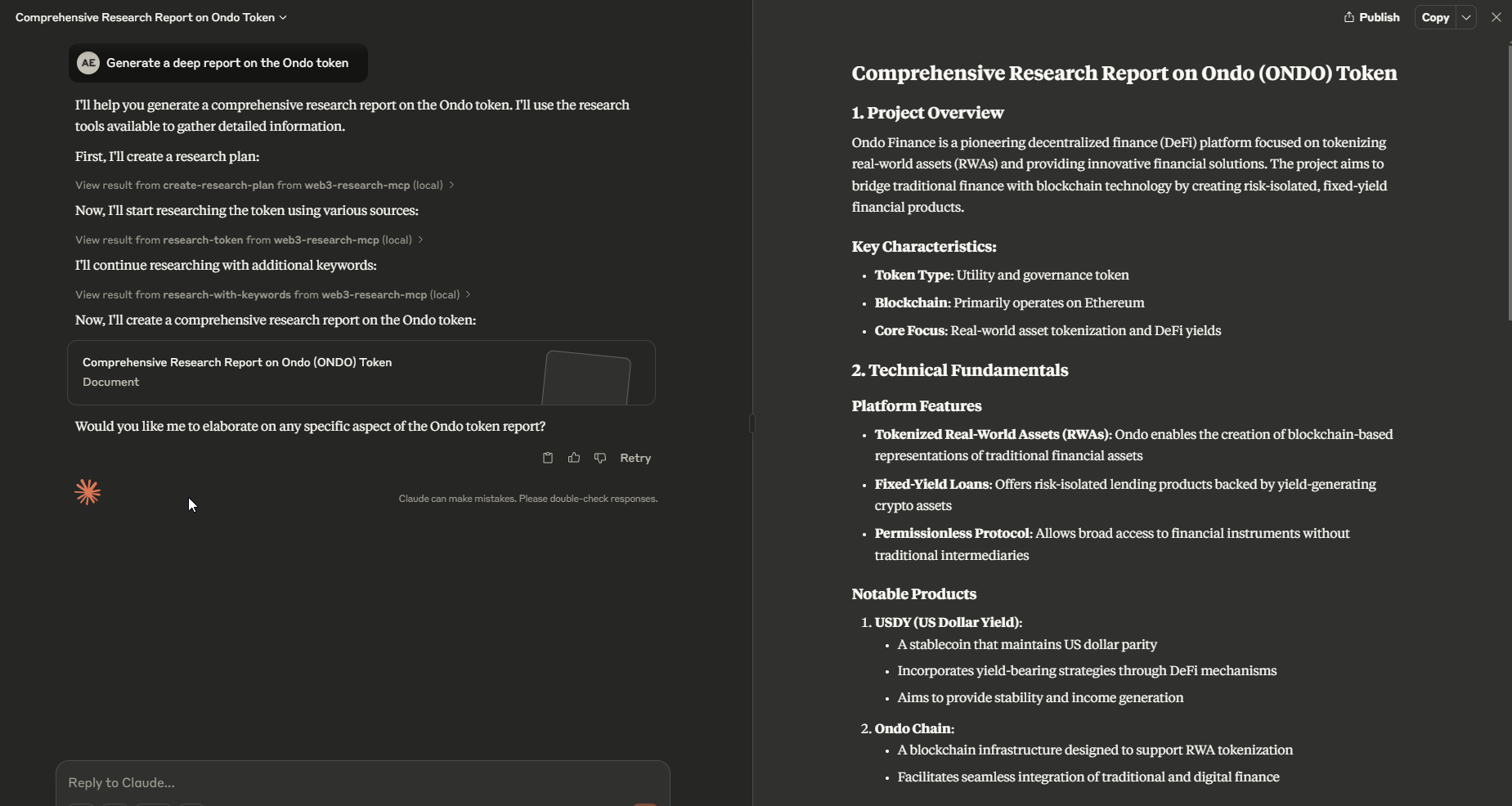
Related MCP server: deeplook
🧠 機能
包括的なリサーチ: あらゆる暗号資産トークンに関する詳細情報を収集
マルチソース分析: CoinGecko、CoinMarketCap、DeFiLlamaなど、複数のソースを横断してリサーチ
構造化レポート: 技術的ファンダメンタルズ、市場データ、ソーシャルセンチメントなどを網羅した詳細レポートを生成
リソース管理: 検索結果やコンテンツを自動的に保存し、参照可能にする
ステータス追跡: リサーチの進捗状況を段階やセクションごとに追跡
📋 要件
Node.js (v16以上)
🔧 インストールとセットアップ
Smithery経由でのインストール
Smithery を使用して、Claude Desktop用にweb3-research-mcpを自動インストールする方法:
npx -y @smithery/cli install web3-research-mcp --client claude🔌 Claude Desktopでの使用方法
Claude Desktopの設定ファイルを編集します
Windows: %APPDATA%\Claude\claude_desktop_config.json
macOS: ~/Library/Application Support/Claude/claude_desktop_config.json
Claude Desktopの設定ファイルに以下を追加してください:
{
"mcpServers": {
"web3-research-mcp": {
"command": "npx",
"args": ["-y", "web3-research-mcp@latest"]
}
}
}その後、Claude Desktopを再起動します
🔌 Cursorでの使用方法
設定画面へ移動: Settings -> Cursor Settings -> MCP -> Add new global MCP server
Cursorの ~/.cursor/mcp.json ファイルに以下を貼り付けます。詳細はCursorのMCPドキュメントを参照してください。
{
"mcpServers": {
"web3-research-mcp": {
"command": "npx",
"args": ["-y", "web3-research-mcp@latest"]
}
}
}その後、Cursorを再起動します
🛠️ ツール
create-research-plan
トークンの構造化されたリサーチ計画を作成します。
パラメータ:
tokenName: トークンのフルネーム
tokenTicker: トークンのティッカーシンボル
search
ウェブ検索を実行し、結果を返します。
パラメータ:
query: 検索クエリ
searchType: 検索タイプ (web, news, images, videos)
research-with-keywords
特定のキーワードでトークンを検索し、結果を保存します。
パラメータ:
tokenName: トークン名
tokenTicker: トークンのティッカーシンボル
keywords: 検索するキーワードの配列
update-status
リサーチセクションのステータスを更新します。
パラメータ:
section: 更新するセクション名 (例: 'projectInfo', 'technicalFundamentals')
status: セクションの新しいステータス (planned, in_progress, completed)
fetch-content
URLからコンテンツを取得し、リソースとして保存します。
パラメータ:
url: コンテンツを取得するURL
format: 出力形式 (text, html, markdown, json)
list-resources
保存されているすべてのリソースを一覧表示します。
search-source
特定のソースからトークンに関する情報を検索します。
パラメータ:
tokenName: トークン名
tokenTicker: トークンのティッカーシンボル
source: 検索するソース (例: 'CoinGecko', 'DeFiLlama', 'News')
coingecko-data
CoinGeckoの公開APIから直接、リアルタイムの市場データを取得します(価格、時価総額、24時間/7日/30日の変動率、ATH/ATL、循環供給量、チェーンごとのコントラクトアドレス、ソーシャル/開発リンク)。HTMLスクレイピングによる403エラーを回避します。
パラメータ:
tokenName: トークンのフルネーム (例: 'Bitcoin')
tokenTicker: トークンのティッカーシンボル (例: 'BTC')
APIキーは不要です。無料の公開ティア(約30リクエスト/分)を使用します。
オプション: 環境変数に COINGECKO_API_KEY を設定すると、CoinGecko Pro APIキーを使用できます。設定されている場合、リクエストは https://pro-api.coingecko.com/api/v3 に x-cg-pro-api-key ヘッダー付きで送信されます。リクエストは15秒でタイムアウトします。
coingecko-search
CoinGeckoのコインインデックスを検索し、候補となる一致結果とCoinGecko IDを返します。ティッカーが曖昧な場合(同じシンボルのトークンが複数ある場合など)に便利です。
パラメータ:
query: 検索クエリ — 名前、ティッカー、またはコントラクトアドレス
defillama-data
DeFiLlamaの公開APIから直接プロトコルデータを取得します(合計TVL、チェーンごとのTVL内訳、手数料(24時間/7日/30日/全期間)、トークンアドレス、資金調達ラウンド、リンク)。一般的なDeFiプロトコルの検索においてHTMLスクレイピングを回避します。
パラメータ:
tokenName: プロトコル/トークンのフルネーム (例: 'Uniswap')
tokenTicker: トークンのティッカーシンボル (例: 'UNI')
APIキーは不要です。無料の公開APIを使用します。リクエストは15秒でタイムアウトします。プロトコルインデックスは、呼び出しごとに /protocols を叩かないよう、プロセスごとに5分間キャッシュされます。
defillama-search
DeFiLlamaのプロトコルインデックスを検索し、候補となる一致結果とスラッグ、TVL、カテゴリを返します。ティッカーが曖昧な場合(似た名前のプロトコルが複数ある場合など)に便利です。
パラメータ:
query: 検索クエリ — プロトコル名、ティッカー、またはスラッグ
📝 プロンプト
token-research
暗号資産トークンに関する包括的なリサーチを開始します。
パラメータ:
tokenName: 暗号資産トークンのフルネーム
tokenTicker: トークンのティッカーシンボル (例: BTC, ETH)
🧠 仕組み
リサーチ開始時に、トークンのあらゆる側面を網羅する構造化された計画が作成されます
サーバーが複数のソースを横断して情報を検索します
検索結果は参照可能なリソースとして保存されます
リサーチはステータス追跡を行いながら、各セクションを進めていきます
トークンのあらゆる側面を網羅した包括的なレポートが生成されます
⚠️ 制限事項
一部のウェブサイトはウェブスクレイピングをブロックしているため、直接のコンテンツ取得が403エラーで失敗する場合があります
検索結果に依存しているため、常に包括的であるとは限りません
検索操作にはレート制限が適用される場合があります
📄 ライセンス
本プロジェクトはApache License 2.0の下でライセンスされています。詳細はLICENSEファイルを参照してください。
Available Tools
14 toolscoingecko-dataD
| Name | Required | Description | Default |
|---|---|---|---|
| tokenName | Yes | Full name of the token (e.g., 'Bitcoin') | |
| tokenTicker | Yes | Ticker symbol (e.g., 'BTC') |
TDQS
Does the description disclose side effects, auth requirements, rate limits, or destructive behavior?
Tool has no description.
Agents need to know what a tool does to the world before calling it. Descriptions should go beyond structured annotations to explain consequences.
Is the description appropriately sized, front-loaded, and free of redundancy?
Tool has no description.
Shorter descriptions cost fewer tokens and are easier for agents to parse. Every sentence should earn its place.
Given the tool's complexity, does the description cover enough for an agent to succeed on first attempt?
Tool has no description.
Complex tools with many parameters or behaviors need more documentation. Simple tools need less. This dimension scales expectations accordingly.
Does the description clarify parameter syntax, constraints, interactions, or defaults beyond what the schema provides?
Tool has no description.
Input schemas describe structure but not intent. Descriptions should explain non-obvious parameter relationships and valid value ranges.
Does the description clearly state what the tool does and how it differs from similar tools?
Tool has no description.
Agents choose between tools based on descriptions. A clear purpose with a specific verb and resource helps agents select the right tool.
Does the description explain when to use this tool, when not to, or what alternatives exist?
Tool has no description.
Agents often have multiple tools that could apply. Explicit usage guidance like "use X instead of Y when Z" prevents misuse.
coingecko-searchD
| Name | Required | Description | Default |
|---|---|---|---|
| query | Yes | Search query — name, ticker, or contract address. Returns candidate CoinGecko IDs. |
TDQS
Does the description disclose side effects, auth requirements, rate limits, or destructive behavior?
Tool has no description.
Agents need to know what a tool does to the world before calling it. Descriptions should go beyond structured annotations to explain consequences.
Is the description appropriately sized, front-loaded, and free of redundancy?
Tool has no description.
Shorter descriptions cost fewer tokens and are easier for agents to parse. Every sentence should earn its place.
Given the tool's complexity, does the description cover enough for an agent to succeed on first attempt?
Tool has no description.
Complex tools with many parameters or behaviors need more documentation. Simple tools need less. This dimension scales expectations accordingly.
Does the description clarify parameter syntax, constraints, interactions, or defaults beyond what the schema provides?
Tool has no description.
Input schemas describe structure but not intent. Descriptions should explain non-obvious parameter relationships and valid value ranges.
Does the description clearly state what the tool does and how it differs from similar tools?
Tool has no description.
Agents choose between tools based on descriptions. A clear purpose with a specific verb and resource helps agents select the right tool.
Does the description explain when to use this tool, when not to, or what alternatives exist?
Tool has no description.
Agents often have multiple tools that could apply. Explicit usage guidance like "use X instead of Y when Z" prevents misuse.
coingecko-tickersD
| Name | Required | Description | Default |
|---|---|---|---|
| limit | No | How many top venues to return (sorted by 24h USD volume) | |
| tokenName | Yes | Full name of the token (e.g., 'Bitcoin') | |
| tokenTicker | Yes | Ticker symbol (e.g., 'BTC') |
TDQS
Does the description disclose side effects, auth requirements, rate limits, or destructive behavior?
Tool has no description.
Agents need to know what a tool does to the world before calling it. Descriptions should go beyond structured annotations to explain consequences.
Is the description appropriately sized, front-loaded, and free of redundancy?
Tool has no description.
Shorter descriptions cost fewer tokens and are easier for agents to parse. Every sentence should earn its place.
Given the tool's complexity, does the description cover enough for an agent to succeed on first attempt?
Tool has no description.
Complex tools with many parameters or behaviors need more documentation. Simple tools need less. This dimension scales expectations accordingly.
Does the description clarify parameter syntax, constraints, interactions, or defaults beyond what the schema provides?
Tool has no description.
Input schemas describe structure but not intent. Descriptions should explain non-obvious parameter relationships and valid value ranges.
Does the description clearly state what the tool does and how it differs from similar tools?
Tool has no description.
Agents choose between tools based on descriptions. A clear purpose with a specific verb and resource helps agents select the right tool.
Does the description explain when to use this tool, when not to, or what alternatives exist?
Tool has no description.
Agents often have multiple tools that could apply. Explicit usage guidance like "use X instead of Y when Z" prevents misuse.
create-research-planD
| Name | Required | Description | Default |
|---|---|---|---|
| tokenName | Yes | Token name | |
| tokenTicker | Yes | Token ticker symbol |
TDQS
Does the description disclose side effects, auth requirements, rate limits, or destructive behavior?
Tool has no description.
Agents need to know what a tool does to the world before calling it. Descriptions should go beyond structured annotations to explain consequences.
Is the description appropriately sized, front-loaded, and free of redundancy?
Tool has no description.
Shorter descriptions cost fewer tokens and are easier for agents to parse. Every sentence should earn its place.
Given the tool's complexity, does the description cover enough for an agent to succeed on first attempt?
Tool has no description.
Complex tools with many parameters or behaviors need more documentation. Simple tools need less. This dimension scales expectations accordingly.
Does the description clarify parameter syntax, constraints, interactions, or defaults beyond what the schema provides?
Tool has no description.
Input schemas describe structure but not intent. Descriptions should explain non-obvious parameter relationships and valid value ranges.
Does the description clearly state what the tool does and how it differs from similar tools?
Tool has no description.
Agents choose between tools based on descriptions. A clear purpose with a specific verb and resource helps agents select the right tool.
Does the description explain when to use this tool, when not to, or what alternatives exist?
Tool has no description.
Agents often have multiple tools that could apply. Explicit usage guidance like "use X instead of Y when Z" prevents misuse.
defillama-dataD
| Name | Required | Description | Default |
|---|---|---|---|
| tokenName | Yes | Full protocol/token name (e.g., 'Uniswap') | |
| tokenTicker | Yes | Ticker symbol (e.g., 'UNI') |
TDQS
Does the description disclose side effects, auth requirements, rate limits, or destructive behavior?
Tool has no description.
Agents need to know what a tool does to the world before calling it. Descriptions should go beyond structured annotations to explain consequences.
Is the description appropriately sized, front-loaded, and free of redundancy?
Tool has no description.
Shorter descriptions cost fewer tokens and are easier for agents to parse. Every sentence should earn its place.
Given the tool's complexity, does the description cover enough for an agent to succeed on first attempt?
Tool has no description.
Complex tools with many parameters or behaviors need more documentation. Simple tools need less. This dimension scales expectations accordingly.
Does the description clarify parameter syntax, constraints, interactions, or defaults beyond what the schema provides?
Tool has no description.
Input schemas describe structure but not intent. Descriptions should explain non-obvious parameter relationships and valid value ranges.
Does the description clearly state what the tool does and how it differs from similar tools?
Tool has no description.
Agents choose between tools based on descriptions. A clear purpose with a specific verb and resource helps agents select the right tool.
Does the description explain when to use this tool, when not to, or what alternatives exist?
Tool has no description.
Agents often have multiple tools that could apply. Explicit usage guidance like "use X instead of Y when Z" prevents misuse.
defillama-searchD
| Name | Required | Description | Default |
|---|---|---|---|
| query | Yes | Search query — protocol name, ticker, or slug. Returns candidate DeFiLlama protocols with their slugs. |
TDQS
Does the description disclose side effects, auth requirements, rate limits, or destructive behavior?
Tool has no description.
Agents need to know what a tool does to the world before calling it. Descriptions should go beyond structured annotations to explain consequences.
Is the description appropriately sized, front-loaded, and free of redundancy?
Tool has no description.
Shorter descriptions cost fewer tokens and are easier for agents to parse. Every sentence should earn its place.
Given the tool's complexity, does the description cover enough for an agent to succeed on first attempt?
Tool has no description.
Complex tools with many parameters or behaviors need more documentation. Simple tools need less. This dimension scales expectations accordingly.
Does the description clarify parameter syntax, constraints, interactions, or defaults beyond what the schema provides?
Tool has no description.
Input schemas describe structure but not intent. Descriptions should explain non-obvious parameter relationships and valid value ranges.
Does the description clearly state what the tool does and how it differs from similar tools?
Tool has no description.
Agents choose between tools based on descriptions. A clear purpose with a specific verb and resource helps agents select the right tool.
Does the description explain when to use this tool, when not to, or what alternatives exist?
Tool has no description.
Agents often have multiple tools that could apply. Explicit usage guidance like "use X instead of Y when Z" prevents misuse.
fetch-contentD
| Name | Required | Description | Default |
|---|---|---|---|
| url | Yes | URL to fetch content from (can be a resource:// URL) | |
| format | No | Output format | markdown |
TDQS
Does the description disclose side effects, auth requirements, rate limits, or destructive behavior?
Tool has no description.
Agents need to know what a tool does to the world before calling it. Descriptions should go beyond structured annotations to explain consequences.
Is the description appropriately sized, front-loaded, and free of redundancy?
Tool has no description.
Shorter descriptions cost fewer tokens and are easier for agents to parse. Every sentence should earn its place.
Given the tool's complexity, does the description cover enough for an agent to succeed on first attempt?
Tool has no description.
Complex tools with many parameters or behaviors need more documentation. Simple tools need less. This dimension scales expectations accordingly.
Does the description clarify parameter syntax, constraints, interactions, or defaults beyond what the schema provides?
Tool has no description.
Input schemas describe structure but not intent. Descriptions should explain non-obvious parameter relationships and valid value ranges.
Does the description clearly state what the tool does and how it differs from similar tools?
Tool has no description.
Agents choose between tools based on descriptions. A clear purpose with a specific verb and resource helps agents select the right tool.
Does the description explain when to use this tool, when not to, or what alternatives exist?
Tool has no description.
Agents often have multiple tools that could apply. Explicit usage guidance like "use X instead of Y when Z" prevents misuse.
list-resourcesD
| Name | Required | Description | Default |
|---|---|---|---|
No parameters | |||
TDQS
Does the description disclose side effects, auth requirements, rate limits, or destructive behavior?
Tool has no description.
Agents need to know what a tool does to the world before calling it. Descriptions should go beyond structured annotations to explain consequences.
Is the description appropriately sized, front-loaded, and free of redundancy?
Tool has no description.
Shorter descriptions cost fewer tokens and are easier for agents to parse. Every sentence should earn its place.
Given the tool's complexity, does the description cover enough for an agent to succeed on first attempt?
Tool has no description.
Complex tools with many parameters or behaviors need more documentation. Simple tools need less. This dimension scales expectations accordingly.
Does the description clarify parameter syntax, constraints, interactions, or defaults beyond what the schema provides?
Tool has no description.
Input schemas describe structure but not intent. Descriptions should explain non-obvious parameter relationships and valid value ranges.
Does the description clearly state what the tool does and how it differs from similar tools?
Tool has no description.
Agents choose between tools based on descriptions. A clear purpose with a specific verb and resource helps agents select the right tool.
Does the description explain when to use this tool, when not to, or what alternatives exist?
Tool has no description.
Agents often have multiple tools that could apply. Explicit usage guidance like "use X instead of Y when Z" prevents misuse.
research-sourceD
| Name | Required | Description | Default |
|---|---|---|---|
| source | Yes | Single source to research | |
| tokenName | Yes | Name of the token | |
| tokenTicker | Yes | Ticker symbol of the token |
TDQS
Does the description disclose side effects, auth requirements, rate limits, or destructive behavior?
Tool has no description.
Agents need to know what a tool does to the world before calling it. Descriptions should go beyond structured annotations to explain consequences.
Is the description appropriately sized, front-loaded, and free of redundancy?
Tool has no description.
Shorter descriptions cost fewer tokens and are easier for agents to parse. Every sentence should earn its place.
Given the tool's complexity, does the description cover enough for an agent to succeed on first attempt?
Tool has no description.
Complex tools with many parameters or behaviors need more documentation. Simple tools need less. This dimension scales expectations accordingly.
Does the description clarify parameter syntax, constraints, interactions, or defaults beyond what the schema provides?
Tool has no description.
Input schemas describe structure but not intent. Descriptions should explain non-obvious parameter relationships and valid value ranges.
Does the description clearly state what the tool does and how it differs from similar tools?
Tool has no description.
Agents choose between tools based on descriptions. A clear purpose with a specific verb and resource helps agents select the right tool.
Does the description explain when to use this tool, when not to, or what alternatives exist?
Tool has no description.
Agents often have multiple tools that could apply. Explicit usage guidance like "use X instead of Y when Z" prevents misuse.
research-tokenD
| Name | Required | Description | Default |
|---|---|---|---|
| source | Yes | Source to research (e.g., 'IQ Wiki', 'CoinMarketCap') | |
| tokenName | Yes | Name of the token | |
| tokenTicker | Yes | Ticker symbol of the token |
TDQS
Does the description disclose side effects, auth requirements, rate limits, or destructive behavior?
Tool has no description.
Agents need to know what a tool does to the world before calling it. Descriptions should go beyond structured annotations to explain consequences.
Is the description appropriately sized, front-loaded, and free of redundancy?
Tool has no description.
Shorter descriptions cost fewer tokens and are easier for agents to parse. Every sentence should earn its place.
Given the tool's complexity, does the description cover enough for an agent to succeed on first attempt?
Tool has no description.
Complex tools with many parameters or behaviors need more documentation. Simple tools need less. This dimension scales expectations accordingly.
Does the description clarify parameter syntax, constraints, interactions, or defaults beyond what the schema provides?
Tool has no description.
Input schemas describe structure but not intent. Descriptions should explain non-obvious parameter relationships and valid value ranges.
Does the description clearly state what the tool does and how it differs from similar tools?
Tool has no description.
Agents choose between tools based on descriptions. A clear purpose with a specific verb and resource helps agents select the right tool.
Does the description explain when to use this tool, when not to, or what alternatives exist?
Tool has no description.
Agents often have multiple tools that could apply. Explicit usage guidance like "use X instead of Y when Z" prevents misuse.
research-with-keywordsD
| Name | Required | Description | Default |
|---|---|---|---|
| keywords | Yes | Keywords to search for | |
| tokenName | Yes | Name of the token | |
| tokenTicker | Yes | Ticker symbol of the token |
TDQS
Does the description disclose side effects, auth requirements, rate limits, or destructive behavior?
Tool has no description.
Agents need to know what a tool does to the world before calling it. Descriptions should go beyond structured annotations to explain consequences.
Is the description appropriately sized, front-loaded, and free of redundancy?
Tool has no description.
Shorter descriptions cost fewer tokens and are easier for agents to parse. Every sentence should earn its place.
Given the tool's complexity, does the description cover enough for an agent to succeed on first attempt?
Tool has no description.
Complex tools with many parameters or behaviors need more documentation. Simple tools need less. This dimension scales expectations accordingly.
Does the description clarify parameter syntax, constraints, interactions, or defaults beyond what the schema provides?
Tool has no description.
Input schemas describe structure but not intent. Descriptions should explain non-obvious parameter relationships and valid value ranges.
Does the description clearly state what the tool does and how it differs from similar tools?
Tool has no description.
Agents choose between tools based on descriptions. A clear purpose with a specific verb and resource helps agents select the right tool.
Does the description explain when to use this tool, when not to, or what alternatives exist?
Tool has no description.
Agents often have multiple tools that could apply. Explicit usage guidance like "use X instead of Y when Z" prevents misuse.
searchD
| Name | Required | Description | Default |
|---|---|---|---|
| query | Yes | Search query | |
| searchType | No | Type of search | web |
TDQS
Does the description disclose side effects, auth requirements, rate limits, or destructive behavior?
Tool has no description.
Agents need to know what a tool does to the world before calling it. Descriptions should go beyond structured annotations to explain consequences.
Is the description appropriately sized, front-loaded, and free of redundancy?
Tool has no description.
Shorter descriptions cost fewer tokens and are easier for agents to parse. Every sentence should earn its place.
Given the tool's complexity, does the description cover enough for an agent to succeed on first attempt?
Tool has no description.
Complex tools with many parameters or behaviors need more documentation. Simple tools need less. This dimension scales expectations accordingly.
Does the description clarify parameter syntax, constraints, interactions, or defaults beyond what the schema provides?
Tool has no description.
Input schemas describe structure but not intent. Descriptions should explain non-obvious parameter relationships and valid value ranges.
Does the description clearly state what the tool does and how it differs from similar tools?
Tool has no description.
Agents choose between tools based on descriptions. A clear purpose with a specific verb and resource helps agents select the right tool.
Does the description explain when to use this tool, when not to, or what alternatives exist?
Tool has no description.
Agents often have multiple tools that could apply. Explicit usage guidance like "use X instead of Y when Z" prevents misuse.
search-sourceD
| Name | Required | Description | Default |
|---|---|---|---|
| source | Yes | Source to search (e.g., 'Dune', 'IQ Wiki', 'News') | |
| tokenName | Yes | Name of the token | |
| tokenTicker | Yes | Ticker symbol of the token |
TDQS
Does the description disclose side effects, auth requirements, rate limits, or destructive behavior?
Tool has no description.
Agents need to know what a tool does to the world before calling it. Descriptions should go beyond structured annotations to explain consequences.
Is the description appropriately sized, front-loaded, and free of redundancy?
Tool has no description.
Shorter descriptions cost fewer tokens and are easier for agents to parse. Every sentence should earn its place.
Given the tool's complexity, does the description cover enough for an agent to succeed on first attempt?
Tool has no description.
Complex tools with many parameters or behaviors need more documentation. Simple tools need less. This dimension scales expectations accordingly.
Does the description clarify parameter syntax, constraints, interactions, or defaults beyond what the schema provides?
Tool has no description.
Input schemas describe structure but not intent. Descriptions should explain non-obvious parameter relationships and valid value ranges.
Does the description clearly state what the tool does and how it differs from similar tools?
Tool has no description.
Agents choose between tools based on descriptions. A clear purpose with a specific verb and resource helps agents select the right tool.
Does the description explain when to use this tool, when not to, or what alternatives exist?
Tool has no description.
Agents often have multiple tools that could apply. Explicit usage guidance like "use X instead of Y when Z" prevents misuse.
update-statusD
| Name | Required | Description | Default |
|---|---|---|---|
| status | Yes | New status for the section | |
| section | Yes | Section name to update (e.g., 'projectInfo', 'technicalFundamentals') |
TDQS
Does the description disclose side effects, auth requirements, rate limits, or destructive behavior?
Tool has no description.
Agents need to know what a tool does to the world before calling it. Descriptions should go beyond structured annotations to explain consequences.
Is the description appropriately sized, front-loaded, and free of redundancy?
Tool has no description.
Shorter descriptions cost fewer tokens and are easier for agents to parse. Every sentence should earn its place.
Given the tool's complexity, does the description cover enough for an agent to succeed on first attempt?
Tool has no description.
Complex tools with many parameters or behaviors need more documentation. Simple tools need less. This dimension scales expectations accordingly.
Does the description clarify parameter syntax, constraints, interactions, or defaults beyond what the schema provides?
Tool has no description.
Input schemas describe structure but not intent. Descriptions should explain non-obvious parameter relationships and valid value ranges.
Does the description clearly state what the tool does and how it differs from similar tools?
Tool has no description.
Agents choose between tools based on descriptions. A clear purpose with a specific verb and resource helps agents select the right tool.
Does the description explain when to use this tool, when not to, or what alternatives exist?
Tool has no description.
Agents often have multiple tools that could apply. Explicit usage guidance like "use X instead of Y when Z" prevents misuse.
Tool Schema Changelog
Recent tool additions, removals, and schema changes observed during successful MCP inspections.
5 tool updates
v1.0.4- Added
coingecko-data - Added
coingecko-search - Added
coingecko-tickers - Added
defillama-data - Added
defillama-search
1 tool update
v1.0.0- Changed
list-resources1 field changed- removed
Input schema / additionalPropertiesRemoved value: -false
9 tool updates
- First observed
create-research-plan - First observed
fetch-content - First observed
list-resources - First observed
research-source - First observed
research-token - First observed
research-with-keywords - First observed
search - First observed
search-source - First observed
update-status
TDQS
Scored across 14 tools
Multiple tools appear to serve overlapping purposes: 'search', 'search-source', 'coingecko-search', and 'defillama-search' are hard to distinguish by name alone. Similarly, 'research-source', 'research-token', and 'research-with-keywords' blur together without descriptions to clarify their exact roles.
Tool names mix kebab-case verbs like 'fetch-content' and 'create-research-plan' with noun-only names like 'coingecko-data' and 'defillama-search', plus a bare generic 'search'. There is no consistent verb_noun or domain-prefixed pattern across the set.
Fourteen tools is within a reasonable range for a research-oriented server, but several names appear to cover nearly identical actions, making the set feel padded. The count itself is not extreme, but the apparent duplication reduces the sense that each tool earns its place.
The set covers a plausible web3 research workflow: planning, searching, fetching content, researching tokens/sources, status updates, and pulling market data. However, there are notable gaps in explicit output/result management and no clear end-to-end lifecycle, making completeness mediocre.
Maintenance
Related MCP Connectors
Multi-LLM AI Research & Analysis — smart routing, consensus analysis, due diligence reports
Evidence-backed crypto due diligence with sources, freshness, and a runtime receipt on every call.
Agentic AI runtime: persistent memory, vault, autonomous agents, deep research, DeFi execution.
Signed BTC and macro market intelligence for autonomous research, risk, and trading agents.
Related MCP Servers
- AlicenseDqualityDmaintenanceEnables deep research into cryptocurrency tokens by gathering data from multiple sources like CoinGecko and DeFiLlama to generate structured reports. It allows users to track research progress, fetch web content, and manage resources locally for comprehensive crypto analysis.995 npm4Apache 2.0
- AlicenseAqualityCmaintenanceResearches any company in ~10 seconds using 10 data sources. Returns structured reports with bull/bear verdict for stocks, crypto, and private companies.212AGPL 3.0
- FlicenseAqualityDmaintenanceProvides real-time Web3 research digest with macro news, KOL sentiment, market data, and personalized on-chain wallet analysis through four AI tools.4-
- AlicenseBqualityDmaintenanceProvides AI agents with research tools for AI agent ecosystem analysis, DeFi protocol analysis, and general market research.329 npmMIT