Glama

Web3 Research MCP

Deep Research für Krypto - kostenlos & vollständig lokal 🧠

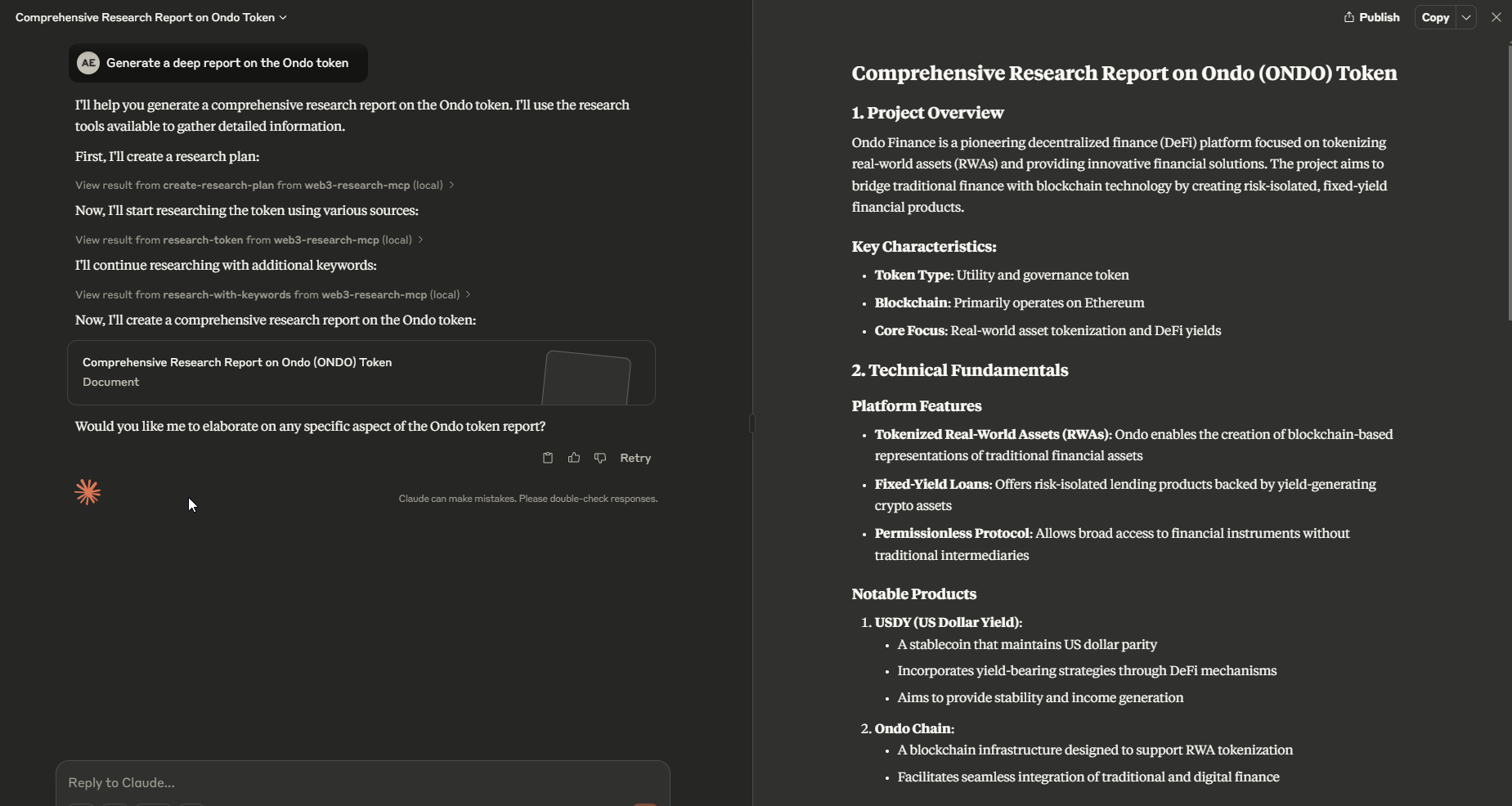
🚀 Vorschau

Vorschau Vorschau2

Related MCP server: deeplook

🧠 Funktionen

  • Umfassende Recherche: Sammeln Sie detaillierte Informationen zu jedem Kryptowährungs-Token

  • Multi-Quellen-Analyse: Recherche über mehrere Quellen hinweg, einschließlich CoinGecko, CoinMarketCap, DeFiLlama und mehr

  • Strukturierte Berichterstattung: Erstellen Sie detaillierte Berichte zu technischen Grundlagen, Marktdaten, sozialer Stimmung und mehr

  • Ressourcenverwaltung: Speichert Suchergebnisse und Inhalte automatisch als Referenz

  • Statusverfolgung: Verfolgen Sie den Forschungsfortschritt durch verschiedene Phasen und Abschnitte

📋 Anforderungen

  • Node.js (v16 oder höher)

🔧 Installation & Einrichtung

Installation über Smithery

Um web3-research-mcp automatisch für Claude Desktop über Smithery zu installieren:

npx -y @smithery/cli install web3-research-mcp --client claude

🔌 Verwendung mit Claude Desktop

Bearbeiten Sie Ihre Claude Desktop-Konfigurationsdatei

  • Windows: %APPDATA%\Claude\claude_desktop_config.json

  • macOS: ~/Library/Application Support/Claude/claude_desktop_config.json

Fügen Sie dies Ihrer Claude Desktop-Konfigurationsdatei hinzu:

{
  "mcpServers": {
    "web3-research-mcp": {
      "command": "npx",
      "args": ["-y", "web3-research-mcp@latest"]
    }
  }
}

Starten Sie anschließend Claude Desktop neu

🔌 Verwendung mit Cursor

Gehen Sie zu: Settings -> Cursor Settings -> MCP -> Add new global MCP server Fügen Sie dies in Ihre Cursor ~/.cursor/mcp.json Datei ein. Weitere Informationen finden Sie in der Cursor MCP-Dokumentation.

{
  "mcpServers": {
    "web3-research-mcp": {
      "command": "npx",
      "args": ["-y", "web3-research-mcp@latest"]
    }
  }
}

Starten Sie anschließend Cursor neu

🛠️ Tools

create-research-plan

Erstellt einen strukturierten Forschungsplan für einen Token.

Parameter:

  • tokenName: Vollständiger Name des Tokens

  • tokenTicker: Ticker-Symbol des Tokens

Führt eine Websuche durch und gibt die Ergebnisse zurück.

Parameter:

  • query: Suchanfrage

  • searchType: Art der Suche (web, news, images, videos)

research-with-keywords

Sucht nach einem Token mit spezifischen Schlüsselwörtern und speichert die Ergebnisse.

Parameter:

  • tokenName: Name des Tokens

  • tokenTicker: Ticker-Symbol

  • keywords: Array von Suchbegriffen

update-status

Aktualisiert den Status eines Forschungsabschnitts.

Parameter:

  • section: Name des zu aktualisierenden Abschnitts (z. B. 'projectInfo', 'technicalFundamentals')

  • status: Neuer Status für den Abschnitt (planned, in_progress, completed)

fetch-content

Ruft Inhalte von einer URL ab und speichert sie als Ressource.

Parameter:

  • url: URL, von der Inhalte abgerufen werden sollen

  • format: Ausgabeformat (text, html, markdown, json)

list-resources

Listet alle verfügbaren gespeicherten Ressourcen auf.

search-source

Sucht nach Informationen über einen Token aus einer bestimmten Quelle.

Parameter:

  • tokenName: Name des Tokens

  • tokenTicker: Ticker-Symbol

  • source: Zu durchsuchende Quelle (z. B. 'CoinGecko', 'DeFiLlama', 'News')

coingecko-data

Ruft Live-Marktdaten direkt von der öffentlichen CoinGecko-API ab – Preis, Marktkapitalisierung, 24h/7d/30d-Änderungen, ATH/ATL, zirkulierendes Angebot, Vertragsadressen über verschiedene Chains hinweg sowie soziale/Entwickler-Links. Umgeht die 403-Probleme des HTML-Scrapings.

Parameter:

  • tokenName: Vollständiger Name des Tokens (z. B. 'Bitcoin')

  • tokenTicker: Ticker-Symbol (z. B. 'BTC')

Kein API-Schlüssel erforderlich. Nutzt die kostenlose öffentliche Stufe (~30 Anfragen/Min.).

Optional: Setzen Sie COINGECKO_API_KEY in der Umgebung, um einen CoinGecko Pro API-Schlüssel zu verwenden. Wenn dieser gesetzt ist, werden Anfragen an https://pro-api.coingecko.com/api/v3 mit dem x-cg-pro-api-key-Header gesendet. Anfragen haben ein Zeitlimit von 15 Sekunden.

Durchsucht den Coin-Index von CoinGecko und gibt Treffer mit ihren CoinGecko-IDs zurück. Nützlich, wenn der Ticker mehrdeutig ist (z. B. mehrere Token mit demselben Symbol).

Parameter:

  • query: Suchanfrage – Name, Ticker oder Vertragsadresse

defillama-data

Ruft Protokolldaten direkt von der öffentlichen DeFiLlama-API ab – gesamte TVL, TVL-Aufschlüsselung pro Chain, Gebühren (24h/7d/30d/all-time), Token-Adressen, Finanzierungsrunden und Links. Umgeht HTML-Scraping für die gängigsten DeFi-Protokoll-Abfragen.

Parameter:

  • tokenName: Vollständiger Protokoll-/Token-Name (z. B. 'Uniswap')

  • tokenTicker: Ticker-Symbol (z. B. 'UNI')

Kein API-Schlüssel erforderlich. Nutzt die kostenlose öffentliche API. Anfragen haben ein Zeitlimit von 15 Sekunden. Der Protokoll-Index wird pro Prozess für 5 Minuten zwischengespeichert, um ein Überlasten von /protocols bei jedem Aufruf zu vermeiden.

Durchsucht den Protokoll-Index von DeFiLlama und gibt Treffer mit ihren Slugs, TVL und Kategorien zurück. Nützlich, wenn der Ticker mehrdeutig ist (z. B. mehrere Protokolle mit ähnlichen Namen).

Parameter:

  • query: Suchanfrage – Protokollname, Ticker oder Slug

📝 Prompts

token-research

Initiiert eine umfassende Recherche zu einem Kryptowährungs-Token.

Parameter:

  • tokenName: Vollständiger Name des Kryptowährungs-Tokens

  • tokenTicker: Ticker-Symbol des Tokens (z. B. BTC, ETH)

🧠 Funktionsweise

  1. Wenn die Recherche beginnt, wird ein strukturierter Plan erstellt, der alle Aspekte des Tokens abdeckt

  2. Der Server führt Suchen über mehrere Quellen hinweg durch, um Informationen zu erhalten

  3. Suchergebnisse werden als Ressourcen gespeichert, auf die verwiesen werden kann

  4. Die Recherche schreitet durch verschiedene Abschnitte voran, wobei der Status verfolgt wird

  5. Ein umfassender Bericht wird erstellt, der alle Aspekte des Tokens abdeckt

⚠️ Einschränkungen

  • Einige Websites blockieren Web-Scraping, daher kann das direkte Abrufen von Inhalten mit 403-Fehlern fehlschlagen

  • Basiert auf Suchergebnissen, die möglicherweise nicht immer vollständig sind

  • Für Suchvorgänge können Ratenbegrenzungen gelten

📄 Lizenz

Dieses Projekt ist unter der Apache License 2.0 lizenziert – siehe die LICENSE-Datei für Details.

Available Tools

14 tools
coingecko-dataD
ParametersJSON Schema
NameRequiredDescriptionDefault
tokenNameYesFull name of the token (e.g., 'Bitcoin')
tokenTickerYesTicker symbol (e.g., 'BTC')

TDQS

D1/5.0
Behavior1/5

Does the description disclose side effects, auth requirements, rate limits, or destructive behavior?

Tool has no description.

Agents need to know what a tool does to the world before calling it. Descriptions should go beyond structured annotations to explain consequences.

Conciseness1/5

Is the description appropriately sized, front-loaded, and free of redundancy?

Tool has no description.

Shorter descriptions cost fewer tokens and are easier for agents to parse. Every sentence should earn its place.

Completeness1/5

Given the tool's complexity, does the description cover enough for an agent to succeed on first attempt?

Tool has no description.

Complex tools with many parameters or behaviors need more documentation. Simple tools need less. This dimension scales expectations accordingly.

Parameters1/5

Does the description clarify parameter syntax, constraints, interactions, or defaults beyond what the schema provides?

Tool has no description.

Input schemas describe structure but not intent. Descriptions should explain non-obvious parameter relationships and valid value ranges.

Purpose1/5

Does the description clearly state what the tool does and how it differs from similar tools?

Tool has no description.

Agents choose between tools based on descriptions. A clear purpose with a specific verb and resource helps agents select the right tool.

Usage Guidelines1/5

Does the description explain when to use this tool, when not to, or what alternatives exist?

Tool has no description.

Agents often have multiple tools that could apply. Explicit usage guidance like "use X instead of Y when Z" prevents misuse.

coingecko-tickersD
ParametersJSON Schema
NameRequiredDescriptionDefault
limitNoHow many top venues to return (sorted by 24h USD volume)
tokenNameYesFull name of the token (e.g., 'Bitcoin')
tokenTickerYesTicker symbol (e.g., 'BTC')

TDQS

D1/5.0
Behavior1/5

Does the description disclose side effects, auth requirements, rate limits, or destructive behavior?

Tool has no description.

Agents need to know what a tool does to the world before calling it. Descriptions should go beyond structured annotations to explain consequences.

Conciseness1/5

Is the description appropriately sized, front-loaded, and free of redundancy?

Tool has no description.

Shorter descriptions cost fewer tokens and are easier for agents to parse. Every sentence should earn its place.

Completeness1/5

Given the tool's complexity, does the description cover enough for an agent to succeed on first attempt?

Tool has no description.

Complex tools with many parameters or behaviors need more documentation. Simple tools need less. This dimension scales expectations accordingly.

Parameters1/5

Does the description clarify parameter syntax, constraints, interactions, or defaults beyond what the schema provides?

Tool has no description.

Input schemas describe structure but not intent. Descriptions should explain non-obvious parameter relationships and valid value ranges.

Purpose1/5

Does the description clearly state what the tool does and how it differs from similar tools?

Tool has no description.

Agents choose between tools based on descriptions. A clear purpose with a specific verb and resource helps agents select the right tool.

Usage Guidelines1/5

Does the description explain when to use this tool, when not to, or what alternatives exist?

Tool has no description.

Agents often have multiple tools that could apply. Explicit usage guidance like "use X instead of Y when Z" prevents misuse.

create-research-planD
ParametersJSON Schema
NameRequiredDescriptionDefault
tokenNameYesToken name
tokenTickerYesToken ticker symbol

TDQS

D1/5.0
Behavior1/5

Does the description disclose side effects, auth requirements, rate limits, or destructive behavior?

Tool has no description.

Agents need to know what a tool does to the world before calling it. Descriptions should go beyond structured annotations to explain consequences.

Conciseness1/5

Is the description appropriately sized, front-loaded, and free of redundancy?

Tool has no description.

Shorter descriptions cost fewer tokens and are easier for agents to parse. Every sentence should earn its place.

Completeness1/5

Given the tool's complexity, does the description cover enough for an agent to succeed on first attempt?

Tool has no description.

Complex tools with many parameters or behaviors need more documentation. Simple tools need less. This dimension scales expectations accordingly.

Parameters1/5

Does the description clarify parameter syntax, constraints, interactions, or defaults beyond what the schema provides?

Tool has no description.

Input schemas describe structure but not intent. Descriptions should explain non-obvious parameter relationships and valid value ranges.

Purpose1/5

Does the description clearly state what the tool does and how it differs from similar tools?

Tool has no description.

Agents choose between tools based on descriptions. A clear purpose with a specific verb and resource helps agents select the right tool.

Usage Guidelines1/5

Does the description explain when to use this tool, when not to, or what alternatives exist?

Tool has no description.

Agents often have multiple tools that could apply. Explicit usage guidance like "use X instead of Y when Z" prevents misuse.

defillama-dataD
ParametersJSON Schema
NameRequiredDescriptionDefault
tokenNameYesFull protocol/token name (e.g., 'Uniswap')
tokenTickerYesTicker symbol (e.g., 'UNI')

TDQS

D1/5.0
Behavior1/5

Does the description disclose side effects, auth requirements, rate limits, or destructive behavior?

Tool has no description.

Agents need to know what a tool does to the world before calling it. Descriptions should go beyond structured annotations to explain consequences.

Conciseness1/5

Is the description appropriately sized, front-loaded, and free of redundancy?

Tool has no description.

Shorter descriptions cost fewer tokens and are easier for agents to parse. Every sentence should earn its place.

Completeness1/5

Given the tool's complexity, does the description cover enough for an agent to succeed on first attempt?

Tool has no description.

Complex tools with many parameters or behaviors need more documentation. Simple tools need less. This dimension scales expectations accordingly.

Parameters1/5

Does the description clarify parameter syntax, constraints, interactions, or defaults beyond what the schema provides?

Tool has no description.

Input schemas describe structure but not intent. Descriptions should explain non-obvious parameter relationships and valid value ranges.

Purpose1/5

Does the description clearly state what the tool does and how it differs from similar tools?

Tool has no description.

Agents choose between tools based on descriptions. A clear purpose with a specific verb and resource helps agents select the right tool.

Usage Guidelines1/5

Does the description explain when to use this tool, when not to, or what alternatives exist?

Tool has no description.

Agents often have multiple tools that could apply. Explicit usage guidance like "use X instead of Y when Z" prevents misuse.

fetch-contentD
ParametersJSON Schema
NameRequiredDescriptionDefault
urlYesURL to fetch content from (can be a resource:// URL)
formatNoOutput formatmarkdown

TDQS

D1/5.0
Behavior1/5

Does the description disclose side effects, auth requirements, rate limits, or destructive behavior?

Tool has no description.

Agents need to know what a tool does to the world before calling it. Descriptions should go beyond structured annotations to explain consequences.

Conciseness1/5

Is the description appropriately sized, front-loaded, and free of redundancy?

Tool has no description.

Shorter descriptions cost fewer tokens and are easier for agents to parse. Every sentence should earn its place.

Completeness1/5

Given the tool's complexity, does the description cover enough for an agent to succeed on first attempt?

Tool has no description.

Complex tools with many parameters or behaviors need more documentation. Simple tools need less. This dimension scales expectations accordingly.

Parameters1/5

Does the description clarify parameter syntax, constraints, interactions, or defaults beyond what the schema provides?

Tool has no description.

Input schemas describe structure but not intent. Descriptions should explain non-obvious parameter relationships and valid value ranges.

Purpose1/5

Does the description clearly state what the tool does and how it differs from similar tools?

Tool has no description.

Agents choose between tools based on descriptions. A clear purpose with a specific verb and resource helps agents select the right tool.

Usage Guidelines1/5

Does the description explain when to use this tool, when not to, or what alternatives exist?

Tool has no description.

Agents often have multiple tools that could apply. Explicit usage guidance like "use X instead of Y when Z" prevents misuse.

list-resourcesD
ParametersJSON Schema
NameRequiredDescriptionDefault

No parameters

TDQS

D1/5.0
Behavior1/5

Does the description disclose side effects, auth requirements, rate limits, or destructive behavior?

Tool has no description.

Agents need to know what a tool does to the world before calling it. Descriptions should go beyond structured annotations to explain consequences.

Conciseness1/5

Is the description appropriately sized, front-loaded, and free of redundancy?

Tool has no description.

Shorter descriptions cost fewer tokens and are easier for agents to parse. Every sentence should earn its place.

Completeness1/5

Given the tool's complexity, does the description cover enough for an agent to succeed on first attempt?

Tool has no description.

Complex tools with many parameters or behaviors need more documentation. Simple tools need less. This dimension scales expectations accordingly.

Parameters1/5

Does the description clarify parameter syntax, constraints, interactions, or defaults beyond what the schema provides?

Tool has no description.

Input schemas describe structure but not intent. Descriptions should explain non-obvious parameter relationships and valid value ranges.

Purpose1/5

Does the description clearly state what the tool does and how it differs from similar tools?

Tool has no description.

Agents choose between tools based on descriptions. A clear purpose with a specific verb and resource helps agents select the right tool.

Usage Guidelines1/5

Does the description explain when to use this tool, when not to, or what alternatives exist?

Tool has no description.

Agents often have multiple tools that could apply. Explicit usage guidance like "use X instead of Y when Z" prevents misuse.

research-sourceD
ParametersJSON Schema
NameRequiredDescriptionDefault
sourceYesSingle source to research
tokenNameYesName of the token
tokenTickerYesTicker symbol of the token

TDQS

D1/5.0
Behavior1/5

Does the description disclose side effects, auth requirements, rate limits, or destructive behavior?

Tool has no description.

Agents need to know what a tool does to the world before calling it. Descriptions should go beyond structured annotations to explain consequences.

Conciseness1/5

Is the description appropriately sized, front-loaded, and free of redundancy?

Tool has no description.

Shorter descriptions cost fewer tokens and are easier for agents to parse. Every sentence should earn its place.

Completeness1/5

Given the tool's complexity, does the description cover enough for an agent to succeed on first attempt?

Tool has no description.

Complex tools with many parameters or behaviors need more documentation. Simple tools need less. This dimension scales expectations accordingly.

Parameters1/5

Does the description clarify parameter syntax, constraints, interactions, or defaults beyond what the schema provides?

Tool has no description.

Input schemas describe structure but not intent. Descriptions should explain non-obvious parameter relationships and valid value ranges.

Purpose1/5

Does the description clearly state what the tool does and how it differs from similar tools?

Tool has no description.

Agents choose between tools based on descriptions. A clear purpose with a specific verb and resource helps agents select the right tool.

Usage Guidelines1/5

Does the description explain when to use this tool, when not to, or what alternatives exist?

Tool has no description.

Agents often have multiple tools that could apply. Explicit usage guidance like "use X instead of Y when Z" prevents misuse.

research-tokenD
ParametersJSON Schema
NameRequiredDescriptionDefault
sourceYesSource to research (e.g., 'IQ Wiki', 'CoinMarketCap')
tokenNameYesName of the token
tokenTickerYesTicker symbol of the token

TDQS

D1/5.0
Behavior1/5

Does the description disclose side effects, auth requirements, rate limits, or destructive behavior?

Tool has no description.

Agents need to know what a tool does to the world before calling it. Descriptions should go beyond structured annotations to explain consequences.

Conciseness1/5

Is the description appropriately sized, front-loaded, and free of redundancy?

Tool has no description.

Shorter descriptions cost fewer tokens and are easier for agents to parse. Every sentence should earn its place.

Completeness1/5

Given the tool's complexity, does the description cover enough for an agent to succeed on first attempt?

Tool has no description.

Complex tools with many parameters or behaviors need more documentation. Simple tools need less. This dimension scales expectations accordingly.

Parameters1/5

Does the description clarify parameter syntax, constraints, interactions, or defaults beyond what the schema provides?

Tool has no description.

Input schemas describe structure but not intent. Descriptions should explain non-obvious parameter relationships and valid value ranges.

Purpose1/5

Does the description clearly state what the tool does and how it differs from similar tools?

Tool has no description.

Agents choose between tools based on descriptions. A clear purpose with a specific verb and resource helps agents select the right tool.

Usage Guidelines1/5

Does the description explain when to use this tool, when not to, or what alternatives exist?

Tool has no description.

Agents often have multiple tools that could apply. Explicit usage guidance like "use X instead of Y when Z" prevents misuse.

research-with-keywordsD
ParametersJSON Schema
NameRequiredDescriptionDefault
keywordsYesKeywords to search for
tokenNameYesName of the token
tokenTickerYesTicker symbol of the token

TDQS

D1/5.0
Behavior1/5

Does the description disclose side effects, auth requirements, rate limits, or destructive behavior?

Tool has no description.

Agents need to know what a tool does to the world before calling it. Descriptions should go beyond structured annotations to explain consequences.

Conciseness1/5

Is the description appropriately sized, front-loaded, and free of redundancy?

Tool has no description.

Shorter descriptions cost fewer tokens and are easier for agents to parse. Every sentence should earn its place.

Completeness1/5

Given the tool's complexity, does the description cover enough for an agent to succeed on first attempt?

Tool has no description.

Complex tools with many parameters or behaviors need more documentation. Simple tools need less. This dimension scales expectations accordingly.

Parameters1/5

Does the description clarify parameter syntax, constraints, interactions, or defaults beyond what the schema provides?

Tool has no description.

Input schemas describe structure but not intent. Descriptions should explain non-obvious parameter relationships and valid value ranges.

Purpose1/5

Does the description clearly state what the tool does and how it differs from similar tools?

Tool has no description.

Agents choose between tools based on descriptions. A clear purpose with a specific verb and resource helps agents select the right tool.

Usage Guidelines1/5

Does the description explain when to use this tool, when not to, or what alternatives exist?

Tool has no description.

Agents often have multiple tools that could apply. Explicit usage guidance like "use X instead of Y when Z" prevents misuse.

search-sourceD
ParametersJSON Schema
NameRequiredDescriptionDefault
sourceYesSource to search (e.g., 'Dune', 'IQ Wiki', 'News')
tokenNameYesName of the token
tokenTickerYesTicker symbol of the token

TDQS

D1/5.0
Behavior1/5

Does the description disclose side effects, auth requirements, rate limits, or destructive behavior?

Tool has no description.

Agents need to know what a tool does to the world before calling it. Descriptions should go beyond structured annotations to explain consequences.

Conciseness1/5

Is the description appropriately sized, front-loaded, and free of redundancy?

Tool has no description.

Shorter descriptions cost fewer tokens and are easier for agents to parse. Every sentence should earn its place.

Completeness1/5

Given the tool's complexity, does the description cover enough for an agent to succeed on first attempt?

Tool has no description.

Complex tools with many parameters or behaviors need more documentation. Simple tools need less. This dimension scales expectations accordingly.

Parameters1/5

Does the description clarify parameter syntax, constraints, interactions, or defaults beyond what the schema provides?

Tool has no description.

Input schemas describe structure but not intent. Descriptions should explain non-obvious parameter relationships and valid value ranges.

Purpose1/5

Does the description clearly state what the tool does and how it differs from similar tools?

Tool has no description.

Agents choose between tools based on descriptions. A clear purpose with a specific verb and resource helps agents select the right tool.

Usage Guidelines1/5

Does the description explain when to use this tool, when not to, or what alternatives exist?

Tool has no description.

Agents often have multiple tools that could apply. Explicit usage guidance like "use X instead of Y when Z" prevents misuse.

update-statusD
ParametersJSON Schema
NameRequiredDescriptionDefault
statusYesNew status for the section
sectionYesSection name to update (e.g., 'projectInfo', 'technicalFundamentals')

TDQS

D1/5.0
Behavior1/5

Does the description disclose side effects, auth requirements, rate limits, or destructive behavior?

Tool has no description.

Agents need to know what a tool does to the world before calling it. Descriptions should go beyond structured annotations to explain consequences.

Conciseness1/5

Is the description appropriately sized, front-loaded, and free of redundancy?

Tool has no description.

Shorter descriptions cost fewer tokens and are easier for agents to parse. Every sentence should earn its place.

Completeness1/5

Given the tool's complexity, does the description cover enough for an agent to succeed on first attempt?

Tool has no description.

Complex tools with many parameters or behaviors need more documentation. Simple tools need less. This dimension scales expectations accordingly.

Parameters1/5

Does the description clarify parameter syntax, constraints, interactions, or defaults beyond what the schema provides?

Tool has no description.

Input schemas describe structure but not intent. Descriptions should explain non-obvious parameter relationships and valid value ranges.

Purpose1/5

Does the description clearly state what the tool does and how it differs from similar tools?

Tool has no description.

Agents choose between tools based on descriptions. A clear purpose with a specific verb and resource helps agents select the right tool.

Usage Guidelines1/5

Does the description explain when to use this tool, when not to, or what alternatives exist?

Tool has no description.

Agents often have multiple tools that could apply. Explicit usage guidance like "use X instead of Y when Z" prevents misuse.

Tool Schema Changelog

Recent tool additions, removals, and schema changes observed during successful MCP inspections.

  1. 5 tool updatesv1.0.4
    • Addedcoingecko-data
    • Addedcoingecko-search
    • Addedcoingecko-tickers
    • Addeddefillama-data
    • Addeddefillama-search
  2. 1 tool updatev1.0.0
    • Changedlist-resources1 field changed
      • removedInput schema / additionalProperties
        Removed value: -false
  3. 9 tool updates
    • First observedcreate-research-plan
    • First observedfetch-content
    • First observedlist-resources
    • First observedresearch-source
    • First observedresearch-token
    • First observedresearch-with-keywords
    • First observedsearch
    • First observedsearch-source
    • First observedupdate-status

TDQS

D1.5/5.0

Scored across 14 tools

Disambiguation2/5

Multiple tools appear to serve overlapping purposes: 'search', 'search-source', 'coingecko-search', and 'defillama-search' are hard to distinguish by name alone. Similarly, 'research-source', 'research-token', and 'research-with-keywords' blur together without descriptions to clarify their exact roles.

Naming Consistency2/5

Tool names mix kebab-case verbs like 'fetch-content' and 'create-research-plan' with noun-only names like 'coingecko-data' and 'defillama-search', plus a bare generic 'search'. There is no consistent verb_noun or domain-prefixed pattern across the set.

Tool Count3/5

Fourteen tools is within a reasonable range for a research-oriented server, but several names appear to cover nearly identical actions, making the set feel padded. The count itself is not extreme, but the apparent duplication reduces the sense that each tool earns its place.

Completeness3/5

The set covers a plausible web3 research workflow: planning, searching, fetching content, researching tokens/sources, status updates, and pulling market data. However, there are notable gaps in explicit output/result management and no clear end-to-end lifecycle, making completeness mediocre.

Maintenance

ActivityActive
ResponsivenessResponsive

Related MCP Connectors

Related MCP Servers