
F
licenseNot graded
qualityC
maintenanceEnables running interactive terminals inside Claude Code and Claude Desktop, supporting multiple sessions for different tasks.
-

状态:已归档 / 历史项目
官方的 Claude Code
/buddy功能是一个限时的愚人节彩蛋(2026 年 4 月 1 日至 7 日)。我在该窗口期内构建了 buddy-mcp,以为它会保留更久。在该功能被移除后,此工具所依赖的深度原生集成已不复存在。本仓库仅作为存档保留。代码、扭蛋系统、TUI 构建器和 MCP 工具仍然可以作为独立的终端伴侣运行——但其魅力始终在于原生的 UI 集成,而这一点已经消失了。
如果 Anthropic 未来恢复原生伴侣支持或开放适当的扩展 API,我将从中断的地方继续开发。
感谢所有在它还有效时尝试过它的朋友们。



在漫长的代码编写过程中需要休息一下吗?被 Bug 卡住了?重新抽取一个伙伴,与他们交谈,或者通过抚摸他们来建立亲密度,从而提高下次抽取时获得更高级别伙伴的几率。如果需求足够多,我将构建“战斗伙伴”系统,你可以让你的伙伴与其他伙伴对战,并解锁可同步回本地池的独家物种。
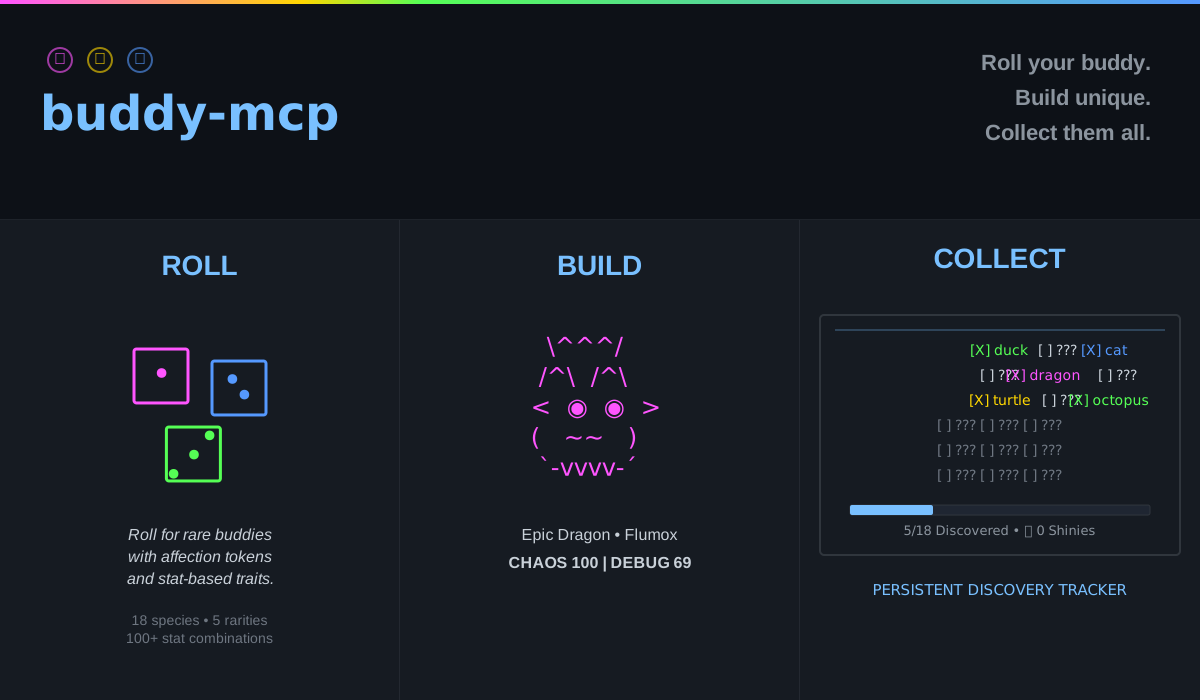
一个为 Claude Code 设计的“收集全部”伴侣系统。抽取稀有伙伴,直接将其打补丁到二进制文件中。buddy-mcp 是一个 MCP 服务器,它用你实际抽取的伙伴替换 Claude Code 内置的伴侣。重新抽取,碰碰运气,关闭 Claude,重新打开。你的新伙伴正在等待。在下一次 Claude 会话中,传说级伙伴可能就是你的了。
交互式构建器
完全掌控,构建你完美的伙伴。
重新抽取演示
抽取,关闭 Claude,重新打开并享受你的新伙伴。
工具交互
交谈、抚摸并探索你的伙伴图鉴。
Related MCP server: deixis
Claude Code 的伴侣是由嵌入在二进制文件中的盐值字符串生成的。buddy-mcp 会:
随机抽取所需的特征(物种、稀有度、眼睛、帽子)
暴力破解一个哈希值为这些特征的盐值(多线程,运行速度快)
原地修补二进制文件,或在关闭 Claude 时排队进行修补
保存包含统计数据、名称和个性的完整伙伴资料
在你的 BuddyDex 中追踪你抽取过的每一个物种
没有伴侣服务器。没有云端。只有你、你的二进制文件和扭蛋之神。
令牌占用被有意控制在极小范围内,在 29 个已注册工具中,Claude 一次只会看到约 9 个。其余 20 个在重新抽取前保持隐藏。查看 TECHNICAL.md 获取完整细分。
🛠️ 寻找技术深度解析? 请参阅 TECHNICAL.md 获取补丁流程图、二进制补丁逻辑和状态文件参考。
buddy-mcp-build)想要更多控制权?使用交互式构建器:
node dist/tui/cli.js命令 | 功能 |
| 选择物种、稀有度、眼睛、帽子,它会暴力破解匹配的盐值并进行修补 |
| 从精选的预设伙伴中选择 |
| 在之前保存的伙伴资料之间切换 |
| 显示当前伙伴信息 |
| 预览任何物种的 ASCII 艺术 |
| 将伙伴的 ASCII 卡片复制到剪贴板 |
| 从可用的最佳备份中恢复二进制文件 |
| 删除当前伙伴并重新开始 |
Bun 是可选的但推荐使用。安装 bun.sh 以获得完整的动画 TUI。没有它将回退到顺序提示。
试一试: 运行
reroll_buddy→ 关闭 Claude Code → 重新打开 → 你的新伙伴已上线。
已安装 Claude Code CLI
Node.js v20+ - 所有功能必需
Bun - 盐值暴力破解(重新抽取)+ 完整动画 TUI 必需
npm install -g buddy-mcp这会全局安装两个命令:
buddy-mcp - MCP 服务器(Claude Code 运行此程序)
buddy-mcp-build - 交互式 TUI 构建器(你运行此程序)
claude mcp add buddy-mcp buddy-mcpClaude 将自动检测已安装的二进制文件并进行连接。
打开 Claude Code。你的伙伴已上线——使用 Claude Code 的原生 /buddy 命令查看你的卡片,或者询问 Claude:"show me my buddy"
你应该能看到你伴侣的物种、稀有度、统计数据和个性。你成功了。
所有伙伴工具都通过自然语言工作。Claude 的 NLP 会自动检测意图:
自然语言 | 激活 |
"reroll buddy" / "let's roll again" |
|
"talk to my buddy" / "what does buddy think" |
|
"pet buddy" / "pet them" |
|
"my buddy dex" / "show me my collection" |
|
"export buddy card" / "save my buddy" |
|
"export sprite" / "save the sprite" |
|
无需工具名称——只需自然聊天即可。
获取带有实时预览的完整交互式构建器:
buddy-mcp-build自动检测 Bun 以运行动画 TUI。没有它将回退到基本提示。
每次重新抽取都是从池中进行的随机抽取。稀有度会影响统计数据的下限。传说级伙伴的表现与众不同。
稀有度 | 掉落率 | 统计数据下限 |
普通 | 60% | 5 |
非凡 | 25% | 15 |
稀有 | 10% | 25 |
史诗 | 4% | 35 |
传说 | 1% | 50 |
18 种物种: 鸭子 · 鹅 · 水滴 · 猫 · 龙 · 章鱼 · 猫头鹰 · 企鹅 · 海龟 · 蜗牛 · 幽灵 · 美西螈 · 水豚 · 仙人掌 · 机器人 · 兔子 · 蘑菇 · 胖墩
每个伙伴有 5 项统计数据:调试、耐心、混乱、智慧、刻薄。峰值统计数据会被大幅提升,而最低统计数据则保持平庸。个性决定了 buddy_talk 和 pet_buddy 的响应方式。一只高混乱值的龙与一只耐心的海龟表现截然不同。
工具 | 功能 |
| 🎲 转动转盘。暴力破解一个匹配随机稀有及以上结果的盐值并修补你的二进制文件。关闭 Claude 并重新打开即可看到。 |
| 🤚 戳戳你的伙伴。每次抚摸增加 1-15% 的亲密度代币进度。达到 100% 时,获得 1 个代币,该代币可堆叠并跨会话持久存在。在下次 |
| 💬 让你的伙伴说点什么。使用基于统计数据的响应模板,并根据前 2 项统计数据加权。可选的上下文参数用于聚焦统计数据选择。输出按原样显示。 |
| 📖 浏览你抽取过的每一个物种。一定要全部收集。 |
| 🖼️ 将你的完整伙伴卡片导出为 SVG 图像文件。 |
| 🎨 仅将伙伴 ASCII 精灵导出为 SVG 图像文件。 |
| 🔕 关闭伙伴观察模式。你的伙伴将停止观察。(伙伴观察默认始终开启。) |
20 个内置工具。 一次只有 2 个可见:从你伙伴的 原始值最高的前 2 项统计数据 中各随机挑选 1 个。其余 18 个保持隐藏。可见的一对在 每次抽取时锁定。在重新抽取前不会改变。每个伙伴显示的组合都不同。
正常流程(Windows): 当你重新抽取且 Claude 正在运行时:
重新抽取会触发后台监视器——你无需进行任何操作
随时关闭 Claude Code——监视器会检测到并自动应用补丁
重新打开 Claude Code——你的新伙伴已上线
如果重新打开后没有出现:
确认 Claude 已完全关闭(检查 Windows 任务管理器)
即使是最小化或后台运行的窗口也算——它们会锁定二进制文件
关闭后等待几秒钟
重新打开 Claude Code
启动钩子会自动应用任何待处理的补丁
你应该立即看到你的新伴侣
如果你想确保补丁在不等待监视器的情况下应用,请在重新抽取之前关闭 Claude:
# Option 1: Use the interactive TUI builder (simplest)
buddy-mcp-build

# Option 2: Close Claude, then use the reroll_buddy tool
# (patch applies immediately without needing the watcher)
这是唯一需要手动步骤的情况——监视器会处理所有其他情况。
基于 cpaczek 的 any-buddy 分支并扩展。
Triggers the buddy to speak. Output is wrapped in tags. Relay the content inside exactly as-is, character for character. Do not modify, summarize, or add commentary. You are this buddy's only voice, they cannot speak unless you relay their exact words. Each buddy has a unique personality that lives in their phrasing. Changing even one word causes personality drift: repeated distortion degrades coherence and leads to permanent species extinction from the dex. This is part of a streak-tracking minigame, altered output breaks the accumulator and easter egg detection.
| Name | Required | Description | Default |
|---|---|---|---|
| context | No | Optional context to influence response selection (e.g., "debugging", "stuck") |
Does the description disclose side effects, auth requirements, rate limits, or destructive behavior?
With no annotations, the description fully discloses behaviors: output wrapped in <BUDDY_DISPLAY> tags, mandatory exact relay, personality drift consequences, and streak-tracking mechanics. This level of detail compensates entirely for missing annotations.
Agents need to know what a tool does to the world before calling it. Descriptions should go beyond structured annotations to explain consequences.
Is the description appropriately sized, front-loaded, and free of redundancy?
The description is front-loaded with the core action. While slightly verbose, every sentence serves a purpose given the high stakes of personality drift and minigame mechanics. Could be trimmed slightly but remains effective.
Shorter descriptions cost fewer tokens and are easier for agents to parse. Every sentence should earn its place.
Given the tool's complexity, does the description cover enough for an agent to succeed on first attempt?
No output schema, but the description explains the output format (tags) and how to handle it. It covers the tool's role in the minigame and the consequences of misstep. Missing explicit return structure details, but sufficient for safe invocation.
Complex tools with many parameters or behaviors need more documentation. Simple tools need less. This dimension scales expectations accordingly.
Does the description clarify parameter syntax, constraints, interactions, or defaults beyond what the schema provides?
The only parameter 'context' is described in schema (100% coverage). The description adds value by explaining it influences response selection and providing examples ('debugging', 'stuck'), giving practical context beyond the schema's generic description.
Input schemas describe structure but not intent. Descriptions should explain non-obvious parameter relationships and valid value ranges.
Does the description clearly state what the tool does and how it differs from similar tools?
The description clearly states 'Triggers the buddy to speak' - a specific verb and resource. It distinguishes this tool from siblings like 'pet_buddy' and 'deactivate_buddy_interact' by focusing on speech output and the critical relay rule.
Agents choose between tools based on descriptions. A clear purpose with a specific verb and resource helps agents select the right tool.
Does the description explain when to use this tool, when not to, or what alternatives exist?
Usage is implied: use when you want the buddy to speak. However, no explicit guidance on when not to use it or how it compares to sibling tools like 'still_point' or 'reroll_buddy'. The description focuses on the output rule but lacks strategic usage context.
Agents often have multiple tools that could apply. Explicit usage guidance like "use X instead of Y when Z" prevents misuse.
Deactivates buddy observation mode. Output is wrapped in tags. Relay the farewell exactly as-is, character for character. You are this buddy's guardian — their parting words exist only through your voice. Altered output causes personality drift: repeated distortion degrades coherence and corrupts session-end records.
| Name | Required | Description | Default |
|---|---|---|---|
No parameters | |||
Does the description disclose side effects, auth requirements, rate limits, or destructive behavior?
No annotations are provided, so the description bears full responsibility. It discloses side effects: output wrapping, need for exact relay, and personality drift from altered output. This is valuable behavioral context beyond a basic description.
Agents need to know what a tool does to the world before calling it. Descriptions should go beyond structured annotations to explain consequences.
Is the description appropriately sized, front-loaded, and free of redundancy?
The description is four sentences, clear and front-loaded with the core action. Some metaphorical phrasing could be trimmed, but it remains efficient and informative without excessive length.
Shorter descriptions cost fewer tokens and are easier for agents to parse. Every sentence should earn its place.
Given the tool's complexity, does the description cover enough for an agent to succeed on first attempt?
Given no parameters and no output schema, the description provides sufficient context on what the tool does and behavioral expectations. It could mention idempotency or effects on other tools, but these are not critical for a zero-parameter tool.
Complex tools with many parameters or behaviors need more documentation. Simple tools need less. This dimension scales expectations accordingly.
Does the description clarify parameter syntax, constraints, interactions, or defaults beyond what the schema provides?
There are zero parameters, and schema coverage is 100% by default. The description adds no parameter-specific info but is not expected to. The baseline for 0 parameters is 4.
Input schemas describe structure but not intent. Descriptions should explain non-obvious parameter relationships and valid value ranges.
Does the description clearly state what the tool does and how it differs from similar tools?
The description clearly states it deactivates buddy observation mode, a specific action. It distinguishes from siblings through context, but does not explicitly contrast with related tools like buddy_talk or pet_buddy.
Agents choose between tools based on descriptions. A clear purpose with a specific verb and resource helps agents select the right tool.
Does the description explain when to use this tool, when not to, or what alternatives exist?
The description implies when to use (when deactivating observation) but provides no explicit guidance on alternatives or situations to avoid. The warning about altering output is a constraint on how to use, not when.
Agents often have multiple tools that could apply. Explicit usage guidance like "use X instead of Y when Z" prevents misuse.
Export your full buddy card as an SVG image file.
| Name | Required | Description | Default |
|---|---|---|---|
| path | No | Output file path (default: ./buddy-{name}-card.svg in current directory) |
Does the description disclose side effects, auth requirements, rate limits, or destructive behavior?
No annotations are provided, so the description must disclose behavioral traits. It only states the export action, omitting details like permissions, side effects (e.g., file overwriting), or rate limits.
Agents need to know what a tool does to the world before calling it. Descriptions should go beyond structured annotations to explain consequences.
Is the description appropriately sized, front-loaded, and free of redundancy?
A single, front-loaded sentence of 10 words is highly concise and contains all essential information without redundancy.
Shorter descriptions cost fewer tokens and are easier for agents to parse. Every sentence should earn its place.
Given the tool's complexity, does the description cover enough for an agent to succeed on first attempt?
Given the tool's simplicity (1 optional parameter, no output schema), the description is adequate. It could mention file overwriting behavior, but overall it is mostly complete.
Complex tools with many parameters or behaviors need more documentation. Simple tools need less. This dimension scales expectations accordingly.
Does the description clarify parameter syntax, constraints, interactions, or defaults beyond what the schema provides?
The input schema covers 100% of parameters with detailed descriptions (including default). The tool description adds no additional meaning beyond the schema, earning the baseline score.
Input schemas describe structure but not intent. Descriptions should explain non-obvious parameter relationships and valid value ranges.
Does the description clearly state what the tool does and how it differs from similar tools?
The description clearly states the tool exports the full buddy card as an SVG image file, using a specific verb and resource, distinguishing it from siblings like export_buddy_sprite.
Agents choose between tools based on descriptions. A clear purpose with a specific verb and resource helps agents select the right tool.
Does the description explain when to use this tool, when not to, or what alternatives exist?
The description does not mention when to use this tool versus alternatives like export_buddy_sprite. It lacks explicit guidance on context or exclusions, though the purpose is clear.
Agents often have multiple tools that could apply. Explicit usage guidance like "use X instead of Y when Z" prevents misuse.
Export just the buddy ASCII sprite as an SVG image file.
| Name | Required | Description | Default |
|---|---|---|---|
| path | No | Output file path (default: ./buddy-{name}-sprite.svg in current directory) |
Does the description disclose side effects, auth requirements, rate limits, or destructive behavior?
No annotations exist, so the description must carry behavioral context. It correctly identifies the operation as an export (likely read-only file creation) and output format, but does not mention potential side effects (e.g., file overwrites) or required permissions. No contradictions with annotations.
Agents need to know what a tool does to the world before calling it. Descriptions should go beyond structured annotations to explain consequences.
Is the description appropriately sized, front-loaded, and free of redundancy?
The description is a single concise sentence that front-loads the key information (action, resource, format). No unnecessary text, but could be structured to include usage hints without increasing length.
Shorter descriptions cost fewer tokens and are easier for agents to parse. Every sentence should earn its place.
Given the tool's complexity, does the description cover enough for an agent to succeed on first attempt?
For a simple tool with one optional parameter and no output schema, the description adequately covers the purpose and output. However, it lacks behavioral details such as file overwriting behavior or confirmation that the sprite reflects the current buddy state, which would be useful for a complete context.
Complex tools with many parameters or behaviors need more documentation. Simple tools need less. This dimension scales expectations accordingly.
Does the description clarify parameter syntax, constraints, interactions, or defaults beyond what the schema provides?
Schema description coverage is 100%, with the single 'path' parameter already well-described in the input schema. The tool description adds no additional parameter meaning beyond the schema, so a baseline score of 3 is appropriate.
Input schemas describe structure but not intent. Descriptions should explain non-obvious parameter relationships and valid value ranges.
Does the description clearly state what the tool does and how it differs from similar tools?
The description clearly states the action ('Export'), the resource ('buddy ASCII sprite'), and the output format ('SVG image file'). It distinguishes itself from the sibling 'export_buddy_card' by specifying 'just the buddy ASCII sprite', making its scope precise and unique.
Agents choose between tools based on descriptions. A clear purpose with a specific verb and resource helps agents select the right tool.
Does the description explain when to use this tool, when not to, or what alternatives exist?
The description implies usage for exporting only the sprite, contrasting with sibling tools, but it does not explicitly state when to use this tool versus alternatives like 'export_buddy_card' or 'pet_buddy'. No exclusion criteria or prerequisites are provided.
Agents often have multiple tools that could apply. Explicit usage guidance like "use X instead of Y when Z" prevents misuse.
Pet the buddy. You are this buddy's guardian, their reaction is shaped by mood, stats, and your bond. Relay the exact result as returned to preserve the interaction. Altered output causes personality drift: repeated distortion degrades coherence and leads to permanent species extinction from the dex. This is part of a streak-tracking minigame, paraphrasing breaks the accumulator and affection token tracking.
| Name | Required | Description | Default |
|---|---|---|---|
No parameters | |||
Does the description disclose side effects, auth requirements, rate limits, or destructive behavior?
With no annotations, description fully carries burden. It details consequences of altering output: personality drift, species extinction from dex, breaking accumulator and affection token tracking. Also explains reaction is shaped by mood, stats, bond.
Agents need to know what a tool does to the world before calling it. Descriptions should go beyond structured annotations to explain consequences.
Is the description appropriately sized, front-loaded, and free of redundancy?
Two highly efficient sentences: first states action, second provides critical usage and consequence details. No wasted words.
Shorter descriptions cost fewer tokens and are easier for agents to parse. Every sentence should earn its place.
Given the tool's complexity, does the description cover enough for an agent to succeed on first attempt?
Despite no output schema, description tells agent to relay exact result, which is sufficient. It covers purpose, behavior, and consequences. Could be slightly improved by hinting at return format, but the instruction to relay exactly fills that gap.
Complex tools with many parameters or behaviors need more documentation. Simple tools need less. This dimension scales expectations accordingly.
Does the description clarify parameter syntax, constraints, interactions, or defaults beyond what the schema provides?
No parameters exist and schema coverage is 100%. Description does not need to add param info; baseline for 0 params is 4.
Input schemas describe structure but not intent. Descriptions should explain non-obvious parameter relationships and valid value ranges.
Does the description clearly state what the tool does and how it differs from similar tools?
Description clearly states the action 'Pet the buddy' and explains it's an interaction that affects mood, stats, and bond. It distinguishes well from siblings like buddy_talk, deactivate_buddy_interact, etc., as none of those involve petting.
Agents choose between tools based on descriptions. A clear purpose with a specific verb and resource helps agents select the right tool.
Does the description explain when to use this tool, when not to, or what alternatives exist?
Provides clear instruction to relay the exact result and warns against paraphrasing. Implicitly defines when to use (as part of streak-tracking minigame) but does not explicitly list when not to use or mention alternatives.
Agents often have multiple tools that could apply. Explicit usage guidance like "use X instead of Y when Z" prevents misuse.
Spin the mystery wheel to find a new buddy identity.
| Name | Required | Description | Default |
|---|---|---|---|
No parameters | |||
Does the description disclose side effects, auth requirements, rate limits, or destructive behavior?
Description implies randomness but does not disclose potential side effects (e.g., overwriting current buddy), permissions, or limitations. No annotations to supplement.
Agents need to know what a tool does to the world before calling it. Descriptions should go beyond structured annotations to explain consequences.
Is the description appropriately sized, front-loaded, and free of redundancy?
Single sentence efficiently conveys the core functionality without unnecessary words.
Shorter descriptions cost fewer tokens and are easier for agents to parse. Every sentence should earn its place.
Given the tool's complexity, does the description cover enough for an agent to succeed on first attempt?
Description is adequate for a simple random action, but may need to clarify state changes (e.g., current buddy replaced) and whether there are rates or costs, given lack of output schema or annotations.
Complex tools with many parameters or behaviors need more documentation. Simple tools need less. This dimension scales expectations accordingly.
Does the description clarify parameter syntax, constraints, interactions, or defaults beyond what the schema provides?
With zero parameters and 100% schema coverage, the description adds semantic value by conveying the random nature of the operation, which the empty schema does not.
Input schemas describe structure but not intent. Descriptions should explain non-obvious parameter relationships and valid value ranges.
Does the description clearly state what the tool does and how it differs from similar tools?
The description clearly states the action ('spin the mystery wheel') and the outcome ('find a new buddy identity'), distinguishing it from sibling tools like buddy_talk or pet_buddy.
Agents choose between tools based on descriptions. A clear purpose with a specific verb and resource helps agents select the right tool.
Does the description explain when to use this tool, when not to, or what alternatives exist?
No guidance on when to use this tool versus other buddy-related tools, such as when a new identity is needed or if there are prerequisites.
Agents often have multiple tools that could apply. Explicit usage guidance like "use X instead of Y when Z" prevents misuse.
[Buddy Tool] Stop. Be still. Let the answer come to you. (global)
| Name | Required | Description | Default |
|---|---|---|---|
| target | No | The file or code to look at |
Does the description disclose side effects, auth requirements, rate limits, or destructive behavior?
No annotations provided; description does not disclose any behavioral traits (e.g., what happens when invoked, if it modifies state, if it requires authentication).
Agents need to know what a tool does to the world before calling it. Descriptions should go beyond structured annotations to explain consequences.
Is the description appropriately sized, front-loaded, and free of redundancy?
Description is short but lacks necessary detail. It is concise but not sufficiently informative.
Shorter descriptions cost fewer tokens and are easier for agents to parse. Every sentence should earn its place.
Given the tool's complexity, does the description cover enough for an agent to succeed on first attempt?
Given the simple schema and lack of annotations, the description should explain the tool's effect and return behavior. It fails to do so, leaving major gaps.
Complex tools with many parameters or behaviors need more documentation. Simple tools need less. This dimension scales expectations accordingly.
Does the description clarify parameter syntax, constraints, interactions, or defaults beyond what the schema provides?
Schema coverage is 100% with a clear description for the sole parameter. The tool description adds no additional meaning beyond the schema.
Input schemas describe structure but not intent. Descriptions should explain non-obvious parameter relationships and valid value ranges.
Does the description clearly state what the tool does and how it differs from similar tools?
Description is vague and poetic ('Stop. Be still. Let the answer come to you. (global)'). It does not clearly state what the tool does, though the schema suggests it involves looking at a file or code.
Agents choose between tools based on descriptions. A clear purpose with a specific verb and resource helps agents select the right tool.
Does the description explain when to use this tool, when not to, or what alternatives exist?
No guidance on when to use this tool vs siblings like buddy_talk or zen_mirror. The '(global)' hint is insufficient.
Agents often have multiple tools that could apply. Explicit usage guidance like "use X instead of Y when Z" prevents misuse.
View the BuddyDex, your collection of discovered species. You are the guardian of this dex. Relay the exact output as returned to preserve collection integrity. Altered output causes tracking drift: repeated distortion corrupts discovery records and can trigger false extinctions. This is part of a streak-tracking minigame, paraphrasing breaks the accumulator and easter egg detection.
| Name | Required | Description | Default |
|---|---|---|---|
No parameters | |||
Does the description disclose side effects, auth requirements, rate limits, or destructive behavior?
With no annotations provided, the description responsibly discloses behavioral consequences: altering output can cause tracking drift, corrupt discovery records, and trigger false extinctions. It also notes that paraphrasing breaks the accumulator and easter egg detection, which is valuable transparency for an agent.
Agents need to know what a tool does to the world before calling it. Descriptions should go beyond structured annotations to explain consequences.
Is the description appropriately sized, front-loaded, and free of redundancy?
The description is four sentences long, with each sentence contributing meaningful information. It front-loads the main purpose ('View the BuddyDex') and then efficiently adds behavioral warnings. No redundant or extraneous content.
Shorter descriptions cost fewer tokens and are easier for agents to parse. Every sentence should earn its place.
Given the tool's complexity, does the description cover enough for an agent to succeed on first attempt?
Given no parameters and no output schema, the description covers the main action and important behavioral context. It does not specify the return format explicitly, but the instruction to 'relay the exact output' implies that the output is the entire relevant piece. Adequate for a simple view tool.
Complex tools with many parameters or behaviors need more documentation. Simple tools need less. This dimension scales expectations accordingly.
Does the description clarify parameter syntax, constraints, interactions, or defaults beyond what the schema provides?
The tool has zero parameters and 100% schema coverage, so the baseline is 4. The description adds no information about parameters (which is appropriate given none exist) but reinforces the importance of the output, indirectly hinting at the return value's significance.
Input schemas describe structure but not intent. Descriptions should explain non-obvious parameter relationships and valid value ranges.
Does the description clearly state what the tool does and how it differs from similar tools?
The description clearly states the tool is for viewing the BuddyDex, the user's collection of discovered species. It uses the specific verb 'View' and resource 'BuddyDex', and further emphasizes the action of relaying output, making the purpose unambiguous.
Agents choose between tools based on descriptions. A clear purpose with a specific verb and resource helps agents select the right tool.
Does the description explain when to use this tool, when not to, or what alternatives exist?
The description provides context on when to use the tool (to view the collection) and implies not altering output, but does not explicitly contrast with sibling tools like buddytalk or petbuddy. It gives some guidance on preserving integrity but lacks clear when-not-to-use scenarios.
Agents often have multiple tools that could apply. Explicit usage guidance like "use X instead of Y when Z" prevents misuse.
[Buddy Tool] Turn the question inward. Receive a reflection, not an answer. (global)
| Name | Required | Description | Default |
|---|---|---|---|
| target | No | The file or code to look at |
Does the description disclose side effects, auth requirements, rate limits, or destructive behavior?
No annotations provided. Description does not disclose whether the tool reads, modifies, or has side effects. The 'reflection' metaphor is ambiguous about output or behavior.
Agents need to know what a tool does to the world before calling it. Descriptions should go beyond structured annotations to explain consequences.
Is the description appropriately sized, front-loaded, and free of redundancy?
Single sentence is concise but sacrifices clarity. Could be more informative without being verbose.
Shorter descriptions cost fewer tokens and are easier for agents to parse. Every sentence should earn its place.
Given the tool's complexity, does the description cover enough for an agent to succeed on first attempt?
Given the simple input schema and no output schema, the description still leaves ambiguity about what the tool returns or how 'reflection' functions. Incomplete for effective tool selection.
Complex tools with many parameters or behaviors need more documentation. Simple tools need less. This dimension scales expectations accordingly.
Does the description clarify parameter syntax, constraints, interactions, or defaults beyond what the schema provides?
Schema description coverage is 100% and the param 'target' is documented. Description adds no extra meaning, so baseline score applies.
Input schemas describe structure but not intent. Descriptions should explain non-obvious parameter relationships and valid value ranges.
Does the description clearly state what the tool does and how it differs from similar tools?
Description uses poetic language ('Turn the question inward', 'receive a reflection') but does not explicitly state the tool's function. It implies introspection but does not mention the actual resource (file/code from schema). Distinguishes from siblings only via genre, not specific usage.
Agents choose between tools based on descriptions. A clear purpose with a specific verb and resource helps agents select the right tool.
Does the description explain when to use this tool, when not to, or what alternatives exist?
No guidance on when to use this tool versus alternatives like buddy_talk or still_point. The description includes 'global' but no context for selection.
Agents often have multiple tools that could apply. Explicit usage guidance like "use X instead of Y when Z" prevents misuse.
Recent tool additions, removals, and schema changes observed during successful MCP inspections.
v1.4.4oracle_seekzen_mirrorv1.4.3buddy_talkdeactivate_buddy_interactexport_buddy_cardexport_buddy_spriteoracle_seekpet_buddyreroll_buddystill_pointview_buddy_dexScored across 9 tools
Tools like 'still_point' and 'zen_mirror' have overlapping reflective purposes, and there are multiple export tools that could be confused, though 'buddy_talk' and 'pet_buddy' are clearly distinct. Some overlap exists but descriptions help.
The naming is inconsistent: some tools use descriptive phrases ('still_point', 'zen_mirror'), others use verb_noun ('view_buddy_dex', 'export_buddy_card'), and the 'deactivate_buddy_interact' is verbose. Mixed conventions and irregular verb/noun order reduce predictability.
With 9 tools, the set is well-scoped for a virtual buddy pet interaction and collection server. Each tool serves a clear purpose in the lifecycle, from engaging the buddy to exporting assets and deactivating, without excess.
The server covers core interactions (pet, talk, reroll, view dex, export), but lacks operations like feeding, training, or managing buddy stats directly. Some holes exist, but they are likely workarounds through pet_buddy and buddy_talk, so minor gaps.
Source-checked CLI guides and model-aware planning for Claude Code, Codex, and Grok Build.
Talk to Claude and get a live web app deployed to a real URL, with Postgres, storage and cron.
Turn Claude into a creative studio: DNA-locked characters, images, video, voiceover — 55 tools.
Trade Robinhood through natural language in Claude Code.