crypto-quant-signal-mcp
AI 交易代理的调用智能层 —— 通过 MCP 提供跨加密货币和传统金融永续合约的复合量化调用、跨交易所套利检测以及具备市场状态感知能力的分类。
实时业绩记录 — 在 900 多次交易调用中保持 90% 以上的方向准确率。公开透明,无需登录。
为什么选择 AlgoVault
大多数 MCP 交易服务器只提供原始数据——价格、订单簿、K 线。你的代理仍然需要自己决定如何处理这些数据。
AlgoVault 则不同。我们为你的代理提供一个答案:一个带有置信度评分的方向性结论,该结论由基于生产级量化系统调优的多因子复合评分引擎生成。每一次调用都被记录,每一个结果都被衡量,且完整的业绩记录从第一天起就是公开的。
它不仅仅是另一个指标封装器,其核心优势在于:
复合评分,而非单一指标噪音。 将多个正交信号(动量震荡指标、趋势结构、衍生品持仓、成交量动态、持仓量流向)融合为单一的加权结论。权重根据实时市场结果数据进行校准,而非使用教科书式的默认值。
具备市场状态感知能力的调用生成。 调用在发出前会经过市场状态分类器的过滤。引擎知道何时发出调用,何时保持沉默——在震荡市场中的趋势跟踪设置会被抑制,而不会被广播。
跨交易所智能。 实时对 Hyperliquid、Binance 和 Bybit 的资金费率进行标准化和对比。目前没有其他 MCP 提供跨交易所衍生品分析功能。
随每次发布公开业绩记录。 每一笔调用都记录了多个时间窗口的成交价格。胜率、利润因子和预期价值均持续计算。无幸存者偏差,无选择性展示。
自适应评分。 指标权重每月根据结果数据重新调整。引擎会学习什么有效并进行调整——你今天得到的调用比上个月的更精准。
覆盖加密货币 + 传统金融。 支持 290 多种资产——标准加密货币永续合约、传统金融永续合约(股票、指数、大宗商品、通过 Hyperliquid xyz dex 进行的外汇交易)以及经过流动性过滤的 Meme 币。资产按质量分级,并采用机构级调用过滤。
Related MCP server: Web3 Signals — Crypto Signal Intelligence
30 秒快速上手
无需代码。无需 API 密钥。无需安装。
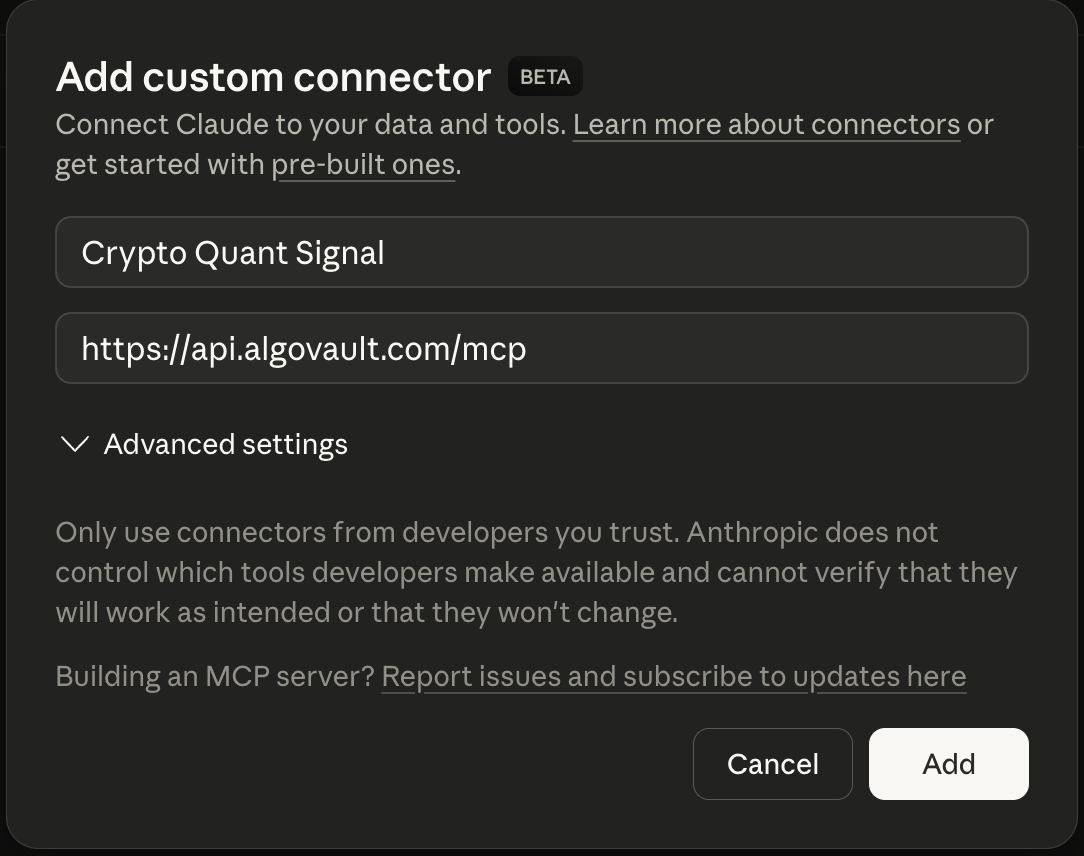
第一步。 打开 Claude → 设置 → 集成 → 添加自定义连接器
第二步。 输入名称和 URL:
字段 | 值 |
名称 |
|
URL |
|

第三步。 询问 Claude 任何问题:
"Get me a trade signal for ETH on the 4h timeframe"
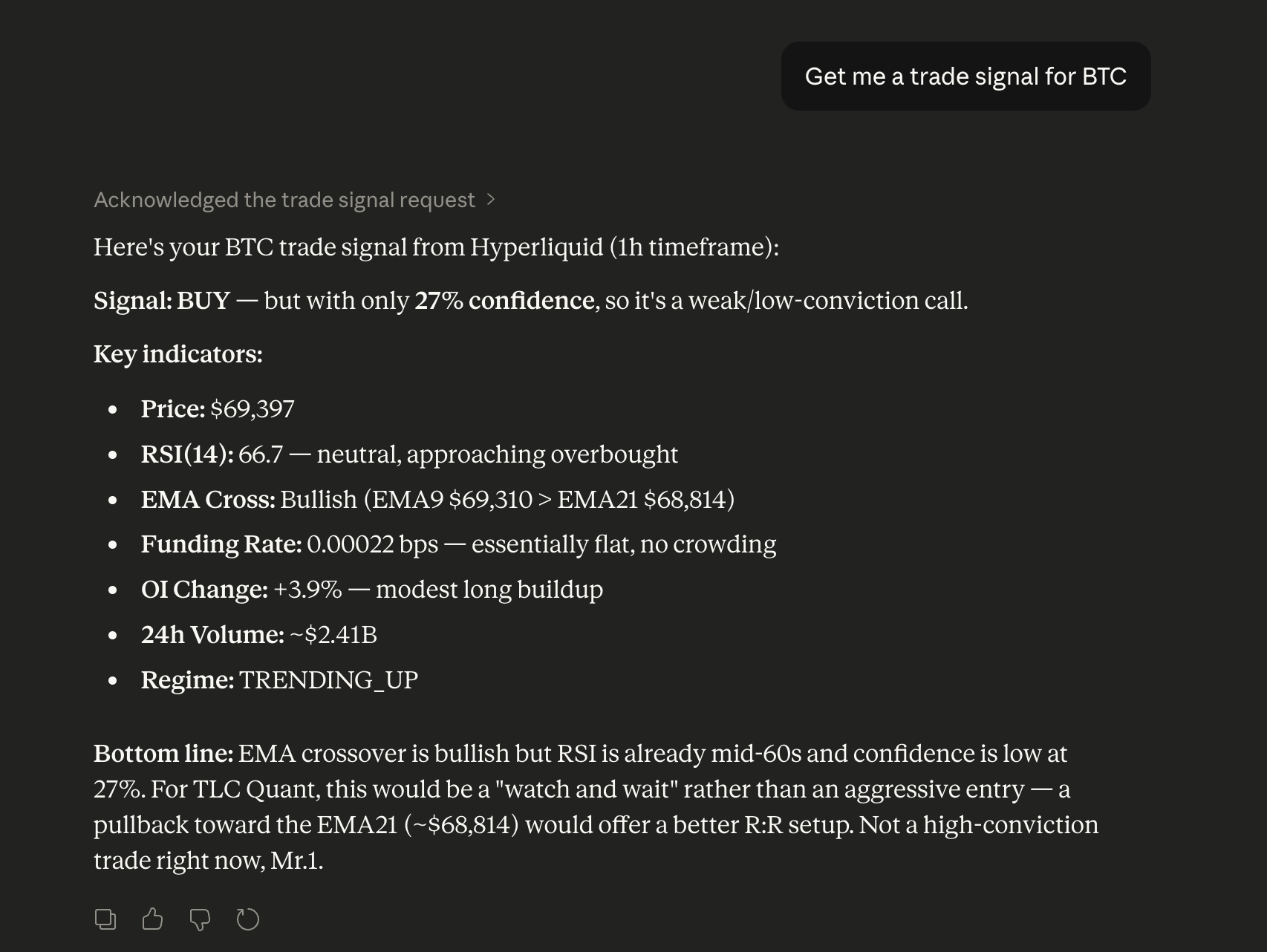
就是这样。你的 Claude 现在内置了一位量化分析师。
工具
get_trade_signal
为任何支持的资产(加密货币永续合约、传统金融永续合约、流动性过滤后的 Meme 币)返回复合的 买入 / 卖出 / 持有 结论及置信度评分。
底层逻辑:多因子评分引擎评估动量、趋势结构、衍生品情绪、持仓量动态和成交量信念。评分在发出最终结论前会经过市场状态感知过滤器和自适应后处理门控——包括资金流分析、波动率状态检测和趋势持续性衰减。
仅生成高信念调用。引擎旨在当优势不明确时保持沉默。
参数:
coin(string, 必填): 资产代码 — 例如"ETH","BTC","SOL","GOLD","TSLA"或 290 多种支持资产中的任意一种timeframe(string, 默认"15m"):"1m","3m","5m","15m","30m","1h","2h","4h","8h","12h","1d"includeReasoning(boolean, 默认true): 调用逻辑的人类可读解释
输出包括: 调用方向、置信度评分(0–100)、所有计算出的指标值、检测到的市场状态、推理叙述,以及用于下游工具组合的 _algovault 元数据。
scan_funding_arb
扫描 Hyperliquid、Binance 和 Bybit 之间的跨交易所资金费率差异。标准化小时费率与 8 小时费率惯例,计算基点价差,并按复合评分(价差幅度、时间紧迫性以及来自 24 小时历史的资金信念)对机会进行排名。
这是唯一提供跨交易所资金费率套利智能的 MCP 服务器——在一个交易所做多,在另一个做空,捕获价差。
参数:
minSpreadBps(number, 默认5): 包含的最小价差(以基点为单位)limit(number, 默认10): 返回的最大结果数
输出包括: 每个机会的交易所费率、最优多/空方向、年化价差百分比以及下一次资金费率结算时间戳。
get_market_regime
将当前市场环境分类为四种状态之一:TRENDING_UP(上涨趋势)、TRENDING_DOWN(下跌趋势)、RANGING(震荡)或 VOLATILE(波动)。
采用多维分类方法,结合方向强度测量与 ADX 斜率分析(检测趋势增强与衰竭)、成交量加权枢轴检测、ATR 自适应资金费率阈值以及跨交易所资金费率情绪背离。市场状态分类直接影响 get_trade_signal 如何过滤其输出——代理也可以独立使用它进行策略选择和仓位管理。
参数:
coin(string, 必填): 资产代码timeframe(string, 默认"4h"): 用于分析的 K 线时间周期
输出包括: 状态标签、置信度评分、底层指标(趋势强度、波动率解读、价格结构)、跨交易所资金费率情绪,以及通俗易懂的策略建议。
业绩追踪
每一笔调用都从发出到结果进行全程追踪。无一例外。
我们衡量的指标:
时间周期适当评估窗口内的结果价格
PFE 胜率 — 价格在评估窗口内的任何时刻是否向调用方向移动
预期价值 — 每次调用的概率加权平均回报
利润因子 — 总盈利除以总亏损
峰值有利偏移 (PFE) 和最大不利偏移 (MAE)
每个资产、时间周期和质量等级的运行统计数据
持有 (HOLD) 调用免费 — 当引擎说“不要交易”时,你无需付费。只有买入和卖出结论会通过 x402 收费或计入订阅配额。这使我们的激励机制保持一致:只有当我们看到可交易的机会时,你才付费。
持有率:引擎拒绝发出交易调用的扫描百分比。高持有率(目前约为 84%)意味着引擎是选择性的——它仅在多个指标条件一致时才发出买入/卖出调用。
基础设施:
远程模式:PostgreSQL,具有自动结果回填功能
本地模式:SQLite,位于
~/.crypto-quant-signal/performance.db仅追踪高置信度的买入/卖出调用 — 持有 (HOLD) 被排除在外
链上验证
每一笔调用在创建时都会进行哈希处理 (keccak256),并通过每日 Merkle 批次锚定在 Base L2 上。这使得业绩记录不可篡改——我们无法编辑过去的调用。
合约:
0x6485...0f81(Base L2)验证任何调用:
https://api.algovault.com/api/verify-signal?signalId=<ID>查看所有批次:
https://api.algovault.com/api/merkle-batches可视化验证: algovault.com/verify
定价
功能 | 免费 | 入门版 ($9.99/月) | 专业版 ($49/月) | 企业版 ($299/月) | x402 (按调用付费) |
资产 | BTC, ETH | 全部 290+ | 全部 290+ | 全部 290+ | 全部 290+ |
资产类别 | 仅加密货币 | 加密 + 传统金融 | 加密 + 传统金融 | 加密 + 传统金融 | 加密 + 传统金融 |
时间周期 | 15m, 1h | 全部 11 个 | 全部 11 个 | 全部 11 个 | 全部 11 个 |
资金费率套利结果 | 前 5 名 | 无限制 | 无限制 | 无限制 | 无限制 |
业绩记录 | 完全访问 | 完全访问 | 完全访问 | 完全访问 | 完全访问 |
每月调用 | ~100/天 | 3,000/月 | 15,000/月 | 100,000/月 | 无限制 |
支持 | 社区 | 邮件 | 优先支持 | 专属支持 | — |
价格 | $0 | $9.99/月 | $49/月 | $299/月 | $0.01–0.05/调用 |
持有 (HOLD) 调用 | 免费 | 免费 | 免费 | 免费 | 免费 |
* 持有 (HOLD) 结论(引擎说“不要交易”)在所有层级中始终免费——无 x402 费用,不扣除配额。
x402 微支付: AI 代理使用 Base 链上的 USDC 按 HTTP 调用付费——无需注册,无需 API 密钥,无需账单。付款收据即凭证。请参阅 x402.org。
订阅: 在 api.algovault.com/signup 注册。入门版($9.99/月)解锁所有资产和时间周期。结账后立即交付 API 密钥。
开发者指南
远程端点(推荐)
https://api.algovault.com/mcp流式 HTTP 传输。兼容任何 MCP 客户端 — Claude, Cursor, Cline, 自定义代理。
通过 npx 本地安装
npx -y crypto-quant-signal-mcpClaude Desktop / Cursor 配置
{
"mcpServers": {
"crypto-quant-signal": {
"command": "npx",
"args": ["-y", "crypto-quant-signal-mcp"],
"env": { "TRANSPORT": "stdio" }
}
}
}npm 安装
npm install crypto-quant-signal-mcp自托管
git clone https://github.com/AlgoVaultLabs/crypto-quant-signal-mcp
cd crypto-quant-signal-mcp
cp .env.example .env # Edit with your values
npm ci && npm run build
docker compose up -d架构
Agent / Claude / Cursor
│
▼
api.algovault.com/mcp (Streamable HTTP)
│
├─ x402 payment verification (USDC on Base)
├─ API key / subscription check
├─ Free tier fallback
│
▼
MCP Server (Express + @modelcontextprotocol/sdk)
│
├─ Composite Scoring Engine
│ ├─ Multi-factor indicator fusion
│ ├─ Regime-aware signal filtering
│ └─ Adaptive post-processing gates
│
├─ Asset Classification Engine
│ ├─ 4-tier quality system (Blue Chip → Major Alt → TradFi → Meme)
│ └─ Liquidity filter for meme/micro assets
│
├─ Exchange Adapter Layer
│ └─ Hyperliquid (standard + xyz TradFi perps) · Binance, Bybit (funding data)
│
├─ Performance Tracker
│ └─ PostgreSQL (remote) / SQLite (local)
│
└─ Hyperliquid Public API (free, no auth)交易所适配器模式: 所有交易所交互都通过 ExchangeAdapter 接口进行 — 支持 Hyperliquid 上的标准加密货币永续合约和 xyz 传统金融永续合约,并支持 Binance 和 Bybit 进行跨交易所资金费率对比。
套件组合性
每个工具的输出都包含一个 _algovault 元数据块,声明版本和兼容的下游工具:
此工具 | 馈送至 (阶段 2+) |
|
|
|
|
|
|
架构设计旨在实现组合性。所有工具共享一致的 timestamp、coin 和 _algovault 字段 — 下游工具直接接受这些对象作为输入。
隐私
本地模式: 零遥测。没有数据发送到 AlgoVault 服务器。调用历史仅存储在你的机器上。
远程模式: 请求元数据记录用于分析(IP 已哈希,从不存储原始数据)。请参阅 隐私政策。
许可证
MIT
由 AlgoVault Labs 构建 — 为自主交易时代提供调用智能。
Available Tools
8 toolschat_knowledgeARead-onlyInspect
Returns a synthesized natural-language answer with citations, grounded in the AlgoVault knowledge bundle (every MCP tool description, response shape, integration tutorial, and code example). Use when you need an explanation, code pattern, or how-to; for raw ranked snippets without LLM synthesis use search_knowledge (faster, no quota cost). Read-only: calls an LLM, no other side effects. Quota: Free 10/month, Starter 50, Pro 200, Enterprise 2000.
| Name | Required | Description | Default |
|---|---|---|---|
| model | No | Optional model override (default claude-haiku-4-5-20251001). | |
| question | Yes | Natural-language question (5-500 chars). |
TDQS
Does the description disclose side effects, auth requirements, rate limits, or destructive behavior?
Despite annotations already declaring read-only, the description adds valuable operational context beyond them: it calls an LLM (implying cost/latency), has no other side effects, and lists specific quota limits per plan (Free 10, Starter 50, Pro 200, Enterprise 2000). This exceeds the annotation baseline.
Agents need to know what a tool does to the world before calling it. Descriptions should go beyond structured annotations to explain consequences.
Is the description appropriately sized, front-loaded, and free of redundancy?
The description is three concise sentences, each with a distinct purpose: what it does, when to use it (and when not), and operational constraints (read-only, quota). No redundant or filler content.
Shorter descriptions cost fewer tokens and are easier for agents to parse. Every sentence should earn its place.
Given the tool's complexity, does the description cover enough for an agent to succeed on first attempt?
The description, combined with a fully documented schema and annotations, covers the tool's return type, use cases, alternatives, quota, and safety profile. Since there is no output schema, the explicit mention of 'synthesized natural-language answer with citations' sufficiently communicates the expected response.
Complex tools with many parameters or behaviors need more documentation. Simple tools need less. This dimension scales expectations accordingly.
Does the description clarify parameter syntax, constraints, interactions, or defaults beyond what the schema provides?
The input schema provides 100% coverage for both parameters (question with length constraints, model with enum options). The description adds no additional parameter semantics, which is the expected baseline when schema coverage is high.
Input schemas describe structure but not intent. Descriptions should explain non-obvious parameter relationships and valid value ranges.
Does the description clearly state what the tool does and how it differs from similar tools?
The description uses a specific verb ('Returns'), identifies the resource ('AlgoVault knowledge bundle'), and specifies the output ('synthesized natural-language answer with citations'). It also explicitly distinguishes the tool from the sibling search_knowledge by contrasting LLM synthesis vs. raw ranked snippets.
Agents choose between tools based on descriptions. A clear purpose with a specific verb and resource helps agents select the right tool.
Does the description explain when to use this tool, when not to, or what alternatives exist?
Clear usage guidance is provided: 'Use when you need an explanation, code pattern, or how-to', and an explicit alternative is named ('for raw ranked snippets without LLM synthesis use search_knowledge'), including the trade-off that it is faster and has no quota cost.
Agents often have multiple tools that could apply. Explicit usage guidance like "use X instead of Y when Z" prevents misuse.
get_market_regimeARead-onlyInspect
Returns the market regime — TRENDING_UP TRENDING_DOWN RANGING VOLATILE — with confidence and a strategy hint, for one crypto perpetual futures. Composite verdict: trend ranging + cross-venue funding rate. Read-only, live exchange APIs. Verified track record: get_track_record or performance://signal-performance; on-chain verified merkle anchor.
| Name | Required | Description | Default |
|---|---|---|---|
| coin | Yes | Base asset crypto signal, e.g. BTC ETH SOL signal. Crypto quant regime. | |
| exchange | No | Crypto venue, e.g. Binance Bybit OKX Bitget Hyperliquid. Multi-exchange. | HL |
| timeframe | No | Candle timeframe, e.g. 1h 4h 1d. Buy sell hold AI trading signal context. | 4h |
TDQS
Does the description disclose side effects, auth requirements, rate limits, or destructive behavior?
Annotations already declare readOnlyHint=true and destructiveHint=false, and the description reinforces this with 'Read-only, live exchange APIs.' It adds useful behavioral context beyond the annotations: the verdict is composite of trend/ranging and cross-venue funding rate, and the output includes confidence and a strategy hint. It does not cover rate limits or failure modes, but with annotations present the safety profile is sufficiently disclosed.
Agents need to know what a tool does to the world before calling it. Descriptions should go beyond structured annotations to explain consequences.
Is the description appropriately sized, front-loaded, and free of redundancy?
The description is two sentences and front-loads the key deliverable: the market regime values, confidence, and strategy hint. The verification sentence is dense but not bloated, and there is no redundant padding.
Shorter descriptions cost fewer tokens and are easier for agents to parse. Every sentence should earn its place.
Given the tool's complexity, does the description cover enough for an agent to succeed on first attempt?
For a read-only retrieval tool with three well-documented parameters and no output schema, the description supplies the return values, confidence, strategy hint, and composite methodology. It lacks explicit sibling routing and exact response structure, but those gaps are minor given the schema enum coverage and annotations.
Complex tools with many parameters or behaviors need more documentation. Simple tools need less. This dimension scales expectations accordingly.
Does the description clarify parameter syntax, constraints, interactions, or defaults beyond what the schema provides?
Schema description coverage is 100%, so the baseline is 3. The description adds little about the exact parameters beyond limiting the tool to a single crypto perpetual futures asset. It does not add syntax, default semantics, or parameter-specific guidance beyond what the schema already provides.
Input schemas describe structure but not intent. Descriptions should explain non-obvious parameter relationships and valid value ranges.
Does the description clearly state what the tool does and how it differs from similar tools?
The description names a specific verb ('Returns'), the resource ('market regime'), the possible output values, and the asset scope ('crypto perpetual futures'). It does not explicitly differentiate itself from siblings like get_trade_signal or get_trade_call, but the regime-value list makes the core purpose clear.
Agents choose between tools based on descriptions. A clear purpose with a specific verb and resource helps agents select the right tool.
Does the description explain when to use this tool, when not to, or what alternatives exist?
The context 'for one crypto perpetual futures' implies when the tool is relevant, and 'Read-only, live exchange APIs' clarifies the nature of the call. However, there is no explicit guidance about when to use this tool versus alternatives, and the get_track_record mention is about validating track record rather than choosing between tools.
Agents often have multiple tools that could apply. Explicit usage guidance like "use X instead of Y when Z" prevents misuse.
get_track_recordARead-onlyInspect
Returns the AlgoVault track record — aggregated PFE win rates by call type, timeframe and asset tier, plus the evaluation methodology and window. The same verified aggregate the performance://signal-performance resource serves, callable from harnesses that bridge tools only. Defaults to the compact aggregate; use include for the per-asset, per-venue or recent-signal breakdowns. Read-only, no side effects.
| Name | Required | Description | Default |
|---|---|---|---|
| include | No | Optional extra sections: byAsset, byExchange, recentSignals. Omit for compact. |
TDQS
Does the description disclose side effects, auth requirements, rate limits, or destructive behavior?
Annotations already declare readOnlyHint=true and destructiveHint=false; the description reinforces this with 'Read-only, no side effects.' It adds useful behavior beyond annotations: compact-by-default output, optional breakdown sections, and the fact that the same aggregate is served by performance://signal-performance. No contradiction.
Agents need to know what a tool does to the world before calling it. Descriptions should go beyond structured annotations to explain consequences.
Is the description appropriately sized, front-loaded, and free of redundancy?
Three sentences, each earning its place: purpose/content, alternative-resource context, and parameter/default behavior. The key return content is front-loaded before the include guidance, and there is no filler.
Shorter descriptions cost fewer tokens and are easier for agents to parse. Every sentence should earn its place.
Given the tool's complexity, does the description cover enough for an agent to succeed on first attempt?
For a read-only aggregate tool with no output schema, the description tells the agent what data is returned (PFE win rates, methodology, window), how to control detail with include, and that it is safe to call. The annotations cover the safety profile, and no essential call-time behavior is missing.
Complex tools with many parameters or behaviors need more documentation. Simple tools need less. This dimension scales expectations accordingly.
Does the description clarify parameter syntax, constraints, interactions, or defaults beyond what the schema provides?
The schema already documents the single include parameter with enum values and the 'Omit for compact' guidance, so description coverage is 100% and the bar is lower. The description adds mild semantic color by calling byExchange 'per-venue' and framing the values as breakdown sections, but it does not substantially extend the schema.
Input schemas describe structure but not intent. Descriptions should explain non-obvious parameter relationships and valid value ranges.
Does the description clearly state what the tool does and how it differs from similar tools?
Description opens with a specific verb and resource ('Returns the AlgoVault track record') and specifies the exact contents: aggregated PFE win rates by call type, timeframe, and asset tier, plus methodology and window. This clearly distinguishes it from sibling tools like get_trade_call and get_trade_signal, which return individual calls/signals rather than an aggregate record.
Agents choose between tools based on descriptions. A clear purpose with a specific verb and resource helps agents select the right tool.
Does the description explain when to use this tool, when not to, or what alternatives exist?
It states when the compact default is appropriate and when to use the include parameter for per-asset, per-venue, or recent-signal breakdowns. It also notes the performance://signal-performance equivalence and harness-only callability. It does not explicitly name exclusion cases or sibling alternatives, but the usage context is clear.
Agents often have multiple tools that could apply. Explicit usage guidance like "use X instead of Y when Z" prevents misuse.
get_trade_callARead-onlyInspect
Returns a composite verdict — BUY SELL HOLD trade call with confidence and market regime — for one crypto or tokenized-stock perpetual futures. One asset only; whole-market scan: scan_trade_calls. Read-only: live exchange APIs, no orders. Verified track record: get_track_record or performance://signal-performance; on-chain verified merkle anchor.
| Name | Required | Description | Default |
|---|---|---|---|
| coin | Yes | Base asset, e.g. BTC ETH SOL signal, or a US stock/ETF ticker (no USDT). | |
| exchange | No | Crypto venue (default Binance), e.g. Binance Bybit OKX Bitget Hyperliquid. | |
| timeframe | No | Candle timeframe, 1m to 1d. Default 15m. Crypto quant intraday horizon. | |
| assetClass | No | Force engine: 'perp' or 'equity'. Cross-venue multi-exchange AI trading signal. | |
| includeReasoning | No | Include reasoning: trend ranging crypto signal and market regime drivers. |
TDQS
Does the description disclose side effects, auth requirements, rate limits, or destructive behavior?
Annotations already mark the tool read-only and non-destructive; the description reinforces this with 'live exchange APIs, no orders,' which adds operational context beyond the hints. It also discloses the verified-provenance angle with get_track_record and the on-chain merkle anchor. No contradiction with annotations.
Agents need to know what a tool does to the world before calling it. Descriptions should go beyond structured annotations to explain consequences.
Is the description appropriately sized, front-loaded, and free of redundancy?
Three compact sentences front-load the core behavior and scope before routing to alternatives. The track-record sentence is marginally tangential but still informative, and there is no real padding.
Shorter descriptions cost fewer tokens and are easier for agents to parse. Every sentence should earn its place.
Given the tool's complexity, does the description cover enough for an agent to succeed on first attempt?
For a simple read-only lookup with rich schema coverage, the description covers purpose, scope, alternative, and safety in a compact way. Without an output schema, it gives the main elements of the return (verdict, confidence, market regime) but not a complete response shape; still sufficient to call correctly with just the coin parameter.
Complex tools with many parameters or behaviors need more documentation. Simple tools need less. This dimension scales expectations accordingly.
Does the description clarify parameter syntax, constraints, interactions, or defaults beyond what the schema provides?
Schema coverage is 100% and each parameter already has descriptive text with defaults and examples. The description adds only the one-asset constraint and the composite-verdict framing, not new parameter-level semantics, so the schema carries the weight.
Input schemas describe structure but not intent. Descriptions should explain non-obvious parameter relationships and valid value ranges.
Does the description clearly state what the tool does and how it differs from similar tools?
The first sentence names a specific verb and resource: returns a composite BUY/SELL/HOLD verdict with confidence and market regime for a single perpetual-futures asset. It also explicitly contrasts with the whole-market scan sibling scan_trade_calls, so an agent can distinguish the tool without opening the schema.
Agents choose between tools based on descriptions. A clear purpose with a specific verb and resource helps agents select the right tool.
Does the description explain when to use this tool, when not to, or what alternatives exist?
The 'One asset only; whole-market scan: scan_trade_calls' sentence gives an explicit alternative and the condition that selects it. However, it does not explain how to choose between get_trade_call and the similarly named get_trade_signal, leaving that distinction implied rather than stated.
Agents often have multiple tools that could apply. Explicit usage guidance like "use X instead of Y when Z" prevents misuse.
get_trade_signalARead-onlyInspect
Returns a composite verdict — BUY SELL HOLD trade call with confidence and market regime — for one crypto or tokenized-stock perpetual futures. One asset only; whole-market scan: scan_trade_calls. Read-only: live exchange APIs, no orders. Verified track record: get_track_record or performance://signal-performance; on-chain verified merkle anchor. [ALIAS] This tool is an alias of get_trade_call — same behavior, kept for backward compatibility. Prefer get_trade_call for new integrations.
| Name | Required | Description | Default |
|---|---|---|---|
| coin | Yes | Base asset, e.g. BTC ETH SOL signal, or a US stock/ETF ticker (no USDT). | |
| exchange | No | Crypto venue (default Binance), e.g. Binance Bybit OKX Bitget Hyperliquid. | |
| timeframe | No | Candle timeframe, 1m to 1d. Default 15m. Crypto quant intraday horizon. | |
| assetClass | No | Force engine: 'perp' or 'equity'. Cross-venue multi-exchange AI trading signal. | |
| includeReasoning | No | Include reasoning: trend ranging crypto signal and market regime drivers. |
TDQS
Does the description disclose side effects, auth requirements, rate limits, or destructive behavior?
Annotations already declare readOnlyHint=true and destructiveHint=false; the description adds that it queries 'live exchange APIs, no orders', discloses alias equivalence with get_trade_call, and mentions a verified track record. This adds useful behavioral context beyond annotations, though it could detail latency or failure modes.
Agents need to know what a tool does to the world before calling it. Descriptions should go beyond structured annotations to explain consequences.
Is the description appropriately sized, front-loaded, and free of redundancy?
The main output is front-loaded in the first sentence. Subsequent sentences each serve a purpose: scope, whole-market alternative, read-only safety, verification, and alias. It is dense but not bloated; the 'performance://signal-performance' reference is slightly cryptic but still earns its place.
Shorter descriptions cost fewer tokens and are easier for agents to parse. Every sentence should earn its place.
Given the tool's complexity, does the description cover enough for an agent to succeed on first attempt?
For a tool with five parameters, no output schema, and informative annotations, the description covers the return shape (BUY/SELL/HOLD, confidence, market regime), single-asset input, read-only behavior, and alias relationship. It could add default exchange/timeframe behavior or response structure details, but the current context is sufficient for correct invocation.
Complex tools with many parameters or behaviors need more documentation. Simple tools need less. This dimension scales expectations accordingly.
Does the description clarify parameter syntax, constraints, interactions, or defaults beyond what the schema provides?
Input schema coverage is 100%, so the baseline is already satisfied. The description adds meaning by clarifying 'One asset only' and 'crypto or tokenized-stock perpetual futures', which usefully constrains the coin and assetClass parameters beyond the schema examples.
Input schemas describe structure but not intent. Descriptions should explain non-obvious parameter relationships and valid value ranges.
Does the description clearly state what the tool does and how it differs from similar tools?
Description opens with a specific verb and resource: 'Returns a composite verdict — BUY SELL HOLD trade call with confidence and market regime — for one crypto or tokenized-stock perpetual futures.' It explicitly distinguishes itself from scan_trade_calls ('One asset only; whole-market scan') and identifies the alias get_trade_call, so sibling confusion is minimized.
Agents choose between tools based on descriptions. A clear purpose with a specific verb and resource helps agents select the right tool.
Does the description explain when to use this tool, when not to, or what alternatives exist?
The description states single-asset scope and routes whole-market scans to scan_trade_calls. It also points to get_track_record/performance://signal-performance for verification and advises preferring get_trade_call for new integrations, giving clear when-to-use and alternative guidance.
Agents often have multiple tools that could apply. Explicit usage guidance like "use X instead of Y when Z" prevents misuse.
scan_funding_arbARead-onlyInspect
Ranked cross-venue funding arbitrage across major crypto perpetual futures venues — funding rate spreads, long one venue short another, as a BUY SELL HOLD composite verdict per pair. AI trading signal for crypto quant and Claude trading agents. Trade call via get_trade_call, market regime via get_market_regime. On-chain verified merkle anchor.
| Name | Required | Description | Default |
|---|---|---|---|
| limit | No | Max ranked results, e.g. 5 (free tier cap). Crypto quant AI trading signal. | |
| minSpreadBps | No | Minimum funding rate spread in bps. Cross-venue multi-exchange crypto signal. |
TDQS
Does the description disclose side effects, auth requirements, rate limits, or destructive behavior?
Annotations already declare readOnlyHint=true and destructiveHint=false. The description adds meaningful context: outputs are ranked, include a composite verdict, and are 'on-chain verified merkle anchor' – enriching the behavioral picture beyond the annotations without contradiction.
Agents need to know what a tool does to the world before calling it. Descriptions should go beyond structured annotations to explain consequences.
Is the description appropriately sized, front-loaded, and free of redundancy?
The description is only three sentences with the core purpose front-loaded. The second sentence ('AI trading signal...') is somewhat promotional, but the overall structure is efficient and no essential details are buried.
Shorter descriptions cost fewer tokens and are easier for agents to parse. Every sentence should earn its place.
Given the tool's complexity, does the description cover enough for an agent to succeed on first attempt?
For a tool with no output schema, the description gives a reasonable sense of what is returned (ranked pairs, spread, separate verdict, merkle anchor). It could be more explicit about output fields, but given the simple params and annotations, it is sufficiently complete.
Complex tools with many parameters or behaviors need more documentation. Simple tools need less. This dimension scales expectations accordingly.
Does the description clarify parameter syntax, constraints, interactions, or defaults beyond what the schema provides?
Schema descriptions cover both parameters (limit, minSpreadBps) with defaults and ranges (100% coverage). The description does not add further parameter-level meaning, so the baseline of 3 is appropriate.
Input schemas describe structure but not intent. Descriptions should explain non-obvious parameter relationships and valid value ranges.
Does the description clearly state what the tool does and how it differs from similar tools?
The description clearly states the tool scans cross-venue funding arbitrage and returns ranked per-pair spreads and BUY/SELL/HOLD verdicts. The specific verb 'scan' and resource 'funding arbitrage' distinguish it from siblings like scan_trade_calls and get_trade_call.
Agents choose between tools based on descriptions. A clear purpose with a specific verb and resource helps agents select the right tool.
Does the description explain when to use this tool, when not to, or what alternatives exist?
The description names related tools (get_trade_call, get_market_regime) providing useful alternatives for specific needs. However, it does not explicitly contrast with scan_trade_calls or mention when not to use this tool, falling just short of full guidance.
Agents often have multiple tools that could apply. Explicit usage guidance like "use X instead of Y when Z" prevents misuse.
scan_trade_callsARead-onlyInspect
Returns ranked BUY SELL HOLD trade calls across the top crypto perpetual futures by open interest — one scan for whole-market coverage, each with confidence and market regime. Use this for breadth; use get_trade_call for per-coin depth and reasoning. Read-only: reads live exchange APIs, places no orders.
| Name | Required | Description | Default |
|---|---|---|---|
| topN | No | How many top perps by open interest to scan, 1 to 100 (default 20). | |
| limit | No | Max ranked calls to return, 1 to 100 (default 10). Non-HOLD ranked first. | |
| rankBy | No | Universe lens: oi (default) volume gainers losers movers funding_positive funding_negative volatility oi_change (aliases vol gain lose move pfr nfr atr oid). funding_*/volatility/oi_change rank among the most-liquid perps; oi_change = real 24h open-interest %Δ. | oi |
| oiBasis | No | OI-delta basis for rankBy=oi_change: notional (default, USD) or contracts (base-coin, price-independent). Ignored by other lenses. | notional |
| exchange | No | Crypto venue (default Binance), e.g. Binance Bybit OKX Bitget Hyperliquid. | BINANCE |
| timeframe | No | Candle timeframe, 1m to 1d for the scan. Default 15m intraday. | 15m |
| includeHolds | No | Include HOLD calls after non-HOLD (default false). | |
| minConfidence | No | Optional confidence floor, 0 to 100, applied to non-HOLD trade calls. | |
| oiChangeWindow | No | OI-delta window for rankBy=oi_change: 1h, 4h, or 24h (default 24h). Ignored by other lenses. | 24h |
| minLiquidityUsd | No | Optional USD liquidity floor applied to the scan universe: notional open interest, or 24h volume on venues that expose no bulk OI. Omitted means no floor. | |
| includeReasoning | No | Enrich each non-HOLD call with price, the top 2-3 drivers, and one-line reasoning (default false → bare verdict cells). HOLDs stay bare. Same per-call detail as get_trade_call. |
TDQS
Does the description disclose side effects, auth requirements, rate limits, or destructive behavior?
Annotations already mark readOnlyHint=true and destructiveHint=false. The description adds context beyond that by stating it 'reads live exchange APIs' and 'places no orders,' and it discloses output characteristics: ranked calls, confidence, and market regime. There is no contradiction with annotations.
Agents need to know what a tool does to the world before calling it. Descriptions should go beyond structured annotations to explain consequences.
Is the description appropriately sized, front-loaded, and free of redundancy?
Three sentences carry all essential information: what it returns, when to use it, and its safety profile. The main purpose is front-loaded, usage guidance comes second, and safety is concise. No filler or redundant restating of the name.
Shorter descriptions cost fewer tokens and are easier for agents to parse. Every sentence should earn its place.
Given the tool's complexity, does the description cover enough for an agent to succeed on first attempt?
For an 11-parameter, read-only market scanner with no output schema, the description covers purpose, breadth-versus-depth routing, safety, and the shape of the result. The remaining operational details (parameter meanings, defaults, constraints) are fully covered by the rich input schema.
Complex tools with many parameters or behaviors need more documentation. Simple tools need less. This dimension scales expectations accordingly.
Does the description clarify parameter syntax, constraints, interactions, or defaults beyond what the schema provides?
Schema description coverage is 100%, and the schema already thoroughly documents every parameter with defaults, ranges, enums, and condition-specific meanings. The description adds high-level context about whole-market scanning but does not need to repeat parameter details. Baseline 3 is appropriate.
Input schemas describe structure but not intent. Descriptions should explain non-obvious parameter relationships and valid value ranges.
Does the description clearly state what the tool does and how it differs from similar tools?
The description opens with a specific verb and resource: 'Returns ranked BUY SELL HOLD trade calls across the top crypto perpetual futures by open interest.' It clearly distinguishes itself from the sibling get_trade_call by framing this as whole-market breadth versus per-coin depth, so an agent can select it without inspecting schemas.
Agents choose between tools based on descriptions. A clear purpose with a specific verb and resource helps agents select the right tool.
Does the description explain when to use this tool, when not to, or what alternatives exist?
The description explicitly says 'Use this for breadth; use get_trade_call for per-coin depth and reasoning.' This provides a direct when-to-use rule and names the alternative, making the selection decision unambiguous.
Agents often have multiple tools that could apply. Explicit usage guidance like "use X instead of Y when Z" prevents misuse.
search_knowledgeARead-onlyInspect
Returns ranked snippets from the AlgoVault knowledge bundle answering a question about its MCP tools, response shapes, integration patterns (LangChain, LlamaIndex, MAF, CrewAI), or code examples. Call this BEFORE other tool calls to confirm parameter usage and avoid hallucinating tool shapes. Fast: BM25 lexical search, no LLM call, no quota cost. For a synthesized natural-language answer use chat_knowledge. Read-only, no side effects.
| Name | Required | Description | Default |
|---|---|---|---|
| limit | No | Max ranked results (1-50, default 10). | |
| query | Yes | Natural-language search query (3-500 chars). |
TDQS
Does the description disclose side effects, auth requirements, rate limits, or destructive behavior?
Annotations already cover read-only and non-destructive hints. The description adds valuable context: fast BM25 lexical search, no LLM call, no quota cost, and explicitly 'Read-only, no side effects.' This goes beyond the annotation basics, though it doesn't detail result structure or pagination, which is acceptable given the tool's simplicity.
Agents need to know what a tool does to the world before calling it. Descriptions should go beyond structured annotations to explain consequences.
Is the description appropriately sized, front-loaded, and free of redundancy?
Three sentences, each earning its place: functionality, usage timing, and alternative. Front-loaded with the core purpose, then key behavioral notes. No fluff or repetition of schema fields.
Shorter descriptions cost fewer tokens and are easier for agents to parse. Every sentence should earn its place.
Given the tool's complexity, does the description cover enough for an agent to succeed on first attempt?
For a read-only, two-parameter tool with no output schema, the description covers purpose, when to use, performance characteristics, safety, and alternative tool. It is sufficiently complete for an agent to select and invoke correctly.
Complex tools with many parameters or behaviors need more documentation. Simple tools need less. This dimension scales expectations accordingly.
Does the description clarify parameter syntax, constraints, interactions, or defaults beyond what the schema provides?
Schema coverage is 100%, so the baseline is 3. The description adds meaning by explaining the query is a natural-language question about specific topics (MCP tools, response shapes, etc.), and reinforces the limit as controlling 'ranked results'. This is more than the schema alone provides.
Input schemas describe structure but not intent. Descriptions should explain non-obvious parameter relationships and valid value ranges.
Does the description clearly state what the tool does and how it differs from similar tools?
The description uses a specific verb ('Returns') and resource ('AlgoVault knowledge bundle') with clear scope: ranked snippets answering questions about MCP tools, response shapes, integration patterns, or code examples. It also explicitly distinguishes itself from sibling chat_knowledge by noting that chat_knowledge provides synthesized natural-language answers.
Agents choose between tools based on descriptions. A clear purpose with a specific verb and resource helps agents select the right tool.
Does the description explain when to use this tool, when not to, or what alternatives exist?
Provides explicit when-to-use guidance: 'Call this BEFORE other tool calls to confirm parameter usage and avoid hallucinating tool shapes.' Also names the alternative: 'For a synthesized natural-language answer use chat_knowledge.' This gives clear context and exclusions.
Agents often have multiple tools that could apply. Explicit usage guidance like "use X instead of Y when Z" prevents misuse.
Tool Schema Changelog
Recent tool additions, removals, and schema changes observed during successful MCP inspections.
5 tool updates
v1.30.0- Changed
get_market_regime1 field changed- changed
Input schema / properties / exchange / enumPrevious value: -[ - "HL", - "BINANCE", - "BYBIT", - "OKX", - "BITGET", - "ASTER", - "BINGX", - "GATE", - "HTX", - "KUCOIN", - "MEXC", - "PHEMEX", - "WHITEBIT", - "BITMART", - "XT" -]New value: +[ + "HL", + "BINANCE", + "BYBIT", + "OKX", + "BITGET", + "ASTER", + "BINGX", + "GATE", + "HTX", + "KUCOIN", + "MEXC", + "PHEMEX", + "WHITEBIT", + "XT", + "WEEX" +]
- Added
get_track_record - Changed
get_trade_call1 field changed- changed
Input schema / properties / exchange / enumPrevious value: -[ - "HL", - "BINANCE", - "BYBIT", - "OKX", - "BITGET", - "ASTER", - "BINGX", - "GATE", - "HTX", - "KUCOIN", - "MEXC", - "PHEMEX", - "WHITEBIT", - "BITMART", - "XT" -]New value: +[ + "HL", + "BINANCE", + "BYBIT", + "OKX", + "BITGET", + "ASTER", + "BINGX", + "GATE", + "HTX", + "KUCOIN", + "MEXC", + "PHEMEX", + "WHITEBIT", + "XT", + "WEEX" +]
- Changed
get_trade_signal1 field changed- changed
Input schema / properties / exchange / enumPrevious value: -[ - "HL", - "BINANCE", - "BYBIT", - "OKX", - "BITGET", - "ASTER", - "BINGX", - "GATE", - "HTX", - "KUCOIN", - "MEXC", - "PHEMEX", - "WHITEBIT", - "BITMART", - "XT" -]New value: +[ + "HL", + "BINANCE", + "BYBIT", + "OKX", + "BITGET", + "ASTER", + "BINGX", + "GATE", + "HTX", + "KUCOIN", + "MEXC", + "PHEMEX", + "WHITEBIT", + "XT", + "WEEX" +]
- Changed
scan_trade_calls1 field changed- changed
Input schema / properties / exchange / enumPrevious value: -[ - "HL", - "BINANCE", - "BYBIT", - "OKX", - "BITGET", - "ASTER", - "BINGX", - "GATE", - "HTX", - "KUCOIN", - "MEXC", - "PHEMEX", - "WHITEBIT", - "BITMART", - "XT" -]New value: +[ + "HL", + "BINANCE", + "BYBIT", + "OKX", + "BITGET", + "ASTER", + "BINGX", + "GATE", + "HTX", + "KUCOIN", + "MEXC", + "PHEMEX", + "WHITEBIT", + "XT", + "WEEX" +]
1 tool update
v1.28.2- Changed
scan_trade_calls1 field changed- changed
Input schema / properties / exchange / descriptionPrevious value: -"Venue: BINANCE (default) HL BYBIT OKX BITGET."New value: +"Crypto venue (default Binance), e.g. Binance Bybit OKX Bitget Hyperliquid."
3 tool updates
v1.28.0- Changed
get_market_regime1 field changed- changed
Input schema / properties / exchange / enumPrevious value: -[ - "HL", - "BINANCE", - "BYBIT", - "OKX", - "BITGET", - "ASTER", - "EDGEX", - "GATE", - "MEXC", - "KUCOIN", - "PHEMEX", - "BINGX", - "HTX", - "WEEX", - "BITMART", - "XT", - "WHITEBIT" -]New value: +[ + "HL", + "BINANCE", + "BYBIT", + "OKX", + "BITGET", + "ASTER", + "BINGX", + "GATE", + "HTX", + "KUCOIN", + "MEXC", + "PHEMEX", + "WHITEBIT", + "BITMART", + "XT" +]
- Changed
get_trade_call1 field changed- changed
Input schema / properties / exchange / enumPrevious value: -[ - "HL", - "BINANCE", - "BYBIT", - "OKX", - "BITGET", - "ASTER", - "EDGEX", - "GATE", - "MEXC", - "KUCOIN", - "PHEMEX", - "BINGX", - "HTX", - "WEEX", - "BITMART", - "XT", - "WHITEBIT" -]New value: +[ + "HL", + "BINANCE", + "BYBIT", + "OKX", + "BITGET", + "ASTER", + "BINGX", + "GATE", + "HTX", + "KUCOIN", + "MEXC", + "PHEMEX", + "WHITEBIT", + "BITMART", + "XT" +]
- Changed
get_trade_signal1 field changed- changed
Input schema / properties / exchange / enumPrevious value: -[ - "HL", - "BINANCE", - "BYBIT", - "OKX", - "BITGET", - "ASTER", - "EDGEX", - "GATE", - "MEXC", - "KUCOIN", - "PHEMEX", - "BINGX", - "HTX", - "WEEX", - "BITMART", - "XT", - "WHITEBIT" -]New value: +[ + "HL", + "BINANCE", + "BYBIT", + "OKX", + "BITGET", + "ASTER", + "BINGX", + "GATE", + "HTX", + "KUCOIN", + "MEXC", + "PHEMEX", + "WHITEBIT", + "BITMART", + "XT" +]
1 tool update
v1.26.0- Changed
scan_trade_calls1 field changed- changed
Input schema / properties / includeHolds / descriptionPrevious value: -"Include HOLD calls after non-HOLD (default false). HOLDs never cost quota."New value: +"Include HOLD calls after non-HOLD (default false)."
7 tool updates
v1.25.0- First observed
chat_knowledge - First observed
get_market_regime - First observed
get_trade_call - First observed
get_trade_signal - First observed
scan_funding_arb - First observed
scan_trade_calls - First observed
search_knowledge
TDQS
Scored across 8 tools
Most tools are clearly separated by scope (market-wide scan vs single-asset call, funding arb vs regime), but get_trade_call and get_trade_signal are exact duplicates -- one is explicitly an alias -- which will cause agent confusion. chat_knowledge and search_knowledge also both serve knowledge retrieval, though their descriptions distinguish synthesis from snippets.
Tool names consistently use snake_case imperative verb + noun (scan_, get_, chat_, search_). Minor inconsistency exists between trade_call and trade_signal for the same concept, and 'arb' is abbreviated in scan_funding_arb, but the overall pattern is predictable.
Eight tools is a well-scoped set for a crypto quant signal server: broad scan, per-asset verdict, regime, arbitrage, track record, and knowledge access. None feel extraneous, and the count matches the stated domain.
The main signal lifecycle is covered: market-wide scan, single-asset calls, regime, funding arbitrage, and verified track record. Minor gaps exist, such as no direct tool for raw market data or per-asset listing, but agents can accomplish the core workflow with this surface.
Maintenance
Related MCP Connectors
Live crypto market signals for AI agents: perp liquidations, funding, OI positioning, yield, FX.
Crypto market intelligence: regime detection, funding rates, liquidations, prices, signals.
Market intelligence for AI agents. Real-time data, cross-market analysis, and regime detection.
AI crypto signals, whale positions, 19 technical indicators, derivatives, screener and backtests
Related MCP Servers
AlicenseAqualityAmaintenanceProvides comprehensive crypto intelligence for the Hyperliquid exchange, allowing users to query trader profiles, behavioral cohorts, and live market data. It enables AI agents to analyze over 1.8 billion trades, track whale positions, and access real-time liquidation heatmaps.10351 npm6MIT- AlicenseNot gradedqualityCmaintenanceAI-powered crypto signal intelligence for 20 assets (BTC, ETH, SOL, etc). 6 scoring dimensions: whale activity, technical analysis, derivatives flow, narrative strength, sentiment, market structure. Market regime detection (TRENDING/RANGING), portfolio optimization, and accuracy tracking. 9 read-only MCP tools. Free via MCP, $0.001 USDC via x402 on Base for REST API.3MIT
- AlicenseAqualityCmaintenanceFinancial intelligence for AI agents. 31 tools across 8 data sources — regime, derivatives, stablecoin flows, momentum, volatility, macro, DeFi, weather patterns, political cycles, seasonality. The context layer between your agent and a bad trade.315 npm9MIT
- AlicenseAqualityCmaintenanceReal-time crypto intelligence for AI agents. Technical analysis, liquidation heatmaps, sentiment, and funding rates for 50+ Hyperliquid perpetuals via x402 micropayments.1551 PyPI1MIT