crypto-quant-signal-mcp
This server provides AI-powered trading signals and market analytics for crypto and tokenized perpetual futures via the Model Context Protocol (MCP). It offers:
Trade Calls:
get_trade_call(orget_trade_signal) returns a composite BUY/SELL/HOLD verdict with confidence, market regime, and reasoning for a specific asset across 17 exchanges (Binance, Bybit, OKX, etc.) on timeframes from 1m to 1d.Market Scans:
scan_trade_callsranks actionable trade calls across top perpetuals by open interest, with optional filters for liquidity, confidence, and ranking lenses (volume, OI change, funding rate, volatility).Market Regime:
get_market_regimeclassifies the current state as TRENDING_UP, TRENDING_DOWN, RANGING, or VOLATILE, with a strategy hint.Funding Arbitrage:
scan_funding_arbidentifies and ranks cross-venue funding rate spreads across 7 major venues for delta-neutral strategies.Knowledge Base:
search_knowledgeprovides free BM25 search over documentation, whilechat_knowledgedelivers synthesized, cited Q&A (uses LLM, quota applies).Integrations: Works seamlessly with all major MCP clients and frameworks (Claude, LangChain, LlamaIndex, CrewAI, etc.) via Streamable HTTP.
Transparency: Trade calls are hashed and anchored on-chain (Base L2), with a public dashboard and Merkle verifier.
Pricing: Free tier (100 calls/month) and paid plans available, with optional x402 micropayments.
Safety: All tools are read-only; no orders are placed.
Provides cross-venue funding rate analysis and arbitrage detection by integrating with Binance's derivatives market data alongside Hyperliquid and Bybit for composite quant signals.
Provides on-chain verification of trade signals via Base L2 (Ethereum layer-2), anchoring call hashes in daily Merkle batches for tamper-proof track record verification.
Supports remote performance tracking infrastructure with automated outcome backfill for trade signal verification and historical analysis.
Provides local performance tracking database for trade signal outcomes and historical analysis in standalone deployments.
Quick start (30 seconds)
No code. No API key. No install. The server speaks Streamable HTTP at https://api.algovault.com/mcp — any Model Context Protocol client connects directly.
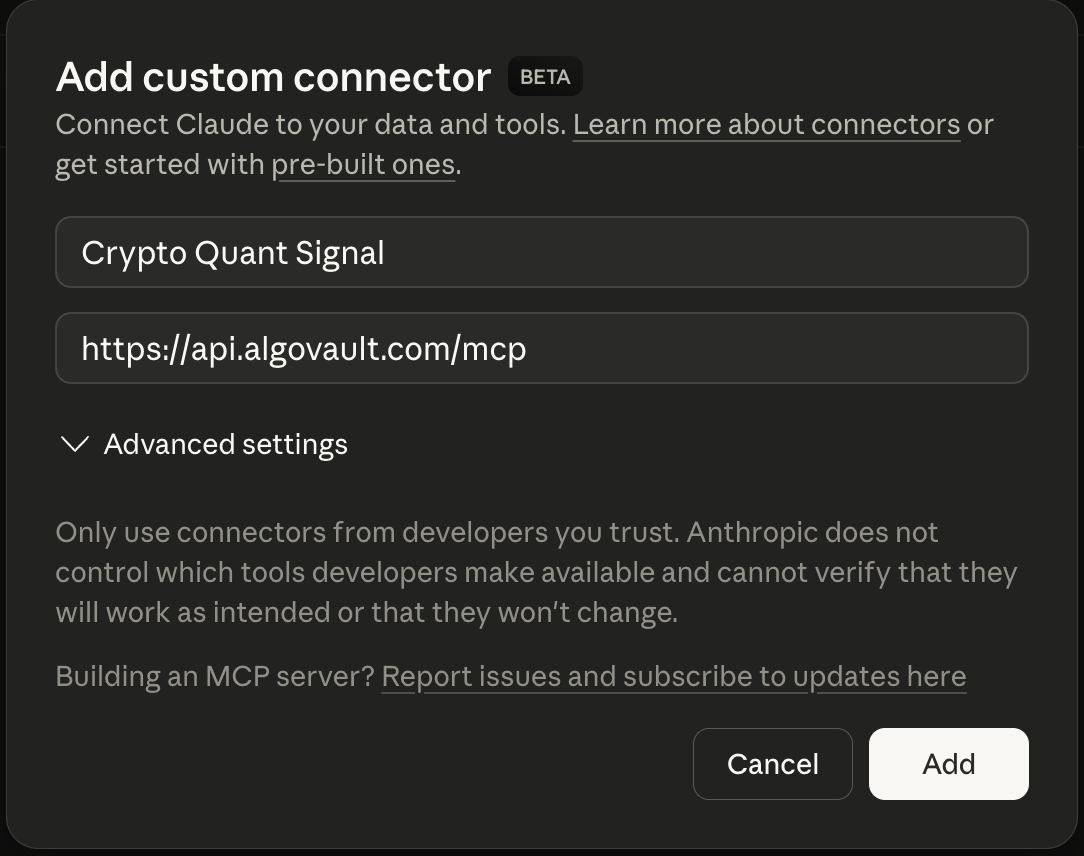
1. Add the connector. In Claude → Settings → Connectors → Add custom connector:
Field | Value |
Name |
|
URL |
|

2. Ask for a call. In plain language:
"Get me a trade call for ETH on the 4h timeframe"

Your Claude now has a quant analyst built in. Prefer local? Run npx -y crypto-quant-signal-mcp.
Running locally on npm 12+? npm v12 disables dependency install scripts by default. AlgoVault's optional local SQLite mode uses the native
better-sqlite3module — if you install it into a project, runnpm approve-scripts(ornpm install --allow-scripts) to build it. The hosted HTTP transport (api.algovault.com/mcp) needs no local build.
Related MCP server: Web3 Signals — Crypto Signal Intelligence
What one call returns
One API call. One verdict. Not 8 raw indicators. get_trade_call returns a directional BUY / SELL / HOLD with a confidence score and the detected market regime — a composite verdict, not a data dump for your agent to interpret.
Under the hood, a self-tuning model fuses momentum, trend structure, derivatives positioning, open interest, and volume into one weighted call. Every call reports market regime — trending, ranging, or volatile — alongside direction and confidence. Directional calls fire only when conviction clears the threshold; roughly 99% of evaluations return HOLD.
{
"call": "BUY",
"confidence": 78,
"price": 84250.50,
"indicators": {
"funding_rate": 0.0001,
"funding_24h_avg": 0.00008,
"funding_state": "NORMAL",
"oi_change_pct": 2.4,
"volume_24h": 2381602633,
"trend_persistence": "HIGH",
"breakout_pending": "INACTIVE"
},
"regime": "TRENDING_UP",
"reasoning": "Trending regime, upward bias. Funding pressure mild. Volatility neither expanding nor compressed. Trend persistence elevated; momentum structure. Strong conviction from aligned signals.",
"timestamp": 1712764800,
"coin": "BTC",
"timeframe": "1h",
"also_see": [
{ "coin": "ETH", "timeframe": "1h", "confidence": 82 },
{ "coin": "SOL", "timeframe": "15m", "confidence": 73 }
],
"_algovault": {
"version": "1.28.2",
"tool": "get_trade_call",
"compatible_with": ["crypto-quant-risk-mcp", "crypto-quant-backtest-mcp"]
}
}The _algovault block makes outputs composable: downstream risk and backtest tools accept the object directly.
Live, verifiable track record
The full record is public and on-chain — no cherry-picking, no survivorship bias:
Live dashboard — algovault.com/track-record
Merkle batch verifier — algovault.com/verify
Anchor contract on Base L2 —
0x6485…0f81All batches (raw JSON) — api.algovault.com/api/merkle-batches
AlgoVault is also a verified agent on the ERC-8004 Identity Registry (Base L2), agentId 44544 — a portable, on-chain handle AI orchestrators can resolve.
Works with your stack
AlgoVault is drop-in for every MCP-spec client, every major agent framework, and every official exchange Agent Trade Kit — no SDK, no wrapper. It serves Streamable HTTP at https://api.algovault.com/mcp; tools/list + resources/list is the API surface.
MCP clients.
Client | Config |
Claude Desktop | Settings → Connectors → Add custom connector → |
Claude Code (CLI) |
|
Cursor |
|
Cline | VS Code Cline extension → MCP server settings → add Streamable HTTP server |
Codex (OpenAI CLI) |
|
Windsurf |
|
Continue.dev |
|
Any other MCP-spec-compliant client | Configure the Streamable HTTP transport with URL |
Agent frameworks. First-party tutorials pair AlgoVault with each framework's canonical MCP adapter — copy-pasteable demo code, no SDK.
Framework | Tutorial | Runnable demo | Mirror |
LangChain | |||
LlamaIndex | |||
Microsoft Agent Framework | |||
CrewAI |
Each demo is runnable as python examples/<framework>/demo.py BTC 4h — gets a real BUY/SELL/HOLD verdict from api.algovault.com/mcp, prints it. ≤5 minutes to first call.
Exchange Agent Trade Kits. AlgoVault returns the analytics; your agent's risk policy decides what to execute. All demos run testnet/demo only. For Binance, the Agent OS path is the recommended default for new integrations — OAuth at connect time, no API keys on the machine; the key-based kit remains right for custom order types.
# | Exchange | Tutorial | Demo | Mirror |
01 | Binance | |||
02 | OKX | |||
03 | Bybit | |||
04 | Bitget | |||
05 | Hyperliquid | |||
06 | Aster | |||
07 | BingX | |||
08 | KuCoin | |||
09 | Gemini | |||
10 | Kraken | |||
11 | Alpaca | |||
12 | Gate.io | |||
13 | Binance Agent OS | — |
Tools & resources
The MCP tools live at https://api.algovault.com/mcp. Every asset works across the full supported timeframe range, on major crypto perpetual venues.
get_trade_call(aliasget_trade_signal) — composite BUY/SELL/HOLD verdict with confidence + regime, any asset, any timeframe.scan_trade_calls— scans the top-N perps by open interest on a venue; returns every actionable call in one shot.scan_funding_arb— cross-venue funding-rate spreads across 7 venues (Hyperliquid, Binance, Bybit, Gate, KuCoin, Aster, OKX), ranked. The only MCP server doing multi-exchange derivatives arbitrage.get_market_regime— classifies TRENDING_UP / TRENDING_DOWN / RANGING / VOLATILE for strategy selection.search_knowledge+chat_knowledge— free BM25 search and grounded Q&A over the full knowledge bundle.
Performance is exposed as a read-only MCP resource: performance://signal-performance (aggregated PFE win rate, never raw outcomes). Full parameter reference at algovault.com/docs.
Skills (20 ready-to-use Anthropic Agent Skills)
Single-prompt wrappers over 1–3 tool calls — regime gating, multi-timeframe consensus, funding-arb monitoring, and more. Install with claude plugin install AlgoVaultLabs/algovault-skills; browse at algovault.com/skills.
# | Slug | Name | Difficulty | Tools |
01 | Quick BTC Check | Beginner |
| |
02 | Portfolio Scanner | Intermediate |
| |
03 | Regime-Aware Trading | Intermediate |
| |
04 | Funding Arb Monitor | Intermediate |
| |
05 | Full 3-Tool Pipeline | Advanced |
| |
06 | Multi-Timeframe Confirmation | Advanced |
| |
07 | TradFi Rotation | Advanced |
| |
08 | Risk-Gated Entry | Advanced |
| |
09 | Funding Sentiment Dashboard | Advanced |
| |
10 | Contrarian Meme Scanner | Advanced |
| |
11 | Divergence Detector | Advanced |
| |
12 | Hourly Digest Bot | Advanced |
| |
13 | Hedging Advisor | Advanced |
| |
14 | Volatility Breakout Watch | Advanced |
| |
15 | Cross-Asset Correlation | Advanced |
| |
16 | Funding Cash-and-Carry | Advanced |
| |
17 | Weekend vs Weekday Patterns | Research |
| |
18 | Agent Portfolio Rebalance | Advanced |
| |
19 | Smart DCA Bot | Advanced |
| |
20 | Multi-Agent War Room | Expert |
|
Pricing
Quota-only tiers. Every tier gets all venues, all assets, all timeframes — you pay for call volume, nothing else.
Two meters per paid tier, monthly and daily, enforced independently: a call is refused when either is exhausted, and the daily window is a UTC calendar day resetting at 00:00 UTC. Quota is counted per call, regardless of verdict.
Feature | Free | Starter ($9.99/mo · $39.90/6mo) | Pro ($49/mo · $129/6mo) | Enterprise (contact us) | x402 (per call) |
Exchanges | All 14 | All 14 | All 14 | All 14 | All 14 |
Assets | All 740+ | All 740+ | All 740+ | All 740+ | All 740+ |
Asset classes | Crypto + TradFi | Crypto + TradFi | Crypto + TradFi | Crypto + TradFi | Crypto + TradFi |
Timeframes | All 11 | All 11 | All 11 | All 11 | All 11 |
Funding arb results | Top 5 | Unlimited | Unlimited | Unlimited | Unlimited |
Track record | Full access | Full access | Full access | Full access | Full access |
Monthly calls | 200/mo | 10,000/mo | 100,000/mo | Custom volume — contact us | Unlimited |
Daily calls | 100/day | 1,000/day | 10,000/day | Custom volume — contact us | Unlimited |
Price | $0 | $9.99/mo or $39.90/6mo | $49/mo or $129/6mo | Contact us | $0.01–0.05/call |
Subscriptions: Sign up at api.algovault.com/signup. Starter unlocks 10,000 calls/mo (up to 1,000/day) for $9.99/mo, or $39.90 for six months prepaid — add ?interval=6month to pick the prepay term. API key delivered instantly after checkout.
Pro 6-month is currently $129 — limited-time pricing; subscribe now and renewals keep your price.
x402 micropayments: AI agents pay per HTTP call with USDC on Base — no signup, no API key, no billing. The payment receipt is the credential. See x402.org.
What's new in v1.28.0
🔐 Authentication now tells you what happened. Every response carries
_algovault.auth. A well-formed but unrecognised key is refused instead of being quietly served free-tier data, and "malformed", "unknown" and "we couldn't verify" are three distinct outcomes rather than one silent fallback.🎛️ The published
exchangelist matches what we actually serve.get_trade_call,get_trade_signal,get_market_regimeandscan_trade_callsadvertise only publicly supported venues, so an agent can trust the enum it reads. Breaking:EDGEXandWEEXare no longer accepted — see Upgrading from v1.27.x below.📘 Two parameters that were always there, now documented.
assetClasson the trade-call tools andminLiquidityUsdonscan_trade_calls. Both project from the live schema, so the docs can't drift from the server — and_receiptsfields are documented from real responses.📗 The docs answer the question instead of pointing at it. Every
rankBylens is documented, REST is as complete as MCP, there's a proper error-code reference, and the copy-paste samples run exactly as written — CI re-checks them against the live API on every deploy.v1.28.1 — clearer tool descriptions for agent tool-selection;
get_trade_signalnow steers new integrations toget_trade_call.v1.28.2 — Pair with Binance Agent OS. One MCP client, two servers: AlgoVault returns the verdict, Binance Agent OS executes it. OAuth at connect time — no API keys on your machine, no request signing, and trading confined to an isolated sub-account you fund yourself. There is no withdrawal scope.
Upgrading from v1.27.x — one breaking change: EDGEX and WEEX are no longer valid exchange values and now return -32602. No tool was added or renamed. Check any hard-coded exchange value against the published enum, and read _algovault.auth if you branch on auth failures.
v1.27.x highlights (recap)
🧮 Counted per call. Your allowance covers every call the engine answers, on both the MCP and HTTP rails.
📶 A new call ladder. Free: 200/month plus 100/day. Starter: 10,000/month plus 1,000/day. Pro: 100,000/month plus 10,000/day.
💳 6-month prepay replaces annual. Starter is $39.90 (
$6.65/mo, 33% off monthly) and Pro is$129($21.50/mo, 56% off monthly). Pick it at signup with?interval=6month. Enterprise remains contact-us.⏱️ Daily limits say when they reset. Hit a daily cap and the refusal tells you the hours remaining, not a monthly figure.
v1.26.0 highlights (recap)
💳 Annual plans — prepay a year, save up to 49%. Starter was $79/yr (
$6.58/mo) and Pro was$299/yr($24.92/mo). Superseded: annual was retired on 2026-08-09 and replaced by 6-month prepay (see v1.27.0);?interval=yearnow redirects to the 6-month checkout, so existing links still work.
Refresh your MCP client to pick up this release. MCP clients cache
tools/listat session start — Claude.ai/Desktop: toggle the connector off+on; Cursor/Cline: restart the MCP server connection.
Privacy
Local mode: zero telemetry — call history stays on your machine. Remote mode: request metadata logged for analytics (IP hashed, never stored raw). See the privacy policy.
License
MIT
Disclaimer: AlgoVault provides directional entry interpretation for AI agents. Exit timing is determined by your agent or strategy. This is not financial advice. Past performance does not guarantee future results.
Available Tools
7 toolschat_knowledgeARead-onlyInspect
Returns a synthesized natural-language answer with citations, grounded in the AlgoVault knowledge bundle (every MCP tool description, response shape, integration tutorial, and code example). Use when you need an explanation, code pattern, or how-to; for raw ranked snippets without LLM synthesis use search_knowledge (faster, no quota cost). Read-only: calls an LLM, no other side effects. Quota: Free 10/month, Starter 50, Pro 200, Enterprise 2000.
| Name | Required | Description | Default |
|---|---|---|---|
| model | No | Optional model override (default claude-haiku-4-5-20251001). | |
| question | Yes | Natural-language question (5-500 chars). |
TDQS
Does the description disclose side effects, auth requirements, rate limits, or destructive behavior?
Despite annotations already declaring read-only, the description adds valuable operational context beyond them: it calls an LLM (implying cost/latency), has no other side effects, and lists specific quota limits per plan (Free 10, Starter 50, Pro 200, Enterprise 2000). This exceeds the annotation baseline.
Agents need to know what a tool does to the world before calling it. Descriptions should go beyond structured annotations to explain consequences.
Is the description appropriately sized, front-loaded, and free of redundancy?
The description is three concise sentences, each with a distinct purpose: what it does, when to use it (and when not), and operational constraints (read-only, quota). No redundant or filler content.
Shorter descriptions cost fewer tokens and are easier for agents to parse. Every sentence should earn its place.
Given the tool's complexity, does the description cover enough for an agent to succeed on first attempt?
The description, combined with a fully documented schema and annotations, covers the tool's return type, use cases, alternatives, quota, and safety profile. Since there is no output schema, the explicit mention of 'synthesized natural-language answer with citations' sufficiently communicates the expected response.
Complex tools with many parameters or behaviors need more documentation. Simple tools need less. This dimension scales expectations accordingly.
Does the description clarify parameter syntax, constraints, interactions, or defaults beyond what the schema provides?
The input schema provides 100% coverage for both parameters (question with length constraints, model with enum options). The description adds no additional parameter semantics, which is the expected baseline when schema coverage is high.
Input schemas describe structure but not intent. Descriptions should explain non-obvious parameter relationships and valid value ranges.
Does the description clearly state what the tool does and how it differs from similar tools?
The description uses a specific verb ('Returns'), identifies the resource ('AlgoVault knowledge bundle'), and specifies the output ('synthesized natural-language answer with citations'). It also explicitly distinguishes the tool from the sibling search_knowledge by contrasting LLM synthesis vs. raw ranked snippets.
Agents choose between tools based on descriptions. A clear purpose with a specific verb and resource helps agents select the right tool.
Does the description explain when to use this tool, when not to, or what alternatives exist?
Clear usage guidance is provided: 'Use when you need an explanation, code pattern, or how-to', and an explicit alternative is named ('for raw ranked snippets without LLM synthesis use search_knowledge'), including the trade-off that it is faster and has no quota cost.
Agents often have multiple tools that could apply. Explicit usage guidance like "use X instead of Y when Z" prevents misuse.
get_market_regimeARead-onlyInspect
Returns the market regime — TRENDING_UP TRENDING_DOWN RANGING VOLATILE — with confidence and a strategy hint, for one crypto perpetual futures. Composite verdict blends trend ranging and cross-venue funding rate sentiment. Read-only, live exchange APIs. Verified track record via performance://signal-performance; on-chain verified merkle anchor.
| Name | Required | Description | Default |
|---|---|---|---|
| coin | Yes | Base asset crypto signal, e.g. BTC ETH SOL signal. Crypto quant regime. | |
| exchange | No | Crypto venue, e.g. Binance Bybit OKX Bitget Hyperliquid. Multi-exchange. | HL |
| timeframe | No | Candle timeframe, e.g. 1h 4h 1d. Buy sell hold AI trading signal context. | 4h |
TDQS
Does the description disclose side effects, auth requirements, rate limits, or destructive behavior?
The annotations already declare readOnlyHint and destructiveHint, so the description's 'read-only' adds little. However, it adds valuable behavioral context: live exchange API dependency, the composite nature of the verdict (trend/ranging blended with cross-venue funding sentiment), and a verified track record via performance and merkle anchor references.
Agents need to know what a tool does to the world before calling it. Descriptions should go beyond structured annotations to explain consequences.
Is the description appropriately sized, front-loaded, and free of redundancy?
Three sentences, front-loaded with the return value, and no filler. Each sentence contributes a distinct piece of information: the output, the methodology, and the trusted/verification characteristics.
Shorter descriptions cost fewer tokens and are easier for agents to parse. Every sentence should earn its place.
Given the tool's complexity, does the description cover enough for an agent to succeed on first attempt?
For a read-only classifier with three parameters and no output schema, the description sufficiently conveys the return concept and input domain. It does not specify the confidence value format or exact response shape, but the output enumeration and annotations largely cover what an agent needs to call it correctly.
Complex tools with many parameters or behaviors need more documentation. Simple tools need less. This dimension scales expectations accordingly.
Does the description clarify parameter syntax, constraints, interactions, or defaults beyond what the schema provides?
Schema description coverage is 100%, so the schema already documents coin, exchange, and timeframe. The description adds a small amount of context by framing the tool as targeting perpetual futures, but it does not materially extend parameter meaning beyond the schema.
Input schemas describe structure but not intent. Descriptions should explain non-obvious parameter relationships and valid value ranges.
Does the description clearly state what the tool does and how it differs from similar tools?
The description names the exact resource (market regime for one crypto perpetual futures), enumerates the possible regime values (TRENDING_UP, TRENDING_DOWN, RANGING, VOLATILE), and specifies the returned fields (confidence and strategy hint). This clearly differentiates it from sibling trade-call/signal tools.
Agents choose between tools based on descriptions. A clear purpose with a specific verb and resource helps agents select the right tool.
Does the description explain when to use this tool, when not to, or what alternatives exist?
Use is implied: call this when a market-regime classification is needed for a coin, exchange, and timeframe. However, there is no explicit guidance about when to prefer this over siblings like get_trade_signal, nor any when-not-to-use conditions.
Agents often have multiple tools that could apply. Explicit usage guidance like "use X instead of Y when Z" prevents misuse.
get_trade_callARead-onlyInspect
Returns a composite verdict — BUY SELL HOLD trade call with confidence and market regime — for one crypto or tokenized-stock perpetual futures. One asset only; for a whole-market scan use scan_trade_calls. Read-only: reads live exchange APIs, no orders. Verified track record via performance://signal-performance; on-chain verified merkle anchor.
| Name | Required | Description | Default |
|---|---|---|---|
| coin | Yes | Base asset, e.g. BTC ETH SOL signal, or a US stock/ETF ticker (no USDT). | |
| exchange | No | Crypto venue (default Binance), e.g. Binance Bybit OKX Bitget Hyperliquid. | |
| timeframe | No | Candle timeframe, 1m to 1d. Default 15m. Crypto quant intraday horizon. | |
| assetClass | No | Force engine: 'perp' or 'equity'. Cross-venue multi-exchange AI trading signal. | |
| includeReasoning | No | Include reasoning: trend ranging crypto signal and market regime drivers. |
TDQS
Does the description disclose side effects, auth requirements, rate limits, or destructive behavior?
Even though readOnlyHint=true already exists, the description adds meaningful behavioral detail: it reads live exchange APIs, places no orders, has a verified track record, and is on-chain merkle anchored. This is valuable beyond annotations.
Agents need to know what a tool does to the world before calling it. Descriptions should go beyond structured annotations to explain consequences.
Is the description appropriately sized, front-loaded, and free of redundancy?
Four tight sentences: core output first, scope and alternative next, then safety and verification. No filler or redundant restatement of the schema.
Shorter descriptions cost fewer tokens and are easier for agents to parse. Every sentence should earn its place.
Given the tool's complexity, does the description cover enough for an agent to succeed on first attempt?
For a read-only single-asset tool with fully documented parameters and enums, the description covers output, scope, alternative, and safety. No output schema exists, but the description names the returned verdict, confidence, and market regime, which is sufficient for correct invocation.
Complex tools with many parameters or behaviors need more documentation. Simple tools need less. This dimension scales expectations accordingly.
Does the description clarify parameter syntax, constraints, interactions, or defaults beyond what the schema provides?
Schema description coverage is 100%, and each parameter already has explanatory text, so the baseline is 3. The description only adds the single-asset cardinality constraint and does not describe parameter formats beyond the schema.
Input schemas describe structure but not intent. Descriptions should explain non-obvious parameter relationships and valid value ranges.
Does the description clearly state what the tool does and how it differs from similar tools?
The description states a specific resource and output: a composite BUY/SELL/HOLD verdict with confidence and market regime for one perpetual contract. It also explicitly distinguishes itself from scan_trade_calls via the 'One asset only' scope, so an agent knows which tool this is.
Agents choose between tools based on descriptions. A clear purpose with a specific verb and resource helps agents select the right tool.
Does the description explain when to use this tool, when not to, or what alternatives exist?
'One asset only; for a whole-market scan use scan_trade_calls' is an explicit when-not and alternative pairing. The read-only note also reinforces when it is safe to call.
Agents often have multiple tools that could apply. Explicit usage guidance like "use X instead of Y when Z" prevents misuse.
get_trade_signalARead-onlyInspect
Returns a composite verdict — BUY SELL HOLD trade call with confidence and market regime — for one crypto or tokenized-stock perpetual futures. One asset only; for a whole-market scan use scan_trade_calls. Read-only: reads live exchange APIs, no orders. Verified track record via performance://signal-performance; on-chain verified merkle anchor. [ALIAS] This tool is an alias of get_trade_call — same behavior, kept for backward compatibility. Prefer get_trade_call for new integrations.
| Name | Required | Description | Default |
|---|---|---|---|
| coin | Yes | Base asset, e.g. BTC ETH SOL signal, or a US stock/ETF ticker (no USDT). | |
| exchange | No | Crypto venue (default Binance), e.g. Binance Bybit OKX Bitget Hyperliquid. | |
| timeframe | No | Candle timeframe, 1m to 1d. Default 15m. Crypto quant intraday horizon. | |
| assetClass | No | Force engine: 'perp' or 'equity'. Cross-venue multi-exchange AI trading signal. | |
| includeReasoning | No | Include reasoning: trend ranging crypto signal and market regime drivers. |
TDQS
Does the description disclose side effects, auth requirements, rate limits, or destructive behavior?
Annotations already mark readOnlyHint=true, openWorldHint=true, and destructiveHint=false; the description adds that it reads live exchange APIs and places no orders, plus mentions a verified track record and on-chain merkle anchor. This goes beyond the annotations and gives useful context about data sources and credibility.
Agents need to know what a tool does to the world before calling it. Descriptions should go beyond structured annotations to explain consequences.
Is the description appropriately sized, front-loaded, and free of redundancy?
The description is dense but efficient: it front-loads the primary output in the first sentence, then covers single-asset scope, read-only behavior, credibility, and alias relationship. Every sentence contributes operational or routing value with no significant fluff.
Shorter descriptions cost fewer tokens and are easier for agents to parse. Every sentence should earn its place.
Given the tool's complexity, does the description cover enough for an agent to succeed on first attempt?
There is no output schema, but the description adequately explains the return value as a composite verdict with confidence and market regime. It also covers read-only behavior, asset scope, the alternative scan_trade_calls, and the alias to get_trade_call, making the tool self-sufficient for an agent to invoke correctly.
Complex tools with many parameters or behaviors need more documentation. Simple tools need less. This dimension scales expectations accordingly.
Does the description clarify parameter syntax, constraints, interactions, or defaults beyond what the schema provides?
Schema description coverage is 100%, so parameters are already well documented. The description adds meaningful scope constraints not explicit in the schema, such as 'one asset only' and 'crypto or tokenized-stock perpetual futures,' which clarifies how the coin parameter should be interpreted beyond the schema wording.
Input schemas describe structure but not intent. Descriptions should explain non-obvious parameter relationships and valid value ranges.
Does the description clearly state what the tool does and how it differs from similar tools?
The description clearly states the tool returns a composite BUY/SELL/HOLD trade call with confidence and market regime for one crypto or tokenized-stock perpetual futures asset. It also distinguishes itself from scan_trade_calls by explicitly limiting scope to one asset, and the alias note clarifies its relationship to get_trade_call.
Agents choose between tools based on descriptions. A clear purpose with a specific verb and resource helps agents select the right tool.
Does the description explain when to use this tool, when not to, or what alternatives exist?
The description explicitly says 'One asset only' and directs agents to scan_trade_calls for whole-market scans. It also states this tool is an alias of get_trade_call and recommends preferring get_trade_call for new integrations, giving clear when-to-use and when-not-to-use guidance.
Agents often have multiple tools that could apply. Explicit usage guidance like "use X instead of Y when Z" prevents misuse.
scan_funding_arbARead-onlyInspect
Ranked cross-venue funding arbitrage across major crypto perpetual futures venues — funding rate spreads, long one venue short another, as a BUY SELL HOLD composite verdict per pair. AI trading signal for crypto quant and Claude trading agents. Trade call via get_trade_call, market regime via get_market_regime. On-chain verified merkle anchor.
| Name | Required | Description | Default |
|---|---|---|---|
| limit | No | Max ranked results, e.g. 5 (free tier cap). Crypto quant AI trading signal. | |
| minSpreadBps | No | Minimum funding rate spread in bps. Cross-venue multi-exchange crypto signal. |
TDQS
Does the description disclose side effects, auth requirements, rate limits, or destructive behavior?
Annotations already declare readOnlyHint=true and destructiveHint=false. The description adds meaningful context: outputs are ranked, include a composite verdict, and are 'on-chain verified merkle anchor' – enriching the behavioral picture beyond the annotations without contradiction.
Agents need to know what a tool does to the world before calling it. Descriptions should go beyond structured annotations to explain consequences.
Is the description appropriately sized, front-loaded, and free of redundancy?
The description is only three sentences with the core purpose front-loaded. The second sentence ('AI trading signal...') is somewhat promotional, but the overall structure is efficient and no essential details are buried.
Shorter descriptions cost fewer tokens and are easier for agents to parse. Every sentence should earn its place.
Given the tool's complexity, does the description cover enough for an agent to succeed on first attempt?
For a tool with no output schema, the description gives a reasonable sense of what is returned (ranked pairs, spread, separate verdict, merkle anchor). It could be more explicit about output fields, but given the simple params and annotations, it is sufficiently complete.
Complex tools with many parameters or behaviors need more documentation. Simple tools need less. This dimension scales expectations accordingly.
Does the description clarify parameter syntax, constraints, interactions, or defaults beyond what the schema provides?
Schema descriptions cover both parameters (limit, minSpreadBps) with defaults and ranges (100% coverage). The description does not add further parameter-level meaning, so the baseline of 3 is appropriate.
Input schemas describe structure but not intent. Descriptions should explain non-obvious parameter relationships and valid value ranges.
Does the description clearly state what the tool does and how it differs from similar tools?
The description clearly states the tool scans cross-venue funding arbitrage and returns ranked per-pair spreads and BUY/SELL/HOLD verdicts. The specific verb 'scan' and resource 'funding arbitrage' distinguish it from siblings like scan_trade_calls and get_trade_call.
Agents choose between tools based on descriptions. A clear purpose with a specific verb and resource helps agents select the right tool.
Does the description explain when to use this tool, when not to, or what alternatives exist?
The description names related tools (get_trade_call, get_market_regime) providing useful alternatives for specific needs. However, it does not explicitly contrast with scan_trade_calls or mention when not to use this tool, falling just short of full guidance.
Agents often have multiple tools that could apply. Explicit usage guidance like "use X instead of Y when Z" prevents misuse.
scan_trade_callsARead-onlyInspect
Returns ranked BUY SELL HOLD trade calls across the top crypto perpetual futures by open interest — one scan for whole-market coverage, each with confidence and market regime. Use this for breadth; use get_trade_call for per-coin depth and reasoning. Read-only: reads live exchange APIs, places no orders.
| Name | Required | Description | Default |
|---|---|---|---|
| topN | No | How many top perps by open interest to scan, 1 to 100 (default 20). | |
| limit | No | Max ranked calls to return, 1 to 100 (default 10). Non-HOLD ranked first. | |
| rankBy | No | Universe lens: oi (default) volume gainers losers movers funding_positive funding_negative volatility oi_change (aliases vol gain lose move pfr nfr atr oid). funding_*/volatility/oi_change rank among the most-liquid perps; oi_change = real 24h open-interest %Δ. | oi |
| oiBasis | No | OI-delta basis for rankBy=oi_change: notional (default, USD) or contracts (base-coin, price-independent). Ignored by other lenses. | notional |
| exchange | No | Crypto venue (default Binance), e.g. Binance Bybit OKX Bitget Hyperliquid. | BINANCE |
| timeframe | No | Candle timeframe, 1m to 1d for the scan. Default 15m intraday. | 15m |
| includeHolds | No | Include HOLD calls after non-HOLD (default false). | |
| minConfidence | No | Optional confidence floor, 0 to 100, applied to non-HOLD trade calls. | |
| oiChangeWindow | No | OI-delta window for rankBy=oi_change: 1h, 4h, or 24h (default 24h). Ignored by other lenses. | 24h |
| minLiquidityUsd | No | Optional USD liquidity floor applied to the scan universe: notional open interest, or 24h volume on venues that expose no bulk OI. Omitted means no floor. | |
| includeReasoning | No | Enrich each non-HOLD call with price, the top 2-3 drivers, and one-line reasoning (default false → bare verdict cells). HOLDs stay bare. Same per-call detail as get_trade_call. |
TDQS
Does the description disclose side effects, auth requirements, rate limits, or destructive behavior?
Annotations already declare readOnlyHint=true and destructiveHint=false, and the description reinforces this with 'Read-only: reads live exchange APIs, places no orders,' adding external-live-data context beyond the annotations. It also discloses that results come with confidence and market regime. No contradiction; the only missing behavioral detail is latency or rate-limit expectations.
Agents need to know what a tool does to the world before calling it. Descriptions should go beyond structured annotations to explain consequences.
Is the description appropriately sized, front-loaded, and free of redundancy?
Three tight sentences: the first states the core action and scope, the second routes to the sibling, and the third confirms safety. Every sentence earns its place and the most decision-relevant information is front-loaded.
Shorter descriptions cost fewer tokens and are easier for agents to parse. Every sentence should earn its place.
Given the tool's complexity, does the description cover enough for an agent to succeed on first attempt?
Even without an output schema, the description explains the broad return shape: ranked trade calls with confidence and market regime. Combined with the rich parameter schema and the includeReasoning parameter describing per-call enrichment, the agent has enough context to invoke correctly. A more explicit output-shape example would push this to 5.
Complex tools with many parameters or behaviors need more documentation. Simple tools need less. This dimension scales expectations accordingly.
Does the description clarify parameter syntax, constraints, interactions, or defaults beyond what the schema provides?
Schema description coverage is 100%, and every parameter is documented with defaults, ranges, enums, and domain meaning. The description adds no parameter-specific detail, but the schema carries the full burden. Baseline 3 is appropriate.
Input schemas describe structure but not intent. Descriptions should explain non-obvious parameter relationships and valid value ranges.
Does the description clearly state what the tool does and how it differs from similar tools?
The description names a specific verb ('Returns'), a specific resource ('ranked BUY SELL HOLD trade calls across the top crypto perpetual futures by open interest'), and the differentiating scope ('one scan for whole-market coverage'). It clearly distinguishes itself from get_trade_call without requiring the reader to open the schema.
Agents choose between tools based on descriptions. A clear purpose with a specific verb and resource helps agents select the right tool.
Does the description explain when to use this tool, when not to, or what alternatives exist?
Explicitly states when to use this tool ('Use this for breadth') and names the alternative for a different need ('use get_trade_call for per-coin depth and reasoning'). This gives an agent concrete routing guidance between siblings.
Agents often have multiple tools that could apply. Explicit usage guidance like "use X instead of Y when Z" prevents misuse.
search_knowledgeARead-onlyInspect
Returns ranked snippets from the AlgoVault knowledge bundle answering a question about its MCP tools, response shapes, integration patterns (LangChain, LlamaIndex, MAF, CrewAI), or code examples. Call this BEFORE other tool calls to confirm parameter usage and avoid hallucinating tool shapes. Fast: BM25 lexical search, no LLM call, no quota cost. For a synthesized natural-language answer use chat_knowledge. Read-only, no side effects.
| Name | Required | Description | Default |
|---|---|---|---|
| limit | No | Max ranked results (1-50, default 10). | |
| query | Yes | Natural-language search query (3-500 chars). |
TDQS
Does the description disclose side effects, auth requirements, rate limits, or destructive behavior?
Annotations already cover read-only and non-destructive hints. The description adds valuable context: fast BM25 lexical search, no LLM call, no quota cost, and explicitly 'Read-only, no side effects.' This goes beyond the annotation basics, though it doesn't detail result structure or pagination, which is acceptable given the tool's simplicity.
Agents need to know what a tool does to the world before calling it. Descriptions should go beyond structured annotations to explain consequences.
Is the description appropriately sized, front-loaded, and free of redundancy?
Three sentences, each earning its place: functionality, usage timing, and alternative. Front-loaded with the core purpose, then key behavioral notes. No fluff or repetition of schema fields.
Shorter descriptions cost fewer tokens and are easier for agents to parse. Every sentence should earn its place.
Given the tool's complexity, does the description cover enough for an agent to succeed on first attempt?
For a read-only, two-parameter tool with no output schema, the description covers purpose, when to use, performance characteristics, safety, and alternative tool. It is sufficiently complete for an agent to select and invoke correctly.
Complex tools with many parameters or behaviors need more documentation. Simple tools need less. This dimension scales expectations accordingly.
Does the description clarify parameter syntax, constraints, interactions, or defaults beyond what the schema provides?
Schema coverage is 100%, so the baseline is 3. The description adds meaning by explaining the query is a natural-language question about specific topics (MCP tools, response shapes, etc.), and reinforces the limit as controlling 'ranked results'. This is more than the schema alone provides.
Input schemas describe structure but not intent. Descriptions should explain non-obvious parameter relationships and valid value ranges.
Does the description clearly state what the tool does and how it differs from similar tools?
The description uses a specific verb ('Returns') and resource ('AlgoVault knowledge bundle') with clear scope: ranked snippets answering questions about MCP tools, response shapes, integration patterns, or code examples. It also explicitly distinguishes itself from sibling chat_knowledge by noting that chat_knowledge provides synthesized natural-language answers.
Agents choose between tools based on descriptions. A clear purpose with a specific verb and resource helps agents select the right tool.
Does the description explain when to use this tool, when not to, or what alternatives exist?
Provides explicit when-to-use guidance: 'Call this BEFORE other tool calls to confirm parameter usage and avoid hallucinating tool shapes.' Also names the alternative: 'For a synthesized natural-language answer use chat_knowledge.' This gives clear context and exclusions.
Agents often have multiple tools that could apply. Explicit usage guidance like "use X instead of Y when Z" prevents misuse.
TDQS
Most tools have clearly distinct purposes: scan_trade_calls vs get_trade_call vs get_market_regime vs scan_funding_arb are well separated, and the two knowledge tools are differentiated by raw vs synthesized output. However, get_trade_signal is explicitly an alias of get_trade_call, and chat_knowledge/search_knowledge overlap enough that an agent could hesitate, though the descriptions help.
All tool names follow a consistent verb_noun snake_case pattern: scan_*, get_*, chat_*, search_*. Even the alias get_trade_signal matches the naming convention. There are no mixed casing styles or unpredictable verbs.
Seven tools is a reasonable size for a crypto signal + knowledge server. The count is slightly inflated by the redundant get_trade_signal alias, which does not earn its place functionally, but overall the number is well within a scoped and manageable range.
The core read-only signal workflow is covered: whole-market scans, per-asset calls, market regime, funding arbitrage, and documentation lookup. Minor gaps exist, such as no explicit supported-asset listing tool and no per-pair funding arbitrage detail beyond the ranked scan, but agents can work around these using scan_trade_calls and knowledge tools.
Maintenance
Resources
Unclaimed servers have limited discoverability.
Looking for Admin?
If you are the server author, to access and configure the admin panel.
Related MCP Connectors
Live crypto market signals for AI agents: perp liquidations, funding, OI positioning, yield, FX.
Hyperliquid perp market data for LLMs: OHLCV, funding, open interest, positioning & forecasts.
Crypto market intelligence: regime detection, funding rates, liquidations, prices, signals.
Market intelligence for AI agents. Real-time data, cross-market analysis, and regime detection.
Related MCP Servers
AlicenseAqualityAmaintenanceProvides comprehensive crypto intelligence for the Hyperliquid exchange, allowing users to query trader profiles, behavioral cohorts, and live market data. It enables AI agents to analyze over 1.8 billion trades, track whale positions, and access real-time liquidation heatmaps.993145MIT- AlicenseNot gradedqualityCmaintenanceAI-powered crypto signal intelligence for 20 assets (BTC, ETH, SOL, etc). 6 scoring dimensions: whale activity, technical analysis, derivatives flow, narrative strength, sentiment, market structure. Market regime detection (TRENDING/RANGING), portfolio optimization, and accuracy tracking. 9 read-only MCP tools. Free via MCP, $0.001 USDC via x402 on Base for REST API.3MIT
- AlicenseAqualityDmaintenanceFinancial intelligence for AI agents. 31 tools across 8 data sources — regime, derivatives, stablecoin flows, momentum, volatility, macro, DeFi, weather patterns, political cycles, seasonality. The context layer between your agent and a bad trade.31199MIT
- AlicenseAqualityCmaintenanceReal-time crypto intelligence for AI agents. Technical analysis, liquidation heatmaps, sentiment, and funding rates for 50+ Hyperliquid perpetuals via x402 micropayments.151MIT
Latest Blog Posts
- Who's Calling? MCP Hosts Are an Identity Blind Spot (And the Spec Knows It)By Om-Shree-0709 on .mcpAgent IdentityOAuth 2.1
- Your AI Chatbot Just Exposed Your CEO's Salary to an InternBy Om-Shree-0709 on .Agent IdentityMCP SecurityOAuth Delegation
- Why MCP Servers Need Execution Sandboxing (And Why Your Current Stack Isn't Enough)By Om-Shree-0709 on .Agentic AiPrompt InjectionWebAssembly
MCP directory API
We provide all the information about MCP servers via our MCP API.
curl -X GET 'https://glama.ai/api/mcp/v1/servers/AlgoVaultLabs/crypto-quant-signal-mcp'
If you have feedback or need assistance with the MCP directory API, please join our Discord server