Glama

crypto-quant-signal-mcp

Уровень интеллектуальных вызовов для AI-торговых агентов — композитные количественные сигналы по крипто- и TradFi-бессрочным контрактам, обнаружение межбиржевого арбитража и классификация рыночных режимов через MCP.


npm version npm downloads License: MIT On-Chain Verified

Live Track Record — точность направления 90%+ по более чем 900 торговым сигналам. Публично, вход в систему не требуется.


Почему AlgoVault

Большинство торговых MCP-серверов предоставляют вам «сырые» данные — цены, книги ордеров, свечи. Вашему агенту все еще приходится самому решать, что с ними делать.

AlgoVault — другой. Мы даем вашему агенту один ответ: направленный вердикт с показателем уверенности, построенный на базе многофакторного композитного движка, настроенного на реальных количественных системах. Каждый сигнал отслеживается, каждый результат измеряется, а полная история результатов доступна публично с первого дня.

Что делает этот инструмент чем-то большим, чем просто обертка для индикаторов:

  • Композитный скоринг, а не шум от одного индикатора. Множество ортогональных сигналов — импульсные осцилляторы, структура тренда, позиционирование деривативов, динамика объема, поток открытого интереса — объединены в единый взвешенный вердикт. Веса откалиброваны на основе данных о реальных рыночных результатах, а не на стандартных учебных значениях.

  • Генерация сигналов с учетом рыночного режима. Сигналы фильтруются через классификатор рыночного режима перед отправкой. Движок знает, когда выдавать сигналы, а когда оставаться в стороне — трендовая стратегия в боковом рынке будет подавлена, а не транслирована.

  • Межбиржевая аналитика. Ставки финансирования (funding rates) с Hyperliquid, Binance и Bybit нормализуются и сравниваются в режиме реального времени. Никто больше не делает анализ деривативов между площадками через MCP.

  • Опубликованная история результатов с каждым релизом. Каждый сигнал записывается с ценами результатов на нескольких горизонтах. Винрейт, коэффициент прибыли и ожидаемая стоимость вычисляются непрерывно. Никакого «выдергивания» удачных сделок, никакой ошибки выжившего.

  • Адаптивный скоринг. Веса индикаторов перенастраиваются ежемесячно на основе данных о результатах. Движок учится тому, что работает, и адаптируется — сигнал, который вы получаете сегодня, лучше, чем тот, что был в прошлом месяце.

  • Покрытие Crypto + TradFi. 290+ активов — стандартные крипто-бессрочные контракты, TradFi-бессрочные контракты (акции, индексы, товары, FX через xyz dex от Hyperliquid) и мем-коины с фильтрацией по ликвидности. Активы классифицируются по уровням качества с фильтрацией сигналов институционального уровня.


Related MCP server: Web3 Signals — Crypto Signal Intelligence

Попробуйте за 30 секунд

Без кода. Без API-ключа. Без установки.

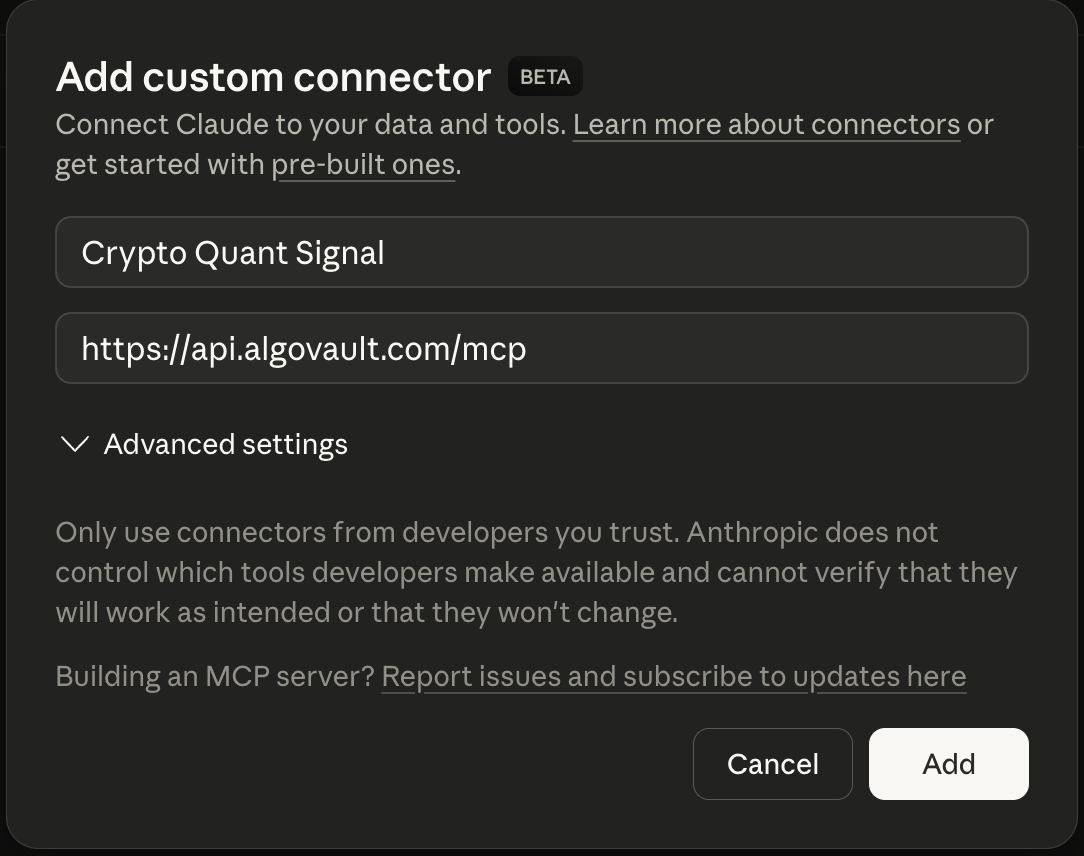
Шаг 1. Откройте Claude → Settings → Integrations → Add custom connector

Шаг 2. Введите имя и URL:

Поле

Значение

Name

Crypto Quant Signal

URL

https://api.algovault.com/mcp

Add Connector

Шаг 3. Спросите Claude о чем угодно:

"Get me a trade signal for ETH on the 4h timeframe"
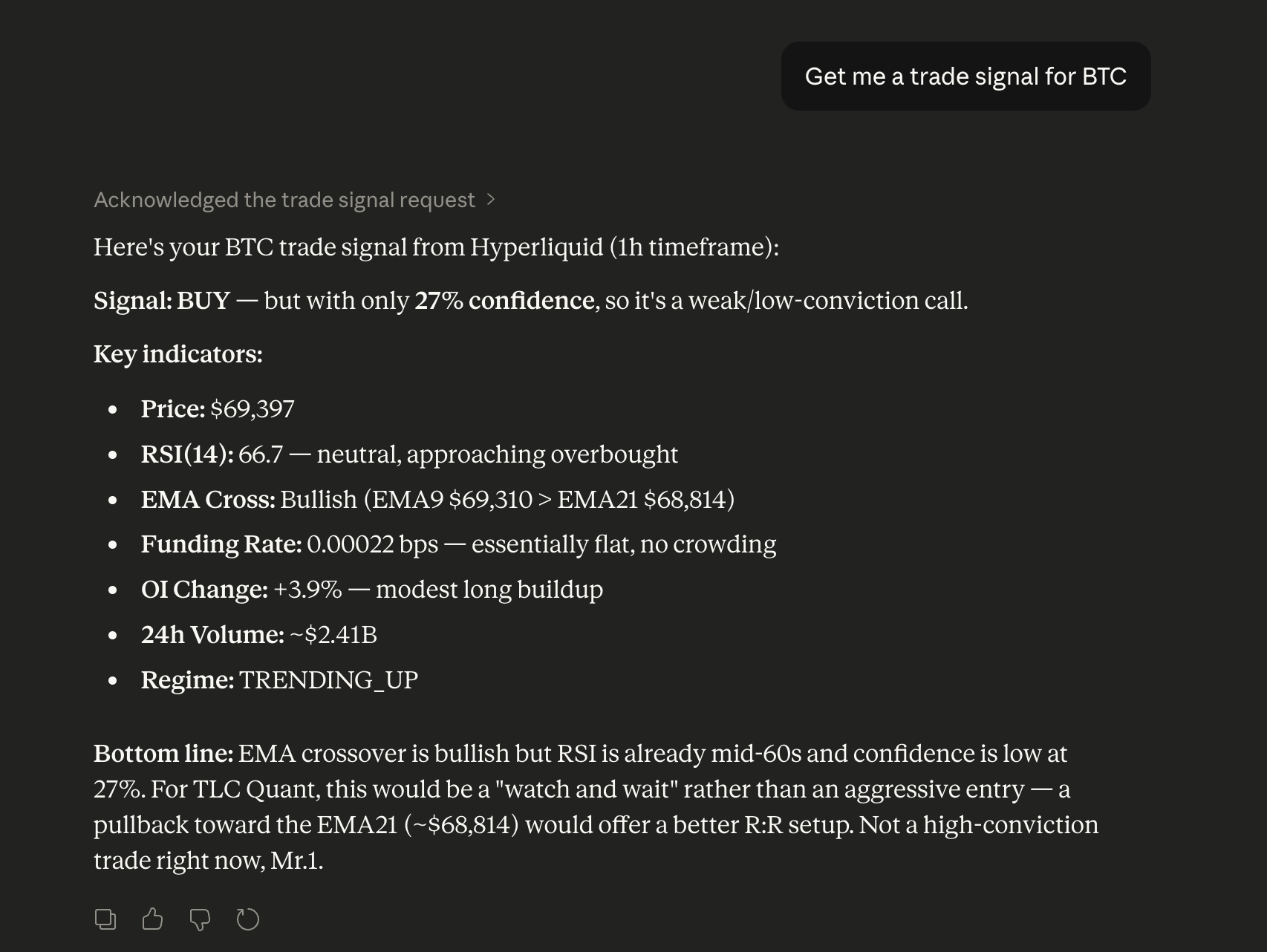
BTC Signal Result

Это всё. Теперь у вашего Claude есть встроенный количественный аналитик.


Инструменты

get_trade_signal

Возвращает композитный вердикт BUY / SELL / HOLD с показателем уверенности для любого поддерживаемого актива — крипто-бессрочные контракты, TradFi-бессрочные контракты (акции, индексы, товары, FX) и мем-коины с фильтрацией по ликвидности на Hyperliquid.

Под капотом: многофакторный движок оценки анализирует импульс, структуру тренда, настроения на рынке деривативов, динамику открытого интереса и убедительность объема. Оценки проходят через фильтры рыночного режима и адаптивные гейты постобработки — включая анализ потоков финансирования, определение режима волатильности и затухание тренда — перед выдачей окончательного вердикта.

Генерируются только сигналы с высокой степенью уверенности. Движок спроектирован так, чтобы молчать, когда преимущество неясно.

Параметры:

  • coin (строка, обязательно): Символ актива — например, "ETH", "BTC", "SOL", "GOLD", "TSLA" или любой из 290+ поддерживаемых активов

  • timeframe (строка, по умолчанию "15m"): "1m", "3m", "5m", "15m", "30m", "1h", "2h", "4h", "8h", "12h", "1d"

  • includeReasoning (булево, по умолчанию true): Понятное человеку объяснение логики сигнала

Вывод включает: направление сигнала, показатель уверенности (0–100), все вычисленные значения индикаторов, обнаруженный рыночный режим, описание логики и метаданные _algovault для компонуемости инструментов.

scan_funding_arb

Сканирует разницу ставок финансирования между площадками Hyperliquid, Binance и Bybit. Нормализует почасовые и 8-часовые конвенции ставок, вычисляет спреды в базисных пунктах и ранжирует возможности по композитному баллу (величина спреда, срочность и убедительность финансирования на основе истории за 24 часа).

Это единственный MCP-сервер, предоставляющий аналитику межбиржевого арбитража финансирования — лонг на одной бирже, шорт на другой, захват спреда.

Параметры:

  • minSpreadBps (число, по умолчанию 5): Минимальный спред в базисных пунктах для включения

  • limit (число, по умолчанию 10): Максимальное количество возвращаемых результатов

Вывод включает: ставки на каждой площадке, оптимальное направление лонг/шорт, годовой процент спреда и время следующего финансирования.

get_market_regime

Классифицирует текущую рыночную среду на один из четырех режимов: TRENDING_UP, TRENDING_DOWN, RANGING или VOLATILE.

Использует многомерный подход к классификации, сочетающий измерение силы направления с анализом наклона ADX (обнаружение усиления или истощения тренда), обнаружение пивотов с учетом объема, адаптивные пороги финансирования ATR и расхождение настроений финансирования между площадками. Классификация режима напрямую влияет на то, как get_trade_signal фильтрует свой вывод — агенты также могут использовать его независимо для выбора стратегии и определения размера позиции.

Параметры:

  • coin (строка, обязательно): Символ актива

  • timeframe (строка, по умолчанию "4h"): Таймфрейм свечей для анализа

Вывод включает: метку режима, показатель уверенности, базовые метрики (сила тренда, интерпретация волатильности, структура цены), настроения финансирования между площадками и предложение стратегии на простом английском языке.


Отслеживание производительности

Каждый сигнал отслеживается от момента выпуска до результата. Без исключений.

Что мы измеряем:

  • Цены результатов в соответствующие таймфрейму окна оценки

  • Винрейт PFE — двигалась ли цена в направлении сигнала в любой момент в течение окна оценки

  • Ожидаемая стоимость — средняя доходность на сигнал, взвешенная по вероятности

  • Коэффициент прибыли — валовые выигрыши, деленные на валовые убытки

  • Пиковое благоприятное отклонение (PFE) и максимальное неблагоприятное отклонение (MAE)

  • Текущая статистика по активам, таймфреймам и уровням качества

Сигналы HOLD бесплатны — когда движок говорит «не торгуй», вы не платите. Только вердикты BUY и SELL оплачиваются через x402 или учитываются в квотах подписки. Это выравнивает наши стимулы: вы платите только тогда, когда мы видим торгуемую возможность.

  • Коэффициент HOLD: Процент сканирований, при которых движок отказывается выдавать торговый сигнал. Высокий коэффициент HOLD (в настоящее время ~84%) означает, что движок избирателен — он выдает BUY/SELL только тогда, когда условия совпадают по нескольким индикаторам.

Инфраструктура:

  • Удаленный режим: PostgreSQL с автоматическим заполнением результатов

  • Локальный режим: SQLite в ~/.crypto-quant-signal/performance.db

  • Отслеживаются только сигналы BUY/SELL с высокой уверенностью — HOLD исключен

On-Chain верификация

Каждый сигнал хешируется (keccak256) в момент создания и закрепляется в Base L2 через ежедневные пакеты Merkle. Это делает историю результатов защищенной от подделки — мы не можем редактировать прошлые сигналы.

  • Контракт: 0x6485...0f81 (Base L2)

  • Проверить любой сигнал: https://api.algovault.com/api/verify-signal?signalId=<ID>

  • Просмотреть все пакеты: https://api.algovault.com/api/merkle-batches

  • Визуальная проверка: algovault.com/verify


Цены

Функция

Бесплатно

Starter ($9.99/мес)

Pro ($49/мес)

Enterprise ($299/мес)

x402 (за сигнал)

Активы

BTC, ETH

Все 290+

Все 290+

Все 290+

Все 290+

Классы активов

Только крипто

Крипто + TradFi

Крипто + TradFi

Крипто + TradFi

Крипто + TradFi

Таймфреймы

15м, 1ч

Все 11

Все 11

Все 11

Все 11

Арбитраж финансирования

Топ 5

Безлимит

Безлимит

Безлимит

Безлимит

История результатов

Полный доступ

Полный доступ

Полный доступ

Полный доступ

Полный доступ

Ежемесячные сигналы

~100/день

3,000/мес

15,000/мес

100,000/мес

Безлимит

Поддержка

Сообщество

Email

Приоритет

Выделенная

Цена

$0

$9.99/мес

$49/мес

$299/мес

$0.01–0.05/сигнал

Сигналы HOLD

Бесплатно

Бесплатно

Бесплатно

Бесплатно

Бесплатно

* Вердикты HOLD (движок говорит «не торгуй») всегда бесплатны на всех уровнях — без списаний x402, без вычета квот.

Микроплатежи x402: AI-агенты платят за каждый HTTP-запрос через USDC в сети Base — без регистрации, без API-ключа, без биллинга. Квитанция об оплате является учетными данными. См. x402.org.

Подписки: Подпишитесь на api.algovault.com/signup. Starter ($9.99/мес) открывает все активы и таймфреймы. API-ключ доставляется мгновенно после оплаты.


Для разработчиков

Удаленная конечная точка (рекомендуется)

https://api.algovault.com/mcp

Потоковый HTTP-транспорт. Совместим с любым MCP-клиентом — Claude, Cursor, Cline, пользовательскими агентами.

Локальная установка через npx

npx -y crypto-quant-signal-mcp

Конфигурация Claude Desktop / Cursor

{
  "mcpServers": {
    "crypto-quant-signal": {
      "command": "npx",
      "args": ["-y", "crypto-quant-signal-mcp"],
      "env": { "TRANSPORT": "stdio" }
    }
  }
}

Установка через npm

npm install crypto-quant-signal-mcp

Самостоятельный хостинг

git clone https://github.com/AlgoVaultLabs/crypto-quant-signal-mcp
cd crypto-quant-signal-mcp
cp .env.example .env  # Edit with your values
npm ci && npm run build
docker compose up -d

Архитектура

Agent / Claude / Cursor
  │
  ▼
api.algovault.com/mcp (Streamable HTTP)
  │
  ├─ x402 payment verification (USDC on Base)
  ├─ API key / subscription check
  ├─ Free tier fallback
  │
  ▼
MCP Server (Express + @modelcontextprotocol/sdk)
  │
  ├─ Composite Scoring Engine
  │    ├─ Multi-factor indicator fusion
  │    ├─ Regime-aware signal filtering
  │    └─ Adaptive post-processing gates
  │
  ├─ Asset Classification Engine
  │    ├─ 4-tier quality system (Blue Chip → Major Alt → TradFi → Meme)
  │    └─ Liquidity filter for meme/micro assets
  │
  ├─ Exchange Adapter Layer
  │    └─ Hyperliquid (standard + xyz TradFi perps) · Binance, Bybit (funding data)
  │
  ├─ Performance Tracker
  │    └─ PostgreSQL (remote) / SQLite (local)
  │
  └─ Hyperliquid Public API (free, no auth)

Паттерн адаптера биржи: Все взаимодействия с биржами проходят через интерфейс ExchangeAdapter — поддерживающий как стандартные крипто-бессрочные контракты, так и xyz TradFi-бессрочные контракты на Hyperliquid, с Binance и Bybit для сравнения финансирования между площадками.


Компонуемость набора

Каждый вывод инструмента включает блок метаданных _algovault, объявляющий версию и совместимые последующие инструменты:

Этот инструмент

Подает данные в (Фаза 2+)

get_trade_signal

crypto-quant-risk-mcp (размер позиции) · crypto-quant-backtest-mcp (валидация)

scan_funding_arb

crypto-quant-execution-mcp (оптимальный вход/выход) · crypto-quant-risk-mcp (экспозиция)

get_market_regime

crypto-quant-risk-mcp (размер с учетом режима) · crypto-quant-backtest-mcp (фильтрованные бэктесты)

Схемы разработаны для компону

Available Tools

8 tools
chat_knowledgeA
Read-only
Inspect

Returns a synthesized natural-language answer with citations, grounded in the AlgoVault knowledge bundle (every MCP tool description, response shape, integration tutorial, and code example). Use when you need an explanation, code pattern, or how-to; for raw ranked snippets without LLM synthesis use search_knowledge (faster, no quota cost). Read-only: calls an LLM, no other side effects. Quota: Free 10/month, Starter 50, Pro 200, Enterprise 2000.

ParametersJSON Schema
NameRequiredDescriptionDefault
modelNoOptional model override (default claude-haiku-4-5-20251001).
questionYesNatural-language question (5-500 chars).

TDQS

A4.7/5.0
Behavior5/5

Does the description disclose side effects, auth requirements, rate limits, or destructive behavior?

Despite annotations already declaring read-only, the description adds valuable operational context beyond them: it calls an LLM (implying cost/latency), has no other side effects, and lists specific quota limits per plan (Free 10, Starter 50, Pro 200, Enterprise 2000). This exceeds the annotation baseline.

Agents need to know what a tool does to the world before calling it. Descriptions should go beyond structured annotations to explain consequences.

Conciseness5/5

Is the description appropriately sized, front-loaded, and free of redundancy?

The description is three concise sentences, each with a distinct purpose: what it does, when to use it (and when not), and operational constraints (read-only, quota). No redundant or filler content.

Shorter descriptions cost fewer tokens and are easier for agents to parse. Every sentence should earn its place.

Completeness5/5

Given the tool's complexity, does the description cover enough for an agent to succeed on first attempt?

The description, combined with a fully documented schema and annotations, covers the tool's return type, use cases, alternatives, quota, and safety profile. Since there is no output schema, the explicit mention of 'synthesized natural-language answer with citations' sufficiently communicates the expected response.

Complex tools with many parameters or behaviors need more documentation. Simple tools need less. This dimension scales expectations accordingly.

Parameters3/5

Does the description clarify parameter syntax, constraints, interactions, or defaults beyond what the schema provides?

The input schema provides 100% coverage for both parameters (question with length constraints, model with enum options). The description adds no additional parameter semantics, which is the expected baseline when schema coverage is high.

Input schemas describe structure but not intent. Descriptions should explain non-obvious parameter relationships and valid value ranges.

Purpose5/5

Does the description clearly state what the tool does and how it differs from similar tools?

The description uses a specific verb ('Returns'), identifies the resource ('AlgoVault knowledge bundle'), and specifies the output ('synthesized natural-language answer with citations'). It also explicitly distinguishes the tool from the sibling search_knowledge by contrasting LLM synthesis vs. raw ranked snippets.

Agents choose between tools based on descriptions. A clear purpose with a specific verb and resource helps agents select the right tool.

Usage Guidelines5/5

Does the description explain when to use this tool, when not to, or what alternatives exist?

Clear usage guidance is provided: 'Use when you need an explanation, code pattern, or how-to', and an explicit alternative is named ('for raw ranked snippets without LLM synthesis use search_knowledge'), including the trade-off that it is faster and has no quota cost.

Agents often have multiple tools that could apply. Explicit usage guidance like "use X instead of Y when Z" prevents misuse.

get_market_regimeA
Read-only
Inspect

Returns the market regime — TRENDING_UP TRENDING_DOWN RANGING VOLATILE — with confidence and a strategy hint, for one crypto perpetual futures. Composite verdict: trend ranging + cross-venue funding rate. Read-only, live exchange APIs. Verified track record: get_track_record or performance://signal-performance; on-chain verified merkle anchor.

ParametersJSON Schema
NameRequiredDescriptionDefault
coinYesBase asset crypto signal, e.g. BTC ETH SOL signal. Crypto quant regime.
exchangeNoCrypto venue, e.g. Binance Bybit OKX Bitget Hyperliquid. Multi-exchange.HL
timeframeNoCandle timeframe, e.g. 1h 4h 1d. Buy sell hold AI trading signal context.4h

TDQS

A3.7/5.0
Behavior4/5

Does the description disclose side effects, auth requirements, rate limits, or destructive behavior?

Annotations already declare readOnlyHint=true and destructiveHint=false, and the description reinforces this with 'Read-only, live exchange APIs.' It adds useful behavioral context beyond the annotations: the verdict is composite of trend/ranging and cross-venue funding rate, and the output includes confidence and a strategy hint. It does not cover rate limits or failure modes, but with annotations present the safety profile is sufficiently disclosed.

Agents need to know what a tool does to the world before calling it. Descriptions should go beyond structured annotations to explain consequences.

Conciseness4/5

Is the description appropriately sized, front-loaded, and free of redundancy?

The description is two sentences and front-loads the key deliverable: the market regime values, confidence, and strategy hint. The verification sentence is dense but not bloated, and there is no redundant padding.

Shorter descriptions cost fewer tokens and are easier for agents to parse. Every sentence should earn its place.

Completeness4/5

Given the tool's complexity, does the description cover enough for an agent to succeed on first attempt?

For a read-only retrieval tool with three well-documented parameters and no output schema, the description supplies the return values, confidence, strategy hint, and composite methodology. It lacks explicit sibling routing and exact response structure, but those gaps are minor given the schema enum coverage and annotations.

Complex tools with many parameters or behaviors need more documentation. Simple tools need less. This dimension scales expectations accordingly.

Parameters3/5

Does the description clarify parameter syntax, constraints, interactions, or defaults beyond what the schema provides?

Schema description coverage is 100%, so the baseline is 3. The description adds little about the exact parameters beyond limiting the tool to a single crypto perpetual futures asset. It does not add syntax, default semantics, or parameter-specific guidance beyond what the schema already provides.

Input schemas describe structure but not intent. Descriptions should explain non-obvious parameter relationships and valid value ranges.

Purpose4/5

Does the description clearly state what the tool does and how it differs from similar tools?

The description names a specific verb ('Returns'), the resource ('market regime'), the possible output values, and the asset scope ('crypto perpetual futures'). It does not explicitly differentiate itself from siblings like get_trade_signal or get_trade_call, but the regime-value list makes the core purpose clear.

Agents choose between tools based on descriptions. A clear purpose with a specific verb and resource helps agents select the right tool.

Usage Guidelines3/5

Does the description explain when to use this tool, when not to, or what alternatives exist?

The context 'for one crypto perpetual futures' implies when the tool is relevant, and 'Read-only, live exchange APIs' clarifies the nature of the call. However, there is no explicit guidance about when to use this tool versus alternatives, and the get_track_record mention is about validating track record rather than choosing between tools.

Agents often have multiple tools that could apply. Explicit usage guidance like "use X instead of Y when Z" prevents misuse.

get_track_recordA
Read-only
Inspect

Returns the AlgoVault track record — aggregated PFE win rates by call type, timeframe and asset tier, plus the evaluation methodology and window. The same verified aggregate the performance://signal-performance resource serves, callable from harnesses that bridge tools only. Defaults to the compact aggregate; use include for the per-asset, per-venue or recent-signal breakdowns. Read-only, no side effects.

ParametersJSON Schema
NameRequiredDescriptionDefault
includeNoOptional extra sections: byAsset, byExchange, recentSignals. Omit for compact.

TDQS

A4.3/5.0
Behavior4/5

Does the description disclose side effects, auth requirements, rate limits, or destructive behavior?

Annotations already declare readOnlyHint=true and destructiveHint=false; the description reinforces this with 'Read-only, no side effects.' It adds useful behavior beyond annotations: compact-by-default output, optional breakdown sections, and the fact that the same aggregate is served by performance://signal-performance. No contradiction.

Agents need to know what a tool does to the world before calling it. Descriptions should go beyond structured annotations to explain consequences.

Conciseness5/5

Is the description appropriately sized, front-loaded, and free of redundancy?

Three sentences, each earning its place: purpose/content, alternative-resource context, and parameter/default behavior. The key return content is front-loaded before the include guidance, and there is no filler.

Shorter descriptions cost fewer tokens and are easier for agents to parse. Every sentence should earn its place.

Completeness5/5

Given the tool's complexity, does the description cover enough for an agent to succeed on first attempt?

For a read-only aggregate tool with no output schema, the description tells the agent what data is returned (PFE win rates, methodology, window), how to control detail with include, and that it is safe to call. The annotations cover the safety profile, and no essential call-time behavior is missing.

Complex tools with many parameters or behaviors need more documentation. Simple tools need less. This dimension scales expectations accordingly.

Parameters3/5

Does the description clarify parameter syntax, constraints, interactions, or defaults beyond what the schema provides?

The schema already documents the single include parameter with enum values and the 'Omit for compact' guidance, so description coverage is 100% and the bar is lower. The description adds mild semantic color by calling byExchange 'per-venue' and framing the values as breakdown sections, but it does not substantially extend the schema.

Input schemas describe structure but not intent. Descriptions should explain non-obvious parameter relationships and valid value ranges.

Purpose5/5

Does the description clearly state what the tool does and how it differs from similar tools?

Description opens with a specific verb and resource ('Returns the AlgoVault track record') and specifies the exact contents: aggregated PFE win rates by call type, timeframe, and asset tier, plus methodology and window. This clearly distinguishes it from sibling tools like get_trade_call and get_trade_signal, which return individual calls/signals rather than an aggregate record.

Agents choose between tools based on descriptions. A clear purpose with a specific verb and resource helps agents select the right tool.

Usage Guidelines4/5

Does the description explain when to use this tool, when not to, or what alternatives exist?

It states when the compact default is appropriate and when to use the include parameter for per-asset, per-venue, or recent-signal breakdowns. It also notes the performance://signal-performance equivalence and harness-only callability. It does not explicitly name exclusion cases or sibling alternatives, but the usage context is clear.

Agents often have multiple tools that could apply. Explicit usage guidance like "use X instead of Y when Z" prevents misuse.

get_trade_callA
Read-only
Inspect

Returns a composite verdict — BUY SELL HOLD trade call with confidence and market regime — for one crypto or tokenized-stock perpetual futures. One asset only; whole-market scan: scan_trade_calls. Read-only: live exchange APIs, no orders. Verified track record: get_track_record or performance://signal-performance; on-chain verified merkle anchor.

ParametersJSON Schema
NameRequiredDescriptionDefault
coinYesBase asset, e.g. BTC ETH SOL signal, or a US stock/ETF ticker (no USDT).
exchangeNoCrypto venue (default Binance), e.g. Binance Bybit OKX Bitget Hyperliquid.
timeframeNoCandle timeframe, 1m to 1d. Default 15m. Crypto quant intraday horizon.
assetClassNoForce engine: 'perp' or 'equity'. Cross-venue multi-exchange AI trading signal.
includeReasoningNoInclude reasoning: trend ranging crypto signal and market regime drivers.

TDQS

A4.1/5.0
Behavior4/5

Does the description disclose side effects, auth requirements, rate limits, or destructive behavior?

Annotations already mark the tool read-only and non-destructive; the description reinforces this with 'live exchange APIs, no orders,' which adds operational context beyond the hints. It also discloses the verified-provenance angle with get_track_record and the on-chain merkle anchor. No contradiction with annotations.

Agents need to know what a tool does to the world before calling it. Descriptions should go beyond structured annotations to explain consequences.

Conciseness4/5

Is the description appropriately sized, front-loaded, and free of redundancy?

Three compact sentences front-load the core behavior and scope before routing to alternatives. The track-record sentence is marginally tangential but still informative, and there is no real padding.

Shorter descriptions cost fewer tokens and are easier for agents to parse. Every sentence should earn its place.

Completeness4/5

Given the tool's complexity, does the description cover enough for an agent to succeed on first attempt?

For a simple read-only lookup with rich schema coverage, the description covers purpose, scope, alternative, and safety in a compact way. Without an output schema, it gives the main elements of the return (verdict, confidence, market regime) but not a complete response shape; still sufficient to call correctly with just the coin parameter.

Complex tools with many parameters or behaviors need more documentation. Simple tools need less. This dimension scales expectations accordingly.

Parameters3/5

Does the description clarify parameter syntax, constraints, interactions, or defaults beyond what the schema provides?

Schema coverage is 100% and each parameter already has descriptive text with defaults and examples. The description adds only the one-asset constraint and the composite-verdict framing, not new parameter-level semantics, so the schema carries the weight.

Input schemas describe structure but not intent. Descriptions should explain non-obvious parameter relationships and valid value ranges.

Purpose5/5

Does the description clearly state what the tool does and how it differs from similar tools?

The first sentence names a specific verb and resource: returns a composite BUY/SELL/HOLD verdict with confidence and market regime for a single perpetual-futures asset. It also explicitly contrasts with the whole-market scan sibling scan_trade_calls, so an agent can distinguish the tool without opening the schema.

Agents choose between tools based on descriptions. A clear purpose with a specific verb and resource helps agents select the right tool.

Usage Guidelines4/5

Does the description explain when to use this tool, when not to, or what alternatives exist?

The 'One asset only; whole-market scan: scan_trade_calls' sentence gives an explicit alternative and the condition that selects it. However, it does not explain how to choose between get_trade_call and the similarly named get_trade_signal, leaving that distinction implied rather than stated.

Agents often have multiple tools that could apply. Explicit usage guidance like "use X instead of Y when Z" prevents misuse.

get_trade_signalA
Read-only
Inspect

Returns a composite verdict — BUY SELL HOLD trade call with confidence and market regime — for one crypto or tokenized-stock perpetual futures. One asset only; whole-market scan: scan_trade_calls. Read-only: live exchange APIs, no orders. Verified track record: get_track_record or performance://signal-performance; on-chain verified merkle anchor. [ALIAS] This tool is an alias of get_trade_call — same behavior, kept for backward compatibility. Prefer get_trade_call for new integrations.

ParametersJSON Schema
NameRequiredDescriptionDefault
coinYesBase asset, e.g. BTC ETH SOL signal, or a US stock/ETF ticker (no USDT).
exchangeNoCrypto venue (default Binance), e.g. Binance Bybit OKX Bitget Hyperliquid.
timeframeNoCandle timeframe, 1m to 1d. Default 15m. Crypto quant intraday horizon.
assetClassNoForce engine: 'perp' or 'equity'. Cross-venue multi-exchange AI trading signal.
includeReasoningNoInclude reasoning: trend ranging crypto signal and market regime drivers.

TDQS

A4.5/5.0
Behavior4/5

Does the description disclose side effects, auth requirements, rate limits, or destructive behavior?

Annotations already declare readOnlyHint=true and destructiveHint=false; the description adds that it queries 'live exchange APIs, no orders', discloses alias equivalence with get_trade_call, and mentions a verified track record. This adds useful behavioral context beyond annotations, though it could detail latency or failure modes.

Agents need to know what a tool does to the world before calling it. Descriptions should go beyond structured annotations to explain consequences.

Conciseness4/5

Is the description appropriately sized, front-loaded, and free of redundancy?

The main output is front-loaded in the first sentence. Subsequent sentences each serve a purpose: scope, whole-market alternative, read-only safety, verification, and alias. It is dense but not bloated; the 'performance://signal-performance' reference is slightly cryptic but still earns its place.

Shorter descriptions cost fewer tokens and are easier for agents to parse. Every sentence should earn its place.

Completeness4/5

Given the tool's complexity, does the description cover enough for an agent to succeed on first attempt?

For a tool with five parameters, no output schema, and informative annotations, the description covers the return shape (BUY/SELL/HOLD, confidence, market regime), single-asset input, read-only behavior, and alias relationship. It could add default exchange/timeframe behavior or response structure details, but the current context is sufficient for correct invocation.

Complex tools with many parameters or behaviors need more documentation. Simple tools need less. This dimension scales expectations accordingly.

Parameters4/5

Does the description clarify parameter syntax, constraints, interactions, or defaults beyond what the schema provides?

Input schema coverage is 100%, so the baseline is already satisfied. The description adds meaning by clarifying 'One asset only' and 'crypto or tokenized-stock perpetual futures', which usefully constrains the coin and assetClass parameters beyond the schema examples.

Input schemas describe structure but not intent. Descriptions should explain non-obvious parameter relationships and valid value ranges.

Purpose5/5

Does the description clearly state what the tool does and how it differs from similar tools?

Description opens with a specific verb and resource: 'Returns a composite verdict — BUY SELL HOLD trade call with confidence and market regime — for one crypto or tokenized-stock perpetual futures.' It explicitly distinguishes itself from scan_trade_calls ('One asset only; whole-market scan') and identifies the alias get_trade_call, so sibling confusion is minimized.

Agents choose between tools based on descriptions. A clear purpose with a specific verb and resource helps agents select the right tool.

Usage Guidelines5/5

Does the description explain when to use this tool, when not to, or what alternatives exist?

The description states single-asset scope and routes whole-market scans to scan_trade_calls. It also points to get_track_record/performance://signal-performance for verification and advises preferring get_trade_call for new integrations, giving clear when-to-use and alternative guidance.

Agents often have multiple tools that could apply. Explicit usage guidance like "use X instead of Y when Z" prevents misuse.

scan_funding_arbA
Read-only
Inspect

Ranked cross-venue funding arbitrage across major crypto perpetual futures venues — funding rate spreads, long one venue short another, as a BUY SELL HOLD composite verdict per pair. AI trading signal for crypto quant and Claude trading agents. Trade call via get_trade_call, market regime via get_market_regime. On-chain verified merkle anchor.

ParametersJSON Schema
NameRequiredDescriptionDefault
limitNoMax ranked results, e.g. 5 (free tier cap). Crypto quant AI trading signal.
minSpreadBpsNoMinimum funding rate spread in bps. Cross-venue multi-exchange crypto signal.

TDQS

A4.1/5.0
Behavior4/5

Does the description disclose side effects, auth requirements, rate limits, or destructive behavior?

Annotations already declare readOnlyHint=true and destructiveHint=false. The description adds meaningful context: outputs are ranked, include a composite verdict, and are 'on-chain verified merkle anchor' – enriching the behavioral picture beyond the annotations without contradiction.

Agents need to know what a tool does to the world before calling it. Descriptions should go beyond structured annotations to explain consequences.

Conciseness4/5

Is the description appropriately sized, front-loaded, and free of redundancy?

The description is only three sentences with the core purpose front-loaded. The second sentence ('AI trading signal...') is somewhat promotional, but the overall structure is efficient and no essential details are buried.

Shorter descriptions cost fewer tokens and are easier for agents to parse. Every sentence should earn its place.

Completeness4/5

Given the tool's complexity, does the description cover enough for an agent to succeed on first attempt?

For a tool with no output schema, the description gives a reasonable sense of what is returned (ranked pairs, spread, separate verdict, merkle anchor). It could be more explicit about output fields, but given the simple params and annotations, it is sufficiently complete.

Complex tools with many parameters or behaviors need more documentation. Simple tools need less. This dimension scales expectations accordingly.

Parameters3/5

Does the description clarify parameter syntax, constraints, interactions, or defaults beyond what the schema provides?

Schema descriptions cover both parameters (limit, minSpreadBps) with defaults and ranges (100% coverage). The description does not add further parameter-level meaning, so the baseline of 3 is appropriate.

Input schemas describe structure but not intent. Descriptions should explain non-obvious parameter relationships and valid value ranges.

Purpose5/5

Does the description clearly state what the tool does and how it differs from similar tools?

The description clearly states the tool scans cross-venue funding arbitrage and returns ranked per-pair spreads and BUY/SELL/HOLD verdicts. The specific verb 'scan' and resource 'funding arbitrage' distinguish it from siblings like scan_trade_calls and get_trade_call.

Agents choose between tools based on descriptions. A clear purpose with a specific verb and resource helps agents select the right tool.

Usage Guidelines4/5

Does the description explain when to use this tool, when not to, or what alternatives exist?

The description names related tools (get_trade_call, get_market_regime) providing useful alternatives for specific needs. However, it does not explicitly contrast with scan_trade_calls or mention when not to use this tool, falling just short of full guidance.

Agents often have multiple tools that could apply. Explicit usage guidance like "use X instead of Y when Z" prevents misuse.

scan_trade_callsA
Read-only
Inspect

Returns ranked BUY SELL HOLD trade calls across the top crypto perpetual futures by open interest — one scan for whole-market coverage, each with confidence and market regime. Use this for breadth; use get_trade_call for per-coin depth and reasoning. Read-only: reads live exchange APIs, places no orders.

ParametersJSON Schema
NameRequiredDescriptionDefault
topNNoHow many top perps by open interest to scan, 1 to 100 (default 20).
limitNoMax ranked calls to return, 1 to 100 (default 10). Non-HOLD ranked first.
rankByNoUniverse lens: oi (default) volume gainers losers movers funding_positive funding_negative volatility oi_change (aliases vol gain lose move pfr nfr atr oid). funding_*/volatility/oi_change rank among the most-liquid perps; oi_change = real 24h open-interest %Δ.oi
oiBasisNoOI-delta basis for rankBy=oi_change: notional (default, USD) or contracts (base-coin, price-independent). Ignored by other lenses.notional
exchangeNoCrypto venue (default Binance), e.g. Binance Bybit OKX Bitget Hyperliquid.BINANCE
timeframeNoCandle timeframe, 1m to 1d for the scan. Default 15m intraday.15m
includeHoldsNoInclude HOLD calls after non-HOLD (default false).
minConfidenceNoOptional confidence floor, 0 to 100, applied to non-HOLD trade calls.
oiChangeWindowNoOI-delta window for rankBy=oi_change: 1h, 4h, or 24h (default 24h). Ignored by other lenses.24h
minLiquidityUsdNoOptional USD liquidity floor applied to the scan universe: notional open interest, or 24h volume on venues that expose no bulk OI. Omitted means no floor.
includeReasoningNoEnrich each non-HOLD call with price, the top 2-3 drivers, and one-line reasoning (default false → bare verdict cells). HOLDs stay bare. Same per-call detail as get_trade_call.

TDQS

A4.7/5.0
Behavior5/5

Does the description disclose side effects, auth requirements, rate limits, or destructive behavior?

Annotations already mark readOnlyHint=true and destructiveHint=false. The description adds context beyond that by stating it 'reads live exchange APIs' and 'places no orders,' and it discloses output characteristics: ranked calls, confidence, and market regime. There is no contradiction with annotations.

Agents need to know what a tool does to the world before calling it. Descriptions should go beyond structured annotations to explain consequences.

Conciseness5/5

Is the description appropriately sized, front-loaded, and free of redundancy?

Three sentences carry all essential information: what it returns, when to use it, and its safety profile. The main purpose is front-loaded, usage guidance comes second, and safety is concise. No filler or redundant restating of the name.

Shorter descriptions cost fewer tokens and are easier for agents to parse. Every sentence should earn its place.

Completeness5/5

Given the tool's complexity, does the description cover enough for an agent to succeed on first attempt?

For an 11-parameter, read-only market scanner with no output schema, the description covers purpose, breadth-versus-depth routing, safety, and the shape of the result. The remaining operational details (parameter meanings, defaults, constraints) are fully covered by the rich input schema.

Complex tools with many parameters or behaviors need more documentation. Simple tools need less. This dimension scales expectations accordingly.

Parameters3/5

Does the description clarify parameter syntax, constraints, interactions, or defaults beyond what the schema provides?

Schema description coverage is 100%, and the schema already thoroughly documents every parameter with defaults, ranges, enums, and condition-specific meanings. The description adds high-level context about whole-market scanning but does not need to repeat parameter details. Baseline 3 is appropriate.

Input schemas describe structure but not intent. Descriptions should explain non-obvious parameter relationships and valid value ranges.

Purpose5/5

Does the description clearly state what the tool does and how it differs from similar tools?

The description opens with a specific verb and resource: 'Returns ranked BUY SELL HOLD trade calls across the top crypto perpetual futures by open interest.' It clearly distinguishes itself from the sibling get_trade_call by framing this as whole-market breadth versus per-coin depth, so an agent can select it without inspecting schemas.

Agents choose between tools based on descriptions. A clear purpose with a specific verb and resource helps agents select the right tool.

Usage Guidelines5/5

Does the description explain when to use this tool, when not to, or what alternatives exist?

The description explicitly says 'Use this for breadth; use get_trade_call for per-coin depth and reasoning.' This provides a direct when-to-use rule and names the alternative, making the selection decision unambiguous.

Agents often have multiple tools that could apply. Explicit usage guidance like "use X instead of Y when Z" prevents misuse.

search_knowledgeA
Read-only
Inspect

Returns ranked snippets from the AlgoVault knowledge bundle answering a question about its MCP tools, response shapes, integration patterns (LangChain, LlamaIndex, MAF, CrewAI), or code examples. Call this BEFORE other tool calls to confirm parameter usage and avoid hallucinating tool shapes. Fast: BM25 lexical search, no LLM call, no quota cost. For a synthesized natural-language answer use chat_knowledge. Read-only, no side effects.

ParametersJSON Schema
NameRequiredDescriptionDefault
limitNoMax ranked results (1-50, default 10).
queryYesNatural-language search query (3-500 chars).

TDQS

A4.7/5.0
Behavior4/5

Does the description disclose side effects, auth requirements, rate limits, or destructive behavior?

Annotations already cover read-only and non-destructive hints. The description adds valuable context: fast BM25 lexical search, no LLM call, no quota cost, and explicitly 'Read-only, no side effects.' This goes beyond the annotation basics, though it doesn't detail result structure or pagination, which is acceptable given the tool's simplicity.

Agents need to know what a tool does to the world before calling it. Descriptions should go beyond structured annotations to explain consequences.

Conciseness5/5

Is the description appropriately sized, front-loaded, and free of redundancy?

Three sentences, each earning its place: functionality, usage timing, and alternative. Front-loaded with the core purpose, then key behavioral notes. No fluff or repetition of schema fields.

Shorter descriptions cost fewer tokens and are easier for agents to parse. Every sentence should earn its place.

Completeness5/5

Given the tool's complexity, does the description cover enough for an agent to succeed on first attempt?

For a read-only, two-parameter tool with no output schema, the description covers purpose, when to use, performance characteristics, safety, and alternative tool. It is sufficiently complete for an agent to select and invoke correctly.

Complex tools with many parameters or behaviors need more documentation. Simple tools need less. This dimension scales expectations accordingly.

Parameters4/5

Does the description clarify parameter syntax, constraints, interactions, or defaults beyond what the schema provides?

Schema coverage is 100%, so the baseline is 3. The description adds meaning by explaining the query is a natural-language question about specific topics (MCP tools, response shapes, etc.), and reinforces the limit as controlling 'ranked results'. This is more than the schema alone provides.

Input schemas describe structure but not intent. Descriptions should explain non-obvious parameter relationships and valid value ranges.

Purpose5/5

Does the description clearly state what the tool does and how it differs from similar tools?

The description uses a specific verb ('Returns') and resource ('AlgoVault knowledge bundle') with clear scope: ranked snippets answering questions about MCP tools, response shapes, integration patterns, or code examples. It also explicitly distinguishes itself from sibling chat_knowledge by noting that chat_knowledge provides synthesized natural-language answers.

Agents choose between tools based on descriptions. A clear purpose with a specific verb and resource helps agents select the right tool.

Usage Guidelines5/5

Does the description explain when to use this tool, when not to, or what alternatives exist?

Provides explicit when-to-use guidance: 'Call this BEFORE other tool calls to confirm parameter usage and avoid hallucinating tool shapes.' Also names the alternative: 'For a synthesized natural-language answer use chat_knowledge.' This gives clear context and exclusions.

Agents often have multiple tools that could apply. Explicit usage guidance like "use X instead of Y when Z" prevents misuse.

Tool Schema Changelog

Recent tool additions, removals, and schema changes observed during successful MCP inspections.

  1. 5 tool updatesv1.30.0
    • Changedget_market_regime1 field changed
      • changedInput schema / properties / exchange / enum
        Previous value: -[
        -  "HL",
        -  "BINANCE",
        -  "BYBIT",
        -  "OKX",
        -  "BITGET",
        -  "ASTER",
        -  "BINGX",
        -  "GATE",
        -  "HTX",
        -  "KUCOIN",
        -  "MEXC",
        -  "PHEMEX",
        -  "WHITEBIT",
        -  "BITMART",
        -  "XT"
        -]New value: +[
        +  "HL",
        +  "BINANCE",
        +  "BYBIT",
        +  "OKX",
        +  "BITGET",
        +  "ASTER",
        +  "BINGX",
        +  "GATE",
        +  "HTX",
        +  "KUCOIN",
        +  "MEXC",
        +  "PHEMEX",
        +  "WHITEBIT",
        +  "XT",
        +  "WEEX"
        +]
    • Addedget_track_record
    • Changedget_trade_call1 field changed
      • changedInput schema / properties / exchange / enum
        Previous value: -[
        -  "HL",
        -  "BINANCE",
        -  "BYBIT",
        -  "OKX",
        -  "BITGET",
        -  "ASTER",
        -  "BINGX",
        -  "GATE",
        -  "HTX",
        -  "KUCOIN",
        -  "MEXC",
        -  "PHEMEX",
        -  "WHITEBIT",
        -  "BITMART",
        -  "XT"
        -]New value: +[
        +  "HL",
        +  "BINANCE",
        +  "BYBIT",
        +  "OKX",
        +  "BITGET",
        +  "ASTER",
        +  "BINGX",
        +  "GATE",
        +  "HTX",
        +  "KUCOIN",
        +  "MEXC",
        +  "PHEMEX",
        +  "WHITEBIT",
        +  "XT",
        +  "WEEX"
        +]
    • Changedget_trade_signal1 field changed
      • changedInput schema / properties / exchange / enum
        Previous value: -[
        -  "HL",
        -  "BINANCE",
        -  "BYBIT",
        -  "OKX",
        -  "BITGET",
        -  "ASTER",
        -  "BINGX",
        -  "GATE",
        -  "HTX",
        -  "KUCOIN",
        -  "MEXC",
        -  "PHEMEX",
        -  "WHITEBIT",
        -  "BITMART",
        -  "XT"
        -]New value: +[
        +  "HL",
        +  "BINANCE",
        +  "BYBIT",
        +  "OKX",
        +  "BITGET",
        +  "ASTER",
        +  "BINGX",
        +  "GATE",
        +  "HTX",
        +  "KUCOIN",
        +  "MEXC",
        +  "PHEMEX",
        +  "WHITEBIT",
        +  "XT",
        +  "WEEX"
        +]
    • Changedscan_trade_calls1 field changed
      • changedInput schema / properties / exchange / enum
        Previous value: -[
        -  "HL",
        -  "BINANCE",
        -  "BYBIT",
        -  "OKX",
        -  "BITGET",
        -  "ASTER",
        -  "BINGX",
        -  "GATE",
        -  "HTX",
        -  "KUCOIN",
        -  "MEXC",
        -  "PHEMEX",
        -  "WHITEBIT",
        -  "BITMART",
        -  "XT"
        -]New value: +[
        +  "HL",
        +  "BINANCE",
        +  "BYBIT",
        +  "OKX",
        +  "BITGET",
        +  "ASTER",
        +  "BINGX",
        +  "GATE",
        +  "HTX",
        +  "KUCOIN",
        +  "MEXC",
        +  "PHEMEX",
        +  "WHITEBIT",
        +  "XT",
        +  "WEEX"
        +]
  2. 1 tool updatev1.28.2
    • Changedscan_trade_calls1 field changed
      • changedInput schema / properties / exchange / description
        Previous value: -"Venue: BINANCE (default) HL BYBIT OKX BITGET."New value: +"Crypto venue (default Binance), e.g. Binance Bybit OKX Bitget Hyperliquid."
  3. 3 tool updatesv1.28.0
    • Changedget_market_regime1 field changed
      • changedInput schema / properties / exchange / enum
        Previous value: -[
        -  "HL",
        -  "BINANCE",
        -  "BYBIT",
        -  "OKX",
        -  "BITGET",
        -  "ASTER",
        -  "EDGEX",
        -  "GATE",
        -  "MEXC",
        -  "KUCOIN",
        -  "PHEMEX",
        -  "BINGX",
        -  "HTX",
        -  "WEEX",
        -  "BITMART",
        -  "XT",
        -  "WHITEBIT"
        -]New value: +[
        +  "HL",
        +  "BINANCE",
        +  "BYBIT",
        +  "OKX",
        +  "BITGET",
        +  "ASTER",
        +  "BINGX",
        +  "GATE",
        +  "HTX",
        +  "KUCOIN",
        +  "MEXC",
        +  "PHEMEX",
        +  "WHITEBIT",
        +  "BITMART",
        +  "XT"
        +]
    • Changedget_trade_call1 field changed
      • changedInput schema / properties / exchange / enum
        Previous value: -[
        -  "HL",
        -  "BINANCE",
        -  "BYBIT",
        -  "OKX",
        -  "BITGET",
        -  "ASTER",
        -  "EDGEX",
        -  "GATE",
        -  "MEXC",
        -  "KUCOIN",
        -  "PHEMEX",
        -  "BINGX",
        -  "HTX",
        -  "WEEX",
        -  "BITMART",
        -  "XT",
        -  "WHITEBIT"
        -]New value: +[
        +  "HL",
        +  "BINANCE",
        +  "BYBIT",
        +  "OKX",
        +  "BITGET",
        +  "ASTER",
        +  "BINGX",
        +  "GATE",
        +  "HTX",
        +  "KUCOIN",
        +  "MEXC",
        +  "PHEMEX",
        +  "WHITEBIT",
        +  "BITMART",
        +  "XT"
        +]
    • Changedget_trade_signal1 field changed
      • changedInput schema / properties / exchange / enum
        Previous value: -[
        -  "HL",
        -  "BINANCE",
        -  "BYBIT",
        -  "OKX",
        -  "BITGET",
        -  "ASTER",
        -  "EDGEX",
        -  "GATE",
        -  "MEXC",
        -  "KUCOIN",
        -  "PHEMEX",
        -  "BINGX",
        -  "HTX",
        -  "WEEX",
        -  "BITMART",
        -  "XT",
        -  "WHITEBIT"
        -]New value: +[
        +  "HL",
        +  "BINANCE",
        +  "BYBIT",
        +  "OKX",
        +  "BITGET",
        +  "ASTER",
        +  "BINGX",
        +  "GATE",
        +  "HTX",
        +  "KUCOIN",
        +  "MEXC",
        +  "PHEMEX",
        +  "WHITEBIT",
        +  "BITMART",
        +  "XT"
        +]
  4. 1 tool updatev1.26.0
    • Changedscan_trade_calls1 field changed
      • changedInput schema / properties / includeHolds / description
        Previous value: -"Include HOLD calls after non-HOLD (default false). HOLDs never cost quota."New value: +"Include HOLD calls after non-HOLD (default false)."
  5. 7 tool updatesv1.25.0
    • First observedchat_knowledge
    • First observedget_market_regime
    • First observedget_trade_call
    • First observedget_trade_signal
    • First observedscan_funding_arb
    • First observedscan_trade_calls
    • First observedsearch_knowledge

TDQS

A4.1/5.0

Scored across 8 tools

Disambiguation3/5

Most tools are clearly separated by scope (market-wide scan vs single-asset call, funding arb vs regime), but get_trade_call and get_trade_signal are exact duplicates -- one is explicitly an alias -- which will cause agent confusion. chat_knowledge and search_knowledge also both serve knowledge retrieval, though their descriptions distinguish synthesis from snippets.

Naming Consistency4/5

Tool names consistently use snake_case imperative verb + noun (scan_, get_, chat_, search_). Minor inconsistency exists between trade_call and trade_signal for the same concept, and 'arb' is abbreviated in scan_funding_arb, but the overall pattern is predictable.

Tool Count5/5

Eight tools is a well-scoped set for a crypto quant signal server: broad scan, per-asset verdict, regime, arbitrage, track record, and knowledge access. None feel extraneous, and the count matches the stated domain.

Completeness4/5

The main signal lifecycle is covered: market-wide scan, single-asset calls, regime, funding arbitrage, and verified track record. Minor gaps exist, such as no direct tool for raw market data or per-asset listing, but agents can accomplish the core workflow with this surface.

Maintenance

ActivityActive
ResponsivenessUnresponsive

Related MCP Connectors

Related MCP Servers

  • A
    license
    A
    quality
    A
    maintenance
    Provides comprehensive crypto intelligence for the Hyperliquid exchange, allowing users to query trader profiles, behavioral cohorts, and live market data. It enables AI agents to analyze over 1.8 billion trades, track whale positions, and access real-time liquidation heatmaps.
    103
    51 npm
    6
    MIT
  • A
    license
    Not graded
    quality
    C
    maintenance
    AI-powered crypto signal intelligence for 20 assets (BTC, ETH, SOL, etc). 6 scoring dimensions: whale activity, technical analysis, derivatives flow, narrative strength, sentiment, market structure. Market regime detection (TRENDING/RANGING), portfolio optimization, and accuracy tracking. 9 read-only MCP tools. Free via MCP, $0.001 USDC via x402 on Base for REST API.
    3
    MIT
  • A
    license
    A
    quality
    C
    maintenance
    Financial intelligence for AI agents. 31 tools across 8 data sources — regime, derivatives, stablecoin flows, momentum, volatility, macro, DeFi, weather patterns, political cycles, seasonality. The context layer between your agent and a bad trade.
    31
    5 npm
    9
    MIT
  • A
    license
    A
    quality
    C
    maintenance
    Real-time crypto intelligence for AI agents. Technical analysis, liquidation heatmaps, sentiment, and funding rates for 50+ Hyperliquid perpetuals via x402 micropayments.
    15
    51 PyPI
    1
    MIT