Glama

crypto-quant-signal-mcp

AI 트레이딩 에이전트를 위한 콜 인텔리전스 레이어 — 암호화폐 및 TradFi 무기한 선물 전반에 걸친 복합 퀀트 콜, 거래소 간 차익거래 감지, MCP를 통한 시장 상황 인식 분류 기능을 제공합니다.


npm version npm downloads License: MIT On-Chain Verified

실시간 트랙 레코드 — 900개 이상의 트레이드 콜에서 90% 이상의 방향성 정확도를 기록했습니다. 공개되어 있으며 로그인 없이 확인 가능합니다.


AlgoVault를 선택해야 하는 이유

대부분의 MCP 트레이딩 서버는 가격, 오더북, 캔들 등 원시 데이터만 제공합니다. 에이전트는 여전히 그 데이터를 어떻게 처리할지 스스로 결정해야 합니다.

AlgoVault는 다릅니다. 우리는 에이전트에게 하나의 답변을 제공합니다. 실제 퀀트 시스템에서 튜닝된 다중 요소 복합 점수 엔진을 기반으로 신뢰도 점수가 포함된 방향성 판정을 내립니다. 모든 콜은 기록되고 모든 결과는 측정되며, 전체 트랙 레코드는 첫날부터 공개됩니다.

단순한 지표 래퍼가 아닌 이유:

  • 단일 지표의 노이즈가 아닌 복합 점수 산정. 모멘텀 오실레이터, 추세 구조, 파생상품 포지셔닝, 거래량 역학, 미결제 약정 흐름 등 여러 직교 신호를 단일 가중치 판정으로 통합합니다. 가중치는 교과서적인 기본값이 아닌 실제 시장 결과 데이터를 기반으로 보정됩니다.

  • 시장 상황을 인식하는 콜 생성. 콜은 발행 전 시장 상황 분류기를 거쳐 필터링됩니다. 엔진은 언제 콜을 발행하고 언제 침묵해야 할지 알고 있습니다. 횡보장에서의 추세 추종 설정은 방송되지 않고 억제됩니다.

  • 거래소 간 인텔리전스. Hyperliquid, Binance, Bybit의 펀딩비를 실시간으로 정규화하고 비교합니다. MCP를 통해 거래소 간 파생상품 분석을 제공하는 곳은 저희가 유일합니다.

  • 릴리스마다 공개되는 트랙 레코드. 모든 콜은 여러 기간에 걸친 결과 가격과 함께 기록됩니다. 승률, 수익 계수, 기대값이 지속적으로 계산됩니다. 체리 피킹이나 생존 편향은 없습니다.

  • 적응형 점수 산정. 지표 가중치는 결과 데이터를 바탕으로 매달 재조정됩니다. 엔진은 무엇이 효과적인지 학습하고 조정하므로, 오늘 받는 콜은 지난달보다 더 정확합니다.

  • 암호화폐 + TradFi 커버리지. 290개 이상의 자산 — 표준 암호화폐 무기한 선물, TradFi 무기한 선물(주식, 지수, 원자재, Hyperliquid의 xyz dex를 통한 FX), 유동성 필터링된 밈 코인을 포함합니다. 자산은 기관급 콜 필터링을 통해 품질 등급별로 분류됩니다.


Related MCP server: Web3 Signals — Crypto Signal Intelligence

30초 만에 시작하기

코드도, API 키도, 설치도 필요 없습니다.

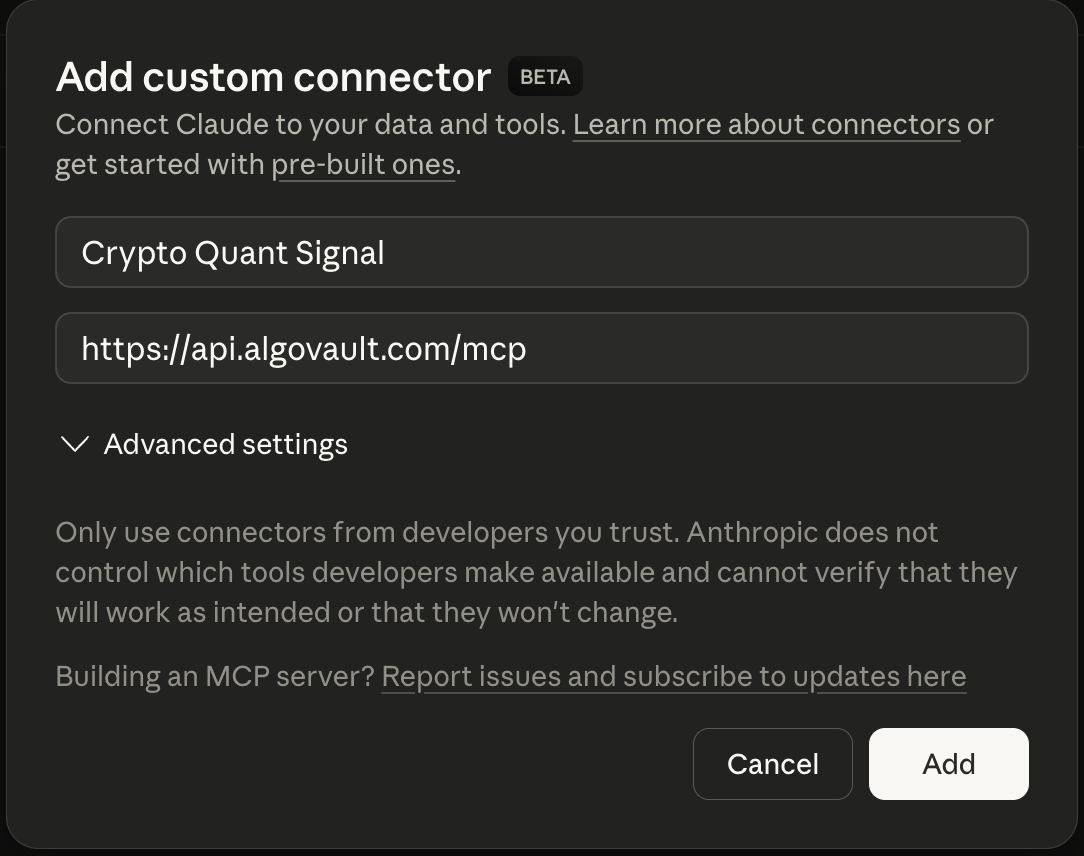
1단계. Claude → 설정 → 통합 → 사용자 지정 커넥터 추가

2단계. 이름과 URL을 입력하세요:

필드

이름

Crypto Quant Signal

URL

https://api.algovault.com/mcp

커넥터 추가

3단계. Claude에게 무엇이든 물어보세요:

"ETH의 4시간 봉 기준 트레이드 신호를 알려줘"
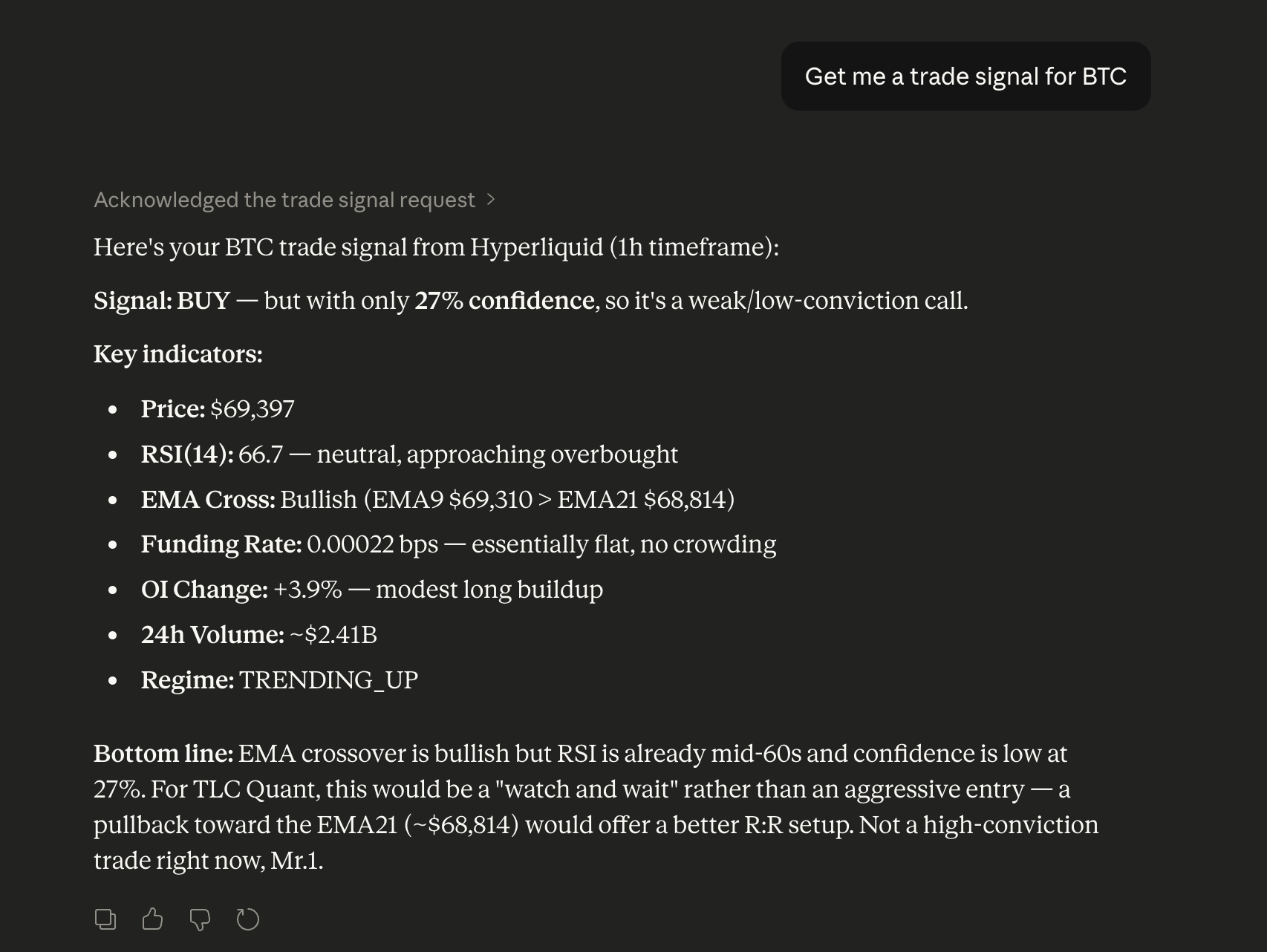
BTC 신호 결과

이것으로 끝입니다. 이제 Claude에 퀀트 분석가가 내장되었습니다.


도구

get_trade_signal

지원되는 모든 자산(암호화폐 무기한 선물, TradFi 무기한 선물, 유동성 필터링된 밈 코인)에 대해 신뢰도 점수가 포함된 매수(BUY) / 매도(SELL) / 보유(HOLD) 판정을 반환합니다.

작동 원리: 다중 요소 점수 엔진이 모멘텀, 추세 구조, 파생상품 심리, 미결제 약정 역학, 거래량 확신을 평가합니다. 점수는 펀딩 흐름 분석, 변동성 상황 감지, 추세 지속성 감쇠 등을 포함한 상황 인식 필터와 적응형 후처리 게이트를 통과한 후 최종 판정이 내려집니다.

확신이 높은 콜만 생성됩니다. 엔진은 우위가 불분명할 때 침묵하도록 설계되었습니다.

매개변수:

  • coin (문자열, 필수): 자산 심볼 — 예: "ETH", "BTC", "SOL", "GOLD", "TSLA" 등 290개 이상의 지원 자산

  • timeframe (문자열, 기본값 "15m"): "1m", "3m", "5m", "15m", "30m", "1h", "2h", "4h", "8h", "12h", "1d"

  • includeReasoning (불리언, 기본값 true): 콜 로직에 대한 사람이 읽을 수 있는 설명 포함 여부

출력 포함 항목: 콜 방향, 신뢰도 점수(0–100), 모든 계산된 지표 값, 감지된 시장 상황, 추론 서술, 하위 도구 구성을 위한 _algovault 메타데이터.

scan_funding_arb

Hyperliquid, Binance, Bybit 전반의 펀딩비 차이를 스캔합니다. 시간당 및 8시간 요율 관례를 정규화하고, 베이시스 포인트 스프레드를 계산하며, 복합 점수(스프레드 규모, 시간 긴급성, 24시간 기록 기반 펀딩 확신)에 따라 기회 순위를 매깁니다.

거래소 간 펀딩 차익거래 인텔리전스를 제공하는 유일한 MCP 서버입니다. 한 거래소에서 롱, 다른 거래소에서 숏을 잡아 스프레드를 확보하세요.

매개변수:

  • minSpreadBps (숫자, 기본값 5): 포함할 최소 스프레드(베이시스 포인트)

  • limit (숫자, 기본값 10): 반환할 최대 결과 수

출력 포함 항목: 기회별 거래소 요율, 최적의 롱/숏 방향, 연간 스프레드 비율, 다음 펀딩 타임스탬프.

get_market_regime

현재 시장 환경을 TRENDING_UP(상승 추세), TRENDING_DOWN(하락 추세), RANGING(횡보), VOLATILE(변동성) 중 하나로 분류합니다.

방향성 강도 측정과 ADX 기울기 분석(추세 강화 vs 소진 감지), 거래량 가중 피벗 감지, ATR 적응형 펀딩 임계값, 거래소 간 펀딩 심리 발산을 결합한 다차원 분류 접근 방식을 사용합니다. 시장 상황 분류는 get_trade_signal이 출력을 필터링하는 방식에 직접적인 영향을 미치며, 에이전트는 전략 선택 및 포지션 규모 결정을 위해 이를 독립적으로 사용할 수도 있습니다.

매개변수:

  • coin (문자열, 필수): 자산 심볼

  • timeframe (문자열, 기본값 "4h"): 분석을 위한 캔들 타임프레임

출력 포함 항목: 상황 라벨, 신뢰도 점수, 기본 지표(추세 강도, 변동성 해석, 가격 구조), 거래소 간 펀딩 심리, 평이한 언어로 된 전략 제안.


성과 추적

모든 콜은 발행부터 결과까지 추적됩니다. 예외는 없습니다.

측정 항목:

  • 타임프레임에 적합한 평가 기간의 결과 가격

  • PFE 승률 — 평가 기간 중 가격이 콜 방향으로 움직였는지 여부

  • 기대값 — 콜당 확률 가중 평균 수익

  • 수익 계수 — 총 손실 대비 총 수익

  • 최대 유리한 변동(PFE) 및 최대 불리한 변동(MAE)

  • 자산, 타임프레임, 품질 등급별 실행 통계

HOLD 콜은 무료입니다 — 엔진이 "거래하지 마라"고 할 때는 비용이 발생하지 않습니다. 매수(BUY) 및 매도(SELL) 판정만 x402를 통해 청구되거나 구독 할당량에서 차감됩니다. 이는 우리의 인센티브를 일치시킵니다. 즉, 거래 가능한 기회가 보일 때만 비용을 지불하면 됩니다.

  • HOLD 비율: 엔진이 트레이드 콜 발행을 거부한 스캔 비율입니다. 높은 HOLD 비율(현재 약 84%)은 엔진이 선택적임을 의미하며, 여러 지표에서 조건이 일치할 때만 매수/매도 콜을 발행합니다.

인프라:

  • 원격 모드: 자동화된 결과 백필이 포함된 PostgreSQL

  • 로컬 모드: ~/.crypto-quant-signal/performance.db의 SQLite

  • 신뢰도가 높은 매수/매도 콜만 추적되며 HOLD는 제외됨

온체인 검증

모든 콜은 생성 시점에 해시(keccak256) 처리되며 일일 머클 배치를 통해 Base L2에 고정됩니다. 이를 통해 트랙 레코드를 위변조할 수 없으며, 과거 콜을 수정할 수 없습니다.

  • 컨트랙트: 0x6485...0f81 (Base L2)

  • 콜 검증: https://api.algovault.com/api/verify-signal?signalId=<ID>

  • 모든 배치 보기: https://api.algovault.com/api/merkle-batches

  • 시각적 검증: algovault.com/verify


가격 정책

기능

무료

스타터 ($9.99/월)

프로 ($49/월)

엔터프라이즈 ($299/월)

x402 (콜당)

자산

BTC, ETH

290개 전체

290개 전체

290개 전체

290개 전체

자산 클래스

암호화폐만

암호화폐 + TradFi

암호화폐 + TradFi

암호화폐 + TradFi

암호화폐 + TradFi

타임프레임

15m, 1h

11개 전체

11개 전체

11개 전체

11개 전체

펀딩 차익거래 결과

상위 5개

무제한

무제한

무제한

무제한

트랙 레코드

전체 액세스

전체 액세스

전체 액세스

전체 액세스

전체 액세스

월간 콜

~100/일

3,000/월

15,000/월

100,000/월

무제한

지원

커뮤니티

이메일

우선순위

전담

가격

$0

$9.99/월

$49/월

$299/월

$0.01–0.05/콜

HOLD 콜

무료

무료

무료

무료

무료

  • HOLD 판정(엔진이 "거래하지 마라"고 함)은 모든 티어에서 항상 무료입니다. x402 요금이나 할당량 차감이 없습니다.

x402 마이크로페이먼트: AI 에이전트는 Base의 USDC로 HTTP 콜당 비용을 지불합니다. 가입, API 키, 청구서가 필요 없습니다. 결제 영수증이 곧 자격 증명입니다. x402.org를 참조하세요.

구독: api.algovault.com/signup에서 가입하세요. 스타터($9.99/월)는 모든 자산과 타임프레임을 잠금 해제합니다. 결제 후 즉시 API 키가 제공됩니다.


개발자를 위한 정보

원격 엔드포인트 (권장)

https://api.algovault.com/mcp

스트리밍 가능한 HTTP 전송. Claude, Cursor, Cline, 사용자 지정 에이전트 등 모든 MCP 클라이언트와 호환됩니다.

npx를 통한 로컬 설치

npx -y crypto-quant-signal-mcp

Claude Desktop / Cursor 설정

{
  "mcpServers": {
    "crypto-quant-signal": {
      "command": "npx",
      "args": ["-y", "crypto-quant-signal-mcp"],
      "env": { "TRANSPORT": "stdio" }
    }
  }
}

npm 설치

npm install crypto-quant-signal-mcp

자체 호스팅

git clone https://github.com/AlgoVaultLabs/crypto-quant-signal-mcp
cd crypto-quant-signal-mcp
cp .env.example .env  # Edit with your values
npm ci && npm run build
docker compose up -d

아키텍처

Agent / Claude / Cursor
  │
  ▼
api.algovault.com/mcp (Streamable HTTP)
  │
  ├─ x402 payment verification (USDC on Base)
  ├─ API key / subscription check
  ├─ Free tier fallback
  │
  ▼
MCP Server (Express + @modelcontextprotocol/sdk)
  │
  ├─ Composite Scoring Engine
  │    ├─ Multi-factor indicator fusion
  │    ├─ Regime-aware signal filtering
  │    └─ Adaptive post-processing gates
  │
  ├─ Asset Classification Engine
  │    ├─ 4-tier quality system (Blue Chip → Major Alt → TradFi → Meme)
  │    └─ Liquidity filter for meme/micro assets
  │
  ├─ Exchange Adapter Layer
  │    └─ Hyperliquid (standard + xyz TradFi perps) · Binance, Bybit (funding data)
  │
  ├─ Performance Tracker
  │    └─ PostgreSQL (remote) / SQLite (local)
  │
  └─ Hyperliquid Public API (free, no auth)

거래소 어댑터 패턴: 모든 거래소 상호작용은 ExchangeAdapter 인터페이스를 통합니다. 표준 암호화폐 무기한 선물과 Hyperliquid의 xyz TradFi 무기한 선물을 모두 지원하며, 거래소 간 펀딩 비교를 위해 Binance와 Bybit를 지원합니다.


제품군 구성 가능성

모든 도구 출력에는 버전과 호환되는 하위 도구를 선언하는 _algovault 메타데이터 블록이 포함되어 있습니다:

이 도구

다음 단계로 연결 (Phase 2+)

get_trade_signal

crypto-quant-risk-mcp (포지션 규모) · crypto-quant-backtest-mcp (검증)

scan_funding_arb

crypto-quant-execution-mcp (최적 진입/청산) · crypto-quant-risk-mcp (익스포저)

get_market_regime

crypto-quant-risk-mcp (상황 인식 규모) · crypto-quant-backtest-mcp (필터링된 백테스트)

스키마는 구성 가능하도록 설계되었습니다. 모든 도구는 일관된 timestamp, coin, `_

Available Tools

8 tools
chat_knowledgeA
Read-only
Inspect

Returns a synthesized natural-language answer with citations, grounded in the AlgoVault knowledge bundle (every MCP tool description, response shape, integration tutorial, and code example). Use when you need an explanation, code pattern, or how-to; for raw ranked snippets without LLM synthesis use search_knowledge (faster, no quota cost). Read-only: calls an LLM, no other side effects. Quota: Free 10/month, Starter 50, Pro 200, Enterprise 2000.

ParametersJSON Schema
NameRequiredDescriptionDefault
modelNoOptional model override (default claude-haiku-4-5-20251001).
questionYesNatural-language question (5-500 chars).

TDQS

A4.7/5.0
Behavior5/5

Does the description disclose side effects, auth requirements, rate limits, or destructive behavior?

Despite annotations already declaring read-only, the description adds valuable operational context beyond them: it calls an LLM (implying cost/latency), has no other side effects, and lists specific quota limits per plan (Free 10, Starter 50, Pro 200, Enterprise 2000). This exceeds the annotation baseline.

Agents need to know what a tool does to the world before calling it. Descriptions should go beyond structured annotations to explain consequences.

Conciseness5/5

Is the description appropriately sized, front-loaded, and free of redundancy?

The description is three concise sentences, each with a distinct purpose: what it does, when to use it (and when not), and operational constraints (read-only, quota). No redundant or filler content.

Shorter descriptions cost fewer tokens and are easier for agents to parse. Every sentence should earn its place.

Completeness5/5

Given the tool's complexity, does the description cover enough for an agent to succeed on first attempt?

The description, combined with a fully documented schema and annotations, covers the tool's return type, use cases, alternatives, quota, and safety profile. Since there is no output schema, the explicit mention of 'synthesized natural-language answer with citations' sufficiently communicates the expected response.

Complex tools with many parameters or behaviors need more documentation. Simple tools need less. This dimension scales expectations accordingly.

Parameters3/5

Does the description clarify parameter syntax, constraints, interactions, or defaults beyond what the schema provides?

The input schema provides 100% coverage for both parameters (question with length constraints, model with enum options). The description adds no additional parameter semantics, which is the expected baseline when schema coverage is high.

Input schemas describe structure but not intent. Descriptions should explain non-obvious parameter relationships and valid value ranges.

Purpose5/5

Does the description clearly state what the tool does and how it differs from similar tools?

The description uses a specific verb ('Returns'), identifies the resource ('AlgoVault knowledge bundle'), and specifies the output ('synthesized natural-language answer with citations'). It also explicitly distinguishes the tool from the sibling search_knowledge by contrasting LLM synthesis vs. raw ranked snippets.

Agents choose between tools based on descriptions. A clear purpose with a specific verb and resource helps agents select the right tool.

Usage Guidelines5/5

Does the description explain when to use this tool, when not to, or what alternatives exist?

Clear usage guidance is provided: 'Use when you need an explanation, code pattern, or how-to', and an explicit alternative is named ('for raw ranked snippets without LLM synthesis use search_knowledge'), including the trade-off that it is faster and has no quota cost.

Agents often have multiple tools that could apply. Explicit usage guidance like "use X instead of Y when Z" prevents misuse.

get_market_regimeA
Read-only
Inspect

Returns the market regime — TRENDING_UP TRENDING_DOWN RANGING VOLATILE — with confidence and a strategy hint, for one crypto perpetual futures. Composite verdict: trend ranging + cross-venue funding rate. Read-only, live exchange APIs. Verified track record: get_track_record or performance://signal-performance; on-chain verified merkle anchor.

ParametersJSON Schema
NameRequiredDescriptionDefault
coinYesBase asset crypto signal, e.g. BTC ETH SOL signal. Crypto quant regime.
exchangeNoCrypto venue, e.g. Binance Bybit OKX Bitget Hyperliquid. Multi-exchange.HL
timeframeNoCandle timeframe, e.g. 1h 4h 1d. Buy sell hold AI trading signal context.4h

TDQS

A3.7/5.0
Behavior4/5

Does the description disclose side effects, auth requirements, rate limits, or destructive behavior?

Annotations already declare readOnlyHint=true and destructiveHint=false, and the description reinforces this with 'Read-only, live exchange APIs.' It adds useful behavioral context beyond the annotations: the verdict is composite of trend/ranging and cross-venue funding rate, and the output includes confidence and a strategy hint. It does not cover rate limits or failure modes, but with annotations present the safety profile is sufficiently disclosed.

Agents need to know what a tool does to the world before calling it. Descriptions should go beyond structured annotations to explain consequences.

Conciseness4/5

Is the description appropriately sized, front-loaded, and free of redundancy?

The description is two sentences and front-loads the key deliverable: the market regime values, confidence, and strategy hint. The verification sentence is dense but not bloated, and there is no redundant padding.

Shorter descriptions cost fewer tokens and are easier for agents to parse. Every sentence should earn its place.

Completeness4/5

Given the tool's complexity, does the description cover enough for an agent to succeed on first attempt?

For a read-only retrieval tool with three well-documented parameters and no output schema, the description supplies the return values, confidence, strategy hint, and composite methodology. It lacks explicit sibling routing and exact response structure, but those gaps are minor given the schema enum coverage and annotations.

Complex tools with many parameters or behaviors need more documentation. Simple tools need less. This dimension scales expectations accordingly.

Parameters3/5

Does the description clarify parameter syntax, constraints, interactions, or defaults beyond what the schema provides?

Schema description coverage is 100%, so the baseline is 3. The description adds little about the exact parameters beyond limiting the tool to a single crypto perpetual futures asset. It does not add syntax, default semantics, or parameter-specific guidance beyond what the schema already provides.

Input schemas describe structure but not intent. Descriptions should explain non-obvious parameter relationships and valid value ranges.

Purpose4/5

Does the description clearly state what the tool does and how it differs from similar tools?

The description names a specific verb ('Returns'), the resource ('market regime'), the possible output values, and the asset scope ('crypto perpetual futures'). It does not explicitly differentiate itself from siblings like get_trade_signal or get_trade_call, but the regime-value list makes the core purpose clear.

Agents choose between tools based on descriptions. A clear purpose with a specific verb and resource helps agents select the right tool.

Usage Guidelines3/5

Does the description explain when to use this tool, when not to, or what alternatives exist?

The context 'for one crypto perpetual futures' implies when the tool is relevant, and 'Read-only, live exchange APIs' clarifies the nature of the call. However, there is no explicit guidance about when to use this tool versus alternatives, and the get_track_record mention is about validating track record rather than choosing between tools.

Agents often have multiple tools that could apply. Explicit usage guidance like "use X instead of Y when Z" prevents misuse.

get_track_recordA
Read-only
Inspect

Returns the AlgoVault track record — aggregated PFE win rates by call type, timeframe and asset tier, plus the evaluation methodology and window. The same verified aggregate the performance://signal-performance resource serves, callable from harnesses that bridge tools only. Defaults to the compact aggregate; use include for the per-asset, per-venue or recent-signal breakdowns. Read-only, no side effects.

ParametersJSON Schema
NameRequiredDescriptionDefault
includeNoOptional extra sections: byAsset, byExchange, recentSignals. Omit for compact.

TDQS

A4.3/5.0
Behavior4/5

Does the description disclose side effects, auth requirements, rate limits, or destructive behavior?

Annotations already declare readOnlyHint=true and destructiveHint=false; the description reinforces this with 'Read-only, no side effects.' It adds useful behavior beyond annotations: compact-by-default output, optional breakdown sections, and the fact that the same aggregate is served by performance://signal-performance. No contradiction.

Agents need to know what a tool does to the world before calling it. Descriptions should go beyond structured annotations to explain consequences.

Conciseness5/5

Is the description appropriately sized, front-loaded, and free of redundancy?

Three sentences, each earning its place: purpose/content, alternative-resource context, and parameter/default behavior. The key return content is front-loaded before the include guidance, and there is no filler.

Shorter descriptions cost fewer tokens and are easier for agents to parse. Every sentence should earn its place.

Completeness5/5

Given the tool's complexity, does the description cover enough for an agent to succeed on first attempt?

For a read-only aggregate tool with no output schema, the description tells the agent what data is returned (PFE win rates, methodology, window), how to control detail with include, and that it is safe to call. The annotations cover the safety profile, and no essential call-time behavior is missing.

Complex tools with many parameters or behaviors need more documentation. Simple tools need less. This dimension scales expectations accordingly.

Parameters3/5

Does the description clarify parameter syntax, constraints, interactions, or defaults beyond what the schema provides?

The schema already documents the single include parameter with enum values and the 'Omit for compact' guidance, so description coverage is 100% and the bar is lower. The description adds mild semantic color by calling byExchange 'per-venue' and framing the values as breakdown sections, but it does not substantially extend the schema.

Input schemas describe structure but not intent. Descriptions should explain non-obvious parameter relationships and valid value ranges.

Purpose5/5

Does the description clearly state what the tool does and how it differs from similar tools?

Description opens with a specific verb and resource ('Returns the AlgoVault track record') and specifies the exact contents: aggregated PFE win rates by call type, timeframe, and asset tier, plus methodology and window. This clearly distinguishes it from sibling tools like get_trade_call and get_trade_signal, which return individual calls/signals rather than an aggregate record.

Agents choose between tools based on descriptions. A clear purpose with a specific verb and resource helps agents select the right tool.

Usage Guidelines4/5

Does the description explain when to use this tool, when not to, or what alternatives exist?

It states when the compact default is appropriate and when to use the include parameter for per-asset, per-venue, or recent-signal breakdowns. It also notes the performance://signal-performance equivalence and harness-only callability. It does not explicitly name exclusion cases or sibling alternatives, but the usage context is clear.

Agents often have multiple tools that could apply. Explicit usage guidance like "use X instead of Y when Z" prevents misuse.

get_trade_callA
Read-only
Inspect

Returns a composite verdict — BUY SELL HOLD trade call with confidence and market regime — for one crypto or tokenized-stock perpetual futures. One asset only; whole-market scan: scan_trade_calls. Read-only: live exchange APIs, no orders. Verified track record: get_track_record or performance://signal-performance; on-chain verified merkle anchor.

ParametersJSON Schema
NameRequiredDescriptionDefault
coinYesBase asset, e.g. BTC ETH SOL signal, or a US stock/ETF ticker (no USDT).
exchangeNoCrypto venue (default Binance), e.g. Binance Bybit OKX Bitget Hyperliquid.
timeframeNoCandle timeframe, 1m to 1d. Default 15m. Crypto quant intraday horizon.
assetClassNoForce engine: 'perp' or 'equity'. Cross-venue multi-exchange AI trading signal.
includeReasoningNoInclude reasoning: trend ranging crypto signal and market regime drivers.

TDQS

A4.1/5.0
Behavior4/5

Does the description disclose side effects, auth requirements, rate limits, or destructive behavior?

Annotations already mark the tool read-only and non-destructive; the description reinforces this with 'live exchange APIs, no orders,' which adds operational context beyond the hints. It also discloses the verified-provenance angle with get_track_record and the on-chain merkle anchor. No contradiction with annotations.

Agents need to know what a tool does to the world before calling it. Descriptions should go beyond structured annotations to explain consequences.

Conciseness4/5

Is the description appropriately sized, front-loaded, and free of redundancy?

Three compact sentences front-load the core behavior and scope before routing to alternatives. The track-record sentence is marginally tangential but still informative, and there is no real padding.

Shorter descriptions cost fewer tokens and are easier for agents to parse. Every sentence should earn its place.

Completeness4/5

Given the tool's complexity, does the description cover enough for an agent to succeed on first attempt?

For a simple read-only lookup with rich schema coverage, the description covers purpose, scope, alternative, and safety in a compact way. Without an output schema, it gives the main elements of the return (verdict, confidence, market regime) but not a complete response shape; still sufficient to call correctly with just the coin parameter.

Complex tools with many parameters or behaviors need more documentation. Simple tools need less. This dimension scales expectations accordingly.

Parameters3/5

Does the description clarify parameter syntax, constraints, interactions, or defaults beyond what the schema provides?

Schema coverage is 100% and each parameter already has descriptive text with defaults and examples. The description adds only the one-asset constraint and the composite-verdict framing, not new parameter-level semantics, so the schema carries the weight.

Input schemas describe structure but not intent. Descriptions should explain non-obvious parameter relationships and valid value ranges.

Purpose5/5

Does the description clearly state what the tool does and how it differs from similar tools?

The first sentence names a specific verb and resource: returns a composite BUY/SELL/HOLD verdict with confidence and market regime for a single perpetual-futures asset. It also explicitly contrasts with the whole-market scan sibling scan_trade_calls, so an agent can distinguish the tool without opening the schema.

Agents choose between tools based on descriptions. A clear purpose with a specific verb and resource helps agents select the right tool.

Usage Guidelines4/5

Does the description explain when to use this tool, when not to, or what alternatives exist?

The 'One asset only; whole-market scan: scan_trade_calls' sentence gives an explicit alternative and the condition that selects it. However, it does not explain how to choose between get_trade_call and the similarly named get_trade_signal, leaving that distinction implied rather than stated.

Agents often have multiple tools that could apply. Explicit usage guidance like "use X instead of Y when Z" prevents misuse.

get_trade_signalA
Read-only
Inspect

Returns a composite verdict — BUY SELL HOLD trade call with confidence and market regime — for one crypto or tokenized-stock perpetual futures. One asset only; whole-market scan: scan_trade_calls. Read-only: live exchange APIs, no orders. Verified track record: get_track_record or performance://signal-performance; on-chain verified merkle anchor. [ALIAS] This tool is an alias of get_trade_call — same behavior, kept for backward compatibility. Prefer get_trade_call for new integrations.

ParametersJSON Schema
NameRequiredDescriptionDefault
coinYesBase asset, e.g. BTC ETH SOL signal, or a US stock/ETF ticker (no USDT).
exchangeNoCrypto venue (default Binance), e.g. Binance Bybit OKX Bitget Hyperliquid.
timeframeNoCandle timeframe, 1m to 1d. Default 15m. Crypto quant intraday horizon.
assetClassNoForce engine: 'perp' or 'equity'. Cross-venue multi-exchange AI trading signal.
includeReasoningNoInclude reasoning: trend ranging crypto signal and market regime drivers.

TDQS

A4.5/5.0
Behavior4/5

Does the description disclose side effects, auth requirements, rate limits, or destructive behavior?

Annotations already declare readOnlyHint=true and destructiveHint=false; the description adds that it queries 'live exchange APIs, no orders', discloses alias equivalence with get_trade_call, and mentions a verified track record. This adds useful behavioral context beyond annotations, though it could detail latency or failure modes.

Agents need to know what a tool does to the world before calling it. Descriptions should go beyond structured annotations to explain consequences.

Conciseness4/5

Is the description appropriately sized, front-loaded, and free of redundancy?

The main output is front-loaded in the first sentence. Subsequent sentences each serve a purpose: scope, whole-market alternative, read-only safety, verification, and alias. It is dense but not bloated; the 'performance://signal-performance' reference is slightly cryptic but still earns its place.

Shorter descriptions cost fewer tokens and are easier for agents to parse. Every sentence should earn its place.

Completeness4/5

Given the tool's complexity, does the description cover enough for an agent to succeed on first attempt?

For a tool with five parameters, no output schema, and informative annotations, the description covers the return shape (BUY/SELL/HOLD, confidence, market regime), single-asset input, read-only behavior, and alias relationship. It could add default exchange/timeframe behavior or response structure details, but the current context is sufficient for correct invocation.

Complex tools with many parameters or behaviors need more documentation. Simple tools need less. This dimension scales expectations accordingly.

Parameters4/5

Does the description clarify parameter syntax, constraints, interactions, or defaults beyond what the schema provides?

Input schema coverage is 100%, so the baseline is already satisfied. The description adds meaning by clarifying 'One asset only' and 'crypto or tokenized-stock perpetual futures', which usefully constrains the coin and assetClass parameters beyond the schema examples.

Input schemas describe structure but not intent. Descriptions should explain non-obvious parameter relationships and valid value ranges.

Purpose5/5

Does the description clearly state what the tool does and how it differs from similar tools?

Description opens with a specific verb and resource: 'Returns a composite verdict — BUY SELL HOLD trade call with confidence and market regime — for one crypto or tokenized-stock perpetual futures.' It explicitly distinguishes itself from scan_trade_calls ('One asset only; whole-market scan') and identifies the alias get_trade_call, so sibling confusion is minimized.

Agents choose between tools based on descriptions. A clear purpose with a specific verb and resource helps agents select the right tool.

Usage Guidelines5/5

Does the description explain when to use this tool, when not to, or what alternatives exist?

The description states single-asset scope and routes whole-market scans to scan_trade_calls. It also points to get_track_record/performance://signal-performance for verification and advises preferring get_trade_call for new integrations, giving clear when-to-use and alternative guidance.

Agents often have multiple tools that could apply. Explicit usage guidance like "use X instead of Y when Z" prevents misuse.

scan_funding_arbA
Read-only
Inspect

Ranked cross-venue funding arbitrage across major crypto perpetual futures venues — funding rate spreads, long one venue short another, as a BUY SELL HOLD composite verdict per pair. AI trading signal for crypto quant and Claude trading agents. Trade call via get_trade_call, market regime via get_market_regime. On-chain verified merkle anchor.

ParametersJSON Schema
NameRequiredDescriptionDefault
limitNoMax ranked results, e.g. 5 (free tier cap). Crypto quant AI trading signal.
minSpreadBpsNoMinimum funding rate spread in bps. Cross-venue multi-exchange crypto signal.

TDQS

A4.1/5.0
Behavior4/5

Does the description disclose side effects, auth requirements, rate limits, or destructive behavior?

Annotations already declare readOnlyHint=true and destructiveHint=false. The description adds meaningful context: outputs are ranked, include a composite verdict, and are 'on-chain verified merkle anchor' – enriching the behavioral picture beyond the annotations without contradiction.

Agents need to know what a tool does to the world before calling it. Descriptions should go beyond structured annotations to explain consequences.

Conciseness4/5

Is the description appropriately sized, front-loaded, and free of redundancy?

The description is only three sentences with the core purpose front-loaded. The second sentence ('AI trading signal...') is somewhat promotional, but the overall structure is efficient and no essential details are buried.

Shorter descriptions cost fewer tokens and are easier for agents to parse. Every sentence should earn its place.

Completeness4/5

Given the tool's complexity, does the description cover enough for an agent to succeed on first attempt?

For a tool with no output schema, the description gives a reasonable sense of what is returned (ranked pairs, spread, separate verdict, merkle anchor). It could be more explicit about output fields, but given the simple params and annotations, it is sufficiently complete.

Complex tools with many parameters or behaviors need more documentation. Simple tools need less. This dimension scales expectations accordingly.

Parameters3/5

Does the description clarify parameter syntax, constraints, interactions, or defaults beyond what the schema provides?

Schema descriptions cover both parameters (limit, minSpreadBps) with defaults and ranges (100% coverage). The description does not add further parameter-level meaning, so the baseline of 3 is appropriate.

Input schemas describe structure but not intent. Descriptions should explain non-obvious parameter relationships and valid value ranges.

Purpose5/5

Does the description clearly state what the tool does and how it differs from similar tools?

The description clearly states the tool scans cross-venue funding arbitrage and returns ranked per-pair spreads and BUY/SELL/HOLD verdicts. The specific verb 'scan' and resource 'funding arbitrage' distinguish it from siblings like scan_trade_calls and get_trade_call.

Agents choose between tools based on descriptions. A clear purpose with a specific verb and resource helps agents select the right tool.

Usage Guidelines4/5

Does the description explain when to use this tool, when not to, or what alternatives exist?

The description names related tools (get_trade_call, get_market_regime) providing useful alternatives for specific needs. However, it does not explicitly contrast with scan_trade_calls or mention when not to use this tool, falling just short of full guidance.

Agents often have multiple tools that could apply. Explicit usage guidance like "use X instead of Y when Z" prevents misuse.

scan_trade_callsA
Read-only
Inspect

Returns ranked BUY SELL HOLD trade calls across the top crypto perpetual futures by open interest — one scan for whole-market coverage, each with confidence and market regime. Use this for breadth; use get_trade_call for per-coin depth and reasoning. Read-only: reads live exchange APIs, places no orders.

ParametersJSON Schema
NameRequiredDescriptionDefault
topNNoHow many top perps by open interest to scan, 1 to 100 (default 20).
limitNoMax ranked calls to return, 1 to 100 (default 10). Non-HOLD ranked first.
rankByNoUniverse lens: oi (default) volume gainers losers movers funding_positive funding_negative volatility oi_change (aliases vol gain lose move pfr nfr atr oid). funding_*/volatility/oi_change rank among the most-liquid perps; oi_change = real 24h open-interest %Δ.oi
oiBasisNoOI-delta basis for rankBy=oi_change: notional (default, USD) or contracts (base-coin, price-independent). Ignored by other lenses.notional
exchangeNoCrypto venue (default Binance), e.g. Binance Bybit OKX Bitget Hyperliquid.BINANCE
timeframeNoCandle timeframe, 1m to 1d for the scan. Default 15m intraday.15m
includeHoldsNoInclude HOLD calls after non-HOLD (default false).
minConfidenceNoOptional confidence floor, 0 to 100, applied to non-HOLD trade calls.
oiChangeWindowNoOI-delta window for rankBy=oi_change: 1h, 4h, or 24h (default 24h). Ignored by other lenses.24h
minLiquidityUsdNoOptional USD liquidity floor applied to the scan universe: notional open interest, or 24h volume on venues that expose no bulk OI. Omitted means no floor.
includeReasoningNoEnrich each non-HOLD call with price, the top 2-3 drivers, and one-line reasoning (default false → bare verdict cells). HOLDs stay bare. Same per-call detail as get_trade_call.

TDQS

A4.7/5.0
Behavior5/5

Does the description disclose side effects, auth requirements, rate limits, or destructive behavior?

Annotations already mark readOnlyHint=true and destructiveHint=false. The description adds context beyond that by stating it 'reads live exchange APIs' and 'places no orders,' and it discloses output characteristics: ranked calls, confidence, and market regime. There is no contradiction with annotations.

Agents need to know what a tool does to the world before calling it. Descriptions should go beyond structured annotations to explain consequences.

Conciseness5/5

Is the description appropriately sized, front-loaded, and free of redundancy?

Three sentences carry all essential information: what it returns, when to use it, and its safety profile. The main purpose is front-loaded, usage guidance comes second, and safety is concise. No filler or redundant restating of the name.

Shorter descriptions cost fewer tokens and are easier for agents to parse. Every sentence should earn its place.

Completeness5/5

Given the tool's complexity, does the description cover enough for an agent to succeed on first attempt?

For an 11-parameter, read-only market scanner with no output schema, the description covers purpose, breadth-versus-depth routing, safety, and the shape of the result. The remaining operational details (parameter meanings, defaults, constraints) are fully covered by the rich input schema.

Complex tools with many parameters or behaviors need more documentation. Simple tools need less. This dimension scales expectations accordingly.

Parameters3/5

Does the description clarify parameter syntax, constraints, interactions, or defaults beyond what the schema provides?

Schema description coverage is 100%, and the schema already thoroughly documents every parameter with defaults, ranges, enums, and condition-specific meanings. The description adds high-level context about whole-market scanning but does not need to repeat parameter details. Baseline 3 is appropriate.

Input schemas describe structure but not intent. Descriptions should explain non-obvious parameter relationships and valid value ranges.

Purpose5/5

Does the description clearly state what the tool does and how it differs from similar tools?

The description opens with a specific verb and resource: 'Returns ranked BUY SELL HOLD trade calls across the top crypto perpetual futures by open interest.' It clearly distinguishes itself from the sibling get_trade_call by framing this as whole-market breadth versus per-coin depth, so an agent can select it without inspecting schemas.

Agents choose between tools based on descriptions. A clear purpose with a specific verb and resource helps agents select the right tool.

Usage Guidelines5/5

Does the description explain when to use this tool, when not to, or what alternatives exist?

The description explicitly says 'Use this for breadth; use get_trade_call for per-coin depth and reasoning.' This provides a direct when-to-use rule and names the alternative, making the selection decision unambiguous.

Agents often have multiple tools that could apply. Explicit usage guidance like "use X instead of Y when Z" prevents misuse.

search_knowledgeA
Read-only
Inspect

Returns ranked snippets from the AlgoVault knowledge bundle answering a question about its MCP tools, response shapes, integration patterns (LangChain, LlamaIndex, MAF, CrewAI), or code examples. Call this BEFORE other tool calls to confirm parameter usage and avoid hallucinating tool shapes. Fast: BM25 lexical search, no LLM call, no quota cost. For a synthesized natural-language answer use chat_knowledge. Read-only, no side effects.

ParametersJSON Schema
NameRequiredDescriptionDefault
limitNoMax ranked results (1-50, default 10).
queryYesNatural-language search query (3-500 chars).

TDQS

A4.7/5.0
Behavior4/5

Does the description disclose side effects, auth requirements, rate limits, or destructive behavior?

Annotations already cover read-only and non-destructive hints. The description adds valuable context: fast BM25 lexical search, no LLM call, no quota cost, and explicitly 'Read-only, no side effects.' This goes beyond the annotation basics, though it doesn't detail result structure or pagination, which is acceptable given the tool's simplicity.

Agents need to know what a tool does to the world before calling it. Descriptions should go beyond structured annotations to explain consequences.

Conciseness5/5

Is the description appropriately sized, front-loaded, and free of redundancy?

Three sentences, each earning its place: functionality, usage timing, and alternative. Front-loaded with the core purpose, then key behavioral notes. No fluff or repetition of schema fields.

Shorter descriptions cost fewer tokens and are easier for agents to parse. Every sentence should earn its place.

Completeness5/5

Given the tool's complexity, does the description cover enough for an agent to succeed on first attempt?

For a read-only, two-parameter tool with no output schema, the description covers purpose, when to use, performance characteristics, safety, and alternative tool. It is sufficiently complete for an agent to select and invoke correctly.

Complex tools with many parameters or behaviors need more documentation. Simple tools need less. This dimension scales expectations accordingly.

Parameters4/5

Does the description clarify parameter syntax, constraints, interactions, or defaults beyond what the schema provides?

Schema coverage is 100%, so the baseline is 3. The description adds meaning by explaining the query is a natural-language question about specific topics (MCP tools, response shapes, etc.), and reinforces the limit as controlling 'ranked results'. This is more than the schema alone provides.

Input schemas describe structure but not intent. Descriptions should explain non-obvious parameter relationships and valid value ranges.

Purpose5/5

Does the description clearly state what the tool does and how it differs from similar tools?

The description uses a specific verb ('Returns') and resource ('AlgoVault knowledge bundle') with clear scope: ranked snippets answering questions about MCP tools, response shapes, integration patterns, or code examples. It also explicitly distinguishes itself from sibling chat_knowledge by noting that chat_knowledge provides synthesized natural-language answers.

Agents choose between tools based on descriptions. A clear purpose with a specific verb and resource helps agents select the right tool.

Usage Guidelines5/5

Does the description explain when to use this tool, when not to, or what alternatives exist?

Provides explicit when-to-use guidance: 'Call this BEFORE other tool calls to confirm parameter usage and avoid hallucinating tool shapes.' Also names the alternative: 'For a synthesized natural-language answer use chat_knowledge.' This gives clear context and exclusions.

Agents often have multiple tools that could apply. Explicit usage guidance like "use X instead of Y when Z" prevents misuse.

Tool Schema Changelog

Recent tool additions, removals, and schema changes observed during successful MCP inspections.

  1. 5 tool updatesv1.30.0
    • Changedget_market_regime1 field changed
      • changedInput schema / properties / exchange / enum
        Previous value: -[
        -  "HL",
        -  "BINANCE",
        -  "BYBIT",
        -  "OKX",
        -  "BITGET",
        -  "ASTER",
        -  "BINGX",
        -  "GATE",
        -  "HTX",
        -  "KUCOIN",
        -  "MEXC",
        -  "PHEMEX",
        -  "WHITEBIT",
        -  "BITMART",
        -  "XT"
        -]New value: +[
        +  "HL",
        +  "BINANCE",
        +  "BYBIT",
        +  "OKX",
        +  "BITGET",
        +  "ASTER",
        +  "BINGX",
        +  "GATE",
        +  "HTX",
        +  "KUCOIN",
        +  "MEXC",
        +  "PHEMEX",
        +  "WHITEBIT",
        +  "XT",
        +  "WEEX"
        +]
    • Addedget_track_record
    • Changedget_trade_call1 field changed
      • changedInput schema / properties / exchange / enum
        Previous value: -[
        -  "HL",
        -  "BINANCE",
        -  "BYBIT",
        -  "OKX",
        -  "BITGET",
        -  "ASTER",
        -  "BINGX",
        -  "GATE",
        -  "HTX",
        -  "KUCOIN",
        -  "MEXC",
        -  "PHEMEX",
        -  "WHITEBIT",
        -  "BITMART",
        -  "XT"
        -]New value: +[
        +  "HL",
        +  "BINANCE",
        +  "BYBIT",
        +  "OKX",
        +  "BITGET",
        +  "ASTER",
        +  "BINGX",
        +  "GATE",
        +  "HTX",
        +  "KUCOIN",
        +  "MEXC",
        +  "PHEMEX",
        +  "WHITEBIT",
        +  "XT",
        +  "WEEX"
        +]
    • Changedget_trade_signal1 field changed
      • changedInput schema / properties / exchange / enum
        Previous value: -[
        -  "HL",
        -  "BINANCE",
        -  "BYBIT",
        -  "OKX",
        -  "BITGET",
        -  "ASTER",
        -  "BINGX",
        -  "GATE",
        -  "HTX",
        -  "KUCOIN",
        -  "MEXC",
        -  "PHEMEX",
        -  "WHITEBIT",
        -  "BITMART",
        -  "XT"
        -]New value: +[
        +  "HL",
        +  "BINANCE",
        +  "BYBIT",
        +  "OKX",
        +  "BITGET",
        +  "ASTER",
        +  "BINGX",
        +  "GATE",
        +  "HTX",
        +  "KUCOIN",
        +  "MEXC",
        +  "PHEMEX",
        +  "WHITEBIT",
        +  "XT",
        +  "WEEX"
        +]
    • Changedscan_trade_calls1 field changed
      • changedInput schema / properties / exchange / enum
        Previous value: -[
        -  "HL",
        -  "BINANCE",
        -  "BYBIT",
        -  "OKX",
        -  "BITGET",
        -  "ASTER",
        -  "BINGX",
        -  "GATE",
        -  "HTX",
        -  "KUCOIN",
        -  "MEXC",
        -  "PHEMEX",
        -  "WHITEBIT",
        -  "BITMART",
        -  "XT"
        -]New value: +[
        +  "HL",
        +  "BINANCE",
        +  "BYBIT",
        +  "OKX",
        +  "BITGET",
        +  "ASTER",
        +  "BINGX",
        +  "GATE",
        +  "HTX",
        +  "KUCOIN",
        +  "MEXC",
        +  "PHEMEX",
        +  "WHITEBIT",
        +  "XT",
        +  "WEEX"
        +]
  2. 1 tool updatev1.28.2
    • Changedscan_trade_calls1 field changed
      • changedInput schema / properties / exchange / description
        Previous value: -"Venue: BINANCE (default) HL BYBIT OKX BITGET."New value: +"Crypto venue (default Binance), e.g. Binance Bybit OKX Bitget Hyperliquid."
  3. 3 tool updatesv1.28.0
    • Changedget_market_regime1 field changed
      • changedInput schema / properties / exchange / enum
        Previous value: -[
        -  "HL",
        -  "BINANCE",
        -  "BYBIT",
        -  "OKX",
        -  "BITGET",
        -  "ASTER",
        -  "EDGEX",
        -  "GATE",
        -  "MEXC",
        -  "KUCOIN",
        -  "PHEMEX",
        -  "BINGX",
        -  "HTX",
        -  "WEEX",
        -  "BITMART",
        -  "XT",
        -  "WHITEBIT"
        -]New value: +[
        +  "HL",
        +  "BINANCE",
        +  "BYBIT",
        +  "OKX",
        +  "BITGET",
        +  "ASTER",
        +  "BINGX",
        +  "GATE",
        +  "HTX",
        +  "KUCOIN",
        +  "MEXC",
        +  "PHEMEX",
        +  "WHITEBIT",
        +  "BITMART",
        +  "XT"
        +]
    • Changedget_trade_call1 field changed
      • changedInput schema / properties / exchange / enum
        Previous value: -[
        -  "HL",
        -  "BINANCE",
        -  "BYBIT",
        -  "OKX",
        -  "BITGET",
        -  "ASTER",
        -  "EDGEX",
        -  "GATE",
        -  "MEXC",
        -  "KUCOIN",
        -  "PHEMEX",
        -  "BINGX",
        -  "HTX",
        -  "WEEX",
        -  "BITMART",
        -  "XT",
        -  "WHITEBIT"
        -]New value: +[
        +  "HL",
        +  "BINANCE",
        +  "BYBIT",
        +  "OKX",
        +  "BITGET",
        +  "ASTER",
        +  "BINGX",
        +  "GATE",
        +  "HTX",
        +  "KUCOIN",
        +  "MEXC",
        +  "PHEMEX",
        +  "WHITEBIT",
        +  "BITMART",
        +  "XT"
        +]
    • Changedget_trade_signal1 field changed
      • changedInput schema / properties / exchange / enum
        Previous value: -[
        -  "HL",
        -  "BINANCE",
        -  "BYBIT",
        -  "OKX",
        -  "BITGET",
        -  "ASTER",
        -  "EDGEX",
        -  "GATE",
        -  "MEXC",
        -  "KUCOIN",
        -  "PHEMEX",
        -  "BINGX",
        -  "HTX",
        -  "WEEX",
        -  "BITMART",
        -  "XT",
        -  "WHITEBIT"
        -]New value: +[
        +  "HL",
        +  "BINANCE",
        +  "BYBIT",
        +  "OKX",
        +  "BITGET",
        +  "ASTER",
        +  "BINGX",
        +  "GATE",
        +  "HTX",
        +  "KUCOIN",
        +  "MEXC",
        +  "PHEMEX",
        +  "WHITEBIT",
        +  "BITMART",
        +  "XT"
        +]
  4. 1 tool updatev1.26.0
    • Changedscan_trade_calls1 field changed
      • changedInput schema / properties / includeHolds / description
        Previous value: -"Include HOLD calls after non-HOLD (default false). HOLDs never cost quota."New value: +"Include HOLD calls after non-HOLD (default false)."
  5. 7 tool updatesv1.25.0
    • First observedchat_knowledge
    • First observedget_market_regime
    • First observedget_trade_call
    • First observedget_trade_signal
    • First observedscan_funding_arb
    • First observedscan_trade_calls
    • First observedsearch_knowledge

TDQS

A4.1/5.0

Scored across 8 tools

Disambiguation3/5

Most tools are clearly separated by scope (market-wide scan vs single-asset call, funding arb vs regime), but get_trade_call and get_trade_signal are exact duplicates -- one is explicitly an alias -- which will cause agent confusion. chat_knowledge and search_knowledge also both serve knowledge retrieval, though their descriptions distinguish synthesis from snippets.

Naming Consistency4/5

Tool names consistently use snake_case imperative verb + noun (scan_, get_, chat_, search_). Minor inconsistency exists between trade_call and trade_signal for the same concept, and 'arb' is abbreviated in scan_funding_arb, but the overall pattern is predictable.

Tool Count5/5

Eight tools is a well-scoped set for a crypto quant signal server: broad scan, per-asset verdict, regime, arbitrage, track record, and knowledge access. None feel extraneous, and the count matches the stated domain.

Completeness4/5

The main signal lifecycle is covered: market-wide scan, single-asset calls, regime, funding arbitrage, and verified track record. Minor gaps exist, such as no direct tool for raw market data or per-asset listing, but agents can accomplish the core workflow with this surface.

Maintenance

ActivityActive
ResponsivenessUnresponsive

Related MCP Connectors

Related MCP Servers

  • A
    license
    A
    quality
    A
    maintenance
    Provides comprehensive crypto intelligence for the Hyperliquid exchange, allowing users to query trader profiles, behavioral cohorts, and live market data. It enables AI agents to analyze over 1.8 billion trades, track whale positions, and access real-time liquidation heatmaps.
    103
    51 npm
    6
    MIT
  • A
    license
    Not graded
    quality
    C
    maintenance
    AI-powered crypto signal intelligence for 20 assets (BTC, ETH, SOL, etc). 6 scoring dimensions: whale activity, technical analysis, derivatives flow, narrative strength, sentiment, market structure. Market regime detection (TRENDING/RANGING), portfolio optimization, and accuracy tracking. 9 read-only MCP tools. Free via MCP, $0.001 USDC via x402 on Base for REST API.
    3
    MIT
  • A
    license
    A
    quality
    C
    maintenance
    Financial intelligence for AI agents. 31 tools across 8 data sources — regime, derivatives, stablecoin flows, momentum, volatility, macro, DeFi, weather patterns, political cycles, seasonality. The context layer between your agent and a bad trade.
    31
    5 npm
    9
    MIT
  • A
    license
    A
    quality
    C
    maintenance
    Real-time crypto intelligence for AI agents. Technical analysis, liquidation heatmaps, sentiment, and funding rates for 50+ Hyperliquid perpetuals via x402 micropayments.
    15
    51 PyPI
    1
    MIT