
A
licenseNot graded
qualityD
maintenanceA minimal server/client application implementation utilizing the Model Context Protocol (MCP) and Azure OpenAI.
35
MIT

此代码库包含一个用于教学目的的模型上下文协议 (MCP) 服务器实现。此代码演示了如何构建一个可与各种 LLM 客户端集成的功能性 MCP 服务器。
要遵循完整的教程,请参阅YouTube 视频教程。
MCP(模型上下文协议)是一种开放协议,它规范了应用程序向 LLM 提供上下文的方式。MCP 就像 AI 应用程序的 USB-C 端口一样,它提供了一种标准化的方式,将 AI 模型连接到不同的数据源和工具。
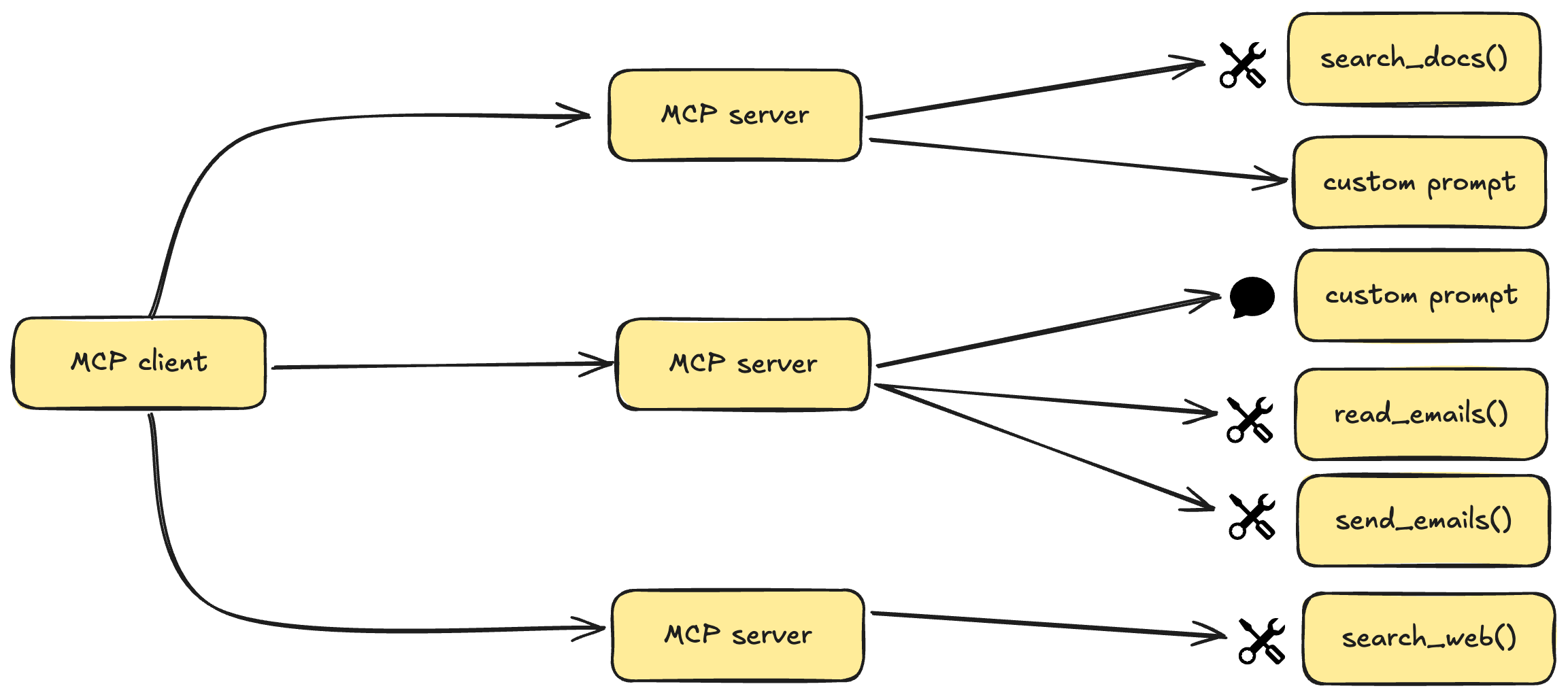
越来越多的预建集成可供您的 LLM 直接插入
灵活地在 LLM 提供商和供应商之间切换
保护基础架构内数据的最佳实践
Related MCP server: Optimized Memory MCP Server V2
MCP 遵循客户端-服务器架构,其中主机应用程序可以连接到多个服务器:
MCP 主机:像 Claude Desktop、IDE 或 AI 工具这样的程序,需要通过 MCP 访问数据
MCP 客户端:与服务器保持 1:1 连接的协议客户端
MCP 服务器:通过标准化模型上下文协议公开特定功能的轻量级程序
数据源:MCP 服务器可以访问的本地(文件、数据库)和远程服务(API)
MCP 服务器可以提供三种主要类型的功能:
资源:客户端可以读取的类似文件的数据(例如 API 响应或文件内容)
工具:可由 LLM 调用的函数(经用户批准)
提示:预先编写的模板,帮助用户完成特定任务
Python 3.10 或更高版本
MCP SDK 1.2.0 或更高版本
uv包管理器
在 MacOS/Linux 上:
curl -LsSf https://astral.sh/uv/install.sh | sh之后请确保重新启动终端以确保uv命令被接收。
创建并初始化项目:
# Create a new directory for our project
uv init mcp-server
cd mcp-server

# Create virtual environment and activate it
uv venv
source .venv/bin/activate  # On Windows use: .venv\Scripts\activate

# Install dependencies
uv add "mcp[cli]" httpx
创建服务器实现文件:
touch main.py启动 MCP 服务器:
uv run main.py服务器将启动并准备接受连接
从官方网站安装Claude Desktop
配置 Claude Desktop 以使用您的 MCP 服务器:
编辑~/Library/Application Support/Claude/claude_desktop_config.json :
{
    "mcpServers": {
        "mcp-server": {
            "command": "uv",  # It's better to use the absolute path to the uv command
            "args": [
                "--directory",
                "/ABSOLUTE/PATH/TO/YOUR/mcp-server",
                "run",
                "main.py"
            ]
        }
    }
}
重启Claude桌面
如果您的服务器未被 Claude Desktop 接收:
检查配置文件路径和权限
验证配置中的绝对路径是否正确
确保 uv 已正确安装并可访问
检查 Claude Desktop 日志中是否有任何错误消息
本项目遵循 MIT 许可证。详情请参阅LICENSE文件。
Search the latest docs for a given query and library. Supports langchain, openai, and llama-index.
Args: query: The query to search for (e.g. "Chroma DB") library: The library to search in (e.g. "langchain")
Returns: Text from the docs
| Name | Required | Description | Default |
|---|---|---|---|
| query | Yes | ||
| library | Yes |
Does the description disclose side effects, auth requirements, rate limits, or destructive behavior?
With no annotations provided, the description carries the full burden for behavioral disclosure. It notes that the tool searches 'latest docs' and returns text, implying a read-only operation, but does not mention potential network dependency, error cases, or any side effects. This is adequate but not rich.
Agents need to know what a tool does to the world before calling it. Descriptions should go beyond structured annotations to explain consequences.
Is the description appropriately sized, front-loaded, and free of redundancy?
The description is concise and well-structured: a one-sentence purpose statement followed by clear Args/Returns sections. Every sentence adds value, and information is front-loaded.
Shorter descriptions cost fewer tokens and are easier for agents to parse. Every sentence should earn its place.
Given the tool's complexity, does the description cover enough for an agent to succeed on first attempt?
For a 2-parameter tool with no output schema, the description provides sufficient context: purpose, supported libraries, parameter guidance, and return type. It lacks explicit error handling or formatting details, but these are not critical for this simple search tool.
Complex tools with many parameters or behaviors need more documentation. Simple tools need less. This dimension scales expectations accordingly.
Does the description clarify parameter syntax, constraints, interactions, or defaults beyond what the schema provides?
Schema description coverage is 0%, so the description must fully explain the parameters. It does so effectively with an Args section providing both meaning and examples for 'query' and 'library', plus listing supported library values in the main description.
Input schemas describe structure but not intent. Descriptions should explain non-obvious parameter relationships and valid value ranges.
Does the description clearly state what the tool does and how it differs from similar tools?
The description clearly states the tool's function: 'Search the latest docs for a given query and library.' It specifies the resource (docs), the verb (search), and scope (latest), and distinguishes from sibling Chroma DB tools by focusing on doc search for specific libraries.
Agents choose between tools based on descriptions. A clear purpose with a specific verb and resource helps agents select the right tool.
Does the description explain when to use this tool, when not to, or what alternatives exist?
The description indicates when to use the tool (when searching docs for langchain, openai, or llama-index) through the list of supported libraries. However, it lacks explicit exclusions or alternative tool references, so it doesn't fully meet the 'when-not/alternatives' criterion.
Agents often have multiple tools that could apply. Explicit usage guidance like "use X instead of Y when Z" prevents misuse.
Recent tool additions, removals, and schema changes observed during successful MCP inspections.
get_docsScored across 1 tool
With only one tool, there is no possibility of ambiguity or overlap between tools. The tool has a single, clear purpose of searching documentation for specific libraries.
The single tool name 'get_docs' follows a clear verb_noun pattern. Since there is only one tool, consistency is inherently perfect with no deviations to evaluate.
A single tool is too few for most server purposes, as it severely limits functionality and scope. This feels thin and incomplete for a documentation search server, which might benefit from additional tools like browsing documentation structure or getting library lists.
The tool surface is severely incomplete for a documentation search domain. It only supports searching text, with no tools for browsing, listing available libraries, or accessing documentation metadata, creating significant gaps that will hinder agent workflows.
A comprehensive Model Context Protocol (MCP) server that enables AI assistants to interact with yo…
A Model Context Protocol server for Wix AI tools
Model Context Protocol server for the Apideck Unified API. Connect any MCP-compatible agent framework to 100+ accounting systems, HRIS platforms, file storage providers, and more through one integration. More information https://www.apideck.com/mcp-server
An MCP server that provides an API to LLMs to manage their JumpCloud resources.