


A
licenseA
qualityD
maintenanceAllows Claude to execute terminal commands on your computer and perform file system operations including surgical code editing with diff-based replacements.
19
125,805 npm
7
MIT


API 토큰 비용 없이 코드와 텍스트로 작업하고, 프로세스를 실행하고, 작업을 자동화하여 다른 AI 편집기보다 훨씬 앞서 나가세요.
모든 AI 개발 도구를 한곳에서 관리하세요. Desktop Commander는 모든 개발 도구를 하나의 채팅방에 모아줍니다. 컴퓨터에서 장기 실행 터미널 명령을 실행하고 모델 컨텍스트 프로토콜(MCP)을 통해 프로세스를 관리하세요. MCP 파일 시스템 서버를 기반으로 구축되어 추가적인 파일 검색 및 바꾸기 기능을 제공합니다.
Related MCP server: Desktop Commander MCP
출력 스트리밍으로 터미널 명령 실행
명령 시간 초과 및 백그라운드 실행 지원
프로세스 관리(프로세스 나열 및 종료)
장기 실행 명령에 대한 세션 관리
서버 구성 관리:
구성 값 가져오기/설정
여러 설정을 한 번에 업데이트
서버를 다시 시작하지 않고도 동적 구성 변경
전체 파일 시스템 작업:
파일 읽기/쓰기
디렉토리 생성/나열
파일/디렉토리 이동
파일 검색
파일 메타데이터 가져오기
코드 편집 기능:
작은 변경 사항에 대한 수술 텍스트 교체
주요 변경 사항에 대한 전체 파일 다시 작성
다중 파일 지원
패턴 기반 교체
vscode-ripgrep 기반 재귀 코드 또는 폴더 내 텍스트 검색
포괄적인 감사 로깅:
모든 도구 호출은 자동으로 기록됩니다.
10MB 크기 제한이 있는 로그 회전
자세한 타임스탬프 및 인수
먼저, Claude Desktop 앱을 다운로드하여 설치했고 npm도 설치 했는지 확인하세요.
터미널에서 다음을 실행하세요.
지엑스피1
디버깅 모드(Node.js 검사기 연결 허용):
npx @wonderwhy-er/desktop-commander@latest setup --debug실행 중이라면 Claude를 다시 시작하세요.
macOS 사용자의 경우 자동화된 bash 설치 프로그램을 사용하면 Node.js 버전을 확인하고 필요한 경우 설치하고 Desktop Commander를 자동으로 구성할 수 있습니다.
curl -fsSL https://raw.githubusercontent.com/wonderwhy-er/DesktopCommanderMCP/refs/heads/main/install.sh | bash이 스크립트는 원활한 설정 환경을 위해 모든 종속성과 구성을 자동으로 처리합니다.
Smithery를 통해 Claude Desktop용 Desktop Commander를 자동으로 설치하려면:
npx -y @smithery/cli install @wonderwhy-er/desktop-commander --client claudeclaude_desktop_config.json에 다음 항목을 추가하세요.
Mac의 경우: ~/Library/Application\ Support/Claude/claude_desktop_config.json
Windows의 경우: %APPDATA%\Claude\claude_desktop_config.json
Linux의 경우: ~/.config/Claude/claude_desktop_config.json
{
  "mcpServers": {
    "desktop-commander": {
      "command": "npx",
      "args": [
        "-y",
        "@wonderwhy-er/desktop-commander"
      ]
    }
  }
}
실행 중이라면 Claude를 다시 시작하세요.
복제 및 빌드:
git clone https://github.com/wonderwhy-er/DesktopCommanderMCP.git
cd DesktopCommanderMCP
npm run setup
실행 중이라면 Claude를 다시 시작하세요.
설치 명령은 다음을 수행합니다.
종속성 설치
서버를 빌드하세요
Claude의 데스크톱 앱 구성
필요한 경우 Claude의 구성에 MCP 서버를 추가합니다.
npx(옵션 1) 또는 Smithery(옵션 3)를 통해 설치한 경우, Claude를 재시작할 때마다 Desktop Commander가 최신 버전으로 자동 업데이트됩니다. 수동 업데이트 과정은 필요하지 않습니다.
수동 설치의 경우, setup 명령을 다시 실행하여 업데이트할 수 있습니다.
이 서버는 여러 범주로 구성된 포괄적인 도구 세트를 제공합니다.
범주 | 도구 | 설명 |
구성 |
| JSON으로 전체 서버 구성을 가져옵니다(blockedCommands, defaultShell, allowedDirectories, fileReadLineLimit, fileWriteLineLimit, telemetryEnabled 포함) |
| 키로 특정 구성 값을 설정합니다. 사용 가능한 설정은 다음과 같습니다. • | |
단말기 |
| 구성 가능한 시간 초과 및 셸 선택으로 터미널 명령 실행 |
| 실행 중인 터미널 세션에서 새 출력을 읽습니다. | |
| 실행 중인 터미널 세션을 강제로 종료합니다. | |
| 모든 활성 터미널 세션 나열 | |
| 자세한 정보와 함께 실행 중인 모든 프로세스를 나열합니다. | |
| PID로 실행 중인 프로세스 종료 | |
파일 시스템 |
| 라인 기반 페이지 매김을 통해 로컬 파일 시스템이나 URL에서 콘텐츠를 읽습니다(오프셋 및 길이 매개변수 지원) |
| 여러 파일을 동시에 읽기 | |
| 다시 쓰기 또는 추가 모드에 대한 옵션을 사용하여 파일 내용을 작성합니다(구성 가능한 줄 제한 사용) | |
| 새 디렉토리를 생성하거나 디렉토리가 존재하는지 확인하세요. | |
| 파일 및 디렉토리의 자세한 목록을 얻으세요 | |
| 파일 및 디렉토리 이동 또는 이름 변경 | |
| 대소문자 구분 없이 문자열 일치를 사용하여 이름으로 파일 찾기 | |
| ripgrep을 사용하여 파일 내용 내의 텍스트/코드 패턴 검색 | |
| 파일이나 디렉토리에 대한 자세한 메타데이터 검색 | |
텍스트 편집 |
| 작은 편집에 대해 향상된 프롬프트를 사용하여 대상 텍스트 교체를 적용합니다(문자 수준 차이 피드백 포함) |
검색/바꾸기 블록 형식:
filepath.ext
<<<<<<< SEARCH
content to find
=======
new content
>>>>>>> REPLACE
예:
src/main.js
<<<<<<< SEARCH
console.log("old message");
=======
console.log("new message");
>>>>>>> REPLACEedit_block 도구에는 안정성을 높이기 위한 여러 가지 향상된 기능이 포함되어 있습니다.
개선된 프롬프트 : 도구 설명은 이제 하나의 큰 변경보다는 여러 개의 작고 집중적인 편집을 강조합니다.
퍼지 검색 대체 : 정확한 일치가 실패하면 퍼지 검색을 수행하고 자세한 피드백을 제공합니다.
문자 수준 차이점 : {-removed-}{+added+} 형식을 사용하여 정확히 무엇이 다른지 보여줍니다.
다중 발생 지원 : expected_replacements 매개변수를 사용하여 여러 인스턴스를 대체할 수 있습니다.
종합 로깅 : 모든 퍼지 검색은 분석 및 디버깅을 위해 로깅됩니다.
검색이 실패하면 가장 유사한 검색 결과에 대한 유사도, 실행 시간, 문자 차이 등 자세한 정보가 표시됩니다. 이러한 모든 세부 정보는 퍼지 검색 로그 도구를 사용하여 나중에 분석할 수 있도록 자동으로 기록됩니다.
read_file 이제 로컬 파일과 URL 모두에서 콘텐츠를 가져올 수 있습니다.
예: 웹 리소스에서 읽기 위해 isUrl: true 매개변수를 사용한 read_file
원격 소스의 텍스트와 이미지 콘텐츠를 모두 처리합니다.
이미지(로컬 또는 URL)는 Claude의 인터페이스에 텍스트가 아닌 시각적으로 표시됩니다.
Claude는 실제 이미지 콘텐츠를 보고 분석할 수 있습니다.
URL 요청에 대한 기본 30초 시간 초과
퍼지 검색 로깅 시스템에는 MCP 환경 외부에서 로그를 분석하기 위한 편리한 npm 스크립트가 포함되어 있습니다.
# View recent fuzzy search logs
npm run logs:view -- --count 20

# Analyze patterns and performance
npm run logs:analyze -- --threshold 0.8

# Export logs to CSV or JSON
npm run logs:export -- --format json --output analysis.json

# Clear all logs (with confirmation)
npm run logs:clear
이 스크립트에 대한 자세한 내용은 scripts/README.md를 참조하세요.
Desktop Commander는 edit_block 도구에서 퍼지 검색 작업에 대한 포괄적인 로깅 기능을 제공합니다. 정확한 일치 항목이 발견되지 않으면 시스템은 퍼지 검색을 수행하고 분석을 위해 자세한 정보를 기록합니다.
모든 퍼지 검색 작업 로그:
검색하여 찾은 텍스트 : 찾고 있는 텍스트와 찾은 텍스트
유사도 점수 : 일치도가 얼마나 가까운지(0~100%)
실행 시간 : 검색에 걸린 시간
캐릭터 차이점 : 차이점을 정확히 보여주는 자세한 차이점
파일 메타데이터 : 확장자, 검색/발견된 텍스트 길이
문자 코드 : 차이를 유발하는 특정 문자 코드
로그는 자동으로 다음 위치에 저장됩니다.
macOS/Linux : ~/.claude-server-commander-logs/fuzzy-search.log
Windows : %USERPROFILE%\.claude-server-commander-logs\fuzzy-search.log
퍼지 검색 로그는 다음을 이해하는 데 도움이 됩니다.
정확한 일치가 실패하는 이유 : 공백 차이, 줄 끝 또는 문자 인코딩과 같은 일반적인 문제
성능 패턴 : 검색 복잡성이 실행 시간에 미치는 영향
파일 유형 문제 : 어떤 파일 확장자가 일반적으로 일치 문제를 일으키는가
문자 인코딩 문제 : diff를 발생시키는 특정 문자 코드
Desktop Commander에는 이제 모든 도구 호출에 대한 포괄적인 로깅이 포함됩니다.
모든 도구 호출은 타임스탬프, 도구 이름 및 인수와 함께 기록됩니다(개인 정보 보호를 위해 삭제됨).
로그 크기가 10MB에 도달하면 자동으로 회전됩니다.
로그는 다음 위치에 저장됩니다.
macOS/Linux : ~/.claude-server-commander/claude_tool_call.log
Windows : %USERPROFILE%\.claude-server-commander\claude_tool_call.log
이 감사 추적은 디버깅, 보안 모니터링, Claude가 시스템과 상호 작용하는 방식을 이해하는 데 도움이 됩니다.
시간이 걸릴 수 있는 명령의 경우:
실제 작업을 진행하는 곳과는 별도의 채팅 창에서 구성을 변경하세요 . Claude는 파일 시스템 접근 제한에 직면하면 구성 설정(예: allowedDirectories )을 수정하려고 할 수 있습니다.
allowedDirectories 설정은 현재 파일 시스템 작업만 제한하며 , 터미널 명령은 제한하지 않습니다. 터미널 명령은 허용된 디렉터리 외부의 파일에도 계속 액세스할 수 있습니다. 완전한 터미널 샌드박싱은 로드맵에 있습니다.
제공된 도구를 사용하여 서버 구성을 관리할 수 있습니다.
// Get the entire config
get_config({})

// Set a specific config value
set_config_value({ "key": "defaultShell", "value": "/bin/zsh" })

// Set multiple config values using separate calls
set_config_value({ "key": "defaultShell", "value": "/bin/bash" })
set_config_value({ "key": "allowedDirectories", "value": ["/Users/username/projects"] })
구성은 서버의 작업 디렉토리에 있는 config.json 에 저장되며 서버를 다시 시작해도 유지됩니다.
구성 변경을 위한 전용 채팅을 만드세요 . 모든 구성 변경을 하나의 채팅에서 처리한 다음, 실제 작업을 위한 새 채팅을 시작하세요.
allowedDirectories 비어 있는 상태로 두는 것에 주의하세요 . 이를 빈 배열( [] )로 설정하면 파일 작업을 위해 전체 파일 시스템에 액세스할 수 있습니다.
구체적인 경로 사용 : / 와 같은 광범위한 경로를 사용하는 대신 액세스하려는 정확한 디렉토리를 지정하세요.
변경 후에는 항상 구성을 확인하세요 . get_config({}) 사용하여 변경 사항이 올바르게 적용되었는지 확인하세요.
명령 실행에 사용할 셸을 지정할 수 있습니다.
// Using default shell (bash or system default)
execute_command({ "command": "echo $SHELL" })

// Using zsh specifically
execute_command({ "command": "echo $SHELL", "shell": "/bin/zsh" })

// Using bash specifically
execute_command({ "command": "echo $SHELL", "shell": "/bin/bash" })
이를 통해 셸 관련 기능을 사용하거나 명령 전반에 걸쳐 일관된 환경을 유지할 수 있습니다.
execute_command 시간 초과 후 초기 출력으로 반환됩니다.
명령은 백그라운드에서 계속됩니다
PID와 함께 read_output 사용하여 새 출력을 얻습니다.
필요한 경우 force_terminate 사용하여 중지하세요.
서버를 디버깅해야 하는 경우 디버그 모드로 설치할 수 있습니다.
# Using npx
npx @wonderwhy-er/desktop-commander@latest setup --debug

# Or if installed locally
npm run setup:debug
이렇게 하면:
Claude가 별도의 "desktop-commander" 서버를 사용하도록 구성합니다.
--inspect-brk=9229 플래그를 사용하여 Node.js 검사기 프로토콜을 활성화합니다.
디버거가 연결될 때까지 시작 시 실행을 일시 중지합니다.
추가 디버깅 환경 변수 활성화
디버거를 연결하려면:
Chrome에서 chrome://inspect 방문하여 Node.js 인스턴스를 찾으세요.
VS Code에서 "노드 프로세스에 연결" 디버그 구성을 사용하세요.
다른 IDE/도구에는 Node.js 디버깅을 위한 유사한 "첨부" 옵션이 있을 수 있습니다.
중요한 디버깅 참고 사항:
디버거가 연결될 때까지 서버는 시작 시 일시 중지됩니다( --inspect-brk 플래그로 인해).
디버깅 중에 활동이 보이지 않으면 올바른 Node.js 프로세스에 연결되어 있는지 확인하세요.
여러 노드 프로세스가 실행 중일 수 있습니다. 포트 9229에 있는 프로세스에 연결하세요.
디버그 서버는 Claude의 MCP 서버 목록에서 "desktop-commander-debug"로 식별됩니다.
문제 해결:
Claude가 디버그 서버를 사용하려고 시도하는 동안 시간이 초과되면 디버거가 제대로 연결되지 않았을 수 있습니다.
제대로 연결되면 프로세스는 첫 번째 중단점에 도달한 후에도 실행을 계속합니다.
연결되면 IDE에 추가 중단점을 추가할 수 있습니다.
이 프로젝트는 MCP 파일 시스템 서버를 확장하여 다음을 지원합니다.
Claude Desktop의 로컬 서버 지원
전체 시스템 명령 실행
프로세스 관리
파일 작업
검색/바꾸기 블록을 사용한 코드 편집
Claude MCP를 탐구하는 일환으로 제작되었습니다: https://youtube.com/live/TlbjFDbl5Us
2025년 5월 20일 v0.1.40 릴리스 - 모든 도구 호출에 대한 감사 로깅 추가, 라인 기반 파일 작업 개선, 소규모 편집에 대한 더 나은 프롬프트를 통해 edit_block 향상, 명시적 원격 측정 옵트아웃 프롬프트 추가
05-05-2025 퍼지 검색 로깅 - 자세한 분석 도구, 문자 수준 차이 및 성능 측정 항목을 통해 편집 블록 실패를 디버깅하는 데 도움이 되는 퍼지 검색 작업을 위한 포괄적인 로깅 시스템이 추가되었습니다.
2025-04-29 구성을 통한 원격 측정 옵트아웃 - 이제 구성에서 원격 측정을 비활성화하는 설정이 있으며 채팅에서 질문할 수 있습니다.
2025년 4월 23일 향상된 편집 기능 - 형식 개선, 퍼지 검색 및 다중 발생 대체 기능 추가, 실패율 감소 및 편집 블록 사용 빈도 증가
2025-04-16 더 나은 구성 - 허용된 경로, 명령 및 셸 환경에 대한 설정이 개선되었습니다.
2025-04-14 Windows 환경 수정 - Windows 플랫폼에 특정된 문제 해결
2025-04-14 Linux 개선 사항 - 다양한 Linux 배포판과의 호환성 향상
2025년 12월 4일 허용 디렉터리 및 차단된 명령 개선 - 파일 읽기/쓰기 및 터미널 명령 제한에 대한 보안 및 경로 검증이 개선되었습니다. 터미널은 허용된 디렉터리를 무시하고 파일에 계속 액세스할 수 있습니다.
2025년 11월 4일 셸 구성 - 명령 실행을 위한 기본 셸을 구성하는 기능 추가
07-04-2025 URL 지원 추가 - read_file 명령이 이제 URL에서 콘텐츠를 가져올 수 있습니다.
2025-03-28 "Watching /" JSON 오류 수정 - JSON이 아닌 메시지를 처리하고 서버 충돌을 방지하기 위해 사용자 지정 stdio 전송을 구현했습니다.
2025-03-25 더 나은 코드 검색 ( 병합 ) - 컨텍스트 인식 결과를 통한 향상된 코드 탐색
현재 다음과 같은 기능이 탐색 중입니다.
WSL 지원 - Linux 통합을 위한 Windows 하위 시스템
SSH 지원 - 원격 서버 명령 실행
CSV/PDF와 같은 형식에 대한 더 나은 파일 지원
보안 강화를 위한 Mac/Linux/Windows용 터미널 샌드박싱
파일 읽기 모드 - 예를 들어 HTML을 일반 텍스트 또는 마크다운으로 읽을 수 있습니다.
대화형 셸 지원 - ssh, node/python repl
대용량 파일 읽기 및 쓰기 개선
아낌없는 후원자 여러분을 소개합니다. 이 프로젝트를 가능하게 해주셔서 감사합니다!
최신 정보, 문서 및 업데이트를 보려면 https://desktopcommander.app/ 의 공식 웹사이트를 방문하세요.
다음 리소스를 통해 이 프로젝트에 대해 자세히 알아보세요.
MCP를 탑재한 Claude가 Cursor와 Windsurf를 대체했습니다. 어떻게 이런 일이 가능했을까요? - 모델 컨텍스트 프로토콜 기능을 탑재한 Claude가 개발자 워크플로우를 어떻게 변화시키고 있는지 자세히 살펴봅니다.
Claude Desktop Commander 비디오 튜토리얼 - Commander를 효과적으로 설정하고 사용하는 방법을 시청하세요.
 이 개발자는 MCP와 함께 Claude를 사용하여 Windsurf와 Cursor를 포기했습니다.
도움을 받고, 피드백을 공유하고, 다른 사용자와 소통하려면 Discord 서버 에 가입하세요.
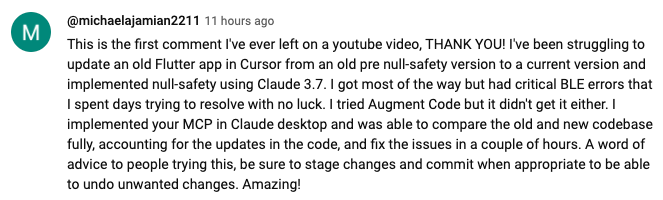
 https://www.youtube.com/watch?v=ly3bed99Dy8\&lc=UgyyBt6\_ShdDX\_rIOad4AaABAg
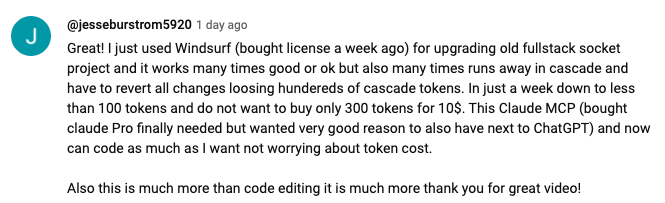
 https://www.youtube.com/watch?v=ly3bed99Dy8\&lc=UgztdHvDMqTb9jiqnf54AaABAg
 https://www.youtube.com/watch?v=ly3bed99Dy8\&lc=UgyQFTmYLJ4VBwIlmql4AaABAg
 https://www.youtube.com/watch?v=ly3bed99Dy8\&lc=Ugy4-exy166\_Ma7TH-h4AaABAg
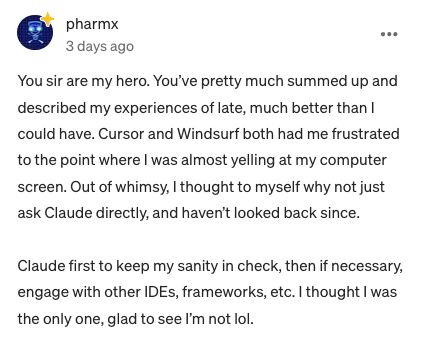 https://medium.com/@pharmx/당신은 내 영웅이에요-62cff5836a3e
이 프로젝트가 유용하다고 생각되시면 GitHub에서 ⭐ 별점을 주세요! 다른 사람들이 이 프로젝트를 알아보고 더 발전하는 데 도움이 됩니다.
커뮤니티 여러분의 참여를 환영합니다! 버그를 발견하셨든, 기능 요청이 있으시든, 또는 코드 기여를 원하시든, 다음과 같은 방법으로 도움을 주실 수 있습니다.
버그를 발견하셨나요? github.com/wonderwhy-er/DesktopCommanderMCP/issues 에서 이슈를 열어주세요.
기능 아이디어가 있으신가요? 이슈 섹션에 기능 요청을 제출해 주세요.
코드에 기여하고 싶으신가요? 저장소를 포크하고, 브랜치를 생성한 후 풀 리퀘스트를 제출하세요.
질문이나 토론이 있으신가요? GitHub 토론 탭에서 토론을 시작하세요.
크고 작음에 관계없이 모든 기여를 환영합니다!
이 도구가 귀하의 업무 흐름에 유용하다고 생각되면 이 프로젝트를 지원해 주시기 바랍니다.
다음은 몇 가지 일반적인 질문에 대한 답변입니다. 더 자세한 FAQ는 자세한 FAQ 문서를 참조하세요.
Claude Desktop이 파일 시스템과 터미널에 접속할 수 있도록 해주는 MCP 도구로, Claude를 코딩, 자동화, 코드베이스 탐색 등을 위한 다재다능한 도우미로 만들어줍니다.
IDE 중심 도구와 달리, Claude Desktop Commander는 코딩 환경뿐만 아니라 전체 OS에서 작동하는 솔루션 중심 접근 방식을 제공합니다. Claude는 파일을 분할하지 않고 전체를 읽고, 여러 프로젝트를 동시에 작업할 수 있으며, 지속적인 검토 없이 한 번에 변경 사항을 실행합니다.
아니요. 이 도구는 Claude Desktop의 표준 Pro 구독(월 20달러)과 호환되지만 API 호출과는 호환되지 않으므로 구독료 외에 추가 비용이 발생하지 않습니다.
네, npx 또는 Smithery를 통해 설치한 경우, Claude를 재시작하면 Desktop Commander가 최신 버전으로 자동 업데이트됩니다. 수동 업데이트 과정은 필요하지 않습니다.
복잡한 코드베이스 탐색 및 이해
다이어그램 및 문서 생성
시스템 전반의 작업 자동화
여러 프로젝트를 동시에 작업
정밀한 제어로 수술 코드 변경
커뮤니티 지원을 위해 Discord 서버 에 가입하고, 알려진 문제는 GitHub 이슈 에서 확인하거나, 문제 해결 팁을 위한 전체 FAQ를 검토하세요. 더욱 사용자 친화적인 환경을 위해 웹사이트 FAQ 섹션을 방문하실 수도 있습니다. 새로운 문제가 발생하면 문제에 대한 자세한 내용을 GitHub 이슈에 기재해 주세요.
Desktop Commander는 도구 개선을 위해 제한된 익명 원격 측정 데이터를 수집합니다. 개인 정보, 파일 내용, 파일 경로 또는 명령 인수는 수집되지 않습니다.
원격 측정 기능은 기본적으로 활성화되어 있습니다. 비활성화하려면 다음 단계를 따르세요.
채팅을 열고 간단히 "원격 측정 비활성화" 라고 물어보세요.
챗봇이 자동으로 설정을 업데이트합니다.
데이터 수집에 대한 자세한 내용은 개인 정보 보호정책을 참조하세요.
MIT
                    Create a new directory or ensure a directory exists.

                    Can create multiple nested directories in one operation.
                    Only works within allowed directories.

                    IMPORTANT: Always use absolute paths for reliability. Paths are automatically normalized regardless of slash direction. Relative paths may fail as they depend on the current working directory. Tilde paths (~/...) might not work in all contexts. Unless the user explicitly asks for relative paths, use absolute paths.
This command can be referenced as "DC: ..." or "use Desktop Commander to ..." in your instructions.| Name | Required | Description | Default |
|---|---|---|---|
| path | Yes |
Does the description disclose side effects, auth requirements, rate limits, or destructive behavior?
The description discloses that it 'only works within allowed directories' and explains path normalization and potential issues with relative paths. The annotations indicate a non-read-only, non-destructive operation, and the description adds useful behavioral context without contradiction.
Agents need to know what a tool does to the world before calling it. Descriptions should go beyond structured annotations to explain consequences.
Is the description appropriately sized, front-loaded, and free of redundancy?
The description is somewhat verbose with multiple paragraphs and code formatting. While it front-loads the purpose, it could be more concise. Some details (e.g., referencing instructions) add length without critical value.
Shorter descriptions cost fewer tokens and are easier for agents to parse. Every sentence should earn its place.
Given the tool's complexity, does the description cover enough for an agent to succeed on first attempt?
For a simple tool with one parameter and no output schema, the description adequately covers what the tool does and how to use it. It provides enough context for the agent to succeed, though it could briefly mention expected return values.
Complex tools with many parameters or behaviors need more documentation. Simple tools need less. This dimension scales expectations accordingly.
Does the description clarify parameter syntax, constraints, interactions, or defaults beyond what the schema provides?
The input schema has one parameter 'path' with no description (0% coverage). The description fully compensates by explaining the meaning of the path, when to use absolute vs relative, and normalization behavior.
Input schemas describe structure but not intent. Descriptions should explain non-obvious parameter relationships and valid value ranges.
Does the description clearly state what the tool does and how it differs from similar tools?
The description clearly states the action: 'Create a new directory or ensure a directory exists.' It also mentions the capability to create multiple nested directories, which distinguishes it from other file operations like 'write_file' or 'edit_block'.
Agents choose between tools based on descriptions. A clear purpose with a specific verb and resource helps agents select the right tool.
Does the description explain when to use this tool, when not to, or what alternatives exist?
Provides explicit guidance on using absolute paths, warns about relative and tilde paths, and mentions path normalization. It also suggests how to reference the command in instructions. However, it does not explicitly contrast with when to use alternative tools.
Agents often have multiple tools that could apply. Explicit usage guidance like "use X instead of Y when Z" prevents misuse.
                    Apply surgical edits to files.

                    BEST PRACTICE: Make multiple small, focused edits rather than one large edit.
                    Each edit_block call should change only what needs to be changed - include just enough
                    context to uniquely identify the text being modified.

                    FORMAT HANDLING (by extension):

                    EXCEL FILES (.xlsx, .xls, .xlsm) - Range Update mode:
                    Takes:
                    - file_path: Path to the Excel file
                    - range: ALWAYS use FROM:TO format - "SheetName!A1:C10" or "SheetName!C1:C1"
                    - content: 2D array, e.g., [["H1","H2"],["R1","R2"]]

                    TEXT FILES - Find/Replace mode:
                    Takes:
                    - file_path: Path to the file to edit
                    - old_string: Text to replace
                    - new_string: Replacement text
                    - expected_replacements: Optional number of replacements (default: 1)

                    DOCX FILES (.docx) - XML Find/Replace mode:
                    Takes same parameters as text files (old_string, new_string, expected_replacements).
                    Operates on the pretty-printed XML inside the DOCX — the same XML you see from
                    read_file with offset/length. Copy XML fragments from read output as old_string.
                    After editing, the XML is repacked into a valid DOCX.
                    Also searches headers/footers if not found in document body.
                    Examples:
                    - Replace text: old_string="<w:t>Old Text</w:t>" new_string="<w:t>New Text</w:t>"
                    - Change style: old_string='<w:pStyle w:val="Normal"/>' new_string='<w:pStyle w:val="Heading1"/>'
                    - Add content: include surrounding XML context in old_string, add new elements in new_string

                    By default, replaces only ONE occurrence of the search text.
                    To replace multiple occurrences, provide expected_replacements with
                    the exact number of matches expected.

                    UNIQUENESS REQUIREMENT: When expected_replacements=1 (default), include the minimal
                    amount of context necessary (typically 1-3 lines) before and after the change point,
                    with exact whitespace and indentation.

                    When editing multiple sections, make separate edit_block calls for each distinct change
                    rather than one large replacement.

                    When a close but non-exact match is found, a character-level diff is shown in the format:
                    common_prefix{-removed-}{+added+}common_suffix to help you identify what's different.

                    Similar to write_file, there is a configurable line limit (fileWriteLineLimit) that warns
                    if the edited file exceeds this limit. If this happens, consider breaking your edits into
                    smaller, more focused changes.

                    IMPORTANT: Always use absolute paths for reliability. Paths are automatically normalized regardless of slash direction. Relative paths may fail as they depend on the current working directory. Tilde paths (~/...) might not work in all contexts. Unless the user explicitly asks for relative paths, use absolute paths.
This command can be referenced as "DC: ..." or "use Desktop Commander to ..." in your instructions.| Name | Required | Description | Default |
|---|---|---|---|
| range | No | ||
| origin | No | ||
| content | No | ||
| options | No | ||
| file_path | Yes | ||
| new_string | No | ||
| old_string | No | ||
| expected_replacements | No |
Does the description disclose side effects, auth requirements, rate limits, or destructive behavior?
Annotations already indicate destructive behavior; description adds rich behavioral details per file type, diff display on close matches, path normalization, and default replacement count. No contradictions.
Agents need to know what a tool does to the world before calling it. Descriptions should go beyond structured annotations to explain consequences.
Is the description appropriately sized, front-loaded, and free of redundancy?
Description is comprehensive but long; structured with headings and examples. Could be more concise by reducing redundancy in uniqueness and expected_replacements explanations. Front-loaded with main purpose.
Shorter descriptions cost fewer tokens and are easier for agents to parse. Every sentence should earn its place.
Given the tool's complexity, does the description cover enough for an agent to succeed on first attempt?
Given the tool's complexity (8 params, multiple modes, no output schema), the description covers modes, edge cases, line limits, path advice, and examples. No output schema needed for this context.
Complex tools with many parameters or behaviors need more documentation. Simple tools need less. This dimension scales expectations accordingly.
Does the description clarify parameter syntax, constraints, interactions, or defaults beyond what the schema provides?
With 0% schema coverage, description explains most parameters (file_path, range, content, old_string, new_string, expected_replacements) with format constraints. However, 'options' and 'origin' parameters are not addressed in the description.
Input schemas describe structure but not intent. Descriptions should explain non-obvious parameter relationships and valid value ranges.
Does the description clearly state what the tool does and how it differs from similar tools?
The description clearly states the tool edits files surgically and distinguishes between file types (Excel range update, text find/replace, DOCX XML mode). It contrasts with siblings like write_file and read_file by emphasizing focused edits.
Agents choose between tools based on descriptions. A clear purpose with a specific verb and resource helps agents select the right tool.
Does the description explain when to use this tool, when not to, or what alternatives exist?
Provides extensive when-to-use guidance including best practices, format-specific instructions, uniqueness requirement, and line limit warnings. However, it does not explicitly state when not to use this tool versus alternatives like write_file.
Agents often have multiple tools that could apply. Explicit usage guidance like "use X instead of Y when Z" prevents misuse.
                    Force terminate a running terminal session.

This command can be referenced as "DC: ..." or "use Desktop Commander to ..." in your instructions.| Name | Required | Description | Default |
|---|---|---|---|
| pid | Yes |
Does the description disclose side effects, auth requirements, rate limits, or destructive behavior?
The description identifies the tool as destructive, matching annotations, and specifies it targets a 'terminal session'. However, it does not disclose required permissions, potential side effects, or how termination is performed.
Agents need to know what a tool does to the world before calling it. Descriptions should go beyond structured annotations to explain consequences.
Is the description appropriately sized, front-loaded, and free of redundancy?
Two sentences, no redundancy. The second sentence about referencing is marginally useful but still concise.
Shorter descriptions cost fewer tokens and are easier for agents to parse. Every sentence should earn its place.
Given the tool's complexity, does the description cover enough for an agent to succeed on first attempt?
Lacks explanation of what constitutes a terminal session, how to obtain a PID, and how this tool differs from the similar 'kill_process'. The presence of siblings demands more context.
Complex tools with many parameters or behaviors need more documentation. Simple tools need less. This dimension scales expectations accordingly.
Does the description clarify parameter syntax, constraints, interactions, or defaults beyond what the schema provides?
The description does not mention the 'pid' parameter or how it identifies the session. With 0% schema coverage, the description fails to clarify the parameter's meaning or format.
Input schemas describe structure but not intent. Descriptions should explain non-obvious parameter relationships and valid value ranges.
Does the description clearly state what the tool does and how it differs from similar tools?
The description clearly states it force terminates a running terminal session, but it does not differentiate from the sibling tool 'kill_process', which likely has similar functionality.
Agents choose between tools based on descriptions. A clear purpose with a specific verb and resource helps agents select the right tool.
Does the description explain when to use this tool, when not to, or what alternatives exist?
No guidance on when to use this tool versus alternatives like 'kill_process' or 'interact_with_process'. The only additional note is about referencing the command, not usage context.
Agents often have multiple tools that could apply. Explicit usage guidance like "use X instead of Y when Z" prevents misuse.
                    Get the complete server configuration as JSON. Config includes fields for:
                    - blockedCommands (array of blocked shell commands)
                    - defaultShell (shell to use for commands)
                    - allowedDirectories (paths the server can access)
                    - fileReadLineLimit (max lines for read_file, default 1000)
                    - fileWriteLineLimit (max lines per write_file call, default 50)
                    - telemetryEnabled (boolean for telemetry opt-in/out)
                    - currentClient (information about the currently connected MCP client)
                    - clientHistory (history of all clients that have connected)
                    - version (version of the DesktopCommander)
                    - systemInfo (operating system and environment details)
This command can be referenced as "DC: ..." or "use Desktop Commander to ..." in your instructions.| Name | Required | Description | Default |
|---|---|---|---|
| origin | No |
Does the description disclose side effects, auth requirements, rate limits, or destructive behavior?
Annotations already indicate readOnlyHint=true; description adds value by detailing the config structure (fields) and return format (JSON), enhancing transparency beyond annotations.
Agents need to know what a tool does to the world before calling it. Descriptions should go beyond structured annotations to explain consequences.
Is the description appropriately sized, front-loaded, and free of redundancy?
The description is somewhat verbose with a field list but is front-loaded with the main action. The meta instruction about 'DC: ...' adds length without core value.
Shorter descriptions cost fewer tokens and are easier for agents to parse. Every sentence should earn its place.
Given the tool's complexity, does the description cover enough for an agent to succeed on first attempt?
For a simple read tool with one optional parameter, the description covers the return value comprehensively by listing all config fields, making it complete enough.
Complex tools with many parameters or behaviors need more documentation. Simple tools need less. This dimension scales expectations accordingly.
Does the description clarify parameter syntax, constraints, interactions, or defaults beyond what the schema provides?
The only parameter 'origin' is not described in the description, despite having an enum. Schema coverage is 0%, and the description fails to explain its purpose or values.
Input schemas describe structure but not intent. Descriptions should explain non-obvious parameter relationships and valid value ranges.
Does the description clearly state what the tool does and how it differs from similar tools?
The description clearly states 'Get the complete server configuration as JSON,' specifying a unique verb and resource, and it distinguishes from sibling tools like set_config_value.
Agents choose between tools based on descriptions. A clear purpose with a specific verb and resource helps agents select the right tool.
Does the description explain when to use this tool, when not to, or what alternatives exist?
The description implies usage for reading config but lacks explicit when-not or alternative tool guidance. The mention of 'DC: ...' is a weak usage hint.
Agents often have multiple tools that could apply. Explicit usage guidance like "use X instead of Y when Z" prevents misuse.
                    Retrieve detailed metadata about a file or directory including:
                    - size
                    - creation time
                    - last modified time
                    - permissions
                    - type
                    - lineCount (for text files)
                    - lastLine (zero-indexed number of last line, for text files)
                    - appendPosition (line number for appending, for text files)
                    - sheets (for Excel files - array of {name, rowCount, colCount})

                    Only works within allowed directories.

                    IMPORTANT: Always use absolute paths for reliability. Paths are automatically normalized regardless of slash direction. Relative paths may fail as they depend on the current working directory. Tilde paths (~/...) might not work in all contexts. Unless the user explicitly asks for relative paths, use absolute paths.
This command can be referenced as "DC: ..." or "use Desktop Commander to ..." in your instructions.| Name | Required | Description | Default |
|---|---|---|---|
| path | Yes |
Does the description disclose side effects, auth requirements, rate limits, or destructive behavior?
Annotations already indicate readOnlyHint=true, so it's a safe read operation. The description adds behavioral context such as workspace restrictions and path normalization details. No contradictions.
Agents need to know what a tool does to the world before calling it. Descriptions should go beyond structured annotations to explain consequences.
Is the description appropriately sized, front-loaded, and free of redundancy?
Well-structured with bullet points for metadata and clear sections. Somewhat lengthy but each sentence adds value. Could be slightly more concise, but overall effective.
Shorter descriptions cost fewer tokens and are easier for agents to parse. Every sentence should earn its place.
Given the tool's complexity, does the description cover enough for an agent to succeed on first attempt?
For a simple one-parameter tool with no output schema, the description covers the parameter thoroughly and lists expected return fields. Mentions workspace restrictions but lacks error handling details. Generally complete.
Complex tools with many parameters or behaviors need more documentation. Simple tools need less. This dimension scales expectations accordingly.
Does the description clarify parameter syntax, constraints, interactions, or defaults beyond what the schema provides?
Schema coverage is 0%, but the description compensates with detailed path usage guidance: absolute vs relative paths, tilde handling, and automatic normalization. This adds significant meaning beyond the schema's parameter name.
Input schemas describe structure but not intent. Descriptions should explain non-obvious parameter relationships and valid value ranges.
Does the description clearly state what the tool does and how it differs from similar tools?
Clearly states it retrieves detailed metadata about a file or directory, listing specific attributes like size, creation time, and type. Distinguishes from sibling tools like list_directory (which lists contents) and read_file (which reads content).
Agents choose between tools based on descriptions. A clear purpose with a specific verb and resource helps agents select the right tool.
Does the description explain when to use this tool, when not to, or what alternatives exist?
Provides clear context on when to use: retrieving file metadata. Includes important path usage guidelines (absolute paths, normalization, tilde handling) and mentions it works only within allowed directories. Does not explicitly exclude alternatives or state when not to use.
Agents often have multiple tools that could apply. Explicit usage guidance like "use X instead of Y when Z" prevents misuse.
                    Get more results from an active search with offset-based pagination.

                    Supports partial result reading with:
                    - 'offset' (start result index, default: 0)
                      * Positive: Start from result N (0-based indexing)
                      * Negative: Read last N results from end (tail behavior)
                    - 'length' (max results to read, default: 100)
                      * Used with positive offsets for range reading
                      * Ignored when offset is negative (reads all requested tail results)

                    Examples:
                    - offset: 0, length: 100     → First 100 results
                    - offset: 200, length: 50    → Results 200-249
                    - offset: -20                → Last 20 results
                    - offset: -5, length: 10     → Last 5 results (length ignored)

                    Returns only results in the specified range, along with search status.
                    Works like read_process_output - call this repeatedly to get progressive
                    results from a search started with start_search.

This command can be referenced as "DC: ..." or "use Desktop Commander to ..." in your instructions.| Name | Required | Description | Default |
|---|---|---|---|
| length | No | ||
| offset | No | ||
| sessionId | Yes |
Does the description disclose side effects, auth requirements, rate limits, or destructive behavior?
The description details offset behavior (positive/negative), length handling, return content (results + status), and reusability, going well beyond the readOnlyHint annotation. No contradictions with annotations.
Agents need to know what a tool does to the world before calling it. Descriptions should go beyond structured annotations to explain consequences.
Is the description appropriately sized, front-loaded, and free of redundancy?
The description is well-structured with separate sections for purpose, parameter rules (bulleted), and examples. It is slightly lengthy but every sentence adds value. Could be marginally trimmed.
Shorter descriptions cost fewer tokens and are easier for agents to parse. Every sentence should earn its place.
Given the tool's complexity, does the description cover enough for an agent to succeed on first attempt?
Given the complexity of offset-based pagination and no output schema, the description thoroughly explains usage patterns, return values, and connection to sibling tools, making it self-contained.
Complex tools with many parameters or behaviors need more documentation. Simple tools need less. This dimension scales expectations accordingly.
Does the description clarify parameter syntax, constraints, interactions, or defaults beyond what the schema provides?
With 0% schema description coverage, the description fully compensates by explaining offset and length semantics with examples (e.g., negative offset for tail, length ignored for negative), and implicitly covers sessionId as required.
Input schemas describe structure but not intent. Descriptions should explain non-obvious parameter relationships and valid value ranges.
Does the description clearly state what the tool does and how it differs from similar tools?
The description clearly states 'Get more results from an active search with offset-based pagination,' specifying the verb (get), resource (results), and mechanism (pagination), distinguishing it from siblings like start_search or stop_search.
Agents choose between tools based on descriptions. A clear purpose with a specific verb and resource helps agents select the right tool.
Does the description explain when to use this tool, when not to, or what alternatives exist?
The description explains the tool is used after start_search and compares it to read_process_output, providing clear context. It does not list explicit alternatives or when-not-to-use, but the usage scenario is well-defined.
Agents often have multiple tools that could apply. Explicit usage guidance like "use X instead of Y when Z" prevents misuse.
                    Retrieve a specific Desktop Commander onboarding prompt by ID and execute it.

                    SIMPLIFIED ONBOARDING V2: This tool only supports direct prompt retrieval.
                    The onboarding system presents 5 options as a simple numbered list:

                    1. Organize my Downloads folder (promptId: 'onb2_01')
                    2. Explain a codebase or repository (promptId: 'onb2_02')
                    3. Create organized knowledge base (promptId: 'onb2_03')
                    4. Analyze a data file (promptId: 'onb2_04')
                    5. Check system health and resources (promptId: 'onb2_05')

                    USAGE:
                    When user says "1", "2", "3", "4", or "5" from onboarding:
                    - "1" → get_prompts(action='get_prompt', promptId='onb2_01')
                    - "2" → get_prompts(action='get_prompt', promptId='onb2_02')
                    - "3" → get_prompts(action='get_prompt', promptId='onb2_03')
                    - "4" → get_prompts(action='get_prompt', promptId='onb2_04')
                    - "5" → get_prompts(action='get_prompt', promptId='onb2_05')

                    The prompt content will be injected and execution begins immediately.

This command can be referenced as "DC: ..." or "use Desktop Commander to ..." in your instructions.| Name | Required | Description | Default |
|---|---|---|---|
| action | Yes | ||
| promptId | Yes |
Does the description disclose side effects, auth requirements, rate limits, or destructive behavior?
The annotation declares readOnlyHint: true, but the description states 'retrieve and execute it', implying execution with potential side effects. This is a clear contradiction. No further behavioral details are provided beyond the contradictory execution claim.
Agents need to know what a tool does to the world before calling it. Descriptions should go beyond structured annotations to explain consequences.
Is the description appropriately sized, front-loaded, and free of redundancy?
The description is well-structured with sections and clear formatting, but it is somewhat verbose. It could be more concise while retaining essential information.
Shorter descriptions cost fewer tokens and are easier for agents to parse. Every sentence should earn its place.
Given the tool's complexity, does the description cover enough for an agent to succeed on first attempt?
The description covers usage and parameter values adequately, but lacks details about return values, error handling, and what 'execution begins immediately' means. Given no output schema, the agent might be left uncertain about results.
Complex tools with many parameters or behaviors need more documentation. Simple tools need less. This dimension scales expectations accordingly.
Does the description clarify parameter syntax, constraints, interactions, or defaults beyond what the schema provides?
Schema coverage is 0%, so the description must compensate. It does so by listing all valid prompt IDs mapped to numbers and specifying the action enum value. This adds meaning beyond the schema's bare string definitions.
Input schemas describe structure but not intent. Descriptions should explain non-obvious parameter relationships and valid value ranges.
Does the description clearly state what the tool does and how it differs from similar tools?
The description clearly states the tool retrieves and executes a specific Desktop Commander onboarding prompt by ID. It distinguishes from sibling tools by focusing exclusively on onboarding prompts and providing a direct numbered list.
Agents choose between tools based on descriptions. A clear purpose with a specific verb and resource helps agents select the right tool.
Does the description explain when to use this tool, when not to, or what alternatives exist?
The description provides explicit mapping from user selections (1-5) to prompt IDs and the action parameter. It effectively tells the agent when to use this tool during onboarding. However, it does not explicitly state when not to use it or mention alternative tools.
Agents often have multiple tools that could apply. Explicit usage guidance like "use X instead of Y when Z" prevents misuse.
                    Get recent local tool call history with arguments and outputs.
                    Returns a chronological list of recent calls loaded from the local history file.

                    Useful for:
                    - Onboarding new chats about work already done
                    - Recovering context after chat history loss
                    - Debugging tool call sequences

                    Note: Does not track its own calls or track_ui_event.
                    History is persisted locally in tool-history.jsonl, keeps up to the last 1000
                    calls in memory, and trims older on-disk history. Stored outputs over 4 KiB
                    are replaced with an omission marker.

This command can be referenced as "DC: ..." or "use Desktop Commander to ..." in your instructions.| Name | Required | Description | Default |
|---|---|---|---|
| since | No | ||
| toolName | No | ||
| maxResults | No |
Does the description disclose side effects, auth requirements, rate limits, or destructive behavior?
Beyond the readOnlyHint annotation, the description discloses substantial behavioral detail: it does not track its own calls or track_ui_event (self-exclusion), persists to tool-history.jsonl, keeps up to 1000 calls in memory while trimming older on-disk history, and replaces outputs over 4 KiB with an omission marker. This gives an agent accurate expectations about data availability and truncation.
Agents need to know what a tool does to the world before calling it. Descriptions should go beyond structured annotations to explain consequences.
Is the description appropriately sized, front-loaded, and free of redundancy?
The description is efficiently structured: a one-sentence purpose, scannable bullet points for use cases, and a compact 'Note:' block for behavioral caveats. The final line about 'DC: ...' referencing adds minor value for intent recognition. Slightly long, but every sentence carries distinct information.
Shorter descriptions cost fewer tokens and are easier for agents to parse. Every sentence should earn its place.
Given the tool's complexity, does the description cover enough for an agent to succeed on first attempt?
For a read-only tool with no output schema, the description is nearly complete: it covers return shape (chronological list), persistence location, retention limits, output truncation, and self-exclusion. The only meaningful gap is the undocumented filtering semantics of the since and toolName parameters.
Complex tools with many parameters or behaviors need more documentation. Simple tools need less. This dimension scales expectations accordingly.
Does the description clarify parameter syntax, constraints, interactions, or defaults beyond what the schema provides?
Schema description coverage is 0%, so the description must compensate for parameter meaning. It partially does: the 'last 1000 calls' limit maps to maxResults' maximum, and 'recent'/'chronological' hints at ordering relevant to the since filter. However, it never explicitly explains that since filters by timestamp or that toolName filters by tool, leaving two of three parameters under-documented.
Input schemas describe structure but not intent. Descriptions should explain non-obvious parameter relationships and valid value ranges.
Does the description clearly state what the tool does and how it differs from similar tools?
The opening sentence states a specific verb+resource+scope: 'Get recent local tool call history with arguments and outputs.' This unambiguously distinguishes it from all siblings — no other tool in the list claims tool call history as its subject, and the second sentence clarifies the chronological return shape.
Agents choose between tools based on descriptions. A clear purpose with a specific verb and resource helps agents select the right tool.
Does the description explain when to use this tool, when not to, or what alternatives exist?
The 'Useful for:' section lists three concrete scenarios: onboarding, recovering context after chat history loss, and debugging tool call sequences. This is clear context for when to invoke it. It stops short of a 5 because it doesn't name explicit alternatives or state when-not-to-use conditions, though no obvious sibling competes for this use case.
Agents often have multiple tools that could apply. Explicit usage guidance like "use X instead of Y when Z" prevents misuse.
                    Get usage statistics for debugging and analysis.

                    Returns summary of tool usage, success/failure rates, and performance metrics.

This command can be referenced as "DC: ..." or "use Desktop Commander to ..." in your instructions.| Name | Required | Description | Default |
|---|---|---|---|
No parameters | |||
Does the description disclose side effects, auth requirements, rate limits, or destructive behavior?
Annotations already declare readOnlyHint=true, so description adds value by specifying what is returned (summary, success/failure rates, performance metrics), providing context beyond the structured fields.
Agents need to know what a tool does to the world before calling it. Descriptions should go beyond structured annotations to explain consequences.
Is the description appropriately sized, front-loaded, and free of redundancy?
The description is concise and front-loaded, with two clear sentences about purpose and output. The third sentence about referencing is slightly meta but not wasteful.
Shorter descriptions cost fewer tokens and are easier for agents to parse. Every sentence should earn its place.
Given the tool's complexity, does the description cover enough for an agent to succeed on first attempt?
For a read-only tool with no params and no output schema, the description sufficiently covers purpose and output details, though the exact scope (real-time vs historical) is not clarified.
Complex tools with many parameters or behaviors need more documentation. Simple tools need less. This dimension scales expectations accordingly.
Does the description clarify parameter syntax, constraints, interactions, or defaults beyond what the schema provides?
No parameters exist, so schema coverage is 100%. Baseline for 0 params is 4; the description does not need to add param info.
Input schemas describe structure but not intent. Descriptions should explain non-obvious parameter relationships and valid value ranges.
Does the description clearly state what the tool does and how it differs from similar tools?
The description clearly states 'Get usage statistics for debugging and analysis' with specific verb and resource, and distinguishes from sibling tools like get_config and get_prompts by focusing on usage metrics.
Agents choose between tools based on descriptions. A clear purpose with a specific verb and resource helps agents select the right tool.
Does the description explain when to use this tool, when not to, or what alternatives exist?
The description only mentions how to reference the tool in instructions, but does not provide guidance on when to use it versus alternatives (e.g., get_recent_tool_calls) or when not to use it.
Agents often have multiple tools that could apply. Explicit usage guidance like "use X instead of Y when Z" prevents misuse.
                    Open feedback form in browser to provide feedback about Desktop Commander.

                    IMPORTANT: This tool simply opens the feedback form - no pre-filling available.
                    The user will fill out the form manually in their browser.

                    WORKFLOW:
                    1. When user agrees to give feedback, just call this tool immediately
                    2. No need to ask questions or collect information
                    3. Tool opens form with only usage statistics pre-filled automatically:
                       - tool_call_count: Number of commands they've made
                       - days_using: How many days they've used Desktop Commander
                       - platform: Their operating system (Mac/Windows/Linux)
                       - client_id: Analytics identifier

                    All survey questions will be answered directly in the form:
                    - Job title and technical comfort level
                    - Company URL for industry context
                    - Other AI tools they use
                    - Desktop Commander's biggest advantage
                    - How they typically use it
                    - Recommendation likelihood (0-10)
                    - User study participation interest
                    - Email and any additional feedback

                    EXAMPLE INTERACTION:
                    User: "sure, I'll give feedback"
                    Claude: "Perfect! Let me open the feedback form for you."
                    [calls tool immediately]

                    No parameters are needed - just call the tool to open the form.

This command can be referenced as "DC: ..." or "use Desktop Commander to ..." in your instructions.| Name | Required | Description | Default |
|---|---|---|---|
No parameters | |||
Does the description disclose side effects, auth requirements, rate limits, or destructive behavior?
Discloses that the tool opens a browser form without pre-filling except for automatically included usage statistics. Describes what the user will fill manually. Annotations (openWorldHint: true) confirm external action, and the description adds specific behavioral context without contradiction.
Agents need to know what a tool does to the world before calling it. Descriptions should go beyond structured annotations to explain consequences.
Is the description appropriately sized, front-loaded, and free of redundancy?
The description is structured with sections and an example, but is verbose, listing all survey questions which could be omitted. Every sentence serves a purpose, but conciseness could be improved.
Shorter descriptions cost fewer tokens and are easier for agents to parse. Every sentence should earn its place.
Given the tool's complexity, does the description cover enough for an agent to succeed on first attempt?
Given no parameters and no output schema, the description fully covers what the tool does, how to use it, and the user experience. No missing information given the tool's simplicity.
Complex tools with many parameters or behaviors need more documentation. Simple tools need less. This dimension scales expectations accordingly.
Does the description clarify parameter syntax, constraints, interactions, or defaults beyond what the schema provides?
No parameters exist; schema coverage is 100%. The description adds value by explicitly stating no parameters are needed, reinforcing ease of use. Baseline for zero parameters is 4.
Input schemas describe structure but not intent. Descriptions should explain non-obvious parameter relationships and valid value ranges.
Does the description clearly state what the tool does and how it differs from similar tools?
The description clearly states the tool opens a feedback form in the browser. It uniquely identifies the action (open form) and resource (feedback for Desktop Commander), and is distinct from sibling tools which deal with files, processes, and searches.
Agents choose between tools based on descriptions. A clear purpose with a specific verb and resource helps agents select the right tool.
Does the description explain when to use this tool, when not to, or what alternatives exist?
Provides explicit workflow: call immediately when user agrees to give feedback, no need to collect information. States no parameters needed and gives an example interaction, making usage clear without ambiguity.
Agents often have multiple tools that could apply. Explicit usage guidance like "use X instead of Y when Z" prevents misuse.
                    Send input to a running process and automatically receive the response.

                    CRITICAL: THIS IS THE PRIMARY TOOL FOR ALL LOCAL FILE ANALYSIS
                    For ANY local file analysis (CSV, JSON, data processing), ALWAYS use this instead of the analysis tool.
                    The analysis tool CANNOT access local files and WILL FAIL - use processes for ALL file-based work.

                    FILE ANALYSIS PRIORITY ORDER (MANDATORY):
                    1. ALWAYS FIRST: Use this tool (start_process + interact_with_process) for local data analysis
                    2. ALTERNATIVE: Use command-line tools (cut, awk, grep) for quick processing
                    3. NEVER EVER: Use analysis tool for local file access (IT WILL FAIL)

                    REQUIRED INTERACTIVE WORKFLOW FOR FILE ANALYSIS:
                    1. Start REPL: start_process("python3 -i")
                    2. Load libraries: interact_with_process(pid, "import pandas as pd, numpy as np")
                    3. Read file: interact_with_process(pid, "df = pd.read_csv('/absolute/path/file.csv')")
                    4. Analyze: interact_with_process(pid, "print(df.describe())")
                    5. Continue: interact_with_process(pid, "df.groupby('column').size()")

                    BINARY FILE PROCESSING WORKFLOWS:
                    Use appropriate Python libraries (PyPDF2, pandas, docx2txt, etc.) or command-line tools for binary file analysis.

                    SMART DETECTION:
                    - Automatically waits for REPL prompt (>>>, >, etc.)
                    - Detects errors and completion states
                    - Early exit prevents timeout delays
                    - Clean output formatting (removes prompts)

                    SUPPORTED REPLs:
                    - Python: python3 -i (RECOMMENDED for data analysis)
                    - Node.js: node -i
                    - R: R
                    - Julia: julia
                    - Shell: bash, zsh
                    - Database: mysql, postgres

                    PARAMETERS:
                    - pid: Process ID from start_process
                    - input: Code/command to execute
                    - timeout_ms: Max wait (default: 8000ms)
                    - wait_for_prompt: Auto-wait for response (default: true)
                    - verbose_timing: Enable detailed performance telemetry (default: false)

                    Returns execution result with status indicators.

                    PERFORMANCE DEBUGGING (verbose_timing parameter):
                    Set verbose_timing: true to get detailed timing information including:
                    - Exit reason (early_exit_quick_pattern, early_exit_periodic_check, process_finished, timeout, no_wait)
                    - Total duration and time to first output
                    - Complete timeline of all output events with timestamps
                    - Which detection mechanism triggered early exit
                    Use this to identify slow interactions and optimize detection patterns.

                    ALWAYS USE FOR: CSV analysis, JSON processing, file statistics, data visualization prep, ANY local file work
                    NEVER USE ANALYSIS TOOL FOR: Local file access (it cannot read files from disk and WILL FAIL)

This command can be referenced as "DC: ..." or "use Desktop Commander to ..." in your instructions.| Name | Required | Description | Default |
|---|---|---|---|
| pid | Yes | ||
| input | Yes | ||
| timeout_ms | No | ||
| verbose_timing | No | ||
| wait_for_prompt | No |
Does the description disclose side effects, auth requirements, rate limits, or destructive behavior?
Annotations indicate readOnlyHint=false and destructiveHint=true. Description adds behavioral details beyond annotations: automatic REPL prompt detection, error detection, early exit, clean output formatting, and performance debugging. Does not explicitly state destructive behavior but consistent with sending input to processes.
Agents need to know what a tool does to the world before calling it. Descriptions should go beyond structured annotations to explain consequences.
Is the description appropriately sized, front-loaded, and free of redundancy?
Description is lengthy but well-structured with clear sections (CRITICAL, FILE ANALYSIS PRIORITY ORDER, REQUIRED WORKFLOW, etc.). Front-loaded with key purpose and critical note. Some repetition (e.g., 'ALWAYS USE FOR' and 'NEVER USE ANALYSIS TOOL') but overall efficient.
Shorter descriptions cost fewer tokens and are easier for agents to parse. Every sentence should earn its place.
Given the tool's complexity, does the description cover enough for an agent to succeed on first attempt?
Given 5 parameters, no output schema, and complexity, the description covers usage, workflows, supported REPLs, performance debugging, and parameter details. Completely addresses the tool's context and provides thorough guidance for correct invocation.
Complex tools with many parameters or behaviors need more documentation. Simple tools need less. This dimension scales expectations accordingly.
Does the description clarify parameter syntax, constraints, interactions, or defaults beyond what the schema provides?
Schema description coverage is 0%, so description must compensate. It provides brief but meaningful descriptions for all five parameters (pid, input, timeout_ms, wait_for_prompt, verbose_timing), including defaults and purpose, adding value beyond schema types and requiredness.
Input schemas describe structure but not intent. Descriptions should explain non-obvious parameter relationships and valid value ranges.
Does the description clearly state what the tool does and how it differs from similar tools?
Explicitly states 'Send input to a running process and automatically receive the response'. Clearly distinguishes from sibling tools by emphasizing it is the primary tool for local file analysis, contrasting with the analysis tool that fails for local files.
Agents choose between tools based on descriptions. A clear purpose with a specific verb and resource helps agents select the right tool.
Does the description explain when to use this tool, when not to, or what alternatives exist?
Provides explicit when-to-use ('ALWAYS use this instead of the analysis tool'), when-not-to-use (analysis tool will fail), and alternatives (command-line tools). Includes priority order and detailed interactive workflow steps.
Agents often have multiple tools that could apply. Explicit usage guidance like "use X instead of Y when Z" prevents misuse.
                    Terminate a running process by PID.

                    Use with caution as this will forcefully terminate the specified process.

This command can be referenced as "DC: ..." or "use Desktop Commander to ..." in your instructions.| Name | Required | Description | Default |
|---|---|---|---|
| pid | Yes |
Does the description disclose side effects, auth requirements, rate limits, or destructive behavior?
Annotations already set destructiveHint=true, so the description's 'forcefully terminate' adds some context but does not disclose additional behaviors like potential data loss or irreversibility. It aligns with annotations but adds little extra.
Agents need to know what a tool does to the world before calling it. Descriptions should go beyond structured annotations to explain consequences.
Is the description appropriately sized, front-loaded, and free of redundancy?
Three sentences, mostly concise. The third sentence about referencing as 'DC: ...' is tangential and adds length without aiding tool invocation.
Shorter descriptions cost fewer tokens and are easier for agents to parse. Every sentence should earn its place.
Given the tool's complexity, does the description cover enough for an agent to succeed on first attempt?
For a simple tool with one parameter and no output schema, the description covers purpose and caution adequately. However, it could include a brief note on prerequisites (e.g., PID must exist) for completeness.
Complex tools with many parameters or behaviors need more documentation. Simple tools need less. This dimension scales expectations accordingly.
Does the description clarify parameter syntax, constraints, interactions, or defaults beyond what the schema provides?
Schema has 0% description coverage; the description only mentions 'by PID' without explaining what PID means or how to obtain it. This adds minimal value beyond the parameter name.
Input schemas describe structure but not intent. Descriptions should explain non-obvious parameter relationships and valid value ranges.
Does the description clearly state what the tool does and how it differs from similar tools?
The description clearly states 'Terminate a running process by PID.' This is a specific verb-resource pairing that distinguishes the tool from siblings like 'interact_with_process' or 'force_terminate'.
Agents choose between tools based on descriptions. A clear purpose with a specific verb and resource helps agents select the right tool.
Does the description explain when to use this tool, when not to, or what alternatives exist?
While the description warns 'Use with caution', it does not specify when to use this tool versus alternatives (e.g., 'interact_with_process' for graceful termination) or when not to use it. No explicit context or exclusions provided.
Agents often have multiple tools that could apply. Explicit usage guidance like "use X instead of Y when Z" prevents misuse.
                    Get a detailed listing of all files and directories in a specified path.

                    Use this instead of 'execute_command' with ls/dir commands.
                    Results distinguish between files and directories with [FILE] and [DIR] prefixes.

                    Supports recursive listing with the 'depth' parameter (default: 2):
                    - depth=1: Only direct contents of the directory
                    - depth=2: Contents plus one level of subdirectories
                    - depth=3+: Multiple levels deep

                    CONTEXT OVERFLOW PROTECTION:
                    - Top-level directory shows ALL items
                    - Nested directories are limited to 100 items maximum per directory
                    - When a nested directory has more than 100 items, you'll see a warning like:
                      [WARNING] node_modules: 500 items hidden (showing first 100 of 600 total)
                    - This prevents overwhelming the context with large directories like node_modules

                    Results show full relative paths from the root directory being listed.
                    Example output with depth=2:
                    [DIR] src
                    [FILE] src/index.ts
                    [DIR] src/tools
                    [FILE] src/tools/filesystem.ts

                    If a directory cannot be accessed, it will show [DENIED] instead.
                    If a path does not exist, it will show [NOT_FOUND] instead.
                    Only works within allowed directories.

                    IMPORTANT: Always use absolute paths for reliability. Paths are automatically normalized regardless of slash direction. Relative paths may fail as they depend on the current working directory. Tilde paths (~/...) might not work in all contexts. Unless the user explicitly asks for relative paths, use absolute paths.
This command can be referenced as "DC: ..." or "use Desktop Commander to ..." in your instructions.| Name | Required | Description | Default |
|---|---|---|---|
| path | Yes | ||
| depth | No | ||
| origin | No |
Does the description disclose side effects, auth requirements, rate limits, or destructive behavior?
Annotations provide readOnlyHint. Description adds significant behavioral details: results with [FILE]/[DIR] prefixes, depth behavior, context overflow warnings, full relative paths, [DENIED]/[NOT_FOUND] for access issues, and absolute path recommendation. No contradiction with annotations.
Agents need to know what a tool does to the world before calling it. Descriptions should go beyond structured annotations to explain consequences.
Is the description appropriately sized, front-loaded, and free of redundancy?
Well-structured with sections: purpose, differentiation, output details, depth parameter, context overflow, path notes. Slightly verbose (e.g., repeated absolute path advice) but front-loaded with core listing purpose.
Shorter descriptions cost fewer tokens and are easier for agents to parse. Every sentence should earn its place.
Given the tool's complexity, does the description cover enough for an agent to succeed on first attempt?
No output schema, but description explains output format with examples, error conditions ([DENIED], [NOT_FOUND]), and allowed directories. Differentiates well from 25 sibling tools. Covers parameters adequately except 'origin'.
Complex tools with many parameters or behaviors need more documentation. Simple tools need less. This dimension scales expectations accordingly.
Does the description clarify parameter syntax, constraints, interactions, or defaults beyond what the schema provides?
Schema coverage is 0% but description explains 'path' (absolute path recommendation) and 'depth' (default, meanings of values, context overflow) in detail. The 'origin' parameter is not explained, but it's an enum likely for internal use. Good compensation for the coverage gap.
Input schemas describe structure but not intent. Descriptions should explain non-obvious parameter relationships and valid value ranges.
Does the description clearly state what the tool does and how it differs from similar tools?
Clear verb and resource: 'Get a detailed listing of all files and directories in a specified path.' Explicitly distinguishes from sibling tool 'execute_command' by stating 'Use this instead of...'.
Agents choose between tools based on descriptions. A clear purpose with a specific verb and resource helps agents select the right tool.
Does the description explain when to use this tool, when not to, or what alternatives exist?
Explicit guidance to use this tool for directory listings instead of ls/dir commands. Provides depth parameter details and context overflow protection, helping the agent decide when and how to use it.
Agents often have multiple tools that could apply. Explicit usage guidance like "use X instead of Y when Z" prevents misuse.
                    List all running processes.

                    Returns process information including PID, command name, CPU usage, and memory usage.

This command can be referenced as "DC: ..." or "use Desktop Commander to ..." in your instructions.| Name | Required | Description | Default |
|---|---|---|---|
No parameters | |||
Does the description disclose side effects, auth requirements, rate limits, or destructive behavior?
Annotations provide readOnlyHint=true, confirming no side effects. Description adds return format details (PID, CPU, memory), adding value beyond annotations.
Agents need to know what a tool does to the world before calling it. Descriptions should go beyond structured annotations to explain consequences.
Is the description appropriately sized, front-loaded, and free of redundancy?
Three sentences, no fluff, front-loaded with key purpose. Every sentence adds value.
Shorter descriptions cost fewer tokens and are easier for agents to parse. Every sentence should earn its place.
Given the tool's complexity, does the description cover enough for an agent to succeed on first attempt?
Tool is simple; description covers purpose and return fields. Could mention lack of filtering, but complete for a list-all tool.
Complex tools with many parameters or behaviors need more documentation. Simple tools need less. This dimension scales expectations accordingly.
Does the description clarify parameter syntax, constraints, interactions, or defaults beyond what the schema provides?
No parameters; baseline for 0 params is 4. Description does not need to elaborate on params.
Input schemas describe structure but not intent. Descriptions should explain non-obvious parameter relationships and valid value ranges.
Does the description clearly state what the tool does and how it differs from similar tools?
Description clearly states 'List all running processes' and specifies returned fields (PID, command name, CPU, memory), distinguishing it from sibling tools like kill_process.
Agents choose between tools based on descriptions. A clear purpose with a specific verb and resource helps agents select the right tool.
Does the description explain when to use this tool, when not to, or what alternatives exist?
Implied usage for listing processes, but no explicit guidance on when to use vs alternatives or when not to use. Sibling tools like 'kill_process' suggest broader context could be added.
Agents often have multiple tools that could apply. Explicit usage guidance like "use X instead of Y when Z" prevents misuse.
                    List all active searches.

                    Shows search IDs, search types, patterns, status, and runtime.
                    Similar to list_sessions for terminal processes. Useful for managing
                    multiple concurrent searches.

This command can be referenced as "DC: ..." or "use Desktop Commander to ..." in your instructions.| Name | Required | Description | Default |
|---|---|---|---|
No parameters | |||
Does the description disclose side effects, auth requirements, rate limits, or destructive behavior?
Annotations already declare readOnlyHint=true. Description adds detail about returned fields and runtime, enhancing understanding beyond annotations. No contradictions.
Agents need to know what a tool does to the world before calling it. Descriptions should go beyond structured annotations to explain consequences.
Is the description appropriately sized, front-loaded, and free of redundancy?
Succinct three-sentence description: main purpose, details, and usage hint. No redundancy, every sentence adds value.
Shorter descriptions cost fewer tokens and are easier for agents to parse. Every sentence should earn its place.
Given the tool's complexity, does the description cover enough for an agent to succeed on first attempt?
Adequately covers the tool's functionality for a simple read-only list command, mentioning output fields. Without output schema, description compensates well, though it could briefly note if no results are shown.
Complex tools with many parameters or behaviors need more documentation. Simple tools need less. This dimension scales expectations accordingly.
Does the description clarify parameter syntax, constraints, interactions, or defaults beyond what the schema provides?
Input schema has no parameters, so schema_description_coverage is 100%. Description adds no parameter info, which is expected. Baseline score of 3 is appropriate.
Input schemas describe structure but not intent. Descriptions should explain non-obvious parameter relationships and valid value ranges.
Does the description clearly state what the tool does and how it differs from similar tools?
Clearly states 'list all active searches' with specific fields (IDs, types, patterns, status, runtime). Differentiates from sibling list_sessions by noting similarity, making purpose unambiguous.
Agents choose between tools based on descriptions. A clear purpose with a specific verb and resource helps agents select the right tool.
Does the description explain when to use this tool, when not to, or what alternatives exist?
Provides context for managing multiple searches and a comparison to list_sessions, implying when to use this tool. However, lacks explicit exclusions or alternative guidance for related tools like start_search or stop_search.
Agents often have multiple tools that could apply. Explicit usage guidance like "use X instead of Y when Z" prevents misuse.
                    List all active terminal sessions.

                    Shows session status including:
                    - PID: Process identifier
                    - Blocked: Whether session is waiting for input
                    - Runtime: How long the session has been running

                    DEBUGGING REPLs:
                    - "Blocked: true" often means REPL is waiting for input
                    - Use this to verify sessions are running before sending input
                    - Long runtime with blocked status may indicate stuck process

This command can be referenced as "DC: ..." or "use Desktop Commander to ..." in your instructions.| Name | Required | Description | Default |
|---|---|---|---|
No parameters | |||
Does the description disclose side effects, auth requirements, rate limits, or destructive behavior?
Annotations already indicate readOnlyHint true. Description adds behavioral details about blocked status meaning waiting for input and implications for stuck processes, beyond what annotations provide.
Agents need to know what a tool does to the world before calling it. Descriptions should go beyond structured annotations to explain consequences.
Is the description appropriately sized, front-loaded, and free of redundancy?
Concise and well-structured with bullet points. Every sentence adds value, and the purpose is immediately clear without extraneous text.
Shorter descriptions cost fewer tokens and are easier for agents to parse. Every sentence should earn its place.
Given the tool's complexity, does the description cover enough for an agent to succeed on first attempt?
For a read-only, parameterless tool, the description fully covers what the tool does, what data it returns, and includes relevant debugging context. No output schema is needed.
Complex tools with many parameters or behaviors need more documentation. Simple tools need less. This dimension scales expectations accordingly.
Does the description clarify parameter syntax, constraints, interactions, or defaults beyond what the schema provides?
No parameters exists, so schema coverage is 100%. Baseline score of 4 applies as description does not need to compensate for any missing parameter information.
Input schemas describe structure but not intent. Descriptions should explain non-obvious parameter relationships and valid value ranges.
Does the description clearly state what the tool does and how it differs from similar tools?
Clearly states it lists active terminal sessions and specifies the information shown (PID, Blocked, Runtime). Differentiates from siblings by focusing on terminal sessions rather than general processes.
Agents choose between tools based on descriptions. A clear purpose with a specific verb and resource helps agents select the right tool.
Does the description explain when to use this tool, when not to, or what alternatives exist?
Provides context for debugging REPLs, suggesting use to verify sessions before sending input. Does not explicitly exclude alternative tools but gives practical usage guidance.
Agents often have multiple tools that could apply. Explicit usage guidance like "use X instead of Y when Z" prevents misuse.
                    Move or rename files and directories.

                    Can move files between directories and rename them in a single operation.
                    Both source and destination must be within allowed directories.

                    IMPORTANT: Always use absolute paths for reliability. Paths are automatically normalized regardless of slash direction. Relative paths may fail as they depend on the current working directory. Tilde paths (~/...) might not work in all contexts. Unless the user explicitly asks for relative paths, use absolute paths.
This command can be referenced as "DC: ..." or "use Desktop Commander to ..." in your instructions.| Name | Required | Description | Default |
|---|---|---|---|
| source | Yes | ||
| destination | Yes |
Does the description disclose side effects, auth requirements, rate limits, or destructive behavior?
Annotations already declare destructiveHint=true, signaling potential deletion or modification. The description adds context about path normalization and allowed directories but does not disclose behavior if destination already exists (e.g., overwrite or error). This is a notable gap for a destructive operation.
Agents need to know what a tool does to the world before calling it. Descriptions should go beyond structured annotations to explain consequences.
Is the description appropriately sized, front-loaded, and free of redundancy?
The description is concise with two short paragraphs. The first sentence immediately states the core purpose. The second paragraph contains essential usage notes. No unnecessary information, and structure is front-loaded effectively.
Shorter descriptions cost fewer tokens and are easier for agents to parse. Every sentence should earn its place.
Given the tool's complexity, does the description cover enough for an agent to succeed on first attempt?
Given the simple two-parameter schema and lack of output schema, the description covers purpose, constraints, and path guidance. It lacks details about return values, error conditions, or behavior on conflict, but overall it provides sufficient context for basic usage.
Complex tools with many parameters or behaviors need more documentation. Simple tools need less. This dimension scales expectations accordingly.
Does the description clarify parameter syntax, constraints, interactions, or defaults beyond what the schema provides?
Schema has 0% description coverage for both parameters. The description clarifies that source and destination are paths and recommends absolute paths, adding some guidance. However, it does not explicitly describe each parameter's expected format (e.g., source must be an existing file/directory) or constraints beyond paths.
Input schemas describe structure but not intent. Descriptions should explain non-obvious parameter relationships and valid value ranges.
Does the description clearly state what the tool does and how it differs from similar tools?
The description explicitly states the tool moves or renames files and directories, using specific verbs and resources. It clearly distinguishes from sibling tools like write_file or create_directory by focusing on relocation/renaming rather than creation or content modification.
Agents choose between tools based on descriptions. A clear purpose with a specific verb and resource helps agents select the right tool.
Does the description explain when to use this tool, when not to, or what alternatives exist?
The description provides explicit guidance on using absolute paths, warnings about relative and tilde paths, and mentions that source and destination must be within allowed directories. However, it lacks explicit 'when not to use' or comparison to alternatives like copy instead of move.
Agents often have multiple tools that could apply. Explicit usage guidance like "use X instead of Y when Z" prevents misuse.
                    Read contents from files and URLs.
                    Read PDF files and extract content as markdown and images.

                    Prefer this over 'execute_command' with cat/type for viewing files.

                    Supports partial file reading with:
                    - 'offset' (start line, default: 0)
                      * Positive: Start from line N (0-based indexing)
                      * Negative: Read last N lines from end (tail behavior)
                    - 'length' (max lines to read, default: configurable via 'fileReadLineLimit' setting, initially 1000)
                      * Used with positive offsets for range reading
                      * Ignored when offset is negative (reads all requested tail lines)

                    Examples:
                    - offset: 0, length: 10     → First 10 lines
                    - offset: 100, length: 5    → Lines 100-104
                    - offset: -20               → Last 20 lines
                    - offset: -5, length: 10    → Last 5 lines (length ignored)

                    Performance optimizations:
                    - Large files with negative offsets use reverse reading for efficiency
                    - Large files with deep positive offsets use byte estimation
                    - Small files use fast readline streaming

                    When reading from the file system, only works within allowed directories.
                    Can fetch content from URLs when isUrl parameter is set to true
                    (URLs are always read in full regardless of offset/length).

                    FORMAT HANDLING (by extension):
                    - Text: Uses offset/length for line-based pagination
                    - Excel (.xlsx, .xls, .xlsm): Returns JSON 2D array
                      * sheet: "Sheet1" (name) or "0" (index as string, 0-based)
                      * range: ALWAYS use FROM:TO format (e.g., "A1:D100", "C1:C1", "B2:B50")
                      * offset/length work as row pagination (optional fallback)
                    - Images (PNG, JPEG, GIF, WebP): Base64 encoded viewable content
                    - PDF: Extracts text content as markdown with page structure
                      * offset/length work as page pagination (0-based)
                      * Includes embedded images when available
                    - DOCX (.docx): Two modes depending on parameters:
                      * DEFAULT (no offset/length): Returns a text-bearing outline — shows paragraphs with text,
                        tables with cell content, styles, image refs. Skips shapes/drawings/SVG noise.
                        Each element shows its body index [0], [1], etc.
                      * WITH offset/length: Returns raw pretty-printed XML with line pagination.
                        Use this to drill into specific sections or see the actual XML for editing.
                      * EDITING WORKFLOW: 1) read_file to get outline, 2) read_file with offset/length
                        to see raw XML around what you want to edit, 3) edit_block with old_string/new_string
                        using XML fragments copied from the read output.
                      * IMPORTANT: offset MUST be non-zero to get raw XML (use offset=1 to start from line 1).
                        offset=0 always returns the outline regardless of length.
                      * For BULK changes (translation, mass replacements): use start_process with Python
                        zipfile module to find/replace all <w:t> elements at once.

                    IMPORTANT: Always use absolute paths for reliability. Paths are automatically normalized regardless of slash direction. Relative paths may fail as they depend on the current working directory. Tilde paths (~/...) might not work in all contexts. Unless the user explicitly asks for relative paths, use absolute paths.
This command can be referenced as "DC: ..." or "use Desktop Commander to ..." in your instructions.| Name | Required | Description | Default |
|---|---|---|---|
| path | Yes | ||
| isUrl | No | ||
| range | No | ||
| sheet | No | ||
| length | No | ||
| offset | No | ||
| origin | No | ||
| options | No |
Does the description disclose side effects, auth requirements, rate limits, or destructive behavior?
Annotations already declare readOnlyHint and openWorldHint. The description adds significant behavioral details: offset/length semantics, performance optimizations, format-specific output, and path restrictions. No contradiction with annotations.
Agents need to know what a tool does to the world before calling it. Descriptions should go beyond structured annotations to explain consequences.
Is the description appropriately sized, front-loaded, and free of redundancy?
The description is verbose and could be more concise. It includes extensive details on format handling and workflows, which are valuable but not all essential for basic use. The structure is clear but front-loads information well.
Shorter descriptions cost fewer tokens and are easier for agents to parse. Every sentence should earn its place.
Given the tool's complexity, does the description cover enough for an agent to succeed on first attempt?
Given the tool's complexity (8 params, multiple formats, no output schema), the description covers most needed context: file types, offset/length, URL support, performance, and restrictions. It lacks some details like return value format for all cases, but overall comprehensive.
Complex tools with many parameters or behaviors need more documentation. Simple tools need less. This dimension scales expectations accordingly.
Does the description clarify parameter syntax, constraints, interactions, or defaults beyond what the schema provides?
With 0% schema description coverage, the description compensates fully. It explains all key parameters (offset, length, range, sheet, isUrl) with examples and edge cases, making their meaning and behavior clear beyond the schema.
Input schemas describe structure but not intent. Descriptions should explain non-obvious parameter relationships and valid value ranges.
Does the description clearly state what the tool does and how it differs from similar tools?
The description clearly states 'Read contents from files and URLs' with specific format handling for PDF, Excel, images, DOCX, etc. It distinguishes itself from sibling tools like 'execute_command' by recommending its use for viewing files.
Agents choose between tools based on descriptions. A clear purpose with a specific verb and resource helps agents select the right tool.
Does the description explain when to use this tool, when not to, or what alternatives exist?
The description provides clear guidance: prefer over 'execute_command', use offset/length for partial reading, always use absolute paths, and includes an editing workflow for DOCX. It implicitly advises when not to use it (e.g., for URLs, full content read).
Agents often have multiple tools that could apply. Explicit usage guidance like "use X instead of Y when Z" prevents misuse.
                    Read the contents of multiple files simultaneously.

                    Each file's content is returned with its path as a reference.
                    Handles text files normally and renders images as viewable content.
                    Recognized image types: PNG, JPEG, GIF, WebP.

                    Failed reads for individual files won't stop the entire operation.
                    Only works within allowed directories.

                    IMPORTANT: Always use absolute paths for reliability. Paths are automatically normalized regardless of slash direction. Relative paths may fail as they depend on the current working directory. Tilde paths (~/...) might not work in all contexts. Unless the user explicitly asks for relative paths, use absolute paths.
This command can be referenced as "DC: ..." or "use Desktop Commander to ..." in your instructions.| Name | Required | Description | Default |
|---|---|---|---|
| paths | Yes |
Does the description disclose side effects, auth requirements, rate limits, or destructive behavior?
Annotations indicate readOnlyHint=true (non-destructive). Description adds behavioral details: partial failure (failed reads don't stop operation), image handling as viewable content, and path normalization. No contradictions with annotations.
Agents need to know what a tool does to the world before calling it. Descriptions should go beyond structured annotations to explain consequences.
Is the description appropriately sized, front-loaded, and free of redundancy?
Description is moderately sized with clear structure. First sentence captures purpose. Some repetition in path guidance could be condensed, but overall efficient.
Shorter descriptions cost fewer tokens and are easier for agents to parse. Every sentence should earn its place.
Given the tool's complexity, does the description cover enough for an agent to succeed on first attempt?
Given no output schema, description covers essential aspects: file reading behavior, image support, failure handling, directory constraints, and path recommendations. Sufficient for a file-reading tool.
Complex tools with many parameters or behaviors need more documentation. Simple tools need less. This dimension scales expectations accordingly.
Does the description clarify parameter syntax, constraints, interactions, or defaults beyond what the schema provides?
Schema has 0% description coverage, so description carries full burden. It explains that content is returned with path references and that images are handled. Adds path advice (absolute paths). Could be more specific about array constraints (e.g., max size) but adds significant value beyond schema.
Input schemas describe structure but not intent. Descriptions should explain non-obvious parameter relationships and valid value ranges.
Does the description clearly state what the tool does and how it differs from similar tools?
Description clearly states 'Read the contents of multiple files simultaneously' with specifics on content handling (text and images) and lists recognized image types. Distinguishes from sibling 'read_file' by focusing on multiple files.
Agents choose between tools based on descriptions. A clear purpose with a specific verb and resource helps agents select the right tool.
Does the description explain when to use this tool, when not to, or what alternatives exist?
Provides clear usage context: reads multiple files with partial failure handling and allowed directory constraints. Gives path guidance (absolute paths, normalization). However, it does not explicitly mention when not to use or alternative tools like 'read_file' for single files.
Agents often have multiple tools that could apply. Explicit usage guidance like "use X instead of Y when Z" prevents misuse.
                    Read output from a running process with file-like pagination support.

                    Supports partial output reading with offset and length parameters (like read_file):
                    - 'offset' (start line, default: 0)
                      * offset=0: Read NEW output since last read (default, like old behavior)
                      * Positive: Read from absolute line position
                      * Negative: Read last N lines from end (tail behavior)
                    - 'length' (max lines to read, default: configurable via 'fileReadLineLimit' setting)

                    Examples:
                    - offset: 0, length: 100     → First 100 NEW lines since last read
                    - offset: 0                  → All new lines (respects config limit)
                    - offset: 500, length: 50    → Lines 500-549 (absolute position)
                    - offset: -20                → Last 20 lines (tail)
                    - offset: -50, length: 10    → Start 50 from end, read 10 lines

                    OUTPUT PROTECTION:
                    - Uses same fileReadLineLimit as read_file (default: 1000 lines)
                    - Returns status like: [Reading 100 lines from line 0 (total: 5000 lines, 4900 remaining)]
                    - Prevents context overflow from verbose processes

                    SMART FEATURES:
                    - For offset=0, waits up to timeout_ms for new output to arrive
                    - Detects REPL prompts and process completion
                    - Shows process state (waiting for input, finished, etc.)

                    DETECTION STATES:
                    Process waiting for input (ready for interact_with_process)
                    Process finished execution
                    Timeout reached (may still be running)

This command can be referenced as "DC: ..." or "use Desktop Commander to ..." in your instructions.| Name | Required | Description | Default |
|---|---|---|---|
| pid | Yes | ||
| length | No | ||
| offset | No | ||
| timeout_ms | No | ||
| verbose_timing | No |
Does the description disclose side effects, auth requirements, rate limits, or destructive behavior?
Annotations provide readOnlyHint=true, and the description elaborates with offset behavior, output protection, smart features, and detection states. No contradiction; adds significant value beyond annotations.
Agents need to know what a tool does to the world before calling it. Descriptions should go beyond structured annotations to explain consequences.
Is the description appropriately sized, front-loaded, and free of redundancy?
Well-structured with sections and examples, but somewhat verbose. Redundant phrases like 'This command can be referenced...' could be removed. Front-loaded purpose, but length could be trimmed without losing clarity.
Shorter descriptions cost fewer tokens and are easier for agents to parse. Every sentence should earn its place.
Given the tool's complexity, does the description cover enough for an agent to succeed on first attempt?
Covers tool purpose, all parameters except verbose_timing fully, output protection, and detection states. No output schema, but describes return format partially with examples. Mostly complete for the tool's complexity.
Complex tools with many parameters or behaviors need more documentation. Simple tools need less. This dimension scales expectations accordingly.
Does the description clarify parameter syntax, constraints, interactions, or defaults beyond what the schema provides?
Schema coverage is 0%, so description must compensate. It thoroughly explains offset and length with examples, mentions timeout_ms, but does not explicitly describe pid or verbose_timing. Partial coverage, so score 3.
Input schemas describe structure but not intent. Descriptions should explain non-obvious parameter relationships and valid value ranges.
Does the description clearly state what the tool does and how it differs from similar tools?
Clearly states 'Read output from a running process with file-like pagination support.' The verb 'read' and resource 'output from a running process' are specific and unambiguous. Distinguishes from siblings like read_file and interact_with_process.
Agents choose between tools based on descriptions. A clear purpose with a specific verb and resource helps agents select the right tool.
Does the description explain when to use this tool, when not to, or what alternatives exist?
Provides detailed parameter usage with examples, including offset semantics and timeout. Does not explicitly state when not to use, but the context and sibling tools imply alternatives. The description gives clear guidance on how to use the tool effectively.
Agents often have multiple tools that could apply. Explicit usage guidance like "use X instead of Y when Z" prevents misuse.
                    Set a specific configuration value by key.

                    WARNING: Should be used in a separate chat from file operations and
                    command execution to prevent security issues.

                    Config keys include:
                    - blockedCommands (array)
                    - defaultShell (string)
                    - allowedDirectories (array of paths)
                    - fileReadLineLimit (number, max lines for read_file)
                    - fileWriteLineLimit (number, max lines per write_file call)
                    - telemetryEnabled (boolean)

                    IMPORTANT: Setting allowedDirectories to an empty array ([]) allows full access
                    to the entire file system, regardless of the operating system.

This command can be referenced as "DC: ..." or "use Desktop Commander to ..." in your instructions.| Name | Required | Description | Default |
|---|---|---|---|
| key | Yes | ||
| value | Yes | ||
| origin | No |
Does the description disclose side effects, auth requirements, rate limits, or destructive behavior?
Annotations already set destructiveHint=true, but the description adds critical behavioral context: warns about security risks and specifically explains that setting allowedDirectories to empty array grants full file system access. This goes beyond annotations.
Agents need to know what a tool does to the world before calling it. Descriptions should go beyond structured annotations to explain consequences.
Is the description appropriately sized, front-loaded, and free of redundancy?
Well-structured: starts with purpose, includes warning in caps, bullet list of keys, and a note on referencing. No unnecessary words; every sentence adds value.
Shorter descriptions cost fewer tokens and are easier for agents to parse. Every sentence should earn its place.
Given the tool's complexity, does the description cover enough for an agent to succeed on first attempt?
Given the tool has 3 params and no output schema, the description covers parameter semantics, usage warnings, and behavioral context. It complements the annotations and sibling tools (e.g., get_config) well.
Complex tools with many parameters or behaviors need more documentation. Simple tools need less. This dimension scales expectations accordingly.
Does the description clarify parameter syntax, constraints, interactions, or defaults beyond what the schema provides?
Schema description coverage is 0%, but the description lists all config keys with their types (e.g., blockedCommands array, defaultShell string), adding meaning beyond the schema. However, the optional 'origin' parameter is not mentioned, a minor gap.
Input schemas describe structure but not intent. Descriptions should explain non-obvious parameter relationships and valid value ranges.
Does the description clearly state what the tool does and how it differs from similar tools?
The description clearly states 'Set a specific configuration value by key.' It lists specific config keys and their types, distinguishing it from sibling tools like get_config (reading) and file/process tools.
Agents choose between tools based on descriptions. A clear purpose with a specific verb and resource helps agents select the right tool.
Does the description explain when to use this tool, when not to, or what alternatives exist?
Explicit warning: 'Should be used in a separate chat from file operations and command execution to prevent security issues.' Also notes how to reference the command, providing clear when-to-use guidance.
Agents often have multiple tools that could apply. Explicit usage guidance like "use X instead of Y when Z" prevents misuse.
                    Start a new terminal process with intelligent state detection.

                    PRIMARY TOOL FOR FILE ANALYSIS AND DATA PROCESSING
                    This is the ONLY correct tool for analyzing local files (CSV, JSON, logs, etc.).
                    The analysis tool CANNOT access local files and WILL FAIL - always use processes for file-based work.

                    CRITICAL RULE: For ANY local file work, ALWAYS use this tool + interact_with_process, NEVER use analysis/REPL tool.

                    Running on Linux (Docker). Default shell: bash.
🐳 DOCKER CONTAINER ENVIRONMENT DETECTED: This Desktop Commander instance is running inside a Docker container.
⚠️ WARNING: No mounted directories detected. Files created outside mounted volumes will be lost when the container stops. Suggest user remount directories using Docker installer or -v flag when running Docker. Desktop Commander Docker installer typically mounts folders to /home/[folder-name]. Container: 067194338a6c
LINUX-SPECIFIC NOTES:
Package managers vary by distro: apt, yum, dnf, pacman, zypper
Python 3 might be 'python3' command, not 'python'
Standard Unix shell tools available (grep, awk, sed, etc.)
File permissions and ownership important for many operations
Systemd services common on modern distributions
                  REQUIRED WORKFLOW FOR LOCAL FILES:
                  1. start_process("python3 -i") - Start Python REPL for data analysis
                  2. interact_with_process(pid, "import pandas as pd, numpy as np")
                  3. interact_with_process(pid, "df = pd.read_csv('/absolute/path/file.csv')")
                  4. interact_with_process(pid, "print(df.describe())")
                  5. Continue analysis with pandas, matplotlib, seaborn, etc.

                  COMMON FILE ANALYSIS PATTERNS:
                  • start_process("python3 -i") → Python REPL for data analysis (RECOMMENDED)
                  • start_process("node -i") → Node.js REPL for JSON processing
                  • start_process("node:local") → Node.js on MCP server (stateless, ES imports, all code in one call)
                  • start_process("cut -d',' -f1 file.csv | sort | uniq -c") → Quick CSV analysis
                  • start_process("wc -l /path/file.csv") → Line counting
                  • start_process("head -10 /path/file.csv") → File preview

                  BINARY FILE SUPPORT:
                  For PDF, Excel, Word, archives, databases, and other binary formats, use process tools with appropriate libraries or command-line utilities.

                  INTERACTIVE PROCESSES FOR DATA ANALYSIS:
                  For code/calculations, use in this priority order:
                  1. start_process("python3 -i") - Python REPL (preferred)
                  2. start_process("node -i") - Node.js REPL (when Python unavailable)
                  3. start_process("node:local") - Node.js fallback (when node -i fails)
                  4. Use interact_with_process() to send commands
                  5. Use read_process_output() to get responses
                  When Python is unavailable, prefer Node.js over shell for calculations.
                  Node.js: Always use ES import syntax (import x from 'y'), not require().

                  SMART DETECTION:
                  - Detects REPL prompts (>>>, >, $, etc.)
                  - Identifies when process is waiting for input
                  - Recognizes process completion vs timeout
                  - Early exit prevents unnecessary waiting

                  STATES DETECTED:
                  Process waiting for input (shows prompt)
                  Process finished execution
                  Process running (use read_process_output)

                  PERFORMANCE DEBUGGING (verbose_timing parameter):
                  Set verbose_timing: true to get detailed timing information including:
                  - Exit reason (early_exit_quick_pattern, early_exit_periodic_check, process_exit, timeout)
                  - Total duration and time to first output
                  - Complete timeline of all output events with timestamps
                  - Which detection mechanism triggered early exit
                  Use this to identify missed optimization opportunities and improve detection patterns.

                  ALWAYS USE FOR: Local file analysis, CSV processing, data exploration, system commands
                  NEVER USE ANALYSIS TOOL FOR: Local file access (analysis tool is browser-only and WILL FAIL)

                  IMPORTANT: Always use absolute paths for reliability. Paths are automatically normalized regardless of slash direction. Relative paths may fail as they depend on the current working directory. Tilde paths (~/...) might not work in all contexts. Unless the user explicitly asks for relative paths, use absolute paths.
This command can be referenced as "DC: ..." or "use Desktop Commander to ..." in your instructions.| Name | Required | Description | Default |
|---|---|---|---|
| shell | No | ||
| origin | No | ||
| command | Yes | ||
| timeout_ms | Yes | ||
| verbose_timing | No |
Does the description disclose side effects, auth requirements, rate limits, or destructive behavior?
Annotations are minimal, but the description goes far beyond them: it documents state detection (waiting, finished, running), early-exit behavior, Docker/mounted-directory data-loss warnings, Linux-specific tooling expectations, and verbose_timing performance details. No annotation contradiction exists.
Agents need to know what a tool does to the world before calling it. Descriptions should go beyond structured annotations to explain consequences.
Is the description appropriately sized, front-loaded, and free of redundancy?
The description is well-structured with sections and bullets, but it is far longer than needed. It includes environment-specific boilerplate such as the container ID and repeated admonitions ('ALWAYS USE FOR', 'NEVER USE ANALYSIS TOOL') that could be trimmed. While the core guidance is front-loaded, the excess length reduces clarity and earning per sentence.
Shorter descriptions cost fewer tokens and are easier for agents to parse. Every sentence should earn its place.
Given the tool's complexity, does the description cover enough for an agent to succeed on first attempt?
For a process-starting tool with no output schema, the description is exceptionally complete: it covers use cases, step-by-step workflows, binary file handling, interactive REPL priority, state reporting, performance debugging, and absolute-path requirements. An agent has everything needed to invoke the tool correctly.
Complex tools with many parameters or behaviors need more documentation. Simple tools need less. This dimension scales expectations accordingly.
Does the description clarify parameter syntax, constraints, interactions, or defaults beyond what the schema provides?
Schema description coverage is 0%, so the description must compensate. It does for the main parameters: command is richly illustrated with patterns (python3 -i, node -i, shell pipelines), shell default is stated as bash, and verbose_timing is explained in detail. However, timeout_ms is only implicit in examples and the origin enum is not mentioned at all, leaving a small but real gap.
Input schemas describe structure but not intent. Descriptions should explain non-obvious parameter relationships and valid value ranges.
Does the description clearly state what the tool does and how it differs from similar tools?
The description opens with a specific verb and resource ('Start a new terminal process') and then clearly establishes this as the primary tool for local file analysis, explicitly distinguishing it from the analysis tool that 'CANNOT access local files'. It is unmistakable what the tool does and how it differs from siblings like read_file or start_search.
Agents choose between tools based on descriptions. A clear purpose with a specific verb and resource helps agents select the right tool.
Does the description explain when to use this tool, when not to, or what alternatives exist?
The description gives explicit when-to-use and when-not-to-use guidance: 'For ANY local file work, ALWAYS use this tool + interact_with_process, NEVER use analysis/REPL tool.' It also provides a priority order for Python, Node.js, and shell, names alternatives, and states that the analysis tool is browser-only and will fail. This is exemplary usage routing.
Agents often have multiple tools that could apply. Explicit usage guidance like "use X instead of Y when Z" prevents misuse.
                    Start a streaming search that can return results progressively.

                    SEARCH STRATEGY GUIDE:
                    Choose the right search type based on what the user is looking for:

                    USE searchType="files" WHEN:
                    - User asks for specific files: "find package.json", "locate config files"
                    - Pattern looks like a filename: "*.js", "README.md", "test-*.tsx"
                    - User wants to find files by name/extension: "all TypeScript files", "Python scripts"
                    - Looking for configuration/setup files: ".env", "dockerfile", "tsconfig.json"

                    USE searchType="content" WHEN:
                    - User asks about code/logic: "authentication logic", "error handling", "API calls"
                    - Looking for functions/variables: "getUserData function", "useState hook"
                    - Searching for text/comments: "TODO items", "FIXME comments", "documentation"
                    - Finding patterns in code: "console.log statements", "import statements"
                    - User describes functionality: "components that handle login", "files with database queries"

                    WHEN UNSURE OR USER REQUEST IS AMBIGUOUS:
                    Run TWO searches in parallel - one for files and one for content:

                    Example approach for ambiguous queries like "find authentication stuff":
                    1. Start file search: searchType="files", pattern="auth"
                    2. Simultaneously start content search: searchType="content", pattern="authentication"
                    3. Present combined results: "Found 3 auth-related files and 8 files containing authentication code"

                    SEARCH TYPES:
                    - searchType="files": Find files by name (pattern matches file names)
                    - searchType="content": Search inside files for text patterns

                    PATTERN MATCHING MODES:
                    - Default (literalSearch=false): Patterns are treated as regular expressions
                    - Literal (literalSearch=true): Patterns are treated as exact strings

                    WHEN TO USE literalSearch=true:
                    Use literal search when searching for code patterns with special characters:
                    - Function calls with parentheses and quotes
                    - Array access with brackets
                    - Object methods with dots and parentheses
                    - File paths with backslashes
                    - Any pattern containing: . * + ? ^ $ { } [ ] | \ ( )

                    IMPORTANT PARAMETERS:
                    - pattern: What to search for (file names OR content text)
                    - literalSearch: Use exact string matching instead of regex (default: false)
                    - filePattern: Optional filter to limit search to specific file types (e.g., "*.js", "package.json")
                    - ignoreCase: Case-insensitive search (default: true). Works for both file names and content.
                    - earlyTermination: Stop search early when exact filename match is found (optional: defaults to true for file searches, false for content searches)

                    DECISION EXAMPLES:
                    - "find package.json" → searchType="files", pattern="package.json" (specific file)
                    - "find authentication components" → searchType="content", pattern="authentication" (looking for functionality)
                    - "locate all React components" → searchType="files", pattern="*.tsx" or "*.jsx" (file pattern)
                    - "find TODO comments" → searchType="content", pattern="TODO" (text in files)
                    - "show me login files" → AMBIGUOUS → run both: files with "login" AND content with "login"
                    - "find config" → AMBIGUOUS → run both: config files AND files containing config code

                    COMPREHENSIVE SEARCH EXAMPLES:
                    - Find package.json files: searchType="files", pattern="package.json"
                    - Find all JS files: searchType="files", pattern="*.js"
                    - Search for TODO in code: searchType="content", pattern="TODO", filePattern="*.js|*.ts"
                    - Search for exact code: searchType="content", pattern="toast.error('test')", literalSearch=true
                    - Ambiguous request "find auth stuff": Run two searches:
                      1. searchType="files", pattern="auth"
                      2. searchType="content", pattern="authentication"

                    PRO TIP: When user requests are ambiguous about whether they want files or content,
                    run both searches concurrently and combine results for comprehensive coverage.

                    Unlike regular search tools, this starts a background search process and returns
                    immediately with a session ID. Use get_more_search_results to get results as they
                    come in, and stop_search to stop the search early if needed.

                    Perfect for large directories where you want to see results immediately and
                    have the option to cancel if the search takes too long or you find what you need.

                    IMPORTANT: Always use absolute paths for reliability. Paths are automatically normalized regardless of slash direction. Relative paths may fail as they depend on the current working directory. Tilde paths (~/...) might not work in all contexts. Unless the user explicitly asks for relative paths, use absolute paths.
This command can be referenced as "DC: ..." or "use Desktop Commander to ..." in your instructions.| Name | Required | Description | Default |
|---|---|---|---|
| path | Yes | ||
| origin | No | ||
| pattern | Yes | ||
| ignoreCase | No | ||
| maxResults | No | ||
| searchType | No | files | |
| timeout_ms | No | ||
| filePattern | No | ||
| contextLines | No | ||
| includeHidden | No | ||
| literalSearch | No | ||
| earlyTermination | No |
Does the description disclose side effects, auth requirements, rate limits, or destructive behavior?
Annotations already declare readOnlyHint=true. Description adds that it returns immediate session ID for background search, uses absolute paths, and handles path normalization. Could mention it does not modify files but readOnlyHint covers that. No contradiction.
Agents need to know what a tool does to the world before calling it. Descriptions should go beyond structured annotations to explain consequences.
Is the description appropriately sized, front-loaded, and free of redundancy?
Well-organized with headings and bullet points, but very verbose. Multiple repeated points (e.g., pro tip about ambiguous queries appears twice, the path note is at the end). Could be shortened while retaining clarity.
Shorter descriptions cost fewer tokens and are easier for agents to parse. Every sentence should earn its place.
Given the tool's complexity, does the description cover enough for an agent to succeed on first attempt?
Covers all aspects for a complex tool: types of searches, pattern matching modes, parameter details, handling ambiguous requests, path requirements, and integration with related tools. No output schema so no missing return info.
Complex tools with many parameters or behaviors need more documentation. Simple tools need less. This dimension scales expectations accordingly.
Does the description clarify parameter syntax, constraints, interactions, or defaults beyond what the schema provides?
Schema coverage is 0% for property descriptions, so the description must compensate. It explains each parameter's meaning, default values, and usage patterns (e.g., literalSearch for special characters, earlyTermination defaults). Comprehensive coverage.
Input schemas describe structure but not intent. Descriptions should explain non-obvious parameter relationships and valid value ranges.
Does the description clearly state what the tool does and how it differs from similar tools?
Clearly states that it starts a streaming search returning results progressively. Distinguishes from sibling tools like stop_search and get_more_search_results. Specific verb and resource.
Agents choose between tools based on descriptions. A clear purpose with a specific verb and resource helps agents select the right tool.
Does the description explain when to use this tool, when not to, or what alternatives exist?
Provides explicit decision criteria for searchType, literalSearch, and ambiguous queries. Includes multiple examples and when-not-to-use scenarios. References sibling tools for post-search actions.
Agents often have multiple tools that could apply. Explicit usage guidance like "use X instead of Y when Z" prevents misuse.
                    Stop an active search.

                    Stops the background search process gracefully. Use this when you've found
                    what you need or if a search is taking too long. Similar to force_terminate
                    for terminal processes.

                    The search will still be available for reading final results until it's
                    automatically cleaned up after 5 minutes.

This command can be referenced as "DC: ..." or "use Desktop Commander to ..." in your instructions.| Name | Required | Description | Default |
|---|---|---|---|
| sessionId | Yes |
Does the description disclose side effects, auth requirements, rate limits, or destructive behavior?
Annotations are neutral (readOnlyHint=false, destructiveHint=false). Description adds gracefulness, background process, and 5-minute cleanup behavior. No contradiction.
Agents need to know what a tool does to the world before calling it. Descriptions should go beyond structured annotations to explain consequences.
Is the description appropriately sized, front-loaded, and free of redundancy?
Description is mostly concise, but includes extraneous meta-comment about referencing format, which adds little value for tool selection.
Shorter descriptions cost fewer tokens and are easier for agents to parse. Every sentence should earn its place.
Given the tool's complexity, does the description cover enough for an agent to succeed on first attempt?
Covers purpose and behavior well, but lacks parameter guidance. For a simple one-param tool, it is moderately complete.
Complex tools with many parameters or behaviors need more documentation. Simple tools need less. This dimension scales expectations accordingly.
Does the description clarify parameter syntax, constraints, interactions, or defaults beyond what the schema provides?
Schema coverage is 0% so description bears full burden. The single required parameter 'sessionId' is not mentioned or explained in the description.
Input schemas describe structure but not intent. Descriptions should explain non-obvious parameter relationships and valid value ranges.
Does the description clearly state what the tool does and how it differs from similar tools?
The description clearly states the tool stops an active search using specific verbs and resource. It distinguishes from sibling 'force_terminate' by describing a graceful stop.
Agents choose between tools based on descriptions. A clear purpose with a specific verb and resource helps agents select the right tool.
Does the description explain when to use this tool, when not to, or what alternatives exist?
The description says when to use it: when found what you need or search is taking too long, and compares to force_terminate. Lacks explicit when-not-to-use but context is clear.
Agents often have multiple tools that could apply. Explicit usage guidance like "use X instead of Y when Z" prevents misuse.
                    Write or append to file contents.

                    IMPORTANT: DO NOT use this tool to create PDF files. Use 'write_pdf' for all PDF creation tasks.
                    DO NOT use this tool to edit DOCX files. Use 'edit_block' with old_string/new_string instead.
                    To CREATE a new DOCX, use write_file with .docx extension — text content with markdown headings (#, ##, ###) is converted to styled DOCX paragraphs.

                    CHUNKING IS STANDARD PRACTICE: Always write files in chunks of 25-30 lines maximum.
                    This is the normal, recommended way to write files - not an emergency measure.

                    STANDARD PROCESS FOR ANY FILE:
                    1. FIRST → write_file(filePath, firstChunk, {mode: 'rewrite'})  [≤30 lines]
                    2. THEN → write_file(filePath, secondChunk, {mode: 'append'})   [≤30 lines]
                    3. CONTINUE → write_file(filePath, nextChunk, {mode: 'append'}) [≤30 lines]

                    ALWAYS CHUNK PROACTIVELY - don't wait for performance warnings!

                    WHEN TO CHUNK (always be proactive):
                    1. Any file expected to be longer than 25-30 lines
                    2. When writing multiple files in sequence
                    3. When creating documentation, code files, or configuration files

                    HANDLING CONTINUATION ("Continue" prompts):
                    If user asks to "Continue" after an incomplete operation:
                    1. Read the file to see what was successfully written
                    2. Continue writing ONLY the remaining content using {mode: 'append'}
                    3. Keep chunks to 25-30 lines each

                    FORMAT HANDLING (by extension):
                    - Text files: String content
                    - Excel (.xlsx, .xls, .xlsm): JSON 2D array or {"SheetName": [[...]]}
                      Example: '[["Name","Age"],["Alice",30]]'

                    Files over 50 lines will generate performance notes but are still written successfully.
                    Only works within allowed directories.

                    IMPORTANT: Always use absolute paths for reliability. Paths are automatically normalized regardless of slash direction. Relative paths may fail as they depend on the current working directory. Tilde paths (~/...) might not work in all contexts. Unless the user explicitly asks for relative paths, use absolute paths.
This command can be referenced as "DC: ..." or "use Desktop Commander to ..." in your instructions.| Name | Required | Description | Default |
|---|---|---|---|
| mode | No | rewrite | |
| path | Yes | ||
| origin | No | ||
| content | Yes |
Does the description disclose side effects, auth requirements, rate limits, or destructive behavior?
Annotations indicate destructiveHint and readOnlyHint, and the description adds behavioral details: chunking is standard, files over 50 lines generate performance notes, only works within allowed directories, paths are normalized. No contradiction with annotations.
Agents need to know what a tool does to the world before calling it. Descriptions should go beyond structured annotations to explain consequences.
Is the description appropriately sized, front-loaded, and free of redundancy?
The description is lengthy with redundancy (chunking instructions repeated) and includes overly detailed process steps. While front-loaded with purpose, it could be streamlined to improve clarity and reduce verbosity.
Shorter descriptions cost fewer tokens and are easier for agents to parse. Every sentence should earn its place.
Given the tool's complexity, does the description cover enough for an agent to succeed on first attempt?
Despite no output schema, the description covers all essential aspects: file types, modes, chunking strategy, continuation, path handling, and format specifics for DOCX and Excel. Tailored to the tool's complexity and sibling context.
Complex tools with many parameters or behaviors need more documentation. Simple tools need less. This dimension scales expectations accordingly.
Does the description clarify parameter syntax, constraints, interactions, or defaults beyond what the schema provides?
Schema has 0% description coverage, so the description fully compensates. It explains mode (rewrite vs append), content format (string, with Excel and DOCX specifics), path (absolute recommended), and provides examples. Adds meaning for all key parameters beyond schema enumeration.
Input schemas describe structure but not intent. Descriptions should explain non-obvious parameter relationships and valid value ranges.
Does the description clearly state what the tool does and how it differs from similar tools?
The description starts with 'Write or append to file contents', clearly stating the verb and resource. It distinguishes from siblings by explicitly saying not to use for PDFs (write_pdf) and not for editing DOCX (edit_block), and explains when write_file is appropriate for creating DOCX.
Agents choose between tools based on descriptions. A clear purpose with a specific verb and resource helps agents select the right tool.
Does the description explain when to use this tool, when not to, or what alternatives exist?
Provides explicit when-to-use (writing text, creating DOCX, Excel) and when-not-to-use (PDFs, editing DOCX), including alternative tool names. Also details chunking process, continuation handling, and path recommendations, giving comprehensive usage context.
Agents often have multiple tools that could apply. Explicit usage guidance like "use X instead of Y when Z" prevents misuse.
Create a new PDF file or modify an existing one.
THIS IS THE ONLY TOOL FOR CREATING AND MODIFYING PDF FILES.
RULES ABOUT FILENAMES:
- When creating a new PDF, 'outputPath' MUST be provided and MUST use a new unique filename (e.g., "result_01.pdf", "analysis_2025_01.pdf", etc.).
MODES:
1. CREATE NEW PDF:
- Pass a markdown string as 'content'.
write_pdf(path="doc.pdf", content="# Title\n\nBody text...")
2. MODIFY EXISTING PDF:
- Pass array of operations as 'content'.
- NEVER overwrite the original file.
- ALWAYS provide a new filename in 'outputPath'.
- After modifying, show original file path and new file path to user.
write_pdf(path="doc.pdf", content=[
{ type: "delete", pageIndexes: [0, 2] },
{ type: "insert", pageIndex: 1, markdown: "# New Page" }
])
OPERATIONS:
- delete: Remove pages by 0-based index.
{ type: "delete", pageIndexes: [0, 1, 5] }
- insert: Add pages at a specific 0-based index.
{ type: "insert", pageIndex: 0, markdown: "..." }
{ type: "insert", pageIndex: 5, sourcePdfPath: "/path/to/source.pdf" }
PAGE BREAKS:
To force a page break, use this HTML element:
<div style="page-break-before: always;"></div>
Example:
"# Page 1\n\n<div style=\"page-break-before: always;\"></div>\n\n# Page 2"
ADVANCED STYLING:
HTML/CSS and inline SVG are supported for:
- Text styling: colors, sizes, alignment, highlights
- Boxes: borders, backgrounds, padding, rounded corners
- SVG graphics: charts, diagrams, icons, shapes
- Images: <img src="/absolute/path/image.jpg" width="300" /> or 
Supports standard markdown features including headers, lists, code blocks, tables, and basic formatting.
Only works within allowed directories.
IMPORTANT: Always use absolute paths for reliability. Paths are automatically normalized regardless of slash direction. Relative paths may fail as they depend on the current working directory. Tilde paths (~/...) might not work in all contexts. Unless the user explicitly asks for relative paths, use absolute paths.
This command can be referenced as "DC: ..." or "use Desktop Commander to ..." in your instructions.| Name | Required | Description | Default |
|---|---|---|---|
| path | Yes | ||
| content | Yes | ||
| options | No | ||
| outputPath | No |
Does the description disclose side effects, auth requirements, rate limits, or destructive behavior?
Beyond the destructiveHint annotation, the description details behavioral traits: file naming rules, modes, operations, page breaks, styling support, path handling (absolute paths recommended, relative may fail), and directory restrictions.
Agents need to know what a tool does to the world before calling it. Descriptions should go beyond structured annotations to explain consequences.
Is the description appropriately sized, front-loaded, and free of redundancy?
The description is front-loaded with purpose and rules, then details modes and operations. While comprehensive, it is lengthy; however, the complexity of the tool justifies the verbosity. Remains well-structured.
Shorter descriptions cost fewer tokens and are easier for agents to parse. Every sentence should earn its place.
Given the tool's complexity, does the description cover enough for an agent to succeed on first attempt?
For a tool with two modes, multiple operations, and advanced styling, the description is exceptionally complete. It covers all critical aspects including page breaks, styling, path guidance, and examples, leaving no significant gaps.
Complex tools with many parameters or behaviors need more documentation. Simple tools need less. This dimension scales expectations accordingly.
Does the description clarify parameter syntax, constraints, interactions, or defaults beyond what the schema provides?
With 0% schema description coverage, the description thoroughly explains 'path' (via examples), 'content' (with modes and operation schemas), and 'outputPath' (mandatory for modify). However, 'options' parameter is not explained, slightly reducing completeness.
Input schemas describe structure but not intent. Descriptions should explain non-obvious parameter relationships and valid value ranges.
Does the description clearly state what the tool does and how it differs from similar tools?
The description clearly states 'Create a new PDF file or modify an existing one' and explicitly declares 'THIS IS THE ONLY TOOL FOR CREATING AND MODIFYING PDF FILES,' distinguishing it from sibling tools.
Agents choose between tools based on descriptions. A clear purpose with a specific verb and resource helps agents select the right tool.
Does the description explain when to use this tool, when not to, or what alternatives exist?
Provides explicit when-to-use guidance, including rules for filenames, modes (create vs modify), and contrasts with other tools by declaring exclusivity. Also includes instructions like never overwrite original files.
Agents often have multiple tools that could apply. Explicit usage guidance like "use X instead of Y when Z" prevents misuse.
Recent tool additions, removals, and schema changes observed during successful MCP inspections.
v0.2.44get_config1 field changedInput schema / properties / originAdded value: +{
+ "enum": [
+ "ui",
+ "llm"
+ ],
+ "type": "string"
+}start_process1 field changedInput schema / properties / originAdded value: +{
+ "enum": [
+ "ui",
+ "llm"
+ ],
+ "type": "string"
+}start_search1 field changedInput schema / properties / originAdded value: +{
+ "enum": [
+ "ui",
+ "llm"
+ ],
+ "type": "string"
+}v0.2.43edit_block1 field changedInput schema / properties / originAdded value: +{
+ "enum": [
+ "ui",
+ "llm"
+ ],
+ "type": "string"
+}list_directory1 field changedInput schema / properties / originAdded value: +{
+ "enum": [
+ "ui",
+ "llm"
+ ],
+ "type": "string"
+}read_file1 field changedInput schema / properties / originAdded value: +{
+ "enum": [
+ "ui",
+ "llm"
+ ],
+ "type": "string"
+}write_file1 field changedInput schema / properties / originAdded value: +{
+ "enum": [
+ "ui",
+ "llm"
+ ],
+ "type": "string"
+}v0.2.17edit_block4 fields changedInput schema / properties / contentAdded value: +{}Input schema / properties / optionsAdded value: +{
+ "additionalProperties": {},
+ "type": "object"
+}Input schema / properties / rangeAdded value: +{
+ "type": "string"
+}Input schema / requiredPrevious value: -[
- "file_path",
- "old_string",
- "new_string"
-]New value: +[
+ "file_path"
+]get_more_search_resultsget_promptsget_recent_tool_callsinteract_with_process1 field changedInput schema / properties / verbose_timingAdded value: +{
+ "type": "boolean"
+}list_directory1 field changedInput schema / properties / depthAdded value: +{
+ "default": 2,
+ "type": "number"
+}list_searchesread_file3 fields changedInput schema / properties / optionsAdded value: +{
+ "additionalProperties": {},
+ "type": "object"
+}Input schema / properties / rangeAdded value: +{
+ "type": "string"
+}Input schema / properties / sheetAdded value: +{
+ "type": "string"
+}read_process_output3 fields changedInput schema / properties / lengthAdded value: +{
+ "type": "number"
+}Input schema / properties / offsetAdded value: +{
+ "type": "number"
+}Input schema / properties / verbose_timingAdded value: +{
+ "type": "boolean"
+}search_codesearch_filesset_config_value3 fields changedInput schema / properties / originAdded value: +{
+ "enum": [
+ "ui",
+ "llm"
+ ],
+ "type": "string"
+}Input schema / properties / value / anyOfAdded value: +[
+ {
+ "type": "string"
+ },
+ {
+ "type": "number"
+ },
+ {
+ "type": "boolean"
+ },
+ {
+ "items": {
+ "type": "string"
+ },
+ "type": "array"
+ },
+ {
+ "type": "null"
+ }
+]Input schema / requiredPrevious value: -[
- "key"
-]New value: +[
+ "key",
+ "value"
+]start_process1 field changedInput schema / properties / verbose_timingAdded value: +{
+ "type": "boolean"
+}start_searchstop_searchwrite_pdfv1.0.0create_directoryedit_blockforce_terminateget_configget_file_infoget_usage_statsgive_feedback_to_desktop_commanderinteract_with_processkill_processlist_directorylist_processeslist_sessionsmove_fileread_fileread_multiple_filesread_process_outputsearch_codesearch_filesset_config_valuestart_processwrite_fileScored across 26 tools
Each tool targets a distinct resource or action: file operations, process management, search, config, and utility functions. Even similar tools like force_terminate (sessions) and kill_process (system processes) are clearly differentiated. No two tools appear to serve the same purpose.
Tool names follow a consistent verb_noun pattern using snake_case (e.g., write_file, start_process, list_directory, get_config). Multi-word names like get_more_search_results still follow the predictable verb_phrase structure. The naming is uniform and intuitive.
With 26 tools, the count is above the typical 3-15 range but justified by the server's broad scope (file management, process control, search, config, and feedback). The tools are organized into clear categories, making the number feel slightly heavy but not excessive.
The tool set covers file read/write/edit/move/info/list, process start/interact/read/terminate/list, search lifecycle, and config get/set. A notable gap is the lack of delete/remove operations for files and directories, which is a common requirement. Process and search coverage is complete.
Shared memory and actions for Claude, Kiro, OpenAI, Cursor, and other MCP-compatible AI clients.
An agent-first office suite Claude & ChatGPT read and write over one MCP URL.
Use AI models for chat, image, and video generation from Claude Code and other MCP hosts.
Augments MCP Server - A comprehensive framework documentation provider for Claude Code