
Keel
Server Quality Checklist
Latest release: v0.2.0
- Disambiguation5/5
All 14 tools have clearly distinct purposes, from SSL certificate checks to DNS lookups, WHOIS, and network diagnostics. There is no overlap or ambiguity between tool descriptions.
Naming Consistency4/5Most tools follow a verb_noun snake_case pattern (e.g., dns_lookup, port_scan), though 'ping', 'traceroute', and 'health' break the pattern. Overall consistent and readable.
Tool Count5/514 tools is well-scoped for a network diagnostics server, covering essential functionalities without being excessive or sparse.
Completeness4/5The tool set covers a wide range of network diagnostic tasks (DNS, SSL, HTTP, ports, traceroute, WHOIS, speed test, subnet scan). Minor gaps (e.g., HTTP method selection, ICMP ping) exist but do not hinder core workflows.
Average 3.4/5 across 14 of 14 tools scored. Lowest: 2.7/5.
See the Tool Scores section below for per-tool breakdowns.
- No community issues in the last 6 months
- 0 commits in the last 12 weeks
- Last stable release on
- No critical vulnerability alerts
- No high-severity vulnerability alerts
- No code scanning findings
- CI is passing
This repository is licensed under MIT License.
This repository includes a README.md file.
No tool usage detected in the last 30 days. Usage tracking helps demonstrate server value.
Tip: use the "Try in Browser" feature on the server page to seed initial usage.
Add a glama.json file to provide metadata about your server.
If you are the author, simply .
If the server belongs to an organization, first add
glama.jsonto the root of your repository:{ "$schema": "https://glama.ai/mcp/schemas/server.json", "maintainers": [ "your-github-username" ] }Then . Browse examples.
Add related servers to improve discoverability.
How to sync the server with GitHub?
Servers are automatically synced at least once per day, but you can also sync manually at any time to instantly update the server profile.
To manually sync the server, click the "Sync Server" button in the MCP server admin interface.
How is the quality score calculated?
The overall quality score combines two components: Tool Definition Quality (70%) and Server Coherence (30%).
Tool Definition Quality measures how well each tool describes itself to AI agents. Every tool is scored 1–5 across six dimensions: Purpose Clarity (25%), Usage Guidelines (20%), Behavioral Transparency (20%), Parameter Semantics (15%), Conciseness & Structure (10%), and Contextual Completeness (10%). The server-level definition quality score is calculated as 60% mean TDQS + 40% minimum TDQS, so a single poorly described tool pulls the score down.
Server Coherence evaluates how well the tools work together as a set, scoring four dimensions equally: Disambiguation (can agents tell tools apart?), Naming Consistency, Tool Count Appropriateness, and Completeness (are there gaps in the tool surface?).
Tiers are derived from the overall score: A (≥3.5), B (≥3.0), C (≥2.0), D (≥1.0), F (<1.0). B and above is considered passing.
Tool Scores
- Behavior3/5
Does the description disclose side effects, auth requirements, rate limits, or destructive behavior?
With no annotations, the description carries full burden. It discloses safety limits (max 100 ports, rate limit), but omits details like error handling, output format, or permission requirements.
Agents need to know what a tool does to the world before calling it. Descriptions should go beyond structured annotations to explain consequences.
Conciseness4/5Is the description appropriately sized, front-loaded, and free of redundancy?
Two short sentences with no unnecessary words. The safety limits are front-loaded. However, the description is too sparse to fully serve its purpose.
Shorter descriptions cost fewer tokens and are easier for agents to parse. Every sentence should earn its place.
Completeness2/5Given the tool's complexity, does the description cover enough for an agent to succeed on first attempt?
Given the parameter count and lack of output schema or annotations, the description is insufficient. It does not differentiate from sibling 'port_check' or explain when to use which.
Complex tools with many parameters or behaviors need more documentation. Simple tools need less. This dimension scales expectations accordingly.
Parameters1/5Does the description clarify parameter syntax, constraints, interactions, or defaults beyond what the schema provides?
Schema has 0% description coverage, and the description adds no parameter-specific meaning. The 'ports' parameter's default behavior (common ports?) is not explained.
Input schemas describe structure but not intent. Descriptions should explain non-obvious parameter relationships and valid value ranges.
Purpose4/5Does the description clearly state what the tool does and how it differs from similar tools?
The description states the tool scans common TCP ports on a host, which is specific. However, it does not explicitly differentiate from sibling tool 'port_check', which likely also scans ports, though 'common' implies a preset list.
Agents choose between tools based on descriptions. A clear purpose with a specific verb and resource helps agents select the right tool.
Usage Guidelines2/5Does the description explain when to use this tool, when not to, or what alternatives exist?
No guidance on when to use this tool vs alternatives (e.g., port_check). Only safety limits are provided, not usage context.
Agents often have multiple tools that could apply. Explicit usage guidance like "use X instead of Y when Z" prevents misuse.
- Behavior2/5
Does the description disclose side effects, auth requirements, rate limits, or destructive behavior?
No annotations are provided, so the description carries the full burden of disclosing behavior. It does not mention how results are returned, error handling, or whether permission is required. The timeout parameter is mentioned in schema but not explained in description.
Agents need to know what a tool does to the world before calling it. Descriptions should go beyond structured annotations to explain consequences.
Conciseness4/5Is the description appropriately sized, front-loaded, and free of redundancy?
The description is a single sentence, which is concise. However, it lacks structure such as parameter explanations or usage notes, making it only slightly above average.
Shorter descriptions cost fewer tokens and are easier for agents to parse. Every sentence should earn its place.
Completeness2/5Given the tool's complexity, does the description cover enough for an agent to succeed on first attempt?
Given the tool is simple but has no output schema, the description does not inform the agent about return values (e.g., boolean vs details). Sibling descriptions may be richer, making this one insufficient for full contextual understanding.
Complex tools with many parameters or behaviors need more documentation. Simple tools need less. This dimension scales expectations accordingly.
Parameters1/5Does the description clarify parameter syntax, constraints, interactions, or defaults beyond what the schema provides?
Schema description coverage is 0%, and the description adds no meaning to the parameters. For example, 'host' (domain or IP?), 'port' (range?), 'timeout' (units?) remain undefined.
Input schemas describe structure but not intent. Descriptions should explain non-obvious parameter relationships and valid value ranges.
Purpose5/5Does the description clearly state what the tool does and how it differs from similar tools?
The description clearly states the action: 'Check whether a single TCP port is open on a host.' It uses a specific verb ('Check') and resource ('TCP port'), and explicitly mentions 'single' to distinguish from siblings like 'port_scan'.
Agents choose between tools based on descriptions. A clear purpose with a specific verb and resource helps agents select the right tool.
Usage Guidelines2/5Does the description explain when to use this tool, when not to, or what alternatives exist?
The description gives no guidance on when to use this tool versus siblings. No alternatives or exclusions are mentioned, despite the presence of sibling tools like 'port_scan' which would handle multiple ports.
Agents often have multiple tools that could apply. Explicit usage guidance like "use X instead of Y when Z" prevents misuse.
- Behavior2/5
Does the description disclose side effects, auth requirements, rate limits, or destructive behavior?
No annotations are provided, so the description carries full burden for behavioral disclosure. It only states 'using dnspython' and does not mention timeouts, error handling, default nameserver behavior, or output format.
Agents need to know what a tool does to the world before calling it. Descriptions should go beyond structured annotations to explain consequences.
Conciseness3/5Is the description appropriately sized, front-loaded, and free of redundancy?
The description is very concise (two sentences) and front-loaded with the action. However, the brevity leads to significant omissions, making it adequate but not optimal.
Shorter descriptions cost fewer tokens and are easier for agents to parse. Every sentence should earn its place.
Completeness2/5Given the tool's complexity, does the description cover enough for an agent to succeed on first attempt?
Given the tool's simplicity and lack of output schema, the description is incomplete. It does not explain what the output looks like or what happens in edge cases, which is important for a network diagnostic tool.
Complex tools with many parameters or behaviors need more documentation. Simple tools need less. This dimension scales expectations accordingly.
Parameters2/5Does the description clarify parameter syntax, constraints, interactions, or defaults beyond what the schema provides?
With 0% schema description coverage, the description must explain parameters. It partially covers record_type by listing supported types, but does not describe the domain or nameserver parameters beyond their names.
Input schemas describe structure but not intent. Descriptions should explain non-obvious parameter relationships and valid value ranges.
Purpose5/5Does the description clearly state what the tool does and how it differs from similar tools?
The description clearly states the action ('Resolve DNS records') and the resource ('for a domain'), and lists supported record types. It distinguishes from siblings like reverse_dns and whois_lookup.
Agents choose between tools based on descriptions. A clear purpose with a specific verb and resource helps agents select the right tool.
Usage Guidelines2/5Does the description explain when to use this tool, when not to, or what alternatives exist?
The description does not provide any guidance on when to use this tool versus alternatives like dns_propagation or when to specify certain parameters. There is no mention of prerequisites or use cases.
Agents often have multiple tools that could apply. Explicit usage guidance like "use X instead of Y when Z" prevents misuse.
- Behavior2/5
Does the description disclose side effects, auth requirements, rate limits, or destructive behavior?
With no annotations, the description fails to disclose any behavioral traits such as whether multiple PTR records are returned, query time, or network dependency.
Agents need to know what a tool does to the world before calling it. Descriptions should go beyond structured annotations to explain consequences.
Conciseness5/5Is the description appropriately sized, front-loaded, and free of redundancy?
The single-sentence description is concise and front-loaded, with no unnecessary words.
Shorter descriptions cost fewer tokens and are easier for agents to parse. Every sentence should earn its place.
Completeness1/5Given the tool's complexity, does the description cover enough for an agent to succeed on first attempt?
Despite high purpose clarity, the description is incomplete: no information on return format, error cases, or behavior for non-resolvable IPs. With 0% schema coverage and no output schema, more context is needed.
Complex tools with many parameters or behaviors need more documentation. Simple tools need less. This dimension scales expectations accordingly.
Parameters2/5Does the description clarify parameter syntax, constraints, interactions, or defaults beyond what the schema provides?
The description does not explain the format or constraints of the 'ip' parameter (IPv4/IPv6, CIDR notation) beyond the schema's type and required flag.
Input schemas describe structure but not intent. Descriptions should explain non-obvious parameter relationships and valid value ranges.
Purpose5/5Does the description clearly state what the tool does and how it differs from similar tools?
The description clearly states the tool performs a reverse DNS lookup for an IP address, distinguishing it from siblings like dns_lookup and whois_lookup.
Agents choose between tools based on descriptions. A clear purpose with a specific verb and resource helps agents select the right tool.
Usage Guidelines2/5Does the description explain when to use this tool, when not to, or what alternatives exist?
No guidance on when to use this tool vs alternatives (e.g., dns_lookup for forward lookups). No context on prerequisites or best use cases.
Agents often have multiple tools that could apply. Explicit usage guidance like "use X instead of Y when Z" prevents misuse.
- Behavior2/5
Does the description disclose side effects, auth requirements, rate limits, or destructive behavior?
Despite no annotations, the description only states it wraps the system traceroute command and parses output. Missing details on system dependencies, permissions, timeout behavior, or output structure.
Agents need to know what a tool does to the world before calling it. Descriptions should go beyond structured annotations to explain consequences.
Conciseness5/5Is the description appropriately sized, front-loaded, and free of redundancy?
Two short, clear sentences with no wasted words. Front-loaded with the core purpose.
Shorter descriptions cost fewer tokens and are easier for agents to parse. Every sentence should earn its place.
Completeness2/5Given the tool's complexity, does the description cover enough for an agent to succeed on first attempt?
Given no annotations, no output schema, and minimal description, the tool lacks important context about return values, error states, and behavior of max_hops. Incomplete for a network tool.
Complex tools with many parameters or behaviors need more documentation. Simple tools need less. This dimension scales expectations accordingly.
Parameters1/5Does the description clarify parameter syntax, constraints, interactions, or defaults beyond what the schema provides?
The description provides no information about the parameters 'host' or 'max_hops'. With 0% schema description coverage, the agent gets no help understanding what values to provide.
Input schemas describe structure but not intent. Descriptions should explain non-obvious parameter relationships and valid value ranges.
Purpose5/5Does the description clearly state what the tool does and how it differs from similar tools?
The description clearly states the tool's action ('Trace the network route to a host'), using a specific verb and resource, and is well-distinguished from sibling tools like ping, dns_lookup, etc.
Agents choose between tools based on descriptions. A clear purpose with a specific verb and resource helps agents select the right tool.
Usage Guidelines2/5Does the description explain when to use this tool, when not to, or what alternatives exist?
No guidance on when to use this tool versus alternatives such as ping or port_check. The description does not mention context or conditions for usage.
Agents often have multiple tools that could apply. Explicit usage guidance like "use X instead of Y when Z" prevents misuse.
- Behavior2/5
Does the description disclose side effects, auth requirements, rate limits, or destructive behavior?
With no annotations, the description should disclose behavioral traits such as system command dependency, potential rate limits, or error scenarios. It only mentions 'using the system `whois` command', implying availability but no further details.
Agents need to know what a tool does to the world before calling it. Descriptions should go beyond structured annotations to explain consequences.
Conciseness5/5Is the description appropriately sized, front-loaded, and free of redundancy?
The description is a single, front-loaded sentence with no unnecessary words. Every part is relevant, making it highly efficient for quick comprehension.
Shorter descriptions cost fewer tokens and are easier for agents to parse. Every sentence should earn its place.
Completeness3/5Given the tool's complexity, does the description cover enough for an agent to succeed on first attempt?
Given the tool's low complexity (1 parameter, no output schema), the description is minimally adequate. However, it fails to mention return value format, error handling, or the fact that the underlying `whois` command may not be available on all systems, leaving gaps for an agent.
Complex tools with many parameters or behaviors need more documentation. Simple tools need less. This dimension scales expectations accordingly.
Parameters2/5Does the description clarify parameter syntax, constraints, interactions, or defaults beyond what the schema provides?
Schema description coverage is 0%, and the description adds no additional meaning beyond the parameter name 'domain'. It does not specify expected format (e.g., FQDN, without protocol) or provide examples, failing to compensate for the schema's lack of description.
Input schemas describe structure but not intent. Descriptions should explain non-obvious parameter relationships and valid value ranges.
Purpose5/5Does the description clearly state what the tool does and how it differs from similar tools?
The description clearly states the action ('WHOIS lookup') and resource ('domain'), and distinguishes itself from sibling tools like dns_lookup or ping by its specific focus on WHOIS data. The mention of the system `whois` command adds context.
Agents choose between tools based on descriptions. A clear purpose with a specific verb and resource helps agents select the right tool.
Usage Guidelines2/5Does the description explain when to use this tool, when not to, or what alternatives exist?
No guidance is provided on when to use this tool versus alternatives (e.g., dns_lookup for DNS records). The description does not include any conditions or exclusions that help an agent decide between this and similar tools.
Agents often have multiple tools that could apply. Explicit usage guidance like "use X instead of Y when Z" prevents misuse.
- Behavior2/5
Does the description disclose side effects, auth requirements, rate limits, or destructive behavior?
No annotations are provided, so the description carries full burden. It only states the action, but does not disclose behavior such as network dependency, format of the IP (IPv4 vs IPv6), or error handling.
Agents need to know what a tool does to the world before calling it. Descriptions should go beyond structured annotations to explain consequences.
Conciseness4/5Is the description appropriately sized, front-loaded, and free of redundancy?
The description is a single sentence, concise and front-loaded with the purpose. No extra words, but could be slightly more structured.
Shorter descriptions cost fewer tokens and are easier for agents to parse. Every sentence should earn its place.
Completeness3/5Given the tool's complexity, does the description cover enough for an agent to succeed on first attempt?
For a simple tool with no output schema, the description should at least hint at the return format. It does not, making it slightly incomplete for an AI agent to know what to expect.
Complex tools with many parameters or behaviors need more documentation. Simple tools need less. This dimension scales expectations accordingly.
Parameters4/5Does the description clarify parameter syntax, constraints, interactions, or defaults beyond what the schema provides?
The tool has zero parameters, and schema coverage is 100% (no params to describe). Baseline is 4, and the description adds no parameter info, which is appropriate given the tool's simplicity.
Input schemas describe structure but not intent. Descriptions should explain non-obvious parameter relationships and valid value ranges.
Purpose5/5Does the description clearly state what the tool does and how it differs from similar tools?
The description clearly states the tool's purpose: 'Get the public IP address of this machine.' It specifies the verb 'get' and the resource 'public IP address', and distinguishes itself from sibling tools like dns_lookup or ping.
Agents choose between tools based on descriptions. A clear purpose with a specific verb and resource helps agents select the right tool.
Usage Guidelines2/5Does the description explain when to use this tool, when not to, or what alternatives exist?
No usage guidance is provided. The description does not indicate when to use this tool versus alternatives or mention any context or exclusions.
Agents often have multiple tools that could apply. Explicit usage guidance like "use X instead of Y when Z" prevents misuse.
- Behavior2/5
Does the description disclose side effects, auth requirements, rate limits, or destructive behavior?
With no annotations provided, the description carries the full burden of behavioral disclosure. It fails to mention important traits like whether the tool follows redirects, handles timeouts, or requires specific HTTP methods. The description only lists return values.
Agents need to know what a tool does to the world before calling it. Descriptions should go beyond structured annotations to explain consequences.
Conciseness5/5Is the description appropriately sized, front-loaded, and free of redundancy?
The description is two sentences, front-loads the action ('Perform an HTTP request'), and lists return values efficiently without extraneous words.
Shorter descriptions cost fewer tokens and are easier for agents to parse. Every sentence should earn its place.
Completeness3/5Given the tool's complexity, does the description cover enough for an agent to succeed on first attempt?
Given the tool has one parameter, no output schema, and no annotations, the description covers the basic purpose and return values. However, it lacks key operational details like timeout behavior, redirect handling, or authentication, making it minimally adequate.
Complex tools with many parameters or behaviors need more documentation. Simple tools need less. This dimension scales expectations accordingly.
Parameters2/5Does the description clarify parameter syntax, constraints, interactions, or defaults beyond what the schema provides?
The single parameter 'url' is required but lacks any description in the schema. The description does not add additional meaning beyond 'perform an HTTP request,' leaving the agent without details on expected URL format or constraints.
Input schemas describe structure but not intent. Descriptions should explain non-obvious parameter relationships and valid value ranges.
Purpose5/5Does the description clearly state what the tool does and how it differs from similar tools?
The description clearly states the tool performs an HTTP request and returns a timing breakdown, status code, response size, and headers, which distinguishes it from sibling tools like ping, traceroute, and DNS lookups.
Agents choose between tools based on descriptions. A clear purpose with a specific verb and resource helps agents select the right tool.
Usage Guidelines3/5Does the description explain when to use this tool, when not to, or what alternatives exist?
The description does not explicitly state when to use this tool versus alternatives, nor does it provide any context on prerequisites or exclusions. There is no guidance on when not to use it.
Agents often have multiple tools that could apply. Explicit usage guidance like "use X instead of Y when Z" prevents misuse.
- Behavior3/5
Does the description disclose side effects, auth requirements, rate limits, or destructive behavior?
Description adds behavioral details beyond annotations (none provided): it restricts to RFC 1918 subnets and specifies probing ports. However, it lacks information about return format, execution time, or potential network impact, which are needed for a network scanning tool.
Agents need to know what a tool does to the world before calling it. Descriptions should go beyond structured annotations to explain consequences.
Conciseness5/5Is the description appropriately sized, front-loaded, and free of redundancy?
Two sentences, front-loaded with the main purpose, and each sentence adds value. No redundancy or fluff.
Shorter descriptions cost fewer tokens and are easier for agents to parse. Every sentence should earn its place.
Completeness3/5Given the tool's complexity, does the description cover enough for an agent to succeed on first attempt?
For a simple tool, the description covers core functionality and constraints. However, it lacks details about output (no schema) and operational context (e.g., speed, safety, firewall concerns), which are relevant for network scanning.
Complex tools with many parameters or behaviors need more documentation. Simple tools need less. This dimension scales expectations accordingly.
Parameters3/5Does the description clarify parameter syntax, constraints, interactions, or defaults beyond what the schema provides?
The only parameter 'subnet' lacks schema description (0% coverage). The description adds meaning by stating the subnet must be RFC 1918 private, but does not specify expected format (e.g., CIDR notation) or provide examples.
Input schemas describe structure but not intent. Descriptions should explain non-obvious parameter relationships and valid value ranges.
Purpose5/5Does the description clearly state what the tool does and how it differs from similar tools?
Description clearly states the tool discovers live hosts on a local subnet by probing common ports. It specifies the exact ports (22, 80, 443) and the subnet constraint (RFC 1918), which distinguishes it from sibling tools like port_scan or ping.
Agents choose between tools based on descriptions. A clear purpose with a specific verb and resource helps agents select the right tool.
Usage Guidelines2/5Does the description explain when to use this tool, when not to, or what alternatives exist?
No explicit guidance on when to use this tool versus alternatives. It implies context by mentioning 'local subnet' and 'private subnets,' but does not provide when-not-to-use criteria or compare with sibling tools.
Agents often have multiple tools that could apply. Explicit usage guidance like "use X instead of Y when Z" prevents misuse.
- Behavior3/5
Does the description disclose side effects, auth requirements, rate limits, or destructive behavior?
No annotations provided, so description bears full burden. Discloses non-destructive inspection and specific returned fields, but lacks details on network dependency, timeout behavior, or handling of invalid certs.
Agents need to know what a tool does to the world before calling it. Descriptions should go beyond structured annotations to explain consequences.
Conciseness5/5Is the description appropriately sized, front-loaded, and free of redundancy?
Two concise sentences with clear front-loaded purpose. No unnecessary words or repetition.
Shorter descriptions cost fewer tokens and are easier for agents to parse. Every sentence should earn its place.
Completeness5/5Given the tool's complexity, does the description cover enough for an agent to succeed on first attempt?
Given simple tool with 2 parameters and no output schema, description adequately lists return fields (issuer, subject, expiry, SANs, days). Provides sufficient context for usage.
Complex tools with many parameters or behaviors need more documentation. Simple tools need less. This dimension scales expectations accordingly.
Parameters2/5Does the description clarify parameter syntax, constraints, interactions, or defaults beyond what the schema provides?
Schema coverage is 0%, no property descriptions. Description only reiterates 'host' implicitly; does not clarify host format (FQDN/IP) or port range. Fails to compensate for missing schema descriptions.
Input schemas describe structure but not intent. Descriptions should explain non-obvious parameter relationships and valid value ranges.
Purpose5/5Does the description clearly state what the tool does and how it differs from similar tools?
Clearly states the action 'Inspect the SSL/TLS certificate on a host' and lists returned fields. Distinct from sibling tools like http_check or port_check.
Agents choose between tools based on descriptions. A clear purpose with a specific verb and resource helps agents select the right tool.
Usage Guidelines2/5Does the description explain when to use this tool, when not to, or what alternatives exist?
No guidance on when to use this vs. alternatives. Does not mention when not to use (e.g., if only port status needed, use port_check).
Agents often have multiple tools that could apply. Explicit usage guidance like "use X instead of Y when Z" prevents misuse.
- Behavior3/5
Does the description disclose side effects, auth requirements, rate limits, or destructive behavior?
No annotations provided, so description carries full burden. It discloses the TCP connect method on port 80 and return formats, but does not mention error handling, unreachable hosts, or whether the tool is safe (non-destructive implied but not explicit).
Agents need to know what a tool does to the world before calling it. Descriptions should go beyond structured annotations to explain consequences.
Conciseness5/5Is the description appropriately sized, front-loaded, and free of redundancy?
Two sentences, front-loaded with purpose and method. Every sentence adds value; no wasted words.
Shorter descriptions cost fewer tokens and are easier for agents to parse. Every sentence should earn its place.
Completeness4/5Given the tool's complexity, does the description cover enough for an agent to succeed on first attempt?
For a simple ping tool with 3 parameters, no output schema, and sibling tools, the description covers core functionality, method, and return values. Could mention that timeout is in seconds and that count is the number of pings, but overall adequate.
Complex tools with many parameters or behaviors need more documentation. Simple tools need less. This dimension scales expectations accordingly.
Parameters2/5Does the description clarify parameter syntax, constraints, interactions, or defaults beyond what the schema provides?
Input schema has 0% description coverage. The description does not explain the 'host', 'count', or 'timeout' parameters beyond their names. It only mentions port 80, but port is not a parameter. No added value for parameter understanding.
Input schemas describe structure but not intent. Descriptions should explain non-obvious parameter relationships and valid value ranges.
Purpose5/5Does the description clearly state what the tool does and how it differs from similar tools?
Clearly states the tool pings a host using TCP connect on port 80 as a non-root ICMP alternative, and explains return values (latency metrics). This distinguishes it from sibling network tools like http_check or port_scan.
Agents choose between tools based on descriptions. A clear purpose with a specific verb and resource helps agents select the right tool.
Usage Guidelines3/5Does the description explain when to use this tool, when not to, or what alternatives exist?
The description implies the tool is for users without root access (non-root ICMP alternative), but does not explicitly state when to use it versus other network tools like http_check or port_scan. No exclusions or alternatives mentioned.
Agents often have multiple tools that could apply. Explicit usage guidance like "use X instead of Y when Z" prevents misuse.
- Behavior2/5
Does the description disclose side effects, auth requirements, rate limits, or destructive behavior?
With no annotations provided, the description bears full responsibility for behavioral disclosure. The minimal description lacks details about side effects, idempotency, or potential impacts, though the operation is inherently read-only.
Agents need to know what a tool does to the world before calling it. Descriptions should go beyond structured annotations to explain consequences.
Conciseness5/5Is the description appropriately sized, front-loaded, and free of redundancy?
The description is a single, front-loaded sentence that conveys the tool's purpose efficiently with no unnecessary words.
Shorter descriptions cost fewer tokens and are easier for agents to parse. Every sentence should earn its place.
Completeness5/5Given the tool's complexity, does the description cover enough for an agent to succeed on first attempt?
For a zero-parameter health check tool with no output schema, the description adequately covers what the tool does (return server version and status), meeting the completeness requirements given low complexity.
Complex tools with many parameters or behaviors need more documentation. Simple tools need less. This dimension scales expectations accordingly.
Parameters4/5Does the description clarify parameter syntax, constraints, interactions, or defaults beyond what the schema provides?
There are zero parameters, so the input schema coverage is 100% trivially. The description adds no parameter-level detail, which is acceptable given no parameters exist.
Input schemas describe structure but not intent. Descriptions should explain non-obvious parameter relationships and valid value ranges.
Purpose5/5Does the description clearly state what the tool does and how it differs from similar tools?
The description clearly states the tool returns server version and status, which is a specific and distinct action compared to sibling tools that focus on network diagnostics like DNS lookups or ping tests.
Agents choose between tools based on descriptions. A clear purpose with a specific verb and resource helps agents select the right tool.
Usage Guidelines3/5Does the description explain when to use this tool, when not to, or what alternatives exist?
The description implies the tool is for basic server health checking, but does not explicitly state when to use it versus alternatives or provide any usage context or exclusions.
Agents often have multiple tools that could apply. Explicit usage guidance like "use X instead of Y when Z" prevents misuse.
- Behavior4/5
Does the description disclose side effects, auth requirements, rate limits, or destructive behavior?
With no annotations, the description fully discloses the test actions (download, TCP pings) and outputs (Mbps, ms), but lacks details on rate limits or network impact.
Agents need to know what a tool does to the world before calling it. Descriptions should go beyond structured annotations to explain consequences.
Conciseness5/5Is the description appropriately sized, front-loaded, and free of redundancy?
Three sentences, each purposeful: first states aim, second details download, third details latency. No fluff, front-loaded with purpose.
Shorter descriptions cost fewer tokens and are easier for agents to parse. Every sentence should earn its place.
Completeness4/5Given the tool's complexity, does the description cover enough for an agent to succeed on first attempt?
Given no parameters or output schema, the description covers what the tool does, how it works, and what it returns, which is complete for a simple measurement tool.
Complex tools with many parameters or behaviors need more documentation. Simple tools need less. This dimension scales expectations accordingly.
Parameters4/5Does the description clarify parameter syntax, constraints, interactions, or defaults beyond what the schema provides?
There are no parameters, so schema coverage is 100%. The description adds context about the test behavior, which is sufficient and meets the baseline for no-parameter tools.
Input schemas describe structure but not intent. Descriptions should explain non-obvious parameter relationships and valid value ranges.
Purpose5/5Does the description clearly state what the tool does and how it differs from similar tools?
The description clearly states it measures network download speed and latency, specifying a 10 MB download from Cloudflare and TCP connect pings, which differentiates it from sibling tools like ping (latency only) or dns_lookup.
Agents choose between tools based on descriptions. A clear purpose with a specific verb and resource helps agents select the right tool.
Usage Guidelines3/5Does the description explain when to use this tool, when not to, or what alternatives exist?
The description implies usage for combined speed and latency testing, but does not explicitly mention when to use this tool versus alternatives like ping or traceroute, nor provide exclusions.
Agents often have multiple tools that could apply. Explicit usage guidance like "use X instead of Y when Z" prevents misuse.
- Behavior4/5
Does the description disclose side effects, auth requirements, rate limits, or destructive behavior?
With no annotations, the description bears the burden. It discloses parallel queries to resolvers and inconsistency highlighting. It could mention rate limits or error behavior, but current detail is fairly transparent.
Agents need to know what a tool does to the world before calling it. Descriptions should go beyond structured annotations to explain consequences.
Conciseness5/5Is the description appropriately sized, front-loaded, and free of redundancy?
Four concise sentences with a clear list of resolvers and record types. No fluff; front-loaded with purpose.
Shorter descriptions cost fewer tokens and are easier for agents to parse. Every sentence should earn its place.
Completeness3/5Given the tool's complexity, does the description cover enough for an agent to succeed on first attempt?
No output schema, and description doesn't detail return values. It mentions highlighting inconsistencies but lacks specifics on response format. Adequate for basic use but leaves agents guessing.
Complex tools with many parameters or behaviors need more documentation. Simple tools need less. This dimension scales expectations accordingly.
Parameters4/5Does the description clarify parameter syntax, constraints, interactions, or defaults beyond what the schema provides?
Schema coverage is 0%, so description adds significant value: it explains 'domain' as the domain to query and 'record_type' defaults to A with supported types listed. It could clarify format or case sensitivity, but overall good.
Input schemas describe structure but not intent. Descriptions should explain non-obvious parameter relationships and valid value ranges.
Purpose5/5Does the description clearly state what the tool does and how it differs from similar tools?
The description clearly states the tool checks DNS propagation across multiple public resolvers (Google, Cloudflare, etc.) and highlights inconsistencies. It lists supported record types, distinguishing it from sibling tools like dns_lookup and reverse_dns.
Agents choose between tools based on descriptions. A clear purpose with a specific verb and resource helps agents select the right tool.
Usage Guidelines4/5Does the description explain when to use this tool, when not to, or what alternatives exist?
The description implies when to use the tool (for propagation checking) but does not explicitly state when not to use it or mention alternatives. Given sibling tools, the context is clear, but explicit exclusions would improve it.
Agents often have multiple tools that could apply. Explicit usage guidance like "use X instead of Y when Z" prevents misuse.
GitHub Badge
Glama performs regular codebase and documentation scans to:
- Confirm that the MCP server is working as expected.
- Confirm that there are no obvious security issues.
- Evaluate tool definition quality.
Our badge communicates server capabilities, safety, and installation instructions.
Card Badge
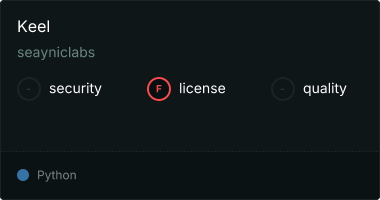
Copy to your README.md:
Score Badge

Copy to your README.md: